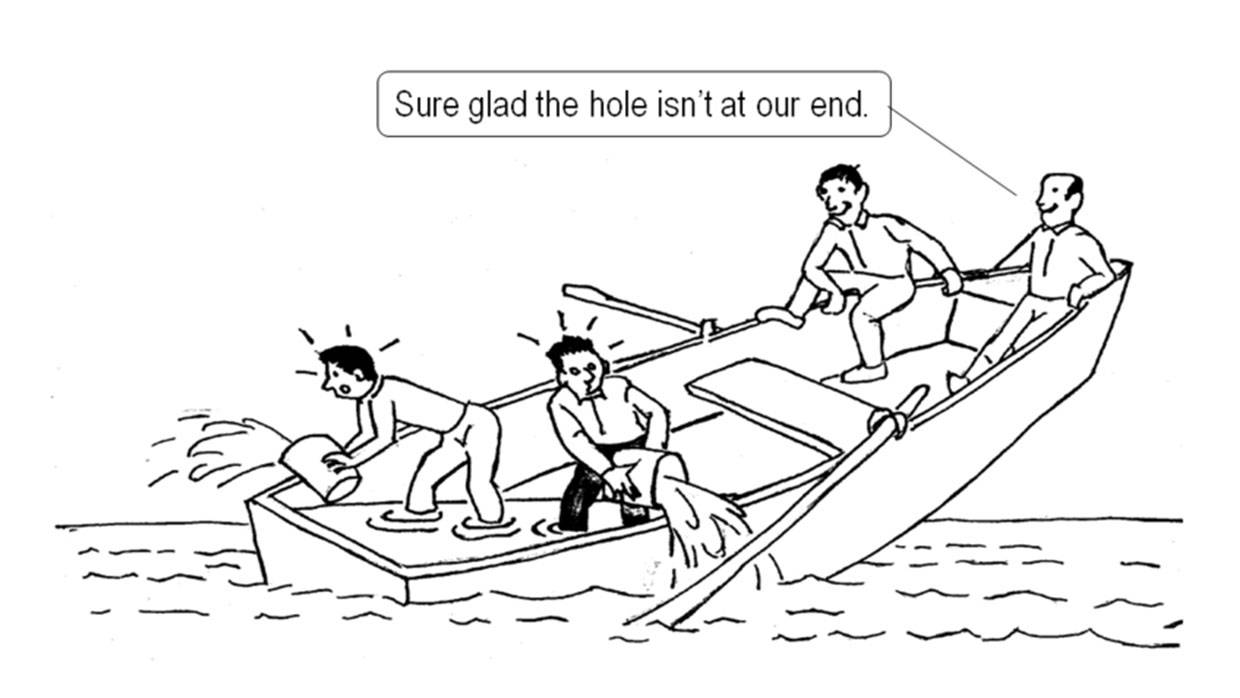
Cartoon – We need to stay focused


After reiterating his promise to repeal and replace the Affordable Care Act, President-elect Donald Trump has indicated that he may keep two of the law’s most popular provisions. One is straightforward enough — children up to age 26 being allowed to stay on their parents’ plan. The other — preventing insurance companies from denying coverage because of preexisting conditions — offers a perfect illustration of why Trump and most of the other Republicans critics of Obamacare don’t understand the health insurance market.
Let’s say that in the beautiful new world of “repeal and replace,” insurers are required to sell you insurance despite the fact that your kid has a brain tumor. Insurance companies know what to do with that. Their actuaries can calculate that kids with brain tumors typically require (I’m making this number up) about $200,000 a year in medical care. So they’ll offer to sell you a policy at an annual premium of $240,000.
At this point your response will probably be that such an outcome is not fair. When the law says insurance companies can’t discriminate on the basis for preexisting conditions, surely what it means is that they have to charge roughly the same price for health insurance, irrespective of your preexisting condition. In the language of insurance, that’s called “guaranteed issue at community rates.”
Unfortunately, in the states that have tried guaranteed issues at community rates, the insurance markets have collapsed. That’s because if you guarantee everyone the right to buy health insurance at community rates, then some consumers will game the system. The young and healthy ones won’t buy any health insurance at all — they’ll go without until they are diagnosed with diabetes or a brain tumor or get hit by a truck crossing the street. And when that happens, they will immediately call up Aetna or Anthem and exercise their right to buy health insurance at the low community rate, irrespective of their medical condition. It won’t be long before insurance companies begin losing a ton of money and are forced either to raise premiums through the roof or stop writing policies altogether.

President-elect Donald Trump is already signaling that he might backpedal on his promise to repeal the Affordable Care Act, telling the Wall Street Journal Friday that he’d consider hanging onto popular Obamacare provisions such as “the prohibition against insurers denying coverage because of patients’ existing conditions, and a provision that allows parents to provide years of additional coverage for children on their insurance policies.”
His apparent reluctance to scrap the entire ACA is understandable. In the long run, waffling on repeal will probably be less painful than causing a health-care catastrophe. Trump capitalized on Republicans’ long dislike of the Affordable Care Act by focusing on news, in the last weeks of the campaign, that premiums would increase sharply for many Americans purchasing insurance through its exchanges. But he didn’t promise a pared-down health-care regime. He promised to repeal and replace Obamacare with a plan that would cover everyone, offer more choice and cost less.
It was a populist approach to health care that wasn’t new. Sixteen years ago, in “The America We Deserve,” he wrote: “I’m a conservative on most issues, but a liberal on this one,” an appeal that didn’t hurt candidate Trump. But President Trump is likely to find the issue challenging. Repeal requires only the will of Congress. Replacement is subject to the laws of economics and mathematics, which aren’t on his side.
In the campaign, Trump proposed replacing the Affordable Care Act with a tax deduction for individuals who pay for health insurance out of pocket. Like all tax deductions, such a deduction is worth more to people with higher tax rates. But most of those who would be left without coverage by an ACA repeal are lower-income individuals with tax rates that are already low. Thus, the benefit they’d receive from a deduction doesn’t come close to the financial hit they would experience from an ACA repeal. Independent estimates suggest repeal would cause about 20 million people to lose coverage, only one-quarter of whom would purchase insurance with the deduction. The rest wouldn’t be able to afford it.

Despite its seemingly endless political and financial travails, Obamacare has taken a big bite out of the number of uninsured Americans since it was enacted in 2010. An estimated 20 million more people are now covered by private health insurance obtained through subsidized government exchanges or expanded Medicaid for the poor.
But as the curtain begins to ring down on President Obama’s administration, roughly 20 million to 24 million people still lack health insurance, a huge piece of unfinished business that will be left to the next president and a new Congress to address. And that raises two interesting questions: precisely who are the uninsured today and why haven’t they been able to obtain coverage?
A national survey by the Commonwealth Fund conducted last February through April finds “notable shifts” in the demographic composition of the uninsured since the Affordable Care Act first took effect in 2014.
A quick snapshot of the detailed findings tells the stories of millions of people either purposefully rejecting health care insurance, not qualifying for a federal program, or being unaware of their options to acquire coverage.
http://www.thefiscaltimes.com/2016/11/03/Obamacare-Faces-New-Challenge-Uninsured-Rate-Plateaus

Amid the administration’s latest drive to sign up millions of Americans for Obamacare coverage, a new government study warns that the uninsured rate may have plateaued after years of dramatic decline.
There were roughly 28 million uninsured Americans during the first six months of this year, a significant change from the 48 million consumers who lacked coverage at the time of the enactment of the Affordable Care Act in 2010. Government-subsidized health insurance policies for low and middle-income people, along with an expansion of the Medicaid program in more than half of the states, have helped more than 20 million uninsured people obtain coverage.

Three years into the Affordable Care Act, there remain places where many people still lack health insurance. But their share keeps shrinking.
The share of people without health insurance keeps falling.
Since 2013, when the major provisions of Obamacare went into effect, the uninsured rate has fallen in every state. And some states that you might not expect have led the way.
The news about the Affordable Care Act has been grim lately: The price of health plans in new marketplaces is up, and choice is declining in many places. But amid the difficulties, new data highlight the law’s effectiveness in getting coverage for millions of Americans.
Over all, the gains are substantial: a seven-percentage-point drop in the uninsured rate for adults. But there remain troublesome regional patterns. Many people in the South and the Southwest still don’t have a reliable way to pay for health care, according to the new, detailed numbers from a pair of groups closely tracking enrollment efforts. Those patterns aren’t an accident. As our maps show, many of the places with high uninsured rates had poor coverage before the Affordable Care Act passed. They tend to be states with widespread poverty and limited social safety nets. Look at Mississippi and Texas, for example.
But many of the places that have reduced their uninsured rates the most had similar characteristics in 2013. Look at Kentucky and Arkansas. Over the years, you can see them diverge sharply from their neighbors.