Healthcare as a zero-sum game: 7 key points

https://www.beckershospitalreview.com/hospital-management-administration/healthcare-as-a-zero-sum-game-7-key-points.html?origin=cfoe&utm_source=cfoe

This article sets out seven thoughts on healthcare systems.

The article discusses:

  1. Types of Healthcare Systems
  2. Mergers and Key Questions to Assess Mergers
  3. Headwinds Facing Systems
  4. The Great Fear of Systems
  5. What has Worked the Last 10 Years
  6. What is Likely to Work the Next 10 Years
  7. A Few Other Issues

Before starting the core of the article, we note two thoughts. First, we view a core strategy of systems to spend a great percentage of their time on those things that currently work and bring in profits and revenues. As a general rule, we advise systems to spend 70 to 80 percent of their time doubling down on what works (i.e., their core strengths) and 20 to 30 percent of their time on new efforts.

Second, when we talk about healthcare as a zero-sum game, we mean the total increases in healthcare spend are slowing down and there are greater threats to the hospital portion of that spend. I.e., the pie is growing at a slower pace and profits in the hospital sector are decreasing.

I. Types of Healthcare Systems

We generally see six to eight types of healthcare systems. There is some overlap, with some organizations falling into several types.

1. Elite Systems. These systems generally make U.S. News & World Report’s annual “Best Hospitals” ranking. These are systems like Mayo Clinic, Cleveland Clinic, Johns Hopkins Hospital, NewYork-Presbyterian, Massachusetts General, UPMC and a number of others. These systems are often academic medical centers or teaching hospitals.

2. Regionally Dominant Systems. These systems are very strong in their geographic area. The core concept behind these systems has been to make them so good and so important that payers and patients can’t easily go around them. Generally, this market position allows systems to generate slightly higher prices, which are important to their longevity and profitability.

3. Kaiser Permanente. A third type of system is Oakland-based Kaiser Permanente itself. We view Kaiser as a type in and of itself since it is both so large and completely vertically integrated with Kaiser Foundation Health Plan, Kaiser Foundation Hospitals and Permanente Medical Groups. Kaiser was established as a company looking to control healthcare costs for construction, shipyard and steel mill workers for the Kaiser industrial companies in the late 1930s and 1940s. As companies like Amazon, Berkshire Hathaway and JPMorgan Chase try to reduce costs, it is worth noting that they are copying Kaiser’s purpose but not building hospitals. However, they are after the same goal that Kaiser originally sought. Making Kaiser even more interesting is its ability to take advantage of remote and virtual care as a mechanism to lower costs and expand access to care.

4. Community Hospitals. Community hospitals is an umbrella term for smaller hospital systems or hospitals. They can be suburban, rural or urban. Community hospitals are often associated with rural or suburban markets, but large cities can contain community hospitals if they serve a market segment distinct from a major tertiary care center. Community hospitals are typically one- to three-hospital systems often characterized by relatively limited resources. For purposes of this article, community hospitals are not classified as teaching hospitals — meaning they have minimal intern- and resident-per-bed ratios and involvement in GME programs.

5. Safety-Net Hospitals. When we think of safety-net hospitals, we typically recall hospitals that truly function as safety nets in their communities by treating the most medically vulnerable populations, including Medicaid enrollees and the uninsured. These organizations receive a great percentage of revenue from Medicaid, supplemental government payments and self-paying patients. Overall, they have very little commercial business. Safety-net hospitals exist in different areas, urban or rural. Many of the other types of systems noted in this article may also be considered safety-net systems.

6. National Chains. We divide national chains largely based on how their market position has developed. National chains that have developed markets and are dominant in them tend to be more successful. Chains tend to be less successful when they are largely developed out of disparate health systems and don’t possess a lot of market clout in certain areas.

7. Specialty Hospitals. These are typically orthopedic hospitals, psychiatric hospitals, women’s hospitals, children’s hospital or other types of hospitals that specialize in a field of medicine or have a very specific purpose.

II. Mergers and Acquisitions

There have seen several large mergers over the last few years, including those of Aurora-Advocate, Baylor Scott & White-Memorial Hermann, CHI-Dignity and Mercy-Bon Secours, among others.

In evaluating a merger, the No. 1 question we ask is, “Is there a clear and compelling reason or purpose for the merger?” This is the quintessential discussion piece around a merger. The types of compelling reasons often come in one of several varieties. First: Is the merger intended to double down and create greater market strength? In other words, will the merger make a system regionally dominant or more dominant?

Second: Does the merger make the system better capitalized and able to make more investments that it otherwise could not make? For example, a large number of community hospitals don’t have the finances to invest in the health IT they need, the business and practices they need, the labor they need or other initiatives.

Third: Does the merger allow the amortization of central costs? Due to a variety of political reasons, many systems have a hard time taking advantage of the amortization of costs that would otherwise come from either reducing numbers of locations or reducing some of the administrative leadership.

Finally, fourth: Does the merger make the system less fragile?

Each of these four questions tie back to the core query: Does the merger have a compelling reason or not?

III. Headwinds

Hospitals face many different headwinds. This goes into the concept of healthcare as a zero-sum game. There is only so much pie to be shared, and the hospital slice of pie is being attacked or threatened in various areas. Certain headwinds include:

1. Pharma Costs. The increasing cost of pharmaceuticals and the inability to control this cost particularly in the non-generic area. Here, increasingly the one cost area that payers are trying to merge with relates to pharma/PBM the one cost that hospitals can’t seem to control is pharma costs. There is little wonder there is so much attention paid to pharma costs in D.C.

2. Labor Costs. Notwithstanding all the discussions of technology and saving healthcare through technology, healthcare is often a labor-intensive business. Human care, especially as the population ages, requires lots of people — and people are expensive.

3. Bricks and Mortar. Most systems have extensive real estate costs. Hospitals that have tried to win the competitive game by owning more sites on the map find it is very expensive to maintain lots of sites.

4. Slowing Rises in Reimbursement – Federal and Commercial. Increasingly, due to federal and state financial issues, governments (and interest by employers) have less ability to keep raising healthcare prices. Instead, there is greater movement toward softer increases or reduced reimbursement.

5. Lower Commercial Mix. Most hospitals and health systems do better when their payer mix contains a higher percentage of commercial business versus Medicare or Medicaid. In essence, the greater percentage of commercial business, the better a health system does. Hospital executives have traditionally talked about their commercial business subsidizing the Medicare/Medicaid business. As the population ages and as companies get more aggressive about managing their own healthcare costs, you see a shift — even if just a few percentage points — to a higher percentage of Medicare/Medicaid business. There is serious potential for this to impact the long-term profitability of hospitals and health systems. Big companies like JPMorgan, Amazon, Berkshire Hathaway and some other giants like Google and Apple are first and foremost seeking to control their own healthcare costs. This often means steering certain types of business toward narrow networks, which can translate to less commercial business for hospitals.

6. Cybersecurity and Health IT Costs. Most systems could spend their entire budgets on cybersecurity if they wanted to. That’s impossible, of course, but the potential costs of a security breach or incident loom large and there are only so many dollars to cover these costs.

7. The Loss of Ancillary Income. Health systems traditionally relied on a handful of key specialties —cardiology, orthopedics, spine and oncology, for example — and ancillaries like imaging, labs, radiation therapy and others to make a good deal of their profits. Now ancillaries are increasingly shifted away from systems toward for-profits and other providers. For example, Quest Diagnostics and Laboratory Corporation of America have aggressively expanded their market share in the diagnostic lab industry by acquiring labs from health systems or striking management partnerships for diagnostic services.

8. Payers Less Reliant on Systems. Payers have signaled less reliance on hospitals and health systems. This headwind is indicated in a couple of trends. One is payers increasingly buying outpatient providers and investing in many other types of providers. Another is payers looking to merge with pharmaceutical providers or pharmacy and benefit managers.

9. Supergroups. Increasingly in certain specialties and multispecialty groups, especially orthopedics and a couple other specialties, there is an effort to develop strong “super groups.” The idea of some of these super groups is to work toward managing the top line of costs, then dole out and subcontract the other costs. Again, this could potentially move hospitals further and further downstream as cost centers instead of leaders.

IV. The Great Fear

The great fear of health systems is really twofold. First: that more and more systems end up in bankruptcy because they just can’t make the margins they need. We usually see this unfold with smaller hospitals, but over the last 20 years, we have seen bankruptcies periodically affect big hospital systems as well. (Here are 14 hospitals that have filed for bankruptcy in 2018 to date. According to data compiled by Bloomberg, at least 26 nonprofit hospitals across the nation are already in default or distress.)

Second, and more likely, is that hospitals in general become more like mid-level safety net systems for certain types of care — with the best business moving away. I.e., as margins slide, hospitals will handle more and more of the essential types of care. This is problematic, in that many hospitals and health systems have infrastructures that were built to provide care for a wide range of patient needs. The counterpoint to these two great fears is that there is a massive need for healthcare and healthcare is expensive. In essence, there are 325,700,000 people in the United States, and it’s not easy to provide care for an aging population.

V. The Last 10 Years – What Worked

What has worked over the last five to 10 years is some mix of the following:

  1. Being an elite system has remained a recipe for financial success.
  1. Being regionally dominant has been a recipe for success.
  1. Being very special at something or being very great at something has been a recipe for success.
  1. Being great in high paying specialties like orthopedics, oncology, and spine has been a recipe for success.
  1. Systems have benefited where they provide extensive ancillaries to make great profits.

VI. The Next 10 Years

Over the next 10 years, we advise systems to consider the following.

  1. Double down on what works.
  1. Do not give up dominance where they have it. Although it may be politically unpopular and expensive to maintain, dominance remains important.
  1. Systems will need a new level of cost control. For years hospitals focused on expanding patient volume, expanding revenue and enlarging their footprint. Now cost control has surpassed revenue growth as the top priority for hospital and health system CEOs in 2018.
  1. Systems will have to be great at remote and virtual care. More and more patients want care where and when they want it.
  1. Because there will be so much change, systems must continue to have great leadership and great teams to adjust and remain successful.
  1. As systems become more consumer-centric, hospitals will have to lead with great patient experience and great patient navigation. These two competencies have to become systemwide strengths for organizations to excel over the next decade.

VII. Other Issues

Other issues we find fascinating today are as follows.

1. First, payers are more likely to look at pharma and pharma benefit companies as merger partners than health systems. We think this is a fascinating change that reflects a few things, including the role and costs of pharmaceuticals in our country, the slowly lessening importance of health systems, and payers’ disinterest in carrying the costs of hospitals.

2. Second, for many years everyone wanted to be Kaiser. What’s fascinating today is how Kaiser now worries about Amazon, Apple and other companies that are doing what Kaiser did 50 to 100 years ago. In essence, large companies’ strategies to design their own health systems, networks or clinics to reduce healthcare costs and provide better care is a force that once created legacy systems like Kaiser and now threatens those same systems.

3. Third, we find politicians are largely tone deaf. On one side of the table is a call for a national single payer system, which at least in other countries of large size has not been a great answer and is very expensive. On the other hand, you still have politicians on the right saying just “let the free market work.” This reminds me of people who held up posters saying, “Get the government out of my Medicare.” We seem to be past a true and pure free market in healthcare. There is some place between these two extremes that probably works, and there is probably a need for some sort of public option.

4. Fourth, care navigation in many elite systems is still a debacle. There is still a lot of room for improvement in this area, but unfortunately, it is not an area that payers directly tend to pay for.

5. Fifth, we periodically hear speakers say “this app is the answer” to every problem. I contrast that by watching care given to elderly patients, and I think the app is unlikely to solve that much. It is not that there is not room for lots of apps and changes in healthcare — because there is. However, healthcare remains as a great mix of technology and a labor- and care-intensive business.


Conservatives Are Using the Courts to Attack Health Care for All Americans

https://www.americanprogress.org/issues/healthcare/news/2018/12/20/464562/conservatives-using-courts-attack-health-care-americans/

A doctor in Milton, Massachusetts, wheels his patient into his office, February 2018.

Conservative state officials, in conjunction with the Trump administration, have launched an all-out attack on health care in the United States. They have brought a suit to overturn the entirety of the Affordable Care Act (ACA), which would have serious consequences for nearly every American who has health coverage, whether through their employer, the individual market, Medicare, or Medicaid. And they found a partisan judge who, last Friday, proved willing to ignore the rule of law and help them advance their political agenda through the courts.

For now, the ACA remains the law of the land. But if the partisan decision in Texas v. United States is upheld, the consequences could be devastating. The Urban Institute estimates that overturning the ACA would result in 17 million more Americans being uninsured in 2019—in addition to coverage reductions that would occur due to the elimination of the individual mandate penalty. Millions of American families could be left without access to health care—and without the financial safety and peace of mind that health insurance provides. Overturning the law would also have serious negative effects on public health and drug development and would shorten the life of the Medicare trust fund. Moreover, it would provide a major tax break to the wealthiest Americans, insurance companies, and drug manufacturers.

Supporters of the decision have talked about this as an effort to end “Obamacare,” which may cause some people to mistakenly believe it only affects those who obtain coverage through the individual marketplace. Nothing could be further from the truth: Virtually no American’s health care coverage would be safe from the effects of this decision. Here are just some of the impacts that this decision, if upheld, would have.

Risks for people who obtain coverage through their employer

  • Lifetime and annual limits on coverage: Polling shows that without the ACA’s ban on lifetime and annual caps on benefits, firms would choose to reinstate limits on coverage. Tens of millions of workers and dependents could face annual or lifetime limits.
  • Loss of coverage for young adult children: The ACA requires employer plans that cover dependents to include young adults up to age 26. More than 2 million young adults have gained coverage under the ACA’s dependent coverage provision.
  • Loss of free preventive services, including contraception: The ACA requires preventive services—such as immunizations; screenings for cancer, diabetes, and depression; and well-child visits—to be available at no cost to the patient. Womensave about $250 annually thanks to the lack of cost sharing for contraception.
  • Elimination of rebates to cover excessively high premiums: The ACA requires insurers to provide rebates if they overprice premiums relative to actual medical costs. Under the ACA’s medical loss ratio provision, insurance companies paid back $344 million in 2016 to people with employer coverage.

Risks for people who receive coverage through Medicare

  • Increases in premiums and out-of-pocket costs: Elimination of the ACA would increase some beneficiaries’ premiums, deductibles, and copayments in Medicare Part A and Part B; overturning the law would eliminate Medicare savings, and premiums are based on program spending.
  • Cost sharing for preventive services such as mammograms: Under the ACA, Medicare provides preventive services and covers a yearly wellness visit at no cost to the patient.
  • Possibility of falling back into the prescription drug coverage gap: The ACA narrowed the Part D coverage gap and was on track to completely fill it by 2020. Without the ACA, many seniors could face higher costs for prescription medications.

Risks for people who receive coverage through Medicaid

  • Loss of coverage under the Medicaid expansion: About 12 million people are covered under the Medicaid expansion, which was funded mostly by the federal government under the ACA.
  • Higher costs for preventive services such as children’s vaccines: The ACA provided a financial incentive for states to provide preventive services to Medicaid beneficiaries free of charge, which a number of states currently utilize.
  • Fewer options to receive care in homes and communities: The ACA provided new options to states to allow elderly enrollees and enrollees with disabilities to receive care in their homes. If the law is overturned, more enrollees will be forced into institutional care.

Risks for people who buy insurance on their own

  • Loss of tax credits that make coverage affordable: Nearly 9 in 10 enrollees in the ACA marketplaces receive premium tax credits. Without the ACA, enrollees would lose financial assistance toward monthly premiums, as well as funding that helps lower deductibles and copayments.
  • Increased costs or denial of coverage due to pre-existing conditions: Without the ACA, individual market insurers would be allowed to charge more, exclude coverage benefits, or turn away people based on medical history. More than 133 millionAmericans with pre-existing conditions could be subject to discrimination if they ever needed individual market coverage.
  • Increased costs for older enrollees: The ACA limits how much more insurance companies can charge older people for coverage relative to younger ones. Without the ACA’s protections, the elderly and near-elderly would see their premiums rise

The legal reasoning behind the lower court’s decision to overturn the ACA is so poor that it has been decried by even some of the most strident conservative legal critics of the law—including those who have backed the previous efforts to overturn it through the courts. Congress has tried and failed to repeal the ACA, and voters in the midterm elections made it clear that they care about keeping protections for pre-existing conditions. Yet the court’s ruling has been approvingly cited by conservative political officials, including President Donald Trump. As such, the decision is best understood not as a legal opinion but instead as a policy preference pursued through the U.S. judiciary. That preference could not be clearer: to give the country’s wealthy and special interests massive taxes cuts—and pay for them with everyone else’s health care.


Amazon’s vision for the future of health care is becoming clear

https://www.cnbc.com/2018/12/17/amazon-vision-future-health-care.html

Image result for Amazon’s vision for the future of health care is becoming clear

KEY POINTS
  • Amazon made some bold first steps into health care this year.
  • We asked health-care experts to help us figure out where the company is going next.
  • Amazon could innovate in a lot of areas from pharmacy to subsidizing healthy food.

Amazon might take its time getting into new industries. But whether it’s online retail, cloud computing or groceries, its vision is typically ambitious.

Now, it’s health care’s turn.

This year, the company made a few early strides in the $3.5 trillion sector. Here are some of the highlights:

With all that in mind, we talked to some experts in the space to put the pieces together and figure out where Amazon might be going next.

Becoming Dr. Amazon

So imagine you have a sore throat. You let Alexa know, and it responds by asking if you want to book an appointment at the doctor’s office or get a virtual consult. You pick the virtual option, and the doctor through Alexa asks you about your symptoms. It decides to send a courier to your home with a tiny portable device to do some basic tests for things like strep throat. The strep test is positive, so the virtual doc sends over a prescription for an antibiotic. (We’re assuming that all the Amazon services are fully compliant with privacy and other laws.)

All this happens within a few hours, and you never need to leave your house to sit in a medical office or stand in line at the pharmacy.

That vision of the future might seem like science fiction, but it’s plausible to some health industry insiders.

“I wouldn’t be surprised if Amazon starts out in health by providing things like over-the-counter medicines, and then moves into making the experience easier for managing your health,” said Tom Robinson, a San Francisco-based partner at Oliver Wyman, who consults with health and life sciences companies.

Robinson said it’s possible for Amazon’s Alexa to become a “front door” of sorts for health care. If it can provide virtual care, including diagnostic testing and pharmacy, it could become a “closed loop” system. It wouldn’t be able to deal with all problems, Robinson points out, as some can only be managed in person. But it could do a lot for basic ailments, preventative care and potentially even to help people with chronic medical conditions.

Food as medicine?

Now that Amazon owns Whole Foods, it could also help people eat healthier.

As Jason Langheier, CEO of a food-tech start-up called Zipongo, told CNBC, Amazon could create a web-based service for people to access meal plans, kits, recipes and even subsidies on fresh foods for those who are already suffering or at risk for disease.

It might inch closer to that, he suggests, by nudging people to eat healthier food options online, which could include some advertising and product placements. “With its underbelly of e-commerce, Amazon can touch the one thing (food) that has the greatest public health impact.”

We haven’t seen many signs of progress around in this area yet, although its employer group is likely looking at poor diet as a leading contributor of preventative (and expensive) illness.


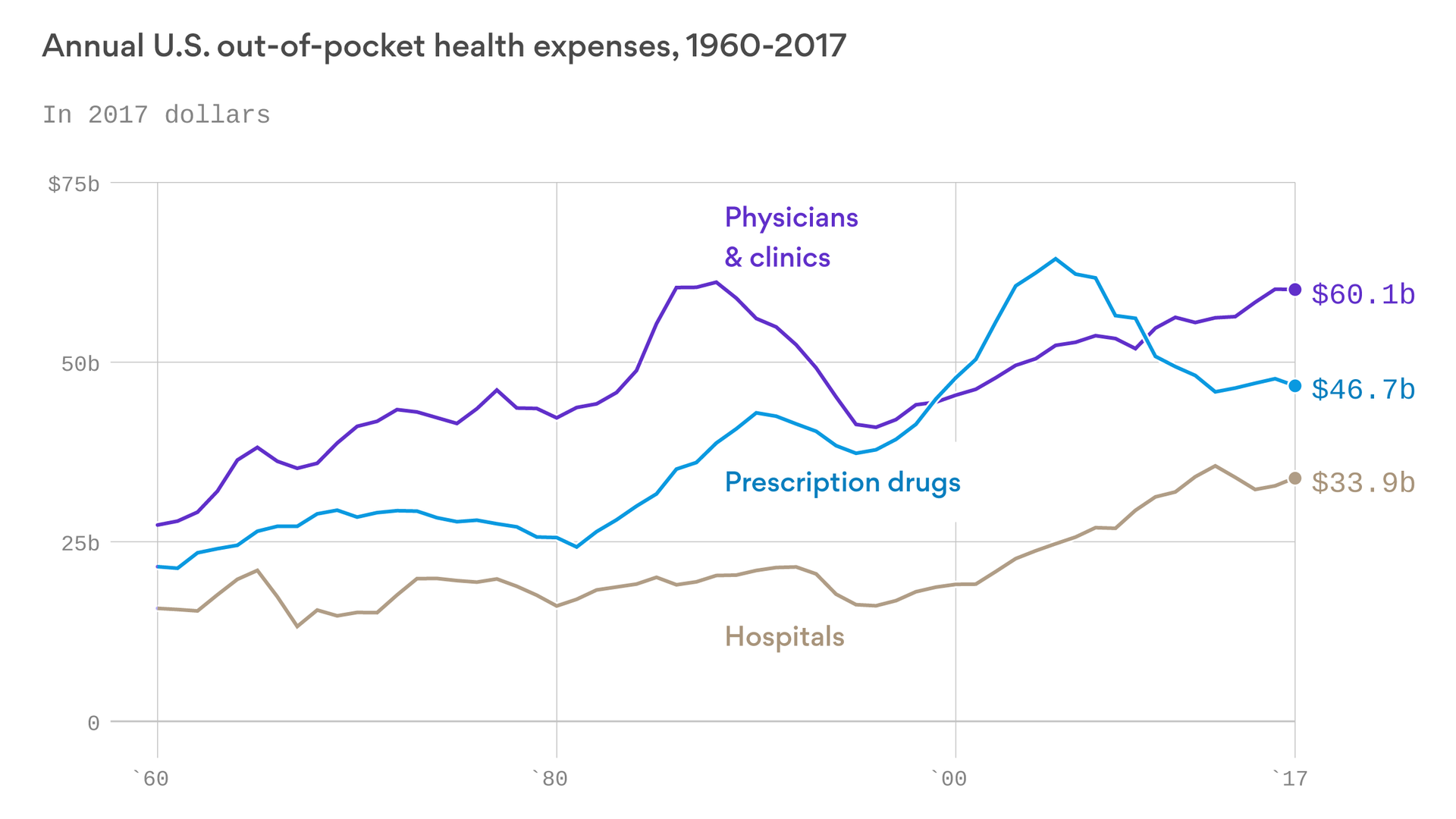
Hospitals smallest part of out-of-pocket costs

https://www.healthsystemtracker.org/interactive/?utm_campaign=KFF-2018-Peterson&utm_source=hs_email&utm_medium=email&utm_content=68267802&_hsenc=p2ANqtz–ktue7Wpa6NlVV1m5K05fMVx7jZNGoCLlk_ATmPS8Y6TgyNwDww1IGCz7sUIjYm69FTQmPft_pPBXXoE4h62JNKY1rEA&_hsmi=68267802&display=U.S.%2520%2524%2520Billions&service=Hospitals%252CPhysicians%2520%2526%2520Clinics%252CPrescription%2520Drug&source=Out%2520of%2520Pocket&tab=0

Image result for Hospitals smallest part of out-of-pocket costs


We spend more on hospital care than any other type of health care service, but hospitals make up the smallest amount of out-of-pocket spending.

  • That means insurers are passing on a smaller percentage of hospital costs to enrollees, although they indirectly pay for hospital care through premiums.

Between the lines:

  • “A big role of patient cost-sharing is to discourage use of inappropriate or unnecessary services. So much of hospital care is non-discretionary from the perspective of patients,” Kaiser Family Foundation’s Larry Levitt says.
  • Levitt adds that insurance tends to pay a bigger part of hospital bills versus other services because hospital bills tend to be large, causing patients to blow through their deductible or hit their out-of-pocket maximum.


Congress could get rid of ACA lawsuit, but won’t

https://www.axios.com/congress-could-get-rid-of-aca-lawsuit-ba906df5-57fd-492a-b365-baab06421ac1.html

 Illustration of hand with gavel breaking a red cross symbol

Congress could kill the lawsuit that threatens to wipe out the Affordable Care Act, legal experts say, but the politics of the issue will almost certainly keep it from doing so.

Why it matters: While these same legal experts think it’s very likely that this case gets thrown out on appeal, that doesn’t mean it definitely will — and a failure to overturn it would wreak havoc on the entire health care system.

The big picture: A federal judge ruled that since Congress repealed the ACA’s fine for not having health insurance, the still-existing-yet-toothless mandate that people have insurance is now unconstitutional, as is the rest of the law.

  • That’s because the requirement for having insurance is no longer bringing in any revenue. Its status as a revenue-generating tax is why the ACA survived its first major legal challenge.
  • The judge wrote in his decision that “both [the 2010 and 2017] Congresses manifested the same intent: The Individual Mandate is inseverable from the entire ACA.” That means the rest of the law is, by association with the mandate, unconstitutional as well.

What they’re saying: Each of the three legal experts I spoke to offered a different idea as to how Congress could make the entire lawsuit moot, if it wanted to.

  • Law professor Nicholas Bagley said that Congress could pass a law, signed by the president, stating that it believes the individual mandate is separable from the ACA – making its intent clear.
  • Legal expert and ACA supporter Tim Jost said that Congress could pass a $1 penalty for not having health insurance, essentially recreating its status as a (constitutional) tax.
  • Legal expert and ACA critic Jonathan Adler told me that Congress could just repeal the health insurance requirement entirely. “The surest way you make that go away is by officially getting rid of the part of the law that is allegedly unconstitutional,” he said.

Yes, but: Doing any of these things would require Republicans to vote to protect the ACA — giving up yet another chance to get rid of it — and Democrats to admit that the lawsuit is reasonable, as well as potentially to vote to repeal the individual mandate.

  • “We shouldn’t be jumping through hoops to try to respond to a judge who just broke decades of legal precedent on severability,” Sen. Chris Murphy said. “Maybe there’s creative things we could do if it got upheld on appeal, but I don’t think it’s going to be upheld on appeal.”
  • “This is an interesting case and we’re going to have to see how it ultimately plays out,” Finance Chairman Orrin Hatch said in a statement.

Incoming House Speaker Nancy Pelosi and Senate Minority Leader Chuck Schumer have said that they want to intervene in the case.

  • While only Pelosi has the power or the votes to make that happen without Republican assistance, it would have little practical effect, the experts said.
  • Courts care what Congress does, not what Congress says,” Adler said. “And intervening to defend the law in court is really more Congress talking than Congress doing.”

Ironicallythe precedent for the House filing a lawsuit or becoming party to a case is when the House sued the Obama administration over the ACA’s cost-sharing reduction payments.

  • “Just like [former Speaker John] Boehner’s intervention was a political stunt, I also think Pelosi’s intervention would be a political stunt,” Bagley said.


The GOP’s health problem: They like big chunks of the Affordable Care Act

https://www.axios.com/aca-ruling-republicans-politics-changed-f54f7a3f-53f4-47f2-9deb-2c4c424534b6.html

A protester in New York holds a sign saying, "ACA saves lives"

Now that a Texas judge has ruled that the entire Affordable Care Act is unconstitutional — all because of its individual mandate — Republicans may find themselves wishing for a different outcome.

The big picture: There is little hope of a deal with Democrats on health reform in a divided Congress if the decision is upheld. Democrats will now use the 2020 campaign to paint Republicans as threatening a host of popular provisions in the ACA. And here’s the kicker: protections for pre-existing conditions, the provision that played such a big role in the midterms, is not even the most popular one.

Here are just some of the more popular provisions that would be eliminated — in order of their popularity, according to the Kaiser Family Foundation’s November tracking poll:

  • Young adults can remain on their parents’ health insurance policies until age 26: 82% of the public supports this, including 66% of Republicans.
  • Subsidies for lower and moderate income people: 81% support this, including 63% of Republicans.
  • Closing the “donut hole” so there’s no gap in Medicare prescription drug coverage: 81% like this, as do 80% of Republicans.
  • Eliminating costs for many preventive services: 79% support this, as do 68% of Republicans.
  • Medicaid expansion: 77% like it, as do 55% of Republicans.

The list goes on, but notably, further down but still very popular: 65% of the public supports protecting people with pre-existing conditions, as do 70% of Democrats, 66% of independents and 58% of Republicans. The fact the pre-existing conditions does not top the list shows how popular all of the other provisions are.

The Republican attorneys general brought their lawsuit in a different political environment, when Republicans held the House, Senate and the White House. If that had continued, they could have had reason to hope that a ruling in their favor, if upheld by higher courts, could have helped them achieve their goal of repeal and replace legislation.

The bottom line: Their world has changed politically, with Democrats preparing to take control of the House next year, and Republicans may have been better off settling for the repeal of the mandate penalty that Congress already passed. The mandate was by far the least popular part of the law and gave them something to crow about. Now, they may have bought more than they bargained for.