The financial challenges caused by the COVID-19 pandemic forced hundreds of hospitals across the nation to furlough, lay off or reduce pay for workers, and others have had to scale back services or close.
Lower patient volume, canceled elective procedures and higher expenses tied to the pandemic have created a cash crunch for hospitals, and hospitals are taking a number of steps to offset financial damage. Executives, clinicians and other staff are taking pay cuts, capital projects are being put on hold, and some employees are losing their jobs. More than 260 hospitals and health systems furloughed workers in the last year, and dozens of others have implemented layoffs.
Below are six hospitals and health systems that are laying off employees in the next 2 months. Some of the layoffs were attributed to financial strain caused by the pandemic.
1. Sacramento, Calif.-based Sutter Healthis laying off hundreds of employees, most of whom work in information technology. In a filing with the state, Sutter said it plans to lay off 277 employees on April 2. The 277 jobs being eliminated include 92 analysts, 43 engineers and 28 project managers, according to the Sacramento Business Journal, citing the system’s filing with California’s Employment Development Department.
2. Plattsburgh, N.Y.-based Champlain Valley Physicians Hospitalplans to cut 60 jobs. The hospital, which is facing a $6.5 million deficit in fiscal year 2021, said the cuts include 10 people who were laid off or had permanent hour reductions, 12 people who are planning retirement, and the rest are open positions that will not be filled.
3. Hialeah (Fla.) Hospital is closing its maternity ward and laying off 62 employees April 5, according to a notice filed with the state. Most of those affected by the layoffs are registered nurses.
4. The outgoing owners of Providence Behavioral Health Hospitalin Holyoke, Mass., are laying off the hospital’s 151 employees, effective April 20, according to MassLive. Trinity Health of New England, part of Livonia, Mich.-based Trinity Health, is selling the hospital to Health Partners New England, which plans to take over the hospital April 20.
5. Olympia Medical Center in Los Angeles is slated to close March 31. The closure will result in the layoffs of about 450 employees.
6. Minneapolis-based Children’s Minnesota is laying off 150 employees, or about 3 percent of its workforce. Children’s Minnesota cited several reasons for the layoffs, including the financial hit from the COVID-19 pandemic. Some layoffs occured in December and the rest will occur at the end of March.
Wealthy nations — including the U.S., the U.K. and the EU — have vaccinated their citizens at a rate of one person per second over the last month, while most developing countries still haven’t administered a single shot, according to the People’s Vaccine Alliance.
Why it matters:As higher-income countries aim to achieve herd immunity in a matter of months, most of the world’s vulnerable people will remain unprotected.
Experts say that mutations that may arise while the virus spreads could be a danger to us all, vaccinated or not.
The big picture: Even though more vaccines will arrive in developing nations soon, only 3% of people in those countries are likely to be vaccinated by mid-2021.
At best, only a fifth of their population will be vaccinated by the end of the year, per the People’s Vaccine Alliance.
What we’re watching: Three dozen countries have bought several times the amount of vaccine that they’ll need to vaccinate their entire population.
The U.S. alone has ordered more than a billion extra doses, Science Magazine reports. Global health leaders are saying it’s time to figure out where all of these excess doses will go.
“Over the next year or two, U.S. surplus doses and those from other countries could add up to enough to immunize everyone in the many poorer nations that lack any secured COVID-19 vaccine,” Science writes.
No matter how hard you squint, or what angle you look at it from, the coronavirus vaccines are a triumph. They are saving lives today; they will help end this pandemic eventually; and they will pay scientific dividends for generations.
The big picture: The pandemic isn’t over. There are still big threats ahead of us and big problems to solve. But for all the things that have gone wrong over the past year, the vaccines themselves have shattered even the most ambitious expectations.
The vaccines represent a “stunning scientific achievement for the world … unprecedented in the history of vaccinology,” said Dan Barouch, an expert on virology and vaccines at Harvard, who worked on the Johnson & Johnson vaccine.
Details: Developing a vaccine takes an average of 10 years — if it works at all. Despite years of well-funded research, there are still no vaccines for HIV or malaria, for example.
We now have multiple COVID-19 vaccines, all developed in less than a year.
The Pfizer and Moderna vaccines are the world’s first successful mRNA vaccines — which, to oversimplify it, teach our bodies to generate an immune response without relying on weakened or inactivated viruses. It’s a milestone that scientists have been working toward for 30 years.
Moderna’s vaccine is the company’s first licensed product of any kind.
Most importantly, all the leading vaccines work extremely well.
All four vaccines or vaccine candidates in the U.S. — from Pfizer, Moderna, AstraZeneca and Johnson & Johnson — appear to prevent coronavirus deaths, and to offer total or near-total protection against serious illness.
Some of the vaccines are more effective than others at preventing mild or asymptomatic infections, but all of them significantly exceed the FDA’s threshold to be considered effective.
The catch:South Africa on Sunday halted distribution of the AstraZeneca vaccine because it appeared not to work against the dangerous variant discovered there — which is spreading across the world.
The other vaccine makers have also said their products aren’t as effective against the South African variant.
But that’s a reason for the rest of the world to lean into the existing vaccines, not to be wary of them.
Viruses can mutate when they spread widely. The best defense against widespread variants is to vaccinate as many people as possible and step up social distancing to contain the virus.
Drugmakers may need to develop booster shots or new recipes to deal with variants, but waiting for a vaccine that addresses every variant will only leave the door open for more variants.
Our biggest problemsare not with the vaccines, but rather the processes that surround them.
Supplies need to increase; distribution needs to become far more efficient; we need to ensure that people get their second shots, when applicable; and people need to be willing to get vaccinated once they’re eligible.
That’s a long and difficult to-do list, and getting those things wrong could drag the pandemic out for years. But if we can get the process right, the vaccines themselves are powerful enough to do the job.
“Once the history of this is written,they are going to be referred to as some of the greatest achievements of science,” Zeynep Tufekci, a University of North Carolina sociologist with a track record of prescience on the coronavirus, told The New York Times’ Ezra Klein.
“It’s the kind of thing you would have national celebration and fireworks and church bells ringing and all of that,” she said.
This wasn’t a miracle, and it didn’t happen overnight. “What we’ve seen over the last year is the result and culmination of decades of scientific advances,” Barouch said.
Researchers have been building toward mRNA-based vaccines for roughly 30 years, fueled by broader advances in genetic science.
Those same advances have also greatly accelerated genetic sequencing — which is why researchers were able to map out COVID-19’s structure within weeks of discovering the virus, and to then begin working on potential vaccines.
What’s next: The vaccine race is one of the few areas of this entire pandemic where the U.S. and the world will be able to learn from our successes, rather than our failures.
The breakthrough of successful mRNA vaccines will, scientists hope, pave the way fora new generation of products that are more effective and easier to develop than previous vaccines.
Shoveling money at vaccine developers and establishing early, step-by-step communication with regulatory agencies also helped accelerate this process, and can help again in future pandemics.
The bottom line: “Good funding, great science and great collaboration with the regulatory agencies — that’s how they were able to do something that I didn’t think could be done in a year,” said Mark Slifka, an immunology professor at Oregon Health & Science University.
One year after the World Health Organization declared COVID-19 a pandemic, the end of that pandemic is within reach.
The big picture:The death and suffering caused by the coronavirus have been much worse than many people expected a year ago — but the vaccines have been much better.
Flashback: “Bottom line, it’s going to get worse,” Anthony Fauci told a congressional panel on March 11, 2020, the day the WHO formally declared COVID-19 to be a global pandemic.
A year ago today, the U.S. had confirmed 1,000 coronavirus infections. Now we’re approaching 30 million.
In the earliest days of the pandemic, Americans were terrified by the White House’s projections — informed by well-respected modeling — that 100,000 to 240,000 Americans could die from the virus. That actual number now sits at just under 530,000.
Many models at the time thought the virus would peak last May. It was nowhere close to its height by then. The deadliest month of the pandemic was January.
Yes, but: Last March, even the sunniest optimists didn’t expect the U.S. to have a vaccine by now.
They certainly didn’t anticipate that over 300 million shots would already be in arms worldwide, and they didn’t think the eventual vaccines, whenever they arrived, would be anywhere near as effective as these shots turned out to be.
Where it stands: President Biden has said every American adult who wants a vaccine will be able to get one by the end of May, and the country is on track to meet that target.
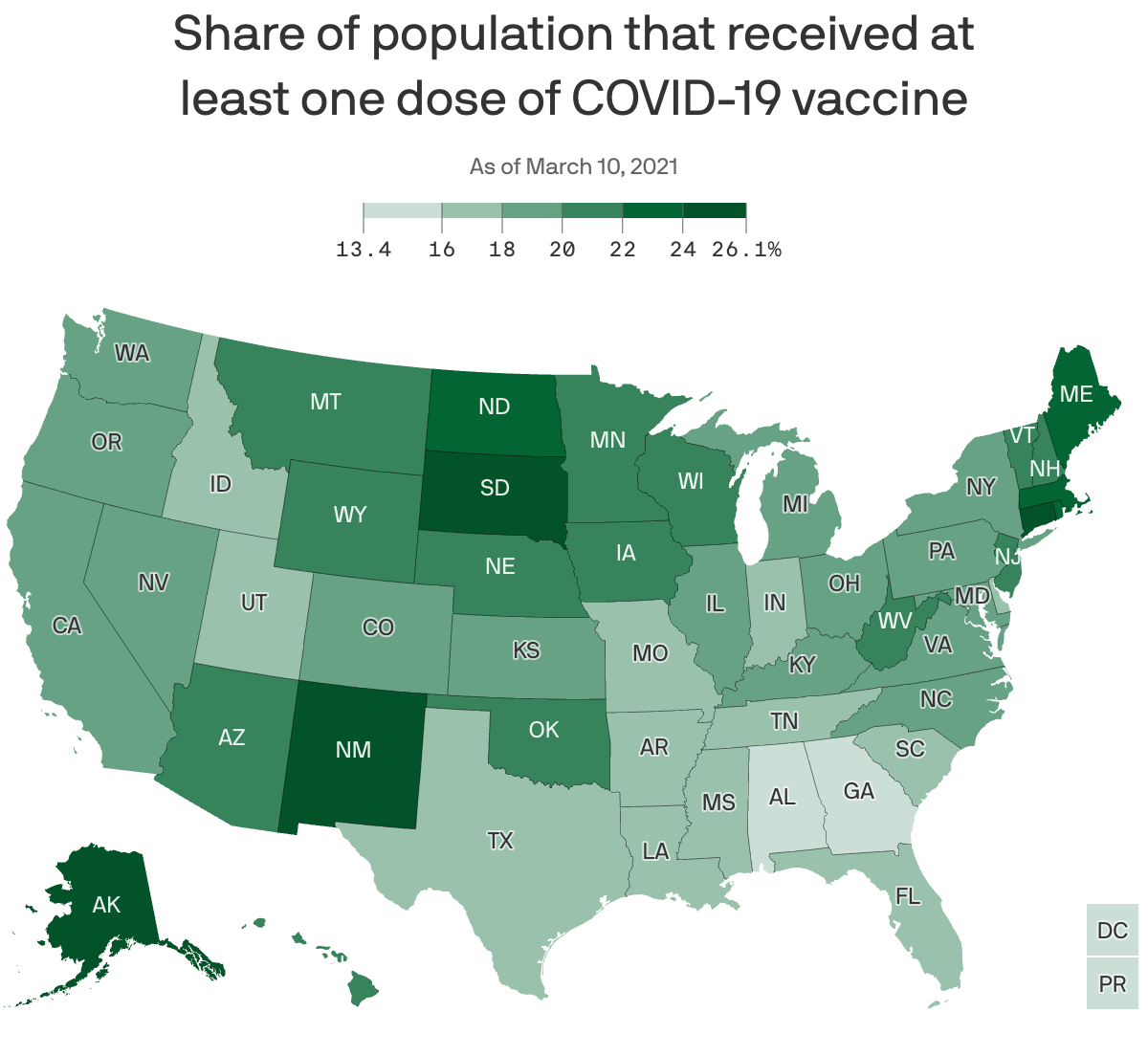
The U.S. is administering over 2 million shots per day, on average. Roughly 25% of the adult population has gotten at least one shot.
The federal government has purchased more doses than this country will be able to use: 300 million from Pfizer, 300 million from Moderna and 200 million from Johnson & Johnson.
The Pfizer and Moderna orders alone would be more than enough to fully vaccinate every American adult. (The vaccines aren’t yet authorized for use in children.)
Yes, millions of Americans are still anxiously awaiting their first shot — and navigating signup websites that are often frustrating and awful.
But the supply of available vaccines is expected to surge this month, and the companies say the bulk of those doses should be available by the end of May.
Cases, hospitalizations and deaths are all falling sharply at the same time vaccinations are ramping up.
The bottom line: Measured in death, loss, isolation and financial ruin, one year has felt like an eternity. Measured as the time between the declaration of a pandemic and vaccinating 60 million Americans, one year is an instant.
The virus hasn’t been defeated, and may never fully go away. Getting back to “normal” will be a moving target. Nothing’s over yet. But the end of the worst of it — the long, brutal nightmare of death and suffering — is getting close.
In their recent Health Affairs paper, Sungchul Park and coauthors examine rates of switching from Medicare Advantage (MA) to traditional Medicare by patient characteristics. MA plans are the private insurance alternative to traditional fee-for-service Medicare overseen by the Centers for Medicare and Medicaid Services. While enrollment in MA has doubled over the past decade, Park and coauthors find that the needs of certain enrollees are not being met by MA plans.
Park and coauthors report that rural enrollees switch from MA to traditional Medicare at an adjusted annual rate of 10.5 percent, significantly higher than metropolitan residents, who switch at a rate of 5.0 percent.
This phenomenon was more pronounced among those who required the use of costly services such as facility stays or hospitalizations, those who had poor self-reported health, and individuals who reported lower satisfaction with their access to care.
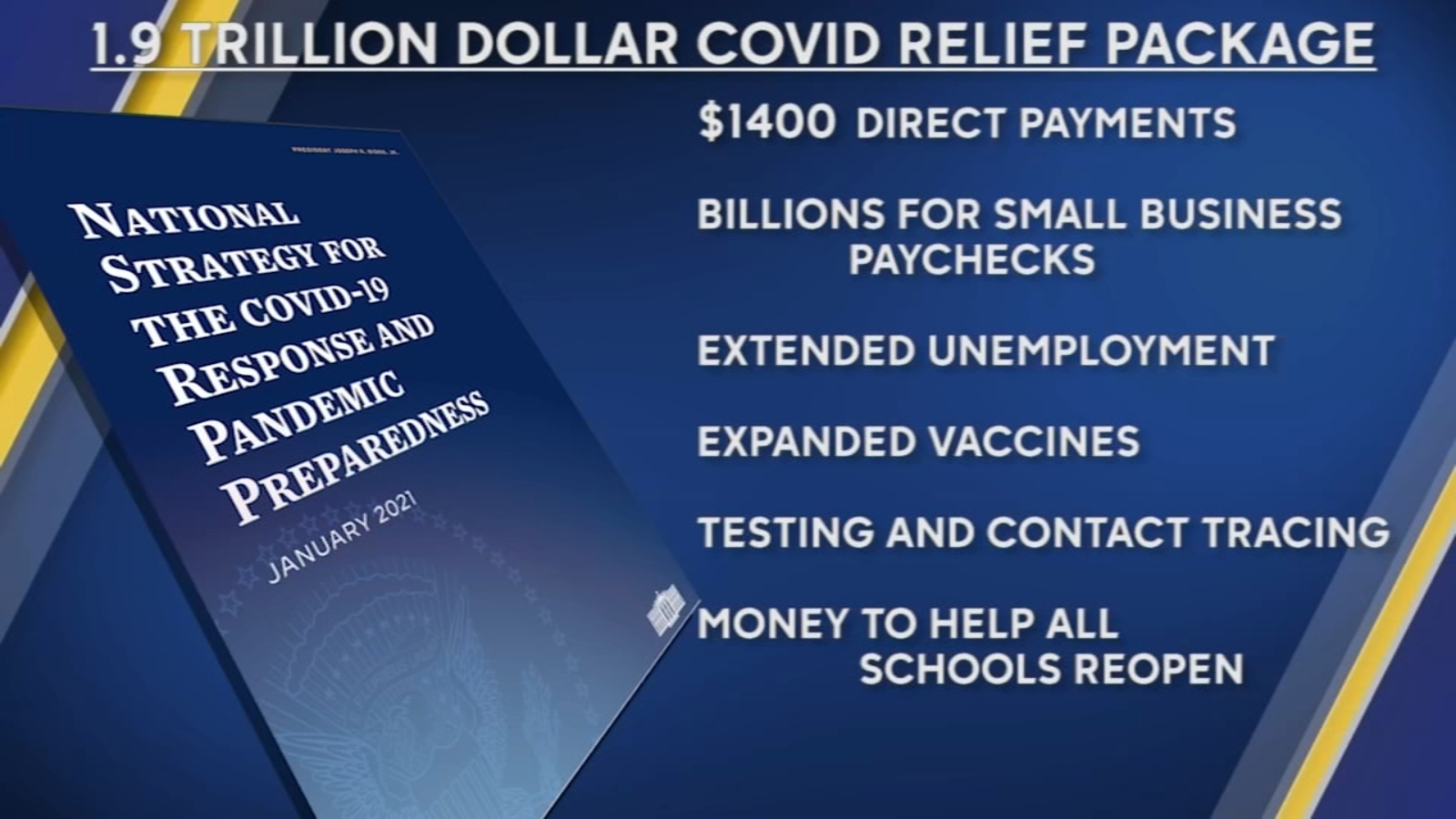
The House on Wednesday passed the mammoth $1.9 trillion COVID-19 relief package, which President Biden is expected to sign Friday.
The House approved the relief package in a starkly partisan 220-211 vote, sending the legislation to the White House and clinching Democrats’ first big legislative victory in the Biden era. No Republicans voted for the package and all but one House Democrat—Rep. Jared Golden of Maine—supported it. The Hill’s Cristina Marcos has more here.
The political split: Unlike the previous relief measures enacted last year, Democrats barely bothered to negotiate with Republicans and pushed the relief package through Congress along party lines using the budget reconciliation process. That allowed them to go as big as they wanted to go without running into a Senate GOP filibuster.
Republicans argue the use of a process dodging the filibuster shows Biden wasn’t serious about bringing unity, and House GOP lawmakers on Wednesday warned of the bill’s total cost.
But Democrats think Republicans will pay for their opposition to the popular bill and argued that they would oppose anything Biden proposed.
What’s in the $1.9T COVID-19 relief package: Along with $1,400 direct payments to households, an extension of expanded unemployment benefits, and aid for state and local governments, the package is loaded with other provisions intended to speed up the recovery from the recession and help struggling families fight the impact of COVID-19.
Tax credits: The bill increases the child tax credit for households below certain income thresholds for 2021 and makes it fully refundable, and also expands the earned income tax credit for the year.
Child care: $15 billion for grants to help low-income families afford child care and increases the child and dependent care tax credit for one year.
Pensions: $86 billion to bailout struggling union pension funds.
Transportation: $30 billion to bolster local subway and bus systems, $8 billion for airports, $1.5 billion for furloughed Amtrak workers, and $3 billion for wages at aerospace companies.
Housing: $27.4 billion in emergency rental assistance, another $10 billion to help homeowners avoid foreclosure, $5 billion in vouchers for public housing, $5 billion to tackle homelessness and $5 billion more to help households cover utility bills.
Small businesses: The American Rescue Plan broadens eligibility guidelines for the Paycheck Protection Program, allowing more nonprofit entities to be eligible, adds $15 billion in emergency grants and also sets aside more than $28 billion in funding for restaurants.
ObamaCare subsidies and Medicaid expansion: The bill increases ObamaCare subsidies through 2022 to make them more generous, a longtime goal for Democrats, and opens up more fully subsidized plans to individuals. It also would provide extra Medicaid funding to states that expand the program and have yet to do so.