The attractive economics of Medicare Advantage

https://mailchi.mp/0ee433170414/the-weekly-gist-february-14-2020?e=d1e747d2d8


After years of subsidizing Medicare Advantage (MA) plans in an effort to attract more insurers and beneficiaries to the market, the government has succeeded in its goal: the average beneficiary can now choose from 28 plans in 2020, and recent studies have shown MA plans are outperforming fee-for-service (FFS) Medicare on several key quality measures.

As shown above, this subsidy has decreased in recent years—as mandated by the Affordable Care Act—and per-beneficiary MA payments are roughly equal to those of FFS Medicare. (These numbers may be underreported, however, due to aggressive risk adjustment measures on the part of MA plans.) However, risk-adjusted average Medicare cost per MA beneficiary is actually 13 percent lower than per Medicare FFS beneficiary, due mainly to lower utilization of high-cost services and other efficiencies.

Insurers offering MA plans are profiting from this lucrative “spread.” 

Growth in MA plans in recent years ensures that private insurers will continue to play an important role in the future of Medicare—the most recent projections estimate that 47 percent of Medicare beneficiaries will be in MA plans within a decade.

But inefficiencies in traditional Medicare may not make it the best standard on which to base MA payments. And ultimately, relative MA payment rates will have to continue to drop for the program to sustainably manage the healthcare costs of the gigantic Baby Boom generation.




Appeals court strikes down Trump approval of Medicaid work requirements

Appeals court strikes down Trump approval of Medicaid work requirements

Image result for Appeals court strikes down Trump approval of Medicaid work requirements

A federal appeals court on Friday struck down the Trump administration’s approval of Medicaid work requirements in Arkansas, the latest legal blow to one of President Trump‘s signature health initiatives. 

The U.S. Court of Appeals for the D.C. Circuit affirmed a lower court ruling that the approval of the work requirements was “arbitrary and capricious.”

More than 18,000 people lost coverage in Arkansas due to the work requirements before they were halted by a lower court.

The court found that the Trump administration disregarded the statutory purpose of Medicaid — to provide health coverage — and did not adequately account for the coverage losses that would result from the work requirements. 

“Failure to consider whether the project will result in coverage loss is arbitrary and capricious,” Judge David Sentelle, an appointee of President Reagan, wrote in the opinion.

Requiring Medicaid recipients to work or else lose coverage is a top priority of Centers for Medicare and Medicaid Services Administrator Seema Verma. She argues that the policy helps lift people out of poverty by getting them jobs and out of Medicaid into employer-based insurance.

But Democrats and health care advocates have denounced the move, saying it imposes burdensome paperwork requirements on low-income people that cause them to lose coverage even if they are working.

The policy has also faced a string of legal losses, with courts ruling that Congress would need to act to authorize the work requirements. 

Arkansas was the only state where the requirements went into effect before being blocked by the courts. Several other states’ efforts were approved, but the initiatives have been halted as the issue works its way through the courts.

“The Court recognized the tragic harm that these work requirements have caused people in Arkansas doing their best to get ahead,” said Kevin De Liban, an attorney at Legal Aid of Arkansas, which helped challenge the requirements. “Now, more than two hundred thousand Arkansans on the program can rest easier knowing that they’ll have health care when they need it.”

Conservative changes to Medicaid have been a leading priority of the Trump administration, which also recently announced plans to let states block-grant their funding for the program. That move was also denounced by Democrats as inevitably leading to coverage losses and is also likely to be challenged in court.

Kentucky had originally also been part of the work requirement litigation, but a Democratic governor, Andy Beshear, was elected last year and ended the initiative.


Cartoon – I can’t afford that diagnosis

Image result for Cartoon high cost of medical care

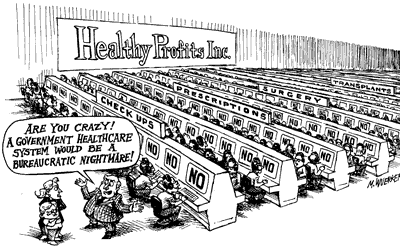
Cartoon – A Bureaucratic Nightmare?

Image result for Cartoon high cost of medical care


Cartoon – We found the Problem

Image result for Cartoon high cost of medical care

California Health Policy Poll Released

https://elink.clickdimensions.com/m/1/52313696/02-b20044-0c24a5f919b04c9baf7a61e0f9656ec6/6/989/a24990fd-e009-4b4b-be17-ea9b7c8eef0e

Increases in Worry Over Health Care Costs and Skipping/ Postponing Treatment Due to Cost Over the Last Year

PERCENTAGE WHO SAY THEY ARE VERY OR SOMEWHAT WORRIED ABOUT…


Steward moves to sell struggling Pennsylvania hospital

https://www.beckershospitalreview.com/hospital-transactions-and-valuation/steward-moves-to-sell-struggling-pennsylvania-hospital.html?utm_medium=email

Image result for easton hospital

Dallas-based Steward Health Care has signed a letter of intent to sell Easton (Pa.) Hospital to a local healthcare system, a source familiar with the agreement told The Morning Call.

The document reviewed by the publication suggest that St. Luke’s University Health Network is the likely buyer. Both Steward and St. Luke’s declined to comment.

Last month, Bethlehem, Pa.-based St. Luke’s University Health Network and Allentown, Pa.-based Lehigh Valley Health Network, submitted bids to buy Easton Hospital.

The takeover bids came after Steward said it would cut services to improve the system’s finances.

Easton Hospital has struggled to compete with both St. Luke’s and Lehigh Valley Health for the last five years, according to the report.

On Feb. 12, Steward sent a warning letter to the Lehigh Valley Health to stop recruiting physicians from Easton Hospital, saying they are contractually banned from working at a competing system. This suggests that St. Luke’s bid may have been approved over Lehigh Valley Health, according to the report. 

Read the full report here.