University of Chicago Medical Center closes level 1 trauma center ahead of strike

https://www.beckershospitalreview.com/human-resources/university-of-chicago-medical-center-closes-level-1-trauma-center-ahead-of-strike.html

Related image

University of Chicago Medical Center has closed its level 1 trauma center for adult and pediatric patients as it prepares for about 2,200 nurses to go on strike next week, medical center leaders announced.

Medical center leaders said UCMC closed its pediatric level 1 trauma program Nov. 18 and its adult trauma program Nov. 20. Its adult and pediatric emergency rooms continue to take walk-in patients.

Nurses are scheduled to strike Nov. 26, two days before Thanksgiving. The nurses also walked off the job Sept. 20 in a strike organized by National Nurses Organizing Committee/National Nurses United. They were allowed to return to work Sept. 25, after the medical center said it fulfilled its contract with temporary nurses to replace the striking ones for five days.

In preparation for the strike, UCMC announced earlier this week that it is moving about 50 babies and 20 children in its neonatal and pediatric intensive care units to other facilities.

UCMC President Sharon O’Keefe is also recruiting about 900 replacement nurses.

However, “it’s exceptionally difficult to hire people who are willing to leave their families during Thanksgiving,” she said in a news release. “At the same time, other hospitals in the city are already at or near capacity, which means they will not be able accept transfers of current inpatients if that need arises when nurses walk out. The combination of the two led us to take the step of temporarily closing our trauma program ahead of the strike.”

UCMC said the hospital was required to offer replacement nurses five days of work “to best recruit qualified and experienced replacement nurses.” Therefore, the nurses on strike will not be able to return to work until 7 a.m. Dec. 1.

Negotiations between UCMC and National Nurses Organizing Committee/National Nurses United began earlier this year. Medical center leaders say incentive pay — and whether the hospital should end the pay for newly hired nurses — is a sticking point in negotiations, according to the Chicago Tribune. The union has continued to express concerns about staffing levels.

The nurses said they plan to strike unless an agreement is reached.


Former UMMS board member indicted in fraud scheme

https://www.beckershospitalreview.com/legal-regulatory-issues/former-umms-board-member-indicted-on-11-counts-of-fraud-tax-evasion.html

Image result for healthy holly children's book

Former Baltimore Mayor Catherine Pugh, who served on the board of University of Maryland Medical System for 18 years, was indicted on charges of wire fraud and tax evasion related to a children’s book scandal that involved the Baltimore-based health system and Oakland, Calif.-based Kaiser Permanente, a local CBS affiliate reports.

The indictment was unsealed Nov. 20, ahead of Ms. Pugh’s scheduled hearing on Nov. 21. If convicted, Ms. Pugh could face up to 100 years in prison and be required to forfeit her home and repay more than $769,000 allegedly obtained through the scheme.

The indictment alleges Ms. Pugh conspired with city employees to defraud buyers of her Healthy Holly children’s books, according to CBS, which published the indictment in full. It alleges Ms. Pugh arranged five $100,000 deals with UMMS to donate a total of 100,000 books to Baltimore public schools. The books were allegedly never delivered, and instead rerouted to alternate storage facilities around the city, distributed at campaign events and double-sold to other customers.

The indictment also alleges Ms. Pugh used Healthy Holly profits to fund straw donations to her mayoral campaign and to buy a house in Baltimore. She also faces allegations of tax evasion related to Healthy Holly sales, according to the report.

CBS notes Kaiser Permanente also disclosed buying $114,000 of the books at a time that overlaps with winning a $48 million contract from the city, according to the report.

The two city officials connected to the scheme pleaded guilty to conspiracy and tax evasion, according to the report.

Read the full story and access the full indictment here.


Trinity Health sees net income plunge 60% as operating margin improves

https://www.beckershospitalreview.com/finance/trinity-health-sees-net-income-plunge-60-as-operating-margin-improves.html

Image result for trinity health headquarters

Trinity Health recorded higher revenue and operating income in the first quarter of fiscal year 2020 than in the same period a year earlier, but the Livonia, Mich.-based system ended the quarter with lower net income, according to unaudited financial documents.

During the first quarter of fiscal 2020, which ended Sept. 30, Trinity reported operating revenue of $4.8 billion, a 1.8 percent increase over the same period of the year prior. Operating expenses climbed 1.7 percent year over year to $4.7 billion.

Trinity ended the first quarter of fiscal 2020 with operating income of $94 million, up from $87 million in the first quarter of last year.

The system reported an operating margin of 2 percent in the first quarter of fiscal 2020, compared to an operating margin of 1.8 percent in the same period of the year prior. Margin growth was partially attributable to Trinity’s divestiture of Camden, N.J.-based Lourdes Health System in June. Growth in patient volumes and payment rates also supported margin growth.

After factoring in nonoperating items, including a decline in investment returns, Trinity reported net income of $166.4 million in the first quarter of fiscal 2020. That’s compared to the first quarter of fiscal 2019, when the system posted net income of $419.9 million.


Warren’s path to Medicare for All is rocky

https://www.axios.com/newsletters/axios-vitals-e30baa47-bebc-4081-81a6-cb96115c5e55.html

Illustration of Elizabeth Warren holding out a health plus.

Sen. Elizabeth Warren’s two-part plan to pass a public option as a transition into “Medicare for All” — and then full-blown “Medicare for All” a few years later — has revealed the difficulty of appealing to both the pragmatic and progressive wings of the party.

The big picture: Warren’s already being criticized by progressives for not being a “Medicare for All” purist, and because of the realities of governing, they may have a point: Passing two major health reforms in one term is unheard of.

  • “In my first week as president, we will introduce Medicare for All legislation,” Sen. Bernie Sanders tweeted on Friday.

Details: Warren’s transition plan — which she said she’ll try to pass within her first 100 days in office — would allow anyone over 50 to enroll in an “improved Medicare program,” and “every person in America” could get coverage through a “Medicare for All option.”

  • Coverage under the public option would immediately be free for children under 18 and families making 200% of the federal poverty level or less. Over time, it’d become free for everyone.
  • Then, by no later than her third year in office, Warren would push Congress to pass full-blown “Medicare for All.”

Reality check: The political capital that it’d take to pass Warren’s public option, even through a special procedure called “budget reconciliation” that’d allow her to bypass GOP opposition, would be enormous.

What they’re saying: “Passing one major piece of health care legislation with a knock down, drag out fight, followed by another one three years later, sounds pretty difficult,” said the Kaiser Family Foundation’s Larry Levitt.

  • “A more likely scenario is that a public option would pass, and be given time to work. Depending on how that debate went, Medicare for [A]ll could be a rallying cry for a reelection campaign.”


More older Americans need Medicare and Medicaid

https://www.axios.com/newsletters/axios-vitals-e30baa47-bebc-4081-81a6-cb96115c5e55.html


Image result for More older Americans need Medicare and Medicaid

Retirement in America is growing less secure, physically and financially, given the omnipresent threat and cost of serious illness or disease, Bob reports.

Why it matters: Qualifying for Medicare does not guarantee that older adults will skirt potentially ruinous medical bills. Millions of seniors have also come to rely on the taxpayer-funded program for lower income people — Medicaid — and there’s no indication that will slow down.

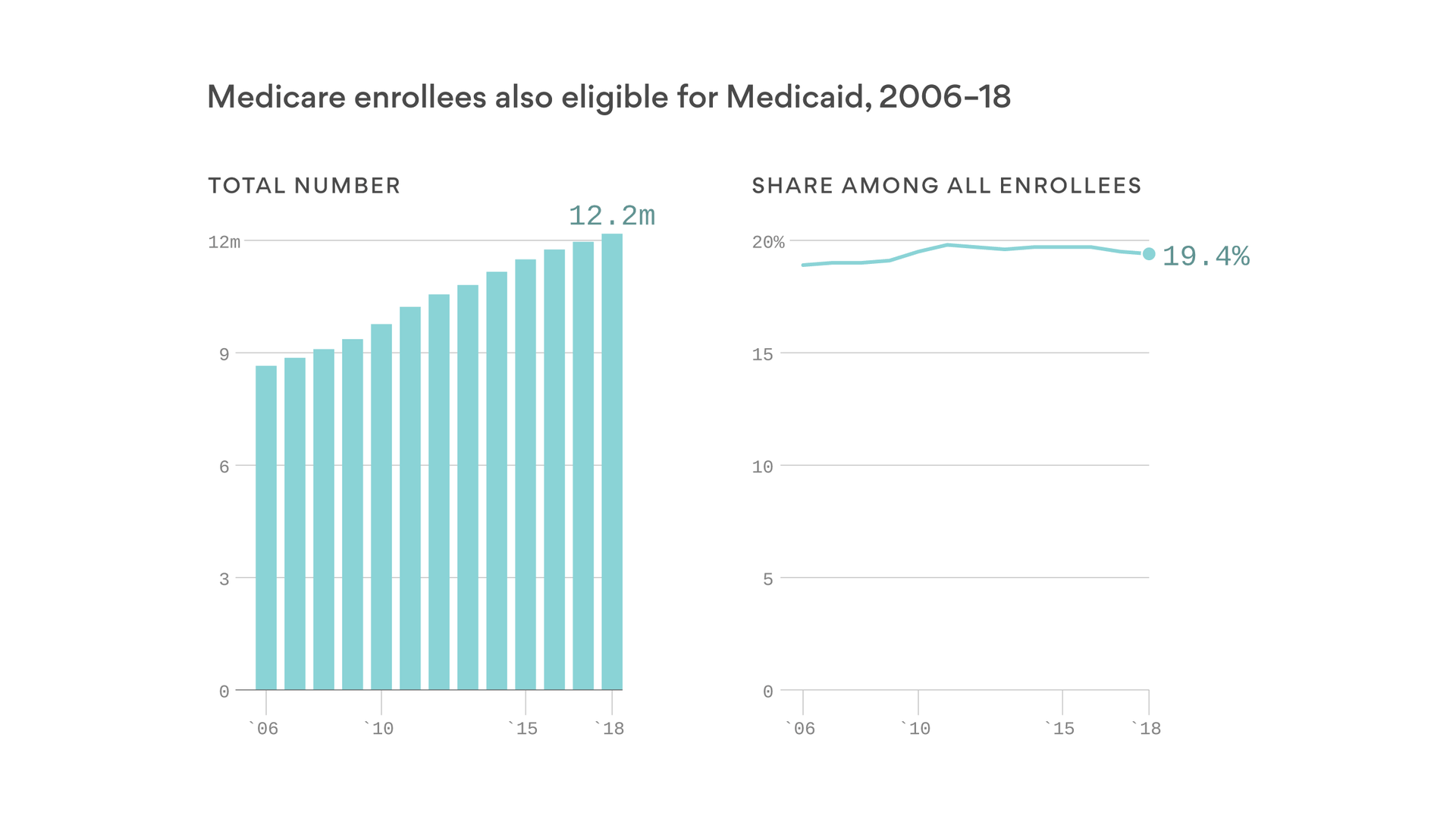
By the numbers: More than 12 million Americans — most of them over 65 — have both Medicare and Medicaid coverage.

  • That represents about one-fifth of all Medicare enrollees, a percentage that has stayed stable over time even as more baby boomers enter the program.
  • This low-income population has some of the most expensive health care conditions and disabilities — averaging roughly $30,000 in annual spending per person, or double the average Medicare enrollee.

Between the lines: Some people who age into Medicare have very few assets and income, and therefore automatically qualify for Medicaid.

  • But retirees who consider themselves middle-class increasingly have to resort to Medicaid because high costs, like dementia or nursing home care, consume their entire nest egg.

What to watch: The federal government has been experimenting with ways to coordinate care better for this population, but that’s a reaction to seniors falling into poverty due to health care costs.

  • Unless policymakers address the high and rising costs of care, more retirees and their families will have to depend on both Medicare and Medicaid.