As Healthcare Changes, So Must its CEOs, CFOs, COOs…

http://www.healthleadersmedia.com/leadership/healthcare-changes-so-must-its-ceos-cfos-coos%E2%80%A6?spMailingID=11163372&spUserID=MTY3ODg4NTg1MzQ4S0&spJobID=1180078976&spReportId=MTE4MDA3ODk3NgS2

To keep up with big changes in how healthcare is administered, financed, and organized, top leaders are finding a need for new talents and organizational structures.

To keep up with big changes in how healthcare is administered, financed, and organized, top leaders are finding a need for new talents and organizational structures.

Healthcare reform as a term has become so ubiquitous that it is almost indefinable. At first, and broadly, it meant removing the waste in an excessively expensive healthcare system that too often added to the problems of the people whose health it aimed to improve. Then it became legislative and regulatory, in the form of the Patient Protection and Affordable Care Act and its incentives aimed at improving the continuum of care and expanding the pool of those covered by health insurance.

Now, for many in the industry, healthcare reform has matured into a business imperative: the process of ingraining tactics, strategies, and reimbursement changes so that health systems improve quality and efficiency with the parallel goal of weaning us all off a system in which incentives have been so misaligned that neither quality nor efficiency was rewarded.

That leaders finally are able to translate healthcare reform into action is welcome, but to many health systems trying to survive and thrive in a rapidly changing business environment, the old maxim that all healthcare is local is being proved true. Making sense of healthcare reform is up to individual organizations and their unique local circumstances. Fortunately, there are some broad themes and organizational principles that are helpful for all that are trying to make this transition. What works in one place won’t necessarily work in another, but the innovation level is off the charts as healthcare organization leaders reshape what being a leading healthcare organization means as well as what it requires.

ACHE report: High healthcare CEO turnover rates now the norm

http://www.fiercehealthcare.com/healthcare/ache-reports-continued-high-turnover-among-healthcare-ceos?utm_medium=nl&utm_source=internal&mrkid=959610&mkt_tok=eyJpIjoiT0RGaE9USTFOR1F4T0dGbSIsInQiOiJsMHdQVHhVK1pcL0c4S0JpV21SZXJxaVFNU3M5TWFHWWRJSU1XWnp1Szl0VkJlT29xdkFzNWJqdE9YMURvUTJYVjl4NVB3RHlBcVpZMEJVUEVVMVZNakFnUUVPNWV4SzU5amdCeGNWTURDdllzYzhrQWwxdFJHdHlxMDZidnlYN3MifQ%3D%3D

Boardroom

The high healthcare CEO turnover rates seen over the past several years continued in 2016, according to the American College of Healthcare Executives (ACHE).

The turnover rate was 18% for healthcare CEOs in 2016, down from the record high of 20% in 2013, ACHE announced. Still, this level was approximately equivalent to those seen over the past few years, which the association notes are among the highest in the past 20 years.

Structural changes in the industry appear to be among the main drivers of this trend, according to ACHE President and CEO Deborah J. Bowen. “The ongoing consolidation of healthcare organizations, continuing movement toward new models of care and retiring leaders from the baby boomer era,” she said in the announcement, are likely influences behind the high turnover rates.

These results align with other recent reports of unprecedented turnover throughout hospitals, which are on pace to turn over half their overall staff every five years, according to previous reporting byFierceHealthcare. High turnover rates in the C-suite present organizations with problems beyond recruitment and retention, however, since changes to top leadership can have a ripple effect throughout the leadership pipeline.

RELATED: Hospitals nationwide face unprecedented turnover, report says

With the multiyear trend continuing unabated, Bowen urges healthcare organizations to ensure they have developed succession plans and that they keep them up to date. “Succession planning should include not only naming and preparing immediate successors to C-suite positions, but more broadly an emphasis on developing the pipeline of future leaders,” she said.

ACHE found the highest rate of turnover in the District of Columbia, which came in at a whopping 67%. That result appears to be an outlier, as the second- and third-highest states of New Hampshire and Washington came in at 38% and 30%, respectively. All other states showed adjusted turnover percentages under 30. Alaska, North Dakota and Delaware showed the most stable trends, all three in single digits.

65 financial benchmarks for hospital executives

http://www.beckershospitalreview.com/finance/65-financial-benchmarks-for-hospital-executives-022117.html

Image result for financial benchmarks

Hospitals leaders across the nation use benchmarking as a way to determine the areas of their business that need improvement. The continuous process of benchmarking allows hospital executives to see how their organizations stack up against local and regional competitors as well as national leaders.

Here are 65 benchmarks related to one of the most important day-to-day areas hospital executives oversee — finance.

Key ratios
Source: Moody’s Investors Service, “U.S. Not-for-Profit Hospital 2015 Medians” report, September 2016.

The medians are based on an analysis of audited 2015 financial statements for 340 freestanding hospitals, single-state health systems and multi-state health systems, representing 81 percent of all Moody’s-rated healthcare entities. Children’s hospitals, hospitals for which five years of data are not available and certain specialty hospitals were not eligible for inclusion in the medians.


Are CEOs Less Ethical Than in the Past?

https://www.strategy-business.com/feature/Are-CEOs-Less-Ethical-Than-in-the-Past?gko=50774&utm_source=itw&utm_medium=20170516&utm_campaign=resp

The job of a chief executive officer at a large publicly held company may seem to be quite comfortable — high pay, excellent benefits, elevated social status, and access to private jets. But the comfortable perch is increasingly becoming a hot seat, especially when CEOs and their employees cross red lines.

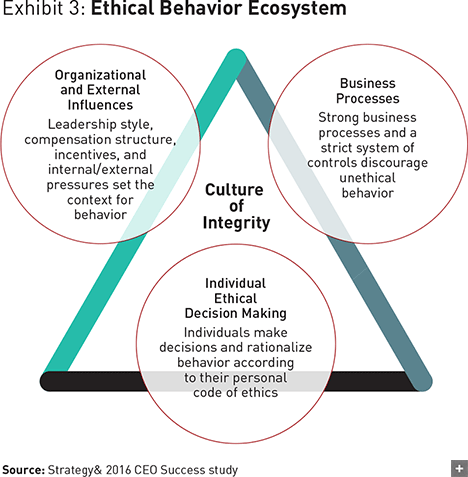
As this year’s CEO Success study shows, boards of directors, institutional investors, governments, and the media are holding chief executives to a far higher level of accountability for corporate fraud and ethical lapses than they did in the past. Over the last several years, CEOs have often garnered headlines for all the wrong reasons: for misleading regulators and investors; for cutting corners; and for failing to detect, correct, or prevent unethical or illegal conduct in their organization. Some high-profile cases, involving some of the world’s largest corporations, have featured oil companies bribing government officials and banks defrauding customers.

To be sure, the number of CEOs who are forced from office for ethical lapses remains quite small: There were only 18 such cases at the world’s 2,500 largest public companies in 2016. But firings for ethical lapses have been rising as a percentage of all CEO successions. (We define dismissals for ethical lapses as the removal of the CEO as the result of a scandal or improper conduct by the CEO or other employees; examples include fraud, bribery, insider trading, environmental disasters, inflated resumes, and sexual indiscretions. See “Methodology,” below.) Globally, dismissals for ethical lapses rose from 3.9 percent of all successions in 2007–11 to 5.3 percent in 2012–16, a 36 percent increase. The increase was more dramatic in North America and Western Europe. In our sample of successions at the largest companies there (those in the top quartile by market capitalization globally), dismissals for ethical lapses rose from 4.6 percent of all successions in 2007–11 to 7.8 percent in 2012–16, a 68 percent increase.

http://www.beckershospitalreview.com/hospital-management-administration/ceo-turnover-for-misbehavior-up-36-worldwide.html


Why do CEOs get fired or leave organizations anyway?

https://interimcfo.wordpress.com/2015/01/09/why-do-ceos-get-fired-or-leave-organizations-anyway/

In my previous post, I made reference to comments written by ‘TiredofTheOverpaidFailures’ in response to a Becker Review article.

Among other things, this writer said, “As a healthcare staffer for 35 years from entry-level employee to Director, I’ve literally never seen any CFO or CEO leave our organizations for any reason other than to “spend more time with my family”.  It’s true, because in every case they collected an inflated golden parachute for the next 2-3 years and indeed manage to take off time to spend with their family or most of the time do part-time consulting at some other organization where they have no idea the horrific failure they were in the previous position. For that matter, what shape they left the organization in.  They usually consider them “the expert” because they are from somewhere else.”

Clearly, he or she  was very bitter about what they had observed in the front office of their organization over a long period of time.

It is true that some of the folks occupying C-suite offices are not that stellar but more often than not, when they leave it is rarely because they are an idiot.  The system does a pretty good job of weeding out idiots before they can reach positions of such power and influence although I have seen a number of suspects among the casts of characters I have dealt with in healthcare administration.  So if the CEO is not an idiot, why let him go?  I will discuss a variety of situations that I have seen that I believe explain in part why CEO turnover in healthcare is so high.

I frequently hear complaints about what a Board is and is not doing with respect to the organization and the CEO.  A healthcare organization is not much different from a professional sports team.  The Board is the owner and the CEO is the coach.  In the end, like a sports team, the Board only has one switch or lever to use to guide the organization; hire the coach or fire the coach.  As long as the Board has not decided to fire the coach (CEO), by default they are supporting or at least tolerating him.  He is still their guy until the notice is delivered which can happen on the same date that an incentive award is given.  If you do not like what you see the CEO doing, it is not necessarily his fault.  Look to the Board for responsibility for the actions and results of their CEO.

Scripps CEO Chris Van Gorder on AHCA vote: Healthcare is personal, not political

http://www.beckershospitalreview.com/hospital-management-administration/scripps-ceo-chris-van-gorder-on-ahca-vote-healthcare-is-personal-not-political.html

Image result for chris van gorder

The House of Representatives on Thursday passed the American Health Care Act of 2017 by a 217-213 vote with all Democrats opposing.

Chris Van Gorder, president and CEO of San Diego-based Scripps Health, shared his reaction to the vote with Becker’s Hospital Review via email.

“Healthcare legislation approved by only one party will not last the test of time,” he wrote. Mr. Van Gorder believes the bill’s passage maintains the uncertainty around the future of healthcare and how it is going to be funded, while also creating fear and confusion among patients and healthcare providers.

“[T]his is just one more example of our elected officials refusing to compromise and work together for the good of the country,” he said. “Healthcare should not be political — it’s personal. It’s about life and death.”

Mr. Van Gorder urged elected officials to drop bipartisan arguments and work together to design a healthcare plan that increases coverage and access, improves quality and outcomes, and lowers costs.

“Good and sustainable legislation should come out of debate, compromise and the involvement of the experts — in this case, healthcare professionals,” he said. “We healthcare leaders stand ready to help.”

Blue Shield CEO Says GOP’s ‘Flawed’ Health Bill Would Harm Sicker Consumers

http://www.healthleadersmedia.com/health-plans/blue-shield-ceo-says-gop%E2%80%99s-%E2%80%98flawed%E2%80%99-health-bill-would-harm-sicker-consumers?spMailingID=10958671&spUserID=MTY3ODg4NTg1MzQ4S0&spJobID=1160435461&spReportId=MTE2MDQzNTQ2MQS2

blue-shield-calif2

The CEO’s comments break with conventional wisdom, showing that at least one insurance industry leader has strong reservations about returning to the practice of scrutinizing people’s medical histories to determine rates.


Molina Healthcare fires its CEO and CFO

http://www.fiercehealthcare.com/payer/molina-healthcare-fires-its-ceo-and-cfo

Boardroom

Citing “the company’s disappointing financial performance,” Molina Healthcare has cut ties with its CEO, J. Mario Molina, and his brother, CFO John Molina.

The Medicaid managed care company announced Tuesday that Joseph W. White, who was its chief accounting officer, will take over the role of CFO and act as the interim president and CEO while Molina seeks a replacement for that role.

Molina’s board of directors took the step of firing the sons of the company’s founder, C. David Molina, “in order to drive profitability through operational improvements,” Chairman Dale B. Wolf said in the announcement.

“With the industry in dynamic transition, the Board believes that now is the right time to bring in new leadership to capitalize on Molina’s strong franchise and the opportunities we see for sustained growth,” he added.

The leadership change comes in the wake of Molina’s revelation in February that it lost $110 million on its Affordable Care Act exchange business last year. On the company’s fourth-quarter earnings call, J. Mario Molina primarily blamed the ACA’s risk adjustment program, which he said uses a methodology that “penalizes low-cost and low-premium health insurers like Molina.”

That was a sharp turnaround from back in September, when the insurer’s CEO said that it had exceeded its own growth targets for its ACA exchange business.

J. Mario Molina has also been an outspoken critic of Republicans’ bill that aims to repeal and replace the Affordable Care Act—a rarity among his peers. In particular, he was critical of the steep funding cuts for Medicaid proposed by the GOP.

Molina’s now-ex-CEO earned $10 million in total compensation in 2016, a slight decrease from the $10.3 million he made the year prior and only one of two executives at the eight largest publicly traded health insurers to take a pay cut.

Cleveland Clinic’s Toby Cosgrove to step down, search begins for new president and CEO

http://www.fiercehealthcare.com/healthcare/cleveland-clinic-s-toby-cosgrove-to-step-down-search-begins-for-new-president-and-ceo?utm_medium=nl&utm_source=internal&mrkid=959610&mkt_tok=eyJpIjoiTm1Oak9EZzNZMkZoTVdKaSIsInQiOiJZY0d6WGVEUmR2S3dTaW5uMFBUWTZWXC9YekZySGpibUJNUWR0Mks3cVZORVZ2ZUZxQVdlcGRseCtiR0JhYUZoVXo0c0RsRHZ0eUVrZzJqRVNDZEdTcVU3S0JTNGEycktPOFNyYkFCeTdRNFpPK3pTNE1wRE1jWHZYbzJKbHp2dVkifQ%3D%3D

Cosgrove_At_State_Of_The_Clinic(Credit:Stephen_Travarca/Cleveland_Clinic)

One of the country’s most influential healthcare leaders plans to hang up his hat later this year.

Toby Cosgrove, M.D., who has served as president and CEO of the Cleveland Clinic for nearly 13 years, announced this morning he intends to step down. He will continue serving as an adviser for the multispecialty academic hospital.

The organization will begin the search for his successor immediately. In keeping with its model as a physician-led institution, the new president and CEO will also be a practicing physician.

Cosgrove was a cardiac surgeon for nearly 30 years before becoming CEO of Cleveland Clinic in 2004. Since then, he has led initiatives that have gained international and national recognition, particularly his focus on improving the patient experience and reorganizing clinical services into a patient-centered care model.

Cosgrove coined the phrase “Patients First” at the institution and was the first to hire a chief patient experience officer, a position that is now a fixture in many hospitals across the country. He also has implemented same-day medical appointments for patients who request them.

“It is an honor and a privilege to be a part of an extraordinary and forward-thinking organization that puts patients at the center of everything we do,” Cosgrove said in an announcement. “Cleveland Clinic’s world-class reputation of clinical excellence, innovation, medical education and research was created and will be maintained by the truly dedicated caregivers who work tirelessly to provide the best care to our patients.”

Under his direction, the Cleveland Clinic has grown into an $8 billion health system with locations in Ohio, Florida, Nevada, Canada and Abu Dhabi. It also will open a facility in London in 2020. The organization is Ohio’s largest employer with more than 50,000 caregivers.

Cleveland Clinic is also a leader in patient care. It was ranked No. 2 in the nation last year by U.S. News & World Report, which also ranked its heart program as No. 1 in America for 10 years in a row.

“The goal of any leader is to leave an institution better than you found it. Without a doubt, Toby has done that,” Cleveland Clinic Board of Directors Chairman Bob Rich said in the announcement. “Our world-class reputation has only grown over the past 13 years, as he has led Cleveland Clinic through a period of dramatic growth and worldwide expansion.”

In recent years, Fortune has also named Cleveland Clinic one of the best workplaces in healthcare. During his tenure, Cosgrove has led major wellness initiatives for both patients and employees, banning smoking on all campuses, adopting a policy not to hire smokers, offering employees free memberships to Weight Watchers and gyms, eliminating fried foods from the hospital cafeteria, opening weekly farmer’s markets in the summer and fall and creating an employee health insurance program that offers discounts for physical activity or for enrollment in a disease management program.

He was a frontrunner twice to serve as the secretary of the Department of Veteran Affairs, most recently as President Trump’s pick to oversee the embattled agency. But he had to turn down the position because he couldn’t get out of his commitment to the Cleveland Clinic.