What’s next for the ACA after Trump’s executive order

 Image result for executive order on healthcare

President Trump couldn’t get Congress to repeal the Affordable Care Act, so he signed an executive order to encourage cheaper, less regulated insurance options — a change that critics fear will remove patient protections and undermine insurance markets. In response, Senators Lamar Alexander and Patty Murray have put forward a bipartisan bill designed to stabilize the ACA markets.

With the future of the ACA so fiercely contested, what impact will Trump’s executive order have on health insurance, and what action should Congress now take?

We asked five experts:

CBO: Alexander-Murray Bill Would Trim Deficit, Keep Americans Insured

http://www.healthleadersmedia.com/health-plans/cbo-alexander-murray-bill-would-trim-deficit-keep-americans-insured?spMailingID=12228675&spUserID=MTY3ODg4NTg1MzQ4S0&spJobID=1262308916&spReportId=MTI2MjMwODkxNgS2#

Image result for congressional budget office

Is the Senate’s bipartisan compromise a workable fix or a ‘futile’ stopgap?

The bipartisan Alexander-Murray bill aimed at propping up the Affordable Care Act long enough for more substantial changes to be made is receiving a mixed response from lobbying groups and legislators, with some saying the bill only extends the life of a system that should be allowed to die.

Supporters say the bill would stabilize a volatile healthcare insurance market and preserve coverage for millions of Americans by continuing the cost sharing reduction (CSR) payments that health plans say are essential to helping them survive the ACA.

The Congressional Budget Office (CBO) and Joint Committee on Taxation (JCT) released an assessment Wednesday of the measure, finding that the deal would reduce the deficit by $3.8 billion over the next decade “without substantially changing the number of people with health insurance coverage, on net.” By contrast, earlier proposals to overhaul the ACA lost steam this year after CBO scores indicated that they would likely drive down the number of insured Americans by tens of millions.

“This nonpartisan analysis shows that our bill provides savings and ensures that funding two years of cost-sharing payments will benefit taxpayers and low-income Americans, not insurance companies,” Sen. Lamar Alexander (R-TN) and Sen. Patty Murray (D-WA) said Wednesday in a joint statement.

The CSR payments are intended to compensate insurers for providing coverage to lower-income consumers at below cost, and many say losing those payments will drive premiums higher and force some insurers to leave certain markets.

The compromise

Alexander and Murray developed the compromise bill in a bid to maintain the CSR subsidies that the Trump administration announced October 12 it would halt. The White House argues the CSRs were never authorized by Congress.

California is leading the charge in a legal challenge of President Trump’s stated intention to stop the payments, and the American Hospital Association, along with several other groups representing hospitals and other healthcare organizations, has filed a brief in support of the CSRs. But a federal judge in California sided Wednesday with the White House, ruling that the government doesn’t have to continue making the payments while states challenge the move in court, Reuters reported.

A bipartisan coalition of 24 senators—12 Republicans and 12 Democrats—have signed on to the healthcare legislation as cosponsors. Preserving the CSRs was a major priority of the Democrats, who compromised by agreeing to the Republican push to allow states to seek waivers of ACA requirements in their own states.

Ending the subsidies is expected to result in healthcare plans raising premiums even higher than otherwise planned. But the Alexander-Murray bill would authorize the CSR payments for two years and tie them to the changes in the ACA that give states more flexibility to seek waivers from the law’s requirements.

The proposed legislation also would allow insurance companies to sell less comprehensive plans to all consumers. Republican leaders say the allowance would make more affordable plans available, which, in turn, would encourage more people to buy coverage and help the insurers remain profitable.

“This is a first step: Improve it, and pass it sooner rather than later. Our purpose is to stabilize and then lower the cost of premiums in the individual insurance market for the year 2018 and 2019,” Alexander said.

Bill opposition

The Association of American Physicians and Surgeons (AAPS) opposes the bill, saying it seeks to stabilize the insurance marketplace by forcing taxpayers to pay insurers to lower out-of-pocket costs for certain plan members.

Jane M. Orient, MD, executive director of AAPS, says the ACA actually makes insurance unaffordable.

“The deceitfully named Affordable Care Act did not just destabilize the individual insurance market; it destroyed it by outlawing genuine, voluntary insurance,” Orient says. “ACA-compliant plans are not true insurance, but coercive prepayment schemes for a federally dictated package that might be rejected by most subscribers.”

Orient says the bill being considered should be seen as an inappropriate form of legislative life support.

“Resuscitating Obamacare with Alexander-Murray would only prolong its dying process, but at great expense,” Orient says.

“Instead of running a futile Code Blue on Obamacare, we should be attending to American medicine and the American economy,” she adds.

Bill ‘provides critical stability’

American College of Emergency Physicians (ACEP) President Becky Parker, MD, FACEP, disagrees.

She says ACEP supports the Alexander-Murray legislation because it will provide critical stability for the individual health insurance marketplace, ensuring that millions of Americans have continued access to the health coverage they need and deserve.

“This legislation is a good-faith bipartisan effort that will help limit increases in health insurance premiums and preserve important consumer protections, such as the Essential Health Benefits package that includes emergency services, while also providing additional flexibility for states to implement innovative approaches to coverage,” Parker says.

Republicans go toe-to-toe, again, with competing ACA bills

https://www.axios.com/vitals-2501052572.html?utm_source=newsletter&utm_medium=email&utm_campaign=newsletter_axiosvitals&stream=health-care

Image result for aca repeal


Now the Senate has two competing plans to fund the ACA’s cost-sharing subsidies — which could mean it won’t be able to pass either one. Senate Finance chair Orrin Hatch and House Ways and Means chair Kevin Brady outlined a new proposal yesterday as an alternative to the bipartisan ACA bill led by Sens. Lamar Alexander and Patty Murray.

The details: It’s hard to call these competing ACA stabilization bills. Although they’d both fund cost-sharing reduction (CSR) subsidies for two years, Hatch-Brady would also waive the law’s individual mandate for five years — effectively replacing one source of rising premiums with another.

  • Conservatives are not happy with Alexander-Murray. They’ve argued that if they’re going to keep the law’s cost-sharing payments flowing, they should be able to extract severe regulatory reforms in exchange.
  • Hatch-Brady is definitely more conservative than Alexander-Murray. The big unknown is whether its presence will stop more Republicans from accepting Alexander-Murray as “The Bill” — especially in the House, where its standing is weaker than in the Senate.
  • What they’re saying: “Sad attempt at relevancy by health care staff on Finance who are upset that their boss is entirely focused on tax reform, as he should be,” a senior GOP aide told my colleague Caitlin Owens.

The odds: 100% of the available evidence, from the entire Trump administration to date, suggests very strongly that Republicans are not capable of passing a health care bill on their own. They couldn’t do it with 50 votes in the Senate, and either one of these bills would need 60.

  • Alexander-Murray has 60 votes in the Senate.
  • Hatch-Brady would have an extremely hard time getting there. Waiving the individual mandate will be too much to ask from most, if not all, Democrats.
  • Leadership will likely face a choice between passing Alexander-Murray, with only minor modifications; or not passing anything at all.
  • All of this still probably comes down to December, when lawmakers have to deal with a host of thorny must-pass bills.

Bipartisan ACA bill gets a challenge from the right

https://www.axios.com/bipartisan-aca-bill-gets-a-challenge-from-the-right-2500833570.html?stream=health-care&utm_source=alert&utm_medium=email&utm_term=alerts_healthcare

Image result for Bipartisan ACA bill

Two prominent Republicans have come up with a more conservative alternative to the Senate’s bipartisan Affordable Care Act bill. The new proposal, from Sen. Orrin Hatch and Rep. Kevin Brady, would waive the ACA’s individual and employer mandates in exchange for temporarily funding its cost-sharing subsidies.

Why it matters: This proposal would be harder to pass than the one that’s already on the table. But it’s a sign that conservatives aren’t willing to sit on the sidelines on a process that, so far, has not given them much of what they want.

The details: Hatch and Brady’s proposal, which hasn’t yet been translated into legislative text, is largely in line with what the White House has said it wants. Their proposal would:

  • Fund the ACA’s cost-sharing subsidies for two years
  • Attach new abortion-related conditions on those funds
  • Waive the individual mandate for five years
  • Retroactively waive the employer mandate for two years
  • Expand health savings accounts

The alternative: The bill sponsored by Sens. Lamar Alexander and Patty Murray, by contrast, would fund the cost-sharing subsidies for two years; allow more people to buy cheaper, less comprehensive coverage; and make it easier for states to seek waivers from some of the ACA’s regulatory requirements.

The bottom line: Few, if any, Democrats could support Hatch-Brady — and that gives it much longer odds than Alexander-Murray, which already has the 60 votes it would need to pass the Senate. The question is whether GOP leaders will try to find a middle ground — and whether the presence of an alternative will stop Alexander-Murray from gaining more GOP support, especially in the House.

State Attorneys General Ask Court For Injunction Reversing CSR Payment Halt

http://healthaffairs.org/blog/2017/10/18/state-attorneys-general-ask-appellate-court-for-injunction-reversing-csr-payment-halt/

On October 18, 2017, the attorneys general of eighteen states and the District of Columbia asked the United States District Court for the Northern District of California for a temporary restraining order and order to show cause why a preliminary injunction should not issue to compel the Trump administration to continue making cost-sharing reduction (CSR) payments until the lawsuit they have filed is resolved. The motion asks the court to make a decision by 4:00 PM tomorow, October 19, as the next cost-sharing reduction payment is due on October 20. The plaintiffs ask for a nationwide injunction as the issue it addresses is nationwide in scope.

The motion is supported by a legal memorandum and numerous affidavits. To obtain preliminary relief, a plaintiff “must establish that he is likely to succeed on the merits, that he is likely to suffer irreparable harm in the absence of preliminary relief, that the balance of equities tips in his favor, and that an injunction is in the public interest.” In the Ninth Circuit, where California is located, it is enough to show that serious legal questions are presented if the balance of hardships tips sharply in the plaintiff’s favor.

The brief begins by explaining the purpose of the Affordable Care Act’s cost-sharing reductions: making health care affordable to lower-income individuals enrolled in silver marketplace plans by reducing out-of-pocket limits, deductibles, and other cost-sharing. It notes that insurers are required to reduce cost sharing for eligible individuals and that they are doing so to the tune of $7 billion for 2017. The ACA requires the federal government to reimburse insurers for these costs and up until September of 2017—including eight months of the Trump administration—it did so. Only days before the October payment was to be made, and less than three weeks before open enrollment began for 2018, the administration cut off the payments.

The states argue that Congress has in fact appropriated funds to cover the cost sharing reduction reimbursement payments. It is undisputed that Congress appropriated in the ACA funds for the premium tax credits and, the states argue, this appropriation covers the CSRs payments as well. They base their argument on the text, structure, and design of the ACA. This argument was rejected by the lower court in the House of Representatives’ lawsuit, but that decision is not binding on any other federal court and the states’ argument has never been ruled on by a federal appellate court.

The states further argue that the executive branch’s sudden termination of the CSR payments was “arbitrary and capricious” and thus prohibited by the Administrative Procedures Act. They contend that President Trump has violated his constitutional duty to “take care that the laws be faithfully executed.” The brief quotes liberally from President Trump’s tweets, in which he claimed, “The Democrats ObamaCare is imploding. Massive subsidy payments to their pet insurance companies has stopped. Dems should call me to fix!”; bragged that the ACA “is being dismantled, but in the meantime, premiums & deductibles are way up!” while health insurance stocks plunge because of his Executive action; and boasted that he had “knocked out the CSRs,” pronouncing the ACA “dead,” “finished,” and “gone.” The brief describes the President as “characteristically frank” in detailing his motives for cutting off the payments, which do not rely on legal analysis.

The brief describes in detail, with frequent cites to affidavits filed with the brief, the harm that the states and their residents will suffer because of the administration’s decision. These include destabilizing the states’ individual health insurance markets, increasing premiums, decreasing consumer plan choices, and suppressing market participation. The decision will also, the states assert, increase the number of uninsured individuals in the states and thus their uncompensated care costs. The brief notes that the District of Columbia Court of Appeals already recognized these burdens on the states when it granted them the right to intervene in the appeal of the case brought by the House of Representatives. The brief contends that the timing of the decision to terminate the CSR payments will cause consumer confusion and cause insurers to absorb multi-million dollar losses, further destabilizing the individual market.

Finally, the brief argues that the balance of the hardships tilts toward the plaintiff states. In particular, as has been noted by the Congressional Budget Office and others, terminating the CSR payments will cost the government more than it saves since it will increase premiums and thus premium tax credits. An injunction is also, the states note, necessary to preserve the status quo until the court can rule on the legal issues in the case.

Moody’s: Trump Executive Actions Credit Negative for HIX Insurers

http://www.healthleadersmedia.com/health-plans/moodys-trump-executive-actions-credit-negative-hix-insurers?spMailingID=12171449&spUserID=MTY3ODg4NTg1MzQ4S0&spJobID=1261586415&spReportId=MTI2MTU4NjQxNQS2

Related image


The investor-service company gauges impact of new ‘association’ health plans, expanded short-term insurance, and elimination of subsidies on the Obamacare exchanges.

President Donald Trump’s health-insurance executive actions last week are credit negative for insurance carriers operating on the Obamacare exchanges, New York, NY-based Moody’s Investors Service reported today.

On Oct. 12, Trump took two executive actions that will likely undermine the insurance exchanges established under the Patient Protection and Affordable Care Act (PPACA), Moody’s says:

  • In an executive order, the president eased regulations on “association” health plans and expanded the definition of short-term health insurance. The executive order calls for the federal departments of Labor, Treasury and Health and Human Services to expand insurance coverage for individuals such as allowing insurance purchases across state lines.
  • Although regulations must be put into place, association health plans will likely allow small businesses to band together to offer insurance to their employees. “Associations likely would be allowed to offer plans with lower benefits and lower costs,” Moody’s reported.
  • In a decision that did not require an executive order, Trump announced that his administration would end cost-sharing reduction (CSR) payments that subsidize the purchase of health insurance on the exchanges. The subsidies help insure low-income individuals who do not qualify for Medicaid coverage but can’t afford to buy commercial insurance health plans.
  • This year, the federal government spent about $7 billion on CSR payments.

The executive order is expected to promote creation of skimpy health plans, which would undermine the PPACA exchanges, Moody’s reported. “The introduction of lower-benefit, lower-cost plans and short-term insurance would be credit negative for health insurers that are still participating in the PPACA-governed individual market. These new plans would incentivize healthy people to exit the PPACA market, which would increase risk in the remaining pool of insureds.”

The decision to stop CSR payments will also have a credit negative effect on commercial carriers operating on the exchanges, Moody’s reported. This negative impact will fall particularly hard on commercial insurers that did not submit rates for next year based on the assumption that the CSR payments would be eliminated.

Health insurance rates are set on a state-by-state basis.

There could be an “offset” linked to the executive order that would soften the financial blow for commercial carriers operating on the exchanges, Moody’s reported. “If the executive order succeeds in bringing more healthy but currently uninsured people into the small group or individual market, that could mitigate at least some of the order’s negative effects.”

Moody’s highlighted the PPACA-exchange risk exposure of four commercial carriers in today’s report, which lists the companies’ beneficiaries on the exchanges as a percentage of their total number of health-insurance beneficiaries:

  • Indianapolis-based Anthem Inc.: 2.9%
  • Chicago-based Health Care Service Corporation: 6.8%
  • St. Louis-based Centene Corporation: 9.2%
  • Long Beach, CA-based Molina Healthcare Inc.: 20.4%

ACA Alterations Will Jolt Health Exchanges for 2018

http://www.healthleadersmedia.com/health-plans/aca-alterations-will-jolt-health-exchanges-2018?spMailingID=12171449&spUserID=MTY3ODg4NTg1MzQ4S0&spJobID=1261586415&spReportId=MTI2MTU4NjQxNQS2#

Image result for wrecking ball hospital

The end of cost sharing reductions has insurers trying to raise premiums even higher than planned. Those high premiums and other changes to the Affordable Care Act may drive consumers away from the exchanges.

The loss of cost sharing reductions (CSR) and the presidential executive order altering the Affordable Care Act will combine to significantly shake up the insurance market for 2018, one analyst says.

The effect is likely to include raising rates so high that the number of healthcare consumers who do not purchase coverage will skyrocket.

Health plans are scrambling to raise their rates even higher than already planned, responding to President Donald Trump’s announcement that insurers will no longer receive the subsidies.

Insurers were forced to submit rates for next year while the fate of CSRs was still uncertain—one set of rates is for if the subsidies continued and the second is for a higher rate to be used if they did not.

Some insurers are asking for a chance to revise the rates already submitted, says Julius W. Hobson Jr., an attorney and healthcare analyst with the Polsinelli law firm in Washington, D.C.

The CSR termination comes right after President Trump issued a new executive order he says is designed to increase competition and choice. Critics say it would seriously weaken the ACA, and some say that’s intentional.

President Trump says the order will give millions of Americans more access to affordable coverage and make it easier for people to obtain large-group coverage. Others worry that it could lure healthy young Americans away from the ACA exchanges, leaving those who remain to pay higher premiums.

“The combination of the executive order and the CSR termination wreaks havoc on the health insurance market for all of 2018,” Hobson says. “This also comes just before the open enrollment and with cutting back money for the patient navigators who help people sign up, and with reduced access to the website. That all means there are going to be fewer people who sign up.”

Higher premiums and deductibles already were driving some consumers away from purchasing individual healthcare plans, Hobson notes, and more will follow when the CSR loss forces insurers to raise rates even higher.

If the Trump administration stops enforcing the individual mandate, as it has said it might, that would make even more consumers forgo coverage, he says.

Fewer consumers buying insurance on the ACA exchanges intensifies their existing problems, Hobson says.

Premiums and deductibles will continue to rise as insurers struggle to remain profitable with a smaller pool of older, sicker patients driving high utilization costs. More and more consumers will leave the exchanges if they can, he says.

“People are going to be looking at premium increases they just can’t afford,” Hobson says. “The individual market will take a big hit, but the impact on the group market is harder to predict. We don’t know yet whether the increases in the individual market will bleed over into the group market.”

The recent changes are intended to weaken the ACA, Hobson says.

“The administration has said the ACA is imploding, but also that they’re going to do everything they can to wreck it. It’s not imploding on its own, it’s being shoved down the trash chute,” Hobson says.

“Losing the CSR payments is critical and, at this point, it’s unlikely that even if Congress acted they could do anything in time to affect 2018. There’s no way of looking at this other than it having a negative outcome,” he says.

No rush to stabilize ACA markets


President Trump’s decision to cut off the Affordable Care Act’s cost-sharing reduction subsidies doesn’t seem to have added much new urgency to the push to stabilize states’ insurance markets — which would likely include a guarantee to keep the subsidy payments flowing.

  • Bad sign: GOP Senate leadership didn’t talk about the CSR issue at all last night in their weekly meeting, at least while staff was in the room, a senior aide told Axios’ Caitlin Owens. To them, it’s still all about tax reform.
  • “They’re focused on tax reform,” Alexander, who’s been spearheading the stabilization effort, said of GOP leaders. “What I’ve asked the Republican leadership to do is to give us a chance to see if we can develop consensus among Republicans as well as Democrats.”
  • “The sooner the better,” Alexander said. “We want whatever agreement we have to benefit people in 2018 by holding down increasing premiums and to lower them in 2019.”

Yes, but: Affecting 2018 premiums will be a tough task — the window to begin signing up for 2018 coverage begins in two weeks.

  • Pennsylvania regulators announced yesterday that they’ve approved new premium hikes, more than 20% higher than the increases that were already on the books, because of the loss of CSR subsidies.
  • If Congress reaches a deal in time, one senior GOP aide told Caitlin, states and insurers could look to options such as rate re-filings and rebates to help consumers next year.
  • But the Kaiser Family Foundation’s Larry Levitt said turbulence for 2018 will likely be minimal. Most insurers had already planned for the payments to end, and therefore don’t need to make any changes.
  • The Trump administration appears to be allowing new increases by insurers that didn’t plan for CSR payments to disappear, Levitt said.
  • “Terminating the CSR payments is producing a lot of confusion, but the market will operate reasonably fine and the effect on consumers will be modest,” Levitt said. “If this was intended to end Obamacare, it’s probably not going to work. The real question at this point is the longer term effect of the administration’s overall strategy to undermine the marketplaces.”
One more problem: Even if a deal is struck, and it could muster 60 votes in the Senate, there’s a very real question of how it passes. Voting on the bill by itself, without being part of a larger package, would be difficult for Republicans. Most legislation that needs to get passed before the end of the year is expected to be clumped into one big bill in early December.

Who will pay more without CSR subsidies

https://www.axios.com/vitals-2497054515.html

Good morning … Last week gave us an executive order and an end to cost-sharing payments. Can’t wait to find out what the health policy universe has in store for us this week.

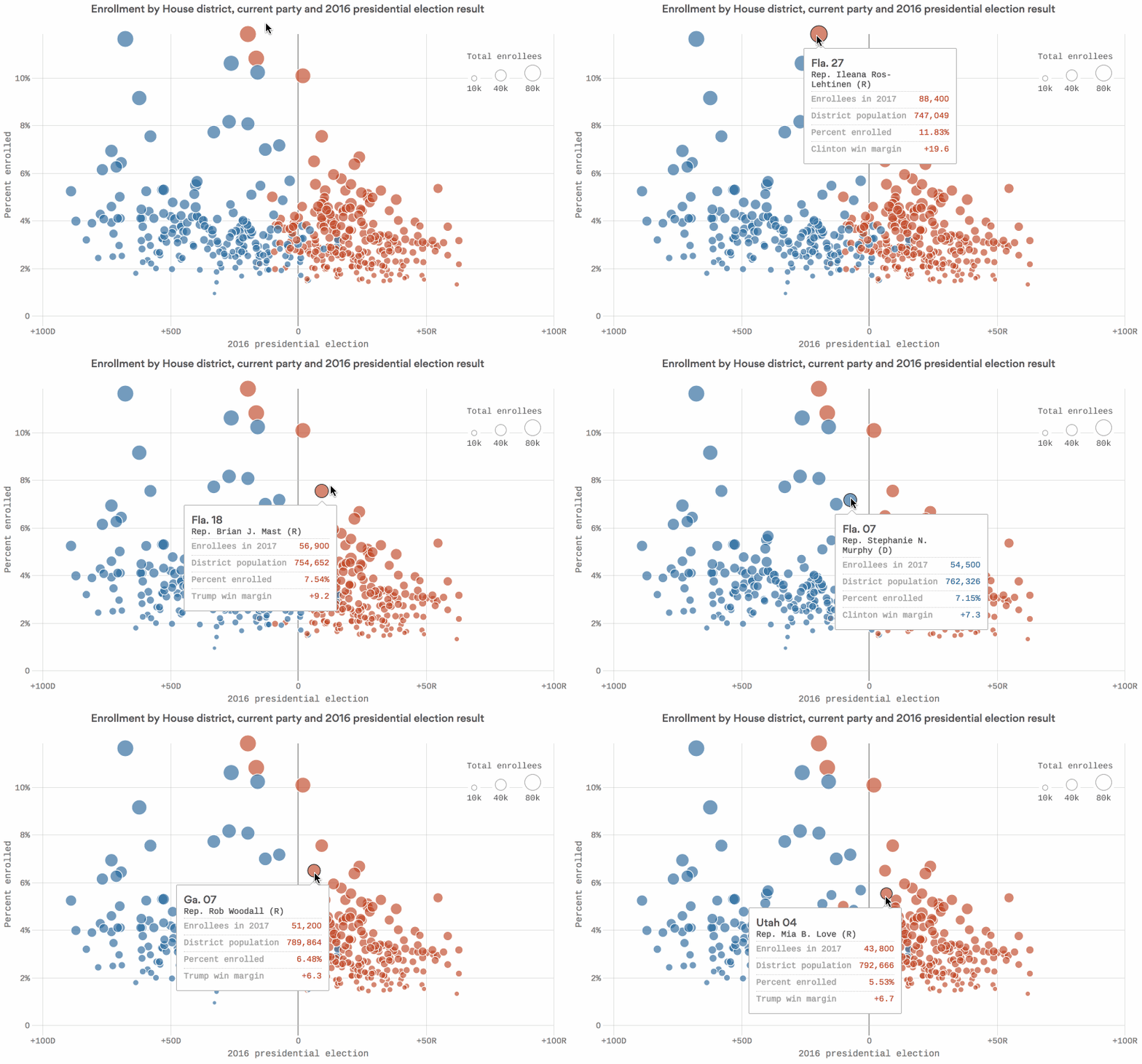
Who will pay more without CSR subsidies

Data: Kaiser Family Foundation; Daily Kos Elections; Census Bureau; Chart: Chris Canipe / Axios

The Trump administration’s decision to stop paying the Affordable Care Act’s cost-sharing reduction subsidies will affect ACA customers in Republican-leaning congressional districts as well as Democratic ones. Here’s a look at how many people could feel the impact in districts that voted for President Trump, compared with those in districts that voted for Hillary Clinton.

The details: This year, 11.1 million people were enrolled in ACA marketplace plans or in a Basic Health Plan created by the law. Of those, 5.9 million live in Republican-held congressional districts and 5.2 million live in districts held by Democrats, per the Kaiser Family Foundation.

The impact: The CSR subsidies are going to 58% of the people who are enrolled in ACA marketplace plans. In all, about 7 million people don’t receive any financial assistance with their premiums, so they’d pay the full cost when health insurance companies raise their rates. But others could be affected if health insurers decided to pull out of the markets rather than deal with the instability.

The flaws in Trump’s legal rationale

There are broader implications of the Trump administration’s decision to lean so heavily on a legal rationale for cutting off the CSR subsidies: institutional divisions between the executive and legislative branches.

Between the lines: The White House said it was ending the payments in part because of a ruling last spring that said it was unconstitutional to make the payments without an explicit appropriation from Congress. As part of that process, Attorney General Jeff Sessions wrote a memo saying, in effect, there was no point appealing that ruling.

  • “Opening the door to lawsuits initiated by Congress over the specifics of how the executive branch spends tax dollars would be a marked change and a potential threat to the White House,” the New York Times’ Carl Hulse noted over the weekend.
  • Trump might particularly wish he hadn’t conceded that point if Democrats retake control of the House and/or Senate while he’s still president. Divided government is how this lawsuit started, after all.

Real talk: Former White House strategist Steve Bannon, speaking at the Values Voters Summit over the weekend, cut to the heart of Trump’s decision: “Not going to make the CSR payments, going to blow that thing up; going to blow those exchanges up, right?”

Administration’s Ending Of Cost-Sharing Reduction Payments Likely To Roil Individual Markets

http://healthaffairs.org/blog/2017/10/13/administrations-ending-of-cost-sharing-reduction-payments-likely-to-roil-individual-markets/

Yesterday, October 12, 2017, the White House press office announced that the administration will no longer be reimbursing insurers for the cost-sharing reductions they are legally required to make for low-income individuals. The Affordable Care Act requires insurers to reduce cost sharing for individuals who enroll in silver plans and have household incomes not exceeding 250 percent of the federal poverty level. These provisions reduce the out-of-pocket limit for these enrollees—particularly for those with incomes below 200 percent of poverty—and sharply reduce deductibles, coinsurance, and copayments. The reductions cost insurers around $7 billion a year currently.

The press secretary’s statement said:

Based on guidance from the Department of Justice, the Department of Health and Human Services has concluded that there is no appropriation for cost-sharing reduction payments to insurance companies under Obamacare. In light of this analysis, the Government cannot lawfully make the cost-sharing reduction payments. The United States House of Representatives sued the previous administration in Federal court for making these payments without such an appropriation, and the court agreed that the payments were not lawful. The bailout of insurance companies through these unlawful payments is yet another example of how the previous administration abused taxpayer dollars and skirted the law to prop up a broken system. Congress needs to repeal and replace the disastrous Obamacare law and provide real relief to the American people.

Acting HHS Secretary Hargan and CMS Administrator Verma issued a similar statement:

It has been clear for many years that Obamacare is bad policy. It is also bad law. The Obama Administration unfortunately went ahead and made CSR payments to insurance companies after requesting—but never ultimately receiving—an appropriation from Congress as required by law. In 2014, the House of Representatives was forced to sue the previous Administration to stop this unconstitutional executive action. In 2016, a federal court ruled that the Administration had circumvented the appropriations process, and was unlawfully using unappropriated money to fund reimbursements due to insurers. After a thorough legal review by HHS, Treasury, OMB, and an opinion from the Attorney General, we believe that the last Administration overstepped the legal boundaries drawn by our Constitution. Congress has not appropriated money for CSRs, and we will discontinue these payments immediately.

The Legal Background

In fact, the ACA requires the federal government to reimburse insurers for these reductions. This is not a bailout. It is rather a statutory obligation of the federal government to pay insurers for services they have provided as required by law. In 2014, the House of Representatives sued the Obama administration in House v. Burwell (now House v. Price) claiming that the cost-sharing reduction (CSR) payments to insurers had never been appropriated by Congress and were thus illegal. A district court judge accepted this argument in the spring of 2016 and enjoined their payment, as President Trump’s statement says, but stayed her order pending appeal. The Obama administration appealed, arguing that there was in fact an appropriation. Until yesterday, the Trump administration had not taken a position on whether there was an appropriation or not.

The appeal is still pending, with the House and the Trump administration having agreed to stay the appeal several times. At the end of August, the D.C. Circuit Court of Appeals allowed 19 state attorneys general to intervene to protect their citizens. For more on the CSR backstory see here and here; for more on the intervention, see here; and for Health Affairs Blog posts on cost-sharing reduction payments, see here.

The Consequences Of Ending The CSR Payments

The effect of terminating the payments has been well analyzed, including a report from the Congressional Budget Office. It will drive up premiums as insurers attempt to cover the cost of the reductions. As premiums go up, so will premium tax credits. Indeed, the government will probably pay more in premium tax credits than it saves in cost-sharing reduction payments. Individuals who earn too much to receive tax credits will be particularly hard hit by the premium increases. Some of these could decide to pursue new forms of coverage that might be made available under the measures announced in President Trump’s October 12 executive order.

Ending the CSR payments could also drive some insurers out of the exchanges. Under their contract with the federal exchange, insurers may terminate participation if cost sharing reduction payments are terminated, but they are still subject to state laws on market withdrawal, which limit their ability to do so. They may not terminate their exchange enrollees unless they fail to pay their premiums, which many likely would do once an insurer left the exchange and premium tax credits were no longer available.

The effect of CSR payment termination, however, will depend heavily on how insurers deal with the change. In several states, including California, insurers have anticipated the termination and have already loaded the lost payments into their on-exchange silver plansIn other states, however, insurers have to date been instructed to assume that the payments will be made, or have been given no instructions whatsoever. In these states, the change is likely to cause considerable confusion. Insurers will have to refile their rates and will likely not be able to do so before open enrollment begins in three weeks. For more on the different responses insurers may have take, see here.

What Might Happen Now

It is possible that the states that have intervened in the House v. Price appeal will seek to block the withdrawal of the funds. It is also very possible that the state attorneys general or a consumer or insurer will sue to block the CSR withdrawal. New York Attorney General Eric Schneiderman issued a press release yesterday threatening legal action if President Trump withdraws the payments, and the California Attorney General has also threatened suit.

It is also possible that Congress will adopt a specific appropriation to fund the CSRs, putting to rest the question of whether such an appropriation exists. The Senate Health, Education, Labor, and Pension Committee held hearings on bipartisan solutions to health reform problems in September and virtually every witness, including insurance commissioners and governors supported removing the uncertainty around the payments and making it clear that they would continue. Support for continuing CSR funding has come from insurers, consumers, the National Association of Insurance Commissioners, and virtually all other stakeholders. The President’s statement, and the likely consequent chaos in the individual marketplaces, may be enough to finally prompt action.

In any event, ending the CSR payments is another sign that President Trump is doing what he can to undermine the stability of the individual market under the ACA. This action will have a much more immediate impact than the measures Trump announced in yesterday’s executive order.