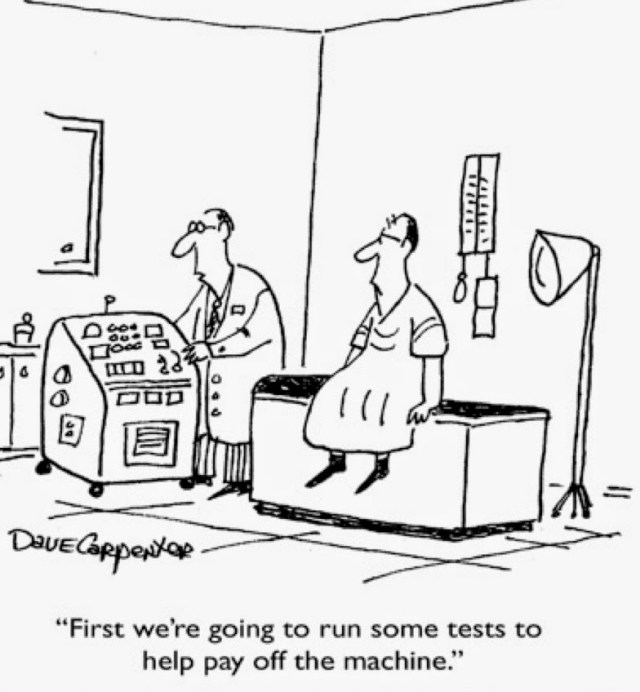
Changing Healthcare’s Culture of Overtreatment a Challenge

https://www.medpagetoday.com/publichealthpolicy/generalprofessionalissues/75402?xid=nl_mpt_DHE_2018-09-29&eun=g885344d0r&pos=&utm_source=Sailthru&utm_medium=email&utm_campaign=Daily%20Headlines%202018-09-29&utm_term=Daily%20Headlines%20-%20Active%20User%20-%20180%20days

Image result for clinical overtesting


More focus on accepting uncertainty is needed, expert says

Medical schools and healthcare workplaces should try harder to change the culture around medical overtreatment, according to Barnett Kramer, MD, MPH.

“Some of the solution may be at the training level of health professionals,” Kramer, director of the cancer prevention division at the National Cancer Institute, in Bethesda, Md., said at a briefing Thursday sponsored by Kaiser Health News. “The number one problem identified by medical historian Kenneth Ludmerer is insufficiency of training for uncertainty in medical school; his thesis was that [this] led to systematic overuse of testing and overtreatment. If neither the physician nor the patient are trained to think [about] and accept uncertainty, then almost always our medical culture is going to lean in one direction, so education in probabalistic thinking [is important].”

Another issue is “knowing when you don’t have to make a decision then and there,” he continued. For instance, “there are situations where we’re learning it’s uncertain what the best way to go is, but there’s pretty good evidence that waiting and seeing what the natural history of the disease is, is acceptable, and sometimes that’s very difficult.”

A third consideration “is to try to keep the discussion focused on what is known about the particular disease,” Kramer said. “There’s a famous saying that ‘If thought corrupts language, the opposite is certainly the case.’ So as soon as you have an entity with the word ‘cancer’ or ‘carcinoma’ in it, sometimes that shuts off the ability to really understand and get informed about what the disease really is.”

“There is some movement … to change the name of some of the things we call cancer,” he added. “If we have enough biological information to know they don’t act like a routine cancer, that at least moves the word off the table and you can focus on what’s known and what’s not known, and try to handle the uncertainties.”

Malpractice liability concerns, especially when combined with clinical uncertainty, also can contribute to overtreatment, said Ranit Mishori, MD, MHS, a family physician and professor of family medicine at Georgetown University here. “There are days when I go home and ask myself again and again and again, ‘Should I have ordered that test? I think I probably shouldn’t have, but is that patient going to sue me?’ God forbid they’ll be the one patient in 1,000 coming down with that rare form of prostate cancer.”

That situation happened to a physician friend of Mishori’s. “He followed all the guidelines about PSA [prostate-specific antigen] testing, and this one person was the person he didn’t test who ended up having prostate cancer and sued the heck out of him,” she said. “Do you think my friend continued with not offering PSA testing to all his other patients? For a while it was a very difficult decision for him.”

Although critics have complained for decades about the problem of physicians overtesting and overtreating because they’re afraid of malpractice suits, not much has changed, Mishori told MedPage Today. She added that the probability of being sued seems to be geographically dependent. “If you’re in rural Arkansas, you’re less likely to be sued, but if you’re in Washington, D.C., and everybody and their sisters are lawyers, it’s something that goes through your mind a little bit more.”

Another problem is that one test often triggers a cascade of testing, said Saurabh Jha, MD, a radiologist and associate professor of radiology at the University of Pennsylvania. He cited a case in which a woman came into the hospital with a suspected pulmonary embolism. A CT scan ruled out that possibility, “but then I did something else which led to cascade of investigations: I measured the main pulmonary artery, and it was 3.3 cm.” Since the threshold for suspecting pulmonary hypertension is 3.1 cm, Jha said in his report that the patient possibly had pulmonary hypertension, and also added the limitations of his conclusion. Because Jha was a resident at the time and most patients passed into others’ care, he then forgot about the case.

Later on, however, another hospital staff member told him that his diagnostic conclusions had resulted in a “cascade of investigations” for that patient. “What I began to realize later on was that the chances of actually picking somebody up with pulmonary hypertension using that number is overwhelmed by causing false positives and putting somebody through a train of investigations,” he said. “Since then, I have begun to be more judicious with measuring, realizing that anything printed in a report can be like a Greek tragedy — very difficult to reverse afterwards.”

Jacqueline Kruser, MD, a pulmonologist and critical care physician at Northwestern Memorial Hospital, in Chicago, called the phenomenon of this testing cascade “clinical momentum.” “We see this for acutely ill patients,” she said. “When they come to the hospital and are admitted to the intensive care unit (ICU), everyone who takes care of you is laser-focused on the acute problems that brought you there … Most importantly, they want to act quickly to fix them, and the environment is designed to fix things rapidly — we can get lab tests back in minutes and rush someone to the operating room in an hour.”

However, although that works well for most patients, “what we worry about is, what about the patients who have different goals [than just getting things fixed] — they want to avoid invasive procedures or burdensome treatment, or they want to be with family, eating what they want to eat?” she said. “All those cascading interventions might not accomplish those goals for that patient.”

The hospital isn’t necessarily designed to focus on those issues, Kruser said. In an ICU, for example, it’s hard to find “enough chairs for everyone to sit down with the patient in the room — with their family, their doctors — and talk about what’s most important to them.”

68% of CEOs say they were not prepared for job

https://www.beckershospitalreview.com/hospital-management-administration/68-of-ceos-say-they-were-not-prepared-for-job.html

Image result for ceo


Confidence is one of the defining characteristics of successful executives, but few CEOs felt prepared for their responsibilities, according to a survey in the Harvard Business Review.

Leadership advisory firm Egon Zehnder surveyed 402 CEOs from 11 countries between January and November 2017 and asked them questions regarding the challenges of stepping into a leadership position.

Four things to know:

1. There is no role that matches the demands of a CEO, and 68 percent of respondents said that, in hindsight, they weren’t fully prepared to take on the job.

2. Every CEO wants to drive culture change, but 50 percent of respondents said the task was more difficult than they expected.

3. Most CEOs know that they are only as effective as the people they surround themselves with, but 47 percent said that developing their senior leadership team was surprisingly challenging.

4. Forty-eight percent said that finding the time for self-reflection was harder than they anticipated.


Successfully transitioning to new leadership roles

https://www.mckinsey.com/business-functions/organization/our-insights/successfully-transitioning-to-new-leadership-roles?cid=other-eml-nsl-mip-mck-oth-1806&hlkid=4adf5e2fa3c24dfd95b286467cbe91cc&hctky=9502524&hdpid=e04a4c97-f260-4069-b1e3-d0eb680bf64e

Image result for Successfully transitioning to new leadership roles

Leadership changes are more common and important than ever. But most companies don’t get it right.

Every leadership transition creates uncertainty. Will the new leader uncover and seize opportunities and assemble the right team? Will the changes be sustainable? Will a worthy successor be developed? These questions boil down to one: Will the leader be successful?

Why are leadership transitions important?

Hardly anything that happens at a company is more important than a high-level executive transition. By the nature of the role, a new senior leader’s action or inaction will significantly influence the course of the business, for better or for worse. Yet in spite of these high stakes, leaders are typically underprepared for—and undersupported during—the transition to new roles.

The consequences are huge

Executive transitions are typically high-stakes, high-tension events: when asked to rank life’s challenges in order of difficulty, the top one is “making a transition at work”—ahead of bereavement, divorce, and health issues.2 If the transition succeeds, the leader’s company will probably be successful; nine out of ten teams whose leader had a successful transition go on to meet their three-year performance goals (Exhibit 1). Moreover, the attrition risk for such teams is 13 percent lower, their level of discretionary effort is 2 percent higher, and they generate 5 percent more revenue and profit than average. But when leaders struggle through a transition, the performance of their direct reports is 15 percent lower than it would be with high-performing leaders. The direct reports are also 20 percent more likely to be disengaged or to leave the organization.

Successful or not, transitions have direct expenses—typically, for advertising, searches, relocation, sign-on bonuses, referral awards, and the overhead of HR professionals and other leaders involved in the process. For senior-executive roles, these outlays have been estimated at 213 percent of the annual salary.4Yet perhaps the most significant cost is losing six, 12, or 18 months while the competition races ahead.

Nearly half of leadership transitions fail

Studies show that two years after executive transitions, anywhere between 27 and 46 percent of them are regarded as failures or disappointments.5Leaders rank organizational politics as the main challenge: 68 percent of transitions founder on issues related to politics, culture, and people, and 67 percent of leaders wish they had moved faster to change the culture. These matters aren’t problems only for leaders who come in from the outside: 79 percent of external and 69 percent of internal hires report that implementing culture change is difficult. Bear in mind that these are senior leaders who demonstrated success and showed intelligence, initiative, and results in their previous roles. It would seem that Marshall Goldsmith’s advice—“What got you here won’t get you there”6—is fully applicable to executive transitions.

Leadership transitions are more frequent, yet new leaders get little help

The pace and magnitude of change are constantly rising in the business world, so it is no surprise that senior-executive transitions are increasingly common: CEO turnover rates have shot up from 11.6 percent in 2010 to 16.6 percent in 2015.7Since 69 percent of new CEOs reshuffle their management teams within the first two years, transitions then cascade through the senior ranks. Sixty-seven percent of leaders report that their organizations now experience “some or many more” transitions than they did in the previous year.


When M&As Go Wrong

http://www.healthleadersmedia.com/leadership/when-mas-go-wrong-0?utm_source=edit&utm_medium=ENL&utm_campaign=HLM-Daily-SilverPop_05112018&utm_source=silverpop&utm_medium=email&utm_campaign=20180511_HLM_Daily_resend%20(1)&spMailingID=13489144&spUserID=MTY3ODg4NTg1MzQ4S0&spJobID=1400998333&spReportId=MTQwMDk5ODMzMwS2

Image result for hospital merger concerns

Considering a merger? Make sure the prospective partner’s financial liabilities and operational challenges are apparent by the time the due diligence phase is completed.

When providers identify a potential M&A candidate and perform due diligence, there are no guarantees that a formal agreement will be concluded. In fact, there are a number of financial and operational ways that a potential deal can be derailed.

According to the 2018 HealthLeaders Media Mergers, Acquisitions, and Partnerships Survey, respondents report that the top three financial reasons an M&A involving their organization was abandoned before or during the due diligence phase are concerns about assumption of liabilities (21%), costs to support the transaction were too high (19%), and concerns about price (19%).

Note that the full extent of a prospective organization’s financial liabilities may not be apparent until the due diligence phase is completed, which may explain why this aspect plays a major role as a deal breaker.

Operational challenges

Respondents say that the top three operational reasons that an M&A involving their organization was abandoned before or during the due diligence phase are incompatible cultures (30%), concerns about governance (24%), and concerns about the operational transition plan (21%).

Interestingly, based on net patient revenue, a greater share of large organizations (47%) than small (25%) and medium (17%) organizations mention incompatible cultures, an indication of some of the challenges providers face when integrating large organizations with disparate cultures.

Pamela Stoyanoff, MBA, CPA, FACHE, executive vice president, chief operating officer at Methodist Health System, a Dallas-based nonprofit integrated healthcare network with 10 hospitals and 28 family health centers, says that organizational culture exists both at the senior leadership level as well as throughout an organization, and problems can arise because sometimes they can be different.

“You have two senior leadership teams sitting in a room trying to agree on deal points and reach a philosophical agreement. Oftentimes, you have cultural compatibility at the senior level (those who are consummating the deal) but find that culture throughout the remaining levels of the organization is not as conducive to a merger. That is something you don’t necessarily see until later, after the deal is done,” she says.


What creates a toxic hospital culture?

https://www.kevinmd.com/blog/2015/10/what-creates-a-toxic-hospital-culture.html

Image result for toxic culture


Hospital culture is largely influenced by the relationship between administrative and clinical staff leaders. In the “old days” the clinical staff (and physicians in particular) held most of the sway over patient care. Nowadays, the approach to patient care is significantly constricted by administrative rules, largely created by non-clinicians. An excellent description of what can result (i.e., disenfranchisement of medical staff, burn out, and joyless medical care) is presented by Dr. Robert Khoo.

Interestingly, a few hospitals still maintain a power shift in the other direction — where physicians have a stranglehold on operations, and determine the facility’s ability to make changes. This can lead to its own problems, including unchecked verbal abuse of staff, inability to terminate bad actors, and diverting patients to certain facilities where they receive volume incentive remuneration. Physician greed, as Michael Millenson points out, was a common feature of medical practice pre-1965. And so, when physicians are empowered, they can be as corrupt as the administrations they so commonly despise.

As I travel from hospital to hospital across the United States (see more about my “living la vida locum” here), I often wonder what makes the pleasant places great. I have found that prestige, location, and generous endowments do not correlate with excellent work culture. It is critically important, it seems, to titrate the balance of power between administration and clinical staff carefully — this is a necessary part of hospital excellence, but still not sufficient to insure optimal contentment.

In addition to the right power balance, it has been my experience that hospital culture flows from the personalities of its leaders. Leaders must be carefully curated and maintain their own balance of business savvy and emotional IQ.  Too often I find that leaders lack the finesse required for a caring profession, which then inspires others to follow suit with bad behavior. Unfortunately, the tender hearts required to lead with grace are often put off by the harsh realities of business, and so those who rise to lead may be the ones least capable of creating the kind of work environment that fosters collaboration and kindness. I concur with the recent article in Forbes magazine that argues that poor leaders are often selected based on confidence, not competence.

The very best health care facilities have somehow managed to seek out, support and respect leaders with virtuous characters. These people go on to attract others like them. And so a ripple effect begins, eventually culminating in a culture of carefulness and compassion. When you find one of these gems, devote yourself to its success because it may soon be lost in the churn of modern work schedules.

Perhaps your hospital work environment is toxic because people like you are not taking on management responsibilities that can change the culture. Do not shrink from leadership because you’re a kind-hearted individual. You are desperately needed. We require emotionally competent leaders to balance out the financially driven ones. It’s easy to feel helpless in the face of a money-driven, heavily regulated system, but now is not the time to shrink from responsibility.

Be the change you want to see in health care.


Sexual abuse scandals: What hospitals can learn from high-profile Hollywood, government cases of harassment

https://www.fiercehealthcare.com/healthcare/sexual-abuse-scandals-what-hospitals-can-learn-from-high-profile-hollywood-government?mkt_tok=eyJpIjoiWVRBeE5EQTFaREJqWVRJMiIsInQiOiJnUXl5b3pxcXlaRVo0Nm51UVcxOXdXd3IybE96SnNuOVhaNzR6UjBUMDMxdUJUN2h0MzlpNXdPRFdwcVwvS0MwQk1SSWdjMFM3T3FuN2tnbThoNjVzVmg2V0NEQmdrOXFcL05BQ1dRWCtkeExsbGxMTWJaMjUyMlwvUklJcGErd1BiYiJ9&mrkid=959610&utm_medium=nl&utm_source=internal

Female nurse looking stressed

While media attention has focused on the accusations of sexual misconduct among Hollywood heavy hitters, television personalities and politicians, the healthcare industry isn’t immune to misbehavior in the workplace.

Indeed, one of the biggest payouts for workplace harassment occurred in 2012 when Mercy General Hospital in California and its parent company, Catholic Healthcare West (now Dignity Health), were ordered to pay more than $167 million to Ani Chopourian, a former physician’s assistant who says she was fired after she complained of sexually inappropriate conduct, bullying and retaliation, in addition to inferior patient care by surgeons.

While USA Today reported that the judge later vacated the award after attorneys on both sides negotiated a settlement, the large payout should serve as a wake-up call to hospital leaders that they can’t ignore complaints of misconduct in the workplace.

The recent high-profile cases that have made national headlines also offers lessons to healthcare leaders. Lawyers say leaders must:

  • Establish policies that address disruptive behavior: Healthcare organizations must foster a culture of teamwork and the need for a safe, cooperative workplace, Anne Murphy, a Bloomberg Law advisory board member and partner at Hinckley Allen in Boston, told Bloomberg BNA.
  • Be willing to investigate complaints, even if they involve a high-profile physician: Hospital leaders must be willing and able to identify and avoid sexual harassment claims and apply the policies equally to everyone. Employees must feel safe to report complaints and leaders must be willing to address those complaints and not sweep them under the rug.

    “Healthcare entities must take these actions in spite of the prospect of losing a significant revenue generator or a critical skill in a single physician,” wrote Katherine Dudley Helms in National Law Review. “Failing to address the situation creates legal liability and sends a loud negative message to employees regarding the importance the organization places on its workforce versus certain key employees.”

  • Develop an action plan to address complaints: David Jarrard, president and CEO of Jarrard, Phillips, Cate & Hancock in Brentwood, Tennessee, told Bloomberg BNA that organization must have plans in place just as they would other responses to natural disasters or mass shootings.
  • Be aware of red flags: Sexual harassment claims shouldn’t come as a surprise. Often, gossip spreads among employees, so leaders should keep their ears open, Jarrard said. He told the publication that senior leaders must be visible and engaged with employees and patients.

    “Hospital leaders might hear about suspect behavior simply by getting out of their offices and walking the hospital’s hallways,” he said.

  • Monitor social media accounts: Jarrard also said that accusations of misconduct often will appear in social media platforms so leaders should monitor accounts for mentions of their organizations. This way they may be able to intervene before the situation becomes worse.
  • Consider peer intervention: Clinical leaders might be able to diffuse a situation by talking to the person accused of misconduct over coffee and before a formal complaint is filed, according to the article.

“Now is an excellent time to remind your employees of your refusal to accept this behavior,” said Helms in the National Law Review piece. “Remind employees and supervisory personnel of your harassment policies, and refresh your sexual harassment training.”