DOJ charges more than 600 in historic fraud takedown involving $2B in false claims

https://www.fiercehealthcare.com/payer/doj-jeff-sessions-medicare-strike-force-fraud-takedown-opioids-oig?mkt_tok=eyJpIjoiTXpRelpESTBaVE5tTVRBNSIsInQiOiJmTnBaRmJoVDJaOVZYRkhCd05cL2JXOVNoYU50NlVYN3pIb3ZlRFg1a3RqRWhXbjVMYm5SeEY3Y1ZNdENBb3NQSkZBTXRSR0tDSjZ4R2pJd0RjUFZ2bmRGbnhqXC9pQ2oxaTVCdHN3TUx0b25Ib09rblVuYlJVMW51NlVDcUdzRGNnIn0%3D&mrkid=959610

Related image

Another year, another record-setting healthcare fraud takedown.

This year, the Department of Justice charged 601 individuals involved in fraud schemes totaling $2 billion in losses to the federal government. That’s nearly 200 more people and an additional $700 million than the previous year’s takedown.

There was a clear emphasis on opioid distribution, with 162 individuals charged with illegally prescribing or distributing narcotics. Of those charged for opioid fraud, 76 were physicians.

“Healthcare fraud is a betrayal of vulnerable patients, and often it is theft from the taxpayer,” Attorney General Sessions said in a statement. “In many cases, doctors, nurses, and pharmacists take advantage of people suffering from drug addiction in order to line their pockets. These are despicable crimes.”

Federal enforcement agencies have zeroed in on medical providers as a source of opioid diversion. Last year the DOJ created a new Opioid Fraud and Abuse Detection Unit with 12 dedicated U.S. attorneys and a focus on data analytics. In January, Sessions said the Drug Enforcement Agency (DEA) would direct agents to focus on prescribers and pharmacies and that dispense an unusual amount of drugs.

“This year’s operations, focusing on opioid-related schemes, spotlight the far-reaching impact of health care fraud,” said HHS Deputy Inspector General Gary Cantrell.

In this year’s takedown announcement, the DOJ said “virtually every health care fraud scheme requires a corrupt medical professional to be involved” and “aggressively pursuing” providers has a deterrent effect and ensures they cannot use their license to perpetuate schemes.

The agency highlighted one particular scheme in which a pain management specialist in New York and New Jersey was accused of taking cash from patients in exchanges for oxycodone and Subsys. He was also charged with second-degree murder after a patient died from an overdose.

Other areas of the country included equally egregious schemes:

  • In Texas a pharmacy owner and pharmacists were charged with using fraudulent prescriptions to fill more than 1 million hydrocodone and oxycodone pills and distributed them to drug dealers.
  • In California, an attorney was accused of offering prostitutes and expensive meals to two podiatrists in exchange for preprinted prescription pads.
  • In Michigan and Illinois, individuals were charged with home health fraud schemes totaling $44 million.
  • In Southern Florida, a hotbed for healthcare fraud, the owner and director of a sober home were charged for a scheme involving widespread fraudulent urine testing and $106 million in claims for substance abuse treatment.

Fraud takedowns of this size and scale have become an annual event, dating back nearly a decade. Both the number of individuals and the amount of money involved in the schemes have gradually increased over the years as the DOJ and the Office of Inspector General (OIG) have emphasized the use of analytics as an investigative tool.

Federal enforcers have also relied on a collaborative approach to enforcement. Like last year, this week’s takedown involved multiple federal agencies, including the Department of Health and Human Services, the OIG, the Centers for Medicare & Medicaid Services (CMS) and the Medicare Fraud Strike Force.

Since 2016, federal agencies have charged more than 1,300 individuals tied to $4.2 billion in fraudulent billing schemes.

 

Healogics to Pay Up to $22.5M in False Claims Settlement

https://www.healthleadersmedia.com/finance/healogics-pay-225m-false-claims-settlement

Image result for hyperbaric chamber

Whistleblower lawsuits had alleged that the Florida-based wound care specialist knowingly filed bogus claims to Medicare for services that weren’t needed.

Healogics, Inc. will pay up to $22.51 million to settle whistleblower allegations that billed Medicare for medically unnecessary and unreasonable hyperbaric oxygen therapy, the Department of Justice said.

Jacksonville, FL-based Healogics manages nearly 700 hospital-based wound care centers across the nation.

The settlement resolves allegations that from 2010 through 2015, Healogics knowingly submitted false claims to Medicare for medically unnecessary or unreasonable HBO therapy, DOJ said.

Healogics will pay $17.5 million, plus an additional $5 million if certain financial contingencies occur within the next five years, for a total potential payment of up to $22.51 million. The company has also has entered into a five-year Corporate Integrity Agreement with the Department of Health and Human Services Office of Inspector General.

“When greed is the primary factor in performing medically unnecessary health care procedures on Medicare beneficiaries, both patient well-being and taxpayer funds are compromised,” said HHS OIG Special Agent in Charge Shimon R. Richmond.

The settlement came as the result of whistleblower lawsuits filed by a former executive at Healogics, and a separate suit filed by two doctors and a former program director who worked at Healogics-affiliated wound care centers. The four whistleblowers are expected to share $4.2 million of the settlement.


Efforts to Undo Pre-Existing Condition Protections Put Millions of Women and Girls at Risk

https://www.americanprogress.org/issues/women/news/2018/06/21/452643/moving-backward/

A mother and her child visit the doctor, October 2013.

The Affordable Care Act (ACA) prohibits discriminatory insurance practices in pricing and coverage in the individual market. Before the law was enacted, women routinely were denied coverage or charged more for insurance based on so-called pre-existing conditions. For example, in the individual insurance market, a woman could be denied coverage or charged a higher premium if she had been diagnosed with or experienced HIV or AIDS; diabetes; lupus; an eating disorder; or pregnancy or a previous cesarean birth, just to name a few. The ACA provided women with protections for pre-existing conditions and access to comprehensive, affordable, and fair health services.

But recent efforts to eliminate key ACA protections, discussed below, would put millions of women and girls once again at risk of being charged more or denied coverage for individual insurance.

Efforts to eliminate ACA protections threaten the security of women with pre-existing conditions

Recently, the U.S. Department of Justice refused to uphold the law in Texas v. United States, when it argued that the community rating and guaranteed issue provisions of the ACA are unconstitutional. Without guaranteed issue, women could be denied coverage based on their medical history, their age, and their occupation, among other factors. Without community rating, women could be charged more, or priced out of the insurance market altogether, based on their health status or other factors. Insurance companies could also try to reinstate gender rating, a common pre-ACA practice in which insurance companies charged women higher premiums than they did men, even though other parts of the ACA protect women from discrimination in the health care system.

Now, think tanks and conservative opponents of the ACA are introducing proposals to repeal the ACA yet again. If implemented, these proposals would similarly put women at risk of being denied coverage or charged more because of their health status.

More than half of all women and girls have pre-existing conditions

The authors estimate that more than half of women and girls nationwide—more than 67 million—have pre-existing conditions. There are also nearly 6 million pregnancies each year, a commonly cited reason for denying women coverage on the individual market before the ACA. The two tables available for download below provide state-level detail for the number of women and girls with pre-existing conditions and the number of pregnancies.

A large share of women have coverage through an employer or Medicaid and would, therefore, not face discriminatory practices such as medical underwriting or denials based on health conditions. But the data make clear that allowing insurers to return to pre-ACA practices could lead to millions of women and girls being denied coverage or charged more based on their health status if they ever sought coverage in the individual market.


The Texas lawsuit could end some of the ACA’s protections for employer coverage

The Texas lawsuit could end some of the ACA’s protections for employer coverage.

Image result for health insurance guaranteed issue

The Trump administration’s refusal to defend portions of the Affordable Care Act is shocking enough. Equally shocking is how little it seems to care what happens if it gets what it’s asking for.

One question in particular: what about legal protections for the 160 million people who get insurance through their employers? Will their insurance still cover their preexisting conditions, even if they switch jobs? I honestly have no idea.

In its brief, the Justice Department argues that the community rating and guaranteed issue provisions of the ACA must be invalidated. But it never mentions that those provisions apply not only to individual health plans, but also to employer plans.

So should those rules give way across the board? Or only for individual insurance plans?

Maybe it should be the latter. The mandate isn’t critical to securing the health of the employer market, so the ACA rules that protect employees aren’t inextricably linked to the mandate and shouldn’t be invalidated. But it could also plausibly be the former: if the rules governing community rating and guaranteed issue are inseverable, maybe the court shouldn’t do micro-surgery to save some subpart of those rules.

But guess what? In its brief, the Justice Department doesn’t say which approach it endorses.

Actually, it’s worse than that.  When the Justice Department identifies the rules governing community rating and guaranteed issue, it doesn’t cite the ACA itself (Public Law 111-948). Instead, it cites parts of the U.S. Code that codify portions of the ACA (e.g., 42 U.S.C. 300gg). The implication is that the Justice Department wants the court to enjoin those code provisions.

But the code provisions were on the books long before the ACA was adopted. Prior to the ACA, they listed protections for employer-sponsored plans that had been adopted in the Health Insurance Portability and Accountability Act. Among other things, HIPAA limited the circumstances under which an employer could refuse to cover an employee’s preexisting conditions. The protections weren’t perfect, but they were something. The ACA patched HIPAA’s gaps by amending those code provisions.

So if the U.S. Code provisions are enjoined altogether—which, again, is what the Justice Department appears to be asking for—some of the HIPAA-era protections would be wiped from the books too.* Is that really what the Justice Department wants? Because that’s the thrust of its brief.

The confusion may reflect a basic legal mistake, one that Tobias Dorsey highlighted in Some Reflections on Not Reading the Statutes: the U.S. Code is a codification of existing laws, but it’s not itself the law. That’s why code provisions shouldn’t themselves be the target of any injunction. Any injunction should run against the ACA itself. If that’s what the Justice Department really wants, then it has to clarify what it’s really asking for. Failing to do so could wreak havoc in the employer-sponsored market.

Even if the injunction only runs against portions the ACA, however, that still wouldn’t resolve whether the ACA’s protections would still apply to employer-sponsored plans. If they don’t, that’s a big deal: HIPAA’s protections are porous.

So far, however, the Trump administration hasn’t said a word—leaving 160 million people in the lurch.


Two Lawsuits with Implications for the Coverage of Millions of Americans

http://www.commonwealthfund.org/publications/blog/2018/jun/lawsuits-implications-for-coverage?omnicid=EALERT1421015&mid=henrykotula@yahoo.com

Image result for us district court of district of columbia

Significant legal challenges have marked the history of the Affordable Care Act (ACA) since its passage in 2010, and have largely determined the outlines of the law’s current structure. Similarly, as Sara Rosenbaum argues in a brief published this week, the courts have substantially shaped the Medicaid program over its 53-year history. Two recent legal challenges have potentially far-reaching implications for both the Affordable Care Act and the Medicaid program, and the millions of Americans who depend on them for their health insurance. While the plaintiffs take different positions regarding the ACA and Medicaid, the cases and the Trump Administration’s responses to them reveal an executive branch that is consistent in its efforts to reduce the federal government’s role in guaranteeing health insurance coverage for Americans.

Stewart v. Azar

Oral arguments in U.S. District Court for the District of Columbia begin today in a class action lawsuit brought by 15 Kentucky Medicaid enrollees. The case challenges the legality of several aspects of Kentucky’s 1115 Medicaid demonstration waiver, which allows the U.S. Department of Health and Human Services (HHS) and states to test time-limited innovations in Medicaid and other public welfare programs without congressional action. Set to go into effect on July 1, the Kentucky waiver’s most controversial provision is the requirement that Medicaid beneficiaries work or perform community service for at least 80 hours per month to retain coverage. The suit also challenges the authority of HHS, now led by Secretary Alex Azar, to both encourage and approve Medicaid work demonstrations generally and the approval of Kentucky’s demonstration in particular.   The suit also challenges the legality of other aspects of the waiver, including the imposition of premiums, the use of six-month lock-out periods for beneficiaries who don’t comply with work requirements or pay their premiums on time, and the elimination of Medicaid’s requirement that new beneficiaries receive three months of retroactive coverage. Three other states have received approval for similar waiversseven states have applications under review at the Centers for Medicare and Medicaid Services, and several others are developing them. Because the case challenges both the Kentucky waiver and HHS policy, it has implications for these states, as well as the future of the Medicaid program.

A critical issue highlighted by the case goes to the heart of the entitlement nature of the Medicaid program. Under the Medicaid Act and subsequent amendments, Congress has determined certain groups of people to be eligible for Medicaid coverage by virtue of their age, income, or health needs. These mandatory coverage groups include children, pregnant women, and the elderly, blind and disabled. Because working-age adults with low incomes were the least likely to work in a job that comes with health benefits, the ACA created a new mandatory eligibility category for adults with income less than 138 percent of the federal poverty level. The Supreme Court decision in 2012 effectively made this optional for states. But once a state elects to cover people who fall into this group, individuals at this income level become a mandatory coverage group. Kentucky expanded eligibility for this group in 2014, and most, but not all, of its waiver provisions apply only to this group. The lawsuit argues that suspending a beneficiary’s coverage for failure to comply with the new waiver requirements would be in violation of their entitlement to coverage under the Medicaid Act. In public speeches, Centers for Medicare and Medicaid Services (CMS) Administrator Seema Verma, also named as a defendant in the suit, has maintained that Congress’s decision to expand eligibility for Medicaid to “able-bodied” adults was a departure from the historical mission of the program and that states should have the opportunity to alter that through work and other requirements. While the vast majority of adults who have coverage through the ACA’s Medicaid expansion have jobs, work requirements will likely impose significant administrative barriers that could trigger eligibility losses even among those working full time. Estimates of coverage losses range from 95,000 to nearly 300,000 people in Kentucky. Because low-income workers remain the least likely group in the U.S. workforce to have coverage through their jobs, many will likely become uninsured.

Texas v. Azar

Secretary Azar is also the defendant in this case, brought by Texas and 19 other Republican-led states. So-called amici, or friend of the court briefs, are due today and several groups have filed briefs. The suit claims that Congress’s repeal of the individual mandate penalty renders the individual mandate — still part of the ACA — unconstitutional. Because the mandate is essential to the operation of the law, the case argues that the entire law is invalid. In an extraordinary departure from executive branch precedent — and as noted by Tim Jost — Attorney General Jeff Sessions notified Congress last Thursday that the administration agreed with the plaintiffs that the individual mandate was unconstitutional. Because of this, the administration argues that insurers selling policies in the individual market can no longer be banned from denying people coverage or charging higher premiums because of their health, gender, or age. However, the administration maintains that other parts of the law, including the Medicaid expansion, are not affected.

Looking forward

Taken together, these cases underscore the Trump Administration’s ongoing interest in reducing the number of people covered under the Affordable Care Act by withdrawing federal support for the law. Today’s oral arguments in the Stewart case will provide early indications as to how the courts will view the administration’s actions. The insurance coverage of millions of Americans and the future of the Medicaid program are at stake.


The ‘Biggest Health Care News of the Year’

http://www.thefiscaltimes.com/2018/06/08/Biggest-Health-Care-News-Year

Image result for supreme court


Trump Administration Says ACA Protections for Preexisting Conditions Are Unconstitutional.

The Department of Justice said Thursday that it will not defend the constitutionality of key provisions of the Affordable Care Act in a lawsuit currently underway in Texas. Here’s what you need to know:

The background: Twenty states, led by Texas, sued the federal government in February as part of an effort to overturn the Affordable Care Act, arguing that, because the GOP tax bill eliminated the penalty for individuals who don’t buy health insurance, the law as a whole was unconstitutional. The Supreme Court’s 2012 ruling that upheld the Affordable Care Act called the individual mandate penalty a tax — and therefore legal. But the lawsuit argues that since the mandate can no longer raise any revenue, the mandate itself is now unconstitutional – and so is the entire ACA.

What they did: The Department of Justice filed a brief Thursday in support of the suit, saying “this Court should hold that the ACA’s individual mandate will be unconstitutional as of January 1, 2019,” and that some other provisions of the law – including those protecting people with pre-existing conditions being denied coverage or charged higher premiums – are inseparable from the mandate and therefore should be declared unconstitutional as well.

Why they did it: Republicans have targeted the Affordable Care Act for elimination ever since it passed, and President Trump continues to promise that it will be overturned. However, the federal support for the states’ lawsuit is unusual, since the Justice Department typically defends existing law. Attorney General Jeff Sessions wrote a letter to House Speaker Paul Ryan explaining that this is a “rare case” that warrants deviating from the Justice Department’s “longstanding tradition of defending the constitutionality of duly enacted statutes.” Tom Miller of the American Enterprise Institute told Politico that the refusal to defend key parts of the ACA shows that the Trump administration is going even further in its battle against the health care law.

What it means: If successful, the states’ lawsuit would allow insurers to charge much higher rates to people with pre-existing conditions, or deny them coverage altogether, effectively ending the ACA’s promise of providing health care for all Americans. If the Justice Department’s analysis is ultimately persuasive, however, other parts of the law, including Medicaid expansion, could stay in place. Some legal experts say the suit is weak, since it turns on the idea that if one part of a law is invalid, the whole thing is invalid, without recognizing that the Congress passed the law and is free to alter it while leaving the rest in place. But the lawsuit has been filed in a conservative court in Texas, and the Trump administration’s refusal to defend key parts of the law has likely boosted the plaintiffs’ chances.

Supporters of the health care law expressed considerable alarm on Friday. Andy Slavitt, who ran the Centers for Medicare and Medicaid Services under President Obama, tweeted that the Justice Department’s decision is the “biggest health care news of the year” and a blow to public health. Slavitt and others criticized the move as an unprecedented decision by the Justice Department to not defend the rule of law. Ultimately, the case may be heading for the Supreme Court.


Trump’s Justice Department says the ACA is unconstitutional

https://www.axios.com/trumps-justice-department-says-aca-is-unconstitutional-06f8714d-7606-4104-9982-f057786828a7.html?stream=top-stories&utm_source=alert&utm_medium=email&utm_campaign=alerts_all

Affordable Care Act protesters in front of the Supreme Court


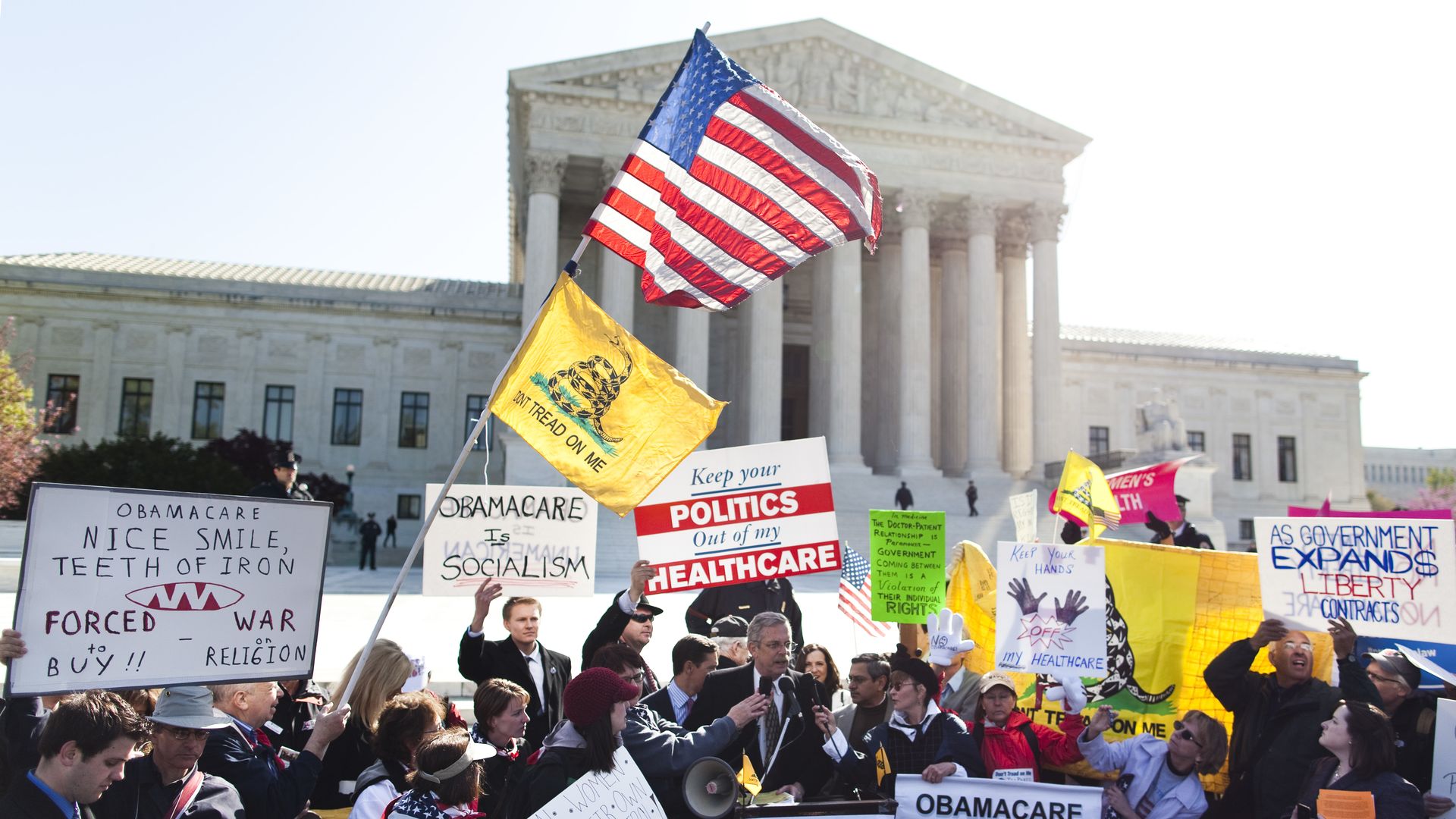
The Justice Department will not defend the Affordable Care Act in court, and says it believes the law’s individual mandate — the provision the Supreme Court upheld in 2012 — has become unconstitutional.

Why it matters: The Justice Department almost always defends federal laws when they’re challenged in court. Its departure from that norm in this case is a major development — career DOJ lawyers removed themselves from the case as the department announced this shift in its position.

The details: The ACA’s individual mandate requires most people to buy insurance or pay a tax penalty. The Supreme Court upheld that in 2012 as a valid use of Congress’ taxing power.

  • When Congress claimed it repealed the individual mandate last year, what it actually did was drop the tax penalty to $0.
  • So the coverage requirement itself is still technically on the books. And a group of Republican attorneys general, representing states led by Texas, say it’s now unconstitutional — because the specific penalty the Supreme Court upheld is no longer in effect.
  • The Justice Department agreed with that position in a brief filed Thursday night.
  • DOJ said the courts should strike down the coverage requirement, as well as the provision of the law that forces insurance companies to cover people with pre-existing conditions.

Between the lines: For the Justice Department to stop defending a federal law is not unprecedented — the Obama administration did it with the Defense of Marriage Act. But it is exceptionally rare.

Yes, but: A group of Democratic attorneys general has been granted permission to defend the ACA in this case, so someone will be in its corner.

What to watch: The argument against it is by no means a slam dunk. For starters, critics — now including the Justice Department — will have to prove that people are still being injured by the remaining shell of the individual mandate, even without a penalty for non-compliance.

Justice Dept. argues key parts of ObamaCare are unconstitutional

Justice Dept. argues key parts of ObamaCare are unconstitutional

Image result for aca challenge

The Department of Justice (DOJ) argued in court Thursday that key parts of ObamaCare are now unconstitutional, siding in large part with a conservative challenge to the law.

The move is a break from the norm of the DOJ to defend federal laws when they are challenged in court. Under President Trump, the department has opted not to defend a law that it strongly opposes.

Attorney General Jeff Sessions acknowledged in a letter to Speaker Paul Ryan (R-Wis.) that the DOJ has a “longstanding tradition” of defending federal laws, but argued that this is “a rare case where the proper course is to forgo defense” of the law.

The lawsuit in question was filed in February by Texas and 19 other GOP-led states, arguing that ObamaCare is unconstitutional and should be overturned.

Legal experts are deeply skeptical the challenge can succeed, and 17 Democratic-led states have already intervened to defend the law in the absence of DOJ action.

The DOJ argues that ObamaCare’s protections against people with pre-existing conditions being denied coverage or charged more should be invalidated, maintaining that the individual mandate that people have insurance or face a tax penalty is now unconstitutional.

The conservative states and DOJ point to the Supreme Court’s 2012 ruling that upheld ObamaCare’s individual mandate under Congress’s taxing power. Now that Congress has repealed the mandate penalty as part of last year’s tax bill – while technically keeping the mandate itself in place – they argue the mandate is no longer a tax and is now invalid.

They also argue that the key pre-existing condition protections cannot be separated from the mandate and should be invalidated. The DOJ argues the remainder of the law can stay.

The chances for that argument succeeding are viewed with deep skepticism by legal experts, in part because Congress itself indicated that the rest of ObamaCare could still stand without the mandate when it moved to repeal the tax penalty last year.

The case is currently before a federal district court judge in Texas, Reed O’Connor, who was appointed by former President George W. Bush.

Some supporters of ObamaCare view the DOJ’s move more as a damaging break from precedent rather than an actual serious legal threat to ObamaCare, since the lawsuit is unlikely to succeed.


Healthcare CEO sentenced to 19 years for $18M physical therapy fraud scheme

https://www.beckershospitalreview.com/legal-regulatory-issues/healthcare-ceo-sentenced-to-19-years-for-18m-physical-therapy-fraud-scheme.html

Image result for dept of justice

The former CEO of Team Work Ready, a Houston-based physical therapy chain, was sentenced June 1 to more than 19 years in prison for his role in an $18 million healthcare fraud scheme, according to the Department of Justice.

The sentencing came after a federal jury convicted Jeffrey Eugene Rose Sr. of healthcare fraud, conspiracy, wire fraud and money laundering in October 2016. Mr. Rose was one of three Team Work Ready executives convicted in the scheme.

According to federal prosecutors, Mr. Rose and his co-conspirators submitted $18.3 million in fraudulent claims for physical therapy services that were never provided through Mr. Rose’s 10 Team Work Ready clinics in Texas, Louisiana, Georgia, Tennessee and Alabama. The claims were submitted under the Federal Employees Compensation Act, which is administered by the Department of Labor’s Office of Workers’ Compensation Program.

In addition to the prison term, Mr. Rose was ordered to pay $14.5 million in restitution to the DOL’s Office of Workers’ Compensation Program.


Anthem Fraud Investigator Arrested in Fraud Investigation

http://www.healthleadersmedia.com/health-plans/anthem-fraud-investigator-arrested-fraud-investigation?utm_source=silverpop&utm_medium=email&utm_campaign=20180530_HLM_HP_resend%20(1)&spMailingID=13610938&spUserID=MTY3ODg4NTg1MzQ4S0&spJobID=1402769496&spReportId=MTQwMjc2OTQ5NgS2

Image result for false claims act


A federal indictment alleges that a former fraud investigator for Anthem Blue Cross took bribes and provided coconspirators with billing codes that would bypass the insurer’s fraud protection firewalls.

Five Californians—including a physician and a former fraud investigator—have been arrested and charged in a scheme that submitted bogus claims to health insurers and used some of the proceeds to provide patients with “free” cosmetic procedures, the Department of Justice said.

The arrest follows the unsealing of a federal indictment this week that details a multi-year scheme that lured patients into two San Fernando Valley clinics to receive free cosmetic procedures—including facials, laser hair removal and Botox injections—which were not covered by insurance.

The conspirators allegedly submitted at least $20 million in claims to the insurance companies, which paid approximately $8 million on those claims, the indictment said.

The scam used the patients’ insurance information to fraudulently billed insurers for unnecessary medical services or for services that were never provided. In exchange, the alleged scammers calculated a “credit” that patients could use to receive “free” or discounted cosmetic procedures, the indictment said.

One of the coconspirators, Gary Jizmejian, 44, of Santa Clarita, was a former senior investigator at the Anthem Special Investigations Unit, the anti-fraud unit within Anthem.

The indictment alleges that Jizmejian took bribes in exchange for providing his coconspirators with confidential Anthem information that helped them submit fraudulent bills to Anthem.


In September 2012, Jizmejian gave his coconspirators insurance billing codes—CPT Codes—that Jizmejian knew could be used to submit fraudulent claims to Anthem without Anthem detecting the fraudulent claims, the indictment said.

Jizmejian also allegedly gave his coconspirators the billing code for an allergy-related lab test and told them to submit to Anthem large numbers of bills with this CPT code. The coconspirators used this billing code to submit approximately $1 million in fraudulent claims to Anthem, according to the indictment.

Jizmejian allegedly helped mask the fraud at the clinics by helping coconspirators avoid responding to inquiries from fraud investigators, diverting attention of other Anthem SIU investigators away from the clinics, and closing Anthem investigations into fraud at the clinics, the indictment said.

When reached for comment, Anthem Blue Cross issued the following response:

  • Mr. Jizmejian is no longer an Anthem employee.
  • Anthem fully cooperated with the government’s investigation.
  • We have no further comment on pending government charges or activity.

The indicted coconspirators were identified as:

  • Roshanak Khadem, aka “Roxanne” and “Roxy” Khadem, 50, of Sherman Oaks. Khadem owned and operated the two clinics at the center of the alleged scheme—R&R Med Spa, which was located in Valley Village until early 2016, and its successor company, Nu-Me Aesthetic and Anti-Aging Center, which operated in Woodland Hills.
  • Roberto Mariano, MD, 59, of Rancho Cucamonga, a physician who helped operate the clinics;
  • Marina Sarkisyan, 49, of Panorama City, who was the office manager at the clinics;
  • Lucine Ilangezyan, 38, of North Hills, an employee and insurance biller for the clinics.

All five defendants are charged with one count of conspiracy to commit healthcare fraud and 13 counts of healthcare fraud. Each count charged in the indictment carries a statutory maximum sentence of 10 years in prison.