The Texas lawsuit could end some of the ACA’s protections for employer coverage

The Texas lawsuit could end some of the ACA’s protections for employer coverage.

Image result for health insurance guaranteed issue

The Trump administration’s refusal to defend portions of the Affordable Care Act is shocking enough. Equally shocking is how little it seems to care what happens if it gets what it’s asking for.

One question in particular: what about legal protections for the 160 million people who get insurance through their employers? Will their insurance still cover their preexisting conditions, even if they switch jobs? I honestly have no idea.

In its brief, the Justice Department argues that the community rating and guaranteed issue provisions of the ACA must be invalidated. But it never mentions that those provisions apply not only to individual health plans, but also to employer plans.

So should those rules give way across the board? Or only for individual insurance plans?

Maybe it should be the latter. The mandate isn’t critical to securing the health of the employer market, so the ACA rules that protect employees aren’t inextricably linked to the mandate and shouldn’t be invalidated. But it could also plausibly be the former: if the rules governing community rating and guaranteed issue are inseverable, maybe the court shouldn’t do micro-surgery to save some subpart of those rules.

But guess what? In its brief, the Justice Department doesn’t say which approach it endorses.

Actually, it’s worse than that.  When the Justice Department identifies the rules governing community rating and guaranteed issue, it doesn’t cite the ACA itself (Public Law 111-948). Instead, it cites parts of the U.S. Code that codify portions of the ACA (e.g., 42 U.S.C. 300gg). The implication is that the Justice Department wants the court to enjoin those code provisions.

But the code provisions were on the books long before the ACA was adopted. Prior to the ACA, they listed protections for employer-sponsored plans that had been adopted in the Health Insurance Portability and Accountability Act. Among other things, HIPAA limited the circumstances under which an employer could refuse to cover an employee’s preexisting conditions. The protections weren’t perfect, but they were something. The ACA patched HIPAA’s gaps by amending those code provisions.

So if the U.S. Code provisions are enjoined altogether—which, again, is what the Justice Department appears to be asking for—some of the HIPAA-era protections would be wiped from the books too.* Is that really what the Justice Department wants? Because that’s the thrust of its brief.

The confusion may reflect a basic legal mistake, one that Tobias Dorsey highlighted in Some Reflections on Not Reading the Statutes: the U.S. Code is a codification of existing laws, but it’s not itself the law. That’s why code provisions shouldn’t themselves be the target of any injunction. Any injunction should run against the ACA itself. If that’s what the Justice Department really wants, then it has to clarify what it’s really asking for. Failing to do so could wreak havoc in the employer-sponsored market.

Even if the injunction only runs against portions the ACA, however, that still wouldn’t resolve whether the ACA’s protections would still apply to employer-sponsored plans. If they don’t, that’s a big deal: HIPAA’s protections are porous.

So far, however, the Trump administration hasn’t said a word—leaving 160 million people in the lurch.
 

Keeping the Alexander-Murray health care bill in context

https://www.axios.com/keeping-the-alexander-murray-health-care-bill-in-context-2498670199.html

Image result for Keeping the Alexander-Murray health care bill in context


As debate continues about a bipartisan fix for the Affordable Care Act marketplaces, Drew Altman’s latest Axios column describes the scale of the problems in the ACA marketplaces and the public’s confusion about whether they are impacted. He says that the news media, experts and policy makers can do more to put the marketplace problems and fixes in context as debate evolves.

As the debate unfolds about the bipartisan bill by Senators Lamar Alexander and Patty Murray to repair the Affordable Care Act marketplaces, the public could be just as confused as they have been about the ACA’s marketplaces. That’s why it’s important to debate it in the right context: It’s aimed at an urgent problem affecting a relatively small sliver of the health insurance system, not all of the ACA and not the entire health system.

The bottom line: It’s a limited measure that will never give conservatives or liberals everything they want.

Reality check: Many people will think it affects their insurance when, in actuality, it will have no impact on the vast majority of Americans who get their coverage outside of the relatively small ACA marketplaces.

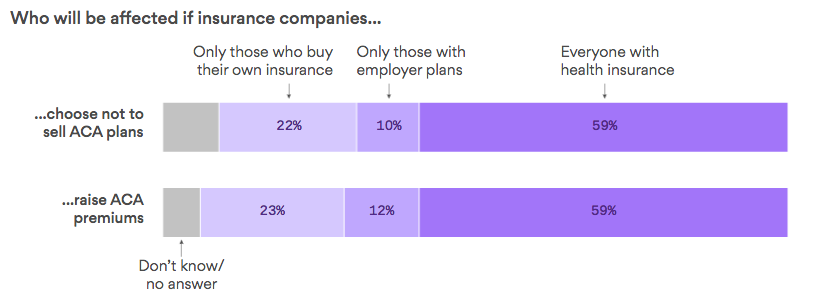
The chart based on our new Kaiser Tracking Poll shows the confusion. Just 23% of the American people know that rising premiums in the ACA marketplaces affect only people who buy their own insurance. More than seven out of 10 wrongly believe rising premiums in the marketplaces affect everyone or people who get coverage through their employer.

The public will be susceptible to spin and misrepresentation of the limited goals of Alexander-Murray: a bipartisan effort to stabilize the marketplaces by funding the cost-sharing reduction subsidies, providing more resources for open enrollment outreach, and expediting state waivers.

President Trump has added to the confusion. He recently pronounced the ACA “dead”, adding, “there is no such thing as Obamacare anymore.” Possibly that’s because he wishes it was dead. More likely, he was referring to the problems in the ACA marketplaces, which he has exaggerated.

Like thinking your whole house is falling down when just a part of the foundation needs shoring up, both he and the American people have an inaccurate picture of where the marketplaces fit in the ACA and where the ACA fits in the health system.

A few facts:

  • There are just 10 million people enrolled in the ACA marketplaces.
  • The law’s larger Medicaid expansion and consumer protections are popular and working well.
  • The far larger Medicare and Medicaid programs and employer based health system combined cover more than 250 million people, and are largely unaffected by developments in the ACA marketplaces.
  • Premiums for the 155 million people who get coverage through their employers rose a very modest 3% in 2017.

Some conservatives in Congress will hold out for repeal, and they’ll resist any legislation that they view as propping up Obamacare. But for everyone else, it’s important to understand the problem and get the facts.


California Employer Health Benefits: Prices Up, Coverage Down

http://www.chcf.org/publications/2017/03/employer-health-benefits?_cldee=aGVucnlrb3R1bGFAeWFob28uY29t&recipientid=contact-58e265c0591ce51180f7c4346bac4b78-22293f7225824dd0a2a16e01c6e7b1e7&esid=7e382ea0-c114-e711-80fa-5065f38a19e1

Since 2000, the percentage of employers offering health benefits has declined in California and nationwide, although coverage rates among offering firms have remained stable. Only 55% of firms reported providing health insurance to employees in 2016, down from 69% in 2000. These findings underscore the important role that Medi-Cal and Covered California play in providing insurance to working Californians — coverage that could be negatively impacted if the Republicans repeal and replace the Affordable Care Act.

Nineteen percent of California firms reported that they increased cost sharing in the past year, and 27% of firms reported that they were very or somewhat likely to increase employees’ premium contribution in the next year. The prevalence of plans with large deductibles also continues to increase.

California Employer Health Benefits: Prices Up, Coverage Down presents data compiled from the 2016 California Employer Health Benefits Survey.

Other key findings include:

  • Health insurance premiums for family coverage grew by 5.6%. Family coverage premiums have seen a cumulative 234% increase since 2002, compared to a 40% increase in the overall inflation rate.
  • The average monthly health insurance premium, including the employer contribution, was $597 for single coverage and $1,634 for family coverage in California, and was significantly higher than the national average.
  • 41% of workers in small firms faced an annual deductible of at least $1,000 for single coverage, compared to 17% of workers in larger firms. The prevalence of these higher deductibles in small firms has increased substantially in the past five years.
  • Only one in four firms with many low-wage workers (those earning $23,000 or less) offered health coverage to employees in 2016.
  • In the past year, 24% of large firms extended eligibility for health benefits to workers not previously eligible.

The complete Almanac report, as well as past editions, is available under Document Downloads.

California Employer Health Benefits: Prices Up, Coverage Down

http://www.chcf.org/publications/2017/03/employer-health-benefits

Since 2000, the percentage of employers offering health benefits has declined in California and nationwide, although coverage rates among offering firms have remained stable. Only 55% of firms reported providing health insurance to employees in 2016, down from 69% in 2000. These findings underscore the important role that Medi-Cal and Covered California play in providing insurance to working Californians — coverage that could be negatively impacted by the Republicans’ repeal and replacement of the Affordable Care Act.

Nineteen percent of California firms reported that they increased cost sharing in the past year, and 27% of firms reported that they were very or somewhat likely to increase employees’ premium contribution in the next year. The prevalence of plans with large deductibles also continues to increase.

California Employer Health Benefits: Prices Up, Coverage Down presents data compiled from the 2016 California Employer Health Benefits Survey.

Other key findings include:

  • Health insurance premiums for family coverage grew by 5.6%. Family coverage premiums have seen a cumulative 234% increase since 2002, compared to a 40% increase in the overall inflation rate.
  • The average monthly health insurance premium, including the employer contribution, was $597 for single coverage and $1,634 for family coverage in California, and was significantly higher than the national average.
  • 41% of workers in small firms faced an annual deductible of at least $1,000 for single coverage, compared to 17% of workers in larger firms. The prevalence of these higher deductibles in small firms has increased substantially in the past five years.
  • Only one in four firms with many low-wage workers (those earning $23,000 or less) offered health coverage to employees in 2016.
  • In the past year, 24% of large firms extended eligibility for health benefits to workers not previously eligible.

The complete Almanac report, as well as past editions, is available under Document Downloads.