Repealing the individual mandate would do substantial harm

https://www.brookings.edu/blog/up-front/2017/11/21/repealing-the-individual-mandate-would-do-substantial-harm/?utm_campaign=Brookings%20Brief&utm_source=hs_email&utm_medium=email&utm_content=58686618

Related image

he tax legislation reported by the Senate Finance Committee last week included repeal of the individual mandate, which was created by the Affordable Care Act (ACA) and requires individuals to obtain health insurance coverage or pay a penalty. The Congressional Budget Office (CBO) has estimated that this proposal would cause large reductions in insurance coverage, reaching 13 million people in the long run.

Supporters of repealing the individual mandate have argued that the resulting reductions in insurance coverage are not a cause for concern because they would be voluntary. Rigorous versions of this argument acknowledge that individuals who drop coverage would lose protection against high medical costs, find it harder to access care, and likely experience worse health outcomes, but assert that the very fact that these individuals would choose to drop insurance coverage shows that they will be better off on net. On that basis, advocates of repealing the mandate claim that its repeal would do no harm. However, this argument suffers from two serious flaws.

The first flaw in this argument is that it assumes individuals bear the full cost of their decisions about whether to obtain insurance coverage; in fact, one person’s decision to go without health insurance coverage shifts costs onto other people. Notably, CBO has estimated that the departure of healthy enrollees from the individual market spurred by repeal of the individual mandate will increase individual market premiums by 10 percent, causing some in that market to involuntarily lose coverage and causing those who remain to bear higher costs. In addition, many of those who become uninsured will end up needing health care but not be able to pay for it, imposing costs on other participants in the health care system. Because individuals who choose to become uninsured do not bear the full cost of that decision, they may choose to do so even in circumstances where the benefits of coverage—accounting for its effects on both the covered individual and the rest of society—exceed its costs.

The second flaw in this argument is that it assumes individual decisions about whether to purchase health insurance coverage reflect a fully informed, fully rational weighing of the cost and benefits. In fact, there is strong reason to believe that many individuals, particularly the healthier individuals most affected by the mandate, are likely to undervalue insurance coverage. This likely reflects a variety of well-documented psychological biases, including a tendency to place too much weight on upfront costs of obtaining coverage (including the “hassle costs” of enrolling) relative to the benefits insurance coverage would provide if the individual got sick and needed care at some point in the future. It is therefore likely that many people who would drop insurance coverage due to repeal of the individual mandate would end up worse off, even solely considering the costs and benefits to the individuals themselves.

The considerations described above mean that, in the absence of subsidies, an individual mandate, or some combination of the two, many people will decline to obtain insurance coverage despite that coverage being well worth society’s cost of providing it. Furthermore, unless the current subsidies and individual mandate penalty provide too strong an incentive to obtain coverage that results in too many people being insured—a view that appears inconsistent with the available evidence—then reductions in insurance coverage due to repealing the individual mandate would do substantial harm.

The remainder of this analysis takes a closer look at the two flaws in the argument that reductions in insurance coverage caused by repeal of the individual mandate would do no harm. The analysis then discusses why these considerations create a strong case for maintaining an individual mandate.

INDIVIDUAL DECISIONS TO DROP INSURANCE COVERAGE IMPOSE SUBSTANTIAL COSTS ON OTHER PEOPLE

As noted above, supporters of repealing the individual mandate have often argued that the resulting reductions in insurance coverage would do no harm because they are the outcome of voluntary choices. One major flaw in this argument is that one person’s decision to drop insurance coverage imposes costs on other people through a pair of mechanisms: increases in individual market premiums and increases in uncompensated care. I discuss each of these mechanisms in greater detail below.

Increases in individual market premium reduce coverage and increase others’ costs

Repealing the individual mandate would reduce the cost of being uninsured and, equivalently, increase the effective cost of purchasing insurance coverage. That increase in the effective cost of insurance coverage would, in turn, cause many people to drop coverage. Because individuals with the most significant health care needs are likely to place the highest value on maintaining insurance coverage, the people dropping insurance coverage would likely be relatively healthy, on average. In the individual market, those enrollees’ departure would raise average claims costs, requiring insurers to charge higher premiums to the people remaining in the individual market.[1]

CBO estimates that, because of this dynamic, repealing the individual mandate would increase individual market premiums by around 10 percent. Those higher premiums would push some enrollees who are not eligible for subsidies out of the individual market. Higher premiums would impose large costs on unsubsidized enrollees who remained in the ACA-compliant individual market—around 6 million people—while increasing federal costs for subsidized enrollees who remain insured.[2]

CBO’s estimates are at least qualitatively consistent with empirical evidence on the effects of the individual mandate. Perhaps the best evidence on this point comes from Massachusetts health reform. Research examining the unsubsidized portion of Massachusetts’ individual market estimated that Massachusetts’ individual mandate increased enrollment in the unsubsidized portion of its individual market by 38 percent, reducing average claims costs by 8 percent and premiums by 21 percent. Similarly, research focused on the subsidized portion of Massachusetts’ market found that the mandate appears to have been an important motivator of enrollment, particularly among healthier enrollees.

Direct evidence on the effects of the ACA’s mandate is relatively scant because it is challenging to disentangle the effect of the mandate from the effect of other policy changes implemented by the ACA. However, it is notable that the uninsured rate among people with incomes above 400 percent of the federal poverty level fell by almost one-third from 2013 to 2015. This trend is consistent with the view that the ACA’s individual mandate has increased insurance coverage since these individuals are not eligible for the ACA’s subsidies, and implementation of the ACA’s bar on varying premiums or denying coverage based on health status, taken on its own, would have been expected to actually reduce insurance coverage in this group. Because this estimate applies to only a relatively small slice of the population, it cannot easily be used to determine the total effect of the individual mandate on insurance coverage, but it does suggest that the mandate has had meaningful effects.

Repealing the individual mandate could also cause broader disruptions in the individual market for some period of time. Insurers would find it challenging to predict exactly what the individual market risk pool would look like after repeal of the mandate. Some insurers might elect to limit their individual market exposure until that uncertainty is resolved, particularly since the Trump Administration has signaled an intent to pursue other significant policy changes affecting the individual market. That uncertainty could cause some insurers to withdraw from the market, potentially leaving some enrollees without any coverage options. Alternatively, insurers could elect to raise premiums by even more than they expect to be necessary (e.g., by more than the CBO 10 percent estimate cited above) to ensure that they are protected in all scenarios, with significant costs to both individuals and the federal government. It is uncertain how widespread these types of broader disruptions would be in practice, but they are possible.

It is important to note that one person’s decision about whether to purchase individual market coverage affects the premiums faced by others because of a conscious policy choice: the decision to bar insurers from varying premiums or denying coverage based on health status. Without those regulations, individual coverage decisions would have little or no effect on the premiums charged to others. But policymakers and the public have, appropriately in my view, concluded that these regulations perform a valuable social function by ensuring that health care cost burdens are shared equitably between the healthy and the sick. Having made that decision, other aspects of public policy must take account of the fact that one person’s decision to go uninsured has consequences for the market as a whole.

Some newly uninsured individuals would need care, but be unable to pay for it

Dropping insurance coverage also allows individuals to shift a portion of the cost of the care they receive onto others in the form of uncompensated care. Even in the group of comparatively healthy individuals who elect to drop their coverage, some will get sick and need health care. Some of these individuals might be able to pay for that care out of pocket, but others—particularly those who get seriously ill—would likely be unable to pay for it. In some cases, that would cause these individuals to forgo needed care, but in other cases they would receive care without paying for it, either due to the legal requirement that hospitals provide care in emergency situations or through various other formal and informal mechanisms. (Although individuals would often still be able to access care without paying for it, they would frequently still be billed for that care, with potential downstream consequences for their ability to access credit.)

Uninsured individuals receive large quantities of uncompensated care in practice. Estimates based on the Medical Expenditure Panel Survey indicate that a non-elderly individual uninsured for the entire year received $1,700 in uncompensated care, on average, during 2013. Consistent with that fact, increases in the number of uninsured individuals increase the amount of uncompensated care. In the context of the Oregon Health Insurance Experiment, a randomized controlled trial of the effects of expanded Medicaid coverage, having Medicaid coverage was estimated to reduce the amount of uncompensated care an individual receives by almost $2,200 per year, on average. Quasi-experimental research has similarly found that increases in the number of uninsured individuals in a hospital’s local area increase the amount of uncompensated care a hospital delivers and that the expansion in insurance coverage achieved by the ACA substantially reduced hospitals’ uncompensated care burdens.

Precisely who bears the cost of uncompensated care, particularly in the long run, is not entirely clear. A portion of uncompensated care costs are borne by federal, state, and local government programs and, therefore, are ultimately borne by taxpayers. In 2013, around three-fifths of uncompensated care was financed by federal, state, and local government programs explicitly or implicitly aimed at this purpose. Increases in uncompensated care burdens are likely to lead to increases in spending on these programs. In some cases, those increases will happen automatically. For example, CBO finds that repealing the individual mandate will increase federal spending on the Medicare Disproportionate Share Hospital (DSH) program, which is intended to defray uncompensated care costs, by $44 billion over the next ten years because the formula for determining DSH payments depends on the uninsured rate. In other cases, changes may occur more indirectly, perhaps because higher uncompensated care burdens create political pressure to expand these programs (or make it harder to cut them).

The impact of uncompensated care therefore depends to a significant degree on how non-profit hospitals cope with reduced operating margins. Evidence on this point is relatively limited. However, in instances where increases in uncompensated care burdens cause providers to incur outright losses, they are likely to ultimately force facilities to close, which could reduce access to care or increase prices charged to those enrolled in private insurance by reducing competition. In instances where increases in uncompensated care burdens merely trim positive operating margins, lower margins presumably force hospitals to reduce capital investments or to reduce cross-subsidies to other activities such as medical education or research.Recent research focused on the hospital sector, which accounts around three-fifths of all uncompensated care, suggests that providers also bear a significant portion of uncompensated care costs in the form of lower operating margins. However, this does not imply that uncompensated care costs are ultimately borne by hospitals’ owners. Indeed, this research finds that reductions in operating margins in response to increases in uncompensated care occur almost exclusively among non-profit hospitals, plausibly because for-profit hospitals are adept at locating in geographic areas where the demand for uncompensated care is relatively low. (Greater distortions where providers choose to locate and what services they choose to offer may be an important cost of increased uncompensated care.)

INDIVIDUAL DECISIONS TO DROP INSURANCE COVERAGE MAY HARM THE INDIVIDUALS THEMSELVES

The argument that reductions in insurance coverage due to repeal of the individual mandate do no harm because they are voluntary has a second important flaw; specifically, this argument assumes that individual decisions about whether to obtain health insurance coverage reflect a fully informed, fully rational weighing of the costs and benefits. There is strong reason to doubt that assumption.

Economists commonly note that many people decline to take-up health even in settings where that coverage is free or nearly so. For example, analysts at the Kaiser Family Foundation (KFF) have estimated that, in 2016, there were 6.8 million people who were eligible for Medicaid or the Children’s Health Insurance Program, but not enrolled in those programs, despite the fact that these programs had negligible premiums. Similarly, for this year’s Marketplace open enrollment period, analysts at KFF estimated that among uninsured individuals eligible to purchase Marketplace coverage, around two-fifths could obtain a bronze plan for a premium of zero, but few expect all of these individuals to enroll.

This type of behavior is very challenging to explain as the outcome of a fully informed, fully rational decision-making process. The fact that individuals who do not purchase insurance coverage can shift significant costs to others, as discussed above, can help explain why some individuals value insurance at less than the cost of providing it. But these factors cannot explain why enrollees would decline to obtain coverage that is literally free to them. In principle, “hassle costs” of enrolling in coverage could explain decisions to forgo coverage in these instances, but those hassle costs would need to be implausibly large to explain a decision to forgo an offer of free insurance coverage.

Precisely why individuals decline to take up insurance coverage even in settings where it seems clearly in their interest to do so is not fully understood. This review article catalogues a wide variety of psychological biases that may play a role, but three seem particularly important in this context:

  • Present bias: Economists have documented that individuals generally exhibit “present bias,” meaning that they place a large weight on current costs and benefits relative to similar costs and benefits in the future. In the context of insurance coverage, this type of bias is likely to cause individuals, particularly those who are currently healthy, to place too much weight on the upfront premium and hassle costs required to enroll in health insurance relative to the benefit of having insurance coverage if they get sick at some point in the future. This may cause individuals to decline to obtain insurance coverage even when it is in their economic interest, including in instances where the premium required to enroll is literally zero.

Overweighting of small up front hassle costs appears to lead suboptimal decisions in many economic settings, but the retirement saving literature provides a particularly striking example. Simply being required to return a form to enroll in an employer’s retirement plan has been documented to sharply reduce take-up of that plan, even in circumstances where employees forgo hundreds or thousands of dollars per year in employer matching contributions by declining to participate.

  • Overoptimistic perceptions of risk: One core function of health insurance is to provide protection against relatively rare, but very costly, illnesses. Indeed, a large fraction of the total value of a health insurance contract is delivered in those states of the world. In 2014, around 5 percent of the population accounted for around half of total health care spending.[3] But because these events are comparatively rare, many individuals, particularly healthier individuals, may have difficulty forming accurate perceptions of the risks they face. Research on Medicare Part D has found that individuals tend to place too much weight on premiums relative to expected out-of-pocket costs when choosing plans, providing some evidence that individuals do indeed underestimate risk (although research focused on insurance products other than health insurance has concluded that individuals may sometimes overestimate risk). Like present bias, misperceptions of risk can cause hassle or premium costs to receive too much weight relative to the actual benefits of coverage.
  • Inaccurate beliefs about affordability: Enrollees could also have inaccurate information about the availability of coverage. Survey evidence has suggested that, as of early 2016, almost 40 percent of uninsured adults were unaware of the existence of the ACA’s Health Insurance Marketplaces. Additionally, approximately two-thirds of those who were aware of the Marketplaces had not investigated their coverage options, with most saying that they had not done so because they did not believe that they could afford coverage. Individuals’ beliefs about whether coverage is affordable may be accurate in some instances, but it is likely that they are not accurate in many other cases. Inaccurate beliefs may cause many individuals to fail to investigate their coverage options, including some who are eligible for free or very-low-cost coverage.

REDUCTIONS IN INSURANCE COVERAGE FROM REPEALING THE INDIVIDUAL MANDATE WOULD DO SUBSTANTIAL HARM

The factors identified above provide strong economic rationale for implementing some combination of subsidies and penalties to strengthen the financial incentive to obtain health insurance coverage. These policy tools can compensate for the fact that individual decisions to go without coverage do not account for the ways in which those decisions increase costs for others. Similarly, in many (though not all) instances, financial incentives can help counteract psychological biases that cause individuals to go without insurance coverage even when it is against their own economic interest.

This discussion does not, of course, speak directly to how large subsidies and penalties should be. At least in theory, it is possible to overcompensate for the factors catalogued in the preceding section by creating too large an incentive to obtain coverage and thereby causing too many people to become insured. This occurs if the cost of the additional health care individuals receive when they become insured plus the administrative costs of providing that coverage exceeds the health benefits of the additional health care and the improved protection against financial risk.

Estimating the optimal size of subsidies and penalties is beyond the scope of this analysis. However, it is notable that virtually no one in the current policy debate is arguing that the United States insures too many individuals. Furthermore, there is reason to doubt that this is an empirically relevant concern. For example, the research on Massachusetts health reform by Hackmann, Kolstad, and Kowalski that was discussed earlier used their estimates to calculate the “optimal” mandate penalty to apply to unsubsidized enrollees. They conclude that just offsetting adverse selection justifies a mandate penalty similar in size to the one included in the ACA; also accounting for either uncompensated care or imperfections in consumer decision making could justify a considerably larger penalty.

It therefore seems difficult to justify repealing the individual mandate on the grounds that current policies provide an excessive overall incentive to obtain insurance coverage. Of course, policymakers might believe that it would be preferable to swap the mandate for larger subsidies, perhaps because they believe that it is inappropriate to penalize individuals for not obtaining coverage. In principle, sufficiently large increases in subsidies could offset the reduction in insurance coverage that repealing the individual mandate would cause. But such an approach would require large increases in federal spending since it would keep insurance enrollment at its current level by providing larger subsidies to each enrolled individual. In any case, the Senate Finance Committee bill does not take this approach. Rather than increasing spending on insurance coverage programs to mitigate coverage losses, the bill uses the reduction in spending on coverage programs caused by repealing the mandate (which results from lower enrollment in those programs) to finance tax cuts.


Podcast: ‘What The Health?’ Tax Bill Or Health Bill?

https://khn.org/news/podcast-what-the-health-tax-bill-or-health-bill/?utm_campaign=KFF-2017-The-Latest&utm_source=hs_email&utm_medium=email&utm_content=58570997&_hsenc=p2ANqtz-90FnDooDrGIdtTTHP8VfZovw1vS_Y_js4RdDwCCIwslKGDgrqu1yZ6bbcLJ5AbWfyJaM2B3HhQ9fR9txLD5dY-TnO3HA&_hsmi=58570997

Image result for kaiser podcast what the health?


Republican efforts to alter the health law, left for dead in September, came roaring back to life this week as the Senate Finance Committee added a repeal of the “individual mandate” fines for not maintaining health insurance to their tax bill.

In this episode of “What the Health?” Julie Rovner of Kaiser Health News, Sarah Kliff of Vox.com, Joanne Kenen of Politico and Alice Ollstein of Talking Points Memo discuss the other health implications of the tax bill, as well as the current state of the Affordable Care Act.

Among the takeaways from this week’s podcast:

  • The tax bill debate proves that Republicans’ zeal to repeal the Affordable Care Act is never dead. The new congressional efforts to kill the penalties for the health law’s individual mandate could seriously wound the ACA since the mandate helps drive healthy people to buy insurance.
  • One of the most overlooked consequences of the tax debate is that it could trigger a substantial cut in federal spending on Medicare.
  • A $25,000 MRI? That’s what one family paid to go out of their plan’s network to get the hospital they wanted for the procedure for their 3-year-old. Such choices are again drawing complaints about narrow networks of doctors and hospitals available in some health plans.
  • Although they don’t likely say it in front of cameras, many Democrats are relieved at President Donald Trump’s choice to head the Department of Health and Human Services, former HHS official Alex Azar.
  • Federal officials have given 10 states and four territories extra money to keep their Children’s Health Insurance Programs running but it’s not clear what couch they found the money hidden in.
  • And in remembrance of Uwe Reinhardt, a reminder that he always stressed that a health care debate was about more than money — it was about real people.

Plus, for “extra credit,” the panelists recommend their favorite health stories of the week they think you should read, too.

Insurers Can Bend Out-Of-Network Rules For Patients Who Need Specific Doctors

https://khn.org/news/insurers-can-bend-out-of-network-rules-for-patients-who-need-specific-doctors/?utm_campaign=KHN%3A%20Topic-based&utm_source=hs_email&utm_medium=email&utm_content=58529177&_hsenc=p2ANqtz-85eIov6h_xyFiUgaAQ4fPQfmFKIGc3Hy-dk3J1iXBI7lQ6d8lPFgPXXyeWrMceH2mGmhwxT0ZSLJVK3aeIMHcE7YGtbg&_hsmi=58529177

The Affordable Care Act has so far survived Republican attempts to replace it, but many people still face insurance concerns. Below, I answer three questions from readers.

Q: I have a rare disease, and there is literally only one specialist in my area with the expertise needed to treat me. I am self-employed and have to buy my own insurance. What do I do next year if there are zero insurance plans available that allow me to see my specialist? I cannot “break up” with my sub-specialty oncologist. I must be able to see the doctor that is literally saving my life and keeping me alive.

If the plan you pick covers out-of-network providers, you can continue to see your cancer specialist, although you’ll have to pay a higher percentage of the cost than if you were seeing someone in your plan’s network.

But many plans these days don’t provide any out-of-network coverage. This is certainly true of plans sold on the health insurance exchanges.

The situation you’re concerned about — that a specialist you consider crucial to your care isn’t in a plan’s provider network — isn’t uncommon, said Sabrina Corlette, a research professor at Georgetown University’s Center on Health Insurance Reforms.

If this happens, you can contact your plan and make the case that this particular provider is the only one who has the expertise to meet your needs. (Unfortunately, you probably can’t get this coverage assurance before you sign up.) Then ask your plan to make an exception and treat the out-of-network specialist as if she were in network for cost-sharing purposes. So, if in your plan an in-network specialist visit requires a $250 copayment, for example, the plan would agree that’s what you’d be charged to see your out-of-network specialist.

Or not. It’s up to the plan officials, and they may argue that someone in network has the expertise you need. If you disagree, you can appeal that decision.

But it may not come to that, said Corlette.

“Plans are prepared for this — the good ones are, anyway,” she said. “My understanding is that it’s pretty routine to grant exceptions for narrow subspecialties.”

Q: My company has asked employees to pay the Cadillac tax rather than putting the burden  on the company. They are also telling us not to worry because it will never happen, but want us to agree that if it does we will take on the cost. Can they do that?

Let’s step back for a minute. The so-called Cadillac tax is a 40 percent surcharge on the value of health plans above the thresholds of $10,200 for single coverage and $27,500 for family plans.

A few months ago when it looked as if the ACA was going to be replaced, many employers believed, as yours apparently still does, that the Cadillac tax would never become effective. Both the House and Senate bills delayed the tax until 2026, and a lot can happen between now and then. With the collapse of efforts to repeal the ACA, however, the tax is on the front burner once again, said J.D. Piro, who leads the health and law group at benefits consultant Aon Hewitt. It’s set to take effect in 2020.

Under the law, insurers or employers would be responsible for paying the tax, but experts say the costs would likely be passed through to enrollees (whether or not you explicitly agree to absorb them). So it may not matter how you respond to your employer.

Also, employers who don’t want to pay the surcharge might sidestep the issue by reducing the value of the plans they offer, said Piro. For example, they could increase employee deductibles and other cost-sharing, make coverage less generous or shrink the provider network.

“That’s simplest way to avoid the tax,” he said.

Q: I need to purchase affordable health insurance for my two daughters who are 19 and 17. Is Trump insurance available yet? I need something I can afford and everything is so expensive.

President Donald Trump never put forward a proposal to replace the ACA. Instead, he backed the House and Senate replacement versions, which ultimately failed. But those versions might not have addressed your concerns, and you could have several options through the ACA.

“Coverage wouldn’t necessarily have been cheaper,” said Judith Solomon, vice president for health policy at the Center on Budget and Policy Priorities.

Under the Senate bill, for example, the nonpartisan Congressional Budget Office predicted that average 2018 premiums for single coverage would be 20 percent higher than this year’s. In 2020, however, premiums would be 30 percent lower than under current law, on average. But deductibles and other out-of-pocket costs would be higher for most people under the Senate bill, according to the CBO.

Premiums for young people would generally have declined. The bill would have allowed insurers to vary rates to a greater degree based on age, resulting in lower premiums for young people. In addition, premium tax credits generally would have increased for young people with incomes above 150 percent of the poverty level.

Your current coverage options under the ACA depend on your family situation. If you have coverage available to you through your employer, you can keep your daughters on your plan until they turn 26. For many parents, this is the most affordable, comprehensive option.

If that’s not a possibility, assuming the three of you live together and you claim them as dependents on your taxes, you may qualify for subsidized coverage on the health insurance marketplace next year. Your household income would need to be no more than 400 percent of the federal poverty level (about $82,000 for a family of three). You can apply for that coverage in the fall.

If you live in one of the 31 states plus the District of Columbia that have expanded Medicaid coverage to adults with incomes below 138 percent of the poverty level (about $28,000 for a family of three), you could qualify for that program. You don’t have to wait for open enrollment to sign up for Medicaid.


Rising Health Insurance Costs Frighten Some Early Retirees

https://khn.org/news/rising-health-insurance-costs-frighten-some-early-retirees/?utm_campaign=KHN%3A%20Topic-based&utm_source=hs_email&utm_medium=email&utm_content=58529177&_hsenc=p2ANqtz-85eIov6h_xyFiUgaAQ4fPQfmFKIGc3Hy-dk3J1iXBI7lQ6d8lPFgPXXyeWrMceH2mGmhwxT0ZSLJVK3aeIMHcE7YGtbg&_hsmi=58529177

Don and Debra Clark of Springfield, Mo., are glad they have health insurance. Don is 56 and Debra is 58. The Clarks say they know the risk of an unexpected illness or medical event is rising as they age and they must have coverage.

Don is retired and Debra works part time a couple of days a week. As a result, along with about 20 million other Americans, they buy health insurance in the individual market — the one significantly altered by the Affordable Care Act (ACA).

But the Clarks are not happy at all with what they pay for their coverage — $1,400 a month for a plan with a $4,500 deductible. Nor are they looking forward to the ACA’s fifth open enrollment period, which runs from Wednesday through Dec. 15 in most states. Many insurers are raising premiums by double digits, in part because of the Trump administration’s decision to stop payments to insurers to cover the discounts they are required to give to some low-income customers to cover out-of-pocket costs.

“This has become a nightmare,” said Don Clark. “We are now spending about 30 percent of our income on health insurance and health care. We did not plan for that.”

Karen Steininger, 62, of Altoona, Iowa, said her ACA coverage not only gave her peace of mind but also helped her and her husband, who is now on Medicare, stay in business the past few years. But they too are concerned about rising costs and the effect of the president’s actions.

The Steiningers are self-employed owners of a pottery studio. Their income varies year to year. They now pay $245 a month for Karen’s subsidized coverage, which, like the Clarks’, has a $4,500 deductible. Without the government subsidy, the premium would be about $700 a month.

“What if we make more money and get less of a subsidy or just if the premiums increase a lot?” Karen Steininger asked. “That would be a burden. We’ll have to cut back on something or switch to cheaper coverage.”

The experiences of the Clarks and the Steiningers point to an emerging shortfall in the ACA’s promise of easier access to affordable health insurance for early retirees and the self-employed. Rising premiums and deductibles, recent actions by the Trump administration, and unceasing political fights over the law threaten those benefits for millions of older Americans.

“These folks are rightly the most worried and confused right now,” said Kevin Lucia, a health insurance specialist and research professor at Georgetown University’s Health Policy Institute in Washington, D.C. “Decisions about which health plan is best for them is more complicated for 2018, and many people feel more uncertain about the future of the law itself.”

At highest risk are couples like the Clarks who get no government subsidy (which comes in the form of an advanced tax credit) when they buy insurance. That subsidy is available to people earning up to 400 percent of the federal poverty level, or just under $65,000 for a couple. Their income is just above the amount that would have qualified them for a subsidy in 2017.

Premiums vary widely by state. Generally, a couple in their late 50s or early 60s with an annual income of $65,000 would pay from $1,200 to $3,000 a month for health insurance.

Premiums rose an average 22 percent nationwide in 2017 and are forecast to rise between 20 and 30 percent overall for 2018.

In an analysis released this week based on insurers’ rate submissions for 2018, the Kaiser Family Foundation found that individuals and families that don’t qualify for a subsidy but are choosing plans on the federal marketplace face premiums 17 to 35 percent higher next year, depending on the type of plan they choose. (Kaiser Health News is an editorially independent program of the foundation.)

A similar increase would be expected for people who also buy on the marketplaces run by some states or buy directly from a broker or insurance company.

The substantial premium increases two years in a row could lead fewer people to buy coverage.

“I’m really worried about this,” said Peter Lee, CEO of Covered California, the exchange entity in that state. “We could see a lot fewer people who don’t get subsidies enroll.” He said that California has taken steps to mitigate the impact for people who don’t get subsidies but that “consumers are very confused about what is happening and could just opt not to buy.”

There are already signs of that, according to an analysis for this article by the Commonwealth Fund. The percentage of 50- to 64-year-olds who were uninsured ticked up from 8 percent in 2015 to 10 percent in the first half of 2017. In 2013, the figure was 14 percent.

Indeed, the ACA has been a boon to people in this age group whether they get a subsidy or not. It barred insurers from excluding people with preexisting conditions — which occur more commonly in older people. And the law restricted insurers from charging 55- to 64-year-olds more than three times that of younger people, instead of five times more, as was common.

The law also provided much better access to health insurance for early retirees and the self-employed — reducing so-called “job lock” and offering coverage amid a precipitous decline in employer-sponsored retiree coverage that began in the late 1990s.

Only 1 in 4 companies with 200 or more workers offered any kind of coverage to early (pre-65) retirees in 2017 compared with 66 percent of firms in 1988, reported the Kaiser Family Foundation. And the vast majority of small firms never did offer such coverage.

Overall, before the ACA became law, 1 in 4 55- to 64-year-olds buying coverage on their own either couldn’t get it at all because of a preexisting condition or couldn’t afford it, according to AARP.

“The aging but pre-Medicare population was our major reason to support the ACA then and it still is now,” said David Certner, director of legislative policy at AARP. “This group benefited enormously from the law, and we think society and the economy benefited, too.”

Just how many 55- to 64-years-olds have been liberated from job lock by the ACA has yet to be fully assessed. But recent data show that 18 percent of people ages 55 to 64 who were still working in 2015 got coverage through the ACA marketplaces, up from 11.6 percent in 2013, according to an analysis for this article by the Employee Benefit Research Institute.

Also, a report released in January 2017 by the outgoing Obama administration found that 1 in 5 ACA marketplace enrollees of any age was a small-business owner or self-employed person.

A bipartisan effort is underway in Congress to provide dedicated funds to woo enrollees to healthcare.gov and help state agencies explain changes in the law for 2018 triggered by the Trump administration. But the fate of the proposed legislation is uncertain.

The Clarks said they’ll look carefully at options to keep their premiums affordable in 2018.

Said Don Clark, “If we get to a point where we have a $10,000 deductible and pay 40 percent or more of our income for health insurance, I’m not sure what we’ll do. We can’t afford that.”


The Senate Tax Bill Threatens Access to Health Care

https://www.americanprogress.org/issues/healthcare/news/2017/11/16/442906/senate-tax-bill-threatens-access-health-care/

Image result for individual mandate

This week, Senate Republicans announced that they plan to pay for their tax cuts for large corporations and millionaires not only by imposing tax increases on the middle-class but also by undermining people’s access to health care. Specifically, they have proposed eliminating the Affordable Care Act’s (ACA) individual mandate, which helps keep premium costs affordable by ensuring that both healthy and sick people have health insurance.

Repealing the mandate would drive up premiums by 10 percent in 2019 and lead to 13 million fewer people having health insurance by 2025. A Congressional Budget Office (CBO) report also revealed that the similar House version of the tax bill would result in $25 billion in cuts to Medicare in fiscal year 2018 and hundreds of billions of dollars of cuts to the program overall. Taken as a whole, the tax bill would not only increase taxes for millions of middle-class families but would also have disastrous effects on people’s health care.

A typical middle-class family buying individual market insurance would see premiums increase nearly $2,000

The Senate tax bill would substantially increase premiums in the individual market for health insurance, and middle-class families would bear the brunt of the price hike. The bill would eliminate the individual mandate—the requirement that people maintain health coverage or pay a penalty. Without the mandate, people would only purchase coverage when they needed it, resulting in adverse selection that would drive up premiums. The CBO estimates that premiums would increase about 10 percent as a result of this adverse selection.

The Center for American Progress estimates that this premium increase translates to an extra $1,990 for benchmark plan coverage for an unsubsidized middle-class family of four. Families with incomes above 400 percent of the federal poverty level (FPL)—more than $98,400 for a family of four in the lower 48 states—are not eligible for premium tax creditsto reduce the cost of marketplace coverage. The 10 percent increase would be an even greater financial burden for families in states with higher premium levels, increasing costs by $2,900 in Alaska, $2,350 in Maine, and $2,060 in Arizona.

13 million more people would be uninsured by 2025

The CBO estimates that repeal of the mandate would result in 4 million fewer people having coverage in 2019 and 13 million fewer with coverage by 2025. As a result, about 16 percent of the nonelderly population would not have health insurance by 2025, compared with about 10 percent currently.

The individual mandate is necessary because of the consumer protections put in place by the ACA. The ACA banned discrimination by insurance companies against people with pre-existing conditions, required that people be charged the same amount regardless of health status, and eliminated annual and lifetime limits on coverage. But these protections would also make it easy for people to game the system by only buying health insurance once they needed it. To address this concern, the ACA coupled these reforms with an individual shared responsibility provision, also known as the individual mandate, which requires that everyone maintain health insurance coverage so that the overall insurance risk pool is healthy and premium rates are kept in check.

Repeal of the mandate would have two effects on the individual market. First, people who expect to be healthy would avoid purchasing coverage until they need it. As a result, the remaining enrollees in the individual market would be sicker on average, and insurance companies would need to raise rates to cover the increased average cost. Second, the resulting higher premiums would discourage additional people from purchasing coverage through the individual market. Those who become uninsured would no longer have financial protection against catastrophic medical costs, and hospitals and other providers would be forced to provide more uncompensated care.

Medicare would be cut by $25 billion in 2018

In addition to its frontal assault on health care for the middle class, the Senate bill would also secretly cut Medicare. Because the tax cuts for the wealthy in the proposed bill are not fully paid for, they would increase the deficit by more than $1.4 trillion over 10 years. But the little-known Statutory Pay-As-You-Go Act of 2010 requires that any deficit-increasing legislation be offset with cuts to other mandatory programs, including Medicare. The CBO has estimated that the offsetting spending reductions for the similar House version of the tax bill would cut Medicare by about $25 billion in fiscal year 2018. Given that similar cuts would be required in subsequent years, the total cost imposed on the Medicare program would be hundreds of billions of dollars over the next decade. This would have a particularly harmful effect on rural hospitals with thin margins, which could be at risk of closure as a result.

Asking millions of middle-class families to pay more in taxes so that corporations and the wealthy few can pay less in bad enough. But to use those cuts to also undermine health care for middle-class families is unconscionable. Once again, the congressional majority seems to be doing everything in its power to make life harder for everyday Americans, just so it can provide giveaways to the wealthy few.

Methodology

Our estimated reduction in coverage in 2025 due to repeal of the mandate is based on national projections by the CBO. The CBO estimates that 13 million fewer people will have coverage in 2025, including 5 million fewer people with Medicaid, 5 million fewer people with individual market coverage, and 3 million fewer people with employer-sponsored insurance. We used data from the 2016 American Community Survey Public Use Microdata Sample (ACS PUMS), available from the IPUMS-USA to tabulate the number of nonelderly people in each state by primary coverage type using a coverage hierarchy. We then assumed that each state’s reduction in coverage was proportional to its share of the national total for each of those three coverage types. For more on the IPUMS-USA data set, see Steven Ruggles and others, “Integrated Public Use Microdata Series: Version 5.0” (Minneapolis: Minnesota Population Center, 2010).

We made two adjustments to our ACS PUMS tabulations to account for potential effects of Medicaid expansion in Maine, given voters’ recent approval of expansion. We increased the number of Medicaid enrollees in Maine by 51,000 based on projections by the Urban Institute. We also decreased the number of people with coverage through Maine’s individual market by 20 percent to account for the fact that some enrollees will lose access to marketplace premium subsidies when they become Medicaid eligible under expansion. Enrollment data from the Centers for Medicare and Medicaid Services (CMS) show that 27 percent of 2017 marketplace plan selections were by people with family incomes between 100 and 150 percent of the federal poverty level.

Our estimates of 2019 premium increases are based on the CBO projection that mandate repeal will increase individual market premiums 10 percent. We used the HealthCare.govplan information to calculate the 2018 average marketplace benchmark—second-lowest cost silver—plan in each state, weighting by the geographic distribution of current marketplace enrollment. We then inflated that premium to 2019 levels according to National Health Expenditure projections for per-enrollee cost growth. To calculate the 2019 average benchmark premium specific to a typical family of four, we borrowed the example family composition that the U.S. Department of Health and Human Services uses in its reports: 40-year-old and 38-year-old parents and two children. We estimated that the family would pay an additional 10 percent of that 2019 benchmark due to mandate repeal. Premium data were not available for all states.

Finally, our estimates of state-level cuts to Medicare in fiscal year 2018 divided the $25 billion total Medicare funding reduction projected by the CBO proportional to each state’s share of national Medicare spending as of 2014, the most recent year for which CMS National Health Expenditure data is available, using data published by the Kaiser Family Foundation.

Poll: Ahead of House Tax Reform Vote, Americans are More Likely to Rank Children’s Health Care, Hurricane Relief and Other Issues as Top Priorities for Washington

http://connect.kff.org/poll-ahead-of-house-tax-reform-vote-americans-are-more-likely-to-rank-childrens-health-care-hurricane-relief-and-other-issues-as-top-priorities-for-washington?ecid=ACsprvumAORaSTpZGqmqhYQaXpeqtZoXjMxf6lbzmdUaIsV8vQ82Gwn_2PBBsI5zIiSuUzZ5w8-C&utm_campaign=KFF-2017-November-Poll-Tax-Reform-Vote&utm_source=hs_email&utm_medium=email&utm_content=58466081&_hsenc=p2ANqtz-8Cag0QgNSRgFKsxX_UJAz_sPw8ZG2hIH2l7nv8vGW9Dn5a8w_Mcy5njs5Hwf79zPT3e9Z8cecPnIWqwTXGvfb_qKXqRg&_hsmi=58466081

tax reform poll chart 2.png

Controlling Immigration Tops Republicans’ Priority List, With Tax Reform among a Number of Second-Tier Issues Including Hurricane Relief and ACA Repeal

Most of the Public Initially Favors Getting Rid of the ACA’s Individual Mandate As Part of Tax Reform, But Some Become Opponents When Presented with Facts and Arguments for Keeping the Mandate

As the House prepares to vote Thursday on its tax reform bill, a new Kaiser Family Foundation poll finds almost three in 10 Americans (28%) view tax reform as a top priority for President Trump and Congress.

That’s significantly fewer than the share that say the same about reauthorizing funding for the Children’s Health Insurance Program (62%), hurricane recovery funding (61%), stabilizing the Affordable Care Act’s insurance marketplaces (48%) and addressing the prescription painkiller epidemic (43%).  Two immigration-related issues – strengthening controls to limit who enters the country (35%) and passing legislation to allow the Dreamers to legally stay (34%) – also rank higher, while a similar share (29%) say repealing the Affordable Care Act is a top priority.

Among Republicans, half (51%) say reforming the tax code is a top Washington priority, behind strengthening immigration controls (69%) but similar to the share who consider hurricane recovery funding (52%), repealing the Affordable Care Act (50%), stabilizing the insurance marketplaces (46%) and reauthorizing CHIP funding (46%) to be top priorities.

In a tweet Monday, President Trump called on Congress to end the Affordable Care Act’s individual mandate, which requires most Americans to have health insurance or pay a tax penalty and has long been the least popular provision in the law. While the House tax reform bill does not currently address the mandate, key Republican senators said Tuesday that they will include such a provision in their version of the bill.

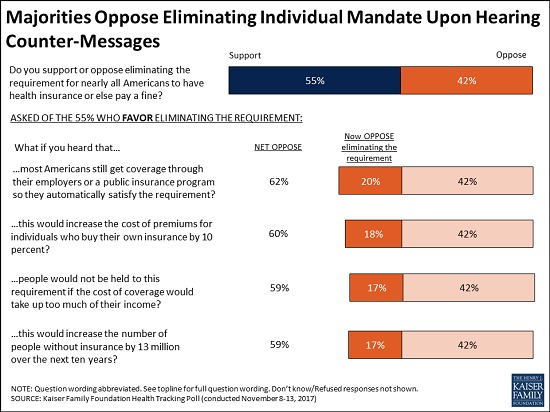
The new poll finds that most Americans (55%) initially support eliminating the mandate as part of tax reform, while four in 10 (42%) oppose it. Most Republicans (73%) and independents (58%) support ending the mandate, while most Democrats (59%) oppose it.

These views are malleable, with about a third of supporters (representing a fifth of the public overall) switching to oppose the mandate’s repeal when presented with facts and arguments about who is impacted and potential consequences of its repeal.

For example, the share who oppose eliminating the mandate can rise as high as 62 percent when initial supporters hear that most Americans get coverage through their employers or government programs that meets the mandate’s requirements. Similar majorities ultimately oppose eliminating the mandate when presented with other arguments against it, including that premiums for people who buy their own health insurance would go up, that people are exempted from the mandate if the cost of coverage takes up too much of their income and that getting rid of the mandate would result in 13 million more people being uninsured over the next 10 years, as the Congressional Budget Office has estimated.

One provision in the House bill would eliminate a tax deduction that allows people with high medical costs to deduct any medical and dental expenses that exceed 10 percent of their income.  A majority (68%) of the public – including majorities of Democrats (77%), independents (66%), and Republicans (61%) oppose eliminating the tax deduction for individuals who have high health care costs.

More than four in 10 (44%) of the public think eliminating the deduction for high medical costs will affect them and their families, though in reality a much smaller share of the public uses that deduction in any given tax year. According to the Internal Revenue Service, about 17 percent of taxpayers who file itemized deductions use this deduction (approximately 6% of all taxpayers and 3% of the public).

Looking ahead to the 2018 midterm elections, the public is divided over whether not passing a tax reform plan or not repealing the ACA would be a bigger deal for President Trump and Republicans. Nearly half of the public say it will be a bigger problem if the president and Republicans are unable to pass their tax reform plan (47%), similar to the share who say it will be a bigger problem if they are unable to revive a repeal of the ACA (44%). Republicans are also divided, with similar shares saying   it would be a bigger deal if President Trump and Republicans are unable to repeal the ACA (50%) and if they are unable to pass tax reform (45%).

Designed and analyzed by public opinion researchers at the Kaiser Family Foundation, the poll was conducted from November 8 – 13, 2017 among a nationally representative random digit dial telephone sample of 1,201 adults. Interviews were conducted in English and Spanish by landline (415) and cell phone (786). The margin of sampling error is plus or minus 3 percentage points for the full sample. For results based on subgroups, the margin of sampling error may be higher.

Why Tax Reform Could Be a Serious Threat to Health Care

http://www.commonwealthfund.org/publications/blog/2017/nov/why-tax-reform-could-be-a-serious-threat-to-health-care

After nine months of unsuccessful efforts to repeal and replace the Affordable Care Act (ACA), Congress has moved on to the challenge of reforming the U.S. tax code. At first glance, it may appear that Congress has shifted priorities: The House tax proposal released last week doesn’t propose to repeal the Affordable Care Act’s individual mandate requiring health insurance, nor does it fund tax reform with cuts to Medicaid.

However, this shift in congressional focus does not mean that Republicans in Washington are done with the ACA. The executive branch continues to undermine the individual health insurance marketplaces. As Sara Collins points out in a recent post on To the Point, two presidential actions last month — the first bypassing ACA consumer protections to allow multistate association health plans, and the second ending payments to insurers for cost-sharing subsidies — are likely to increase premiums on the marketplaces by 2019. Executive branch decisions to cut funding for marketplace outreach are already making it difficult for young, healthy people to explore their insurance options, which could depress enrollment for 2018 and further destabilize the marketplaces.

Moreover, this shift in focus does not mean that the attempts to deeply cut federal health care programs are over, either. Even if congressional leaders lose their appetite for full-scale ACA repeal bills, the futures of tax reform and health care will be intertwined for at least three reasons.

First, some conservatives in the House and Senate remain committed to including ACA repeal provisions in the tax bill. And, while they initially lost in their efforts to attach a repeal of the individual mandate to the current House Bill, conservatives may withhold support unless such a provision is included in the final bill.

Second, the House tax proposal is expensive: the proposed tax cuts total $5 trillion. The budget resolution Congress passed last month allows up to $1.5 trillion of the total cost of the tax cut to be paid for with an increase in the federal deficit. That means the U.S. Treasury will have to borrow money to cover 30 percent of the cost of the House bill — a notable departure from Reagan-era tax cuts that were fully offset. This shortfall will go up over time, because several of the bill’s tax code changes expire in a few years.

While the current House proposal includes $3.5 trillion in revenue-generating provisions to help pay for the remaining 70 percent of the tax cuts, several provisions are unpopular with rank-and-file Republicans. These include a 50 percent cut to the maximum home mortgage deduction and elimination of the current deduction for state and local income taxes. If some Republicans force these provisions out of the bill or modify them to affect fewer taxpayers — changes likely to be sought by Republicans representing districts in large Blue states with high housing costs and high state taxes — then the bill will not raise the revenue required by the budget resolution. Congressional leadership would be forced to pay for tax cuts with other sources of revenue or with cuts in federal spending. Key targets would be cuts to Medicaid and Medicare.

Third, tax reform may ultimately affect access to health care in the not-so-distant future, even if specific health provisions are not included in the bill. Should it pass, the ballooning federal deficit that will follow its implementation will invariably lead to calls to reduce federal spending. Medicaid, Medicare, and ACA coverage will again be in the crosshairs given the portion of federal spending — 28 percent in 2017, growing to 40 percent in 2037 according to the Congressional Budget Office — these health programs represent.

The problem with American health care is the care

The problem with American health care is the care

A bipartisan health care deal recently brokered by Sens. Lamar Alexander (R-Tenn.) and Patty Murray (D-Wash.) would give states greater power over health policy. But even if this nascent legislation falters, states will likely see their influence grow through actions of the Trump administration.

If state governors are going to be in the driver’s seat, they should understand something that Congress, with its narrow focus on insurance coverage, seems to have missed: the main problem with American health care is the care. Although it is important to have stable insurance markets, changes to coverage or benefit design will ultimately do little to reduce costs or make Americans healthier.

Our health care system is stuck in the 1950s, when the prevailing epidemics were polio and influenza. Today’s public health challenges are chronic diseases like diabetes, obesity, and opioid addictionHalf of all adults — 117 million Americans — have a chronic condition; the projected cost is $794 billion in lost productivity alone between 2016 and 2030.

For the most part, chronic diseases aren’t caused by microbes but by problems for which there are no pills or vaccines: deeply rooted personal, social, financial, and behavioral issues, messy, real-life problems like job layoffs, eviction notices, or loneliness. These issues have a profound effect on health, particularly in working-class communities where health care costs are high.

Our health care system hasn’t caught up with the evolving face of disease in America. It is still mostly a workforce of doctors and nurses who dutifully treat patients in hospitals with expensive drugs and high-tech medical devices. If we could reconfigure health care to detect and address the root causes of costly illness, health reform would be a true success.

Several initiatives have laid a path forward. This year, the Center for Medicare and Medicaid Innovation will begin Accountable Health Communities, a five-year grant that enables hospitals and doctor’s offices to check their patients for real-life issues that affect health. Once these have been identified, community health workers — trained laypeople from local communities — would help support patients and connect them to resources like housing or child care. This type of support can have a profound effect on health and lower costs.

In a recent study, my colleagues and I found that a community health worker program called IMPaCT lowered hospitalizations by 30 percent and reduced cigarette smoking, obesity, the severity of diabetes, and mental illness. This model yields a 2-to-1 return on investment, which has prompted large health systems and payers to invest millions in scaling it up.

The current debate around state waivers is focused on limiting health insurance coverage or scaling back essential benefits. Maine has joined Wisconsin, Kentucky, Arkansas, and Utah in submitting waiver applications that impose premiums for Medicaid beneficiaries and coverage lockouts that bar them from re-enrolling in health insurance coverage if they lose it because of unpaid premiums. Maine anticipates that its proposed waiver would lose its members a collective 55,000 months of coverage.

Instead of this approach, governors could apply for waivers to shift Medicaid funds into programs that screen for and address root causes of health through hospitals and doctor’s offices. These programs could yield significant cost savings while improving health, instead of cutting coverage.

Reshuffling insurance coverage schemes as a way to reduce costs is basically a shell game — a dangerous one — that does little to address the core ills of the system. It would be a wasted opportunity if health care reform did not also transform the way we deliver health care so Americans can have better health at lower cost.


Maine Medicaid expansion vote seen as ‘Obamacare’ referendum

https://www.apnews.com/59f70b01af374560baccce244cca0b3d/Maine-Medicaid-expansion-vote-seen-as-‘Obamacare’-referendum

Image result for maine

The roiling national debate over the government’s proper role in health care is coming to a head in a state more commonly known for moose, lobster and L.L. Bean.

On Nov. 7, voters in Maine will decide whether to join 31 other states and expand Medicaid under former President Barack Obama’s Affordable Care Act. It is the first time since the law took effect nearly four years ago that the expansion question has been put to voters.

The ballot measure comes after Maine’s Republican governor vetoed five attempts by the politically divided Legislature to expand the program and take advantage of the federal government picking up most of the cost.

It also acts as a bookend to a year in which President Donald Trump and congressional Republicans tried and failed repeatedly to repeal Obama’s law.

Activists on both sides of the issue are looking at the initiative, Maine Question 2, as a sort of national referendum on one of the key pillars of the law, commonly known as Obamacare. Roughly 11 million people nationwide have gained coverage through the expansion of Medicaid, the state-federal health insurance program for lower-income Americans.

Republican consultant Lance Dutson called Maine’s initiative a national bellwether in which the needs of the people could trump political ideology.

A pillar of former President Barack Obama’s health care law faces a test in Maine, where voters will decide whether to expand Medicaid. If voters pass the initiative, Maine would become the 32nd state to accept the expansion. (Oct. 31)

“People believe there are good parts to Obamacare and bad parts to Obamacare. And without taking Medicaid expansion, we are leaving one of the good parts on the table while still suffering from the bad parts of it,” said Dutson, who supports Question 2.

Maine may not be the last state to put the Medicaid question before voters. Expansion proponents in Idaho and Utah have launched similar efforts in those states aimed at the 2018 ballot.

If the initiative passes, an estimated 70,000 people in Maine would gain health coverage. The issue is personal to many in an aging, economically struggling state with a population that is smaller than the city of San Diego.

Nature painter Laura Tasheiko got dropped from Medicaid three years ago after successfully battling breast cancer. Since then, she has relied on the charitable services of a hospital near her home in Northport, a seaside village of less than 2,000 people about 100 miles northeast of Portland.

She worries about having another serious health problem before she is eligible for Medicare when she turns 65 next year.

“Some of the after-effects of the chemo can be severe, like heart failure,” she said. “Having no insurance is really scary.”

Maine’s hospitals support the Medicaid expansion and say charity care costs them over $100 million annually. The initiative’s supporters have reported spending about $2 million on their campaign, with hundreds of thousands of dollars coming from out-of-state groups. By comparison, the lead political action committee established to oppose the measure has spent a bit less than $300,000.

Among those who say Maine will benefit from the expansion is Bethany Miller. She said her adult son, Kyle, needed Medicaid because he couldn’t afford subsidized monthly insurance premiums even though he was working.

She remembers watching as her son’s eyes went hollow and his body turned skeletal in the weeks before he died, at age 25, from a diabetic coma a year ago.

“He had a job, but he didn’t make enough money to pay for his basic needs and his insulin, and he couldn’t live without his insulin,” said Miller, who lives in Jay, a small paper mill town about 70 miles north of Portland.

LePage, a Trump supporter, is lobbying furiously against the initiative. He and other critics warn that the expansion will be too costly for Maine, even with the federal government picking up most of the tab. After 2020, the state’s share of paying for the expansion population would be 10 percent.

LePage warns that he would have to divert $54 million from other programs — for the elderly, disabled and children — to pay for Medicaid expansion.

“It’s going to kill this state,” he said.

LePage said he considers Medicaid another form of welfare and wants to require recipients to work and pay premiums.

Maine currently serves about 268,000 Medicaid recipients, down from 354,000 in 2011. LePage credits the drop to his administration’s tightened eligibility restrictions.

If Question 2 passes, the Medicaid expansion would cover adults under age 65 with incomes at or below 138 percent of the federal poverty level. That’s $16,643 for a single person or $22,412 for a family of two.

State Rep. Deborah Sanderson, a Republican, said Maine is already struggling to serve its rapidly aging population as nursing homes shutter and rural hospitals struggle.

“I get accused on occasion of trying to pit one population of folks against another,” she said. “It’s a case of only having a certain amount of resources to take care of a large number of needs.”

Finances are a concern in a state marked by factory closures and sluggish wage growth.

But with more people living on the margins, advocates of the expansion say that is all the more reason to extend the benefits of Medicaid. About 8 percent of Maine residents do not have insurance, a little less than the national percentage.

Democratic Sen. Geoffrey Gratwick, a retired rheumatologist, said he has seen many patients throughout his career who did not have health insurance and came to him with a disease already in its late stages. He voted for all five Medicaid expansion attempts.

“They are just as good people as you or I, but their lives will be shorter and they will be sicker,” he said. “Compassion, common sense and our economic interest demand that we get them the health care they need.”

Nathalie Arruda and her husband, Michael, are in that group that is sometimes without insurance. They live in the farming community of Orland, halfway between New Hampshire and the state’s eastern border with New Brunswick, Canada.

The couple run a computer business and rely on herbal teas and locally grown greens to stay healthy as they fall in and out of Medicaid eligibility. LePage restricted Medicaid eligibility for adults with dependents, like the Arrudas.

“There have absolutely been times when my husband or I have put off getting something looked at that we probably should have because we didn’t have coverage,” Arruda said.

In Miller’s view, her son would still be alive if LePage had signed one of the Medicaid expansion bills sent to him by the Legislature.

When Kyle turned 21, he was one of thousands who lost MaineCare coverage under the governor’s reforms. She said he juggled construction jobs but couldn’t afford his $80 subsidized monthly premium for private insurance.

He struggled to pay medical bills from emergency room visits, Miller said.

Before Kyle died last November, he had landed a steady job at a plastics factory that promised health insurance. He didn’t live long enough to get the coverage, falling into a diabetic coma.

“He started rationing his insulin so he could buy food,” his mother said. “And it cost him his life.”

Trump and the Essential Health Benefits

Trump and the Essential Health Benefits

Image result for essential health benefits

On Friday, HHS released a proposed rule that would make a number of adjustments to the rules governing insurance exchanges for 2019. The rule is long and detailed; there’s a lot to digest. Among the most noteworthy changes, however, are those relating to the essential health benefits. They’re significant, and I’m not convinced they’re legal.

By way of background, the ACA requires all health plans in the individual and small-group markets to cover a baseline roster of services, including services falling into ten broad categories (e.g., maternity care, prescription drugs, mental health services). Taken as a whole, the essential health benefits must be “equal to the scope of benefits provided under a typical employer plan, as determined by the Secretary.”

The ACA’s drafters anticipated that HHS would establish a national, uniform slate of essential health benefits. Instead, the Obama administration opted to allow the states to select a “benchmark plan” from among existing plans in the small group market (or from plans for state employees). The benefits covered under the benchmark were then considered “essential” within the state.

At the time, Helen Levy and I concluded that HHS’s approach brushed up against the limits of what the law allowed. We noted, among other things, that the ACA tells HHS to establish the essential health benefits—not the states. And it’s black-letter administrative law that an agency can’t subdelegate its powers to outside entities, states included.

At the end of the day, however, Helen and I concluded that the Obama-era regulation passed muster. Our rationale bears repeating:

Although a federal agency cannot delegate its powers to the states, it “may turn to an outside entity for advice and policy recommendations, provided the agency makes the final decisions itself.” Here, the secretary gave the states a constrained set of options (e.g., choose a benchmark plan from among the three largest small-group plans in the state) and retained the authority to select a benchmark for any state that either does not pick a benchmark or chooses an inappropriate one. As such, the secretary remains firmly in control. Nothing in the ACA prevents her from deferring to states that select benchmark plans from among the few options she has provided. That choice to defer is itself an exercise of her delegated powers.

The Trump administration’s proposed rule would vastly enlarge this Obama-era subdelegation. For starters, the rule would allow a state to adopt another state’s benchmark, or part of a state’s benchmark, as its own. Michigan, for example, could borrow Alabama’s benchmark plan wholesale, or it could incorporate Alabama’s benchmark for mental health and substance use disorder treatment. More significantly, the rule would allow a state to “selec[t] a set of benefits that would become the State’s EHB-benchmark plan.”

You read that right: if the rule is adopted, each state can pick whatever essential health benefits it likes. No longer will it be choosing from a preselected menu; it’ll be picking the essential benefits out of a hat. In so doing, the proposed rule looks like it would unlawfully cede to the states the power to establish the essential benefits.

This extraordinary subdelegation of regulatory authority is subject only to the loosest of constraints: benefits can’t be “unduly weighted” toward any one benefit category or another, and the benchmark must “[p]rovide benefits for diverse segments of the population, including women, children, persons with disabilities, and other groups.” The selected benefits also can’t be more generous than the state’s 2017 benchmark (or any of the plans the state could have selected as its benchmark), but that’s a ceiling, not a floor, so states have lots of room to pare back.

The only meaningful constraint is that the benefits covered by the state’s benchmark must be “equal to the scope of benefits provided under a typical employer plan.” But another portion of the proposed rule would hollow out that requirement:

[W]e propose to define a typical employer plan as an employer plan within a product (as these terms are defined in §144.103 of this subchapter) with substantial enrollment in the product of at least 5,000 enrollees sold in the small group or large group market, in one or more States, or a self-insured group health plan with substantial enrollment of at least 5,000 enrollees in one or more States.

In other words, HHS is saying it will treat as “typical” any employer plan, in any state, that covers more than 5,000 people.

This looks like an innocuous change. It’s not. If the rule is adopted, it means that a single outlier plan can now count as typical, even if it’s way stingier than any other plan in the market. It also makes me wonder if HHS already has in mind some large employer with an unusually narrow health plan—maybe some hospital-based “administrative services only” plan, as Dave Anderson speculates. If so, voilá, the states can all ratchet down their essential benefits to that plan’s level.

I don’t think that’s legal. To know if a slate of health benefits is typical, you have to know something about how many health plans cover those benefits and how many don’t. The proposed rule eschews that comparative inquiry, and instead defines typicality with reference to the number of people who are covered by a single plan. Some random self-insured plan that excludes appendectomies could be treated as typical, even if it’s the only plan in the nation that does so.

In other words, HHS wants to define a “typical employer plan” to include atypical plans—which the agency emphatically cannot do. Yes, plans that enroll 5,000+ people are less likely to be outliers than smaller ones. But in a country as big and complicated as ours, there are bound to be some idiosyncratic quirks even in large plans. Those quirks would all be considered typical under HHS’s rule.

This definitional change, combined with the choose-your-own-adventure option to devise a benchmark, means that states will have wide authority to water down the essential health benefits requirement. Whether that’s good or bad is hard to say. Requiring plans to cover lots of services assures comprehensive coverage, but it also raises the cost of insurance. Because there’s no single “best” way to strike the balance, I think there’s a lot to be said for giving states the freedom to choose for themselves.

Wise or not, however, I’m skeptical that the Trump administration’s effort to hollow out the rule governing essential health benefits is legal. If HHS presses ahead with the rule, it could face tough sledding in the courts.