Trump is reading the GOP base wrong on the Affordable Care Act

https://www.axios.com/trump-reading-base-wrong-aca-b6e2521c-d386-4c94-81e8-b018a6aaf3b1.html?utm_source=newsletter&utm_medium=email&utm_campaign=newsletter_axiosvitals&stream=top

Image result for Trump is reading the GOP base wrong on the Affordable Care Act


The only plausible explanation for President Trump’s renewed effort through the courts to do away with the Affordable Care Act, other than muscle memory, is a desire to play to his base despite widely reported misgivings in his own administration and among Republicans in Congress.

Reality check: But the Republican base has more complicated views about the ACA than the activists who show up at rallies and cheer when the president talks about repealing the law. The polling is clear: Republicans don’t like the ACA, but just like everyone else, they like its benefits and will not want to lose them.

The big picture: About three quarters of Republicans still have an unfavorable view of the ACA, and seven in 10 say repealing the law is a top health priority for Congress — higher than other priorities such as dealing with prescription drug costs. And yes, 7 in 10 Republicans still want to see the Supreme Court overturn the law.

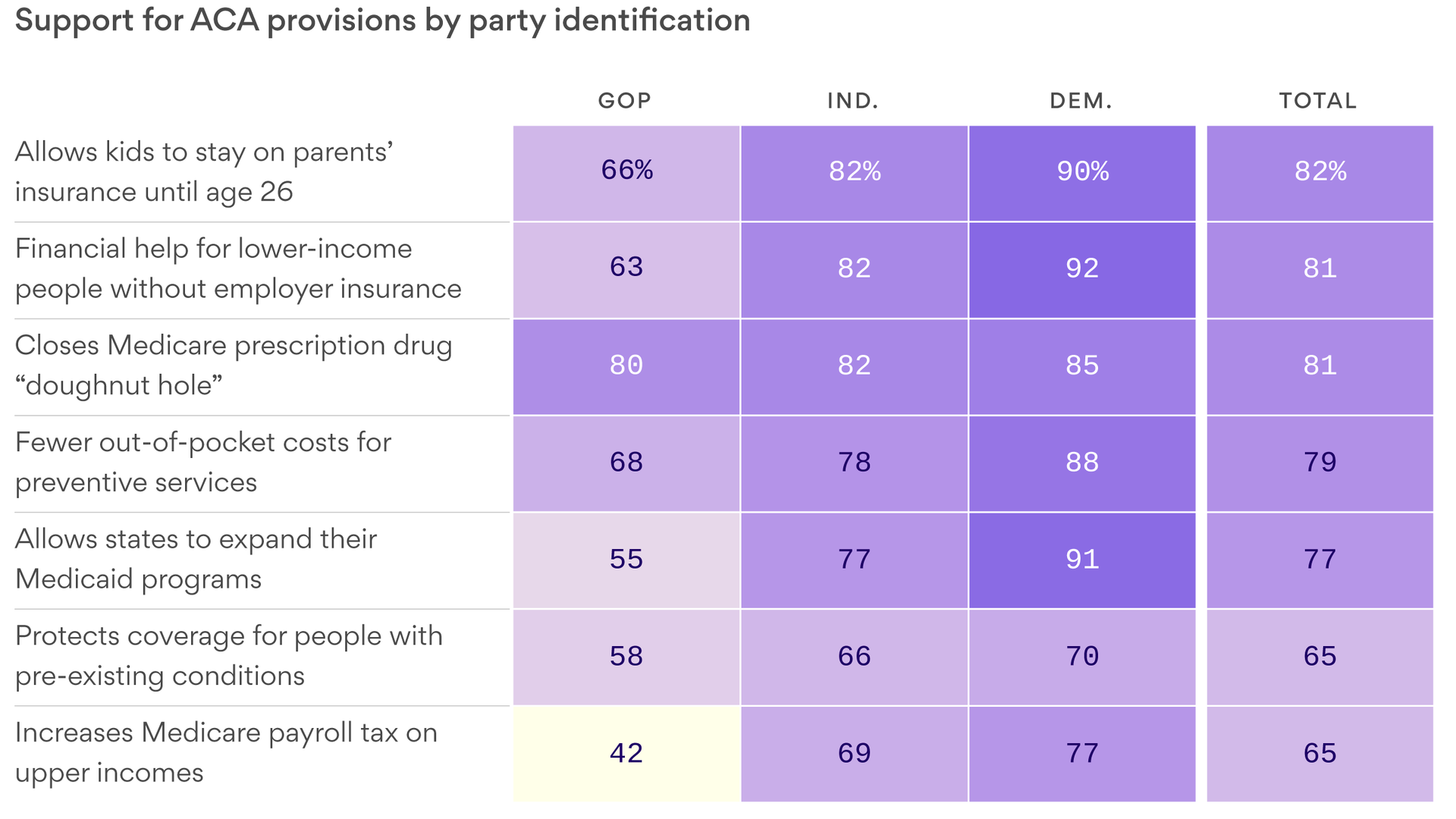
But as the chart shows, majorities of Republicans like many elements of the ACA —especially closing the “donut hole” in Medicare prescription drug coverage (80%), eliminating copayments for preventive services (68%), keeping young adults under 26 on their parents’ plans (66%) and subsidies for low and middle-income households (63%).

  • Nearly half of Republicans want the Supreme Court to keep the protections for pre-existing conditions (49%), and even more show general support for the pre-existing conditions protections (58%).
  • During the repeal and replace debate in 2017, even Republicans were nervous to hear that these sorts of things would go away. The 2020 campaign would drive home to the public, and to Republicans, what they have to lose — and it would become especially real to them if the 5th Circuit Court of Appeals upholds the ruling striking down the ACA.

Maybe Republicans would forget about these lost benefits if they could agree on a replacement plan they liked? But there isn’t one, and many of the ideas thought to be elements of one — such as cutting and block granting both Medicaid and ACA subsidies — are non-starters with Democrats and moderate Republicans on Capitol Hill. They’re unpopular with the public, too. 

The bottom line: It is widely accepted that a renewed debate about repeal hands Democrats a powerful new political opportunity. Deeper in the polling, it’s also clear that’s it’s more of a mixed bag for Republicans than President Trump may realize.  


So, about being the “party of health care”

https://www.axios.com/newsletters/axios-vitals-4b66c0e1-2525-4bb1-a974-f97c9e3e5392.html?utm_source=newsletter&utm_medium=email&utm_campaign=newsletter_axiosvitals&stream=top

Image result for kicking the can

GOP leaders are trying their best to put a lid on President Trump’s talk of a new and wonderful health care plan that would define the Republican Party for 2020.

“Not any longer,” Senate Majority Leader Mitch McConnell said yesterday when asked whether he and Trump differ on health care.

  • McConnell said he spoke to Trump Monday and “made it clear to him that we were not going to be doing that in the Senate.”
  • RNC Chair Ronna McDaniel and Trump campaign manager Brad Parscale also “tried to tell the president they could not understand what he was doing,” The New York Times reports.

Rhetorically, Trump has kicked the can past 2020, just after pushing his administration to dive back into — and escalate — the legal fight that hurt Republicans so badly in 2018.

  • “I wanted to delay it myself,” Trump said in the Oval Office yesterday, denying that McConnell forced his hand. “I want to put it after the election, because we don’t have the House.”

Reality check: It’s still the Justice Department’s position that the courts should strike down the Affordable Care Act. As long as this lawsuit is still active — and that will be a while — it’ll be accurate for Democrats to say on the campaign trail that Trump is trying to end protections for pre-existing conditions.

  • In the short term, Trump’s rhetorical punt to 2021 may dampen the intensity of questions about how Republicans would rebuild a new system for individual coverage — questions the party has struggled to answer for the past 9 years.
  • But in the end, the only good way out is for the Trump administration to lose this case.


The winning health care message will be about out of pocket costs

https://www.axios.com/winning-2020-health-care-out-of-pocket-costs-d5708e35-b308-4c91-a636-121e45f82032.html

Illustration of a wallet full of band-aids

As the 2020 campaign ramps up, Democrats may be able to rally their base by talking about universal coverage and making health care a right through Medicare-for-all. Republicans may be able to motivate their core voters by branding progressive Democratic ideas as socialism.

The catch: But it’s the candidates who can connect their plans and messages to voters’ worries about out of pocket costs who will reach beyond the activists in their base. And the candidates aren’t speaking to that much, at least so far.

By the numbers:

  • The anxiety over out of pocket costs is real. In a January 2017 Kaiser poll, 48 percent of voters worried about paying their health care bills.
  • People who are sick are especially concerned, with 66 percent worried and 49 percent very worried.
  • It isn’t just in their heads: a whopping half of people who are sick have a problem paying their medical bills over the course of a year. The health insurance system is not working for people who are sick.

Thanks in part to the Affordable Care Act, only 10 percent of the population remains uncovered. But that means many Americans are less focused on getting to universal coverage, even though candidate after candidate talks about it. They have insurance and are focused on their own, often crippling health care costs.

  • Most Americans are healthy and don’t use much care, but almost everyone, not just people with a major illness, worries about what might happen if they or a family member get cancer or heart disease or suffer a permanent injury.
  • That’s what fuels health care as an issue: the fear of facing costs people know they cannot afford. And that’s why protections for people with pre-existing conditions broke through as a prominent issue in the midterm election.
  • The debate and the Democratic message could shift back to the ACA again, after President Trump and the Justice Department’s surprise decision to push for throwing out the entire law in the courts. That move handed Democrats a political opportunity they will not ignore: a pre-existing conditions debate on steroids.

Recent trends have made problems with out of pocket costs worse:

Some of the administration’s policies are exacerbating the problem, such as their efforts to push cheaper short term insurance plans for the healthy, which drive up costs for the sick because they leave fewer healthy people in the regular insurance plans to help pay for sick people’s costs.

  • Several of the candidates’ plans address out of pocket costs, including the Bernie Sanders plan, which eliminates them. Their advocates just don’t talk about it much.

The bottom line: It’s hard to see the new debate about the health system breaking out of familiar boxes unless the messaging changes. And when the general election comes, both parties will have to convince voters that they will do something about out of pocket costs if they want to reach beyond core base voters. 


DOJ supports striking entire ACA: 5 things to know

https://www.beckershospitalreview.com/legal-regulatory-issues/doj-supports-striking-entire-aca-5-things-to-know.html

Image result for severability

In a March 25 court filing, the Department of Justice said it supports a judge’s ruling that the entire Affordable Care Act should be invalidated, according to CNN.

Five things to know:

1. In December, a federal judge in Texas held that the ACA is unconstitutional. He sided with the Republican-led states that brought the lawsuit, Texas v. United States, calling for the entire ACA to be struck down because Congress eliminated the healthcare law’s individual insurance mandate penalty.

2. The case is now pending in the 5th Circuit Court of Appeals. In a filing with the appellate court on March 25, the Justice Department said it supports the federal judge’s ruling that invalidated the ACA.

3. “The Department of Justice has determined that the district court’s judgment should be affirmed,” lawyers for the Justice Department wrote to the 5th Circuit Court of Appeals, according to Politico. “[T]he United States is not urging that any portion of the district court’s judgment be reversed.”

4. The filing signals a major shift in the Justice Department’s position. When Jeff Sessions was attorney general, the administration argued only certain parts of the ACA, like protections for people with pre-existing conditions, should be struck down, but the rest of the law could stand, according to CNN.

5. A coalition of Democratic-led states is challenging the Texas ruling. Regardless of the outcome, the 5th Circuit’s ruling is likely to be appealed to the Supreme Court, according to Politico.

Access the full CNN article here.

Access the full Politico article here.


Trump admin now backs elimination of ACA in court

https://www.healthcaredive.com/news/trump-admin-now-backs-elimination-of-aca-in-court/551319/

UPDATED: AHA blasted the decision, calling it “unprecedented and unsupported” by law or facts and warned it would lead to repeal of Medicaid expansion and gut protections for those with pre-existing conditions.

Dive Brief:

  • The Trump administration has reversed its stance on the Affordable Care Act, arguing in a court filing Monday that the entire law should be eliminated instead of just removing provisions protecting people with preexisting conditions.
  • The move came hours after Democratic attorneys general defending the ACA filed their brief arguing that the landmark law is still constitutional even without an effective individual mandate penalty. Both filings are in the Fifth Circuit following an appeal of a Texas judge’s decision from December declaring the law unconstitutional after Congress set the mandate penalty to zero in tax overhaul legislation. That decision was stayed pending appeal.
  • Industry groups lambasted the administration’s about-face. America’s Health Insurance Plans CEO Matt Eyles said in a statement the decision was, like the Texas ruling, “misguided and wrong.” He added the payer lobby “will continue to engage on this issue as it continues through the appeals process so we can support and strengthen affordable coverage for every American.” Federation of American Hospitals CEO Chip Kahn said in a statement the decision is “unfortunate but not unexpected considering [the administration’s] long-held views on the health law.”

Dive Insight:

Elimination of the ACA would be a particular blow for some payers that have found increasing profitability in the individual market. Centene and Molina have found success with the exchanges and have expanded their footprints.

It would also put major hospital chains in a bad spot. Companies like HCA, Tenet and Community Health Systems have exposure that could subject them to reduced patient volumes and more bad debt, Leerink analyst Ana Gupte said when the Texas ruling first came down.

Public support for the ACA has gradually increased over the years, and the latest polling from the Kaiser Family Foundation shows about 53% of respondents giving a favorable view and 40% unfavorable. Individual components of the law are even more popular.

The ACA, which just days ago marked its ninth anniversary, brought forth massive change in American healthcare. A repeal of the law would do the same, stripping insurance coverage for as many as 17 million people.

The Trump administration’s new stance presents an intensely stark contrast with the growing field of Democratic presidential contenders, who have shifted the healthcare conversation to the left as the 2020 field shapes up. Candidates have proposed various forms of Medicare for all as well as scaled back versions that still greatly expand government coverage.

It moves the DOJ away from even some Republicans. During last year’s midterms a few GOP candidates said they approved of the ACA’s most popular element — protection for people with preexisting conditions (although voting records didn’t necessarily back them up).

Most Democrats in Congress aren’t fully backing any single-payer model at the moment, but their support for the ACA is strong. Democrats in the House of Representatives are expected to announce a legislative package Tuesday that would strengthen the ACA by eliminating short-term health plans that don’t comply with the law and increasing subsidies for exchange plans.

Since the GOP’s quite public failure to repeal the law two years ago, efforts to do so through Congress have sputtered to nearly a halt. Instead, the Trump administration started chipping away at the law’s provisions. It cut the open enrollment period for ACA plans, as well as the advertising budget for promoting sign-ups, and stopped cost-sharing reduction payments to insurers.

More recently, HHS has bolstered short-term and association health plans that offer cheap but skimpy coverage not in line with ACA requirements. Analysts fear proliferation of these plans could draw young and healthy people away from the exchanges, jeopardizing the stability of the risk pool.

A Democratic-led House panel launched an investigation into short-term plans and is requesting documents from Anthem and UnitedHealth Group, among other companies.

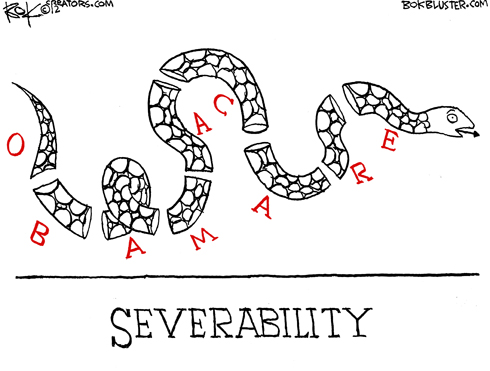
The legal issue at hand is known as severability — the question of whether a single provision of the law, in this case the individual mandate, becoming unenforceable invalidates the entire statute. The mandate was also the key question in the original U.S. Supreme Court ruling allowing the ACA to move forward.

The high court has since lurched to the right, which is notable if the appeal on the Texas ruling reaches that stage, although that would likely be far down the road.


Judge rules Trump AHP expansion unlawful ‘end-run’ around ACA

https://www.healthcaredive.com/news/judge-rules-trump-ahp-expansion-unlawful-end-run-around-aca/551601/

Image result for association health plans

Dive Brief:

  • A federal judge on Thursday struck down a Trump administration expansion of association health plans, which aren’t bound by the requirements of the Affordable Care Act. U.S. District Judge John Bates said the June rule from the Department of Labor that loosened restrictions on what groups could band together to offer AHPs “is clearly an end-run around the ACA.”
  • The ruling stems from a lawsuit 11 states and the District of Columbia filed to challenge the DOL rule. It comes the same week the Trump administration stepped up its attacks against the ACA, arguing in a court filing Monday the law should be eliminated in its entirety following a Texas judge’s decision the act is unconstitutional without the individual mandate penalty.
  • The judge had strong language condemning the administration’s attempt to allow for easier creation and use of AHPs, calling the regulatory change a “magic trick” that allowed for “absurd results” undermining the intent of Congress.

Dive Insight:

The ruling is a blow to the Trump administration’s efforts to circumvent the ACA, which ramped up significantly with the administration’s filing this week seeking complete repeal of the law. Another hit to those efforts came down Wednesday when a different federal judge struck down Medicaid work requirements in Arkansas and Kentucky.

The renewed fight comes as Democrats lining up for a 2020 presidential run are pushing for more progressive policies than have previously gained public traction. Some Democratic contenders are making Medicare for all and other single-payer models a central part of their platforms as healthcare shapes up to be a major issue for the next presidential election.

Experts have argued extended use of AHPs could siphon away young and healthy people looking for minimum coverage at a lower cost. If they choose AHPs they upset the balance on risk pools for more comprehensive coverage. Also, many consumers don’t understand the tradeoff and could be surprised by what isn’t covered when they are in need.

But even though the plans aren’t required to meet ACA standards, some that have formed have been adamant they provide adequate coverage, including the 10 essential ACA benefits. The plans are less obstructive to the regulatory environment than short-term health plans, which have also been granted more leeway under the Trump administration.

Land O’Lakes, for example, which said it was the first to offer an AHP under the more relaxed rules, said its plan covered essential benefits and pre-existing conditions, as well as “broad network coverage.”

The Society of Actuaries has said as many as 10% of people in ACA plans could leave for AHPs, which would also drive up premiums for plans in the individual market. Avalere predicted about 3.2 million people would shift and premiums would rise by 3.5%.

Supporters of AHPs decried the judge’s decision Thursday. Kev Coleman, founder of AssocationHealthPlans.com, said in a statement the ruling will hurt small businesses throughout the country.

“Thousands of employees and family members within the small business community have already enrolled in association health plans — which help lower health care costs — since they first became available last fall,” he said. “They have provided a means by which broad benefits may be accessed at more economical prices. While I do not believe today’s ruling will survive appeal, I believe Judge Bates’ decision is an unnecessary detour on small businesses’ path toward more affordable health coverage.”


Health Insurance Coverage Eight Years After the ACA

https://www.commonwealthfund.org/publications/issue-briefs/2019/feb/health-insurance-coverage-eight-years-after-aca

Fewer Uninsured Americans and Shorter Coverage Gaps, But More Underinsured

What does health insurance coverage look like for Americans today, more than eight years after the Affordable Care Act’s passage? In this brief, we present findings from the Commonwealth Fund’s latest Biennial Health Insurance Survey to assess the extent and quality of coverage for U.S. working-age adults. Conducted since 2001, the survey uses three measures to gauge the adequacy of people’s coverage:

  • whether or not they have insurance
  • if they have insurance, whether they have experienced a gap in their coverage in the prior year
  • whether high out-of-pocket health care costs and deductibles are causing them to be underinsured, despite having continuous coverage throughout the year.

As the findings highlighted below show, the greatest deterioration in the quality and comprehensiveness of coverage has occurred among people in employer plans. More than half of Americans under age 65 — about 158 million people — get their health insurance through an employer, while about one-quarter either have a plan purchased through the individual insurance market or are enrolled in Medicaid.1Although the ACA has expanded and improved coverage options for people without access to a job-based health plan, the law largely left the employer market alone.2

Survey Highlights

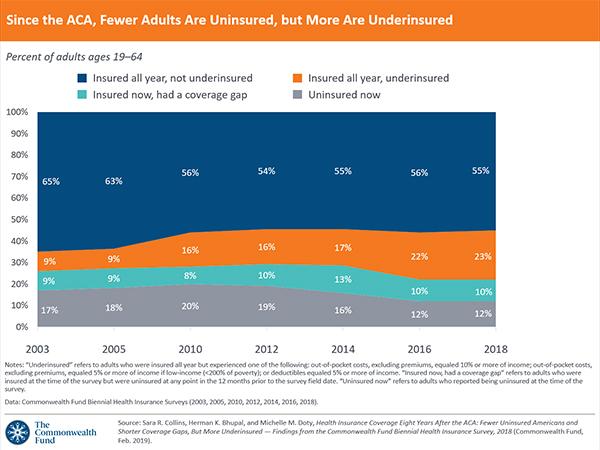
  • Today, 45 percent of U.S. adults ages 19 to 64 are inadequately insured — nearly the same as in 2010 — though important shifts have taken place.
  • Compared to 2010, many fewer adults are uninsured today, and the duration of coverage gaps people experience has shortened significantly.
  • Despite actions by the Trump administration and Congress to weaken the ACA, the adult uninsured rate was 12.4 percent in 2018 in this survey, statistically unchanged from the last time we fielded the survey in 2016.
  • More people who have coverage are underinsured now than in 2010, with the greatest increase occurring among those in employer plans.
  • People who are underinsured or spend any time uninsured report cost-related problems getting care and difficulty paying medical bills at at higher rates than those with continuous, adequate coverage.
  • Federal and state governments could enact policies to extend the ACA’s health coverage gains and improve the cost protection provided by individual-market and employer plans.

The 2018 Commonwealth Fund Biennial Heath Insurance Survey included a nationally representative sample of 4,225 adults ages 19 to 64. SSRS conducted the telephone survey between June 27 and November 11, 2018.3 (See “How We Conducted This Study” for more detail.)

WHO IS UNDERINSURED?

In this analysis, we use a measure of underinsurance that accounts for an insured adult’s reported out-of-pocket costs over the course of a year, not including insurance premiums, as well as his or her plan deductible. (The measure was first used in the Commonwealth Fund’s 2003 Biennial Health Insurance Survey.*) These actual expenditures and the potential risk of expenditures, as represented by the deductible, are then compared with household income. Specifically, we consider people who are insured all year to be underinsured if:

  • their out-of-pocket costs, excluding premiums, over the prior 12 months are equal to 10 percent or more of household income; or
  • their out-of-pocket costs, excluding premiums, over the prior 12 months are equal to 5 percent or more of household income for individuals living under 200 percent of the federal poverty level ($24,120 for an individual or $49,200 for a family of four); or
  • their deductible constitutes 5 percent or more of household income.

The out-of-pocket cost component of the measure is only triggered if a person uses his or her plan to obtain health care. The deductible component provides an indicator of the financial protection the plan offers and the risk of incurring costs before someone gets health care. The definition does not include other dimensions of someone’s health plan that might leave them potentially exposed to costs, such as copayments or uncovered services. It therefore provides a conservative measure of underinsurance in the United States.

Compared to 2010, when the ACA became law, fewer people today are uninsured, but more people are underinsured. Of the 194 million U.S. adults ages 19 to 64 in 2018, an estimated 87 million, or 45 percent, were inadequately insured (see Tables 1 and 2).

Despite actions by the Trump administration and Congress to weaken the ACA, our survey found no statistically significant change in the adult uninsured rate by late 2018 compared to 2016 (Table 3). This finding is consistent with recent federal surveys, but other private surveys (including other Commonwealth Fund surveys) have found small increases in uninsured rates since 2016 (see “Changes in U.S. Uninsured Rates Since 2013”).

While there has been no change since 2010, statistically speaking, in the proportion of people who are insured now but have experienced a recent time without coverage, these reported gaps are of much shorter duration on average than they were before the ACA. In 2018, 61 percent of people who reported a coverage gap said it has lasted for six months or less, compared to 31 percent who said they had been uninsured for a year or longer. This is nearly a reverse of what it was like in 2012, two years before the ACA’s major coverage expansions. In that year, 57 percent of adults with a coverage gap reported it was for a year or longer, while one-third said it was a shorter gap.

There also has been some improvement in long-term uninsured rates. Among adults who were uninsured at the time of the survey, 54 percent reported they had been without coverage for more than two years, down from 72 percent before the ACA coverage expansions went into effect. The share of those who had been uninsured for six months or less climbed to 20 percent, nearly double the rate prior to the coverage expansions.

Of people who were insured continuously throughout 2018, an estimated 44 million were underinsured because of high out-of-pocket costs and deductibles (Table 1). This is up from an estimated 29 million in 2010 (data not shown). The most likely to be underinsured are people who buy plans on their own through the individual market including the marketplaces. However, the greatest growth in the number of underinsured adults is occurring among those in employer health plans.

WHY ARE INSURED AMERICANS SPENDING SO MUCH OF THEIR INCOME ON HEALTH CARE COSTS?

Several factors may be contributing to high underinsured rates among adults in individual market plans and rising rates in employer plans:

  1. Although the Affordable Care Act’s reforms to the individual market have provided consumers with greater protection against health care costs, many moderate-income Americans have not seen gains. The ACA’s essential health benefits package, cost-sharing reductions for lower- income families, and out-of-pocket cost limits have helped make health care more affordable for millions of Americans. But while the cost-sharing reductions have been particularly important in lowering deductibles and copayments for people with incomes under 250 percent of the poverty level (about $62,000 for a family of four), about half of people who purchase marketplace plans, and all of those buying plans directly from insurance companies, do not have them.4
  2. The bans against insurers excluding people from coverage because of a preexisting condition and rating based on health status have meant that individuals with greater health needs, and thus higher costs, are now able to get health insurance in the individual market. Not surprisingly, the survey data show that people with individual market coverage are somewhat more likely to have health problems than they were in 2010, which means they also have higher costs.
  3. While plans in the employer market historically have provided greater cost protection than plans in the individual market, businesses have tried to hold down premium growth by asking workers to shoulder an increasing share of health costs, particularly in the form of higher deductibles.5 While the ACA’s employer mandate imposed a minimum coverage requirement on large companies, the requirement amounts to just 60 percent of typical person’s overall costs. This leaves the potential for high plan deductibles and copayments.
  4. Growth in Americans’ incomes has not kept pace with growth in health care costs. Even when health costs rise more slowly, they can take an increasingly larger bite out of incomes.

It is well documented that people who gained coverage under the ACA’s expansions have better access to health care as a result.6 This has led to overall improvement in health care access, as indicated by multiple surveys.7 In 2014, the year the ACA’s major coverage expansions went into effect, the share of adults in our survey who said that cost prevented them from getting health care that they needed, such as prescription medication, dropped significantly (Table 4). But there has been no significant improvement since then.

The lack of continued improvement in overall access to care nationally reflects the fact that coverage gains have plateaued, and underinsured rates have climbed. People who experience any time uninsured are more likely than any other group to delay getting care because of cost (Table 5). And among people with coverage all year, those who were underinsured reported cost-related delays in getting care at nearly double the rate of those who were not underinsured.

There was modest but significant improvement following the ACA’s coverage expansions in the proportion of all U.S. adults who reported having difficulty paying their medical bills or said they were paying off medical debt over time (Table 4). Federal surveys have found similar improvements.8 However, those gains have stalled.

Inadequate insurance coverage leaves people exposed to high health care costs, and these expenses can quickly turn into medical debt. More than half of uninsured adults and insured adults who have had a coverage gap reported that they had had problems paying medical bills or were paying off medical debt over time (Table 6). Among people who had continuous insurance coverage, the rate of medical bill and debt problems is nearly twice as high for the underinsured as it is for people who are not underinsured.

Having continuous coverage makes a significant difference in whether people have a regular source of care, get timely preventive care, or receive recommended cancer screenings. Adults with coverage gaps or those who were uninsured when they responded to the survey were the least likely to have gotten preventive care and cancer screenings in the recommended time frame.

Being underinsured, however, does not seem to reduce the likelihood of having a usual source of care or receiving timely preventive care or cancer screens — provided a person has continuous coverage. This is likely because the ACA requires insurers and employers to cover recommended preventive care and cancer screens without cost-sharing. Even prior to the ACA, a majority of employer plans provided predeductible coverage of preventive services.9

Conclusion and Policy Implications

U.S. working-age adults are significantly more likely to have health insurance since the ACA became law in 2010. But the improvement in uninsured rates has stalled. In addition, more people have health plans that fail to adequately protect them from health care costs, with the fastest deterioration in cost protection occurring in the employer market. The ACA made only minor changes to employer plans, and the erosion in cost protection has taken a bite out of the progress made in Americans’ health coverage since the law’s enactment.

Both the federal government and the states, however, have the ability to extend the law’s coverage gains and improve the cost protection of both individual-market and employer plans. Here is a short list of policy options:

  • Expand Medicaid without restrictions. The 2018 midterm elections moved as many as five states closer to joining the 32 states that, along with the District of Columbia, have expanded eligibility for Medicaid under the ACA.10 As many as 300,000 people may ultimately gain coverage as a result.11 But, encouraged by the Trump administration, several states are imposing work requirements on people eligible for Medicaid — a move that could reverse these coverage gains. So far, the U.S. Department of Health and Human Services (HHS) has approved similar work-requirement waivers in seven states and is considering applications from at least seven more. Arkansas imposed a work requirement last June, and, to date, more than 18,000 adults have lost their insurance coverage as a result.
  • Ban or place limits on short-term health plans and other insurance that doesn’t comply with the ACA. The Trump administration loosened regulations on short-term plans that don’t comply with the ACA, potentially leaving people who enroll in them exposed to high costs and insurance fraud. These plans also will draw healthier people out of the marketplaces, increasing premiums for those who remain and federal costs of premium subsidies. Twenty-three states have banned or placed limits on short-term insurance policies. Some lawmakers have proposed a federal ban.
  • Reinsurance, either state or federal. The ACA’s reinsurance program was effective in lowering marketplace premiums. After it expired in 2017, several states implemented their own reinsurance programs.12  Alaska’s program reduced premiums by 20 percent in 2018. These lower costs particularly help people whose incomes are too high to qualify for ACA premium tax credits. More states are seeking federal approval to run programs in their states. Several congressional bills have proposed a federal reinsurance program.
  • Reinstate outreach and navigator funding for the 2020 open-enrollment period. The administration has nearly eliminated funding for advertising and assistance to help people enroll in marketplace plans.13 Research has found that both activities are effective in increasing enrollment.14 Some lawmakers have proposed reinstatingthis funding.
  • Lift the 400-percent-of-poverty cap on eligibility for marketplace tax credits. This action would help people with income exceeding $100,000 (for a family of four) better afford marketplace plans. The tax credits work by capping the amount people pay toward their premiums at 9.86 percent. Lifting the cap has a built in phase out: as income rises, fewer people qualify, since premiums consume an increasingly smaller share of incomes. RAND researchers estimate that this policy change would increase enrollment by 2 million and lower marketplace premiums by as much as 4 percent as healthier people enroll. It would cost the federal government an estimated $10 billion annually.15 Legislation has been introduced to lift the cap.
  • Make premium contributions for individual market plans fully tax deductible. People who are self-employed are already allowed to do this.16
  • Fix the so-called family coverage glitch. People with employer premium expenses that exceed 9.86 percent of their income are eligible for marketplace subsidies, which trigger a federal tax penalty for their employers. There’s a catch: this provision applies only to single-person policies, leaving many middle-income families caught in the “family coverage glitch.” Congress could lower many families’ premiums by pegging unaffordable coverage in employer plans to family policies instead of single policies.17

REDUCE COVERAGE GAPS

  • Inform the public about their options. People who lose coverage during the year are eligible for special enrollment periods for ACA marketplace coverage. Those eligible for Medicaid can sign up at any time. But research indicates that many people who lose employer coverage do not use these options.18 The federal government, the states, and employers could increase awareness of insurance options outside the open-enrollment periods through advertising and education.
  • Reduce churn in Medicaid. Research shows that over a two-year period, one-quarter of Medicaid beneficiaries leave the program and become uninsured.19 Many do so because of administrative barriers.20 By imposing work requirements, as some states are doing, this involuntary disenrollment is likely to get worse. To help people stay continuously covered, the federal government and the states could consider simplifying and streamlining the enrollment and reenrollment processes.
  • Extend the marketplace open-enrollment period. The current open-enrollment period lasts just 45 days. Six states that run their own marketplaces have longer periods, some by as much as an additional 45 days. Other states, as well as the federal marketplace, could extend their enrollment periods as well.

IMPROVE INDIVIDUAL-MARKET PLANS’ COST PROTECTIONS

  • Fund and extend the cost-sharing reduction subsidies. The Trump administration eliminated payments to insurers for offering plans with lower deductibles and copayments. Insurers, which by law must still offer reduced-cost plans, are making up the lost revenue by raising premiums. But this fix, while benefiting enrollees who are eligible for premium tax credits, has distorted both insurer pricing and consumer choice.21 In addition, it is unknown whether the administration’s support for the fix will continue in the future, creating uncertainty for insurers.22 Congress could reinstate the payments to insurers and consider making the plans available to people with higher earnings.
  • Increase the number of services excluded from the deductible.Most plans sold in the individual market exclude certain services from the deductible, such as primary care visits and certain prescriptions.23As the survey data suggest, these types of exclusions appear to be important in ensuring access to preventive care among people who have coverage but are underinsured. In 2016, HHS provided a standardized plan option for insurers that excluded eight health services — including mental health and substance-use disorder outpatient visits and most prescription drugs — from the deductible at the silver and gold level.24 The Trump administration eliminated the option in 2018. Congress could make these exceptions mandatory for all plans.

IMPROVE EMPLOYER PLANS’ COST PROTECTIONS

  • Increase the ACA’s minimum level of coverage. Under the ACA, people in employer plans may become eligible for marketplace tax credits if the actuarial value of their plan is less than 60 percent, meaning that under 60 percent of health care costs, on average, are covered. Congress could increase this to the 70 percent standard of silver-level marketplace plans, or even higher.
  • Require deductible exclusions. Congress could require employers to increase the number of services that are covered before someone meets their deductible. Most employer plans exclude at least some services from their deductibles.25 Congress could specify a minimum set of exclusions for employer plans that might resemble the standardized-choice options that once existed for ACA plans.
  • Refundable tax credits for high out-of-pocket costs. Congress could make refundable tax credits available to help insured Americans pay for qualifying out-of-pocket costs that exceed a certain percentage of their income.26
  • Protect consumers from surprise medical bills. Several states have passed laws that protect patients and their families from unexpected medical bills, generally from out-of-network providers.27A bipartisan group of U.S. senators has proposed federal legislation to protect consumers, including people enrolled in employer and individual-market plans.

Health care costs are primarily what’s driving growth in premiums across all health insurance markets. Employers and insurers have kept premiums down by increasing consumers’ deductibles and other cost-sharing, which in turn is making more people underinsured. This means that policy options like the ones we’ve highlighted above will need to be paired with efforts to slow medical spending. These could include changing how health care is organized and providers are paid to achieve greater value for health care dollars and better health outcomes.28 The government also could tackle rising prescription drug costs29 and use antitrust laws to combat the growing concentration of insurer and provider markets.30


Since the ACA, Fewer Adults Are Uninsured, but More Are Underinsured

https://www.commonwealthfund.org/chart/2019/aca-fewer-adults-are-uninsured-more-are-underinsured

Image result for Since the ACA, Fewer Adults Are Uninsured, but More Are Underinsured


Ads for short-term plans may be confusing

https://www.rwjf.org/content/dam/farm/reports/issue_briefs/2019/rwjf451339?utm_source=newsletter&utm_medium=email&utm_campaign=newsletter_axiosvitals&stream=top

Image result for short term health insurance

People Googling for ACA coverage often found results that were actually trying to sell them skimpier short-term health plans, according to a report from Robert Wood Johnson Foundation and the Urban Institute.

Why it matters: Consumer confusion is one of the things regulators worried about most when the Trump administration expanded access to “short-term” coverage.

  • For some people, especially those who do only need coverage for a short time, one of these more bare-bones options might be a better choice than the comprehensive policies sold under the ACA.
  • But if you don’t realize you’re signing up for a plan with incredibly limited coverage and the right to drop you once you get sick, you could be in for a catastrophic surprise.
  • That’s why HHS mandated a disclosure statement about the plans’ limited benefits.

Details: Researchers Googled terms including “cheap health insurance” and “Obamacare plans” and looked at the first 4 results — which are usually ads.

  • Sites that included short-term plans “dominated the results,” though some of those sites also sell ACA-compliant plans. Sites varied in how much information they provided about the differences between the two types of plans.


Pre-existing conditions at House Ways and Means panel’s first policy hearing

Dems hit GOP on pre-existing conditions at panel’s first policy hearing

Dems hit GOP on pre-existing conditions at panel's first policy hearing

The powerful House Ways and Means Committee used its first policy hearing of the new Congress to hammer Republicans on pre-existing conditions, an issue that helped propel Democrats into the majority during the 2018 midterm elections.

Democratic panel members highlighted actions by the Trump administration that they argue have hurt people with pre-existing conditions, like the expansion of non-ObamaCare plans that could draw healthy people from the markets, raising premiums for those left behind.

The administration has expanded access to association and short-term health plans, which cost less than ObamaCare plans but cover fewer services. Republicans say they provide an off-ramp for consumers who can’t afford ObamaCare plans.

The witness invited by Republicans, Rob Robertson with the Nebraska Farm Bureau, said its newly developed association health plan “meets the needs of our members,” who can’t afford ObamaCare plans.

“We’re in this for the long term,” he told lawmakers. “We want to reduce costs, and the costs in the individual market are very, very high.”

ObamaCare’s popular consumer protections became the centerpiece of the November midterms after 20 Republican-led states sued to overturn the 2010 health care law, known as the Affordable Care Act (ACA).

Democrats tied congressional Republicans to the lawsuit after the Trump administration declined to defend ObamaCare and argued that those protections are unconstitutional.

Republicans say there are different ways to cover people with pre-existing conditions, like high-risk pools, which were banned after ObamaCare was implemented. Some pools had caps on coverage and long-waiting lists.

GOP committee members called Tuesday’s hearing political theatre, arguing they also support pre-existing protections but want to lower ObamaCare’s costs.

“Everyone up here wants protections for people with pre-existing conditions. Always have, always will,” said Rep. Devin Nunes (R-Calif.), ranking member of the health subcommittee. “We should be careful that we’re not stoking fear that someone is going to lose their health insurance. We have a responsibility to come up with a better health care system because ObamaCare is not the solution.”

Democrats on Tuesday said the GOP proposals aren’t serious.

Republicans have “political amnesia” and have “forgotten what it was like before the ACA,” said Rep. Lloyd Doggett (D-Texas), chairman of the health subcommittee. “Those with a diagnosis of a serious disease would also get a diagnosis of financial ruin. There were no protections for them before the ACA.”

Some Democratic panel members appealed to the emotional side of the health care debate, with one lawmaker announcing her cancer diagnosis at the hearing.

“This is a cancer I will live with for the rest of my life, but, because of my high-quality healthcare and insurance coverage, it is not a cancer I will die from,” said Rep. Gwen Moore (D-Wis.), 67.

Tensions ran high at times during Tuesday’s hearing, with members re-litigating the 2010 passage of ObamaCare and repeated GOP efforts to repeal it.

“Not one Republican up here supports pre-existing protections for the American people,” said Rep. Brian Higgins (D-N.Y.), who at times pounded his fist on the dais.

That drew a testy response from Rep. Tom Reed (R-Pa.), who said Republicans “heard the voices and the fear” from voters in the 2018 midterms when “this issue became the centerpiece.”

“We listened to this American people, as Republicans,” he said.