Only 20 Percent Of Americans Support Health Law Repeal Without Replacement Plan

http://khn.org/news/only-20-of-americans-support-health-law-repeal-without-replacement-plan/

0106117-kff-fig7

The Republican strategy of repealing the Affordable Health Care Act before devising a replacement plan has the support of only one in five Americans, a poll released Friday finds.

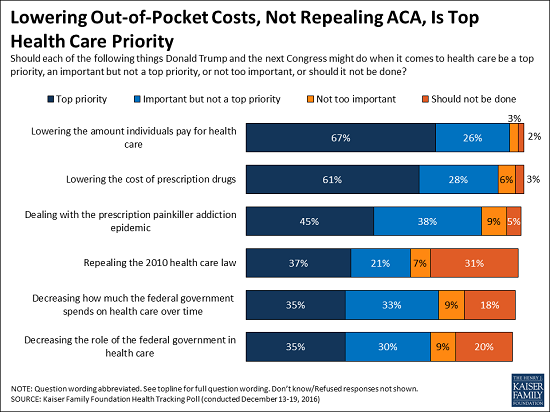
The Kaiser Family Foundation survey also disclosed that shrinking the federal government’s involvement and spending in health care — the long-sought goal of House Speaker Paul Ryan and other Republican lawmakers — is less important to most Americans than is ensuring medical care is affordable and available. (Kaiser Health News is an editorially independent project of the foundation.)

Views split not only on partisan lines but also within the Republican Party, where nearly four in 10 think that the government should guarantee health care is available to the elderly and to low-income people, even if it means more federal involvement.

Despite the rout of Democrats in the election, which gave the GOP control of both the White House and Congress, the public’s view on the Affordable Care Act remains as divided as it has been since it was passed by President Barack Obama and congressional Democrats in 2010.  Currently, 47 percent of the public wants to keep the law, which upended the way insurers do business and expanded coverage to 20 million Americans.


The Health Care Plan Trump Voters Really Want

This week Republicans in Congress began their effort to repeal and potentially replace the Affordable Care Act. But after listening to working-class supporters of Donald J. Trump — people who are enrolled in the very health care marketplaces created by the law — one comes away feeling that the Washington debate is sadly disconnected from the concerns of working people.

Those voters have been disappointed by Obamacare, but they could be even more disappointed by Republican alternatives to replace it. They have no strong ideological views about repealing and replacing the Affordable Care Act, or future directions for health policy. What they want are pragmatic solutions to their insurance problems. The very last thing they want is higher out-of-pocket costs.

The Kaiser Foundation organized six focus groups in the Rust Belt areas — three with Trump voters who are enrolled in the Affordable Care Act marketplaces, and three with Trump voters receiving Medicaid. The sessions, with eight to 10 men and women each, were held in late December in Columbus, Ohio, Grand Rapids, Mich., and New Cumberland, Pa. Though the participants did not agree on everything, they expressed remarkably similar opinions on many health care questions. They were not, by and large, angry about their health care; they were simply afraid they will be unable to afford coverage for themselves and their families. They trusted Mr. Trump to do the right thing but were quick to say that they didn’t really know what he would do, and were worried about what would come next.

They spoke anxiously about rising premiums, deductibles, copays and drug costs. They were especially upset by surprise bills for services they believed were covered. They said their coverage was hopelessly complex. Those with marketplace insurance — for which they were eligible for subsidies — saw Medicaid as a much better deal than their insurance and were resentful that people with incomes lower than theirs could get it. They expressed animosity for drug and insurance companies, and sounded as much like Bernie Sanders supporters as Trump voters. One man in Pennsylvania with Type 1 diabetes reported making frequent trips to Eastern Europe to purchase insulin at one-tenth the cost he paid here.


Poll: Public Divided on Repealing Obamacare, But Few Want It Repealed Without Replacement Details

http://connect.kff.org/poll-public-divided-on-repealing-obamacare-but-few-want-it-repealed-without-replacement-details?ecid=ACsprvtG5kIoCbXzcE3WLgrX01kIXFDaDUgXQ0BUzNGGn2gIr2haSAC8OzTQSp0H3e0Qeujg-Q9Y&utm_campaign=KFF-2017-January-Priorities-Tracking-Poll&utm_source=hs_email&utm_medium=email&utm_content=40166809&_hsenc=p2ANqtz-_zwF7NlvPoFINfG9Nd0OPcBebPHjaaSvuWqkCefkoOcmCo9aOPqJHM0W6_uhOAYH4ucOOIuXrEe40HttSNtSg8udNc1A&_hsmi=40166809

1.6.17 - 2017 tracking email alert - image 2.png

Out-of-Pocket Costs, Not the Affordable Care Act, Top Public’s List of Health Care Priorities for new Administration and Congress

As Congress begins to work on repealing and replacing the Affordable Care Act, the latest Kaiser Health Tracking Poll finds that one in five Americans (20%) support repeal alone, while three quarters either oppose repeal altogether (47%) or want to wait to repeal the law until the replacement plan’s details are known (28%).

Overall, the poll finds that nearly equal shares say that the next Congress should vote to repeal the law (49%) and that it should not vote to repeal it (47%), which mirrors the public’s overall views of the 2010 law (46% view it unfavorably, 43% favorably).

The debate surrounding repeal could influence the public’s views, as the poll finds that some people shift their opinions after hearing counter-arguments.  For example, after hearing pro-repeal arguments about the law’s costs to individuals and the government, the share of the public supporting repeal grows as large as 60 percent, while anti-repeal arguments about people losing coverage and the impact on people with pre-existing conditions decreases support for repeal to as low as 27 percent.

When asked directly about their family’s health care costs, similar shares of the public say repealing the Affordable Care Act would make their situation worse (28%) as say it would make it better (27%). Most say their own ability to get and keep health insurance (55%) and the quality of their own health care (57%) will stay about the same if Congress votes to repeal the law.

GOP won’t promise ObamaCare fix will cover all

GOP won’t promise ObamaCare fix will cover all

Image result for uninsured

Republican leaders are refusing to commit to their ObamaCare replacement plan covering as many people as President Obama’s health law.

Congressional Republicans are quickly moving forward to pass a repeal of ObamaCare and say a replacement plan will come later this year.

But it’s unclear whether that eventual replacement will provide insurance options for at least 20 million people, the number who gained coverage under ObamaCare, amid worries that many could lose their health insurance.


Doctors Group Warns Against Loss Of Coverage From ObamaCare Repeal

Doctors group warns against loss of coverage from ObamaCare repeal

Doctors group warns against loss of coverage from ObamaCare repeal

The country’s leading doctors group is urging Republicans to take steps to ensure that people do not lose their health insurance once ObamaCare is repealed.

The American Medical Association (AMA), wrote a letter to congressional leaders on Tuesday calling for the gains in coverage from ObamaCare, which has expanded insurance to 20 million people, to be preserved.

“In considering opportunities to make coverage more affordable and accessible to all Americans, it is essential that gains in the number of Americans with health insurance coverage be maintained,” AMA CEO Dr. James Madara wrote leaders in both parties.

“Consistent with this core principle, we believe that before any action is taken through reconciliation or other means that would potentially alter coverage, policymakers should lay out for the American people, in reasonable detail, what will replace current policies,” Madara continued.

“Patients and other stakeholders should be able to clearly compare current policy to new proposals so they can make informed decisions about whether it represents a step forward in the ongoing process of health reform.”

The AMA’s position is at odds with Republicans’ current plan. The GOP is moving forward this month with plans to repeal ObamaCare without a replacement, but delay repeal going into effect for a few years to buy time for drafting an alternative.

The American Hospital Association, meanwhile, warned in a report last month of an “unprecedented public health crisis” from people losing coverage under ObamaCare repeal.

The AMA added that ObamaCare is “imperfect” and said it would favor policies if they increased coverage, choices and affordability.

More than 50 million adults with pre-existing conditions would lose coverage in wake of Obamacare repeal, Kaiser study says

http://www.healthcarefinancenews.com/news/more-50-million-adults-pre-existing-conditions-would-lose-coverage-wake-obamacare-repeal-kaiser

Image result for pre-existing conditions

Kaiser Family Foundation poll found the 53 percent of people reported that they or someone in their household has a pre-existing condition.

Crossing the Political Chasm

http://www.commonwealthfund.org/publications/blog/2016/dec/crossing-the-political-chasm

As a new chapter in the saga of U.S. health care reform is written in the coming year, it’s worth remembering that, behind the layers of jargon and obscure political maneuvers, the consequences of success—and of failure—will be shared by individuals and groups across our society…regardless of ideology, demography, or geography.

After the Election, the Public Remains Sharply Divided on Future of the Affordable Care Act

http://connect.kff.org/after-the-election-the-public-remains-sharply-divided-on-future-of-the-affordable-care-act?ecid=ACsprvtkG7thn0KvqmasXGGSnW1I2ovnfcZhoigDXi-aw9Wa_OhWGcyqpjasxqgfF_XFOsbs0N1f&utm_campaign=KFF-2016-November-Tracking-Poll&utm_source=hs_email&utm_medium=email&utm_content=38490459&_hsenc=p2ANqtz–qXSbCJ4pmKneag47QgP5kargBeYht5Al3rljRS8wEAQj-n-71yE8rwo5xn_Bg9Nwp-C89R9o_HVKBqqv5G6aMyddn9g&_hsmi=38490459

november poll1.png

Among Those Who Favor Repeal, Arguments About Loss of Coverage for Those with Pre-Exiting Conditions Can Sway Some Opinions

Many Obamacare Provisions Remain Broadly Popular Across Party Lines, But Not its Mandate

The first Kaiser Health Tracking Poll since the 2016 election finds that Americans are largely divided on the future of the Affordable Care Act even though many of the law’s major provisions remain quite popular across party lines.

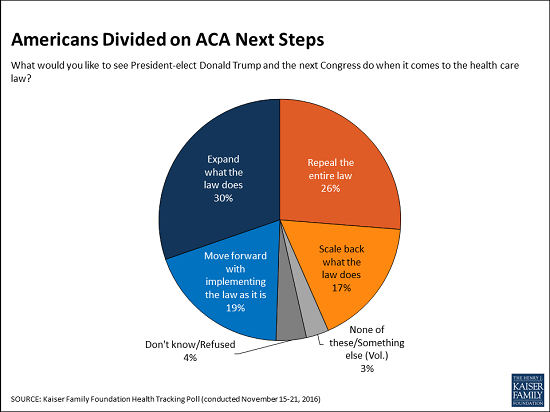
The new survey finds that one fourth (26%) of Americans want to see President-elect Donald Trump and the next Congress repeal the entire law, and an additional 17 percent want them to scale back what the law does. This compares to 30 percent of the public who want to see the law expanded and 19 percent who want to see lawmakers move forward with implementing the law as it is.

The poll captures a slight uptick in the share of Americans who want lawmakers to scale back the law as well as a decrease in the share who want lawmakers to repeal the entire law.  This is largely driven by Republicans: About half (52%) of Republicans now say they want to see the Affordable Care Act repealed, down from 69 percent in October. At the same time, a quarter (24%) of Republicans now want to see the law scaled back, up from 11 percent in October.

Among the quarter (26%) of Americans that want to see the Affordable Care Act repealed, 31 percent want to see the health care law just repealed and not replaced. About two-thirds wants lawmakers to repeal the health care law and replace it with a Republican-sponsored alternative, with 42 percent wanting lawmakers to wait to repeal it until the details of a replacement plan have been figured out and 21 percent wanting lawmakers to repeal it immediately and figure out a replacement plan later.

Among those who want the law repealed, 38 percent (or 10% of the public overall) change their opinion after hearing the argument that repealing the ACA would mean that insurance companies could deny coverage to people with pre-existing conditions. A slightly smaller share change their opinion after hearing that more than 20 million Americans could lose their coverage.

Building A System That Works: The Future Of Health Care

http://healthaffairs.org/blog/2016/12/12/building-a-system-that-works-the-future-of-health-care/?utm_source=RealClearHealth+Morning+Scan&utm_campaign=4e312288c8-EMAIL_CAMPAIGN_2016_12_12&utm_medium=email&utm_term=0_b4baf6b587-4e312288c8-84752421

Blog_Burwell2

Nearly a century after Theodore Roosevelt’s Bull Moose Party first called for health insurance reform, the United States has made major advances in access, quality, and affordability.

In the six years since President Obama signed the Affordable Care Act (ACA) into law, 20 million more people have health insurance, and, for the first time in our history, more than nine out of every 10 Americans are insured. Growth in both premiums for employer coverage and overall Medicare spending has also slowed. The Centers for Medicare and Medicaid Services’ Actuaries now project that we are on track to spend $2.6 trillion less over the ACA’s first decade than was projected without the ACA back in 2010.

Even with this slow down, any increase in costs can be challenging for businesses monitoring expenses or families working through their budgets. That’s why stakeholders nationwide have been coming together to reshape the future of health care. Using new advancements in data, medicine, and the tools and resources provided by the Affordable Care Act, institutions across the country are building a health care system that works better for all Americans.

This work has gone on steadily for years — through political turmoil and challenges in the courts. Yet through each challenge, these reforms have endured.

They must continue to endure. The 20 million Americans who gained coverage cannot lose it again. The more than 129 million people with pre-existing conditions do not want to go back to a time when insurers could discriminate against them, or block them from coverage. Eleven million Medicare Part D beneficiaries cannot afford to lose the $2,000 they have each saved, on average, from the law’s work to begin closing the “donut hole.” The American people do not want to turn back our nation’s progress. Improvements need to be made, but they need to build on progress and not take us backwards in terms of access (the number of insured), affordability (costs to individuals, businesses, and taxpayers), and quality (the benefits that are being provided).

As the Obama Administration comes to a close, this piece lays out my vision for the future of health care. I share the steps we have taken to change how we pay for health care, incentivize coordination, and unlock health care data. This is the path forward—a system where innovative actors are putting the patient at the center—and, despite differences in health care, I firmly believe it is a vision on which we can all agree.