The line between payer and provider continues to blur. Not only are insurers increasingly working closely with providers, but more and more, they are acting like them—and vice versa. Just ask David Bernd, CEO emeritus of the integrated system Sentara Health, who pointed out that the historical “head-to-head combat” between the two entities no longer works in today’s health system. Similarly, as evidenced by the amount of time AHIP CEO Marilyn Tavenner spent lauding Medicaid managed care plans, care management—with a focus on the member as a whole person, not just a patient—is the future.
Tag Archives: Health Insurance Coverage
Office Chatter: Your Doctor Will See You In This Telemedicine Kiosk

Less than a decade ago, telemedicine was mainly used by hospitals and clinics for secure doctor-to-doctor consultations. But today, telemedicine has become a more common method for patients to receive routine care at home or wherever they are — often on their cellphones or personal computers.
This Obamacare Repeal Plan Cripples State Budgets—and Economies
http://www.thefiscaltimes.com/2016/06/14/Obamacare-Repeal-Plan-Cripples-State-Budgets-and-Economies

If Republicans finally make good on their vow to repeal the Affordable Care Act — but without adopting a suitable replacement — 24 million Americans would be removed from the health care insurance rolls in 2021. And federal spending on health care would decline by $927 billion over the next decade, according to a provocative new study by the Urban Institute and the Robert Wood Johnson Foundation.
Transgender nurse sues Dignity Health for refusing to cover gender reassignment costs
Specifically, the lawsuit alleges Dignity’s policy violates regulations released by HHS last month that prohibit healthcare companies that receive federal aid from denying coverage to plan members for health services related to gender transformation.
Demand for short-term health insurance policies continues to grow

Short-term health insurance policies continue to increase in demand even though they don’t include benefits such as prescription drugs or maternity coverage, can reject applicants based on their medical history, according to a report from The New York Times. This is also the kind of plan the Obama administration had hoped to get rid of with the ACA. Purchasers of these temporary policies are usually filling a coverage gap and need a basic policy to cover an emergency without the higher costs of regular health policies.
Clinton’s Plan to Extend Medicare Raises Red Flags

Hillary Clinton last month dusted off a long-standing proposal of hers to expand health care coverage by allowing uninsured people 55 and older to qualify for Medicare – the government health care program for the elderly.
Her proposal potentially could help nearly 13 million Americans below the age of 65 who are currently without insurance. It also provided the former secretary of state with a rejoinder to rival Sen. Bernie Sanders’ call for supplanting Obamacare with a European-style national health insurance program he called “Medicare for All.”
Are Freestanding Emergency Rooms Driving Up Costs?
http://healthcare.dmagazine.com/2016/05/18/are-freestanding-emergency-rooms-driving-up-costs/
In most affluent corners of North Texas, these centers have become as ubiquitous as Starbucks. They’ve sprouted near households whose families are insured through private insurance plans and sold as a boon to a community in need of emergency services. (A Texas Tribune study found that these neighborhoods have incomes 49 percent higher than the state’s average). In 2010, there were about 20 freestanding ERs in Texas. Now, just six years later, there are north of 215, galvanized by a 2009 state law that allowed them to become licensed emergency rooms.
Why Today’s Poll Numbers on Health Proposals Are Bound to Change
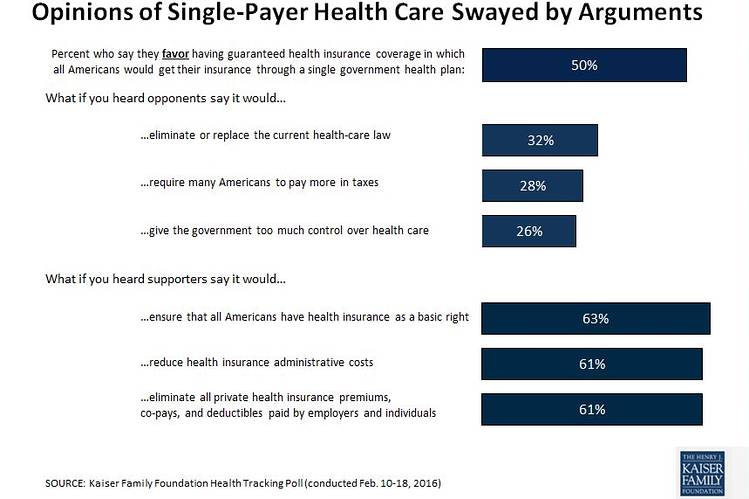
Gallup polling released last week showed majority support–58%–for replacing the Affordable Care Act with a federally funded health system. The same poll found 51% support for repealing the ACA. There is a basic point that often gets lost in reaction to poll findings like these: They measure the public’s initial response to ideas and words, and proposals such as single payer or ACA repeal that people associate with candidates–but they don’t tell us much about the likely level of support for a policy if there is a real debate about legislation before Congress, with winners and losers laid bare.
It’s always a fair bet that support would decline for big changes that come with big trade-offs–whether it is single-payer health care or ACA repeal or something else–but there is no way to know those levels in advance, and support could rise or fall depending on how a legislative debate plays out. Consider single-payer health care as an example. In February, the Kaiser Family Foundation monthly tracking poll simulated some of the arguments the public might hear in a debate about single payer.
More Employers Cover Transgender Surgery As Politics Shift

http://www.healthcaredive.com/news/transgender-surgery-increasingly-covered-by-us-employers/419361/
The nation’s employers are increasingly becoming more open to covering gender reassignment surgery for their workers as attitudes and public policies shift on transgender rights. Nearly one-third of large companies include gender confirmation surgery as part of employee health benefit packages. Though it does vary by employer size and by region of the country, the trend is rapidly moving toward providing coverage, benefits consultants say.
Are High Out-Of-Pocket Costs Forcing Patients To Settle For Substandard Care?

Rosemary Myers and her husband came to the oncology clinic with no major treatment decisions to make. Her breast cancer had metastasized to her brain many months ago, but after the metastasis was removed surgically, it had not shown signs of recurrence in any follow-up tests. So today’s visit wasn’t going to involve talking about chemotherapy or radiation; it wasn’t going to center upon end-of-life decision-making. Myers (a pseudonym) was here to see if her doctor could improve her quality of life. Eventually, that quality-of-life discussion would focus on the cost of Myers’ care.