Estimates: Average ACA Marketplace Premiums for Silver Plans Would Need to Increase by 19% to Compensate for Lack of Funding for Cost-Sharing Subsidies

Estimates: Average ACA Marketplace Premiums for Silver Plans Would Need to Increase by 19% to Compensate for Lack of Funding for Cost-Sharing Subsidies

A new Kaiser Family Foundation analysis finds that the average premium for a benchmark silver plan in Affordable Care Act (ACA) marketplaces would need to increase by an estimated 19 percent for insurers to compensate for lost funding if they don’t receive federal payment for ACA cost-sharing subsidies.

Established by the health law to reimburse insurers for the cost of reducing out-of-pocket costs for lower-income people buying marketplace plans (with incomes from 100% to 250% of the poverty level), the subsidies have been challenged in a lawsuit from the U.S. House. With a legal appeal pending, the federal government and Congress are in a position to choose whether to continue reimbursing insurers for their cost.

Among 12.2 million people who selected a 2017 ACA marketplace plan, about 58 percent, or 7.1 million, are receiving cost-sharing reductions. An earlier Foundation analysis of 2017 plans found the subsidies lower combined medical and prescription drug deductibles by as much as $3,354 and reduce annual out-of-pocket maximums by up to $5,587.

The Foundation’s new analysis examines the amount insurers would need to increase premiums to make up for the lack of funding, if federal payments cease for the cost-sharing reduction program.


California Employer Health Benefits: Prices Up, Coverage Down

http://www.chcf.org/publications/2017/03/employer-health-benefits?_cldee=aGVucnlrb3R1bGFAeWFob28uY29t&recipientid=contact-58e265c0591ce51180f7c4346bac4b78-22293f7225824dd0a2a16e01c6e7b1e7&esid=7e382ea0-c114-e711-80fa-5065f38a19e1

Since 2000, the percentage of employers offering health benefits has declined in California and nationwide, although coverage rates among offering firms have remained stable. Only 55% of firms reported providing health insurance to employees in 2016, down from 69% in 2000. These findings underscore the important role that Medi-Cal and Covered California play in providing insurance to working Californians — coverage that could be negatively impacted if the Republicans repeal and replace the Affordable Care Act.

Nineteen percent of California firms reported that they increased cost sharing in the past year, and 27% of firms reported that they were very or somewhat likely to increase employees’ premium contribution in the next year. The prevalence of plans with large deductibles also continues to increase.

California Employer Health Benefits: Prices Up, Coverage Down presents data compiled from the 2016 California Employer Health Benefits Survey.

Other key findings include:

  • Health insurance premiums for family coverage grew by 5.6%. Family coverage premiums have seen a cumulative 234% increase since 2002, compared to a 40% increase in the overall inflation rate.
  • The average monthly health insurance premium, including the employer contribution, was $597 for single coverage and $1,634 for family coverage in California, and was significantly higher than the national average.
  • 41% of workers in small firms faced an annual deductible of at least $1,000 for single coverage, compared to 17% of workers in larger firms. The prevalence of these higher deductibles in small firms has increased substantially in the past five years.
  • Only one in four firms with many low-wage workers (those earning $23,000 or less) offered health coverage to employees in 2016.
  • In the past year, 24% of large firms extended eligibility for health benefits to workers not previously eligible.

The complete Almanac report, as well as past editions, is available under Document Downloads.

The Wrong Way to Lower Health-Insurance Premiums

https://www.bloomberg.com/view/articles/2017-03-17/the-wrong-way-to-lower-health-insurance-premiums

Image result for high deductible health plan

For proponents of the American Health Care Act, perhaps the most encouraging nugget in the Congressional Budget Office’s otherwise critical analysis is that insurance premiums could fall by 10 percent on average by 2026. Even this prediction is more mirage than reality, however, in part because of an obscure concept known as “actuarial value.”

As many opponents of the Republicans’ Obamacare replacement legislation have already noted, for many people, the decline in premiums would be smaller than the cutback in their subsidies, so they would still end up paying more. And in any case, the predicted fall in premiums partly reflects a troubling rise in the share of older Americans without insurance, a change that would shift the enrollment pool to younger, less expensive beneficiaries.

Another factor, however, has received less attention, though it is hidden in plain sight in the CBO analysis: The premium reduction would occur in no small part because the insurance products wouldn’t be as good. In other words, their actuarial value would fall.

An insurance policy’s actuarial value is the share of total health-care costs paid by the plan rather than the policy holder, through deductibles and copayments. A plan with an actuarial value of 80 percent will pick up, on average, 80 percent of the cost of care. Plans with higher actuarial values have higher premiums, not surprisingly, because they provide deeper insurance. And if a plan’s actuarial value is very low, it may not really qualify as insurance at all.

The Affordable Care Act sets minimum actuarial values for each of the four tiers of plans that can be sold on the exchanges; the lowest, for bronze plans, is about 60 percent. The new legislation would repeal these minimums.

 In its analysis of the Republican proposal, the CBO found that insurers would offer lower-value policies “because they could offer a plan priced closer to the amount of the premium tax credit so that a younger person would have low out-of-pocket costs for premiums and would be more likely to enroll.” Similarly, insurers would hesitate “to offer plans with high actuarial values out of a fear of attracting a greater proportion of less healthy enrollees to those plans.” Since plans would still be required to cover 10 categories of essential health benefits, and since out-of-pocket limits would remain in place, plans would not dip too far below 60 percent, in the CBO’s estimation. But more plans would drop toward that level.

To see how big a deal this is, it is instructive to study the table toward the end of the CBO’s analysis, which calculates premiums under current law and under the AHCA. A 40-year-old single person could see his or her premium fall 7 percent — to $6,050, from $6,500. That’s only slightly less than the average 10 percent premium decline. Yet the actuarial value of the person’s plan would decline to 65 percent, from 70 percent or 87 percent, depending on his or her income.

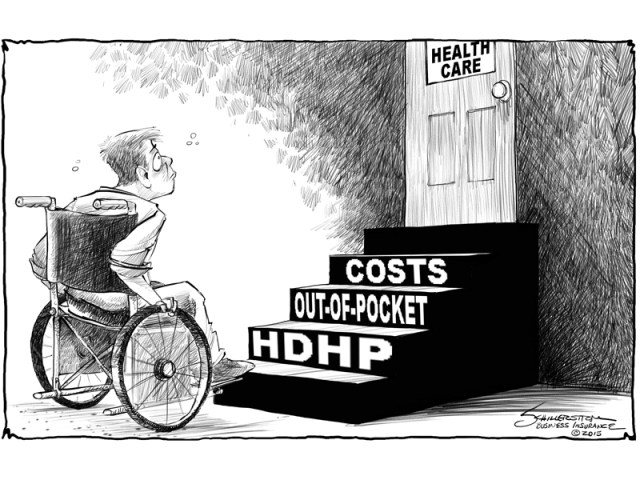
To get some sense of what these lower actuarial values mean in terms of higher deductibles, we can look to the most recent Centers for Medicare and Medicaid Services calculator. It suggests that a plan with a $1,500 deductible, an 80 percent coinsurance rate (the plan pays 80 percent of costs above the deductible and below the maximum out-of-pocket threshold), and a $7,200 maximum out-of-pocket limit would have an actuarial value of 73 percent. The same plan with a $5,000 deductible would have an actuarial value of 61 percent. In other words, a decline in actuarial value of about 12 percentage points (not far from the average decline in the CBO examples) would raise the policy’s deductible by $3,500.

It’s no wonder that the premium for such a plan would be lower — in the same way that it’s no wonder a 12-ounce can of soda costs less than a 35-ounce bottle. It’s no great accomplishment to lower premiums by increasing other consumer costs.

As the CBO concluded, under the Republicans’ system, “individuals’ cost-sharing payments, including deductibles, in the nongroup market would tend to be higher than those anticipated under current law.” Indeed, according to an analysis from the Center for American Progress, average total costs to consumers would be significantly higher.

If you think that competition can fix this, note another problem that the CBO points out: Under Obamacare, the actuarial value requirements allow for easy comparison shopping; plan A can be directly compared with plan B. Under the Republican system, it would be harder to shop for a policy based on price.

Health-care reform is indeed complicated. Esoteric concepts like actuarial value have big effects on every family’s bottom line.


California Employer Health Benefits: Prices Up, Coverage Down

http://www.chcf.org/publications/2017/03/employer-health-benefits

Since 2000, the percentage of employers offering health benefits has declined in California and nationwide, although coverage rates among offering firms have remained stable. Only 55% of firms reported providing health insurance to employees in 2016, down from 69% in 2000. These findings underscore the important role that Medi-Cal and Covered California play in providing insurance to working Californians — coverage that could be negatively impacted by the Republicans’ repeal and replacement of the Affordable Care Act.

Nineteen percent of California firms reported that they increased cost sharing in the past year, and 27% of firms reported that they were very or somewhat likely to increase employees’ premium contribution in the next year. The prevalence of plans with large deductibles also continues to increase.

California Employer Health Benefits: Prices Up, Coverage Down presents data compiled from the 2016 California Employer Health Benefits Survey.

Other key findings include:

  • Health insurance premiums for family coverage grew by 5.6%. Family coverage premiums have seen a cumulative 234% increase since 2002, compared to a 40% increase in the overall inflation rate.
  • The average monthly health insurance premium, including the employer contribution, was $597 for single coverage and $1,634 for family coverage in California, and was significantly higher than the national average.
  • 41% of workers in small firms faced an annual deductible of at least $1,000 for single coverage, compared to 17% of workers in larger firms. The prevalence of these higher deductibles in small firms has increased substantially in the past five years.
  • Only one in four firms with many low-wage workers (those earning $23,000 or less) offered health coverage to employees in 2016.
  • In the past year, 24% of large firms extended eligibility for health benefits to workers not previously eligible.

The complete Almanac report, as well as past editions, is available under Document Downloads.

A Deep Dive Into 4 GOP Talking Points On Health Care

http://khn.org/news/a-deep-dive-into-4-gop-talking-points-on-health-care/

Image result for Talking Points

Republican leaders have a lengthy list of talking points about the shortcomings of the health law. Shortly before his inauguration last month, President Donald Trump said that it “is a complete and total disaster. It’s imploding as we sit.” And they can point to a host of issues, including premium increases averaging more than 20 percent this year, a drop in the number of insurers competing on the Affordable Care Act marketplaces and rising consumer discontent with high deductibles and limited doctor networks.

Yet a careful analysis of some of the GOP’s talking points show a much more nuanced situation and suggest that the political fights over the law may have contributed to some of its problems. Here is an annotated guide to four of the most common talking points Republicans have been using. 


Physician: Consequences of ACA Repeal ‘Gigantic for Us’

http://www.healthleadersmedia.com/physician-leaders/physician-consequences-aca-repeal-gigantic-us?spMailingID=10400909&spUserID=MTY3ODg4NTg1MzQ4S0&spJobID=1100770334&spReportId=MTEwMDc3MDMzNAS2#

Image result for Physician ACA

Physician organization leaders are trying to plot business strategies for a post-ACA landscape of increased healthcare consumerism, lower reimbursement, and new partnerships.

Cartoon – US Healthcare Options

Image result for cartoon health insurance benefits

California’s Uninsured: As Coverage Grows, Millions Go Without

Click to access PDF%20CaliforniaUninsuredDec2016.pdf

Image result for California’s Uninsured: As Coverage Grows, Millions Go Without

Since the implementation of the Affordable Care Act (ACA) in 2014, the uninsured rate in California dropped by nearly half, from 16% in 2013 to 9% in 2015. However, 2.9 million Californians remained uninsured.

California’s Uninsured: As Coverage Grows, Millions Go Without provides a look at the uninsured two years after full implementation of the ACA. There could be big changes in health insurance coverage ahead with the election of President Donald Trump.

Key findings include:

  • The drop in the uninsured rate was mainly due to a seven percentage point increase in individually purchased insurance coupled with a five percentage point increase in Medi-Cal enrollment.
  • One in three of California’s uninsured had annual incomes of less than $25,000. At this income level, people are potentially eligible for Medi-Cal.
  • Of the state’s remaining uninsured, one in four were age 25 to 34, one in three were noncitizens, and more than half were Latino.
  • 62% of the uninsured were employed. Of the 1.8 million uninsured workers, 44% worked in firms with fewer than 50 employees.
  • Fewer Californians cited “lack of affordability” as the main reason for going without health insurance in 2015 compared to 2014.

Why risk adjustment is a crucial component of individual market reform

https://www.brookings.edu/blog/up-front/2017/01/25/why-risk-adjustment-is-a-crucial-component-of-individual-market-reform/

Related image

The mantra of ‘Repeal and Replace’ has escalated in recent weeks, though what, specifically, the ‘Replace’ component might look like is still unclear. However, many of the current proposals include, at a minimum, some type of continuous coverage provision that allows people with chronic health conditions who have continuously maintained coverage to buy health insurance at standard rates. For example, Paul Ryan’s A Better Way proposal and Tom Price’s Empowering Patients First Act would each prohibit insurers from charging sicker patients more than standard premiums in the individual market as long as they have maintained continuous coverage since before becoming sick.

Such provisions are important to keep patients from seeing their health insurance premiums sky-rocket after becoming sick, which would defeat the purpose of insurance in the first place. However, these provisions also require that insurers sell policies to these patients at premiums that they know will not cover their expected health care spending, generating losses for the insurance company. On its own, this would create a situation where insurers have a strong financial incentive to avoid enrolling these sicker patients.

Risk adjustment combats disincentives to provide coverage for sicker patients

In order to mitigate these incentives for insurance companies to avoid sicker patients, policymakers will need to include a risk adjustment program in any replacement reforms that require insurers to issue insurance to any applicant (also known as “guaranteed issue”) and set limits on adjusting premiums to fully reflect an enrollee’s health status. Continuous coverage provisions are one example of such limits, but risk adjustment will be necessary to combat against adverse selection across a wide range of potential reforms.

A risk adjustment program would make behind-the-scenes financial transfers to insurers to adequately compensate them for enrolling these sicker patients when they are not allowed to charge the individual higher premiums. Risk adjustment will be necessary to promote a well-functioning market where private insurers compete based on the value they deliver and not simply by avoiding sicker patients.