Cost of Family Health Insurance Now Nearly $20,000 a Year

https://www.thefiscaltimes.com/2018/10/03/Cost-Family-Health-Insurance-Now-Nearly-20000-Year


Annual premiums for employer-provided health insurance hit an average of $19,616 for a family this year, a rise of 5 percent over 2017, according to a new survey by the Kaiser Family Foundation. Employees paid an average of $5,547 for their coverage, with employers covering the rest.

The average premium for family coverage has risen 55 percent since 2008 — about twice as fast as wages, which are up 26 percent, and three times as fast as inflation, up 17 percent over a decade.

Faced with relentlessly rising health care costs, many companies have required employees to pay for more of their care before insurance kicks in, and the Kaiser survey found that deductibles are rising even faster than premiums. Among workers who have a deductible — about 85 percent of insured workers — the average deductible amount has risen to $1,573, a 212 percent increase since 2008. Deductibles have risen eight times faster than wages over the last 10 years, the survey said (see the chart below).

Kaiser President and CEO Drew Altman said that he expects health care costs to be an important political issue for the foreseeable future. “As long as out-of-pocket costs for deductibles, drugs, surprise bills and more continue to outpace wage growth, people will be frustrated by their medical bills and see health costs as huge pocketbook and political issues,” Altman said.

Read a summary of the Kaiser Family Foundation’s 2018 Employer Health Benefits Survey here, and the .


1 big thing: Out-of-network coverage is disappearing

https://www.axios.com/newsletters/axios-vitals-df4bea3c-3e1a-4efb-84f7-6e3247205ba7.html?utm_source=newsletter&utm_medium=email&utm_campaign=newsletter_axiosvitals&stream=top

Image result for health insurance out of network coverage disappearing

One reason surprise medical bills are going up: Coverage for out-of-network care is going down, according to the Robert Wood Johnson Foundation.

Per RWJF:

  • Just 29% of insurance plans in the individual market provide any benefits for out-of-network providers. That’s down from 58% a mere three years ago.
  • Coverage is also declining in the market for small businesses, but not nearly as dramatically — 64% of small-group plans offer some out-of-network coverage, down from 71% in 2015.
  • Those small-group numbers are probably roughly in line with where things stand among large employers’ plans.

Why it matters: The burgeoning controversy over surprise hospital bills stems partly (though not exclusively) from the bills patients receive when they’re treated by an out-of-network provider — even without their knowledge, often within an in-network facility.

  • Out-of-network coverage has obviously never been as generous as in-network coverage (that’s the whole point of creating a network), but as insurers pull back even further, more patients will likely find themselves on the hook for even bigger bills.


How hospitals protect high prices

https://www.axios.com/newsletters/axios-vitals-5af4f54b-8427-48c2-b638-933a1ae4883a.html?utm_source=newsletter&utm_medium=email&utm_campaign=newsletter_axiosvitals&stream=top

Large hospital systems don’t command high prices just because patients like them, or just because they have strong market share. There’s also another big reason: their contracts with insurance companies actively prohibit the sort of competitive pressures a free market is supposed to support.

“The free market has been distorted in an unhealthy way,” health care consultant Stuart Piltch told the Wall Street Journal’s Anna Wilde Mathews for this deep dive into hospitals’ pricing practices.

How it works: Hospital systems are consolidating rapidly and buying up physicians’ practices (which charge higher prices once they’re part of a hospital).

On top of that, per WSJ: Hospitals’ deals with insurance companies “use an array of secret contract terms to protect their turf and block efforts to curb health-care costs.”

  • Some hospitals do not allow their prices to be posted on the comparison-shopping sites insurers provide to their customers.
  • They often require insurers to cover every facility or doctor the hospital owns, and prohibit insurers from offering incentives — like lower copays — for patients to use less expensive competitors.
  • When Walmart, the country’s biggest private employer, wanted to exclude the lowest-quality 5% of providers from its network, its insurers couldn’t do so because of their hospital contracts.

The other side: Hospital executives told the Journal that mergers don’t drive higher prices, and reiterated their position that hospitals have to collect higher payments from private insurance to make up for the lower rates they get from Medicare and Medicaid.

My thought bubble: High-deductible health plans are increasingly popular, in part, because of the idea that patients will use their purchasing power to drive a more efficient system overall.

  • But if Walmart doesn’t have enough market power to actually penalize low-quality providers, you and I definitely don’t, either — especially if we can’t find out what the prices are, and especially if we only have one hospital to choose from in the first place.

Go deeper: Think drug costs are bad? Try hospital prices


Is Obamacare Constitutional? The Battle Begins Again

http://www.thefiscaltimes.com/2018/09/05/Obamacare-Constitutional-Battle-Begins-Again


The debate over the Affordable Care Act entered a new phase Wednesday as a federal court in Texas began hearing oral arguments in a lawsuit brought by 20 Republican-led states challenging the constitutionality of the 2010 law.

Eighteen Republican state attorneys general and two GOP governors bringing the suit argue that the law’s individual mandate was rendered unconstitutional when Congress lowered the penalty for individuals who don’t buy coverage to zero.

The Supreme Court, in upholding the law in 2012, deemed that penalty a tax and thus a valid and legal exercise of Congress’ power of the purse. The lawsuit claims that the law is no longer constitutional because the zeroed-out penalty can no longer raise revenue. “It’s nothing but a hollow shell because its core has been invalidated,” said Misha Tseytlin, Wisconsin’s solicitor general.

The plaintiffs also claim that this means the entire ACA — and, in particular, its protections for patients with pre-existing conditions looking to buy insurance — must be struck down because the mandate can’t be severed from the rest of the law. The Trump Justice Department decided not to defend the ACA in the case.

What a Kavanaugh Confirmation Might Mean

The case, which legal experts see as a long shot, may still wind up before the Supreme Court — which is why Democrats have brought up Obamacare and its protections for patients with pre-existing conditions in this week’s confirmation hearing for Brett Kavanaugh, President Trump’s nominee to replace Justice Anthony Kennedy.

“Kavanaugh has signaled in private meetings with Senate Democrats that he is skeptical of some of the legal claims being asserted in the latest GOP-led effort to overturn the Affordable Care Act,” the Los Angeles Times’ Jennifer Haberkorn reported last week. Three Democrats in the meetings told the Times that Kavanaugh suggested that if one piece of the law is struck down, the rest of the law doesn’t necessarily have to fall with it.

But that may not be enough to assuage Democratic fears that Kavanaugh could be the deciding Supreme Court vote against Obamacare. “Democrats are more concerned about Kavanaugh’s past writings on expansive presidential powers, which they say could lead to his supporting efforts by the Trump administration to dismantle the health-care law without Congress,” The Washington Post’s Colby Itkowitz notes.

Where Public Opinion Stands

The political debate over Obamacare has shifted as public perception of the law has improved. The latest Kaiser Family Foundation tracking poll, released Wednesday, finds that 50 percent now view the law favorably while 40 percent see it unfavorably, with the divide still falling along partisan lines. Just under 80 percent of Democrats support the law, while a similar percentage of Republicans oppose it.

That may be why Republicans still view repealing the law as a potent issue with their base. Vice President Mike Pence, in Wisconsin last week to campaign for Senate candidate Leah Vukmir, said the GOP push to repeal and replace the health care law was still alive: “We made an effort to fully repeal and replace Obamacare and we’ll continue, with Leah Vukmir in the Senate, we’ll continue to go back to that,” he told reporters. With Sen. Jon Kyl (R-AZ) replacing John McCain, a critical vote against the GOP’s 2017 Obamacare repeal bill, there has been chatter about another potential repeal effort — though Senate Majority Leader Mitch McConnell effectively shot that down on Wednesday.

In the meantime, open enrollment on the ACA exchanges is set to begin on November 1, with the Trump administration once again providing reduced funding for outreach groups that help people enroll. A recent report by the nonpartisan Government Accountability Office criticized the administration’s management of Obamacare signup periods.

Public blames everyone for high health costs

Kaiser Health Tracking Poll – Late Summer 2018: The Election, Pre-Existing Conditions, and Surprises on Medical Bills

Health care costs remain a leading issue ahead of this year’s midterms, and voters have plenty of blame to go around, according to the Kaiser Family Foundation’s latest tracking poll.

  • Kaiser asked its respondents whether certain factors are a “major reason” health care costs are rising. (There could be multiple “major reasons.”)
  • Blame for the potential political culprits — the ACA and the Trump administration — was split about evenly.
  • But there’s a broader bipartisan agreement that industry is to blame: At least 70% faulted drug companies, hospitals and insurers. Doctors caught a break, at 49%.

Partisanship reigns, though, on the question of whether President Trump will help.

  • A mere 13% of Democrats are at least somewhat confident that Americans will pay less for prescription drugs under the Trump administration, compared with a whopping 83% of Republicans. Independents generally share Democrats’ skepticism.
  • Roughly a quarter of Democrats and two-thirds of Republicans, think Trump’s public criticism of drug companies will help bring down prices.

Surprise hospital bills haven’t attracted the same political uproar as prescription drug costs, but the Kaiser poll provides more reason to believe they could be the next big controversy.

  • 67% said they’re “very worried” or “somewhat worried” about being unable to pay a surprise medical bill, while 53% fear they won’t be able to pay their deductible and 45% are afraid of the tab for their prescription drugs.
  • 39% experienced a surprise bill in the past year.


New Accumulator Adjustment Programs Threaten Chronically Ill Patients

https://www.healthaffairs.org/do/10.1377/hblog20180824.55133/full/?utm_term=Read%20More%20%2526gt%3B%2526gt%3B&utm_campaign=Health%20Affairs%20Sunday%20Update&utm_content=email&utm_source=Act-On_2018-08-05&utm_medium=Email&cm_mmc=Act-On%20Software-_-email-_-Individual%20Mandate%20Litigation%3B%20Housing%20And%20Equitable%20Health%20Outcomes%3B%20Simplifying%20The%20Medicare%20Plan%20Finder%20Tool-_-Read%20More%20%2526gt%3B%2526gt%3B

Related image

For too many Americans with chronic illnesses, such as HIV, arthritis, and hemophilia, insurance companies and their pharmacy benefit managers (PBMs) are erecting access barriers to innovative and life-saving prescription medicines. A new and growing trend—called accumulator adjustment programs—threatens to exacerbate the problem by significantly increasing out-of-pocket spending for patients. On top of it, patients are not even aware of this sudden and very costly change.

Patients with chronic illnesses already jump through hoops to receive their drugs. First, they have to ensure that their medicines are covered by their plan. Then they often have to work through a series of utilization management steps, such as prior authorization and step-therapy.

On top of those hurdles, more and more patients are facing high deductibles for prescription drugs or are being asked to pay a percentage of the cost of a drug, which is called coinsurance, instead of a nominal copayment. Coinsurance and deductibles often require patients to pay cost sharing based on the list price, which does not reflect the rebates that the PBMs receive from the drug companies.

When patients are still satisfying their deductible or are paying high coinsurance, they can face out-of-pocket spending of thousands of dollars to fill one prescription. If they cannot afford these costs, they will leave the pharmacy counter empty-handed and risk becoming sick or getting sicker. Drug manufacturers offer coupons to prevent this and make cost sharing for these drugs affordable. Historically, commercial insurance plans have applied the value of these coupons to a patient’s annual deductible and out-of-pocket maximum; reaching these limits translates into lower out-of-pocket spending for the rest of the year.

Now, however, accumulator adjustment programs are currently being pushed by PBMs, such as Express Scripts and CVS Caremark, to insurers including United HealthcareMolina, and BlueCross BlueShield of Texas and Illinois, and to large employers such as WalmartHome Depot, and Allstate. These programs change the calculus for patients by no longer applying the copay coupons to patient deductibles and out-of-pocket maximums. Patients must spend more out of pocket to reach their deductible; sometimes thousands of dollars more. For too many patients, this makes the drugs they depend on unaffordable.

While there has been an ongoing debate between the insurance industry and the drug companies regarding who is responsible for the high cost of some medications, this new practice has nothing to do with the actual cost of the drug. The only thing that has changed is how much the insurance company, employer, or PBM is requiring patients to pay for their drug. And these entities are beginning to implement accumulator adjustment programs without adequately informing beneficiaries, who will be shocked to learn that the cost-sharing assistance they have been relying on no longer applies toward their deductible or out-of-pocket costs.

People living with HIV and hepatitis have long relied on these copay coupons to afford the cost of their medications. The impact on a countless number of peoples’ lives has been profound. But this new practice will increase patient out-of-pocket spending, leaving patients at risk of hitting a “cost cliff” mid-year. This cliff could cause disruptions to patients’ care as medication becomes prohibitively expensive. For people living with HIV, hepatitis, and so many other health conditions, the resulting decision can literally mean life or death.

While some may claim that coupons are being used to incentivize brand-name drugs over generics, the fact is 87 percent of the coupons are for drugs that have no generic equivalent. The 13 percent of branded drugs programs in which generic equivalent products are available accounted for only 0.05 percent of all prescriptions filled.

There is a relatively new drug regimen, known as pre-exposure prophylaxis (or PrEP), that when taken regularly, prevents HIV. Because there is no generic alternative, most patients can’t afford the high coinsurance and rely on manufacturer copay assistance to reach their deductible and lighten the burden. This new practice of no longer applying the copay coupons to patient deductibles and out-of-pocket maximums by the insurance companies and PBMs are making access to this remarkable treatment more difficult and will have a significant impact on our efforts to prevent HIV in the United States.

But it does not have to be like this. The growing practice of not counting copay coupons toward a beneficiary’s deductible most likely stems from PBMs, insurers, and human resources professionals, who sign off on these plans, failing to fully comprehend the impact these programs will have on vulnerable patient populations and the overall health care system.

Patient groups and employees across the country should reach out to their health insurance providers and workplace plan managers to check whether their plan is implementing this new troubling practice. And if they are, people need to speak up and push back. These new insurance practices are not acceptable and bad for the health of our country.


The uninsured rate remains plateaued

https://www.cdc.gov/nchs/data/nhis/earlyrelease/Insur201808.pdf?utm_source=newsletter&utm_medium=email&utm_campaign=newsletter_axiosvitals&stream=top-stories

Image result for The uninsured rate remains plateaued


The Centers for Disease Control and Prevention is out with its latest health insurance coverage data this morning, and the nation’s uninsured rate isn’t really changing a whole lot.

By the numbers: As of March 2018, 8.8% of all Americans, or about 28.3 million people, had no health insurance.

  • Those numbers are almost identical to the CDC’s 2017 report, when 28.1 million people were uninsured as of March 2017.
  • It’s also worth noting that 47% of people younger than 65 are in a high-deductible plan, up from 42.3% recorded at the same point last year.

The big picture: The federal and state exchanges established by the ACA are treading water when it comes to enrollment, and no new states have expanded Medicaid. (Notably, Maine Gov. Paul LePage is still resisting his state’s voter-approved Medicaid expansion.)

The bottom line: Don’t expect the uninsured rate to fluctuate a lot until more states expand Medicaid or the ACA exchanges get more federal support.

Looking ahead: The U.S. Census Bureau will unveil its 2017 health insurance numbers on Sept. 12.


Priced Out of Health Insurance, Americans Rig Their Own Safety Nets

https://www.bloomberg.com/news/features/2018-08-22/priced-out-of-health-insurance-americans-rig-their-own-safety-nets
Risking It: Stories From America's Uninsured

Consumers frustrated by high costs are bypassing the bureaucracy with patchwork plans.

When their son Sky was born four years ago, Lindsie and Chris Bergevin were hit with a big surprise: $7,000 in bills for the birth that their health plan didn’t cover. Sky was two when the couple jettisoned their medical insurance, which helped them eventually pay off the debt.

Now that they’re ready to have a second child, they’re not going back to their old coverage, with its premiums of more than $350 a month. Instead, they’ve patched together an alternative through a religious group and a primary-care doctor whom they can visit anytime for a monthly fee.

“I was so jaded with the whole health-care insurance situation,” Lindsie, 35, says. “I just didn’t want to deal with it.”

The Bergevins, who rent a snug little house near downtown Boise, Idaho, are joining a small but growing number of Americans rigging their own medical safety nets. They’re frustrated by the high costs, opaque pricing, and maddening bureaucracy of health insurance.

In their quest for a different way, they’re meeting doctors like Julie Gunther who are also fed up. These physicians have opted to reject insurance, instead charging patients directly in return for more personalized care.

“I like to think we can protect people in vulnerable moments where they’re going to get lost like a widget,” Gunther said, “because they’re not a widget for us.”
We Want to Hear Your Insurance Story:

Bloomberg News wants to hear about being uninsured in America in 2018 and what it means to you.
Please click here to tell us your story.

Bloomberg News is following people who are uninsured in a year-long effort to tell the story of Americans struggling to afford the rising costs of health care, and the financial and medical trade-offs they make.

No reliable data exist on how many people are replacing insurance with arrangements like the Bergevins’, but the trend appears to be gaining momentum.
The number of people joining so-called health-care sharing ministries—religion-based cost-sharing plans—rose 74 percent from 2014 to 2016, according to the latest Internal Revenue Service data. An alliance for the groups said that more than 1 million people now participate in such programs. Similarly, primary-care clinics like the one Julie Gunther started in 2014 have grown to almost 900 from just a handful in the early 2000s, according to the Direct Primary Care Coalition, a trade group for the clinics.

The number of people without traditional insurance is expected to increase. The Trump Administration lifted the Affordable Care Act’s penalty for those who go without insurance, while also encouraging the growth of lightly regulated products such as short-term health plans. Proponents of Obamacare fear the administration’s actions will draw healthy people out of the ACA marketplaces, raising costs for those who remain.

Though the ACA expanded coverage to 19 million Americans, some of those gains are reversing. About 28 million remain uninsured. A study by the Kaiser Family Foundation, a health-research nonprofit, determined that most uninsured families simply found health insurance too expensive.

The Bergevins are one of those families.
Lindsie is a freelance graphic designer who focuses on clients in the craft industry. Chris, 34, is a supervisor at the auto shop the Bergevins jointly own with another couple. Though the business is growing, things were tight enough that Chris didn’t draw a salary until last summer. Last year, the couple took home from $40,000 to $50,000, after taxes.

In 2014, when Lindsie was pregnant with Sky, the couple still had coverage through her job at the Idaho Statesman newspaper.
A calculator on her Aetna health plan’s website estimated the Bergevins would need to pay about $3,000 or $4,000 out-of-pocket for Sky’s birth. When the total bill came, the sum for prenatal care, hospital costs, anesthesia, and other care was triple the estimate.

They were still paying off Sky’s birth in 2016 when Lindsie had surgery to remove her tonsils and correct a deviated septum, leaving them with several thousands of dollars more in bills.

She put the sum on a CareCredit medical credit card and is paying $300 each month toward that debt.
As the couple thought more about it, maintaining their coverage made little sense. They were falling deeper into medical debt, despite having insurance which itself cost thousands of dollars a year. In 2016, Lindsie left her newspaper job to devote herself full-time to her thriving freelance design business—and they went uninsured.

“I couldn’t justify it,” she says. The cheapest policy she could find through the Affordable Care Act, she recalls, was $547 a month—more than half the family’s $875 monthly rent at the time. It had a high deductible that could leave them with out-of-pocket costs of more than $10,000.

“If something were to happen to us, we would have been in trouble,” she acknowledges. To hedge, the couple bought an inexpensive accident policy from Aflac that would cover some costs from an injury if, for example, Chris hurt himself working.

A friend told them about a small primary-care clinic called SparkMD less than a mile from their house. The doctors didn’t accept insurance. Instead, they charged a monthly fee of $130 per family. That allowed visits as needed without any limits. When Lindsie went to check it out, a physician began with an in-depth conversation about the family’s health.

“It was amazing. She sat down with me for an hour and talked about everything,” Lindsie says.

Gunther, the Bergevins’ new physician, had long wanted to be a family doctor in her hometown. Working for a large hospital system, though, she was soon chafing under a bureaucracy that seemed to make too many of her clinical decisions for her, down to what tools and equipment she could use. Even worse, Gunther was paid based on her volume of patients and services billed.

She saw patients in 15-minute intervals and says she felt like a factory line worker. She’d later joke that she spent longer waiting in line for her morning coffee than she did with a patient.

“I was saying ‘I’m sorry’ all the time,” Gunther, 42, recalls. “I’m sorry I’m late, I’m sorry this didn’t get called in, I’m sorry this got forgotten, I’m sorry they didn’t give me the message.”

Burned out, she quit her job in 2014 and started her own practice. She borrowed about $200,000 to renovate an old red-brick law office on a leafy corner of downtown Boise, a few blocks from one of the city’s big hospital campuses.

Along with a nurse practitioner and a small office staff, she cares for about 600 patients. A typical primary-care doctor carries at least double or triple that load. More than half of Gunther’s patients have health insurance, often in high-deductible plans. Others are small business owners like the Bergevins. Most are disenchanted with the health-care system.

Last year, Lindsie Bergevin had a bad fever and what she described as “the worst pain I think I ever had in my head.” She called Gunther at 9:30 p.m. on a Saturday. Gunther met her at the clinic 15 minutes later. “She’s like, ‘Girl, you have a double ear infection, and the worst I’ve ever seen.’”

Bergevin walked out with an antibiotic and says that if Gunther hadn’t seen her, she would’ve gone to the emergency room, which could have resulted in a bill for hundreds or thousands of dollars.

Gunther tells her patients that belonging to her practice is not a replacement for having health insurance.

“There’s a whole bunch of things I can’t take care of,” Gunther says. “If you’re not standing upright, or bleeding doesn’t stop, do not call me.”

In April, knowing that they wanted to conceive this year, the Bergevins paid to join a Christian nonprofit called Liberty HealthShare. Organizations like Liberty, sometimes called faith-based plans, help like-minded members share some medical costs. To join, members must pledge to adhere to Christian principles. They are required to make fixed payments each month, and the money is disbursed to cover health-care needs for other families.

Though health-sharing ministries function like insurance in some ways, they aren’t regulated by states, don’t have capital requirements to protect against large losses and don’t have to adhere to rules about minimum benefits. They decline to cover medical expenses that result from behavior they deem immoral. They won’t pay medical costs for a drunk driver in a car crash, for example, or for contraception.

There are other restrictions too: Liberty limits coverage of pre-existing conditions for up to three years, according to its guidelines. Members can also get bounced for “failure to fully disclose known or suspected pre-existing condition information” when they join. Those limits are part of the reason why they’re cheaper—and potentially riskier.

The Bergevins originally expected to pay $450 per month for Liberty. Because Lindsie is overweight, they pay a surcharge of $80 per month—a fee regulated insurers are barred from charging. When they joined, their plan had an “annual unshared amount”—the equivalent of a deductible—of $1,500. Two months later, they learned that amount would increase to $2,250. Lindsie wasn’t thrilled, but she calls it “a ton cheaper than a typical deductible.” And on the plus side, Liberty would reimburse them for some of the cost of membership in SparkMD.

In early June, Lindsie sat at her kitchen table with a stack of medical bills going back four years. Sky ran in from the living room, where Dr. Seuss cartoons played on the TV, looking for dessert before he  finished his dinner.

The Bergevins’ improvised plan has pros and cons. They didn’t have to pay premiums for almost two years while they were uninsured, easing their finances significantly while their businesses grew. They love the personalized care they get from Gunther. And their costs for having another child should be capped at a lower level under the Liberty plan.

But between Liberty and SparkMD, the Bergevins pay more than they did for health coverage through Lindsie’s old job, and, she estimates, about as much as Obamacare insurance would cost. The family is still exposed to considerable risk. Liberty caps reimbursements at $1 million—a limit that insurance companies can’t impose. They have two friends who have had cancer, and, Chris says, “a million’s definitely not enough.”

The Bergevins have their fingers crossed that their choices will allow them to expand their family without incurring the kind of debt that Sky’s birth and Lindsie’s surgery left them with. But they know their improvised approach isn’t for everyone.

“It’s not like I’m trying to say, just go without insurance,” Lindsie says. “You have to find something that’s going to work for you.”

It’s not just the uninsured — it’s also the cost of health care

https://www.axios.com/not-just-uninsured-cost-of-health-care-cdcb4c02-0864-4e64-b745-efbe5b4b7efc.html

Image result for It's not just the uninsured — it's also the cost of health care

We still have an uninsured problem in the U.S., but we have a far broader health care affordability problem that hits sick people especially hard.

Why it matters: It’s time to think more broadly about who’s having trouble paying for the health care they need. The combination of lack of insurance and affordability affects about a quarter of the non-elderly population at any one time, but almost half of people who are sick.


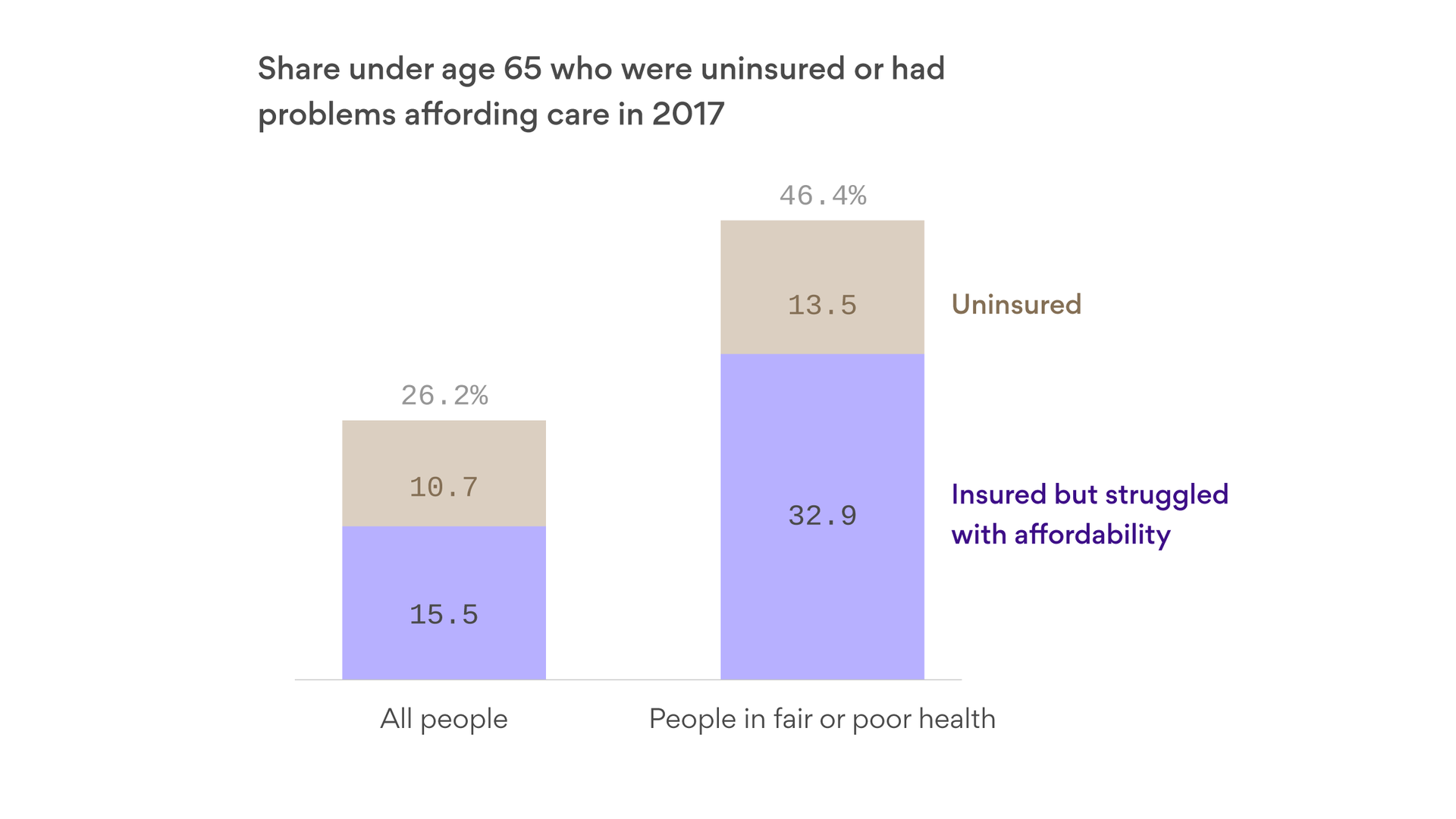
Now that the Affordable Care Act has expanded health coverage, the percentage of the non-elderly population that is uninsured is now just under 11%, the lowest level ever recorded. But as the chart shows:

  • Another 15.5% who have insurance either skipped or delayed care because of the cost or reported that they or someone in their family faced problems paying their bills in 2017.
  • That brings the total percentage of non-elderly people with insurance and affordability problems to 26.2%.


More striking: nearly half of all people in fair or poor health — 46.4% — are uninsured or have affordability problems despite having coverage.

  • That includes 13.5% who were uninsured and in fair or poor health — arguably the worst off in the entire system — and another 32.9% percent who have insurance but said they or a family member have had a problem affording care in the last year.


It’s not surprising that people who are sicker and need more care would have more problems paying for it. But arguably an insurance system should work best for people who need it the most.


All this says a lot about current health care politics.

  • It helps explain why so many people name health their top issue, despite the progress that has been made in covering the uninsured. And everyone who’s sick and can’t afford medical care has family members and friends who see what they are going through, creating a political multiplier effect.
  • It is also why health care is substantially an economic issue as well as an issue of access to care. When people have trouble paying medical bills, it’s a hard hit to their family budgets — causing many people to take a second job, roll up more debt, borrow money, and forego other important family needs.


For as long as I have been in the field, we have used two measures more than any others to gauge the performance of the health system: the number of Americans who are uninsured and the percentage of GDP we spend on health. Both measures remain valid today.

The bottom line: If we want a measure that captures how people perceive the system when the number of uninsured is down and overall health spending has moderated, we need better ways of counting up the much larger share of the population who are having problems affording care.

And whatever big policy idea candidates are selling, from single payer on the left to health care choices on the right, the candidate who connects that idea to the public’s worries about paying their medical bills is the one who will have found the secret sauce.