Poll: Public Divided on Repealing Obamacare, But Few Want It Repealed Without Replacement Details

http://connect.kff.org/poll-public-divided-on-repealing-obamacare-but-few-want-it-repealed-without-replacement-details?ecid=ACsprvtG5kIoCbXzcE3WLgrX01kIXFDaDUgXQ0BUzNGGn2gIr2haSAC8OzTQSp0H3e0Qeujg-Q9Y&utm_campaign=KFF-2017-January-Priorities-Tracking-Poll&utm_source=hs_email&utm_medium=email&utm_content=40166809&_hsenc=p2ANqtz-_zwF7NlvPoFINfG9Nd0OPcBebPHjaaSvuWqkCefkoOcmCo9aOPqJHM0W6_uhOAYH4ucOOIuXrEe40HttSNtSg8udNc1A&_hsmi=40166809

1.6.17 - 2017 tracking email alert - image 2.png

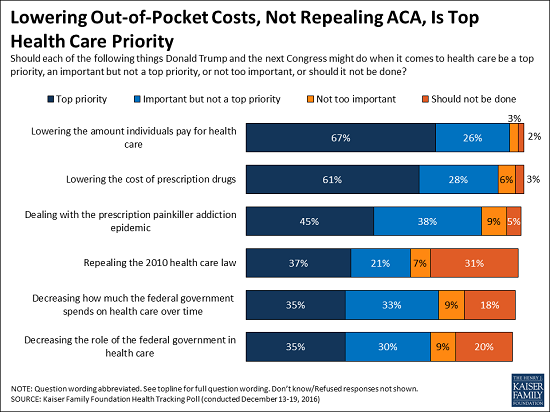
Out-of-Pocket Costs, Not the Affordable Care Act, Top Public’s List of Health Care Priorities for new Administration and Congress

As Congress begins to work on repealing and replacing the Affordable Care Act, the latest Kaiser Health Tracking Poll finds that one in five Americans (20%) support repeal alone, while three quarters either oppose repeal altogether (47%) or want to wait to repeal the law until the replacement plan’s details are known (28%).

Overall, the poll finds that nearly equal shares say that the next Congress should vote to repeal the law (49%) and that it should not vote to repeal it (47%), which mirrors the public’s overall views of the 2010 law (46% view it unfavorably, 43% favorably).

The debate surrounding repeal could influence the public’s views, as the poll finds that some people shift their opinions after hearing counter-arguments.  For example, after hearing pro-repeal arguments about the law’s costs to individuals and the government, the share of the public supporting repeal grows as large as 60 percent, while anti-repeal arguments about people losing coverage and the impact on people with pre-existing conditions decreases support for repeal to as low as 27 percent.

When asked directly about their family’s health care costs, similar shares of the public say repealing the Affordable Care Act would make their situation worse (28%) as say it would make it better (27%). Most say their own ability to get and keep health insurance (55%) and the quality of their own health care (57%) will stay about the same if Congress votes to repeal the law.

Presidential candidates in fantasy land over health care

https://www.publicintegrity.org/2015/09/28/18071/presidential-candidates-fantasy-land-over-health-care

Image result for pharmaceutical industry lobby

The drug companies always win, which is why Americans pay far more than citizens of any other country for prescription medications. We pay exactly 100 percent more per capita for pharmaceuticals than the average paid by citizens of the 33 other developed countries that comprise the Organization for Economic Cooperation and Development (OECD).

Obama also once supported drug re-importation, as did Sen. John McCain, the Arizona Republican who lost to Obama in the 2008 presidential election. In 2012, two years after the passage of the Affordable Care Act, McCain teamed up with Sen. Sherrod Brown, (D-Ohio) in another attempt to get Congress to pass a drug re-importation bill.

When it became clear that his bill would not pass, McCain took to the floor to denounce the ability of well-financed special interests to control the federal government.

“What you’re about to see is the reason for the cynicism that the American people have about the way we do business in Washington. (The pharmaceutical industry)… will exert its influence again at the expense of low-income Americans who will again have to choose between medication and eating.”

Don’t expect that to change anytime soon. As long as interest groups can spend unlimited amounts of money to influence elections and can hire hundreds of lobbyists to do their bidding, millions of Americans will have to decide between health care and eating, while executives and shareholders get richer and richer.

The Politics of Pain

https://www.publicintegrity.org/2016/12/15/20549/drugmakers-set-gain-taxpayers-foot-new-opioid-costs?utm_source=email&utm_campaign=watchdog&utm_medium=publici-email&goal=0_ffd1d0160d-747506714a-102628325&mc_cid=747506714a&mc_eid=34d0ba268e

Critics say the answer pharmaceutical companies are pushing to address the ongoing opioid crisis boosts their profits while forcing taxpayers to shoulder the costs.

Some drugmakers aim to replace ubiquitous painkillers such as Vicodin and Percocet with harder-to-abuse formulations that are patent-protected and command higher prices — a plan that could cost government-funded health programs hundreds of millions of dollars in higher medication expenses.

A pending measure in Illinois, for example, would cost taxpayers $55 million annually to cover the higher-priced drugs for state Medicaid recipients, according to an initial state analysis. A proposal in Ohio was estimated to bring $167 million in higher costs.

And on the federal level, an industry-backed provision benefiting reformulated opioids tucked into a law this summer will cost the federal government $75 million in lost Medicaid payments over 10 years, according to an estimate by the Congressional Budget Office.


Clinton vs. Trump: 5 critical election issues

http://managedhealthcareexecutive.modernmedicine.com/managed-healthcare-executive/news/hillary-vs-trump-5-critical-election-issues?cfcache=true&ampGUID=A13E56ED-9529-4BD1-98E9-318F5373C18F&rememberme=1&ts=25102016

While Hillary Clinton vows to forge ahead with Obamacare if she is elected president, Donald Trump would scrap it altogether. The end results would be two very different forms of healthcare, and industry leaders have much to consider.

Brill“Many different factors are weighing on managed care executives such as the costs of pharmaceuticals, diagnostics and devices; the impact of consolidation amongst hospitals, physicians, health plans; and the losses in the exchange marketplace,” says Managed Healthcare Executive editorial advisor Joel V. Brill, MD, chief medical officer, Predictive Health, LLC, which partners with stakeholders to improve coverage of value-driven care. “With each of these factors, plans can, at least at a high level, make some educated guesses about the relative risk of each factor and impact to the bottom line.”

The election results, however, are much less certain, which from a risk perspective, weighs heavily on the minds of healthcare executives, Brill says. “How can you plan for business knowing that whatever you are doing currently could be upended in the beginning of November?”

To help provide some clarity, Managed Healthcare Executive identified five of the top industry issues, reviewed the candidates’ platforms for each, and asked industry experts to weigh in.

Medicare shouldn’t pay more for drugs when others pay less

https://www.statnews.com/2016/10/18/medicare-drug-prices/?_hsenc=p2ANqtz–zfLIsv2nEEzVlLISqrp28lPm5ANNScP2_qYXJZI-DenazQvHTSROulTck5xdVsR5KMAzBoOaUWrYMEPSR1ZxAyLybMQ&_hsmi=36101369

Hillary Clinton and Donald Trump don’t see eye-to-eye on much. But they do agree that drug costs are spiraling out of control at the public’s expense. Both the Democratic and the Republican candidates for president have said that Medicare should be able to negotiate drug prices, something that currently isn’t allowed by law. Letting Medicare do that — which the Department of Veterans Affairs and other countries have been doing for years — has the potential to transform health care.

Most developed nations, including Canada and the United Kingdom, negotiate with pharmaceutical companies to determine how much they will pay for medications. In the US, health care is covered by many different payers, with Medicare being the largest by far. The federal government never gave Medicare the power to negotiate drug prices. Instead, that’s done by the many private insurers that manage Medicare drug plans.

Giving Medicare the power to negotiate drug prices would immediately save billions of dollars. The implications would also reach far beyond the 37 million Americans covered by the Medicare drug benefit (Part D), because commercial insurers often follow Medicare’s lead.


Campaign 2016 Healthcare Election Issues

http://connect.kff.org/poll-health-care-issues-in-the-2016-elections-the-publics-views-on-zika-and-electronic-medical-records?ecid=ACsprvsNwVqzoYoktjeMadLmMP_j5z4aIEIDLtV7mAYMiD8KEFvV0TCbNnPbhhL1Z-Bec8iS2pPQ&utm_campaign=KFF-2016-August-Tracking-Poll&utm_source=hs_email&utm_medium=email&utm_content=33682024&_hsenc=p2ANqtz-8xtyy8YqJQ7WAY3Hy2-UCQDhQKjYlvB05qHdtEnzbB4uaWO2JZQtkeD0o1C6GXU8BopN7QM81MUjiM3NFIn_7Xlb8t-A&_hsmi=33682024

Chart_1_-_Poll_Alert.png

Two thirds of voters (66%), including large shares of Democrats, Republicans, and independents, identify access and affordability of health care and the future of Medicare, an issue not being widely discussed on the campaign trail, as top priorities for the presidential candidates to talk about during the campaign. Smaller majorities of voters say the same about Medicaid’s future (54%), prescription drug costs (53%), and the future of the 2010 health care law (52%).


Prices soar for some popular drugs despite insurer discounts

http://www.fiercehealthcare.com/payer/price-hikes-for-popular-drugs-soar-above-inflation-despite-insurer-discounts

white and green pillswhite and green pills

Three out of four medicines with $1 billion or more of yearly global sales increased prices by more than double the rate of inflation between 2009 and 2015, even when insurer- and pharmacy benefit manager-negotiated discounts were factored in, a Bloomberg analysis shows.

Insurers can easily require patients to switch to alternatives, the analysis notes, giving them leverage to negotiate lower prices.

But drug costs are still putting significant pressure on payers’ margins, rising from less than 10 percent of care-cost expenditures years ago to 13 percent in 2010 and 17 percent in 2015. Insurers and state lawmakers have tried pushing back, with Virginia among severalstates trying to legislate better price transparency. Insurers also are experimenting with negotiating deals with drug manufacturers that link prices to how well the drugs work.

Bloomberg looked at 39 drugs for its analysis. Only six increased in price at the rate of inflation or below, the news agency found. Discounted prices rose significantly as well. The discounted prices for 27 of the 39 drugs rose by 25 percent or more over six years; the consumer price index rose just 9.5 percent during the same period, according to the article. Prices doubled or more for seven drugs.