Trump Likes Drug Price Negotiations; His Nominee for Health Secretary Doesn’t

Image result for high drug prices

 Alex M. Azar II, President Trump’s nominee for secretary of health and human services, said Tuesday that he was wary of proposals for the government to negotiate drug prices for Medicare beneficiaries, an idea endorsed by Mr. Trump in the 2016 campaign.

But Mr. Azar said that in some situations, he was willing to look at proposals to negotiate prices for a limited number of medicines.

He made the comments at a Senate confirmation hearing on Tuesday, where he tried to allay the concerns of some Democrats who asserted that he would be biased in favor of pharmaceutical companies because he had worked for a decade as a top executive at Eli Lilly, the company in Indiana that sells drugs for diabetes, erectile dysfunction and schizophrenia, among other conditions.

Mr. Azar’s remarks on drug price negotiations were carefully circumscribed and somewhat ambiguous — an approach that allowed him to get through the hearing largely unscathed.

If Medicare negotiates drug prices, he said, patients might have less access to some medicines because the government would probably establish a list of preferred products.

“For the government to negotiate there, we would have to have a single national formulary that restricted access to all seniors for medicines,” Mr. Azar told the Senate Finance Committee. “I don’t believe we want to go there in restricting patient access.”

At the same time, Mr. Azar said, “it’s worth looking at” proposals to allow price negotiations for drugs in Part B of Medicare. Under this part of the program, patients receive cancer drugs and other medications, often by infusion or injection, in doctor’s offices and hospital outpatient clinics.

Mr. Azar, who worked for six years in the administration of President George W. Bush, is expected to win confirmation, with support from Republicans and perhaps a few Democrats, who view him as a pragmatic problem solver rather than an ideologue. He would take charge of a cabinet department that spends more than a trillion dollars a year providing health insurance to more than 130 million Americans.

Senator Bill Nelson, Democrat of Florida, asked Mr. Azar whether he would support cuts in Medicare, Medicaid or Social Security to offset increases in the federal budget deficit that would be caused by the recently passed tax legislation.

“The president has stated his opposition to cuts to Medicare, Medicaid or Social Security,” Mr. Azar replied. “He said that in the campaign, and I believe he remains steadfast in his views on that. He’s made that commitment. I will live up to that if I’m confirmed.”

But like many Republicans, Mr. Azar said that cuts in the growth of federal benefit programs were not really cuts if federal spending on the programs continued to increase.

Democrats kept returning to the question of drug prices. Mr. Azar said that the expertise he acquired in the pharmaceutical industry would help him rein in drug costs as a federal official.

“Across the board,” he said, “drug prices are too high. Insulin prices are too high. All drug prices are too high in this country.”

Democrats were generally skeptical, based on Lilly’s record during Mr. Azar’s time at the company.

“The price of Lilly’s bone-growth drug Forteo, used to treat osteoporosis, more than doubled on Mr. Azar’s watch,” said Senator Ron Wyden of Oregon, the senior Democrat on the Finance Committee. In the same period, Mr. Wyden said, the company more than doubled prices for other drugs including Humalog, used to treat diabetes, and Strattera, for attention deficit hyperactivity disorder.

Mr. Wyden asked Mr. Azar if, as head of Lilly’s operations in the United States, he had ever approved a reduction in the price of a Lilly drug.

Mr. Azar avoided a direct answer and blamed “the system.”

“I don’t know that there is any drug price of a branded product that has ever gone down from any company on any drug in the United States because every incentive in this system is toward higher prices,” Mr. Azar said, adding: “No one company is going to fix that system. That’s why I want to be here working with you.”

Mr. Azar said he saw no need for the government to negotiate prices for drugs covered by Part D of Medicare, which pays for pills and other products that patients can give themselves and purchase from neighborhood drugstores and mail-order pharmacies.

Medicare’s Part D drug benefit is delivered entirely by private companies under contract with the government. These companies and their agents, known as pharmacy benefit managers, negotiate with drug manufacturers, and Mr. Azar said he did not believe the government could get lower prices by negotiating directly with drug companies.

A 2003 law prohibits the Department of Health and Human Services from interfering in negotiations between drug manufacturers and insurers that provide drug coverage under Part D of Medicare. “You would not get better pricing by removing” that prohibition, Mr. Azar said.

In the 2016 campaign and since taking office, Mr. Trump has said that Medicare could save large sums by negotiating directly with drug companies. But drug companies adamantly oppose that idea, and Mr. Trump has not taken steps to translate that into practice.

Asked specifically if Medicare should negotiate drug prices, Mr. Azar said: “In Part D, we do significant negotiation through pharmacy benefit managers that get the best rates of any commercial payers. We don’t do that in Part B, which is where we have physician-administered drugs. We basically pay sales price plus 6 percent or some other number.”

As an alternative, Mr. Azar said he supported proposals to link the pricing of prescription drugs to an assessment of how well they work for patients. Under such arrangements, known as value-based pricing, insurers would pay more for medicines that were highly effective and less for those that did not work well.

Mr. Azar also said he supported an agency created by the Affordable Care Act to test novel ways of delivering and paying for health care. And he said that some of the experiments could require doctors and hospitals to participate. Republicans in Congress have generally opposed mandatory participation.

Top 10 health care surprises of 2017

https://www.politico.com/story/2017/12/30/trump-health-care-surprises-248996

Image result for healthcare top stories of 2017

President Donald Trump stormed into office last January confident that he could knock off Obamacare in a nanosecond. It didn’t turn out that way — and from drug prices to the Tom Price travel scandal, a lot of health policy didn’t go according to plan. Here’s a look at 10 health care surprises from 2017.

1. Obamacare survives its seventh year

In control of the White House and both chambers of Congress, Republicans had their best shot ever at Obamacare repeal — and even thought they could have it on Trump’s desk on Inauguration Day. The grand ambitions quickly met roadblocks. Members rebelled over policy details, GOP leaders struggled to find consensus, moderates mutinied, and virtually the entire health care industry — along with Democrats and Obamacare advocates — lined up against every plan that Republicans put forward.

Even so, the GOP eventually squeaked a bill through the House and after several false starts put a proposal on the Senate floor. That’s when Sen. John McCain (R-Ariz.) delivered perhaps the biggest stunner of the year: a late-night thumbs-down that sunk the Senate bill and effectively ended the GOP’s repeal effort … until 2018.

Still, Senate Republicans concede that with an even narrower vote margin, dismantling Obamacare may become, as Sen. Ron Johnson (R-Wis.) delicately put it, “a little more difficult.”

2. Price jets away from HHS

After years of railing against Obamacare as a member of Congress, Tom Price finally got a chance to do something about it as Health and Human Services secretary. The former orthopedic surgeon would aid Republicans’ effort to repeal the law while simultaneously unraveling Obamacare’s web of regulations. He fell short on both counts. Price all but disappeared during the Senate’s bid to craft a repeal bill, frustrating Republicans and, more importantly, the president. Soon after, POLITICO revealed that he had routinely traveled by chartered private or military aircraft, costing taxpayers $1 million.

The scrutiny over his travel habits, combined with Trump’s irritation on Affordable Care Act repeal, sped Price’s resignation seven months into the job. He left few tangible accomplishments — other than the distinction of being the first Cabinet member to make his exit.

3. Tough talk and no action on drug prices

Trump lobbed insults at a host of health care targets, but perhaps none landed with more rhetorical force than his denunciations of the “disastrous” drug industry.

“The drug companies, frankly, are getting away with murder,” he seethed early on, suggesting he might empower Medicare to negotiate with pharmaceutical companies.

It didn’t happen. For all of Trump’s tough talk, he’s made no concrete moves toward cracking down on pharmaceutical prices. A promised executive order never materialized — and a leaked draft of the directive appeared largely pharma-friendly anyway.

In November, Trump nominated Alex Azar, a former pharmaceutical executive, to serve as his next HHS secretary. Azar has already rejected sweeping changes to rein in drug prices, like allowing drug reimportation or giving Medicare greater negotiating power. The administration’s agenda on drug prices now looks smaller, more traditional, and far less of a threat to the pharmaceutical industry.

4. GOP kills the individual mandate — in a tax bill

For all their failures on repealing and replacing Obamacare, Republicans did land a major blow — it just took a tax bill to get the job done. The GOP’s sweeping tax overhaul zeroes out the penalty levied on most people for not purchasing insurance starting in 2019, effectively gutting Obamacare’s individual mandate.

Republicans had long made the mandate a top target for repeal. But it’s also a pillar of the health law — the mechanism that Obamacare supporters contend is crucial to keeping enough healthy people in the market to stabilize premiums.

Yet, in a twist, Senate Republicans who months earlier proved too skittish to dismantle Obamacare jumped at the chance to eliminate the mandate, despite Congressional Budget Office projections that it would drive up premiums 10 percent and leave 13 million more people uninsured over the next decade.

With just 12 days left in a year they’d vowed was Obamacare’s last, Republicans passed their tax bill — and in the process, made their only major legislative change to the health law.

5. Planned Parenthood’s funding goes untouched

The GOP’s sweep into power also placed Republicans on the verge of accomplishing a second top health care goal: defunding Planned Parenthood. Once again, Republicans found themselves foiled by their own members. Moderate Sens. Lisa Murkowski (R-Alaska) and Susan Collins (R-Maine) used their leverage as Senate swing votes to protect the funding of an organization they ardently support.

When McCain joined them in voting down repeal in July, it also put the defunding efforts on hold indefinitely. And now facing only a two-vote advantage in the Senate in 2018, it’s unclear whether the GOP can find the political will to take federal action against Planned Parenthood.

6. The vaccine controversy that never was

When high-profile vaccine skeptic Robert Kennedy Jr. traveled to New York in January to meet with Trump, it looked like the start of a controversial plan to boost the scientifically disproved theory that vaccines can cause autism. Trump had previously suggested vaccines could be dangerous, and Kennedy emerged from Trump Tower touting plans to chair “a commission on vaccine safety and scientific integrity” at the president-elect’s behest.

“President-elect Trump has some doubts about the current vaccine policies and has questions about it,” Kennedy said.

But Trump’s team never confirmed Kennedy’s assertions, and after Inauguration Day any momentum for a vaccine commission appeared to fizzle out. The chiefs of the administration’s Food and Drug Administration, Centers for Disease Control and Prevention and National Institutes of Health all advocate for vaccines, and there hasn’t been a peep from the White House so far about taking any close look at vaccine safety beyond the normal regulatory oversight.

7. Single payer gets serious

At this time last year, single-payer health care was a progressive pipe dream. Now it’s a rallying point for liberal Democrats, a possible litmus test for 2020 hopefuls and a serious policy proposal that’s won the backing of nearly a third of the Senate Democratic Caucus.

Sen. Bernie Sanders’ universal health care plan vaulted into the mainstream in September, after high-profile Democrats trying to strike a contrast to the GOP’s Obamacare repeal efforts latched onto the goal of universal coverage.

“Quality health care shouldn’t be the providence of people’s wealth. It should be a virtue of us being United States citizens,” Sen. Cory Booker (D-N.J.), one of several likely 2020 candidates backing the plan, said at the time.

The single-payer push exposed divisions over how exactly to achieve universal coverage, and several Democrats have put forth their own ideas on how to move more gradually. But the shift in the Democratic platform is clear: Three years after Sanders (I-Vt.) failed to win a single co-sponsor for his plan, universal health care is becoming a defining issue for Democrats in the run-up to 2020.

8. Medicaid as a wedge issue

In a year that was supposed to be all about Obamacare, Congress spent much of its time on Medicaid. The GOP’s Obamacare repeal bills all targeted the low-income health insurance program as well. Their proposals would have profoundly changed the nature of Medicaid — not just the expansion that was part of Obamacare but the traditional parts that predated the ACA by decades.

That’s where the GOP’s health care effort hit perhaps its most intense resistance, as Medicaid — traditionally overshadowed by Medicare — suddenly became a third rail. Democrats seized on projections that capping federal funding would drive deep coverage losses and leave the nation’s most vulnerable worse off. State governors on both sides of the aisle warned that the changes would cripple their ability to deliver crucial services. Swing vote Republicans balked at deep cuts at a time when Medicaid offered the first line of defense against the growing opioid epidemic.

That hasn’t stopped the GOP from taking on Medicaid in other ways. The Trump administration is encouraging states to impose work requirements and has made entitlement and welfare reform — both of which could involve Medicaid — a priority for 2018.

9. Shkreli goes to jail over Hillary’s hair

That Martin Shkreli will finish off this year from prison isn’t a surprise — but it’s what put him there that was unexpected.

The former Turing Pharmaceutical CEO, who gained notoriety for hiking the price of an AIDS drug, was convicted of securities fraud in August. But he was living freely while awaiting sentencing until he offered $5,000 on Facebook for a strand of then-presidential candidate Hillary Clinton’s hair. The post qualified as a “solicitation of assault,” a judge ruled, before revoking Shkreli’s bond and sending him to prison.

It’s just one of many strange twists in Shkreli’s saga, which included calling congressmen “imbeciles” on Twitter hours after refusing to answer questions at a House committee hearing; livestreaming on YouTube for hours on end, including right after his conviction; and purchasing the sole copy of a 2015 Wu-Tang Clan album for more than $1 million. He’ll now serve jail time over his request for Clinton’s hair until a mid-January sentencing hearing.

10. Collins, Murkowski play power brokers in the Senate

The most moderate members in a Republican Conference that narrowly controls the Senate, Collins and Murkowski were always going to be crucial players. But GOP leaders may not have anticipated just how much they’d flex that power.

Collins and Murkowski held out throughout the repeal effort over Medicaid cuts and skimpier subsidies they worried would hurt their states — and tanked a top GOP priority. At the end of the day, both voted for the big tax bill, with its individual mandate repeal. Collins got a promise from Senate leaders that two ACA stabilization bills would be included in Congress’ year-end spending agreement — though the bill have been pushed into 2018 and are in trouble, given the House opposition.

With Republicans’ margin in the Senate set to narrow to just 51-49 next year, Collins and Murkowski appear set to exercise even more influence over the party’s direction come 2018.


Five key decisions for the GOP on healthcare

http://thehill.com/policy/healthcare/366528-five-key-decisions-for-the-gop-on-healthcare

Image result for federal healthcare policy

Republicans have repealed ObamaCare’s individual mandate, but they still have a number of decisions to make on health care in the coming year.

Even without the unpopular mandate, the health care law is still largely in effect, with nearly 9 million people enrolled in private plans for 2018.

And beyond ObamaCare, Republicans could seek action on entitlement reform and drug pricing in 2018.

Here are five things to watch out for.

Will Republicans try again to repeal ObamaCare? 

After Republicans failed to act on a seven-year promise to repeal and replace ObamaCare, they assured voters they would return to the issue after passing tax reform.

But now that the tax law is on the books, it’s far from certain that Republicans will make another run at the Affordable Care Act. With the GOP’s Senate majority set to shrink in January, repeal might be off the table for now.

“Well, we obviously were unable to completely repeal and replace with a 52-48 Senate,” Senate Majority Leader Mitch McConnell told NPR on Thursday.

“We’ll have to take a look at what that looks like with a 51-49 Senate. But I think we’ll probably move on to other issues.”

But McConnell could face pressure from more conservative Senate Republicans — and possibly from the House — to revisit health care, no matter how steep the challenge.

“To those who believe — including Senate Republican leadership — that in 2018 there will not be another effort to Repeal and Replace Obamacare — well you are sadly mistaken,” Sen. Lindsay Graham (R-S.C.), author of the most recent repeal bill, tweeted last week.

Will Congress act to stabilize ObamaCare? 

Sens. Susan Collins (R-Maine) and Lamar Alexander (R-Tenn.) have been pushing for a vote on two bipartisan bills to stabilize ObamaCare’s insurance markets, but those efforts were pushed off until next year.

McConnell assured Collins the bills would be attached to a “must-pass” bill by the end of 2017, but that changed as Republicans scrambled to avoid a government shutdown.

Now Senate Republicans are looking to attach the ObamaCare bills to the long-term spending bill that is expected to come up for a vote in January.

But passing the ObamaCare bills is far from certain, with House Republicans demanding the inclusion of Hyde Amendment language to prevent any federal money from going to plans that cover abortions.

House Republicans have also been critical of the overall substance of the bills, arguing they’re a “bail out” of a failing law.

It’s unclear whether House Republicans would support a spending bill that contains the ObamaCare bills, but many have said they definitely won’t if the abortion language isn’t included.

Sen. Mike Rounds (R-S.C.) said Senate Republicans are looking at ways to resolve the issue, and Alexander said he’s optimistic about the bills passing in January.

“We have the president’s renewed interest, more interest from the House, Senate McConnell has renewed his commitment to schedule it and support it, so I think it’s just a matter of when we come back, putting out ideas together and finding a way to get it done,” Alexander told reporters.

Will Republicans try to tackle entitlements?

Speaker Paul Ryan (R-Wis.) has said Republicans should move to entitlement reform next year, citing the need to address the nation’s red ink.

“We’re going to have to get back next year at entitlement reform, which is how you tackle the debt and the deficit,” Ryan told the Ross Kaminsky radio talk show earlier this month.

While there’s broad support in the GOP for taking up welfare reform, changes to entitlement programs like Medicare and Social Security could be a tough sell.

McConnell has noted that a slim Republican majority in the Senate could put broader entitlement reform out of reach.

“The sensitivity of entitlements is such that you almost have to have a bipartisan agreement in order to achieve a result,” McConnell said at a press conference Friday.

“The only time we’ve been able to do that is on a bipartisan basis, and it was a long time ago.”

Entitlement cuts could also be politically dangerous for Republicans leading into the 2018 midterms.

Will Trump try to help ObamaCare? 

Democrats have accused the Trump administration of trying to sabotage ObamaCare by slashing the law’s advertising and outreach budget and cutting open enrollment in half.

But those actions seemed to have a minimal effect on enrollment. The administration said 8.8 million people signed up for coverage in the exchanges this year, which is only a slight drop from the 9.2 million people who signed up last year.

Democrats say these numbers show the resiliency of the law.

“[The] enrollment numbers make clear that the American people want access to high quality, affordable health insurance coverage, and they want Congress and the Administration to stop playing games with our health care system,” said Rep. Frank Pallone (D-N.Y.), ranking member of the House Energy & Commerce Committee.

Trump indicated on Tuesday that his administration still intends on repealing and replacing ObamaCare, however.

“Based on the fact that the very unfair and unpopular individual mandate has been terminated as part of our tax cut bill, which essentially repeals (over time) ObamaCare, the Democrats & Republicans will eventually come together and develop a great new HealthCare plan!”

Will Trump take action on drug prices? 

Trump came out swinging against drug companies when he took office in January, declaring that the industry is getting away with murder, but so far has taken little action on drug prices.

The administration has been preparing an executive order aimed at lowering drug prices since the summer, but critics argue the order would be friendly to drug companies.

Trump has also abandoned campaign promises to allow Medicare to negotiate drug prices and expand importation of cheaper drugs from other countries.

However, Alex Azar, a former drug executive and Trump’s nominee to lead the Department of Health and Human Services, has said that addressing h drug prices will be one of his top priorities if he’s confirmed.

“I believe I can hit the ground running to work with you and others to identify solutions here,” Azar told senators during his confirmation hearing.


Stat: In A Shift, Debate Over Drug Prices Overshadows Obamacare

Obamacare? That’s so last month. On Capitol Hill, drug prices are now the hot topic

Image result for high drug prices


Obamacare? That’s so last month. On Capitol Hill, drug prices are now the hot topic.

Drug prices finally have lawmakers’ attention.

After years in which the debate over Obamacare has dominated all health policymaking discussion on Capitol Hill, U.S. lawmakers are increasingly turning their attention to the prices that everyday Americans pay for their prescription drugs.

Less than one year ago, when the Senate health committee spent four hours grilling Tom Price, President Trump’s nominee as secretary of health and human services, Democrats focused their most aggressive attention on his support for repealing Obamacare and for making major changes to the Medicare and Medicaid programs, as well as his investments in an Australian biotech company.

After years in which the debate over Obamacare has dominated all health policymaking discussion on Capitol Hill, U.S. lawmakers are increasingly turning their attention to the prices that everyday Americans pay for their prescription drugs.

Less than one year ago, when the Senate health committee spent four hours grilling Tom Price, President Trump’s nominee as secretary of health and human services, Democrats focused their most aggressive attention on his support for repealing Obamacare and for making major changes to the Medicare and Medicaid programs, as well as his investments in an Australian biotech company.

On Wednesday, the same panel heard from Alex Azar, who has been nominated as the next official to take over the helm of HHS. This time the grilling was bipartisan: All but four of the 18 lawmakers, on both sides of the aisle, used their opening remarks and questions to press Azar about different drug pricing and pharmaceutical issues.

Chairman Lamar Alexander of Tennessee and the panel’s top Democrat, Sen. Patty Murray of Washington, made drug prices the subject of their very first questions. Sen. Johnny Isakson (R-Ga.) pressed Azar to draft a list of proposals to “end the gaming of the system” by drug makers and other companies before next July. And Sen. Rand Paul (R-Ky.) suggested he could even oppose Azar’s confirmation unless he receives clearer answers on the safety risks of drug importation.

Most of the Obamacare questions, if they came at all, came as the hearing wound down. Other issues, like Medicare payment initiatives, got almost no attention. It was a stark contrast to the same panel’s focus even just in June, when Democrats derailed a hearing on drug pricing to focus on Republican efforts to repeal Obamacare.

Even Alexander noticed something different was taking place on Wednesday.

“For the last, oh, seems like forever, we have focused on health insurance,” he said in his closing remarks. “There’s so much other important [work] we should we working on when we talk about health, health care and the agencies that you work on. Drug pricing is one this committee has a great interest in.”

The debate over Obamacare is hardly over; a tax reform bill approved by the House and a similar version up for consideration in the Senate this week, for instance, would repeal the law’s individual mandate, a provision that has prompted outcry among Democrats.

It’s also true that congressional interest in drug prices isn’t entirely new. Lawmakers turned their attention to drug pricing in the wake of state-budget-busting drugs like the hepatitis C treatment Sovaldi, headline-grabbing increases like Martin Shkreli’s 5,500 percent price spike for the HIV medication Daraprim, and widespread public outcry. Trump made the issue a central tenet of his campaign for president, and lawmakers on both sides of the aisle have introduced legislation aimed at tackling aspects of the issue.

For the most part, however, lawmakers’ interest has yielded few concrete results. They have largely avoided any policymaking on the issue, even as they delivered major priorities for the industry, like a package of so-called user fees and the 21st Century Cures Act to spur medical innovation.

Azar, a former pharmaceutical executive at Eli Lilly, was sensitive to the shift in tone over drug prices on Wednesday, and gave far longer and more detailed answers to related questions than to queries about issues like access to contraception. He took an early stand on the topic himself, saying the issue would be his top priority for his time at the agency and declaring emphatically, in his opening remarks, that prices are “too high.”

For the most part, the policy solutions he offered are more in line with other conservative thinkers than with Trump, who broke with some Republicans to support more liberal policies like drug importation and Medicare price negotiations on the campaign trail. Azar pushed back on importation in his testimony and dodged questions about negotiation, highlighting instead efforts to increase generic competition and deter abuses of the patent system.

He, like other Republicans and pharmaceutical executives, also shifted some blame from drugmakers and highlighted the role other industry players play in the pricing debate.

“Everybody in the system owns a piece of this,” he said, as Sen. Tammy Baldwin (D-Wis.) pushed him to admit that drug makers, too, had a role. “The system has to get fixed. That’s the problem. … What we need to do is work to fix the system so that [consumers] have insurance that covers that insulin, so they have low out-of-pockets. We’ve got to get the list prices down, also.”

If not for Azar’s tenure at Lilly, drug pricing might be considered an unusual focus for a hearing ostensibly aimed at vetting Azar as health secretary. Few of Azar’s day-to-day responsibilities — or even his authority — would center on drug pricing if he is confirmed. Most of the concerns senators raised would need to be addressed with congressional action, not regulatory changes at the Health and Human Services Department.

Sen. Maggie Hassan of New Hampshire, for example, pressed Azar to opine on the drug company Allergan’s efforts to avoid patent challenges by selling its intellectual property to a Native American tribe. Azar said he shared her concerns — but even he noted he wouldn’t have jurisdiction on the issue. Indeed, any of the major patent system changes he suggested Wednesday would fall to the Patent and Trademark Office Director or, more likely, to Congress.

Major changes to spur generic competitors to existing prescription drugs — the subject of questions from Sen. Susan Collins (R-Maine) — would likely require congressional action. Lawmakers, too, would have to make changes about who is held liable in cases like a Lilly lawsuit, focused on its marketing for the drug Zyprexa, that Sen. Elizabeth Warren (D-Mass.) made the centerpiece of her questions. The same goes for efforts to speed changes to over-the-counter drug marketing, as Sen. Lisa Murkowski (R-Alaska) raised.

In the handful of areas in which Azar could, if confirmed, actually affect pricing policy, his attitude was mixed.

Though he would legally have the authority to encourage the importation of drugs from other countries, he expressed great skepticism of that idea when pressed by Paul and other senators. That skepticism is in line with his earlier comments on the issue, though notably differs from Trump’s.

Interestingly, Azar suggested he would like to explore changes to the way Medicare pays for drugs administered by doctors — an area over which he would have jurisdiction alongside the administrator of the Centers for Medicare and Medicaid Services, Seema Verma. His remarks were notably vague, but offered insight into policies he may try to pursue if confirmed.

“How could we think about the ways to take the learnings from Part D and actually bring lower costs to the system, but also lower costs to the patient because they pay a share of whatever Medicare reimburses in part B?” he asked. “That’s a double win. Lower for the system and lower for the patient on their out-of-pocket costs. That’s the kind of thing I would have energy to see, where we could really save money and actually improve things for our patients.”

Many senators used their second round of questioning to press harder on Obamacare — and lawmakers on the Senate Finance Committee, which has jurisdiction over Medicare policy, will have another chance to question him on those and other issues when that panel takes up Azar’s nomination officially.

That hearing has not yet been scheduled. But Alexander used his remarks Wednesday to announce a few future hearings for his panel, including a Dec. 12 meeting — on drug prices.

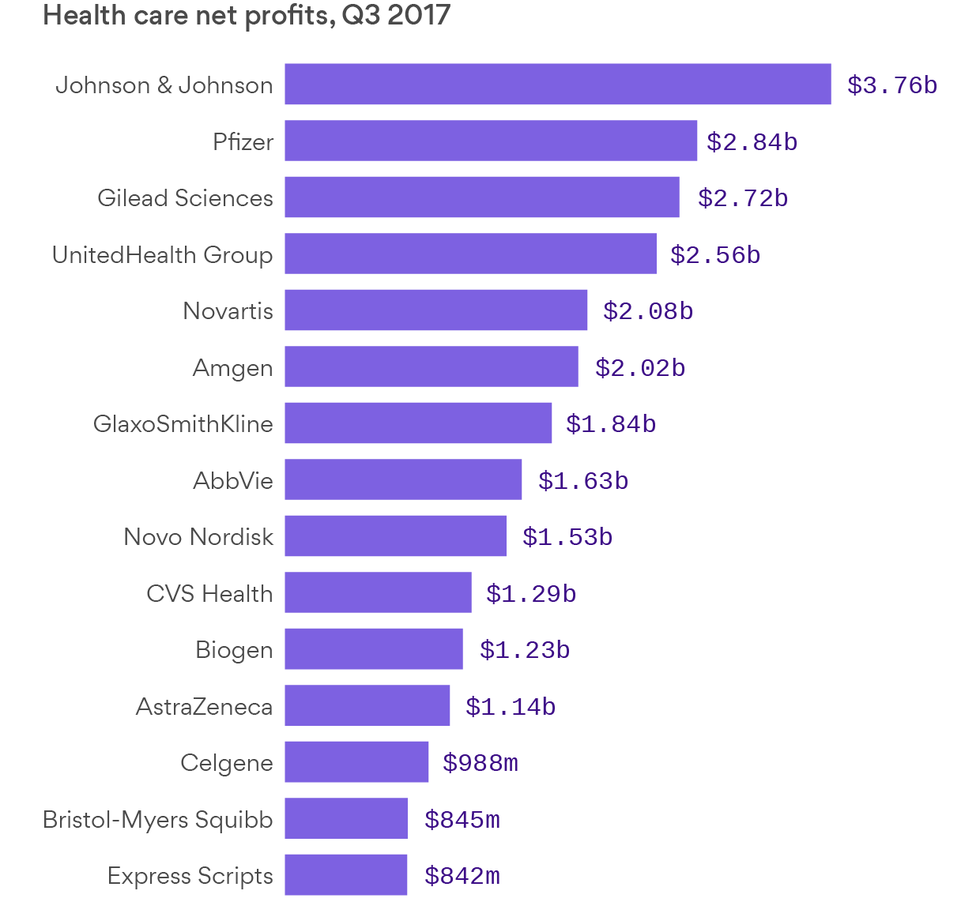
​Pharma’s big quarter

Data: SEC filings; Chart: Andrew Witherspoon / Axios

Axios’ Bob Herman has been tracking the health care industry’s financials over the third quarter, in which the 99 largest publicly traded health care companies cumulatively collected $33 billion of profit and $577 billion of revenue worldwide.

Winners: Pharmaceutical companies collected more than 60% of those profits, but only 22% of the revenue.

  • No health care company netted more profits than Johnson & Johnson, the behemoth maker of drugs, medical devices and consumer products like Band-Aids and Tylenol. Its net profit was $3.8 billion in the quarter.
  • 8 of the 15 highest net profit margins were at drug companies.
  • 12 of the 15 highest net profit totals were at drug companies.

Hospital groups to sue CMS over $1.6 billion cut to 340B payments

http://www.healthcarefinancenews.com/news/cms-finalizes-outpatient-payment-rule-reduces-hospitals-payment-rate-under-340b-drug-program?mkt_tok=eyJpIjoiWVdWa1lXTTBORFJpWTJSayIsInQiOiJndXNTdWM2czNvZzR6dDlRVXA4N3ZZWUhiV29FTzZ4VndOT3VGeUkzSGtGcms1QnlhSnNRTTlQbGRmcmY5UEpEY2VuWWg1UHIwTXVQUkg1ZklLZGN6SGYxMmpwc3lmZGJtK1pBcTNDNnZZZ0FmYzQ3Q2R2YWloNjVJSlorWStcL3QifQ%3D%3D

Credit: <a href="https://en.wikipedia.org/wiki/United_States_Department_of_Health_and_Human_Services#/media/File:DHHS2_by_Matthew_Bisanz.JPG">Matthew Bisanz</a>.

The final rule will also allow for higher payment when Medicare beneficiaries receive certain procedures in outpatient departments.

Several groups representing U.S. hospitals on Wednesday said they plan to sue the Centers for Medicare and Medicaid Services over a hospital outpatient prospective payment system final rule released Wednesday that reduces what hospitals are paid under the 340B drug program.

The rule lowers the cost of prescription drugs for seniors and other Medicare beneficiaries by reducing the payment rate to hospitals for certain Medicare Part B drugs purchased through the 340B program. The existing rule would have paid hospitals 6 percent above the sale price of drugs, but the final rule instead pays hospitals 22.5 percent less than sale prices, amounting to a $1.6 billion cut.

The American Hospital AssociationAssociation of American Medical Collegesand America’s Essential Hospitals said they will seek litigation to prevent the cuts.

“CMS’s decision in today’s rule to cut Medicare payments to hospitals for drugs covered under the 340B program will dramatically threaten access to health care for many patients, including uninsured and other vulnerable populations,” AHA Executive Vice President Tom Nickels said in a statement. “We strongly urge CMS to abandon its misguided 340B rule, and instead take direct action to halt the unchecked, unsustainable increases in the cost of drugs.”

America’s Essential Hospitals CEO Bruce Siegel said the organization saw no reasonable rationale for diverting Medicare Part B reimbursement from hospitals in the 340B drug pricing program that are in the greatest need of support to providers not eligible for 340B discounts. CMS has no evidence that the policy will combat rising drug prices, he said.

“Congress clearly intended that the 340B program help hospitals that care for many vulnerable patients; this new policy subverts that goal,” Siegel said. “Essential hospitals operate with an average margin less than half that of other hospitals and depend on 340B program savings to stretch resources for patient care and community services. Given their fragile financial position, essential hospitals will not weather this policy’s 27 percent cut to Part B drug payments without scaling back services or jobs.”

340B Health said the rule is a backdoor effort to undermine an important drug discount program.

“Responding to a survey earlier this year, 340B hospitals were unanimous in saying implementation of the CMS rule would cause them to cut back services. For example, Genesis Healthcare System in Zanesville, Ohio, estimates a loss of $3 million in Medicare payments could force it to cancel critical services such as substance abuse treatment, cancer treatment, and behavioral health programs.The MetroHealth System Cancer Center in Cleveland, Ohio, estimates an $8 million loss would raise patients’ costs and reduce access to needed services including transportation and care navigation that are supported by 340B savings,” said 340B Health CEO Ted Slafsky.

However, the AIR340B Coalition said it would continue to advocate for regulatory action to better align the program with its original intent of helping vulnerable patients.

“We applaud the Administration for taking action to help address one aspect of the 340B program that has been leading to higher costs for Medicare and its beneficiaries,” the AIR340B Coalition said.

Areas of change it supports include clearly defining a 340B eligible patient, examination of hospital and satellite clinic eligibility criteria, and a more rational and legally supportable policy on contract pharmacy arrangements.

CMS said the savings will be reallocated equally to all hospitals paid under the hospital outpatient prospective payment system. Children’s hospitals, certain cancer hospitals, and rural sole community hospitals will be excluded from these drug payment reductions.

CMS will work with Congress for additional considerations on 340B for safety net hospitals, said CMS Administrator Seema Verma.

Consumers would save an estimated $320 million in copayments in 2018 under the new payment rule that gives Medicare beneficiaries the benefit of discounts hospitals receive under the 340B program, according to Verma.

“As part of the president’s priority to lower the cost of prescription drugs, Medicare is taking steps to lower the costs Medicare patients pay for certain drugs in the hospital outpatient setting,” Verma said.

The final rule will also allow outpatient payment to be made when Medicare beneficiaries receive certain procedures in a lower cost setting, the outpatient department. The new availability of the higher OPPS payment applies to six procedures, including total knee replacements, a common and costly Medicare surgical procedure, CMS said.

Starting in January 2018, Medicare beneficiaries undergoing any of the six procedures can opt to have them performed in a lower cost setting when a clinician believes such a setting is appropriate.

Additionally, the final rule provides relief to rural hospitals by placing a two-year moratorium on the direct physician supervision requirements for rural hospitals and critical access hospitals.

“CMS understands the importance of strengthening access to care, especially in rural areas,” Verma said. “This policy helps to ensure access to outpatient therapeutic services for seniors living in rural communities and provides regulatory relief to America’s rural hospitals.”

In a home health prospective payment system final rule, CMS is not finalizing the home health groupings model and will take additional time to further engage with stakeholders.

Trump suggests repealing ObamaCare mandate in tax bill

Trump suggests repealing ObamaCare mandate in tax bill

Related image

President Trump on Wednesday suggested using the GOP tax bill to repeal ObamaCare’s individual mandate.

“Wouldn’t it be great to Repeal the very unfair and unpopular Individual Mandate in ObamaCare and use those savings for further Tax Cuts,” Trump tweeted.

The idea is being pushed by Sen. Tom Cotton (R-Ark.) and also has the backing of House Freedom Caucus Chairman Mark Meadows (R-N.C.).

Meadows said Wednesday he supports repealing the mandate in tax reform and thinks “ultimately” it will be included because he is going to push for it. He said he has been talking to Cotton about it.

A Cotton spokeswoman told The Hill that Cotton and Trump spoke by phone about the idea over the weekend and “the President indicated his strong support.”

Senate Finance Committee Chairman Orrin Hatch (R-Utah) this week said that he wouldn’t rule out including repeal of the mandate in the tax legislation.

But other top Republicans have rejected the idea, including House Ways and Means Committee Chairman Kevin Brady (R-Texas), Senate Majority Whip John Cornyn (R-Texas) and Sen. John Thune (R-S.D.). They fear adding the ObamaCare change would jeopardize tax reform.

“Look, I want to see that individual mandate repealed,” Brady said during an interview with radio host Hugh Hewitt on Tuesday. “I just haven’t seen, no one has seen, 50 votes in the Senate to do it.”

Brady added that he would be open to adding a repeal of the mandate to the House bill if the Senate passed it first.

Asked Wednesday about the president’s tweet, Senate Majority Whip John Cornyn (R-Texas) threw cold water on the idea.

“I think tax reform is complicated enough without adding another layer of complexity,” Cornyn told The Hill.

Thune, meanwhile, said mandate repeal is “not currently a part of our deliberations.”

But Thune added that some members have expressed interest in the idea and said he was “somewhat” interested in it because of the revenue implications.

Sen. Mike Rounds (R-S.D.) on Tuesday also dismissed adding a repeal of the mandate to tax reform.

“If there was a way to do it, I’d be open to it, but I’m not going to pitch it because I want to focus on taxes in the tax reduction plan,” Rounds told reporters.

The Congressional Budget Office has estimated that repealing the mandate would save the government $416 billion over a decade.

The mandate requires people, with some exceptions, to pay a fine to the IRS if they do not have health insurance.

Experts have said repealing the mandate would result in massive premium spikes and a major increase in the number of uninsured people.

It could also send ObamaCare exchanges into a “death spiral” because it would discourage healthy younger individuals to sign up for insurance.

Asked about it on Wednesday after Trump’s tweet, Hatch again did not rule out the move, but cautioned that he wants to keep health care separate from tax reform, a point echoed by GOP aides.
“I think we ought to do tax reform. If they want to do something on health care they can do that separate,” Hatch said. It was not clear who “they” referred to.
“I’d have to really look at all sides of that. I’ve never been very excited about the individual mandate,” Hatch said.

Californians will get more information on what’s driving prescription drug prices under law signed by governor

http://www.latimes.com/politics/la-pol-ca-prescription-drug-price-disclosure-20171009-story.html

Image result for Californians will get more information on what’s driving prescription drug prices under law signed by governor

Gov. Jerry Brown approved a measure Monday to increase disclosure on prescription drug prices, the focal point of growing efforts to clamp down on climbing pharmaceutical costs.

Supporters call the law the nation’s most sweeping effort to make prescription drug pricing more transparent. The measure would require drugmakers to provide notice to health plans and other purchasers 60 days in advance of a planned price hike if the increase exceeds certain thresholds.

The measure, SB 17 by state Sen. Ed Hernandez (D-Azusa), will also require health plans to submit an annual report to the state that details the most frequently prescribed drugs, those that are most expensive and those that have been subject to the greatest year-to-year price increase.

”The essence of this bill is pretty simple,” Brown said at a Capitol signing ceremony. “Californians have a right to know why their medical costs are out of control, especially when pharmaceutical profits are soaring.”

The disclosure, backers say, would help shed light on how prescription drugs are contributing to overall healthcare costs.

“SB 17 speaks to the needs of all Californians who have felt the strain of nonstop prescription drug price increases,” Charles Bacchi, president and chief executive of the California Assn. of Health Plans, said in a statement. “Pharmaceutical prices have long played an outsized role in driving up the cost of health coverage across the board. SB 17 gives us the tools to address the issue by helping us prepare for price hikes and discouraging needless cost increases.”

But pharmaceutical companies strongly opposed the measure, arguing the information would paint an inaccurate picture of drug spending, since the disclosure centers on full sticker cost set by manufacturers. Purchasers rarely pay the full list price, either through negotiated discounts or through use of consumer rebates or coupons.

“It is disappointing that Gov. Brown has decided to sign a bill that is based on misleading rhetoric instead of what’s in the best interest of patients,” Priscilla VanderVeer, a spokeswoman for the Pharmaceutical Research and Manufacturers of America, said in a statement. She said the measure “ignores the reality that spending on prescription medicines remains a much smaller portion of overall healthcare spending.”

VanderVeer said the manufacturers’ group was ready to work to combat affordability issues but added: “It’s time to move beyond creating new, costly bureaucratic programs that don’t make a dent in patients’ costs for medicines.”

Escalating drug prices inspired a slate of measures from lawmakers this year. Brown on Monday signed an additional measure, AB 265 by Assemblyman Jim Wood (D-Healdsburg), that will restrict the use of drug rebates or coupons for brand-name drugs when cheaper generic alternatives are available.

The law includes a number of exemptions, including for when patients have gotten authorization from their health insurers for brand-name treatments. But Wood has pitched his measure as a way to stem widespread use of such vouchers, which some researchers have said drive higher overall healthcare costs by giving patients incentive to pick pricier medicines.

Other related bills, including a measure to clamp down on gifts doctors can receive from pharmaceutical companies and a proposal to regulate pharmacy benefit managers, a little-scrutinized part of the drug supply chain, sputtered earlier this year.

The disclosure bill was seen as the centerpiece of the focus on drug prices, setting off a fierce lobbying battle in which the pharmaceutical industry squared off against a coalition of backers that included health plans, labor groups and consumer advocates.

It also garnered support from some Republican lawmakers, who have typically been aligned with drug makers.

“Shouldn’t we do something to help make this system operate better so we can get better cost savings for our consumers? That’s a conservative principle,” said Assemblyman James Gallagher (R-Yuba City).

Now, Hernandez said, he hoped the law would inspire similar action on a national level.

“I want to challenge our federal elected officials…to do the same thing at the national level,” he said, “so that we can make sure that every single person in this country not only has access to healthcare but they can afford their healthcare premium dollars.”

In his signing remarks, Brown said the angst over rising drug costs — and manufacturers’ substantial profits — was symptomatic of the broader gap between the haves and have-nots.

“The social and political fabric is being ripped apart,” Brown said. “The inequities are growing. The rich are getting richer, the powerful are getting more powerful and a growing number of people are getting more desperate, more alienated.”

He directed a message to the pharmaceutical industry that opposed the bill: “You’ve got to join with us. You’re part of America. And if we all don’t pull together, we’re going to pull apart.”

Grassley Pressing to Include Drug Pricing Measures in CHIP Reauthorization

https://morningconsult.com/2017/10/03/grassley-pressing-include-drug-pricing-measures-chip-reauthorization/

Image result for high drug prices


  • The CREATES Act would crack down on practices employed by some brand-name drugmakers to thwart generic competition.
  • The Preserve Access to Affordable Generics Act targets deals between brand-name drugmakers and their generic counterparts to delay the market entry of competing drugs.

Sen. Chuck Grassley, a senior member and former chairman of the powerful Senate Finance Committee, is pressing GOP leaders to tackle high drug prices in a critical bill to renew funding for the Children’s Health Insurance Program.

Grassley (R-Iowa), who has tried for years to advance legislation targeting rising prescription drug costs to little avail, is pushing two bills as potential offsets for CHIP funding.

Both measures have some bipartisan support, but neither has advanced in previous congressional sessions amid fierce pushback from the pharmaceutical industry. But with urgency on Capitol Hill to renew CHIP, which expired last week, Grassley is taking a shot at getting the bills — the CREATES Act and the Preserve Access to Affordable Generics Act — included in the reauthorization as partial offsets.

The CREATES Act would crack down on practices employed by some brand-name drugmakers to thwart generic competition, while the Preserve Access to Affordable Generics Act targets deals between brand-name drugmakers and their generic counterparts to delay competing drugs from entering the market.

Experts on Grassley’s staff have talked with staff on the Senate Finance Committee and in leadership about the proposals ahead of a committee markup of the CHIP legislation on Wednesday, according to a senior GOP aide.

Supporters from the health sector, which include health insurers, providers and patient organizations, say their chances have never been better, given public outrage at exorbitant drug prices, bipartisan desire to address the issue in Congress and interest in drug prices from within the Trump administration. The proposals have even united progressive advocacy group Public Citizen and the conservative FreedomWorks.

Still, despite unprecedented momentum to tackle rising prescription costs, it is still far from certain whether Grassley will be successful. Senate Finance Committee Chairman Orrin Hatch (R-Utah) has not endorsed either measure and has sometimes sided with brand-name drugmakers on divisive pricing issues. Hatch’s office did not respond to a request for comment on Tuesday.

“It is a delicate conversation between two chairmen who’ve been here for more than a cup of coffee,” Rodney Whitlock, Grassley’s former health policy expert, said in an interview Tuesday. Whitlock is now vice president of health policy at the consulting firm ML Strategies LLC.

Political procedure also complicates Grassley’s effort. Both drug pricing measures have been referred to the Senate Judiciary Committee, which Grassley chairs, while the Senate Finance Committee has jurisdiction over CHIP.

A spokesman for Senate Majority Leader Mitch McConnell (R-Ky.) directed a request for comment to Grassley’s office.

Eyes Fixed On California As Governor Ponders Inking Drug Price Transparency Bill

Eyes Fixed On California As Governor Ponders Inking Drug Price Transparency Bill

Insurers, hospitals and health advocates are waiting for Gov. Jerry Brown to deal the drug lobby a rare defeat, by signing legislation that would force pharmaceutical companies to justify big price hikes on drugs in California.

“If it gets signed by this governor, it’s going to send shock waves throughout the country,” said state Sen. Ed Hernandez, a Democrat from West Covina, the bill’s author and an optometrist. “A lot of other states have the same concerns we have, and you’re going to see other states try to emulate what we did.”

The bill would require drug companies to give California 60 days’ notice to state agencies and health insurers anytime they plan to raise the price of a drug by 16 percent or more over two years. They would also have to explain why the increases are necessary. In addition, health insurers would have to report what percentage of premium increases are caused by drug spending.

Drugmakers spent $16.8 million on lobbying from January 2015 through the first half of this year to kill an array of drug legislation in California, according to data from the secretary of state’s office. For the pricing bill alone, the industry has hired 45 lobbyists or firms to fight it. Against the backdrop of this opposition campaign, Brown must decide by Oct. 15 whether to sign or veto the bill.

“When they have to justify in California, de facto, they have to justify it to the other 49 states,” said Gerard Anderson, a health policy professor at Johns Hopkins Bloomberg School of Public Health in Baltimore. “Other states essentially get to piggyback on the good efforts of California, and hopefully, because they might have difficulty justifying the price increases, everybody’s prices around the country will be lower.”

Other states, including Maryland, Vermont, Nevada and New York, have passed similar laws aimed at bringing more transparency to prices and curbing price gouging. But the pharmaceutical industry has fought the hardest in California. If drug companies don’t like the disclosure laws in smaller states, they could decide not to sell their drugs there, Anderson said, but the market in California is just too big to ignore.

“States like Maryland are just not as powerful,” he said. “It just doesn’t have the clout that a state like California has.”

This is the second go-round for such a drug price bill. Last summer, similar legislation crashed and burned. Its intended regulations were gutted so extensively that Hernandez decided to pull it. But, he said, two key things happened after that, setting the stage for a successful second attempt.

First, in August 2016, less than a week after Hernandez pulled the bill, controversy erupted nationally over the price of EpiPens, which spiked nearly 500 percent. The increase sparked outrage from parents who carry the auto-injectors to save their children from life-threatening allergic reactions.

Momentum grew among federal lawmakers last September. They called for hearings. Several bills were proposed across the country aimed to rein in drug prices.

Then came the election of November 2016. After Donald Trump became president and Republicans took control of Congress, the No. 1 health policy priority became repealing and replacing the Affordable Care Act, President Barack Obama’s signature legislation.

As federal lawmakers focused on dismantling the ACA, Hernandez said he saw another opportunity for state lawmakers to act on drug prices. He reintroduced his bill in early 2017, and this time political support grew quickly — beyond the usual suspects.

“It wasn’t just labor,” he recalls. “It was consumer groups, it was health plans. It was the Chambers of Commerce, it was the hospital association.”

The Pharmaceutical Research and Manufacturers of America, or PhRMA, a drug industry’s trade group, argued that the bill known as SB 17 was full of “false promises” that wouldn’t help consumers pay for their medicines and would instead stifle innovation with cumbersome regulatory compliance.

“That takes up a lot of resources and will take up a lot of time,” said Priscilla VanderVeer, deputy vice president of public affairs for PhRMA. “And that could mean pulling resources from research and development and having to put it into the reporting structure.”

Some experts say that price transparency alone is not sufficient to bring down costs  and that other changes are needed.

Hernandez is optimistic the governor will sign SB 17 into law. But he knows nothing’s certain. That’s because of what happened on Sept. 11, the day the bill came up for a key vote in the state Assembly — the same place it went down the year before. Hernandez thought he’d secured all the votes he needed, but at the last minute the votes started slipping away.

The bill needed 41 votes to pass the Assembly. During the roll call, the tally stalled around 35. Hernandez said he had plenty of colleagues willing to cast the 42nd vote, but with drug lobbyists swarming the Capitol, no legislators wanted to be the one to cast the deciding vote.

“If the bill fails and you’re stuck out there, then you’re the person that’s attacking the industry,” Hernandez said.

Still, the bill crossed the 41-vote threshold and the remaining lawmakers joined in. In the end, the bill passed with 66 votes. All the Democrats and half of the Republicans in the state Assembly voted for it.

This was much to the dismay of drug companies, which lobbied hard and issued a blitz of advertising in the last weeks before the vote.

Experts said the drug industry doesn’t want a large influential state like California forcing them to share their data.

Drugmakers are likely already devising ways to work around the California bill, warned Anderson, the Johns Hopkins professor. They’ve filed lawsuits to try to slow or stop laws from being implemented in other states, or to weaken the rules if and when they go into effect. Policy experts are watching to see what kinds of legal challenges the California law might be vulnerable to, and if it can withstand them.

“We learn from the mistakes of other states,” Anderson said. “Legislation is an iterative process. We have 50 states and hopefully, by some time, we’ll get it right. We’re looking for California to take the lead on this.”