Last-Ditch Effort By Republicans To Replace ACA: What You Need To Know

http://khn.org/news/last-ditch-gop-effort-to-replace-aca-5-things-you-need-to-know/

Related image

Republican efforts in Congress to “repeal and replace” the federal Affordable Care Act are back from the dead. Again.

While the chances for this last-ditch measure appear iffy, many GOP senators are rallying around a proposal by Sens. Lindsey Graham (R-S.C.) and Bill Cassidy (R-La.), along with Sens. Dean Heller (R-Nev.) and Ron Johnson (R-Wis.)

They are racing the clock to round up the needed 50 votes — and there are 52 Senate Republicans.

An earlier attempt to replace the ACA this summer fell just one vote short when Sens. Susan Collins (R-Maine), Lisa Murkowski (R-Alaska) and John McCain (R-Ariz.) voted against it. The latest push is setting off a massive guessing game on Capitol Hill about where the GOP can pick up the needed vote.

After Sept. 30, the end of the current fiscal year, Republicans would need 60 votes ­— which means eight Democrats — to pass any such legislation because special budget rules allowing approval with a simple majority will expire.

Unlike previous GOP repeal-and-replace packages that passed the House and nearly passed the Senate, the Graham-Cassidy proposal would leave in place most of the ACA taxes that generated funding to expand coverage for millions of Americans. The plan would simply give those funds as lump sums to each state. States could do almost whatever they please with them. And the Congressional Budget Office has yet to weigh in on the potential impact of the bill, although earlier estimates of similar provisions suggest premiums would go up and coverage down.

“If you believe repealing and replacing Obamacare is a good idea, this is your best and only chance to make it happen, because everything else has failed,” said Graham in unveiling the bill last week.

Here are five things to know about the latest GOP bill: 

1. It would repeal most of the structure of the ACA.

The Graham-Cassidy proposal would eliminate the federal insurance exchange, healthcare.gov, along with the subsidies and tax credits that help people with low and moderate incomes — and small businesses — pay for health insurance and associated health costs. It would eliminate penalties for individuals who fail to obtain health insurance and employers who fail to provide it.

It would eliminate the tax on medical devices. 

2. It would eliminate many of the popular insurance protections, including those for people with preexisting conditions, in the health law.

Under the proposal, states could “waive” rules in the law requiring insurers to provide a list of specific “essential health benefits” and mandating that premiums be the same for people regardless of their health status. That would once again expose people with preexisting health conditions to unaffordable or unavailable coverage. Republicans have consistently said they wanted to maintain these protections, which polls have shown to be popular among voters.

3. It would fundamentally restructure the Medicaid program.

Medicaid, the joint-federal health program for low-income people, currently covers more than 70 million Americans. The Graham-Cassidy proposal would end the program’s expansion under the ACA and cap funding overall, and it would redistribute the funds that had provided coverage for millions of new Medicaid enrollees. It seeks to equalize payments among states. States that did not expand Medicaid and were getting fewer federal dollars for the program would receive more money and states that did expand would see large cuts, according to the bill’s own sponsors. For example, Oklahoma would see an 88 percent increase from 2020 to 2026, while Massachusetts would see a 10 percent cut.

The proposal would also bar Planned Parenthood from getting any Medicaid funding for family planning and other reproductive health services for one year, the maximum allowed under budget rules governing this bill. 

4. It’s getting mixed reviews from the states.

Sponsors of the proposal hoped for significant support from the nation’s governors as a way to help push the bill through. But, so far, the governors who are publicly supporting the measure, including Scott Walker (R-Wis.) and Doug Ducey (R-Ariz.), are being offset by opponents including Chris Sununu (R-N.H.), John Kasich (R-Ohio) and Bill Walker (I-Alaska).

On Tuesday 10 governors — five Democrats, four Republicans and Walker — sent a letterto Senate leaders urging them to pursue a more bipartisan approach. “Only open, bipartisan approaches can achieve true, lasting reforms,” said the letter.

Bill sponsor Cassidy was even taken to task publicly by his own state’s health secretary. Dr. Rebekah Gee, who was appointed by Louisiana’s Democratic governor, wrote that the bill “uniquely and disproportionately hurts Louisiana due to our recent [Medicaid] expansion and high burden of extreme poverty.”

5. The measure would come to the Senate floor with the most truncated process imaginable.

The Senate is working on its Republican-only plans under a process called “budget reconciliation,” which limits floor debate to 20 hours and prohibits a filibuster. In fact, all the time for floor debate was used up in July, when Republicans failed to advance any of several proposed overhaul plans. Senate Majority Leader Mitch McConnell (R-Ky.) could bring the bill back up anytime, but senators would immediately proceed to votes. Specifically, the next order of business would be a process called “vote-a-rama,” where votes on the bill and amendments can continue, in theory, as long as senators can stay awake to call for them.

Several senators, most notably John McCain, who cast the deciding vote to stop the process in July, have called for “regular order,” in which the bill would first be considered in the relevant committee before coming to the floor. The Senate Finance Committee, which Democrats used to write most of the ACA, has scheduled a hearing for next week. But there is not enough time for full committee consideration and a vote before the end of next week.

Meanwhile, the Congressional Budget Office said in a statement Tuesday that it could come up with an analysis by next week that would determine whether the proposal meets the requirements to be considered under the reconciliation process. But it said that more complicated questions like how many people would lose insurance under the proposal or what would happen to insurance premiums could not be answered “for at least several weeks.”

That has outraged Democrats, who are united in opposition to the measure.

“I don’t know how any senator could go home to their constituents and explain why they voted for a major bill with major consequences to so many of their people without having specific answers about how it would impact their state,” said Senate Minority Leader Chuck Schumer (D-N.Y.) on the Senate floor Tuesday.

Centrist Democrats Turn to Pragmatism, Seek Bipartisan ACA Fixes

https://morningconsult.com/2017/09/15/centrist-dems-seek-bipartisan-aca-fixes-not-single-payer-plan/

Click to access attachment-1.pdf

Image result for healthcare policy

While some progressives campaigned this week for “Medicare for all,” a group of moderate House Democrats aligned themselves with a more modest push to stabilize the Affordable Care Act, arguing that it could spur broader health care reforms in the future.

Thirty-eight of the 61 members of the New Democrat Coalition sent a letterFriday urging the leaders of the Senate Health, Education, Labor and Pensions Committee to agree on a bipartisan bill to keep premiums from rising further for Obamacare enrollees next year.

The letter outlines five short-term proposals agreed to by the group — several of which are likely to be included in the Senate bill, such as the extension of key insurer payments known as cost-sharing reductions.

New Democrat Coalition Chair Rep. Jim Himes (D-Conn.) said that while some Democrats and Republicans continue to push polarizing health care plans after the July collapse of Senate Republicans’ Obamacare repeal push, some lawmakers of both parties are ready to try bipartisanship.

“There’s a pretty substantial group of Democrats and Republicans who are ready to work together and get some things done on this most politically charged of topics,” Himes said in an interview Thursday.

Only three of the 38 Democrats who signed the letter are co-sponsors of a single-payer health care bill introduced by Rep. John Conyers (D-Mich.) that has been endorsed by approximately 60 percent of the House Democratic caucus; Sen. Bernie Sanders (I-Vt.) introduced similar legislation in the Senate on Wednesday.

But the progressive single-payer legislation has almost no chance of passing the Republican-led Congress, and members of the New Democrat Coalition are taking a more pragmatic approach: While “Medicare for all” proponents support placing nearly all Americans on a government plan, the New Democrat Coalition is backing reforms to improve private health insurance coverage and reduce health care costs.

“We believe these ideas provide a framework to reduce health care costs for families and seniors, increase choices for consumers, and encourage participation by the young and healthy,” the Democrats wrote in the letter.

Some members of the New Democrat Coalition are also in the House Problem Solvers Caucus, which consists of centrist GOP and Democratic lawmakers and sent its own letter Wednesday urging the Senate HELP and Finance committees to move toward a bill as a crucial Sept. 27 deadline for insurers approaches.

HELP Committee Chairman Lamar Alexander hopes to reach an agreement on the legislation by early next week, the Tennessee Republican said at a hearing on Thursday.


Following the ACA Repeal-and-Replace Effort, Where Does the U.S. Stand on Insurance Coverage?

http://www.commonwealthfund.org/publications/issue-briefs/2017/sep/post-aca-repeal-and-replace-health-insurance-coverage

Image result for the commonwealth fund


Conclusion and Policy Implications

The findings of this study could inform both short- and long-term actions for policymakers seeking to improve the affordability of marketplace plans and reduce the number of uninsured people in the United States.

Short-Term

The most immediate concern for policymakers is ensuring that the 17 million to 18 million people with marketplace and individual market coverage are able to enroll this fall.

Congress could take the following three steps:

  1. The Trump administration has not made a long-term commitment to paying insurers for the cost-sharing reductions for low-income enrollees in the marketplaces, which insurers are required to offer under the ACA. Congress could resolve this by making a permanent appropriation for the payments. Without this commitment, insurers have already announced that they are increasing premiums to hedge against the risk of not receiving payments from the federal government. Since most enrollees receive tax credits, higher premiums also will increase the federal government’s costs.9
  2. While it appears that most counties will have at least one insurer offering plans in the marketplaces this year, Congress could consider a fallback health plan option to protect consumers if they do not have a plan to choose from, with subsidies available to help qualifying enrollees pay premiums.
  3. Reinsurance to help carriers cover unexpectedly high claims costs.10 During the three years in which it was functioning, the ACA’s transitional reinsurance program lowered premiums by as much as 14 percent.

The executive branch can also play an important role in two ways:

  1. Signaling to insurers participating in the marketplaces that it will enforce the individual mandate. Uncertainty over the administration’s commitment to the mandate, like the cost-sharing reductions, is leading to higher-than-expected premiums for next year.
  2. Affirming the commitment to ensuring that all eligible Americans are aware of their options and have the tools they need to enroll in the coverage that is right for them during the 2018 open enrollment period, which begins November 1. The survey findings indicate that large shares of uninsured Americans are unaware of the marketplaces and that enrollment assistance makes a difference in whether people sign up for insurance.

Long-Term

The following longer-term policy changes will likely lead to affordability improvement and reductions in the number of uninsured people.

  1. The 19 states that have not expanded Medicaid could decide to do so.
  2. Alleviate affordability issues for people with incomes above 250 percent of poverty by:
    1. Allowing people earning more than 400 percent of poverty to be eligible for tax credits. This would cover an estimated 1.2 million people at an annual total federal cost of $6 billion, according to a RAND analysis.11
    2. Increasing tax credits for people with incomes above 250 percent of poverty.
    3. Allowing premium contributions to be fully tax deductible for people buying insurance on their own; self-employed people have long been able to do this.
    4. Extending cost-sharing reductions for individuals with incomes above 250 percent of poverty, thus making care more affordable for insured individuals with moderate incomes.
  3. Consider immigration reform and expanding insurance options for undocumented immigrants.

In 2002, the Institute of Medicine concluded that insurance coverage is the most important determinant of access to health care.12 In the ongoing public debate over how to provide insurance to people, the conversation often drifts from this fundamental why of health insurance. At this pivotal moment, more than 30 million people now rely on the ACA’s reforms and expansions. Nearly 30 million more are uninsured — because of the reasons identified in this survey. It is critical that the health of these 60 million people, along with their ability to lead long and productive lives, be the central focus in our debate over how to improve the U.S. health insurance system, regardless of the approach ultimately chosen.

There’s one Obamacare repeal bill left standing. Here’s what’s in it.

https://www.washingtonpost.com/graphics/2017/politics/cassidy-graham-explainer/?utm_term=.c90e0ce41aa2

Image result for cartoon dilbert beating a dead horse

After a dramatic series of failed Senate votes in July, there’s one repeal-and-replace plan for the Affordable Care Act left standing. Trump is pushing for a vote, per Politico, and John McCain has announced his support, but the bill has yet to gain significant traction.

The proposal, crafted by Sens. Bill Cassidy (R-La.), Lindsey O. Graham (R-S.C.) and Dean Heller (R-Nev.), essentially turns control of the health-care markets over to the states. Rather than funding Medicaid and subsidies directly, that money would be put into a block grant that a state could use to develop any health-care system it wants. It also allows states to opt out of many ACA regulations. “If you like Obamacare, you can keep it,” Graham has said, using a common nickname for the health-care law. “If you want to replace it, you can.”

In reality, that may not be true. The Medicaid expansion and subsidy funding would be cut sharply compared to current spending, going to zero in a decade.

 “You can’t actually keep the same program if your federal funding is being cut by a third in 2026,” said Aviva Aron-Dine, a senior fellow at the left-leaning Center on Budget and Policy Priorities. And even putting aside the cuts, she said, the block grant structure would fundamentally change the health-care landscape. “[Funding] is capped, so it wouldn’t  go up and down with the economy,” when fewer or more people become eligible for subsidies.

Republicans contest this. The drop in funding “gives strong incentives for the states to be more efficient with their program,” said Ed Haislmaier, a senior fellow at the conservative Heritage Foundation. That is, states may be able to maintain the ACA structure and regulations as long as they streamline operations.

If the streamlining turns out to be insufficient, the cuts would hit liberal states the hardest, according to a report by the Center for Budget and Policy Priorities. This is largely because they tend to be the biggest spenders on health care: They’ve expanded Medicaid and aggressively signed people up for marketplace coverage. They have the most to lose.

 On the whole, Aron-Dine says, “This is a lot more similar to the [Senate repeal bill] than different. All of them end with devastating cuts to marketplace subsidies, Medicaid, and weakening of consumer protections.”

Haislmaier agreed, pointing out the Cassidy-Graham plan was originally intended as an amendment to the Senate bill.

Here’s the nitty gritty of what would change, compared to the ACA and the Senate plan that failed in July:

Who would need to be covered

Under the Cassidy-Graham plan, the mandates would be eliminated at the federal level. States could choose to keep the measure, replace it or get rid of it completely.

How they would pay for coverage

The federal health insurance subsidies that help most people with ACA marketplace plans afford their coverage would change. This bill would shift those subsidies to the state-level, so people in some states may see their subsidy scaled back or eliminated.

Proposed changes to Medicaid

The bill would restructure Medicaid and decrease its funding. That would make it very difficult for states to maintain the Medicaid expansion.


Trump wants one last Senate push on Obamacare repeal

http://www.politico.com/story/2017/09/05/trump-obamacare-repeal-senate-242346

Image result for beating a dead horse

The odds are slim, but the White House still hopes for action on a bill drafted by Lindsey Graham and Bill Cassidy.

President Donald Trump and some Senate Republicans are refusing to give up on Obamacare repeal, even after this summer’s spectacular failure and with less than a month before a key deadline.

The president and White House staff have continued to work with Republican Sens. Lindsey Graham of South Carolijna and Bill Cassidy of Louisiana over the summer on their proposal to block grant federal health care funding to the states. And though the bill is being rewritten and Congress faces a brutal September agenda, Trump and his allies on health care are making a last-gasp effort.

“He wants to do it, the president does. He loves the block grants. But we’ve got to have political support outside Washington,” Graham said in an interview. He said the bill needs to have a “majority of the Republican governors behind the idea” to gain momentum in the Senate.

But there’s far more work to do even than that. Senate Majority Leader Mitch McConnell would need to find room on the packed calendar this month to hold another uncertain push to repeal Obamacare on party lines. The Senate has only until the end of the month to pass the measure using powerful budget reconciliation procedures, but is also planning to fund the government, raise the debt ceiling, write a new defense policy bill and extend a host of expiring programs.

Cassidy said he hopes to have the bill text finalized by this week and has declined to reveal details about what changed in the bill during August.

“We are still refining the legislative language — just things you got to clear up,” he said. “We think we have good legislation, good policy.”

The Congressional Budget Office would also still need time to analyze the cost of the bill, a process that could take several weeks.

Trump berated McConnell and the Senate GOP over the summer for falling one vote short of sending repeal into conference with the House in July, when Sen. John McCain of Arizona voted down the GOP’s “skinny” repeal bill. So the White House has continued to work on the Graham-Cassidy bill behind the scenes, seeing it as the best option to make progress, according to several administration officials.

The bill would keep most of Obamacare’s taxes and devolve many spending decisions to the states. It was submitted as an amendment to the repeal bill in July but did not receive a vote; aides say it could not pass the Senate in its current form.

Trump has intermittently told aides he wants progress on health care and is still frustrated that the bill failed. The White House’s legislative team has talked with Republican governors in recent weeks and is planning to bring more to the White House, according to one of the officials. Internally, White House officials say they have listened to concerns from governors and tried to tweak the state block grant formulas.

Hill leadership hasn’t played a central role in the effort.

McConnell said in Kentucky last month that the path forward is “somewhat murky” and pointed to efforts by Sen. Lamar Alexander (R-Tenn.) to stabilize insurance markets as one avenue forward, though he doubted Democrats’ resolve on the bipartisan effort.

“We’re going to see what Sen. Alexander and his team can do on a bipartisan basis. The Democrats have been pretty uninterested in any reforms. They’re really interested in sending money to insurance companies but not very interested in reforms,” McConnell said then.

Inside the White House, there is little hope that a health care bill can happen quickly, with a stacked legislative agenda. And some close to the president prefer he would focus on tax reform and other immediate fiscal issues.

The Senate parliamentarian has ruled that the chamber’s reconciliation instructions, which allow the GOP to evade a Democratic filibuster and the chamber’s 60-vote requirement, expire at the end of the month. Republicans are planning to use their next budget measure to pass tax reform via a simple majority. But Graham insisted there’s a short window to fulfill the party’s seven-year promise if the GOP goes into overdrive, starting this week.

“It’s possible, yes. But you’ve got to do it quickly … introduce it this week, have a hearing soon about the bill, then the process is set to actually take it to floor and vote,” Graham said. “Everything has to fall in place.”

State officials plead for bipartisan ObamaCare fix

State officials plead for bipartisan ObamaCare fix

State officials plead for bipartisan ObamaCare fix

State insurance officials pleaded with senators on Wednesday to quickly act to stabilize the ObamaCare marketscalling for a multiyear extension of key payments to help fund premiums for low-income customers.

Congress must pass a fix by the end of September to shore up the wobbly individual markets, several officials said, in particular funding for key ObamaCare insurer payments known as cost-sharing reductions (CSR).

“The CSR funding issue is the single most critical issue that you can address to help stabilize insurance markets for 2018 and potentially bring down costs,” Tennessee’s insurance commissioner Julie Mix McPeak told the Senate Health Committee.

The panel kicked off a series of hearings Wednesday on stabilizing the markets. If Congress can pass a bill, it would represent the biggest bipartisan update since President Obama signed the law in 2010.

Health committee Chairman Lamar Alexander (R-Tenn.) wants to find consensus by the end of next week. To sell the fix, he and ranking member Patty Murray (D-Wash.) held a private meeting with senators not on the committee and the witnesses who testified as Wednesday’s hearing.

“If we can do two things, that would be two more things that we have agreed on in a bipartisan way in the last seven years in health insurance,” Alexander told reporters.

“And then let the leaders see if we can pass it, and hope the House does and that the president signs it.”

Despite some pushback that could still come from conservatives calling the payments an “insurer bailout,” Alexander and Murray hope to cobble together a bipartisan group that agree some continuation of the payments is necessary.

The cost sharing subsidies, which reimburse insurers for giving discounted deductibles and co-pays to low-income customers, have been made by the Trump administration on a month-to-month basis.

Republicans had sued the Obama administration over the payments, calling them unconstitutional, but many have since acknowledged they need to continue at least in the near term to prevent steep premium hikes.

Insurers have asked for long-term certainty on the payments, threatening to hike premiums and leave the ObamaCare markets altogether if they don’t get it.

Democrats, and some Republicans like Alexander, agree Congress should fund the payments, but there’s disagreement on the time frame.

Alexander wants to fund the payments through 2018 while Murray has pushed for multiple years.

“It is critical that we work toward a multiyear solution in order to provide the kind of certainty that will have the most impact on families’ premiums and choices in the marketplaces,” Murray said.

America’s Health Insurance Plans, the nation’s largest insurer trade association, and other stakeholder groups urged Congress to fund the payments through at least 2019.

“Without two years of CSR funding, uncertainty will persist and the Congress will need to address these same issues early next year,” the groups wrote in a letter to the committee Tuesday.

Meanwhile, Republicans say a bipartisan health bill must include changes to ObamaCare’s state waivers so states have more control over what their insurance plans look like.

Alexander said ObamaCare’s waivers should be amended so “states can have more flexibility to devise ways to provide more coverage with more choices and lower costs.”

“It just hasn’t been very appealing to states because it is a difficult tool to use,” he said.

This point was echoed by Pennsylvania’s insurance commissioner Theresa Miller, who called the process to get approved cumbersome.

“Baseline coverage requirements should be kept intact as much as possible … but make it easier for states to respond to market issues,” she said.

For example, it takes at least six months to get a waiver approved with the federal government, which the commissioners said made it difficult to quickly respond to market issues.

But Democrats have been wary of anything they say could result in coverage losses and the availability of less comprehensive insurance plans.

The Senate GOP’s ObamaCare repeal plan, which failed in a dramatic vote with Sen. John McCain (R-Ariz.) joining two other Republicans in opposition, contained language intended to make it easier for states to approve less comprehensive plans.

However, Democrats say that is going in the wrong direction.

We should be “moving forward not backward on affordability, coverage and quality of care,” Murray said.

“We’re all well aware threading this needle won’t be easy,” she said, “but I do believe an agreement that protects patients and families from higher costs and uncertainty, and maintains the guardrails in our current health care system, is possible.”

Several commissioners also recommended setting up a temporary reinsurance program to help insurers with high cost patients with the intent of lowering premiums for healthier ones.

“Congress should enact a federal reinsurance program with a minimum duration of three years,” said Washington state insurance commissioner Mike Kreidler, adding that it would “significantly help stabilize the individual health insurance market.”

But Alexander indicated it’s unlikely for the bill to include reinsurance funding, noting that the U.S. is already trillions in debt.

“If a reinsurance program is such a good idea … why don’t states do it?” he asked, suggesting states impose small fees on every insurance plan sold to help fund it.

Democrats are also pushing for a bill to restore ObamaCare outreach funding after the Trump administration announced drastic cuts to the program.

Alaska’s insurance director Lori Wing-Heier said the cuts concern her because “these programs reduce the number of uninsured citizens and maximize public participation.”

Bipartisan group of governors calls on Congress to shore up elements of Affordable Care Act

https://www.washingtonpost.com/national/health-science/bipartisan-group-of-governors-calls-on-congress-to-shore-up-elements-of-affordable-care-act/2017/08/31/7853b978-8e71-11e7-84c0-02cc069f2c37_story.html?utm_term=.3975c59ec12b

Image result for bipartisanship

A bipartisan group of governors is trying to jump-start efforts to strengthen private insurance under the Affordable Care Act, urging Congress to take prompt steps to stabilize marketplaces created by law while giving states more freedom from its rules.

In a blueprint issued Thursday, the eight governors ask House and Senate leaders of both parties to take several steps to reverse the rising rates and dwindling choices facing many of the 10 million Americans who buy health plans on their own through ACA marketplaces.

Specifically, the state leaders say Congress should devote money for at least two years toward “cost-sharing subsidies” that the 2010 health-care law promises to pay ACA insurers to offset deductibles and other out-of-pocket expenses for lower-income customers. The House sued the Obama administration over the subsidies’ legality, and President Trump has repeatedly suggested that he might halt the payments — sending tremors through insurance companies in the marketplaces.

Five days before the House and Senate return to Washington, the governors also recommend preserving “for now” the ACA’s requirement that most Americans carry health insurance. Though this rule is unpopular, they concluded that it is “for the time being … perhaps the most important incentive for healthy people to enroll in coverage.”

The proposal also calls for a federal fund, to be available for two years, to buffer insurers from high-cost customers, and for the government to foster competition in ACA marketplaces by encouraging insurers to move into counties with only one company. Those that do would have the law’s insurer taxes waived on health plans sold in those locations.

Led by Ohio Gov. John Kasich (R) and Colorado Gov. John Hickenlooper (D), the blueprint essentially fleshes out the contours of four principals that many of the same governors recommended to Senate leaders in June. It focuses on the insurance market for individuals and families that buy coverage on their own — a fraction of the country’s consumers with private insurance but a perennially shaky part of the industry that the ACA was designed to strengthen.

Greg Moody, a longtime health-care aide to Kasich, said the blueprint is also an acknowledgment of the failure this year of Republicans who control Congress to deliver on their years-long goal of replacing the ACA. “We’ve recently seen how difficult that is,” Moody said.

The blueprint envisions a quick federal boost to shore up the marketplace for the coming year, while deferring to states longer term to experiment with potential changes in insurance subsidies, for instance, or different forms of penalties for consumers who drop coverage.

The proposal was released Thursday so that it would attract attention before two days of hearings scheduled next week by the Senate’s health committee, which will explore bipartisan ideas for improving the law and its marketplaces.

The other governors who signed on are Brian Sandoval (R-Nev.), Tom Wolf (D-Pa.), Bill Walker (I-Alaska), Terry McAuliffe (D-Va.), John Bel Edwards (D-La.) and Steve Bullock (D-Mont.).

After repeal scare, Obamacare has never been more popular

https://www.cbsnews.com/news/obamacare-repeal-has-never-been-more-popular/

obamacare-sentiment.png

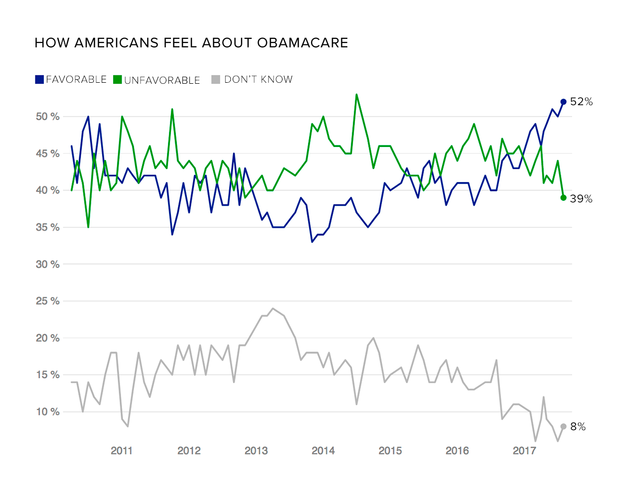
Underscoring the adage that you don’t know what you’ve got until it’s (almost) gone, the popularity of Obamacare is surging.

Only weeks after Republicans in Congress failed to repeal the landmark health reform law, 52 percent of respondents hold a favorable view of the Affordable Care Act (ACA), according to a recent Kaiser Family Foundation August poll. That’s up 10 percentage points since June of last year and nearly 20 points since November 2013, when public support for the ACA was at its nadir.

A July poll by CBS News after the repeal effort collapsed found that a plurality of Americans favor a bipartisan push in Congress to improve Obamacare.

The shift in sentiment coincides with other positive developments for Obamacare following its close call in Washington. With several large, and some smaller, insurers pulling out of the program over the past year or so, until recently it looked as if more than 92,000 participants spread out over 82 counties would have no insurer in their local health care exchanges, Cynthia Cox, associate director of Kaiser Family Foundation, said. But state insurance commissioners and other officials in states in jeopardy of losing Obamacare coverage have worked closely with insurers to negotiate continued coverage.

In Ohio, for instance, there were 20 counties without insurers, but officials ultimately convinced five health plans to cover all but one. Then, on August 24, the Ohio Department of Insurance announced that Paulding County, the last “bare county” in the country, would be covered by insurer CareSource.

In addition, the exchange marketplace overall has shown signs of stabilizing. After big financial losses in 2014 and 2015, individual market insurers saw improved performance in 2016, a trend that has continued this year, according to a different Kaiser Family Foundation study.

If Obamacare’s popularity is up, the program’s shortcomings remain clear. At last count, more than 2.6 million enrollees across 1,300 counties were expected to have only one insurer in their exchanges. More insurers also could pull out or move to sharply increase their premiums. The deadline for insurance companies to commit to participate in an exchange is September 27.

Until then, many insurers are watching closely to see if the Trump Administration will continue funding the federal cost-sharing subsidies that help low-income members pay for deductibles, co-pays and other out-of-pocket costs. Industry players are also waiting or Senate hearings to start after Labor Day in which which insurance commissioners, lawmakers and state governors are expected to testify about what can be done to stabilize the individual marketplace.

Meanwhile, some states are beginning to take matters into their own hands, moving to rewrite the ACA rules by applying for what’s known as a “Section 1332” waiver. Oklahoma is asking for a waiver to establish its own reinsurance program using some federal funds, which would cover the highest-cost individual marketplace cases. Alaska recently received approval for a similar reinsurance waiver. Oklahoma, however, is also looking ahead to more major structural changes that may spur debate.

Iowa, which is undergoing huge premium increases in its individual marketplace, has submitted a waiver that would overhaul the state’s insurance marketplace by redistributing federal tax credit money. The plan would create a single standard health plan and offer a flat tax credit based on age and income.

Critics argue this would increase health care costs significantly for Iowa’s low-income population, putting coverage out of reach for many. Proponents argue that increasing Iowa’s pool of healthy insured people is the best way to stabilize Iowa’s individual market and lower premiums for everyone.

How to keep ACA stabilization narrow

https://www.axios.com/aca-markets-narrow-problem-2479649219.html

When Congress returns next week, the health debate will shift from trying to pass sweeping legislation to stabilizing the non-group insurance market. This will be a different debate about a thorny but smaller problem. The weaknesses that need to be fixed are fairly specific, and they don’t affect the majority of Americans.

Data: Kaiser Family Foundation; Chart: Andrew Witherspoon / Axios

The bottom line: If Congress can keep the focus on market stabilization and doesn’t get mired in another divisive debate about health reform, and the news media can keep this relatively manageable problem in perspective for the public, there is at least a decent chance for bipartisan cooperation and a successful outcome.

The problem: Premiums in the Affordable Care Act marketplaces have been rising sharply, with the average increase for the benchmark “silver plan” up 21% this year. Proposed rates for next year will range from a 49% increase in Wilmington, Delaware to a 5% decrease in Providence, Rhode Island.

But the non-group market is actually fairly small, covering about 18 million people, with about 10 million of them in the ACA marketplaces which have received so much attention.

The perception: Kaiser Family Foundation poll this month found that when people read headlines or hear about “premiums soaring” in the ACA marketplaces, most Americans — 76% — they think they are hearing about their own premiums, even though the vast majority of Americans are not in the individual insurance market and are not affected. (A smaller but sizeable percentage believe they are affected when they hear about counties with no or limited insurance options in the ACA marketplaces.)

There are several reasons for this, and the media bears some of the responsibility. Health journalists have generally done an outstanding job covering the issue, but sloppy cable headlines, commentary from pundits, and spin from politicians have too often implied that everyone in America is affected when they are not.

For context: In fact, the rest of the health system where most Americans get their coverage looks very different from the non-group market. As the chart shows:

  • Average premiums in the employer insurance market, where 151 million Americans get their health coverage, rose by an average of just 3% last year. And we’re expecting continued moderation this year.
  • Likewise, per capita spending for Medicaid is projected to grow a modest 3% in 2017, with per capita Medicare spending growing by just 2 percent.

The back story: Insurers and regulators have been struggling with a unique set of issues in the non-group market, most especially a sicker than expected risk pool and the uncertainty surrounding Trump administration policies. The most important areas of uncertainty have been whether the administration will continue to pay out the $7 billion in cost sharing subsidies and enforce the individual mandate.

But even before the ACA, the non-group market was also the weak link of the insurance system, with sick people priced out or excluded from coverage altogether.

What to watch: Some think a deal on stabilizing the non-group market could be as narrow as an agreement to appropriate the $7 billion in federal cost sharing subsidies in exchange for greater flexibility for states under the ACA. That might not be a slam dunk if that flexibility trips over third rail issues, such as endangering coverage for people with pre-existing conditions.

But whether the formula for a bipartisan deal is that one or another one, policymakers will have a better chance of addressing the problems in the marketplaces if they forge a narrow agreement. And the debate stands a better chance of not spinning out of control if the news media works overtime to help the public understand who is affected and who is not.


Time Crunch Among Hurdles for Bipartisan Senate Push to Bolster ACA

https://morningconsult.com/2017/08/18/time-crunch-among-hurdles-bipartisan-senate-push-bolster-aca/

Image result for aca


The leaders of a key Senate committee say they are cautiously optimistic about reaching a deal to shore up the Affordable Care Act’s individual marketplaces, but even with a bipartisan effort, it is far from certain whether they can hash out an agreement in time.

The Senate Health, Education, Labor and Pensions Committee leaders of both parties have set a self-imposed mid-September deadline for a bipartisan agreement. To keep lingering animosity from the Obamacare repeal fight from seeping into negotiations, Chairman Lamar Alexander has made clear that what he’s seeking is far from comprehensive.

The bill will have to be “small, bipartisan and balanced,” the Tennessee Republican said in a statement Wednesday.

Above all, Democrats want to make sure insurers continue to receive payments that help them cover out-of-pocket costs for some low-income patients. President Donald Trump has threatened to cut off the payments, and the administration has kept insurers on tenterhooks by making them only on a month-to-month basis.

Without the subsidies, known as cost-sharing reductions, some insurers warn they’ll be forced pull out of the ACA markets or hike premiums. The companies need certainty about payments at the latest by Sept. 27, the final deadline for them to decide whether to sell Obamacare plans in 2018.

If the committee can reach agreement next month, it would still be a challenge to get a bill through the full Senate and House before the key deadline for insurers. And Trump would still have to sign a bill into law that extends payments he is loath to continue.

The potential for chaos was highlighted this week when the nonpartisan Congressional Budget Office released a report estimating average premiums would rise 20 percent next year and the federal deficit would grow by $194 billion by 2026 if the administration stops paying.

While some conservative hard-liners want to cut off the CSRs, Alexander and other top Republicans have shown they’re willing to work with Democrats to have Congress extend the payments.

Sen. Patty Murray of Washington, the panel’s ranking Democrat, on Thursday called for quick action.

“People across the country are facing much higher premiums next year because of uncertainty driven by the Trump Administration, so I hope Republicans will join Democrats to act quickly to protect patients and families from paying more for care they need — and then continue working in a bipartisan way to make health care more affordable, accessible, and higher quality for all,” Murray said in a statement.

Democrats also want some sort of reinsurance program, an idea that has bipartisan support and would help insurers pay for their most expensive enrollees.

But in return for extending CSRs and including reinsurance, Republicans want to give states more authority over their health care systems, and Democrats could balk at some of their proposals.

Alexander has specifically pointed to changing the ACA’s 1332 waiver program, which allows states to opt out of key ACA regulations as long as it doesn’t lead to reduced coverage, skimpier benefits, more expensive insurance or a higher federal deficit.

In remarks to reporters earlier this month, Alexander noted a proposal that would eliminate all of those requirements besides increasing the federal deficit, in order to give states “more of an opportunity to approve insurance plans.” The plan, which was included in Senate Republicans’ health overhaul bill, would also bar the administration from rejecting a waiver as long as it doesn’t increase the federal deficit.

Democrats would likely oppose that proposal, wary of allowing states to undercut key Obamacare requirements without those other conditions in place.

Sen. Tim Kaine (D-Va.) said he’s interested in a proposal from Sens. Bill Cassidy (R-La.) and Susan Collins (R-Maine) to let states replace Obamacare’s most contentious provision — the mandate requiring people to purchase health insurance or pay a penalty — with a system that automatically enrolls individuals in low-cost coverage if they don’t do so on their own.

Backers of this approach argue it would offer comparable coverage to the individual mandate while being less intrusive, allowing people to opt out.

“I think that’s intriguing,” Kaine said earlier this month in a brief interview. “We ought to have that discussion, but you can’t blow the mandate without something to bring people into the program and do what insurance needs to do, which is to spread risk.”

But auto-enrollment has raised concerns among some liberal health care analysts, including over how to implement and administer such a system. The outstanding questions cast doubt on whether it could garner enough backing to be included in the stabilization bill.