Insurers Can Bend Out-Of-Network Rules For Patients Who Need Specific Doctors

https://khn.org/news/insurers-can-bend-out-of-network-rules-for-patients-who-need-specific-doctors/?utm_campaign=KHN%3A%20Topic-based&utm_source=hs_email&utm_medium=email&utm_content=58529177&_hsenc=p2ANqtz-85eIov6h_xyFiUgaAQ4fPQfmFKIGc3Hy-dk3J1iXBI7lQ6d8lPFgPXXyeWrMceH2mGmhwxT0ZSLJVK3aeIMHcE7YGtbg&_hsmi=58529177

The Affordable Care Act has so far survived Republican attempts to replace it, but many people still face insurance concerns. Below, I answer three questions from readers.

Q: I have a rare disease, and there is literally only one specialist in my area with the expertise needed to treat me. I am self-employed and have to buy my own insurance. What do I do next year if there are zero insurance plans available that allow me to see my specialist? I cannot “break up” with my sub-specialty oncologist. I must be able to see the doctor that is literally saving my life and keeping me alive.

If the plan you pick covers out-of-network providers, you can continue to see your cancer specialist, although you’ll have to pay a higher percentage of the cost than if you were seeing someone in your plan’s network.

But many plans these days don’t provide any out-of-network coverage. This is certainly true of plans sold on the health insurance exchanges.

The situation you’re concerned about — that a specialist you consider crucial to your care isn’t in a plan’s provider network — isn’t uncommon, said Sabrina Corlette, a research professor at Georgetown University’s Center on Health Insurance Reforms.

If this happens, you can contact your plan and make the case that this particular provider is the only one who has the expertise to meet your needs. (Unfortunately, you probably can’t get this coverage assurance before you sign up.) Then ask your plan to make an exception and treat the out-of-network specialist as if she were in network for cost-sharing purposes. So, if in your plan an in-network specialist visit requires a $250 copayment, for example, the plan would agree that’s what you’d be charged to see your out-of-network specialist.

Or not. It’s up to the plan officials, and they may argue that someone in network has the expertise you need. If you disagree, you can appeal that decision.

But it may not come to that, said Corlette.

“Plans are prepared for this — the good ones are, anyway,” she said. “My understanding is that it’s pretty routine to grant exceptions for narrow subspecialties.”

Q: My company has asked employees to pay the Cadillac tax rather than putting the burden  on the company. They are also telling us not to worry because it will never happen, but want us to agree that if it does we will take on the cost. Can they do that?

Let’s step back for a minute. The so-called Cadillac tax is a 40 percent surcharge on the value of health plans above the thresholds of $10,200 for single coverage and $27,500 for family plans.

A few months ago when it looked as if the ACA was going to be replaced, many employers believed, as yours apparently still does, that the Cadillac tax would never become effective. Both the House and Senate bills delayed the tax until 2026, and a lot can happen between now and then. With the collapse of efforts to repeal the ACA, however, the tax is on the front burner once again, said J.D. Piro, who leads the health and law group at benefits consultant Aon Hewitt. It’s set to take effect in 2020.

Under the law, insurers or employers would be responsible for paying the tax, but experts say the costs would likely be passed through to enrollees (whether or not you explicitly agree to absorb them). So it may not matter how you respond to your employer.

Also, employers who don’t want to pay the surcharge might sidestep the issue by reducing the value of the plans they offer, said Piro. For example, they could increase employee deductibles and other cost-sharing, make coverage less generous or shrink the provider network.

“That’s simplest way to avoid the tax,” he said.

Q: I need to purchase affordable health insurance for my two daughters who are 19 and 17. Is Trump insurance available yet? I need something I can afford and everything is so expensive.

President Donald Trump never put forward a proposal to replace the ACA. Instead, he backed the House and Senate replacement versions, which ultimately failed. But those versions might not have addressed your concerns, and you could have several options through the ACA.

“Coverage wouldn’t necessarily have been cheaper,” said Judith Solomon, vice president for health policy at the Center on Budget and Policy Priorities.

Under the Senate bill, for example, the nonpartisan Congressional Budget Office predicted that average 2018 premiums for single coverage would be 20 percent higher than this year’s. In 2020, however, premiums would be 30 percent lower than under current law, on average. But deductibles and other out-of-pocket costs would be higher for most people under the Senate bill, according to the CBO.

Premiums for young people would generally have declined. The bill would have allowed insurers to vary rates to a greater degree based on age, resulting in lower premiums for young people. In addition, premium tax credits generally would have increased for young people with incomes above 150 percent of the poverty level.

Your current coverage options under the ACA depend on your family situation. If you have coverage available to you through your employer, you can keep your daughters on your plan until they turn 26. For many parents, this is the most affordable, comprehensive option.

If that’s not a possibility, assuming the three of you live together and you claim them as dependents on your taxes, you may qualify for subsidized coverage on the health insurance marketplace next year. Your household income would need to be no more than 400 percent of the federal poverty level (about $82,000 for a family of three). You can apply for that coverage in the fall.

If you live in one of the 31 states plus the District of Columbia that have expanded Medicaid coverage to adults with incomes below 138 percent of the poverty level (about $28,000 for a family of three), you could qualify for that program. You don’t have to wait for open enrollment to sign up for Medicaid.

 

Rising Health Insurance Costs Frighten Some Early Retirees

https://khn.org/news/rising-health-insurance-costs-frighten-some-early-retirees/?utm_campaign=KHN%3A%20Topic-based&utm_source=hs_email&utm_medium=email&utm_content=58529177&_hsenc=p2ANqtz-85eIov6h_xyFiUgaAQ4fPQfmFKIGc3Hy-dk3J1iXBI7lQ6d8lPFgPXXyeWrMceH2mGmhwxT0ZSLJVK3aeIMHcE7YGtbg&_hsmi=58529177

Don and Debra Clark of Springfield, Mo., are glad they have health insurance. Don is 56 and Debra is 58. The Clarks say they know the risk of an unexpected illness or medical event is rising as they age and they must have coverage.

Don is retired and Debra works part time a couple of days a week. As a result, along with about 20 million other Americans, they buy health insurance in the individual market — the one significantly altered by the Affordable Care Act (ACA).

But the Clarks are not happy at all with what they pay for their coverage — $1,400 a month for a plan with a $4,500 deductible. Nor are they looking forward to the ACA’s fifth open enrollment period, which runs from Wednesday through Dec. 15 in most states. Many insurers are raising premiums by double digits, in part because of the Trump administration’s decision to stop payments to insurers to cover the discounts they are required to give to some low-income customers to cover out-of-pocket costs.

“This has become a nightmare,” said Don Clark. “We are now spending about 30 percent of our income on health insurance and health care. We did not plan for that.”

Karen Steininger, 62, of Altoona, Iowa, said her ACA coverage not only gave her peace of mind but also helped her and her husband, who is now on Medicare, stay in business the past few years. But they too are concerned about rising costs and the effect of the president’s actions.

The Steiningers are self-employed owners of a pottery studio. Their income varies year to year. They now pay $245 a month for Karen’s subsidized coverage, which, like the Clarks’, has a $4,500 deductible. Without the government subsidy, the premium would be about $700 a month.

“What if we make more money and get less of a subsidy or just if the premiums increase a lot?” Karen Steininger asked. “That would be a burden. We’ll have to cut back on something or switch to cheaper coverage.”

The experiences of the Clarks and the Steiningers point to an emerging shortfall in the ACA’s promise of easier access to affordable health insurance for early retirees and the self-employed. Rising premiums and deductibles, recent actions by the Trump administration, and unceasing political fights over the law threaten those benefits for millions of older Americans.

“These folks are rightly the most worried and confused right now,” said Kevin Lucia, a health insurance specialist and research professor at Georgetown University’s Health Policy Institute in Washington, D.C. “Decisions about which health plan is best for them is more complicated for 2018, and many people feel more uncertain about the future of the law itself.”

At highest risk are couples like the Clarks who get no government subsidy (which comes in the form of an advanced tax credit) when they buy insurance. That subsidy is available to people earning up to 400 percent of the federal poverty level, or just under $65,000 for a couple. Their income is just above the amount that would have qualified them for a subsidy in 2017.

Premiums vary widely by state. Generally, a couple in their late 50s or early 60s with an annual income of $65,000 would pay from $1,200 to $3,000 a month for health insurance.

Premiums rose an average 22 percent nationwide in 2017 and are forecast to rise between 20 and 30 percent overall for 2018.

In an analysis released this week based on insurers’ rate submissions for 2018, the Kaiser Family Foundation found that individuals and families that don’t qualify for a subsidy but are choosing plans on the federal marketplace face premiums 17 to 35 percent higher next year, depending on the type of plan they choose. (Kaiser Health News is an editorially independent program of the foundation.)

A similar increase would be expected for people who also buy on the marketplaces run by some states or buy directly from a broker or insurance company.

The substantial premium increases two years in a row could lead fewer people to buy coverage.

“I’m really worried about this,” said Peter Lee, CEO of Covered California, the exchange entity in that state. “We could see a lot fewer people who don’t get subsidies enroll.” He said that California has taken steps to mitigate the impact for people who don’t get subsidies but that “consumers are very confused about what is happening and could just opt not to buy.”

There are already signs of that, according to an analysis for this article by the Commonwealth Fund. The percentage of 50- to 64-year-olds who were uninsured ticked up from 8 percent in 2015 to 10 percent in the first half of 2017. In 2013, the figure was 14 percent.

Indeed, the ACA has been a boon to people in this age group whether they get a subsidy or not. It barred insurers from excluding people with preexisting conditions — which occur more commonly in older people. And the law restricted insurers from charging 55- to 64-year-olds more than three times that of younger people, instead of five times more, as was common.

The law also provided much better access to health insurance for early retirees and the self-employed — reducing so-called “job lock” and offering coverage amid a precipitous decline in employer-sponsored retiree coverage that began in the late 1990s.

Only 1 in 4 companies with 200 or more workers offered any kind of coverage to early (pre-65) retirees in 2017 compared with 66 percent of firms in 1988, reported the Kaiser Family Foundation. And the vast majority of small firms never did offer such coverage.

Overall, before the ACA became law, 1 in 4 55- to 64-year-olds buying coverage on their own either couldn’t get it at all because of a preexisting condition or couldn’t afford it, according to AARP.

“The aging but pre-Medicare population was our major reason to support the ACA then and it still is now,” said David Certner, director of legislative policy at AARP. “This group benefited enormously from the law, and we think society and the economy benefited, too.”

Just how many 55- to 64-years-olds have been liberated from job lock by the ACA has yet to be fully assessed. But recent data show that 18 percent of people ages 55 to 64 who were still working in 2015 got coverage through the ACA marketplaces, up from 11.6 percent in 2013, according to an analysis for this article by the Employee Benefit Research Institute.

Also, a report released in January 2017 by the outgoing Obama administration found that 1 in 5 ACA marketplace enrollees of any age was a small-business owner or self-employed person.

A bipartisan effort is underway in Congress to provide dedicated funds to woo enrollees to healthcare.gov and help state agencies explain changes in the law for 2018 triggered by the Trump administration. But the fate of the proposed legislation is uncertain.

The Clarks said they’ll look carefully at options to keep their premiums affordable in 2018.

Said Don Clark, “If we get to a point where we have a $10,000 deductible and pay 40 percent or more of our income for health insurance, I’m not sure what we’ll do. We can’t afford that.”


Poll: Ahead of House Tax Reform Vote, Americans are More Likely to Rank Children’s Health Care, Hurricane Relief and Other Issues as Top Priorities for Washington

http://connect.kff.org/poll-ahead-of-house-tax-reform-vote-americans-are-more-likely-to-rank-childrens-health-care-hurricane-relief-and-other-issues-as-top-priorities-for-washington?ecid=ACsprvumAORaSTpZGqmqhYQaXpeqtZoXjMxf6lbzmdUaIsV8vQ82Gwn_2PBBsI5zIiSuUzZ5w8-C&utm_campaign=KFF-2017-November-Poll-Tax-Reform-Vote&utm_source=hs_email&utm_medium=email&utm_content=58466081&_hsenc=p2ANqtz-8Cag0QgNSRgFKsxX_UJAz_sPw8ZG2hIH2l7nv8vGW9Dn5a8w_Mcy5njs5Hwf79zPT3e9Z8cecPnIWqwTXGvfb_qKXqRg&_hsmi=58466081

tax reform poll chart 2.png

Controlling Immigration Tops Republicans’ Priority List, With Tax Reform among a Number of Second-Tier Issues Including Hurricane Relief and ACA Repeal

Most of the Public Initially Favors Getting Rid of the ACA’s Individual Mandate As Part of Tax Reform, But Some Become Opponents When Presented with Facts and Arguments for Keeping the Mandate

As the House prepares to vote Thursday on its tax reform bill, a new Kaiser Family Foundation poll finds almost three in 10 Americans (28%) view tax reform as a top priority for President Trump and Congress.

That’s significantly fewer than the share that say the same about reauthorizing funding for the Children’s Health Insurance Program (62%), hurricane recovery funding (61%), stabilizing the Affordable Care Act’s insurance marketplaces (48%) and addressing the prescription painkiller epidemic (43%).  Two immigration-related issues – strengthening controls to limit who enters the country (35%) and passing legislation to allow the Dreamers to legally stay (34%) – also rank higher, while a similar share (29%) say repealing the Affordable Care Act is a top priority.

Among Republicans, half (51%) say reforming the tax code is a top Washington priority, behind strengthening immigration controls (69%) but similar to the share who consider hurricane recovery funding (52%), repealing the Affordable Care Act (50%), stabilizing the insurance marketplaces (46%) and reauthorizing CHIP funding (46%) to be top priorities.

In a tweet Monday, President Trump called on Congress to end the Affordable Care Act’s individual mandate, which requires most Americans to have health insurance or pay a tax penalty and has long been the least popular provision in the law. While the House tax reform bill does not currently address the mandate, key Republican senators said Tuesday that they will include such a provision in their version of the bill.

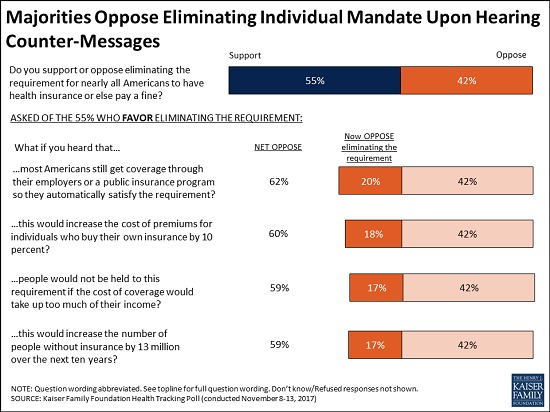
The new poll finds that most Americans (55%) initially support eliminating the mandate as part of tax reform, while four in 10 (42%) oppose it. Most Republicans (73%) and independents (58%) support ending the mandate, while most Democrats (59%) oppose it.

These views are malleable, with about a third of supporters (representing a fifth of the public overall) switching to oppose the mandate’s repeal when presented with facts and arguments about who is impacted and potential consequences of its repeal.

For example, the share who oppose eliminating the mandate can rise as high as 62 percent when initial supporters hear that most Americans get coverage through their employers or government programs that meets the mandate’s requirements. Similar majorities ultimately oppose eliminating the mandate when presented with other arguments against it, including that premiums for people who buy their own health insurance would go up, that people are exempted from the mandate if the cost of coverage takes up too much of their income and that getting rid of the mandate would result in 13 million more people being uninsured over the next 10 years, as the Congressional Budget Office has estimated.

One provision in the House bill would eliminate a tax deduction that allows people with high medical costs to deduct any medical and dental expenses that exceed 10 percent of their income.  A majority (68%) of the public – including majorities of Democrats (77%), independents (66%), and Republicans (61%) oppose eliminating the tax deduction for individuals who have high health care costs.

More than four in 10 (44%) of the public think eliminating the deduction for high medical costs will affect them and their families, though in reality a much smaller share of the public uses that deduction in any given tax year. According to the Internal Revenue Service, about 17 percent of taxpayers who file itemized deductions use this deduction (approximately 6% of all taxpayers and 3% of the public).

Looking ahead to the 2018 midterm elections, the public is divided over whether not passing a tax reform plan or not repealing the ACA would be a bigger deal for President Trump and Republicans. Nearly half of the public say it will be a bigger problem if the president and Republicans are unable to pass their tax reform plan (47%), similar to the share who say it will be a bigger problem if they are unable to revive a repeal of the ACA (44%). Republicans are also divided, with similar shares saying   it would be a bigger deal if President Trump and Republicans are unable to repeal the ACA (50%) and if they are unable to pass tax reform (45%).

Designed and analyzed by public opinion researchers at the Kaiser Family Foundation, the poll was conducted from November 8 – 13, 2017 among a nationally representative random digit dial telephone sample of 1,201 adults. Interviews were conducted in English and Spanish by landline (415) and cell phone (786). The margin of sampling error is plus or minus 3 percentage points for the full sample. For results based on subgroups, the margin of sampling error may be higher.

Trump and the Essential Health Benefits

Trump and the Essential Health Benefits

Image result for essential health benefits

On Friday, HHS released a proposed rule that would make a number of adjustments to the rules governing insurance exchanges for 2019. The rule is long and detailed; there’s a lot to digest. Among the most noteworthy changes, however, are those relating to the essential health benefits. They’re significant, and I’m not convinced they’re legal.

By way of background, the ACA requires all health plans in the individual and small-group markets to cover a baseline roster of services, including services falling into ten broad categories (e.g., maternity care, prescription drugs, mental health services). Taken as a whole, the essential health benefits must be “equal to the scope of benefits provided under a typical employer plan, as determined by the Secretary.”

The ACA’s drafters anticipated that HHS would establish a national, uniform slate of essential health benefits. Instead, the Obama administration opted to allow the states to select a “benchmark plan” from among existing plans in the small group market (or from plans for state employees). The benefits covered under the benchmark were then considered “essential” within the state.

At the time, Helen Levy and I concluded that HHS’s approach brushed up against the limits of what the law allowed. We noted, among other things, that the ACA tells HHS to establish the essential health benefits—not the states. And it’s black-letter administrative law that an agency can’t subdelegate its powers to outside entities, states included.

At the end of the day, however, Helen and I concluded that the Obama-era regulation passed muster. Our rationale bears repeating:

Although a federal agency cannot delegate its powers to the states, it “may turn to an outside entity for advice and policy recommendations, provided the agency makes the final decisions itself.” Here, the secretary gave the states a constrained set of options (e.g., choose a benchmark plan from among the three largest small-group plans in the state) and retained the authority to select a benchmark for any state that either does not pick a benchmark or chooses an inappropriate one. As such, the secretary remains firmly in control. Nothing in the ACA prevents her from deferring to states that select benchmark plans from among the few options she has provided. That choice to defer is itself an exercise of her delegated powers.

The Trump administration’s proposed rule would vastly enlarge this Obama-era subdelegation. For starters, the rule would allow a state to adopt another state’s benchmark, or part of a state’s benchmark, as its own. Michigan, for example, could borrow Alabama’s benchmark plan wholesale, or it could incorporate Alabama’s benchmark for mental health and substance use disorder treatment. More significantly, the rule would allow a state to “selec[t] a set of benefits that would become the State’s EHB-benchmark plan.”

You read that right: if the rule is adopted, each state can pick whatever essential health benefits it likes. No longer will it be choosing from a preselected menu; it’ll be picking the essential benefits out of a hat. In so doing, the proposed rule looks like it would unlawfully cede to the states the power to establish the essential benefits.

This extraordinary subdelegation of regulatory authority is subject only to the loosest of constraints: benefits can’t be “unduly weighted” toward any one benefit category or another, and the benchmark must “[p]rovide benefits for diverse segments of the population, including women, children, persons with disabilities, and other groups.” The selected benefits also can’t be more generous than the state’s 2017 benchmark (or any of the plans the state could have selected as its benchmark), but that’s a ceiling, not a floor, so states have lots of room to pare back.

The only meaningful constraint is that the benefits covered by the state’s benchmark must be “equal to the scope of benefits provided under a typical employer plan.” But another portion of the proposed rule would hollow out that requirement:

[W]e propose to define a typical employer plan as an employer plan within a product (as these terms are defined in §144.103 of this subchapter) with substantial enrollment in the product of at least 5,000 enrollees sold in the small group or large group market, in one or more States, or a self-insured group health plan with substantial enrollment of at least 5,000 enrollees in one or more States.

In other words, HHS is saying it will treat as “typical” any employer plan, in any state, that covers more than 5,000 people.

This looks like an innocuous change. It’s not. If the rule is adopted, it means that a single outlier plan can now count as typical, even if it’s way stingier than any other plan in the market. It also makes me wonder if HHS already has in mind some large employer with an unusually narrow health plan—maybe some hospital-based “administrative services only” plan, as Dave Anderson speculates. If so, voilá, the states can all ratchet down their essential benefits to that plan’s level.

I don’t think that’s legal. To know if a slate of health benefits is typical, you have to know something about how many health plans cover those benefits and how many don’t. The proposed rule eschews that comparative inquiry, and instead defines typicality with reference to the number of people who are covered by a single plan. Some random self-insured plan that excludes appendectomies could be treated as typical, even if it’s the only plan in the nation that does so.

In other words, HHS wants to define a “typical employer plan” to include atypical plans—which the agency emphatically cannot do. Yes, plans that enroll 5,000+ people are less likely to be outliers than smaller ones. But in a country as big and complicated as ours, there are bound to be some idiosyncratic quirks even in large plans. Those quirks would all be considered typical under HHS’s rule.

This definitional change, combined with the choose-your-own-adventure option to devise a benchmark, means that states will have wide authority to water down the essential health benefits requirement. Whether that’s good or bad is hard to say. Requiring plans to cover lots of services assures comprehensive coverage, but it also raises the cost of insurance. Because there’s no single “best” way to strike the balance, I think there’s a lot to be said for giving states the freedom to choose for themselves.

Wise or not, however, I’m skeptical that the Trump administration’s effort to hollow out the rule governing essential health benefits is legal. If HHS presses ahead with the rule, it could face tough sledding in the courts.

Trump suggests repealing ObamaCare mandate in tax bill

Trump suggests repealing ObamaCare mandate in tax bill

Related image

President Trump on Wednesday suggested using the GOP tax bill to repeal ObamaCare’s individual mandate.

“Wouldn’t it be great to Repeal the very unfair and unpopular Individual Mandate in ObamaCare and use those savings for further Tax Cuts,” Trump tweeted.

The idea is being pushed by Sen. Tom Cotton (R-Ark.) and also has the backing of House Freedom Caucus Chairman Mark Meadows (R-N.C.).

Meadows said Wednesday he supports repealing the mandate in tax reform and thinks “ultimately” it will be included because he is going to push for it. He said he has been talking to Cotton about it.

A Cotton spokeswoman told The Hill that Cotton and Trump spoke by phone about the idea over the weekend and “the President indicated his strong support.”

Senate Finance Committee Chairman Orrin Hatch (R-Utah) this week said that he wouldn’t rule out including repeal of the mandate in the tax legislation.

But other top Republicans have rejected the idea, including House Ways and Means Committee Chairman Kevin Brady (R-Texas), Senate Majority Whip John Cornyn (R-Texas) and Sen. John Thune (R-S.D.). They fear adding the ObamaCare change would jeopardize tax reform.

“Look, I want to see that individual mandate repealed,” Brady said during an interview with radio host Hugh Hewitt on Tuesday. “I just haven’t seen, no one has seen, 50 votes in the Senate to do it.”

Brady added that he would be open to adding a repeal of the mandate to the House bill if the Senate passed it first.

Asked Wednesday about the president’s tweet, Senate Majority Whip John Cornyn (R-Texas) threw cold water on the idea.

“I think tax reform is complicated enough without adding another layer of complexity,” Cornyn told The Hill.

Thune, meanwhile, said mandate repeal is “not currently a part of our deliberations.”

But Thune added that some members have expressed interest in the idea and said he was “somewhat” interested in it because of the revenue implications.

Sen. Mike Rounds (R-S.D.) on Tuesday also dismissed adding a repeal of the mandate to tax reform.

“If there was a way to do it, I’d be open to it, but I’m not going to pitch it because I want to focus on taxes in the tax reduction plan,” Rounds told reporters.

The Congressional Budget Office has estimated that repealing the mandate would save the government $416 billion over a decade.

The mandate requires people, with some exceptions, to pay a fine to the IRS if they do not have health insurance.

Experts have said repealing the mandate would result in massive premium spikes and a major increase in the number of uninsured people.

It could also send ObamaCare exchanges into a “death spiral” because it would discourage healthy younger individuals to sign up for insurance.

Asked about it on Wednesday after Trump’s tweet, Hatch again did not rule out the move, but cautioned that he wants to keep health care separate from tax reform, a point echoed by GOP aides.
“I think we ought to do tax reform. If they want to do something on health care they can do that separate,” Hatch said. It was not clear who “they” referred to.
“I’d have to really look at all sides of that. I’ve never been very excited about the individual mandate,” Hatch said.

CMS to allow states to define essential health benefits

http://www.modernhealthcare.com/article/20171027/NEWS/171029872/cms-to-allow-states-to-define-essential-health-benefits

Image result for end run

The CMS proposed a rule late Friday aimed at giving states more flexibility in stabilizing the Affordable Care Act exchanges and in interpreting the law’s essential health benefits as a way to lower the cost of individual and small group health plans.

In the 365-page proposed rule issued late Friday, the agency said the purpose is to give states more flexibility and reduce burdens on stakeholders in order to stabilize the individual and small-group insurance markets and improve healthcare affordability.

The CMS said the rule would give states greater flexibility in defining the ACA’s minimum essential benefits to increase affordability of coverage. States would play a larger role in the certification of qualified health plans offered on the federal insurance exchange. And they would have more leeway in setting medical loss ratios for individual-market plans.

“Consumers who have specific health needs may be impacted by the proposed policy,” the agency said. “In the individual and small group markets, depending on the selection made by the state in which the consumer lives, consumers with less comprehensive plans may no longer have coverage for certain services. In other states, again depending on state choices, consumers may gain coverage for some services.”

However, the CMS acknowledged it’s unclear how much money the new state flexibility will save. States are not required to make any changes under the policy.

The CMS urged states to consider the so-called spillover effects if they choose to pick their own benefits. These include increased use of other services, such as increased used of emergency services or increased use of public services provided by the state or other government entities.

The agency in 2017 proposed standardized health plan options as a way to simplify shopping for consumers on the federally run marketplaces. The CMS said it would eliminate standardized options for 2019 to maximize innovation. “We believe that encouraging innovation is especially important now, given the stresses faced by the individual market,” the proposed rule states.

The CMS proposes to let states relax the ACA requirement that at least 80% of premium revenue received by individual-market plans be spent on members’ medical care. It said states would be allowed to lower the 80% medical loss ratio standard if they demonstrate that a lower MLR could help stabilize their individual insurance market.

The CMS also said it intended to consider proposals in future rulemaking that would help cut prescription drug costs and promote drug price transparency.

The Trump administration hopes to relax the ACA’s requirements and provide as much state flexibility as possible through administrative action, following the collapse of congressional Republican efforts this year to make those changes legislatively.

The proposed rule comes after months of calls from health insurers and provider groups for the federal administration to help stabilize the struggling individual insurance market. The fifth ACA open enrollment is slated to begin Nov. 1, and experts have predicted fewer sign-ups in the wake of a series of actions by the Trump administration to undercut the exchanges.

In the proposed rule, the CMS also proposes to exempt student health insurance from rate reviews for policies beginning on or after Jan. 1, 2019. The CMS said student health insurance coverage is written and sold more like group coverage, which is already exempt from rate review, and said the change would reduce regulatory burden on states and insurance companies.

The ACA requires that insurers planning to increase premiums by 10% or more submit their rates to regulators for review. The CMS proposed to increase the rate review threshold to 15% “in recognition of significant rate increases in the past number of years.”

The rule also tweaks a requirement that enrollees need to have prior coverage before attempting to get coverage via special enrollment after moving to a new area. Under the proposal, a person who lived in an area with no exchange qualified health plans will be able to obtain coverage.

The President’s Executive Order: Less Than Meets The Eye?

http://healthaffairs.org/blog/2017/10/20/the-presidents-executive-order-less-than-meets-the-eye/

Image result for less than meets the eye

The executive order (EO) signed by President Donald Trump on October 12 directs the Departments of Health and Human Services (HHS), Labor, and Treasury to develop federal regulations that could allow new and less expensive health insurance options for employers and consumers.

The EO marks a shift in the administration’s strategy on health care. After failing to get legislation through Congress to repeal and replace the Affordable Care Act (ACA), the administration is now attempting to move away from the ACA’s heavily-regulated markets through changes that can be implemented without a change in the law.

The executive order does not itself change any federal regulations. Instead, it sets into motion a policy development process that could lead to new regulations or regulatory guidance within the confines of current law. Although the EO gives general policy direction, the specific content of future regulations depends on legal and technical analysis to be conducted by the agencies.

The policy themes are familiar: expand access to lower-cost insurance outside of the ACA’s exchange mechanism and enhance the use of financing vehicles to help workers pay for their care. The extent of possible changes is limited. For example, the EO seeks to allow the sale of insurance across state lines, but relies on potentially expanding the ability of employers to form Association Health Plans (AHPs) under the Employee Retirement Income Security Act (ERISA). Individuals purchasing their own insurance would continue to be subject to federal and state insurance market rules.

An Uncertain And Potentially Lengthy Timeline

The timeline for producing rule changes is uncertain. The EO gives the agencies 60 days to “consider proposing regulations or revising guidance” without specifying the date when a proposed rule would be released. It typically takes months, and sometimes years, to put a new federal regulation into effect.

The Administrative Procedures Act specifies that agencies must follow an open public process when they issue regulations. Following an often-lengthy internal clearance process, a proposed rule is issued that invites public comments. The final rule taking those comments into consideration must be developed and cleared before publication. Less time is required if an agency determines that it can issue an interim final rule without first publishing a proposed rule. Interim final rules generally take effect immediately.

Even if the federal agencies move expeditiously, it is unlikely that new regulations could affect the marketplace for health insurance in 2018. ACA exchange plans have been finalized in time for this year’s open enrollment period, starting November 1. Most employers will have signed contracts for their insurance plans for next year well before the end of 2017 as well. Most Americans will be required to select next year’s coverage before the end of this year. Realistically, any new rules are likely to be effective starting in 2019 or later.

Major Policy Areas

The EO targets three policy areas for change.

Association Health Plans (AHPs)

Republicans have long supported the use of AHPs to give small employers some of the advantages that large employers have in purchasing insurance for their workers. AHPs potentially could allow small firms to operate as one large employer plan, giving them scale economies and greater market power than they have purchasing insurance as separate companies. In addition, AHPs could be exempted from some of the ACA’s requirements (including essential health benefits and community-rated premiums). However, as the law is now interpreted, AHPs are subject to the same state and federal regulations that apply to the small group and individual insurance markets, largely eliminating their usefulness.

The EO directs the Labor Department, which oversees the regulation of employer plans, to look for ways to make it easier for small businesses to join AHPs. The existing rules for multi-employer insurance plans are complex, but it may be possible that ERISA could be reinterpreted to make AHPs more effective and attractive than they are today. The EO raises the possibility that AHPs could be formed among employers operating in the same geographic area or industry. Details may not be available for some time.

Whatever changes are pursued will be heavily scrutinized and likely challenged in court. Insurers selling in ACA-regulated markets might oppose the new regulations if they expect AHPs to attract healthier individuals from more comprehensive (and more expensive) exchange plans.

It is not clear that AHPs would be a better option for small employers than they have today. Forming larger groups can help spread insurance risk and administrative costs. Larger plans can also use their leverage to push better managed care protocols into their insurance plans, and thus cut costs. However, the voluntary nature of AHPs could result in plans competing for healthier groups of workers rather than investing the resources necessary to make health care more efficient and effective.

Small employers may have the option of joining more than one AHP or staying in the regulated market. Competing AHPs might structure their coverage to attract firms with younger, healthier workers. The press statement accompanying the EO states that employers would not be allowed to discriminate among workers based on their health status. But small employers would not be forced to join AHPs, and the rules for joining might be written in ways that implicitly and subtly target firms with healthier workers.

AHPs could add value to the health system if they moved people out of expensive, unmanaged fee-for-service insurance with high administrative costs into better-run managed care plans that cut expenses through economies of scale and elimination of unnecessary use of services. The Trump administration might find a way within current law to make these kinds of AHPs available without shifting higher premiums onto less healthy workers. But the history of AHPs and related types of organizations is not promising. Many previous multi-employer plans have suffered from undercapitalization, and have gone insolvent. It will not be easy to secure the necessary capital to build a viable AHP in a market in which small employers may have several insurance options.

Short-Term, Limited Duration Insurance (STLDI)

Short-term health insurance policies offer coverage to individuals who are unable to obtain other forms of health insurance but want to be protected for a specific period of time. STDLI plans are not subject to the ACA’s insurance rules. They do not have to cover the ACA’s essential health benefits, they do not cover pre-existing conditions, and they are not required to cover people in poor health. One study found that STDLI plans are one-third the price of exchange plans. These plans have generally been viewed as niche products, sold primarily to people who are between jobs.

The EO calls on HHS, Labor, and Treasury to reverse decisions of the Obama administration that restricted the availability of STLDI plans. A regulation issued on October 31, 2016 limits their duration to no more than three months, and the plans are not renewable. Moreover, enrollment in an STLDI plan does not constitute coverage under the ACA’s individual mandate. It seems likely that the agencies have the authority under current law to allow STLDI plans to cover an individual for up to one year and to be renewable.

STLDI plans are clearly not for everyone but could prove attractive to some customers. Low-cost coverage should be made available to individuals who change jobs and those who are unable to buy exchange coverage after the open season has ended. Consumers enrolled in STLDI plans who develop a serious medical condition would probably not be able to renew their coverage but would have access to higher-premium plans offered on the ACA-regulated marketplace.

An open question is whether the Trump administration will also attempt to exempt STLDI enrollees from the individual mandate’s tax penalties. That would make short-term plans more attractive for healthy people and thus exacerbate the adverse selection that is already driving up premiums for ACA-compliant plans.

Health Reimbursement Arrangements (HRAs)

HRAs allow employers to reimburse workers for their families’ medical expenses, including deductibles and other cost-sharing payments and health items not covered by insurance. Unlike health savings accounts, workers do not contribute to HRAs. Payments made by an employer through an HRA are not treated as taxable income for the worker. The Obama administration required HRAs to be used solely in conjunction with ACA-compliant health plans.

The EO directs the agencies to propose ways to expand the availability and use of HRAs. The EO specifically states an intention to allow HRAs to be used for workers purchasing their own non-group coverage. The administration may be planning to allow HRA funds to be used to pay premiums and cost-sharing in the individual insurance market, including plans that are not ACA-compliant. Those plans might include AHP plans and STDLI, depending on other regulatory changes that might result from the EO.

For some small employers, an expanded role for HRAs may be an attractive way to help pay insurance premiums for their workers without sponsoring an insurance plan themselves. But it is far from clear how much authority there is under current law to make this kind of change. Moreover, even if the administration were able to create a larger role for HRAs, workers in small firms may not be eager to get their insurance through the ACA exchanges instead of through their place of work.

Premature Predictions

Several commentators have said that the Trump administration’s EO would result in risk segmentation that would drive up premiums and could eventually lead to dismantling the ACA exchanges. That prediction seems premature. AHPs as they exist today do not pose a threat to the ACA. It remains to be seen if the administration can make room for a viable AHP option, and whether or not that option will adversely affect the ACA exchanges. The STLDI plans are a niche market today. While it is possible their role could expand, their value is limited and attractive to only a small segment of the market. The administration’s vision for HRAs is not clear enough to predict how any changes would affect the existing ACA markets.

Each of the changes contemplated by the Trump EO would take time to put into effect. Once the rules are changed, the private sector would need to make investments to change their business practices. It is doubtful there would be a rapid transition.

Millions of consumers are enrolled in ACA-compliant plans today. The ACA exchanges face an elevated level of adverse selection. But those markets remain the only real game in town primarily because the ACA’s generous premium subsidies are only available through the exchanges. The President’s EO cannot change this reality. Whatever is done in response to the EO is likely to have a less dramatic effect on the market than some in the administration now hope, and others now fear.


ACA Alterations Will Jolt Health Exchanges for 2018

http://www.healthleadersmedia.com/health-plans/aca-alterations-will-jolt-health-exchanges-2018?spMailingID=12171449&spUserID=MTY3ODg4NTg1MzQ4S0&spJobID=1261586415&spReportId=MTI2MTU4NjQxNQS2#

Image result for wrecking ball hospital

The end of cost sharing reductions has insurers trying to raise premiums even higher than planned. Those high premiums and other changes to the Affordable Care Act may drive consumers away from the exchanges.

The loss of cost sharing reductions (CSR) and the presidential executive order altering the Affordable Care Act will combine to significantly shake up the insurance market for 2018, one analyst says.

The effect is likely to include raising rates so high that the number of healthcare consumers who do not purchase coverage will skyrocket.

Health plans are scrambling to raise their rates even higher than already planned, responding to President Donald Trump’s announcement that insurers will no longer receive the subsidies.

Insurers were forced to submit rates for next year while the fate of CSRs was still uncertain—one set of rates is for if the subsidies continued and the second is for a higher rate to be used if they did not.

Some insurers are asking for a chance to revise the rates already submitted, says Julius W. Hobson Jr., an attorney and healthcare analyst with the Polsinelli law firm in Washington, D.C.

The CSR termination comes right after President Trump issued a new executive order he says is designed to increase competition and choice. Critics say it would seriously weaken the ACA, and some say that’s intentional.

President Trump says the order will give millions of Americans more access to affordable coverage and make it easier for people to obtain large-group coverage. Others worry that it could lure healthy young Americans away from the ACA exchanges, leaving those who remain to pay higher premiums.

“The combination of the executive order and the CSR termination wreaks havoc on the health insurance market for all of 2018,” Hobson says. “This also comes just before the open enrollment and with cutting back money for the patient navigators who help people sign up, and with reduced access to the website. That all means there are going to be fewer people who sign up.”

Higher premiums and deductibles already were driving some consumers away from purchasing individual healthcare plans, Hobson notes, and more will follow when the CSR loss forces insurers to raise rates even higher.

If the Trump administration stops enforcing the individual mandate, as it has said it might, that would make even more consumers forgo coverage, he says.

Fewer consumers buying insurance on the ACA exchanges intensifies their existing problems, Hobson says.

Premiums and deductibles will continue to rise as insurers struggle to remain profitable with a smaller pool of older, sicker patients driving high utilization costs. More and more consumers will leave the exchanges if they can, he says.

“People are going to be looking at premium increases they just can’t afford,” Hobson says. “The individual market will take a big hit, but the impact on the group market is harder to predict. We don’t know yet whether the increases in the individual market will bleed over into the group market.”

The recent changes are intended to weaken the ACA, Hobson says.

“The administration has said the ACA is imploding, but also that they’re going to do everything they can to wreck it. It’s not imploding on its own, it’s being shoved down the trash chute,” Hobson says.

“Losing the CSR payments is critical and, at this point, it’s unlikely that even if Congress acted they could do anything in time to affect 2018. There’s no way of looking at this other than it having a negative outcome,” he says.

No rush to stabilize ACA markets


President Trump’s decision to cut off the Affordable Care Act’s cost-sharing reduction subsidies doesn’t seem to have added much new urgency to the push to stabilize states’ insurance markets — which would likely include a guarantee to keep the subsidy payments flowing.

  • Bad sign: GOP Senate leadership didn’t talk about the CSR issue at all last night in their weekly meeting, at least while staff was in the room, a senior aide told Axios’ Caitlin Owens. To them, it’s still all about tax reform.
  • “They’re focused on tax reform,” Alexander, who’s been spearheading the stabilization effort, said of GOP leaders. “What I’ve asked the Republican leadership to do is to give us a chance to see if we can develop consensus among Republicans as well as Democrats.”
  • “The sooner the better,” Alexander said. “We want whatever agreement we have to benefit people in 2018 by holding down increasing premiums and to lower them in 2019.”

Yes, but: Affecting 2018 premiums will be a tough task — the window to begin signing up for 2018 coverage begins in two weeks.

  • Pennsylvania regulators announced yesterday that they’ve approved new premium hikes, more than 20% higher than the increases that were already on the books, because of the loss of CSR subsidies.
  • If Congress reaches a deal in time, one senior GOP aide told Caitlin, states and insurers could look to options such as rate re-filings and rebates to help consumers next year.
  • But the Kaiser Family Foundation’s Larry Levitt said turbulence for 2018 will likely be minimal. Most insurers had already planned for the payments to end, and therefore don’t need to make any changes.
  • The Trump administration appears to be allowing new increases by insurers that didn’t plan for CSR payments to disappear, Levitt said.
  • “Terminating the CSR payments is producing a lot of confusion, but the market will operate reasonably fine and the effect on consumers will be modest,” Levitt said. “If this was intended to end Obamacare, it’s probably not going to work. The real question at this point is the longer term effect of the administration’s overall strategy to undermine the marketplaces.”
One more problem: Even if a deal is struck, and it could muster 60 votes in the Senate, there’s a very real question of how it passes. Voting on the bill by itself, without being part of a larger package, would be difficult for Republicans. Most legislation that needs to get passed before the end of the year is expected to be clumped into one big bill in early December.

In New Test for Obamacare, Iowa Seeks to Abandon Marketplace

Image result for In New Test for Obamacare, Iowa Seeks to Abandon Marketplace

With efforts to repeal the Affordable Care Act dead in Congress for now, a critical test for the law’s future is playing out in one small, conservative-leaning state.

Iowa is anxiously waiting for the Trump administration to rule on a request that is loaded with implications for the law’s survival. If approved by the federal Centers for Medicare and Medicaid Services, it would allow the state to jettison some of Obamacare’s main features next year — its federally run insurance marketplace, its system for providing subsidies, its focus on helping poorer people afford insurance and medical care — and could open the door for other states to do the same.

Iowa’s Republican leaders think their plan would save the state’s individual insurance market by making premiums cheaper for everyone. But critics say the lower prices come at the expense of much higher deductibles for many with modest incomes, and that approval of the plan would amount to another way of undermining the law. Already the administration has slashed funding for advertising and outreach to help people sign up for insurance, and President Trump is preparing to issue an executive order allowing more access to plans that don’t meet the law’s standards.

Adding to the uncertainty, the Washington Post reported last week that Mr. Trump in August asked Seema Verma, the federal official in charge of reviewing Iowa’s plan, to reject it. Some supporters of the law saw that as a deliberate effort to keep premiums high; Mr. Trump frequently cites sharply rising premiums as proof that the health law is failing.

Neither C.M.S. nor the White House would comment on whether Mr. Trump had pushed for the application to be denied. A spokeswoman for C.M.S. said only that the plan remains under review.

In Des Moines on Tuesday, Gov. Kim Reynolds told reporters that her team was in constant contact with the White House and C.M.S. about the plan, including a call with Ms. Verma this week, trying “to get to yes.” She said the administration has been “very receptive” to the plan as a solution to the “unaffordable,” “unworkable” health law until it can be repealed.

Iowa calls its request a stopgap plan that would allow the state to opt out of the federal health insurance marketplace, HealthCare.gov, for 2018 and create a state-run system that its insurance commissioner says would lower premiums for the 72,000 Iowans who currently have Obamacare health plans, including 28,000 who earn too much to get subsidies to help with the cost.

But the cheaper premiums would come with a big trade-off: higher out-of-pocket costs. The only option for customers would be a plan with deductibles of $7,350 for a single person and $14,700 for a family. The proposal would also reallocate millions of federal dollars that the health law dedicates to lowering costs for people with modest incomes and use the money for premium assistance to those with higher incomes, no matter how much money they make.

The individual insurance market is particularly fragile in Iowa, partly because the state has allowed tens of thousands of people to keep old plans that do not meet the health law’s standards. Aetna and Wellmark Blue Cross & Blue Shield, the state’s most popular insurer, are both withdrawing at the end of the year. The only insurer planning to remain, Medica, is seeking premium increases that average 56 percent, blaming Mr. Trump’s ongoing threats to stop paying subsidies known as cost-sharing reductions that lower many people’s deductibles and other out-of-pocket costs. Wellmark has said it will stay if the stopgap plan is approved.

“What we are trying to address is a really large number of people being priced out,” said Doug Ommen, the state’s Republican insurance commissioner.

Two other states, Alaska and Minnesota, have already won permission to shore up their Obamacare markets with waivers allowed under the law; they will use federal money to help insurers cover the claims of their most expensive customers next year. But Oklahoma abruptly withdrew a similar request in late September — one that state officials said would have reduced premiums by an average of 30 percent — saying that the Trump administration had reneged on a promise to approve it by Sept. 25 and they were out of time. (A C.M.S. spokeswoman said, “At no time was an approval package or an approval date ever agreed upon.”)

Iowa’s waiver request is more far-reaching, providing what Timothy S. Jost, an emeritus professor of health law at Washington and Lee University, has called a “watershed moment” for Obamacare.

“It’s a decision to abandon a number of key principles of the Affordable Care Act,” he said.

Under the law, people who don’t get insurance through work can buy it through the online marketplace. They get federal subsidies to help with the cost if their income is below 400 percent of the poverty level, or about $65,000 a year for a couple. Those whose incomes are below 250 percent of the poverty level — $40,600 a year for a couple — also get cost-sharing reductions.

Iowa’s plan would reallocate much of that federal assistance, using it to provide premium subsidies based on age and income for even the wealthiest individual market customers. It would also be used to create a “reinsurance” program, like Alaska’s and Minnesota’s, to help insurers cover their sickest customers. The law’s essential health benefits and protections for people with pre-existing conditions would remain in place, but every individual market customer would get the same standardized high-deductible plan.

Mr. Jost and other supporters of the law say Iowa’s proposal does not meet the requirements for so-called innovation waivers, including that the coverage they provide must be at least as comprehensive and affordable as Obamacare plans, because poorer people would face higher deductibles and other out-of-pocket costs. That, they say, leaves the plan open to almost-certain legal challenges.

Seemingly acknowledging that problem, Mr. Ommen has tweaked Iowa’s proposal — including with a supplemental filing to the Trump administration on Thursday — to preserve subsidies that reduce out-of-pocket costs for roughly 21,000 low-income Iowans.

But those at slightly higher income levels would lose cost-sharing assistance completely, facing the $7,350 deductible and other out-of-pocket expenses.

“You still have some real problems from the perspective of making sure low-income people can afford coverage,” said Joel Ario, a managing director at Manatt Health who worked on the Affordable Care Act at the Department of Health and Human Services during the Obama administration.

But for the roughly 28,000 Iowans who have Obamacare coverage but earn too much to get subsidies, the need for a shake-up is urgent. And with open enrollment starting in about three weeks, time is of the essence.

Dozens of them, including many farmers, submitted comments to Mr. Ommen or testified at public hearings in favor of the stopgap plan, with many saying they would be forced to drop their insurance next year if it were not approved.

“Fortunately both my husband and I have already prepaid our funeral expenses,” write a woman identified as Nancy K., of Bellevue, who said she could no longer afford her coverage. “Every single item, even our cemetery marker, is paid for or covered for my death in the event that we cannot afford insurance to pay for any so-called catastrophic health care.”

Landi Livingston, whose family raises beef cattle in rural southern Iowa, said she was paying almost $500 a month for a Wellmark plan and dreaded having to switch to Medica next year, with what she assumed would be significantly higher prices.

If the Trump administration approves the state’s request, Ms. Livingston’s premium would likely drop to around $350 a month, according to estimates from the state, saving her $1,800 next year. But her $3,000 deductible would more than double, meaning that if she had high medical expenses she could end up paying more toward those bills.

“I still think it’s the best thing on the table right now,” she said of the stopgap plan. “It’s high time the people in power get this figured out.”

For Tony Ross, a retired paralegal in Des Moines who has a subsidized marketplace plan from Aetna, the stopgap plan would lower his premiums to about $85 a month, from $220, according to the state estimates. But his deductible – currently $750 because his low income qualifies him for cost-sharing reductions – would balloon by almost tenfold. That would mean paying thousands more each year for his expensive blood pressure medication, he said.

“Obviously I need a way lower deductible than $7,350,” said Mr. Ross, 63. “This doesn’t seem like a fair way of fixing things.”