


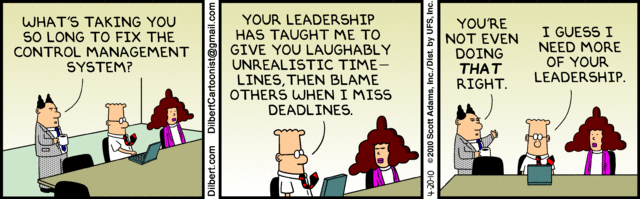
Cartoon – Leadership Experience?

Simon Sinek is best known for a TED Talk on leadership that has been viewed over 32 million times. During a visit to the offices of The New York Times he shared some more helpful leadership tips.
Listed below are four leadership qualities that Mr. Sinek says are underrated ways to shape a productive organization.

Apart from intervention, the past is the future. Past performance reflects future accomplishment. Past attitudes predict future interactions.
Leadership is intervention.
Disruption…Interruption…Interference.
Intervention is making failure less likely and success more probable.
Intervention is elevating good to great.
Place an obstacle in the path of repeated failure. Establish rigid reporting procedures to monitor progress, for example. Use this as a temporary measure, not a long-term strategy.
Disrupt thinking by reflecting on past performance with the future in mind.
Make failure uncomfortable – when it’s a pattern – unless you want more of it.
#1. Passive acceptance isn’t intervention. Acceptance is the beginning of successful intervention, but acceptance alone is endorsement.
Apart from acceptance, intervention is offense, but lack of intervention ratifies failure.
#2. Frustration isn’t intervention. Address the roots of frustration or frustrations escalate. Soothing anger without solving the cause opens the door to future anger.
Appeasement is approval.
#3. Optimism isn’t intervention until it inspires action.
#4. Second chances aren’t interventions. Second chances only work when first chances are learning experiences.
Nagging frustrations indicate lack of learning. Second chances won’t help.
Pigs don’t lay eggs, but there’s always room for growth. It’s futile to expect people to be something they’re not. If you have a team of pigs, fall in love with bacon.
Throw sand in the gears. Make failure uncomfortable. Establish a point where negative consequences kick in. Remove responsibilities, for example.
Intervention might include doing less, if you’re inclined to quickly offer help. Instead of offering solutions, ask what they would like to try.
How might leaders intervene when failure is a pattern?
What does intervention look like when things are going well?

Though there are many different leadership styles one can employ to inspire exceptional performance, poor leadership can have devastating effects on the morale and productivity of an organization, according to Entrepreneur.
Listed below are five ineffective leadership styles to avoid avoid if you hope to have a high-performing organization.

Baylor Scott & White Health says it will split the office of President and CEO, a little more than six months into President and CEO Jim Hinton’s tenure at the Dallas- and Temple, Texas-based organization. Hinton had been serving in both roles since he took over the nonprofit health system in January, as had his predecessor Joel Allison, who retired.
Pete McCanna, who is currently executive vice president and chief operating officer at Chicago-based Northwestern Memorial Healthcare, will assume the new president role in September, and will take over a number of Hinton’s current duties, according to a press release.
While his expected duties as president were not immediately apparent, McCanna has ties to Hinton, having served as chief financial officer at Presbyterian early in Hinton’s 20-year career at that organization, where Hinton served as president and CEO before coming to Baylor Scott & White. Hinton said the new office of the president will expand the capabilities of the health system’s “already talented leadership team, helping us more rapidly evolve.”
Presumably that rapid evolution involves Hinton focusing more intently on integrating the Scott & White Health Plan into the entire organization.
In fact, one reason for Hinton’s appointment in the wake of Allison’s retirement was his extensive experience running an integrated delivery system at Presbyterian, where the provision of healthcare services is combined with a proprietary health plan, allowing for smoother integration of population health principles and tactics. Baylor Health Care System’s 2013 merger with Scott & White Healthcare created the blueprint for such an integrated system, which includes 48 hospitals, 44,000 employees, and the Scott & White Health Plan.
“We are committed to extending Baylor Scott & White’s long history of success by transforming into a nationally recognized, high-value integrated delivery network; and to transform, we must drive costs down, while making the right investments in key areas,” said Hinton, in the release.
McCanna should be instrumental in helping Baylor Scott & White achieve financial and strategic growth targets. In his 15 years at Northwestern, operating revenue grew from $700 million to more than $5 billion, while patient experience, employee engagement and quality goals exceeded targets.
He also gets credit for helping integrate the faculty physician practice plan at Northwestern University Feinberg School of Medicine with Northwestern Memorial Hospital.
“Pete is a highly respected senior executive with a track record of helping to grow organizations, create and implement successful, long-range strategic plans and lead financial turnarounds,” said Hinton. “He is one of the best and brightest in healthcare.”

Blunder #1: Getting lost in their own work.
Drive sabotages inexperienced leaders when they go into heads-down mode.
Leaders often have work responsibilities beyond leadership. Their job includes being part of the team as well as leading the team. Inexperienced leaders lose sight of others and the big picture. Reality sneaks up and smacks them later.
Suggestions:
Blunder #2: Minimizing the difficulty of doing things they haven’t done.
There’s almost always more to a job than you think, especially when you’ve never done it before.
When you minimize difficulties you offend those who are actually doing it.
Suggestions:
Blunder #3: Not asking for help.
You prefer giving help, but receiving help lets others know they matter.
Suggestion:
Self-confidence and trust are key factors in asking for help.
Blunder #4: Getting stuck in negative patterns.
Pattern recognition is a skill of experienced leaders that requires insight, input, and reflection. Quickly moving from one project to the next – without input and reflection – almost always produces self-defeating patterns. You wrongly think you understand the causes of success or failure.
Suggestions:
Blunder #5: Feeling picked on and misunderstood.
The reason people don’t know you is you close them out. It’s safer to remain distant, but the consequences often short-circuit success.
Suggestions:
What blunders do inexperienced leaders fall into?
How might inexperienced leaders avoid common blunders?

Amidst the social gatherings and backyard barbecues of the Independence Day celebrations that we have each year, there are many important and dramatic stories about the sacrifices of our founding fathers who signed the Declaration of Independence.
Some of them are inflated, but what is true is they knew that it was a bold, courageous step that would prompt a strong response from the mother country. What they expected was brutal military action against them by the best organized and equipped army in the world. There were personal and professional risks for those leaders.
The Price of Freedom in the POW Camps
The same challenges were true for our senior leaders in the Vietnam POW camps. There was a lot at stake as they wrestled to set an example for the rest of us to serve with honor in difficult times.
As POWs, we battled daily to have the freedoms that we enjoy in the U.S. We know what it’s like to live without freedom, and we don’t take it for granted. I know it can sound a bit trite, but it’s true—Freedom is not Free.
“FREEDOM IS THE BURNING DESIRE OF EVERY HUMAN BEING, BUT IT COMES WITH A RESPONSIBILITY.”
It can only be maintained by what my organization calls the core of courageous accountability – Character, Courage, and Commitment.

The Courageous Accountability Model(tm) is featured in Lee’s book, Engage with Honor: Building a Culture of Courageous Accountability.
The Internal Battle
Human nature naturally goes toward the easy way out. The truth is that honor, character, courage, and commitment do not have many easy days.
“LIVING AND LEADING WITH HONOR REQUIRES SACRIFICE, AND IT’S MAINLY LETTING GO OF OUR EGO AND SELF-INTEREST.”
We’re always bound to self-interest, yet we must learn to periodically rise above it and that takes sacrifice to put the good of others first. That’s what our founders did, what the military does, and what our elected representatives are supposed to do.
In fact, we all play a role in preserving our freedom and national security.
Safeguarding our Freedom and Independence
As we reflect this month on our national independence and individual liberty, it’s a good time to reflect on our individual responsibilities for preserving these liberties that we can so easily take for granted.
So you might ask, “What can I do to help safeguard our independence and freedom?”Playing off our brand and mission at Leading with Honor®, we are engaged in a battle to be leaders who live with honor.
Here are three important points:
The Sacrificial Payoff
This mindset is not easy. It takes courageous, character, and commitment that’s supported by self-awareness and discipline. To be frank, living and leading with honor doesn’t come easy. It requires an ongoing battle with the dark and lazy side of human nature. it’s easy to just settle, drift and become indifferent and apathetic about our greatest treasures as a nation.
So as you gathered with your family and friends, I hope that you paused to remember your responsibilities as a citizen and as a protector of our freedoms.
It’s very clear that our founders understood that when they signed off on the Declaration of Independence and closed with these words:
“And for the support of this Declaration, with a firm reliance on the protection of Divine Providence, we mutually pledge to each other our Lives, our Fortunes, and our sacred Honor.”
Please share your comments and experiences below, too.
 The foundational pillars of Character, Courage, and Commitment form the bedrock to lead with a model of courageous accountability shown in the article. Want to learn the full model to continue growing as an honorable leader?
For a limited time, we’re offering the Engage with Honor Launch Package when you purchase a copy this award-winning book.


 HENRY KOTULA