

Click to access What_keeps_healthcare_finance_executive_up_WP.pdf



Artificial intelligence has the potential to completely revolutionize the way healthcare systems interact with their patients.
More than 80 percent of healthcare executives polled by Accenture believe that artificial intelligence is on track to completely revolutionize healthcare, and a similar number believe that the advent of machine learning and digital healthcare is driving a significant restructuring of industry economics.
“AI is the new UI,” proclaims the report. “It’s a new world where artificial intelligence is moving beyond a back-end tool for the healthcare enterprise to the forefront of the consumer and clinician experience.”
“AI is taking on more sophisticated roles, with the potential to make every technology interface both simple and smart – setting a high bar for how future interactions work.”
The report envisions a healthcare environment where AI can take over the majority of processes currently overseen by humans. Consumer relations and patient engagement are likely to be among the first tasks to undergo the shift.
Eighty-four percent of executives believe that AI will fundamentally alter how they gain information from patients and interact with consumers. A similar number have prioritized the implementation of centralized platforms that take advantage of messaging bots and other services.
More than three-quarters believe that these decisions will make or break their ability to develop a competitive advantage over their peers in the near future. Eighty-two percent agree that industry leadership will be defined by how well healthcare organizations architect comprehensive, seamless digital ecosystems that truly understand what motivates the choices of their patients.
“The new frontier of digital experience is technology specifically designed for individual human behavior,” the report asserts. “Healthcare leaders recognize that as technology shrinks the gap between effective human and machine cooperation, accounting for unique human behavior expands not only the quality of the experience, but also the effectiveness of technology solutions.”
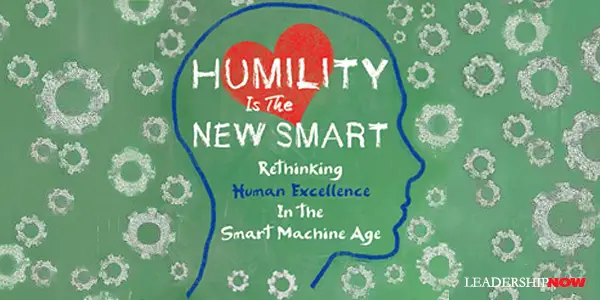
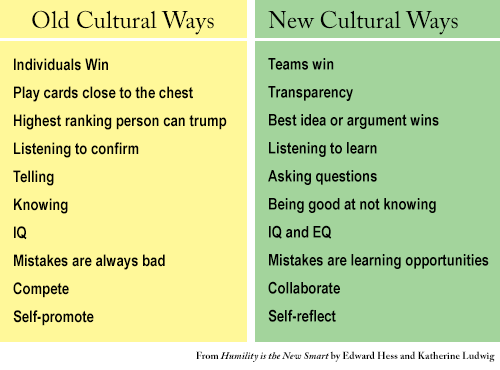
SMART used to be a quantity game. “I know more than you. I get more things right.” But Ed Hess and Katherine Ludwig say that in the new Smart Machine Age, that’s losing game. The new smart is about quality. Specifically, the quality of your thinking, your listening, and your relating and collaborative skills.
Are you ready?
The Smart Machine Age (SMA) will revolutionize how most of us live and work. In Humility is the New Smart, the authors state that “smart technologies will become ubiquitous, invading and changing many aspects of our professional and personal lives and in many ways challenging our fundamental beliefs about success, opportunity, and the American Dream.” This means that the “number and types of available jobs and required skills will turn our lives and our children’s lives upside down.”
New skills will be needed. Uniquely human skills. Those skills, while uniquely human, are not what we are typically trained to do and require a deal of messy personal development. We will need to become better thinkers, listeners, relators, and collaborators, while working to overcome our culture of obsessive individualism in order to thrive in the SMA. Humility is the mindset that will make all of this possible.
Most of today’s adults have had no formal training in how to think, how to listen, how to learn and experiment through inquiry, how to emotionally engage, how to manage emotions, how to collaborate, or how to embrace mistakes as learning opportunities.
In short, say the authors, we need to acquire and continually develop four fundamental NewSmart behaviors:
Quieting Ego
Quieting Ego has always been the challenge for us humans. As they observe, “Even if we don’t consider ourselves part of the ‘big me’ cultural phenomenon, for many of us to feel good about ourselves we have to constantly be ‘right,’ self-enhance, self-promote, and conceal our weaknesses, all of which drive ego defensiveness and failure intolerance that impedes higher-level thinking and relating.” This tendency negatively affects our behavior, thinking, and ability to relate to and engage with others.
Managing Self—Thinking and Emotions
We need to get above ourselves to see ourselves impartially. We all struggle “to self-regulate our basic humanity—our biases, fears, insecurities, and natural fight-flee-or-freeze response to stress and anxiety.” We need to be willing to treat all of our “beliefs (not values) as hypotheses subject to stress tests and modification by better data.”
Negative emotions cause narrow-mindedness. Positive emotions on the other hand, have been scientifically linked to “broader attention, open-mindedness, deeper focus, and more flexible thinking, all of which underlie creativity and innovative thinking.”
Reflective Listening
Because we are limited by our own thinking, we need to listen to others to “open our minds and, push past our biases and mental models, and mitigate self-absorption in order to collaborate and build better relationships.” The problem is “we’re just too wired to confirm what we already believe, and we feel too comfortable having a cohesive simple story of how our world works.” Listening to others helps to quiet our ego.
Otherness
To create these new behaviors and mindsets, it should become obvious that we need to enlist the help of others. “We can’t think, innovate, or relate at our best alone.” As Barbara Fredrickson observed, “nobody reaches his or her full potential in isolation.” Jane Dutton out it this way: “It seems to be another fact that no man can come to know himself except as the outcome of disclosing himself to another.”
The NewSmart Organization
Optimal human performance in the SMA will require an emphasis on the emotional aspects of critical thinking, creativity, innovation and engaging with others. “The work environment must be designed to reduce fears, insecurities, and other negative emotions.”
To do this it means “providing people a feeling of being respected, held in positive regard, and listened to. It means creating opportunities for people to connect and build trust. “It means allocating time and designing work environments that bring people together to relate about nonwork matters.” Finally, it means getting to know employees and helping them to get the “right training or opportunities to develop and provide feedback.”
The NewSmart organization needs to be a safe place to learn. “Feeling safe means that you feel that your boss your employer, and your colleagues will do you no harm as you try to learn.”
https://hbr.org/2016/04/culture-is-not-the-culprit

hen organizations get into big trouble, fixing the culture is usually the prescription. That’s what most everyone said General Motors needed to do after its recall crisis in 2014—and ever since, CEO Mary Barra has been focusing on creating “the right environment” to promote accountability and head off future disasters. Pundits far and wide called for the same remedy when it came to light that the U.S. Department of Veterans Affairs, deemed a corrosive bureaucracy by federal investigators, kept veterans waiting months for critical health care. Cultural reform has likewise been proposed as the solution to excessive use of force by police departments, unethical behavior in banks, and just about any other major organizational problem you can think of. All eyes are on culture as the cause and the cure.
But the corporate leaders we have interviewed—current and former CEOs who have successfully led major transformations—say that culture isn’t something you “fix.” Rather, in their experience, cultural change is what you get after you’ve put new processes or structures in place to tackle tough business challenges like reworking an outdated strategy or business model. The culture evolves as you do that important work.
Though this runs counter to the going wisdom about how to turn things around at GM, the VA, and elsewhere, it makes intuitive sense to look at culture as an outcome—not a cause or a fix. Organizations are complex systems with many ripple effects. Reworking fundamental practices will inevitably lead to some new values and behaviors. Employees may start seeing their contributions to society in a whole new light. This is what happened at Ecolab when CEO Doug Baker pushed decisions down to the front lines to strengthen customer relationships. Or people might become less adversarial toward senior executives—as Northwest employees did after Delta CEO Richard Anderson acquired the airline and got workers on board by meeting their day-to-day needs.
The leaders we spoke with took different approaches for different ends. For example, Alan Mulally worked to break down barriers between units at Ford, whereas Dan Vasella did a fair amount of decentralizing to unleash creative energy at Novartis. But in every case, when the leaders used tools such as decision rights, performance measurement, and reward systems to address their particular business challenges, organizational culture evolved in interesting ways as a result, reinforcing the new direction.
Revisiting their stories provides a richer understanding of corporate transformation and culture’s role in it, so we share highlights from our conversations here. Most of these stories involve some aspect of merger integration, one of the most difficult transitions for companies to manage. And they all show, in a range of settings, that culture isn’t a final destination. It morphs right along with the company’s competitive environment and objectives. It’s really more of a temporary landing place—where the organization should be at that moment, if the right management levers have been pulled.


Philosophers and psychologists have been discussing the importance of self-control for ages. Plato, for example, argued that the human experience is a constant struggle between our desire and rationality, and that self-control is needed to achieve our ideal form. Likewise, Freud suggested that self-control is the essence of a civilized life.
The scientific study of self-control started about 25 years ago in the fields of criminology and psychology. Since then, hundreds of studies have shown the positive effects that come from possessing self-discipline. For instance, people with higher levels of self-control eat healthier, are less likely to engage in substance abuse, perform better at school, and build high-quality friendships. At work, leaders with higher levels of self-control display more effective leadership styles – they are more likely to inspire and intellectually challenge their followers, instead of being abusive or micromanaging. But what happens when people lack self-control at work?
We conducted a comprehensive review of research findings on employee self-control in a forthcoming paper in the Academy of Management Annals. Analyzing more than 120 management papers, we found that there are three main reasons why people occasionally lose self-control: 1) self-control is a finite cognitive resource; 2) different types of self-control tap the same pool of self-control resources; and 3) exerting self-control can negatively affect future self-control if it is not replenished. Think of self-control as analogous to physical strength: Our physical strength is limited, various tasks (e.g., football, basketball, walking, etc.) deplete it, and continued exertion can negatively affect future physical strength if it’s not restored.
For example, our own research has found that service employees in leadership positions who have to force a smile in customer interactions (thereby exercising self-control to suppress their true feelings) are later less able to regulate their interactions with their subordinates – they lie and are more rude to them.
Our review identified a few consequences that are consistently linked to having lower self-control at work:
Our review makes clear that helping employees maintain self-control is an important task if organizations want to be more effective and ethical. Fortunately, we identified three key factors that can help leaders foster self-control among employees and mitigate the negative effects of losing self-control.
First, sleep appears to have an amazing restorative effects on self-control. One study found that leaders who slept well at night (defined as having minimal interruptions to sleep) were much more likely to exercise their self-control and refrain from displaying abusive supervision, such as yelling and cursing at low-performing subordinates, compared to their counterparts who did not sleep well. Modern organizations often require employees to work beyond traditional office hours in the name of increased productivity. But this could be counter-productive and lead to negative workplace behaviors due to employees lacking self-control. Instead, organizations should be mindful about how long work hours can impact employees’ behavior and wellbeing. Google, for example, installed sleep pods at the office to allow employees to nap and be reenergized.
Second, “service with a smile” might not always pay. Service-oriented organizations often force employees to smile in front of customers. While this might please customers in the short-term, it can cause other organizational problems. Dropping this practice perhaps is not be a practical option, but companies should consider training employees to tap into the emotions they display. For example, another study showed that physicians who engaged in perspective taking and felt genuine empathy toward their patients did not experience reduced self-control and its associated negative workplace behaviors such as burnout, whereas physicians who were forced to fake empathic behaviors toward patients later reported increased burnout and lower job satisfaction. Service-oriented employees may also benefit from engaging in more perspective-taking rather than faking their emotions.
Third, creating the right environment may help prevent some of the negative behaviors associated with lower self-control. For example, we came across research showing that employees with low self-control were no more likely to engage in deviant behavior when organizations promoted an ethical culture —displaying the company’s code of conduct where employees could see it made them less tempted to behave unethically. This type of intervention tends to be very effective in the short-term.
Ultimately, the keys to avoiding self-control failures are to 1) allow the body to rest and restore self-control, 2) reexamine existing organizational policies that might inadvertently reduce employees’ self-control, and 3) create a culture that deters negative behaviors in moments of reduced self-control.

 HENRY KOTULA