Can A Community Hospital Stick To Its Mission When It Goes For-Profit?

http://radio.wpsu.org/post/can-community-hospital-stick-its-mission-when-it-goes-profit

Proponents of hospital mergers say the change can help struggling nonprofit hospitals "thrive," with an infusion of cash to invest in updated technology and top clinical staff. But research shows the price of care, especially for low-income patients, usually rises when a hospital joins a for-profit corporation.

Mission Health, the largest hospital system in western North Carolina, provided $100 million in free charity care last year. This year, it has partnered with 17 civic organizations to deliver care for substance abuse by people who are low-income.

Based in bucolic Asheville, the six-hospital system also screens residents for food insecurity; provides free dental care to children in rural areas via the “ToothBus” mobile clinic; helps the homeless find permanent housing and encourages its 12,000 employees to volunteer at schools, churches and nonprofit groups.

Asheville residents say the hospital is an essential resource.

“Mission Health helped saved my life,” says Susan ReMine, a 68-year-old Asheville resident for 30 years who now lives in nearby Fletcher, N.C. She was in Mission Health’s main hospital in Asheville for three weeks last fall with kidney failure. And, from 2006 to 2008, a Mission Health-supported program called Project Access provided ReMine with free care after she lost her job because of illness.

After 130 years as a nonprofit with deep roots in the community, Mission Health announced in March that it was seeking to be bought by HCA Healthcare, the nation’s largest for-profit hospital chain. HCA owns 178 hospitals in 20 states and the United Kingdom.

The pending sale reflects a controversial national trend in the U.S. as hospitals consolidate at an accelerating pace and the cost of health care continues to rise.

“We understand the business reasons [for the deal], but our overwhelming concern is the price of health care,” says Ron Freeman, chief financial officer at Ingles Markets, a supermarket chain headquartered in Asheville with 200 stores in six states.

“Will HCA after a few years start to press the hospital to make more profit by raising prices? We don’t know,” Freeman says.

And the local newspaper, the Citizen Timeseditorialized in March: “How does it help to join a corporation where nearly $3 billion that could have gone to health care instead was recorded as profit? … We would feel better were Western North Carolina’s leading health-care provider to remain master of its own fate.”

Across the U.S., the acquisition of nonprofit hospitals by corporations is raising concern among some advocates for patients and communities.

“The main motivation of for-profit companies is to grow so they can cut costs, get paid more and maximize profits,” says Suzanne Delbanco, executive director of the Catalyst for Payment Reform, an employer-led health care think tank and advocacy group. “They are not as focused on improving access to care or the community’s overall health.”

Merger mania across the U.S.

From 2013 to 2017, nearly 1 in 5 of the nation’s 5,500-plus hospitals were acquired or merged with another hospital, according to Irving Levin Associates, a health care analytics firm in Norwalk, Conn. Industry analysts say for-profit hospital companies are poised to grow more rapidly as they buy up both for-profits and nonprofits — potentially altering the character and role of public health-oriented nonprofits.

Nonprofit hospitals are exempt from state and local taxes. In return, they must provide community services and care to poor and uninsured patients — a commitment that is honored to varying degrees nationwide.

Of the nation’s 4,840 general hospitals that aren’t run by the federal government, 2,849 are nonprofit, 1,035 are for-profit and 956 are owned by state or local governments, according to the American Hospital Association.

In 2017, 29 for-profit companies bought 18 for-profit hospitals and 11 not-for-profits, according to an analysis for Kaiser Health News by Irving Levin Associates.

Sales can go the other way, too: 53 nonprofit hospital companies bought 18 for-profits as well as 35 nonprofits in 2017.

A recent report by Moody’s Investors Service predicted stable growth for for-profit hospital companies, saying they are well-positioned to demand higher rates from insurers and have less exposure to the lower rates paid by government insurance programs such as Medicare and Medicaid. In contrast, a second Moody’s report downgraded — from stable to negative — its 2018 forecast for the not-for-profit hospital sector.

‘We wanted to thrive, and not just survive’

Ron Paulus, Mission Health’s president and CEO, says he and the hospital’s 19-member board concluded last year that the future of Mission Health was iffy at best without a merger.

HCA declined to make anyone available for an interview but provided this written statement: “We are excited about the prospect of a transaction that would allow us to support the caliber of care they [Mission Health hospitals] have been providing.”

Driving Mission Health’s decision, Paulus says, were strained finances and the board’s strong feeling that the hospital needed to invest in new technology, modern data management tools and top clinical talent.

“We wanted to thrive and not just survive,” he says. “I had a healthy dose of skepticism about HCA at first. But I think we made the right decision.”

During the past four years, Paulus says, the company has had to cut costs — from between $50 million and $80 million a year — to preserve an “acceptable operating margin.” The forecast for 2019 and 2020, he says, saw the gap between revenue and expenses rising to $150 million a year.

Miriam Schwarz, executive director of the Western Carolina Medical Society, says many physicians in the area were surprised by the move and “are trying to grapple with the shift.”

“There’s concern about the community benefits, but also job loss,” Schwarz says. Still, she adds, the doctors in her region “do recognize that the hospital must become more financially secure.”

Weighed against community concerns is the prospect of a large nonprofit foundation created by the deal. Depending on the final price, the foundation could have close to $2 billion in assets.

Creation of such foundations is common when for-profit companies buy nonprofit hospitals or insurance companies. Paulus says the foundation created from Mission Health could generate $50 million or more a year to — among other initiatives — “test new care models such as home-based care … and address the causes of poor health in the community in the first place.”

In addition, HCA will have to pay upward of $10 million in state and local taxes.

Mixed results

Industry analysts say the hospital merger and consolidation trend nationwide is inevitable given the powerful forces afoot in health care.

That includes pressure to lower prices and costs and improve quality, safety and efficiency; to modernize information technology systems and equipment; and to do more to improve overall health.

But academics and consumer advocates say hospital consolidation yields mixed results. While mergers — especially purchases by for-profit companies — provide much-needed capital and financial stability, competition is stifled, and that’s often led to higher prices.

Martin Gaynor, a professor of economics and health policy at Carnegie Mellon University, and colleagues examined 366 hospital mergers from 2007 to 2011 and found that prices were, on average, 12 percent higher in areas where one hospital dominated the market versus areas with at least four rivals. Another recent study found that 90 percent of U.S. cities today have a “highly concentrated” hospital market. Asheville is one, and Mission Health is dominant there.

“The evidence is overwhelming at this point,” Gaynor says. “Mergers solve some problems for hospitals, but they don’t make health care less expensive or better. In fact, prices usually go up.”

Mission Health CEO Paulus says he believes HCA is committed to restraining price increases and the growth in costs.

If no obstacles arise, Paulus says, HCA’s purchase of Mission Health would be formalized in August and finalized in November or December, pending state regulatory approval.


With 8k more physicians than Kaiser, Optum is ‘scaring the crap out of hospitals’

https://www.beckershospitalreview.com/payer-issues/with-8k-more-physicians-than-kaiser-optum-is-scaring-the-crap-out-of-hospitals.html

Image result for optumcare


Since its acquisition of 250 Las Vegas-area physicians in 2008, UnitedHealth Group has steadily expanded its physician workforce to shield itself from competitors and hospitals, according to a Bloomberg report.

To date, the health insurance giant’s physician arm, OptumCare, employs or is affiliated with about 30,000 physicians. If OptumCare completes its acquisition of Davita Medical Group, the insurer will tack on another 17,000 physicians to its ranks — making it one of the largest physician employers in America.

Hospitals are gobbling up physicians, too. A recent Avalere Health study found that by mid-2016, hospitals employed 42 percent of U.S. physicians. Nashville, Tenn.-based HCA Healthcare has roughly 37,000 physicians, Bloomberg reports. Still, Optum outpaces Oakland, Calif.-based Kaiser Permanente’s roughly 22,000 physicians by 8,000.

“This is obviously scaring the crap out of hospitals in many markets,” Chas Roades, CEO at consulting firm Gist Healthcare, told the publication. By controlling a greater number of physicians, Optum is not only buffering itself from competitors, but attempting to steer patients toward lower-priced care outside of the hospital.

In some cases, Bloomberg notes, UnitedHealth is directing members toward its acquired physicians. For example, UnitedHealth lists New West Physicians, a Denver-area group of 120 physicians that the insurer purchased last year, as a favored narrow-network plan for commercial members. Some members can see the physicians for 20 percent to 30 percent less in out-of-pocket expenses compared to physicians outside the network.

Andrew Hayek, a leader in UnitedHealth’s care delivery operation, told Bloomberg the company has “been slowly, steadily, methodically aligning and partnering with phenomenal medical groups who choose to join us.” In the future, OptumCare hopes to expand its 30-market operation to 75 markets, including the nation’s most populous states: California, Texas, Florida and New York.

Whether it’s hospital- or insurer-employed physicians, Ken Marlow, an attorney with Waller Lansden Dortch & Davis, told the publication, “The smartest participants in the system are the ones who are going to be able to provide quality care at the lowest cost setting. Whoever gets there first, and whoever is able to do that, I think will be the winner.”


Kavanaugh Supreme Court Fight Will Be All About Health Care

https://www.thefiscaltimes.com/2018/07/10/Kavanaugh-Supreme-Court-Fight-Will-Be-All-About-Health-Care

Image result for supreme court


he fight over President Trump’s pick of Appeals Court Judge Brett Kavanaugh to the Supreme Court is on, with Democrats launching what The Washington Post called “an all-out blitz” to defeat the nomination.

So get ready to hear a lot about health care in the coming days.

The Washington Post’s Dana Milbank notes that former Republican senator Jon Kyl, now a lobbyist for the pharmaceuticals industry, has been tapped to guide Kavanaugh’s path through the Senate. Why? Because by picking Kavanaugh, “Trump has guaranteed that health care will be at the center of the confirmation fight,” Milbank says.

Democrats welcome that fight, even if they have little chance of actually blocking the nomination. “The liberal base is fired up about abortion rights, but Senate Democratic Leader Charles Schumer (N.Y.) will seek to emphasize access to affordable health care as much as Roe v. Wade in the battle over the Supreme Court,” The Hill’s Alexander Bolton reports.

Focusing on health care might make sense for Democrats in a number of ways:

  • It reinforces the party’s preferred midterm election messaging in an area where voters say they trust Democrats more than Republicans.
  • Framing women’s reproductive rights as a matter of access to health care will be less polarizing in red states where seats are at stake in November, Bolton writes.
  • Playing up access to affordable health care may also put more pressure on Republican Sens. Susan Collins of Maine and Lisa Murkowski of Alaska, both of whom voted against Obamacare repeal last year.

If confirmed, Kavanaugh may get to weigh in on any of a number of cases with the potential to reshape health policy well beyond abortion rights. Despite his long legal record, “many of his health-related decisions are open to parsing from either side of the aisle and don’t actually provide a clear insight into where he’d stand on the Supreme Court,” The Washington Post’s Colby Itkowitz says.

Here are some key issues and cases that could be decided by the Supreme Court and Kavanaugh:

Obamacare’s protections for people with pre-existing medical conditions: Americans overwhelmingly support keeping these protections in place, according to a Kaiser Family Foundation poll from last month, but Trump’s Justice Department has asked a federal court to rule that those provisions of Obamacare are invalid. The case will soon be heard in a district court in Texas and could make its way to the Supreme Court before long. Sen. Joe Manchin of West Virginia, one of the few Democrats who might back Kavanaugh, said in a statement that he wants to hear where the judge stands on the ACA protections for those with pre-existing conditions before deciding whether to confirm him.

Medicaid: A federal court late last month blocked Kentucky’s plan to introduce work requirements for Medicaid recipients. The Trump administration is likely to appeal the ruling. Other states are also implementing work requirements. “As more states experiment with these programs and the cases wind their way through the courts, the Supreme Court may weigh in and shape how low-income Americans access Medicaid across the country,” Arielle Kane, director of health care at the Progressive Policy Institute, writes at the New York Daily News. The high court could also be asked to consider whether private health care providers can sue over Medicaid reimbursement rates, a question that could open the door to state funding cuts.

Risk adjustment payments to insurers: The Trump administration just froze billions of dollars of payments to insurers who enroll costlier-than-expected patients. The payments come from money collected from other insurers in the individual market. Legal challenges involving these payments are making their way through the courts. In the meantime, “the insurers in the individual market must manage uncertainty and constant change — resulting in higher prices for health care consumers,” Kane writes.

Industry consolidation: “Last year, four of the largest insurers tried, and failed, to merge into two. This year, CVS has proposed merging with Aetna, Amazon has acquired PillPack, and Walmart is seeking to combine with Humana,” Kane writes. “This so called ‘vertical integration’ raises questions about monopolies, competition and health-care pricing. It is likely that at some point courts will weigh in.”


The real driver of health care spending

https://commonwealthmagazine.org/opinion/the-real-driver-of-health-care-spending/

An inefficiency gap is boosting costs — and profits

THE HEALTH CARE DEBATES that occurred in Washington over the past year were largely irrelevant to what’s happening in the health care marketplace. Republicans couldn’t repeal the Affordable Care Act but they made some changes that weakened it. Those changes will increase insurance premiums in the individual market but they do nothing to address the most significant trends that are evolving across the system. To understand the important trends, one must look elsewhere.

In March, three researchers from the Harvard T. H. Chan School of Public Health published a study in JAMA analyzing the well-known reality that the United States spends dramatically more on health care than other wealthy countries. They compared the US, where health care consumes 17.8 per cent of gross domestic product, to 10 comparable nations where the mean expenditure is 11.5 percent. Despite spending much less, the other countries provide health insurance to their entire populations and have outcomes equal to or better than ours. The researchers found that this inefficiency gap is primarily driven by two characteristics of the US system: the high cost of pharmaceuticals and inordinate administrative expenses.

The high administrative spending derives in large part from the fact that 55 percent of the people in the US are covered by private health insurers who embed their own billing requirements, expenses, and profit into the system. The next highest country in this regard is Germany, where 10.8 percent of the population is covered by private insurers. In many countries, there are no such middlemen.

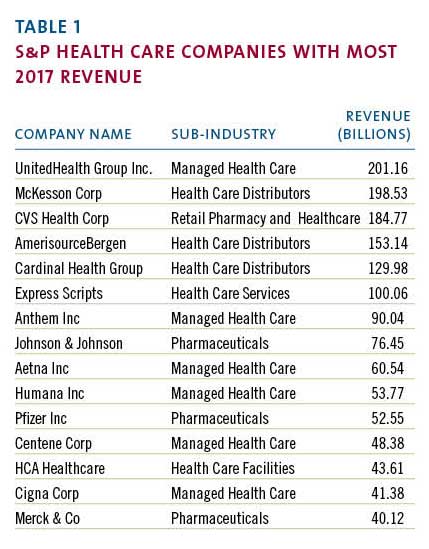
Coincidentally, when the JAMA study was published, the large publicly traded health care companies that dominate the US market had just finished disclosing their 2017 financial results. Examining those results provides additional insight into the economic forces that make our system so expensive and inefficient. The scale of the money involved is sometimes hard to grasp. The largest health care corporations, those included in the S&P 500, had almost $2 trillion in revenue last year. (Table 1)

Most of these enormous companies are engaged in one of two businesses: they’re either selling drugs or they’re selling health insurance. The excess costs reported by the Harvard researchers serve mainly to support the revenue of the companies in those fields.

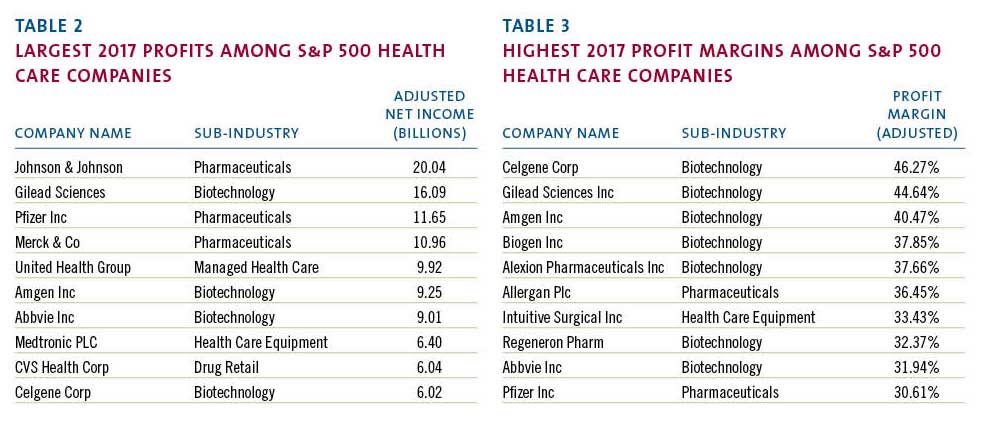
The 2017 reporting of corporate profits was complicated by the passage of the new tax bill. But most companies also reported “adjusted net income,” which shows their normalized profits after accounting for the one-time impact of the tax law. The chart below (Table 2) uses the adjusted numbers to show the largest annual profits among S&P health care companies.

Health insurers such as United Health and retailers such as CVS have enormous revenue and impressive profits but, when profit is measured as a percentage of revenue, they can’t compete with biotech and pharma. The highest relative profitability, using the same reported adjusted results, is in the chart below. (Table 3)

These profit margins show that there are many situations where between a third and a half of every dollar spent on a prescription drug falls to the bottom line of the of the company that made it. This profit derives in large part from the enormous difference in drug prices in the US versus other countries where such prices are more effectively controlled.

The high administrative cost of the US system stems from the large portion of the market dominated by insurance companies looking to maximize their profits.  Notwithstanding many news stories about turmoil in the insurance markets, 2017 was a banner year for the largest health insurers. The big players all had significant increases in annual profitability in 2017.

Note that Humana did not report “adjusted” numbers even though its profit was swollen by unusual events. A major distortion was a huge break-up fee the company received from a failed merger. That accounted for approximately $630 million in after-tax profit. Even discounting that, it was a very good year.

The revenue and profitability of these corporations support the proposition that high pharmaceutical prices and insurance-related administrative costs account for much of the extraordinary expense of our system. US health policy, or the absence thereof, has enabled these businesses annually to drive costs up for the benefit of their bottom line. That effect will continue. Not surprisingly, the big health care companies are developing new strategies to enhance their businesses and drive their profits going forward.

The term now heard often among health care giants is “vertical integration,” which means combining upstream suppliers with downstream buyers to control the flow of business. If this strategy persists, health care delivery will evolve significantly although it is unlikely to become less expensive. The most prominent current example of  vertical integration is the planned $68 billion acquisition of Aetna by CVS.

How would these companies work together? A Wall Street analyst recently described the vision as a way to “identify high risk patients and preemptively get them into a Minute Clinic.” Thus, your health insurer could send you to a local store for diagnosis, treatment, drugs, and anything else you might need from the shelves. This will keep even more of the health care dollar under their control.

Similarly, Cigna is in the process of acquiring Express Scripts, a huge pharmacy benefits manager, for $54 billion, another attempt to bring more services under one roof. The combined company would have annual revenue of $142 billion and, presumably, enough leverage with drug companies to improve profits although not necessarily to lower costs to patients. United Health, a leader of vertical integration, previously bought a pharmacy benefit manager but co-pays and deductibles for its patients have continued to climb. United has aggressively acquired physician practices in recent years and is now in the process of buying DaVita Medical Group, which operates nearly 300 clinics and outpatient surgical centers.

More striking are reports of a potential but unsigned merger of Walmart and Humana, a combined company that would have revenue of $550 billion. Walmart is a large operator of retail pharmacies inside its stores and the logic is similar to the Aetna-CVS deal. Humana, a huge insurer, is separately in the process of acquiring a large home health business from Kindred so this could represent yet another level of vertical integration.

If this course continues, the health care system will evolve quickly, giving fewer and larger companies even more market leverage. Integration of this kind benefits the large corporations that initiate it but there is no evidence it will lead to lower costs, improved access, or enhanced quality. These changes are driven by highly focused corporate financial interests and are occurring without reference to public policy. That’s because there is no coherent public policy to guide these changes.

On May 11, President Trump made a long-awaited speech to reveal what he described as “the most sweeping action in history to lower the price of prescription drugs for the American people.” His typically firebrand language struck at “drug makers, insurance companies, distributors, pharmacy benefit managers, and many others” who contributed to “this incredible abuse.” His attack seemed to target the large public companies that have benefited from the abuse. Unsurprisingly, his speech did not include specifics. His staff then released tepid policy details, which immediately generated a significant upward spike in the biotech stock index as well as the stock prices of other large health care companies. For all the presidential bombast, investors saw Trump’s policy for what it is: indifference to the current path and no threat to high prices.

It is not in the interest of huge profit-making corporations to restrain the overall cost of the US health care system. In fact, their interest is served by driving health care expenditures higher. When combined with the spending analysis provided by researchers, the financial data disclosed by public corporations point to a path that the country must follow to make our system more coherent and less costly. Any progress will require driving down pharmaceutical pricing and reducing administrative costs imposed by middlemen. We are not doing that yet but, ultimately, we must.


Why acquiring a cash-strapped hospital brings new levels of risk

https://www.healthcarefinancenews.com/news/why-acquiring-cash-strapped-hospital-brings-new-levels-risk?mkt_tok=eyJpIjoiWm1abU9EWXhZMlppT0dSbSIsInQiOiJtQm1aMUNkVFBZWmNoUlpQMHRkOHBJcHlEMTg1MDRCa2xPR3h0bXJLWDVjSG1pZU5kZmx5ejNDbWFxMTRHVWR4N0FrQzA4cGgzXC9IdlpLMlBHcFBWemhOWTc3SHR0QUJjdXcxcHk2TTRBZFZxTk55Sis5NVJ2TnRyWFpyaHVWcVMifQ%3D%3D

Image result for cash strapped

A look at the financial, branding and cultural considerations when deciding to acquire or merge with another hospital.

Mergers and acquisitions are common occurrences in healthcare. The impetus behind consolidation can range from shifting patient demographics to new and disruptive technologies, but financial concerns are almost always at the root — which means the acquiring entities always assume some modicum of risk when pulling the trigger on these deals.

Oftentimes, the acquirer will subsume members, who then become part of the larger system. This brings risk if the hospital being acquired is distressed. These hospitals either don’t have the in-house expertise or aren’t willing to hire outside expertise, or they take shortcuts with physicians and kickbacks, according to Roger Strode, a partner with Foley and Lardner, who said he has seen it time and time again.

“They tend to be so cash-strapped, and they’re in such dire need, that they’ll take risks that other systems won’t take,” said Strode. “You might not have a pool of indemnification, so it takes a lot to get these deals done. The other risk is that they’ve brought on a base of employees so you’ve got cultural risk.”

Cash-strapped hospitals, for instance, are likely to operate under a different culture than organizations that have the financial means to pay for strong leadership. And then there’s the risk of how the healthcare provider is going to be perceived in the community. Will they be looked at as the hero swooping in to rescue the struggling hospital, and keep its promises, like maintaining services in the community? There’s risk if the acquirer hasn’t done its due diligence and realizes only after the fact they they can’t keep all the services it said they would. The health of a company’s branding is on the hook.

There’s a tremendous amount of diligence to keep in mind when making these deals, said Strode. There are lawyers and outside accountants to hire. There’s understanding the material contracts. And there’s hashing out what the five-to-10-year financial plan is going to be.

“There’s a certain amount of mission-driven thinking that goes into this,” said Strode. “If you’ve seen one of these deals, you’ve seen one of these deals. Healthcare is local, markets are different, so every deal is a little bit different. Some feel that if they don’t grab it now, their competitors will grab it, so they’ll fix the problems after they get it. Sometimes there’s a concern they’ll go to bankruptcy, and then it’s really difficult to acquire them.”

Rob Fraiman, president of Cain Brothers, sees most merger and acquisition activity taking place among nonprofit entities, more so than in the investor-owned world. There’s certainly some of the latter — Tenet and Universal Health come to mind — but they’re generally the exception, and structurally, most of these nonprofit transactions are outright sales of a hospital. They’re essentially mergers with a membership substitution, so a tax exempt entity merges with another tax-exempt entity and substitutes the tax-exempt member of the company with the new business.

“They don’t pay any cash, typically,” said Fraiman. “And the acquirer essentially picks up all the liabilities as well as all of the assets of the system. As far as risks, they’re merging with an enterprise that may have financial stress, which may be what’s leading the board to choose to do a transaction. Those financials don’t go away just because a transaction happens. It happens if the acquiring entity can go in and make some significant changes.”

There are also elements related to what kind of payer contracts the entity has. When two systems join together, replacing the contracts the acquirer has with the payer is not a quick, snap-of-the-finger type of move. It happens over time. Initially, the buyer is stepping into the shoes of whatever the seller has in place. Those contracts are a part of the reason there’s stress on the part of the target entity, so the acquirer is assuming that risk, though it tends to be short-term risk.

Capital is what drives a lot of those transactions, said Fraiman. Ultimately, the hospital industry is very capital intensive. In many of these instances, the target hospital or health system looks at the three-to-five-year time horizon and concludes they don’t have enough capital to invest in their business, and they need some deeper pockets. It’s not about price. It’s about terms, and how much capital they’re prepared to commit.

“There’s a huge risk the buyer is taking to assess whether the amount of capital they’re willing to commit over five or eight years is in fact going to be a good investment,” said Fraiman. “And if it’s not, that’s a huge risk, obviously, for the acquirer. At that point they’re really committed to it.”

There’s a view in the healthcare industry that scale is critically important, said Fraiman. Large corporate players are transforming how they’re operating in the healthcare economy.

“You’ve got some very, very large transactions that are happening in other parts of the healthcare economy, typically in the payer world, and that has a huge impact on hospitals,” he said. “In a given market or state, there’s a handful of insurance companies, and if a couple of them combine, that can have a real impact on the hospital system. Similarly, physician groups are going through a massive consolidation. All of that has a direct or indirect impact on health systems.”

Strode said that risk is slowly shifting away from insurance companies, and that this has had a catalytic effect on the ways mergers and acquisitions have played out in healthcare over the past several years.

“Insurance companies used to handle all the risk,” said Strode. “Now when they’re pushing that risk on hospitals and health systems, they have to spread that risk over larger and larger populations of people. They need more people to spread that risk. They need more doctors to spread that risk. The system needs to be bigger. You’re looking to be bigger because bigger geography gets the attention of payers. Smaller hospitals and community health systems can’t keep up. They can’t negotiate the same deals. They’d rather join them than fight them.”

Strode said that, despite the decreased number of independent facilities due to consolidation, the trend is still good in terms of market competition — at least for now — because it tends to drive down prices. He sees continued consolidation in the coming years, partly because there are still a lot of fragmented markets throughout the country. There are also a lot of academic medical centers that are expanding their sphere of influence by swallowing up some of the smaller hospitals around them.

Fraiman said the key to these deals is to be as prepared as possible.

“Like any business, it’s all about management,” said Fraiman. “Do they have the management capability to actually implement what they say they’re going to implement? That’s really hard. The implementation is harder than the deal. The deal might takes six months or a year, but you’ve got to live with it forever.”


AT&T, Time Warner, and the Future of Health Care

https://www.commonwealthfund.org/blog/2018/att-time-warner-and-future-health-care?omnicid=EALERT%25%25jobid%25%25&mid=%25%25emailaddr%25%25

AT&T Time Warner Merger

Policymakers and private actors should not interpret a federal court’s AT&T and Time Warner ruling as an unconditional green light for vertical integration in health care.

The need for change in the U.S. health care system is obvious, but whether vertical integration is the change we need remains to be determined.

The recent federal district court ruling allowing the merger of AT&T and Time Warner — a case of so-called vertical integration — will likely encourage similar unions throughout the U.S. economy, including in health care. Nevertheless, a close look at the court’s decision, and at the wide variety of vertical health care mergers under way, suggests that policymakers and private actors should not interpret the court’s ruling as an unconditional green light for vertical integration in health care, or any other sector.

Vertical integration typically involves the combination of entities operating on different parts of a supply chain in the production of a particular product. Manufacturers of tires, for example, are part of the supply chain that results in a finished automobile. Similarly, ambulatory physician services are sometimes seen as an input on the supply chain of more advanced hospital services. The acquisition of physician practices by hospitals is often characterized as vertical integration.

Some antitrust experts question whether the analogy between manufactured products and health care delivery is accurate. Independent physicians, for example, often work within hospitals and help to produce their “products.” Nevertheless, there are clear differences between mergers across the same types of health care organizations, like hospitals, and those between different types of providers, like physicians and hospitals.

The AT&T/Time Warner case was the first time in 40 years that the government has taken a proposed vertical integration to court, and many commentators have noted that antitrust theory with respect to vertical integration could use some updating. In the meantime, however, Judge Richard Leon’s 172-page opinion seems to have relied on traditional antitrust considerations: would the merger increase or decrease competition, and thereby increase or decrease consumer welfare? His ruling rested heavily on what he viewed as the government’s failure to supply evidence that the merger would have adverse effects. In other words, if the government had produced more convincing data, the ruling could have gone the other way.

Judge Leon’s ruling may be appealed and, if so, may not stand. But if it does, what are its implications for vertical integration in health care? Simply put, the facts matter. And unfortunately, the facts about vertical integration in health care are obscure, and likely to vary enormously according to the details of the merger and from market to market.

Evidence on the effects of horizontal health care mergers has grown considerably in recent years, and generally shows that they increase prices. But studies of vertical health care mergers are much less common. Perhaps the most relevant experience concerns long-standing integrated health systems, such as Kaiser Permanente, Intermountain, Geisinger, and a handful of similar organizations.

Widely regarded as industry leaders in quality and efficiency, these systems seem to demonstrate the benefits of vertical integration: they are able to coordinate services across different types of providers, and, when incentives encourage it, they can easily substitute less expensive services (e.g., ambulatory care) for more expensive ones (e.g., hospital care). However, whether the experiences of these integrated systems are generalizable to the current flock of mergers is unclear. Each of these venerable organizations has a unique history and culture that have shaped its performance over decades.

Studies of vertical integration will have to take into account the type of merger under consideration. The most common type of vertical integration seems to be the acquisition of physician groups — both primary care and specialty — by hospitals. Between 2012 and 2016, the number of hospital-employed U.S. physicians increased from 95,000 to 155,000.

But health care is witnessing a variety of other types of vertical integration. Insurers are buying physician groups, as in the case of UnitedHealth Group’s acquisition of parts of DaVita’s physician network. Drug store chains are buying insurers, as in the case of CVS’s purchase of Aetna. And integrated health systems like Partners HealthCare are proposing to buy insurers like Harvard Pilgrim Health Care.

The effects of these varied mergers will depend on the types of services being combined and the markets affected. From both a societal and legal standpoint, the facts matter.

For example, it turns out that the CVS-Aetna merger includes an important horizontal union between Part D health plans owned independently by CVS and Aetna. Part D health plans provide drug coverage to Medicare beneficiaries. In recent testimony before the California Department of Insurance, economist Richard Scheffler showed that in a number of markets, the merger of these Part D plans would significantly reduce competition, and thereby, could potentially increase the prices of drug coverage for Medicare patients. Fear of consolidation among Part D plans has caused the American Medical Association to oppose CVS’s acquisition of Aetna.

Adding to the uncertainty surrounding these questions is the unique nature of the health market, in which governments are the largest purchasers and consumers often don’t know the prices or value of the products they buy. Traditional competition in local markets sometimes results in radically increasing prices and costs, as providers pile on new technologies and facilities and compete for star physicians in an effort to attract customers. And many parts of health care already have a high degree of consolidation that limits price competition.  The result is a level of dysfunction that has created an almost universal cry for radical disruption of the status quo.

Health care is a conundrum on many levels, and how and whether to regulate vertical integration among its varied components may turn out to be another one. The need for change is obvious. Whether vertical integration is the change we need, and how the courts will treat it, remain to be determined.


INSURANCE CONSOLIDATION MAY SOON INCLUDE HOSPITALS, CREATE POWERHOUSES

https://www.healthleadersmedia.com/finance/insurance-consolidation-may-soon-include-hospitals-create-powerhouses

Image result for healthcare conglomerates


Recent moves to consolidate insurance customers under one corporate structure could lead next to carriers acquiring hospital networks.

The continued market consolidation and efforts to create an “all-in-one” approach to healthcare insurance customers may lead to carriers acquiring large hospital networks, particularly if the CVS-Aetna transaction proves to be successful and profitable, one analyst says.

The mergers and acquisitions in the insurance industry over the last year is the preamble for what will happen over the next two years, says CEO of Tom Borzilleri of InteliSys Health, a company aimed at bringing greater transparency to prescription drug prices, and the former founder and CEO of a pharmacy benefit manager (PBM).

The effort will ramp up to include hospitals if health plans start seeing financial rewards from the recent moves, he says.

“We are seeing carriers acquiring PBMs, as with Cigna/Express Scripts, and pharmacy chains/PBMs acquiring carriers, like CVS/Aetna, in search of cost efficiencies to increase earnings,” he says. “One may view these mergers and acquisitions as a favorable strategy to delivering both cost savings and patient convenience, but this strategy also has the potential to produce a serious negative effect on other critical stakeholders like doctors, hospitals, clinics, and others.”

In the past, many carriers managed their pharmacy benefits internally and found that it would be more cost-efficient to outsource that function to third-party PBMs, Borzilleri notes.

“As the PBM industry grew significantly over the last decade, allowing PBMs to gain market share and buying power for the millions of lives they managed, it opened the door for PBMs to methodically profiteer at the expense of both the carriers and their insured through the vague and complicated contracts for services the carriers were forced to sign,” he says.

Borzilleri continues, “In essence, the carriers really didn’t know what they were paying for at the end of the day for these services. As the market began to change with the onset of a movement and demand within the industry for more price transparency, carriers began to realize that they would be better served to bring the PBM function back in-house to reduce costs and increase earnings.”

CREATING A CLOSED LOOP

Borzilleri explains that a merger like the CVS-Aetna acquisition provides the insurer the ability to:

  • Control drug costs by eliminating the profits that the PBM formerly enjoyed
  • Realize cost efficiencies to dispense medications at the pharmacy level
  • Directly employ the providers that can treat their members at a cost much lower than the reimbursement rates they currently pay their network doctors
  • Create a brand-new revenue stream from the retail products sold in these stores

That brings a ton of reward to CVS-Aetna, but not to anyone else, Borzilleri says.

“This type of closed-loop network will limit patient options to everything from who will be treating them, where they will be treated, and how much they will be forced to pay for services and their prescriptions,” he says.

“Based on the millions of patient lives that both CVS-Caremark and Aetna manage, patients will be herded into their own locations to be treated by their own doctors/providers and the independent physician or practice will be significantly impacted. So in essence, both the patients and doctors who treat them will lose,” Borzilleri says.

RETURNING TO CLASSIC DESIGN

Hospital acquisition also could be driven by consumers, says Bill Shea, vice president  of Cognizant, a company providing digital, consulting, and other services to healthcare providers. As consumers select health services on demand, they will create their own systems of care instead of relying on a third party to do so, he says.

“The impact of these changes likely means integrated delivery systems must focus on providing on-demand healthcare and do so on a large scale. These systems can point to the proven value of offering a vetted and curated set of cost-effective providers and coordinating care to deliver better cost and quality outcomes,” Shea says.

Health plans also may consider returning to their pre-managed care origins to purse a classic insurance model of benefit design, risk management, and underwriting, he says. Some organizations could become a one-stop shop for every insurance need.

“These diversified insurance players will have the economies of scale to better manage profit and loss across multiple lines of business and to take creative approaches to health-related insurance, such as offering personalized policies targeted to specific market segments,” Shea says.

MORE STATE, REGIONAL MOVES

Consolidation is likely to increase at the state and regional level, says Suzanne Delbanco, PhD, executive director of Catalyst for Payment Reform.

“As providers with market dominance command higher prices, insurers will need to amass greater market power to push back. This means fewer choices of insurers for employers, other healthcare purchasers and consumers,” Delbanco says.

She says, “Fewer choices means less competition and less pressure to innovate. It’s possible we’ll see more of the integrated delivery systems and accountable care organizations beginning to offer insurance products where state laws and regulations allow them to as new entrants into the market.”

Those changes will make it more and more difficult to thrive as a small insurer or a small provider, she says.

Also, while rising prices and a continuation of uneven quality will motivate employers and other healthcare purchasers to demand greater transparency into provider performance and prices, larger players may more easily resist that call, she says.

“Increasingly it will be a seller’s game, not a buyer’s,” Delbanco says. “While quality measurement, provider payment reforms, and healthcare delivery reforms increasingly move toward putting the patient at the center, this may be more lip service than reality. Even if consumers end up with more information to make smarter decisions, their options may have dwindled to ones that are largely unaffordable.”


Viewpoint: Small hospitals should be hopeful and wary of national health systems

https://www.beckershospitalreview.com/hospital-management-administration/viewpoint-small-hospitals-should-be-hopeful-and-wary-of-national-health-systems.html

636559387263432757-ccwestonbuilding.jpg

With Cleveland Clinic eyeing acquisitions at two locations on Florida’s Treasure Coast — Indian River Medical Center in Vero Beach and Martin Health System in Stuart — residents and hospital workers should be wary but hopeful, according to the local TC Palm.

That a national power in the healthcare industry wants to snap up two independent nonprofit hospitals in Florida is no surprise. The area’s patient population has the trifecta of demographics: aging, wealthy and insured, TC Palm‘s Gil Smart wrote. In an era of increasing expenses, declining reimbursements and growing powers, finding a partner system can give small hospitals more weight in negotiations and help fund capital for investments in growth and change.

Yet as examples have shown, allowing bigger players to come into local markets means change, and not all of it is good, Mr. Smart noted. Unions will have it tougher at the negotiation table and control will change hands.

“Bottom line: There will be a loss of local control. There always is, where the bigger, faraway healthcare system gulps down the local guy,” Mr. Smart wrote. “Yet we shouldn’t let the drawbacks overshadow the potential benefits of having a globally renowned healthcare ‘brand’ set up shop in our backyards.”

The benefits, such as easier, better and more coordinated care, are a lot to be hopeful for. Read the full column here.

https://www.tcpalm.com/story/opinion/editorials/2018/06/04/cleveland-clinic-mean-better-health-care-here/668585002/


Top Three Trends in Mergers, Acquisitions, and Partnerships

http://www.healthleadersmedia.com/leadership/top-three-trends-mergers-acquisitions-and-partnerships?utm_source=silverpop&utm_medium=email&utm_campaign=20180530_HLM_Daily_resend%20(1)&spMailingID=13608756&spUserID=MTY3ODg4NTg1MzQ4S0&spJobID=1402748019&spReportId=MTQwMjc0ODAxOQS2

Image result for M&A


Learn how MAP activity is reshaping the healthcare landscape with these three key findings.

Mergers, acquisitions, and partnerships (MAP) show no sign of slowing down, and their momentum is expected to increase in the coming years, according to the HealthLeaders Media report Mergers, Acquisitions, and Partnerships: Examining Financial and Operational Impacts. MAP activity is “driven by the move to value-based care and provider needs for greater scale and geographic coverage,” says Jonathan Bees, senior research analyst at HealthLeaders Media.

The report also includes findings from a HealthLeaders Media survey, which polled 190 senior executives on recent and future MAP activity. The majority of respondents (71%) say their organizations plan to increase MAP activity in the next three years, with 68% exploring potential deals and completing deals underway over the next 12–18 months.

Here are three key findings from the latest wave of MAP activity.

1. MAPs lead to positive clinical and financial results

When healthcare organizations commit to a MAP activity, they are equally focused on meeting financial and care delivery objectives. Organizations cite a variety of financial reasons for pursuing MAP planning or activity, including to improve financial stability (63%), to improve operational cost efficiencies (61%), to increase market share in their geographical area (60%), and to improve position for payer negotiations (59%).

The results show that larger organizations are more interested in expanding geographic reach compared to smaller entities, which are more focused on meeting financial goals. Respondents say their top care delivery objectives include improving their position for care delivery efficiencies (65%), improving clinical integration (55%), and improving their position for population health management (54%).

Respondents are generally positive about MAP financial and clinical results. Nearly half (46%) say their net patient revenue increased following a recent MAP activity, while 28% report it remained the same. Only 6% experienced a decrease. Moreover, 73% of respondents expect the cumulative total dollar value of their organization’s MAP activity to increase within the next three years. Clinical markers are up as well, with 35% reporting quality outcomes increased after a MAP activity and 40% saying they remained the same. Patient readmission results were mixed. Forty percent mention they stayed the same, while 18% saw a decrease, and 11% experienced an increase.

2. New partnership deals are emerging

The majority of recent MAP activities don’t fall under a merger or acquisition category, technically. Twenty-nine percent of survey respondents report their most recent MAP activity was a contractual relationship that wasn’t an M&A. “The use of non-M&A partnerships is expected to grow because this type of agreement is typically less expensive than traditional M&A and usually doesn’t require an exchange of assets or a change of local governance,” according to the  report.

In the broader healthcare environment, transformative developments are also taking place, says Brent McDonald, head of Healthcare Strategic Advisory Services, managing director at Bank of America Merrill Lynch. “The U.S. healthcare landscape is certainly undergoing changes that are beyond the more traditional horizontal (hospital-to-hospital) mergers,” he says, pointing to Amazon’s announcement that it will enter the healthcare space, United/Optum’s acquisition of DaVita Medical Group, and the contemplated merger between CVS and Aetna.

3. Why most deals fall apart

As a MAP comes together, the due diligence period begins, and so does the potential for derailment. Financial liabilities and cultural issues are the leading causes for shutting down a MAP deal. The top three financial reasons MAPs are abandoned before or during due diligence are concerns about assumption of liabilities (21%), costs to support the transaction were too high (19%), and concerns about price (19%).

The operational reasons for backing out of a MAP include incompatible cultures (30%), concerns about governance (24%), and concerns about the operational transition plan (21%). Cultural clashes can occur at every level of the organization. “Oftentimes, you have cultural compatibility at the senior level (those who are consummating the deal), but find that culture throughout the remaining levels of the organization is not as conducive to a merger,” says Pamela Stoyanoff, MBA, CPA, FACHE, executive vice president, chief operating officer at Dallas-based Methodist Health System, and lead advisor for the HealthLeaders Media MAP survey. “That is something you don’t necessarily see until later, after the deal is done.”

Don’t lose sight of your key stakeholders

In this period of heightened MAP activity and an uncertain future, it’s important that healthcare organizations focus on building sustainable consumer-centered care models. It is critical to set strategic goals that strengthen an organization’s relevance with and attractiveness to employers and payers, as well as increase patient convenience and connectivity, says McDonald. “It would be prudent to keep a keen focus on positioning health systems with their key stakeholders in mind and on becoming/continuing as the healthcare delivery network of choice and a ‘must have.’ ”


The health care industry is being transformed, one deal at a time

The health care industry is being transformed, one deal at a time

Related image

More than 200 health care deals representing $72.6 billion were announced in the first quarter of 2018, kicking off what will be an active year for deal making in the U.S. Consolidation plans, pent up private equity demand, new entrants, and other market forces will continue to motivate industry players to reflect, reevaluate their business models, and make strategic bets on deals and partnerships.

New business models are emerging. Their common goal is to drive down costs, create value, and compete more effectively. These deals position major players to transition to a system based on value of care versus the volume of services — a system that better aligns with what consumers have come to expect from their health care experience.

Four archetypes of new health care deals are emerging. As I described in a recent PwC Health Research Institute report, they include:

  • Vertical integrators such as Cigna and Express Scripts, which hope to build efficiencies of scale and condense the value chain
  • Employer activists such as Amazon, Berkshire Hathaway, and JPMorgan Chase, who seek a better health care offering for their employees
  • Technology invaders such as Google or Uber aiming to gain better footholds in the industry
  • Health retailers such as Amazon looking to gain market share by better understanding consumer desires and behavior and provide some types of health care directly

If these new models gain steam, disruption will follow.

An arduous journey

Current health care deals have to close in one of the most complex and regulated markets in the world. Before these companies can actually effect change, they will have to create entirely new infrastructures, drive behavior change, and bring on the right leaders to help them navigate twists and turns for years. New entrants — many from fast-paced industries that have long put data analytics and the customer experience at the center of their businesses — will have to endure a grueling pace on the path to change.

The health care industry will transform, but we will likely see more plans on the shelf than in the market. Changes will be slow, but several trends will be more visible this year:

The landscape will keep changing. Announcements of more deals will put pressure on other companies to secure their own acquisitions. Activity begets more activity, and consolidation prompts other companies to acquire — and then likely divest — as they reshape their business. And it’s no secret that private equity has a surplus of cash and its eyes on health care.

Companies will learn to compete differently. As large organizations continue to merge — and they will — small organizations will reposition themselves as more nimble, customer-centric options. They will leverage their size to invest more into building relationships with consumers, winning loyalty points from them along the way.

The customer experience will evolve and drive deals. There is little question among most experts and patients that significant improvements to health services’ customer experience are needed. Health care as an industry has the lowest Net Promoter Score, a tool used to gauge the loyalty of a firm’s customer relationships, of any industry: Health care’s score is 15, compared with tech’s impressive 60. Many companies are looking at ways to use data and technology to improve patients’ experiences.

New models must foster new cultures. For all the reasons it is difficult to enter the health services market, it is even more difficult to create real change that affects the sector’s most important stakeholder: consumers. As companies continue to find ways to deliver more values-based care through acquisition and partnerships, they will also have to explore ways to drive a culture shift. Taking care of doctors so they can spend more time with patients and less time with paperwork and electronic health records, and empowering consumers with the right tools and information to actively participate in their own care, all have distinct roles in the future health economy.

The health services industry can expect to see steady deal making in what will prove to be an exciting time. But amidst all the excitement, we will need to remain cautiously optimistic that this increased consolidation will create value, as the system is incredibly nuanced and slow to change. New entrants will need to have endurance and commitment to succeed.