Home health agencies could see decreases of $80 million in 2017 and $950 million in 2019.
Home health providers object to the Centers for Medicare and Medicaid Services’ proposed rule that would reduce Medicare payments by 0.4 percent, or $80 million, in 2018, and up to $950 million in 2019.
The Partnership for Quality Home Healthcare is especially concerned about a groupings model proposal starting in 2019 that would change the unit of payment from 60-day episodes of care to 30-day periods of care and places patients in payment groups based on how they fit in six clinical categories.
“CMS is proposing a major reform to home health reimbursement without having worked collaboratively with industry partners like the Partnership and we expect to be included in payment reform development going forward,” said Partnership Chairman Keith Myers. “We question whether CMS has the unilateral authority to make such a proposed change without action by Congress.”
CMS said the six clinical groups used to categorize 30-day periods of care are based on the patient’s primary reason for home healthcare.
The new model could result in a $950 million Medicare payment cuts for home health providers in 2019 if it is implemented in a non-budget neutral manner, according to Home Health Care News. If implemented in a partially-budget-neutral manner, it could reduce payments by $480 million, the report said.
CMS is not proposing a revision to the split percentage payment approach in the change to a 30-day period. However, the agency said it is proposing to phase-out of the split percentage payment approach in the future and is soliciting feedback now.
For 2018, Medicare payments to home health agencies would be reduced by 0.4 percent, or $80 million, based on the proposed policies, CMS projects.
The $80 million decrease reflects the effects of a $190 million increase from a 1 percent home health payment update, a $170 million decrease from a -0.97 percent adjustment to the 60-day episode payment rate to account for nominal case-mix growth, and a $100 million decrease due to the sunset of the rural add-on provision.
The Medicare Access and CHIP Reauthorization Act, or MACRA extended until Jan. 1, 2018 the rural add-on, which increased by 3 percent the payment amount otherwise made for home health services in a rural area.
Additionally, the proposed rule for 2018 refines the home health value-based purchasing model. It revises the applicable measure for receiving performance scores for any of the home health consumer assessment of healthcare providers and systems, or HHCAHPS.
The Partnership for Quality Home Health Care said it plans to release an analysis of the proposed payment model and its impacts on home health delivery.
The coalition is concerned that Affordable Care Act directives for high-risk beneficiaries to receive access to home health services would result in disproportionate cuts to provide the care if the payments are implemented as drafted.
Tuesday’s home health rule is among several proposals that reflect a broader strategy by CMS to relieve regulatory burdens for providers, support the patient-doctor relationship in healthcare and promote transparency, flexibility, and innovation in the delivery of care, CMS said.
“CMS is committed to helping patients and their doctors make better decisions about their healthcare choices,” said CMS Administrator Seema Verma. “We’re redesigning the payment system to be more responsive to patients’ needs and to improve outcomes. The new payment system aims to encourage innovation and collaboration and to incentivize home health providers to meet or exceed industry quality standards.”
ACOs in Track 1 of the Medicare Shared Savings Program are losing out on millions of dollars in additional net payments from CMS by not taking on more risk and missing out on the Quality Payment Program’s 5 percent lump sum bonus payment for ACOs in Track 2 and 3, according to an analysis from Avalere.
The analysis simulates how much Track 1 ACOs would earn if they were enrolled in Track 2 — based on 2015 performance — and the QPP was in place. Track 1 ACOs do not bear downside financial risk, and therefore share in a smaller portion of savings than their Track 2 and 3 counterparts. However, if these ACOs had taken on more risk in 2015, they would have earned $178 million more in shared savings, according to the analysis. And if the Track 1 ACOs took on downside risk, they would qualify as an Advanced Alternative Payment Model under the Medicare Access and CHIP Reauthorization Act’s QPP. These models have the opportunity to earn a bonus up to 5 percent on Medicare Part B expenditures — and based on 2015 performance, those ACOs would be leaving $1.1 billion in AAPM bonus payments on the table by not bearing the downside risk necessary to qualify, according to the report.
“The CMS’ new value-based payment incentives really tip the scales for doctors to assume greater financial risk,” Josh Seidman, PhD, senior vice president at Avalere, said in a statement. “For those physicians who were dipping their toes in the water with low-risk ACO models, the incentives now make it advantageous for a majority of them to move more aggressively into greater accountability for population health.”
Of course, some of the ACOs would have also generated net losses. The analysis indicates some of the ACOs in the simulation would have had to pay back CMS for spending above the benchmark. These shared losses would have totaled $437 million. Benefits and losses taken together, if all Track 1 ACOs joined Track 2 of the MSSP and performed as well as they did in 2015, they would earn additional net payments of $886 million, according to the analysis.
However, the majority of ACOs would still benefit by joining Track 2. Avalere found 79 percent, or 307 of the Track 1 ACOs, would have financially benefitted, compared to 21 percent, or 82, that would not.
This year 486 ACOs are participating in Track 1, accounting for most of the MSSP program. Track 2 counts just six participants and Track 3 has 36 ACOs.
Now that the GOP’s plan for repealing and replacing Obamacare seems to be in a coma, the party has turned its attention to the 2018 federal budget.
Although specific spending details in the House committee mark-ups are still being hammered out, the GOP is back to its old script.
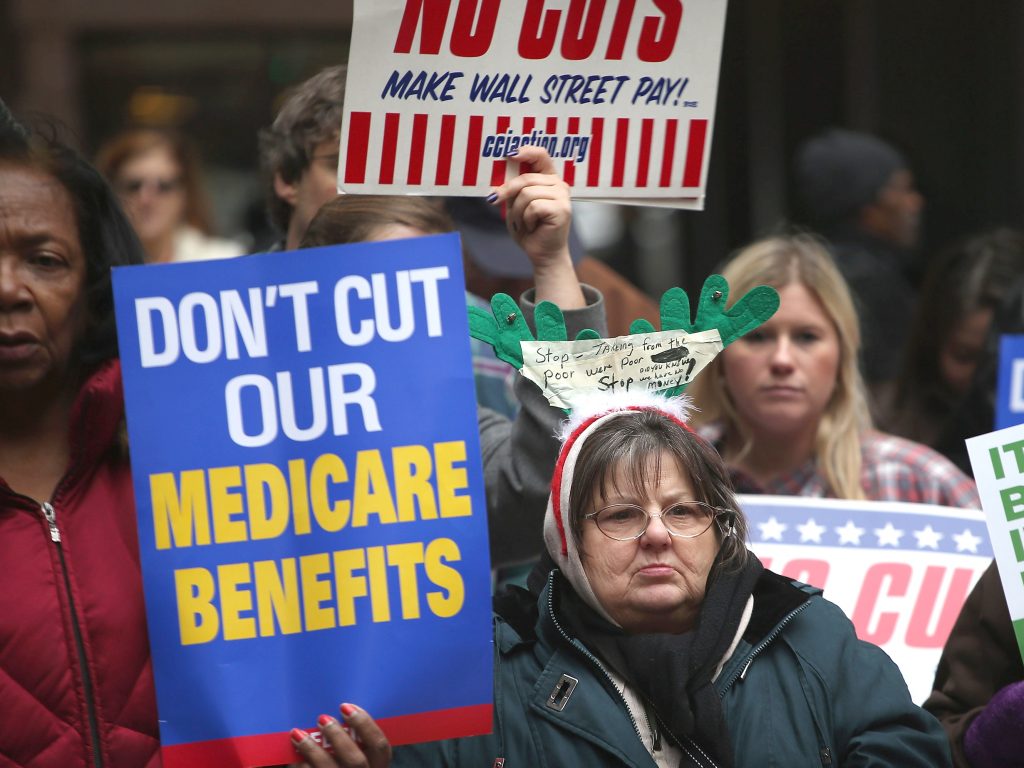
The GOP has a working blueprint to cut billions out of federal programs and balance the budget without tax increases. And, among other items, it still wants to privatize Medicare.
Speaker of the House Paul Ryan (R-WI). (Photo by Win McNamee/Getty Images)
Medicare covers more than 55 million Americans. Most of them are 65 or older and millions are permanently disabled. It’s the nation’s second-largest government-managed single-payer plan after Medicaid, which covers some 70 million.
While Medicare provides coverage for doctors and hospitals, it also covers prescription drugs if you pay an additional premium. You also have the option to buy into private policies through Medicare Advantage — if you don’t want the fee-for-service part of basic Medicare.
The rehashed House GOP budget blueprint wants to reshape Medicare into more of a Medicare Advantage model, which now covers some 19 million Americans.
What does that mean? Funding for the guaranteed part of Medicare would be shifted into the privatized scheme. You’d receive a fixed stipend or “premium support” to buy a private policy on an exchange.
Buying private plans on an exchange? Where have we heard that before? Oh yes, that was the model for the Affordable Care Act, or Obamacare, which the GOP has spent the last seven yearstrying to repeal. It’s been a staple of House Speaker Paul Ryan’s policy platform for years.
“The Medicare improvements envisioned in this budget resolution would adopt the popular simplified coverage structure of Medicare Advantage, and allow seniors greater plan choices while reducing costs.
It would resemble the private insurance market, in which the majority of Americans select a single health care plan to cover all their medical needs.”
In theory, having private insurers compete with the government to provide more coverage at a lower cost sounds like a good idea. But is it possible, given the government’s massive economies of scale?
Without generous subsidies, the prospect of insurers offering a better Medicare deal is like the corner grocer trying to compete with Wal-Mart. Moreover, using Medicare Advantage as a model is a horrible idea.
Medicare Advantage insurers have been embroiled in numerous billing scams, according to the non-partisan Center for Public Integrity. The Center, an independent watchdog, has published more than two dozen pieces on this ongoing morass. Here’s a summary of their findings:
“Congress created private Medicare Advantage health plans 11 years ago to help control health care spending on the elderly. But a Center for Public Integrity investigation found that billions of tax dollars are wasted every year through manipulation of a Medicare payment tool called a “risk score.”
The formula is supposed to pay health plans more for sicker patients and less for healthy people, but often it pays too much. The government has for years missed opportunities to corral tens of billions of dollars in overcharges and other billing errors tied to abuse of risk scores.
Meanwhile, the growing power of the Medicare Advantage industry has muzzled many critics in Congress, and turned others into cheerleaders for the program.”
Back to the main story: What House Speaker Paul Ryan and GOP congressional leaders are proposing is to tear down and remold basic Medicare into the troubled Medicare Advantage program, which would be like throwing kerosene on a house fire.
There’s even more of a muddle on how the GOP would calculate how much to give seniors for their yearly stipend to cover private premiums. What if policy costs go up double digits and the stipend doesn’t keep pace with the private market?
Would private insurers offer lower rates to healthier seniors and price less-healthy Americans out of the market? Although basic Medicare would still be available, wouldn’t the money diverted to premium support undermine funding for the traditional Medicare Hospital Trust Fund, which may be insolvent by 2029?
I think there’s a reason why there’s a billboard in Kenosha, Wisconsin — in the heart of Ryan’s Congressional District — that shows Ryan in a robber’s mask. There’s an attempted theft in progress, but older Americans and the disabled will be the victims.
The House Budget Committee on Wednesday agreed to bake in hundreds of billions in Medicaid cuts from its ACA repeal bill to the budget resolution, plus an additional $114 billion in cuts over 10 years.
The committee’s Republicans’ unanimously approved the decision with no Democrats on board. The budget resolution, which is the foundation for passing tax reform in the Senate without Democratic votes, also assumes Medicare will reduce spending by $487 million from 2018 to 2027.
Some of the additional savings would come from imposing a work requirement on Medicaid adult beneficiaries who are younger than 65 and are not on Social Security disability as a condition of eligibility.
The Medicare savings are built on an idea long-favored by Republicans — using vouchers to buy insurance, though Republicans say future beneficiaries will have the option to buy traditional Medicare too. Democrats during Wednesday’s hearing complained that traditional Medicare would cost 25% more than it does now if vouchers come into play.
The Republicans also included savings that would stem from raising the Medicare eligibility age for future beneficiaries who are 51 or younger. Under the proposal, those individuals would not become eligible for full Social Security benefits or Medicare until the age of 67. The Congressional Budget Office has estimated that would reduce Medicare spending by 2% once everyone in the program is covered by the later eligibility age.
The proposal includes a requirement that affluent seniors pay higher premiums, and that people with incomes of $1 million or more pay the full cost of Medicare premiums without any federal subsidy.
Rep. Matt Gaetz, R-Fla., said during the hearing that the proposed changes are based on math rather than Tea Party politics, as some have alleged.
The Republican spending outline also assumes the government will do better at recouping or avoiding improper payments. The proposal said that there was $59.7 billion in improper Medicare payments in in the last fiscal year, and $36.3 billion in improper Medicaid payments. The outline assumes future improper payments will be 50% lower than today’s levels.
Rep. Debbie Wasserman-Schultz, D-Fla., introduced an amendment that would have changed the resolution so that it no longer assumed American Health Care Act changes would be future law, citing the Senate bill’s collapse this week.
But every Republican present on the committee voted against the amendment. “This is the official position of the House on repeal and reform efforts,” said Rep. Bill Johnson, R-Ohio.
The budget resolution also includes a reduction in health spending of $43.9 billion over 10 years, the CBO estimate of how much the malpractice reform bill that passed the House would save.
Ranking Member John Yarmuth, D-Ky., called the budget disgraceful and others called the cuts to Medicare, Medicaid and food stamps draconian, several Republicans worried what it envisions might not come to pass.
“We might fail to achieve savings in mandatory spending,” which includes Medicaid and Medicare, Johnson said, noting that the budget resolution might make it harder to pass tax reform in the Senate.
The first hurdle, however, is for the resolution to pass the entire House of Representatives.
All eyes yesterday were focused on the Senate, which released significant new amendments to the Better Care Reconciliation Act. But the Senate was not the only game in town.
On July 13 the Medicare Trustees released their 2017 Medicare Trust Fund report. One of the most controversial creations of the ACA was the Independent Payment Advisory Board (IPAB). The ACA established specific target growth rates for Medicare and charged the IPAB with ensuring that Medicare expenditures stayed within these limits.
Each year the CMS Chief Actuary must make a determination as to whether the projected average Medicare growth rate for the 5-year period ending 2 years later will exceed the target growth rate. For each year since the provision went into effect in 2013, the CMS Chief Actuary has determined that the projected growth rates will not exceed these limits. It was thought that this year might be different, but for 2017 the Chief Actuary again concluded that the growth rate will not be exceeded, and said so in a letter to CMS.
The IPAB was supposed to be a 15-member board of experts that would, for years when Medicare growth rates were projected to exceed the threshold, make recommendations for cutting costs. These would be implemented unless Congress enacted an alternate approach that would achieve the same savings or waived the requirement to cut costs by a three-fifths majority. The IPAB has never been created, but under the ACA, in the absence of an IPAB its power to make program cuts devolves to the HHS Secretary.
The IPAB is deeply disliked in Congress and proposals to abolish it have wide support. But the IPAB statute seems to say that the IPAB can only be abolished by a joint resolution of Congress which must be introduced into Congress by February 1, 2017 and be enacted, following very specific procedures, by August 15, 2017. In fact, one bill to abolish the IPAB was introduced into the Senate by February 1 with 36 Republican co-sponsors, and another with 12 Democratic co-sponsors, while a House bill was introduced on February 3 with 233 Democratic and Republican cosponsors. But August 15 is coming up quickly and Congress seems to have its hands full with other issues. Moreover, the CBO would likely view elimination of the IPAB as coming with a high price tag.
It may not matter much. The IPAB provision recognizes that Congress can always change its mind. It could presumably change its rules to allow it to abolish the IPAB whenever it chose to do so. In fact, the rules that the House adopted for the 115th session provide that any IPAB submittals are not to be considered during the 2017-2018 session. But if Congress chose to proceed according to the ACA’s provisions, the IPAB would find few defenders.
Federal Exchange Eligibility Redeterminations And Re-Enrollment
CMS released on July 13 a guidance describing how it intends to handle eligibility redeterminations and re-enrollment for federal exchange enrollees for 2018. Basically, CMS intends to use the same procedures it used for redeterminations and reenrollment for 2017, which in turn were similar to those used for 2016. The exchange will continue to auto-reenroll enrollees who fail to select a plan, and to terminate enrollees who have been auto-reenrolled more than once without contact with the exchange.
There is one change for 2018: CMS will discontinue advance premium tax credits (APTC) and cost-sharing reduction (CSR) payments not just for enrollees who received APTC or CSRs and did not file a tax return in a prior year in which they received ATPC or CSRs, as CMS did in 2016, but additionally for enrollees who failed to file form 8962 to reconcile the APTC they received and the premium tax credits to which they were entitled, and failed to contact the exchange and obtain an updated eligibility determination for 2018. Filing a tax return and reconciling APTC with premium tax credits is an eligibility requirement for receiving APTC and CSRs in subsequent years, but federal regulations prohibit termination of coverage for this reason unless direct notice is sent to the enrollee that coverage will be terminated for failure to file. Until now, CMS has not been able to provide the required notice for those who fail to reconcile.
Finally, on July 13, 2017, the Government Accountability Office released a report on Improvements Needed in CMS and IRS Controls over Health Insurance Premium Tax Credits. The report is long and detailed and reviews comprehensively the controls that CMS and the IRS have in place—or, more often, do not have in place—for ensuring that improper premium tax credits are not made.
The GAO scored both agencies for failing to provide accurate assessments of improper payments. It also criticized each agency for failing to have procedures in place for verifying most eligibility requirements for premium tax credits and for identifying and correcting errors in premium tax credit reporting and collecting overpayments. The agencies responded that they are working on improving verification and processing procedures, but that that they have limited resources and verification is not always possible.
In the end, a tax-based system for paying for health insurance that depends on accurate reporting and verification of citizenship or lawful alien status, incarceration status, income, residence, health insurance premiums, household composition, availability of alternative forms of coverage, and tax filing status of applicants and enrollees—and requires coordination of two independent federal agencies—is very difficult to administer. If the Senate’s BCRA is adopted, administration of the program will only become more complicated, as all of these factors remain relevant and to them will be added age and the possibility of new forms of coverage that do not qualify for premium tax credits, but can be paid for using tax-subsidized health savings accounts. The GAO has its future work cut out for it in any event.
The outreach was prompted by a Justice Department announcement in June that Genesis Healthcare would pay the federal government more than $53.6M.
The nonprofit Corporate Whistleblower Center is urging a medical doctor in any state to call them if they possess proof a healthcare company is substantially overbilling Medicare for hospice services for people who are not dying. The organization is also interested in hearing about skilled nursing or nursing homes facilities that are billing Medicare as if they are fully staffed when in fact they’re not.
The outreach was prompted by a Justice Department announcement in June that Genesis Healthcare would pay the federal government more than $53.6 million to settle lawsuits and investigations alleging that companies it acquired violated the False Claims Act — submitting false claims to government healthcare programs for medically unnecessary therapy and hospice services, and grossly substandard nursing care.
Allegedly the companies were also billing for hospice services for patients who weren’t terminally ill and were thus ineligible for the Medicare hospice benefit. The companies also allegedly billed inappropriately for certain physician evaluation management services.
Additionally, the settlement resolves allegations that Genesis and its affiliates violated certain essential requirements that nursing homes have to meet to participate in and receive reimbursements from government healthcare programs, and failed to provide sufficient nurse staffing to meet residents’ needs. The whistleblowers will receive a combined $9.67 million as their share of the recovery in this case.
The Corporate Whistleblower Center suspects that similar scenarios have the potential to occur in every state, whether it be a hospital admitting Medicare patients who should not have been admitted, a nursing home billing Medicare as if their Medicare patients are receiving the proper care when they’re not, or a hospice company signing up patients who are not dying.
The group advised potential whistleblowers not to approach the government first, or the news media. It offers help finding law firms to handle the information.
Potential whistleblowers can contact the Corporate Whistleblower Center at 866-714-6466 or at corporatewhistleblower.com.
An important question in the debate over proposals to repeal and replace the Affordable Care Act (ACA) is what might happen to the law’s many provisions affecting the Medicare program. The American Health Care Act (AHCA), which was passed by the House of Representative on May 4, 2017, and the Better Care Reconciliation Act (BCRA), released by Senate Republicans on June 22, 2017, would leave most ACA changes to Medicare intact, including the benefit improvements (no-cost preventive services and closing the Part D coverage gap), reductions to payments to health care providers and Medicare Advantage plans, the Independent Payment Advisory Board, and the Center for Medicare and Medicaid Innovation.
However, both bills would repeal the Medicare payroll surtax on high-income earners that was added by the ACA, effective January 2023. That provision, which took effect in 2013, provides additional revenue for the Part A trust fund, which pays for hospital, skilled nursing facility, home health and hospice benefits. The Part A trust fund is financed primarily through a 2.9 percent tax on earnings paid by employers and employees (1.45 percent each). The ACA increased the payroll tax for a minority of taxpayers with relatively high incomes—those earning more than $200,000/individual and $250,000/couple—by 0.9 percentage points.
In addition to repealing the ACA’s Medicare payroll surtax, both bills would repeal virtually all other tax and revenue provisions in the ACA, including the annual fee paid by branded prescription drug manufacturers, which would decrease revenue to the Part B trust fund. The bills would also reinstate the tax deduction for employers who receive Part D Retiree Drug Subsidy (RDS) payments, which would increase Medicare Part D spending.
According to the Congressional Budget Office, the provision in the AHCA and the BCRA to repeal the Medicare payroll surtax would reduce revenue for Part A benefits by $58.6 billion between 2017 and 2026. Proposed changes to the ACA’s marketplace coverage provisions and to Medicaid financing in both bills would also increase the number of uninsured, putting additional strain on the nation’s hospitals to provide uncompensated care. As a result, Medicare’s “disproportionate share hospital” (DSH) payments would increase, leading to higher Part A spending between 2018 and 2026 of more than $40 billion, according to CBO.
Altogether, changes to Part A spending and financing in the AHCA and BCRA would weaken Medicare’s financial status by depleting the Part A trust fund two years earlier than under current law, moving up the projected insolvency date from 2028 to 2026, according to Medicare’s actuaries(Figure 1).
After much secrecy and no public deliberation, Senate Republicans finalized release their “draft” repeal and replace bill for the Affordable Care Act on June 22. Unquestionably, the released “draft” will not be the final version.
Amendments and a potential, albeit not necessary, conference committee are likely to make some adjustments. However, both the House version – American Health Care Act (AHCA) – and the Senate’s Better Care Reconciliation Act (BCRA) will significantly reduce coverage for millions of Americans and reshape insurance for virtually everyone. The Congressional Budget Office (CBO) is expected to provide final numbers early the week of June 26.
If successful, the repeal and replacement of the Affordable Care Act would be in rare company. Even though the U.S. has been slower than any other Western country to develop a safety net, the U.S. has rarely taken back benefits once they have been bestowed on its citizenry. Indeed, only a small number of significant cases come to mind.
My academic work has analyzed the evolution of the American health care system including those rare instances. I believe historical precedents can provide insights for the current debate.
Providing help to mothers and infants
The first major federal grant program for health purposes was also the first one to quickly be eliminated. The program was authorized under the Sheppard-Towner Maternity and Infancy Protection Act of 1921. It provided the equivalent of US$20 million a year in today’s dollars to states in order to pay for the needs of women and young children.
Sheppard-Towner, which provided funding to improve health care services for mothers and infants, was enacted after a long debate in Congress amid accusations of socialism and promiscuity. Interestingly enough, the act may have passed only due to pressure from newly voting-eligible women.
Jeanette Rankin, the original sponsor of the Shepard-Towner Act and the first woman elected to Congress, pictured in 1970.John Duricka/AP
Overall, the program was responsible for more than 3 million home visits, close to 200,000 child health conferences and more than 22 million pieces of health education literature distributed. It also helped to establish 3,000 permanent health clinics serving 700,000 expectant mothers and more than 4 million babies.
The program continued until 1929, when Congress, under pressure from the American Medical Association, the Catholic Church and the Daughters of the American Revolution, terminated the program. Without federal support, a majority of states either eliminated the programs or only provided nominal funding. Fortunately for America’s children and mothers, the Social Security Amendment of 1935 reestablished much of the original funding and expanded it over time.
Helping America’s farmers during the New Deal
America’s next major program confronted a similar fate. To address the challenges of rural America during the Great Depression, the federal government developed a variety of insurance and health care programs that offered extensive and comprehensive services to millions of farm workers, migrants and farmers.
Grandmother and sick baby of a migratory family in Arizona. These types of families were targeted for help by the Farm Security Administration.NARA/ Dorothea Lange
Some of these programs provided subsidies to farmers to form more than 1,200 insurance cooperatives nationwide. At times, the federal government’s Farm Security Administaton (FSA) provided extensive services directly to migrant farm workers through medical assistance on agricultural trains, mobile and roving clinics, migratory labor camps that included health centers staffed with qualified providers, full-service hospitals and Agricultural Workers Health Associations (AWHA).
In all cases, services were generally comprehensive and included ordinary medical care, emergency surgery and hospitalization, maternal and infant care, prescription drugs and dental care.
Although these services were accepted during wartime, the American Medical Association and the Farm Bureau opposed them, which ultimately led to their demise shortly after World War II. Millions of farmers lost their insurance.
Medicaid in the 1980s
Perhaps the most indicative expectations on what will happen in case congressional Republicans are able to pass their proposal hails from the Medicaid program itself.
In the early 1980s, Medicaid underwent a series of cuts and reductions leading to the first contracting in the program’s history. These involved both a reduction in federal funding and in eligibility, and an increase in state flexibility to run the program, as do the Republican proposals in Congress.
The 1980s also saw the creation and quick demise of another health care program. The Medicare Catastrophic Coverage Act of 1988 sought to fill in the gaps of the original Medicare program for America’s seniors. Specifically, it sought to provide them with protection from major medical costs and offer them a prescription drug benefit for the first time.
Similarly to the Affordable Care Act, the law had a redistributive foundation by requiring richer seniors to contribute more than poorer individuals. Also, similarly to the Affordable Care Act, it phased in benefits over a period of time.
Congress, confronted by affluent seniors who would have shouldered much of the financial burden of the program, quickly repealed much of the law before its provisions came into effect.
A Republican President, George W. Bush, was responsible for extending prescription drug benefits to seniors under Medicare Part D.Jason Reed/Reuters
It took more than a decade to provide America’s seniors with a prescription drug benefit through Medicare Part D, while only limited steps have been taken to protect seniors from major medical losses.
The consequences of those rare cases are nonetheless instructive. States were unable to continue the program without federal support or offer a valid replacement. Indeed, the programs quickly faded away. With them, millions of Americans lost access to health care.
In all three previous cases, the federal government eventually renewed its financial support. However, at times it took time for a replacement program to emerge.
The current changes proposed by congressional Republicans, particularly to the Medicaid program, are tremendously more consequential than anything we have previously experienced.
Indeed, in scale and extent, the proposed changes are unprecedented and would significantly roll back, likely for the foreseeable future, America’s safety net.
Cleveland Clinic, Kaiser, NewYork-Presbyterian executives are all concerned over the Senate’s bill.
Healthcare CEOs made the rounds of news shows in this week to air their grievances with the Better Care Reconciliation Act, the Senate GOP bill intended to replace Obamacare.
But, it’s healthcare CEOs who are working to mitigate the anticipated changes who are anticipating how the proposed legislation would affect their organizations.
Among healthcare chief executives weighing in on the topic in recent days are Cleveland Clinic CEO Toby Cosgrove, MD, New York Presbyterian CEO Steven J. Corwin, MD, and Kaiser Permanente CEO Bernard Tyson.
Cleveland Clinic CEO Toby Cosgrove
With the anticipated greater numbers of uninsured patients coming into hospitals, “you’re going to have hospitals that are in very deep financial trouble,” Cosgrove told CNBC’s “Squawk Box” on Wednesday. “And this is particularly true of rural hospitals and safety net hospitals, which are very dependent on Medicare and Medicaid for their returns.”
As he sees it, legislators are not looking at the “root cause of the problem.” It’s not how you divide the money,” he said. “The problem really is the rising cost of healthcare.”
“I think if we came together and dealt with the root cause there’d be plenty of money to go around to look after people,” Cosgrove said. “But if we don’t deal with it now, we’re going to have the same problem going 10 years from now.”
“We’re really headed in the wrong direction,” Cosgrove said. We’re talking about payment reform; we’re not talking healthcare reform.”
Kaiser Permanente CEO Bernard J. Tyson
Bernard J. Tyson, chairman and CEO of Oakland, Calif.-based Kaiser Permanente, wrote in a LinkedIn post that although the ACA – also known as Obamacare – is an imperfect legislation, future healthcare reform must build on its progress, rather than undo it.
“We need to pause and ask policymakers to answer the most fundamental question: What does progress on healthcare look like for the people in America?”
In his view, it should cover more people, not fewer people; be affordable.
Without question, we must make healthcare more affordable; provide the best quality of care and best health outcomes.
Tyson points out that the U.S. has among the poorest health outcomes compared to the other developed nations. The healthcare industry can improve quality if “we commit to moving from a predominantly ‘sick care,’ episodic, fee-for-service model to a predominantly preventive model with incentives for value, integrated care and, most important, keeping people healthy.”
“The draft bill does not expand coverage; it does not do enough to protect people in need of care, nor does it provide enough assistance to those who need help in paying for health care and coverage,” he writes.
NewYork-Presbyterian CEO Steven J. Corwin
Speaking to Bloomberg on Tuesday, Steven J. Corwin, CEO of NewYork-Presbyterian said, “Just remember this: One in three children in this country is insured by Medicaid. One in three.”
Corbin noted that two-thirds of the expense of Medicaid are for people who are in nursing homes.
“So, you can work all your life, be a grandma, or ma, and then go through your assets, and then you have to be on Medicaid to go into a nursing home,” he said. “This is going to be devastating to so many people.”
Asked whether he would prefer having something concrete done in Congress or just see the proposed bill go away, Corbin said: “I’d like to see it go away. And, I’d like to see the Medicaid expansion remain, and I’d like to see the insurance market stabilized.”