


http://www.latimes.com/business/la-fi-prime-healthcare-20160525-snap-story.html
The U.S. Justice Department has joined a whistle-blower case against Prime Healthcare Services, adding significant weight to allegations of widespreadMedicare overbilling at 14 of the company’s hospitals in California. A Los Angeles magistrate judge granted the agency’s request to intervene in the case Tuesday, one day after the government declared in a court filing that its investigation of the Ontario- hospital operator has “yielded sufficient evidence” that the facilities “submitted or caused the submission of claims to Medicare for unnecessary inpatient stays.” Prime finds itself under federal scrutiny because of a whistle-blower complaint submitted in 2011 by Karin Berntsen, a registered nurse and director of quality and risk management at Alvarado Hospital in San Diego. Berntsen’s lawsuit accuses Prime of routinely making Medicare patients’ illnesses seem more severe than they really were in order to justify billing for additional services and increasing hospital admissions.
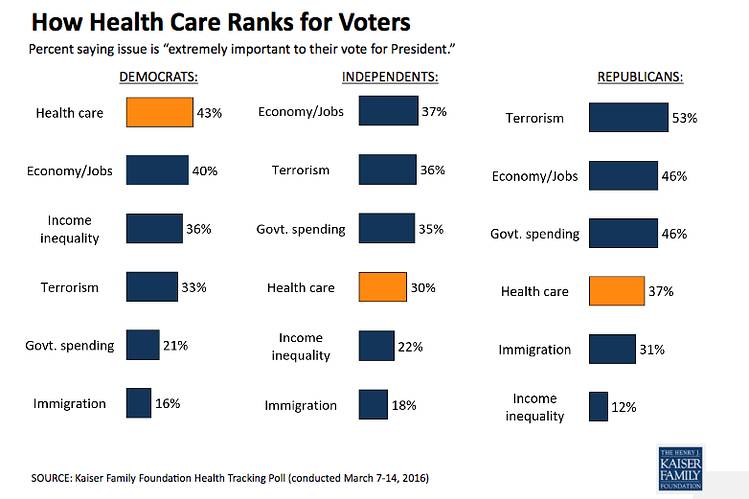
Health care has faded into the background of the election campaign as Donald Trump himself has become the issue on the Republican side and the debate between Hillary Clinton and Bernie Sanders over health care has shifted to other topics. This doesn’t mean that health will be the No. 1 or No. 4 factor when Democrats and Republicans vote in November. As the chart also shows, issue priorities are closely bunched, and my experience has been that voters cast ballots in presidential elections on the basis of their overall views of the candidates rather than candidates’ specific positions on issues.
When people say health care is an extremely important voting issue, they aren’t always thinking of the ACA. Among Republicans who say health is “extremely important” to their vote, about equal shares are thinking about the ACA as are thinking about issues such as access to care and health-care costs. Nor are Democrats always intending to support the ACA when they cite health as a voting issue. They are more likely to cite improving access or addressing costs generally as their reason for naming health a top voting issue.

An Obama administration proposal to reduce Medicare payments for many prescription drugs has run into sharp bipartisan criticism, suggesting that it is easier to diagnose the problem of high prices than to solve it.
Healthcare Triage News: Pay for Performance in Medicine: It Doesn’t Work

“Pay-for-performance” is an umbrella term for initiatives aimed at improving the quality, efficiency, and overall value of health care. These arrangements provide financial incentives to hospitals, physicians, and other health care providers to carry out such improvements and achieve optimal outcomes for patients.

Hospitals instead will receive a one-time payment of 0.6 percent next year to offset the 0.2 percent reduction implemented from 2014 through 2016.
The shrinkage of employee retirement resources in the U.S. has been well documented, as employers shift more risk onto their workers. Less so is the rate at which employers have been eliminating healthcare benefits for retirees. As the Kaiser Family Foundation recently reported, retiree health coverage is becoming an endangered species.
http://www.healthcaredive.com/news/performance-measures-put-heat-on-hospitals/418477/

This year has seen a bevy of new programs and initiatives aimed at moving providers toward a value-based model of care.
http://www.rwjf.org/en/library/research/2016/04/medicare-s-new-physician-payment-system.html

http://www.rwjf.org/content/dam/farm/reports/issue_briefs/2016/rwjf428568

 HENRY KOTULA