CHI’s operating loss widens in Q3, but finances improve over longer term

https://www.beckershospitalreview.com/finance/chi-s-operating-loss-widens-in-q3-but-finances-improve-over-longer-term.html

Image result for catholic health initiatives


Englewood, Colo.-based Catholic Health Initiatives saw its operating loss widen in the third quarter of fiscal year 2018, but the health system’s financial picture improved over the first nine months of the fiscal year.

CHI’s operating revenues declined from $3.8 billion in the third quarter of fiscal year 2017 to $3.7 billion in the third quarter of fiscal 2018. However, the health system’s expenses before restructuring also declined about 1.7 percent year over year to $3.7 billion in the third quarter of the current fiscal year.

After factoring in restructuring, impairment and other one-time costs, the system ended the third quarter of fiscal year 2018 with an operating loss of $35.3 million, compared to an operating loss of $17.2 million in the same period a year earlier. CHI said its operating EBIDA improved by nearly $80 million during the third quarter of fiscal year 2018 after adjusting for transactional gains and other items.

CHI launched a turnaround plan about three years ago, and the improvements the system has achieved under that plan are clear when looking at financial results for the first nine months of the current fiscal year. For the nine months ended March 31, CHI reported an operating loss of $114.7 million, which was a significant improvement from the nearly $344 million loss the system recorded in the same period of the year prior.

“We continue to see strong momentum that has played out in the current fiscal year,” said Dean Swindle, president of enterprise business lines and CFO of CHI, in an earnings release. “We have established a strong foundation through a performance-improvement plan stretching back nearly three years, and we expect that these positive results will continue throughout the rest of this fiscal year and well beyond as we become a truly high-performing health system.”

The three major rating agencies — Moody’s Investors Service, Fitch Ratings and S&P Global Ratings — have all recognized CHI’s progress in recent months with positive adjustment in their outlooks for the health system.


Health Insurers Had Their Best Quarter in Years, Despite the Flu

https://www.bloomberg.com/news/articles/2018-05-03/health-insurers-had-their-best-quarter-in-years-despite-the-flu

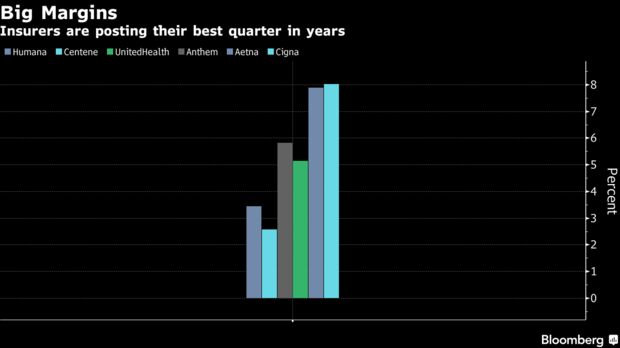
Here’s a look at how the margins of the largest in the quarter, based on data compiled by Bloomberg:

U.S. health insurers just posted their best financial results in years, shrugging off worries that the worst flu season in recent history would hurt profits.

Aetna Inc., for instance, posted its widest profit margin since 2004. Centene Corp. had its most profitable quarter since 2008. And Cigna Corp., which reported on Thursday, had its biggest margin in about seven years.

Analysts at Morgan Stanley, in a research note, said insurers are in the midst of a “hot streak.”

One big reason for the windfall is the tax cuts passed by Congress last year, which in some cases more than halved what the insurers owe the government. Aetna said its effective tax rate fell to 16.8 percent from 39.6 percent, for example. Many insurers also spent less on medical care than analysts had expected, even taking into account increased spending on flu treatments.


Kaiser’s operating income climbs to $1.1B in Q1

https://www.beckershospitalreview.com/finance/kaiser-s-operating-income-climbs-to-1-1b-in-q1.html

Image result for billion dollars


Oakland, Calif.-based Kaiser Permanente reported higher revenues and operating income for its nonprofit hospital and health plan units in the first quarter of 2018, according to recently released financial documents.

Kaiser saw revenues increase to $20.3 billion in the first quarter of this year. That’s up about 12 percent from revenues of $18.1 billion in the same period of 2017.

The boost was attributable in part to the system’s health plan unit. Since Dec. 31, Kaiser has added approximately 472,000 health plan members. As of March 31, Kaiser had about 12.2 million members.

Kaiser reported operating income of $1.1 billion in the first quarter of this year, up from $1.04 billion in the same period of 2017.

After factoring in nonoperating income, which declined year over year, Kaiser ended the first quarter of 2018 with net income of $1.4 billion. That’s compared to the same period of 2017, when the organization reported net income of $1.6 billion.


As Proton Centers Struggle, A Sign Of A Health Care Bubble?

https://khn.org/news/as-proton-centers-struggle-a-sign-of-a-health-care-bubble/

The Maryland Proton Treatment Center chose “Survivor” as the theme for its grand opening in 2016, invoking the reality-TV show’s tropical sets with its own Tiki torches, palm trees and thatched booths piled with pineapples and bananas.

It was the perfect motif for a facility dedicated to fighting cancer. Jeff Probst, host of CBS’ “Survivor,” greeted guests via video from a Fiji beach.

But behind the scenes, the $200 million center’s own survival was less than certain. Insurers were hesitating to cover procedures at the Baltimore facility, affiliated with the University of Maryland Medical Center. The private investors who developed the machine had badly overestimated the number of patients it could attract. Bankers would soon be owed repayment of a $170 million loan.

Only two years after it opened, the center is enduring a painful restructuring with investors poised for huge losses. It has never made money, although it has ample cash to finance operations, said Jason Pappas, its acting CEO since November. Last year it lost more than $1 million, he said.

Volume projections were “north” of the current rate of about 85 patients per day, Pappas said. How far north? “Upper Canada,” he said.

For years, health systems rushed enthusiastically into expensive medical technologies such as proton beam centers, robotic surgery devices and laser scalpels — potential cash cows in the one economic sector that was reliably growing. Developers got easy financing to purchase the latest multimillion-dollar machine, confident of generous reimbursement.

There are now 27 proton beam units in the U.S., up from about half a dozen a decade ago. More than 20 more are either under construction or in development.

But now that employers, insurers and government seem determined to curb growth in health care spending and to combat overcharges and wasteful procedures, such bets are less of a sure thing.

The problem is that the rollicking business of new medical machines often ignored or outpaced the science: Little research has shown that proton beam therapy reduces side effects or improves survival for common cancers compared with much cheaper, traditional treatment.

If the dot-com bubble and the housing bubble marked previous decades, something of a medical-equipment bubble may be showing itself now. And proton beam machines could become the first casualty.

“The biggest problem these guys have is extra capacity. They don’t have enough patients to fill the rooms” at many proton centers, said Dr. Peter Johnstone, who was CEO of a proton facility at Indiana University before it closed in 2014 and has published research on the industry. At that operation, he said, “we began to see that simply having a proton center didn’t mean people would come.”

Sometimes occupying as much space as a Walmart store and costing enough money to build a dozen elementary schools, the facilities zap cancer with beams of subatomic proton particles instead of conventional radiation. The treatment, which can cost $48,000 or more, affects surrounding tissue less than traditional radiation does because its beams stop at a tumor rather than passing through. But evidence is sparse that this matters.

And so, except in cases of childhood cancer or tumors near sensitive organs such as eyes, commercial insurers have largely balked at paying for proton therapy.

“Something that gets you the same clinical outcomes at a higher price is called inefficient,” said Dr. Ezekiel Emanuel, a health policy professor at the University of Pennsylvania and a longtime critic of the proton-center boom. “If investors have tried to make money off the inefficiency, I don’t think we should be upset that they’re losing money on it.”

Investors backing a surge of new facilities starting in 2009 counted on insurers approving proton therapy not just for children, but also for common adult tumors, especially prostate cancer. In many cases, nonprofit health systems such as Maryland’s partnered with for-profit investors seeking high returns.

Companies marketed proton machines under the assumption that advertising, doctors and insurers would ensure steady business involving patients with a wide variety of cancers. But the dollars haven’t flowed in as expected.

Indiana University’s center became the first proton-therapy facility to close following the investment boom, in 2014. An abandoned proton project in Dallas is in bankruptcy court.

California Protons, formerly associated with Scripps Health in San Diego, landed in bankruptcy last year.

A number of others, including Maryland’s, have missed financial targets or are hemorrhaging money, according to industry analysts, financial documents and interviews with executives.

  • The Hampton University Proton Therapy Institute in Virginia has lost money for at least five years in a row, recording an operating loss of $3 million in its most recent fiscal year, financial statements show.
  • The Provision CARES Proton Therapy Center in Knoxville, Tenn., lost $1.7 million last year on revenue of $23 million — $5 million below its revenue target. The center is meeting its debt obligations, said Tom Welch, its president.
  • Centers operated by privately held ProCure in Somerset, N.J., and Oklahoma City have defaulted on debt, according to Loop Capital, an investment bank working on deals for new proton facilities.
  • A facility associated with the Seattle Cancer Care Alliance, a consortium of hospitals, lost $19 million in fiscal 2015 before restructuring its debt, documents show. Patient volume is growing but executives “continue to be disappointed in the slower-than-expected acceptance of proton therapy treatment” by insurers, said Annika Andrews, CEO of SCCA Proton Therapy.
  • A center near Chicago lost tens of millions of dollars before restructuring its finances in a 2013 sale to hospitals now affiliated with Northwestern Medicine, documents filed with state regulators show. The facility is “meeting our budget expectations,” said a Northwestern spokesman.

Representatives from ProCure and the facilities in San Diego and Hampton did not respond to repeated requests for interviews.

“In any industry that’s really an emerging industry, you often have people who enter the business with over-exuberant expectations,” said Scott Warwick, executive director of the National Association for Proton Therapy. “I think maybe that’s what went on with some of the centers. They thought the technology would grow faster than it has.”

In the absence of evidence showing protons produce better outcomes for prostate, lung or breast cancer, “commercial insurers are just not reimbursing” for these more common tumors, said Brandon Henry, a medical device analyst for RBC Capital Markets.

The most expensive type of traditional, cancer-fighting radiation — intensity modulated radiation therapy — costs around $20,000 per treatment, while others cost far less. The government’s Medicare program for seniors covers proton treatment more often than private insurers but is insufficient by itself to recoup the massive investment, analysts said.

The rebellion by private insurers “is very, very good” and may signal the health system “is finally figuring out how to say no to low-value procedures,” said Amitabh Chandra, a Harvard health policy professor who has called proton facilities unaffordable “Death Stars.”

Proton centers are fighting back, enlisting patients, legislators and nonprofits to push for reimbursement. Oklahoma has passed and Virginia has considered legislation to effectively require insurers to cover proton therapy in more cases.

An entire day at the 2017 National Proton Conference in Orlando was dedicated to tips on getting paid, including a session titled “Strategies for Engaging Health Insurance on Proton Therapy Coverage.”

Proton facilities tell patients the therapy is appropriate for many kinds of cancer, never mentioning the cost and guiding them through complicated appeals to reverse coverage denials. The Alliance for Proton Therapy Access, an industry group, has online software for generating letters to the editor demanding coverage.

In hopes of navigating a difficult market, many new centers are smaller — with one or two treatment rooms — and not as expensive as the previous generation of units, which typically have four or five rooms, like the Baltimore facility, and cost $200 million or more.

Location is also critical. Treatment requires near-daily visits for more than a month, which may explain why larger centers such as Maryland’s never attracted the out-of-town business they needed.

To make the finances work, hospitals are combining forces. The first proton beam center in New York City is under construction, a joint project of Memorial Sloan Kettering, Mount Sinai and Montefiore Health System.

Smaller facilities, which can cost less than $50 million, should be able to keep their rooms full in many major metro areas, said Prakash Ramani, a senior vice president at Loop Capital, which is helping develop such projects in Alabama, Florida and elsewhere.

Maryland’s center hopes to break even by year’s end, executives said. That will involve refinancing, converting to nonprofit, inflicting losses on investors and issuing municipal bonds.

But plans call for four centers soon to be open in the D.C. area.

“It’s a real arms race,” said Johnstone, the former proton-center CEO, who has co-authored papers on proton-therapy economics. He is now vice chair of radiation oncology at Moffitt Cancer Center in Tampa, which doesn’t have a proton center. “What places need now are patients — a huge supply of patients.”


CHS beats expectations with cost cuts despite volume slump

https://www.healthcaredive.com/news/chs-beats-expectations-with-cost-cuts-despite-volume-slump/522579/

Dive Brief:

  • Community Health Systems beat Wall Street expectations Tuesday when it reported a small adjusted net profit during the first quarter, as its cost cutting helped offset weak admissions volume. Its net loss narrowed to $25 million, compared to a net loss of $199 million in the year earlier period.
  • Net operating revenues dropped nearly 18% to $3.69 billion, compared with $4.49 billion for the same period in 2017. The health system continues to struggle with declining admissions, reporting a 2.4% decrease for the quarter.
  • CHS sold off 30 hospitals last year and continues its divestment strategy this year.

Dive Insight:

The Brentwood, Tennessee-based hospital operator is hoping to pare down its outsized debt, much of which was acquired when the company bought the financially-distressed Florida-based system Health Management Associates for $7.6 billion in 2014.

In January, CEO Wayne Smith told investors his goal is to slim down to 100 hospitals in “significantly improved markets.” The company is attempting to make $1.3 billion off of divestitures this year, counting six pending divestitures this year in Florida, Louisiana and Tennessee.

The strategy might be paying off. With 30 fewer hospitals, the company’s inpatient and outpatient revenues for Q1 each increased 0.1% on a same-store basis, and income from operations skyrocketed 198% to $212 million, compared to $71 million in 2017.

Jefferies noted the system offset lower volumes by keeping labor and staffing costs low.

Still, it said future growth “hinge[s] largely on seeing a stabilization in organic volume trends, which has eluded the company for eight consecutive quarters.”

The analysts said new initiatives like an accountable care organization were promising, “though their benefits will likely take a few quarters to materialize.”

Last year, ASL Strategic Value Fund sent a letter to CHS’ board of directors saying “it is time” to replace the CEO. The letter, dated Aug. 8, argued that action is needed immediately as management’s “previous missteps have resulted in billions of dollars of shareholder losses.”

In a comment issued with the earnings report, Smith argued to investors that the company’s turnaround strategy is beginning to work.

“We achieved continued progress across a number of our strategic and operating initiatives,” he said. “During the first few months of the year, we expanded our transfer and access program, launched Accountable Care Organizations, and invested in both outpatient capabilities and service line enhancements across our markets. These efforts helped drive a good financial performance during the first quarter and position the Company for further anticipated improvements during the balance of 2018.”

However, CHS still has a long way to go. The company recently brought in financial advisors to help restructure $13.8 billion in long-term debt.


Adventist Health’s net income nears $230M in FY17

https://www.healthcaredive.com/news/adventist-healths-net-income-nears-230m-in-fy17/522093/

Dive Brief:

  • Adventist Health’s net income grew 366% to $229.8 million in fiscal year 2017, up from $169.1 million in 2016.
  • Operating income was $203.9 million for the year ended Dec. 31, an 11.6% increase from $812.8 million the previous year, according to recent released financial documents.
  • The 90-hospital, Roseville, CA-based nonprofit health system reported $4.1 billion in revenue, a 5.8% gain over 2016’s $3.9 billion.

Dive Insight:

Adventist’s rosy performance gain reflects at least a short-term upward trend in financials as nonprofits show some signs of bouncing back from several years of rough currents fueled by shrinking volumes and reimbursement cuts. Geisinger Health System saw net income jump nearly $200 million to $324.9 million in the first half of fiscal year 2018, compared with the prior year, providing an excess margin of 9%.

Mayo Clinic reported $707 million in operating income and $12 billion in revenue for 2017, an increase of more than $225 million and $1 billion, respectively, from the previous year. Meanwhile, UPMC’s net income rose to $1.3 billion last year, spurred by strong operating and investing results and integration of UPMC Pinnacle into UPMC operations. Operating revenue and operating income also increased.

Adventist is looking to expand its brand footprint. Earlier this month, the system inked a deal to acquire Florida-based 421-bed Munroe Regional Medical Center from Community Health Systems. It has also broadened its reach in northern California through an affiliation agreement with Fremont-Rideout Health Group, which become effective at the first of this month.

Net patient service revenue at Adventist was $3.8 billion, up from $3.6 billion a year earlier. Total expenses rose to $3.9 billion, versus $3.7 billion in 2016. Of that, $1.9 billion was for employee compensation. The system recorded total cash and investments of $1.9 billion for last year.

Occupancy of licensed beds stayed mostly flat at 55.6% across the system. Average length of stay was down slightly and outpatient revenues as a percentage of gross patient revenue was down to 44.7% from 45.1% in 2016.


Anthem reports flat operating revenues due to exit from Affordable Care Act market

http://www.healthcarefinancenews.com/news/anthem-reports-flat-operating-revenues-due-exit-affordable-care-act-market?mkt_tok=eyJpIjoiT1RrME5HWmxNV0kyTkRZeCIsInQiOiJzQ2N6dzlKclF2QmpZaGZraHhUYWRwZThOSit4NjFJZ003dUtnU3NKem9WSkN0QXZUdVJVcUFIRWhMRHJZQ2I3a0N6YWNiR1pLVVFTdzdcL0hvSFl3WVR5ZVpJRWFhSUM1Y3Jyd0FRZVk0YXdOYjF3bXRWUXFXMkN1VlwvMkRMTGNpIn0%3D

Net income increased 30 percent driven by premium rate increases, the return of the health insurance tax and the acquisition of MA plans.

Anthem reported a 30 percent increase in net income for the first quarter compared to the same three months of 2017, but operating revenues remained relatively flat primarily due to the insurer’s planned exits from the Affordable Care Act marketplace.

On Wednesday, Anthem reported net income for the first quarter of $1.3 billion, versus 1 billion for the first three months in 2017.

First quarter operating revenues were relatively flat at $22.3 billion year-over-year due to a decrease in its individual market business.

In 2017, Anthem announced it would cut back its ACA footprint by about 70 percent.

Revenues were helped by premium rate increases to cover overall cost trends, the return of the health insurance tax and the acquisitions of HealthSun and America’s 1st Choice.

Anthem’s acquisition of HealthSun, completed at the end of 2017, added a Medicare Advantage health plan and delivery network in Florida.

The acquisition of America’s 1st Choice was finalized in February. The privately-held, for-profit Medicare Advantage organization  offers HMO products, including chronic special needs plans and dual-eligible special needs plans under its Freedom Health and Optimum brands in Florida. The deal added 135,000 Medicare Advantage members and included a 5 star plan.

Anthem’s medical enrollment totaled approximately 39.6 million members as of March 31, a decrease of 1 million or 2.5 percent percent, from 40.6 million at March 31, 2017.

The company said it now expects medical enrollment to be between 40.1 – 40.3 million for the full year 2018.

Counteracting the individual market decline, Anthem’s government business grew 10 percent year-over-year through a focus on serving the complex social and medical requirements of the dual special needs population.

Medical enrollment declined by 616,000 during the first quarter reflecting a decrease in the individual and local group fully-insured businesses. Medicare grew by 237,000 members and Medicaid enrollment declined by 120,000 individuals.

“We are pleased with our first quarter 2018 financial performance, which reflects our commitment to strong medical cost performance by effectively leveraging community based innovative and integrated clinical and value based care models across our markets,” said CEO and President Gail Boudreaux. “Throughout 2018, we are prioritizing investments to create a more flexible infrastructure that can quickly respond to the evolving needs of our customers and the changing healthcare environment.”


Moody’s: Preliminary nonprofit healthcare profitability margins at 10-year low

https://www.beckershospitalreview.com/finance/moody-s-preliminary-nonprofit-healthcare-profitability-margins-at-10-year-low.html

Image result for negative outlook

The nonprofit hospital median operating cash flow margin decreased to 8.1 percent in fiscal year 2017, marking the lowest level seen since the 2008-09 recession, according to preliminary financial data from Moody’s Investors Service.

The revenue decline comes amid expense growth and pinched revenue growth.

Here are five report insights to know.

1. The nonprofit hospital median operating cash flow margin was 8.1 percent in fiscal year 2017 compared to 9.5 percent the year prior.

2. The nonprofit hospital annual median revenue growth rate decreased by 2.2 percent in fiscal year 2017 compared to the year prior, while the median expense growth rate fell by 1.7 percent. Pinched revenue growth was attributed to factors such as declining reimbursement from payers, as well as median growth in outpatient visits (2.2 percent) outpacing median growth in inpatient hospitalizations (1.2 percent). Moody’s expects nonprofit hospitals’ credits to continue to be stressed by the aging population and declining reimbursement.

3. Nonprofit hospital’s median absolute unrestricted cash and investments increased by 8.2 percent in fiscal year 2017, partially due to strong market returns, according to Moody’s. This compares to 3.8 percent in fiscal year 2016. But the agency reported this growth was offset by median days cash on hand, which only increased 1.5 percent as organizations were pressured by labor, technology and supply costs. Moving forward, Moody’s expects limited liquidity improvement as expenses grow and capital spending needs increase.

4. Due to weaker operating performance, nonprofit hospitals generally saw tempered leverage ratios. This is despite the fact median total absolute debt decreased 1.7 percent in fiscal year 2017, according to Moody’s. “Operating challenges and increased debt issuance in the fourth quarter of calendar year 2017 will keep debt service coverage measures subdued,” the agency wrote.

5. The fiscal year 2017 preliminary financial data from Moody’s is in line with the agency’s negative outlook on the nonprofit healthcare and hospital sector. The data was based on audited fiscal year 2017 financial statements for 160 nonprofit healthcare organizations, including freestanding hospitals as well as single- and multi-state health systems.

Access the full data here.

Healthcare megadeals may have major long-term impact, Moody’s says

https://www.healthcaredive.com/news/healthcare-megadeals-may-have-major-long-term-impact-moodys-says/521578/

Image result for mega deals

Dive Brief:

  • CVS Health’s plan to buy Aetna could have a significant impact on hospitals, health insurers and pharmacy benefit managers (PBMs), according to Moody’s Investors Service’s Healthcare Quarterly.
  • Payers’ vertical integration strategies are credit negative for hospitals, but hospitals’ plans to make generic drugs and other new strategies are positives, Moody’s said.
  • On the payer side, Moody’s said mergers between health insurers and PBMs are credit negative in the short-term because of increased debt and risk associated with integration. However, in the long run, these deals may lower costs.

Moody’s said hospitals may feel the impact of UnitedHealth’s Optum buying DaVita Medical and Humana investing in Kindred Healthcare. However, Cigna’s purchase of Express Scripts won’t have much of an effect on hospitals.

Payers’ vertical integration strategies, such as buying physician groups and non-acute care providers, are credit negative for nonprofit and for-profit hospitals and put more pressure on hospital volumes and margins, Moody’s said.

The issue comes from payer vertical integration being able to offer preventive, outpatient and post-acute care for lower costs than acute care hospitals. These initiatives will have an increasingly disruptive impact to hospitals’ credit quality, according to the report.

“These strategies would place insurers in direct competition with hospitals, which offer the same services and are also seeking to align with physician groups,” Moody’s said.

On the payer side, two recently announced megadeals, CVS-Aetna and Cigna-Express Scripts, are both designed to control rising medical costs and target drug prescriptions, which now account for nearly one-fifth of total health spending. While payers have been able to limit growth in utilization, medical inflation and sources of medical care, prescription drug costs continue to rise, Moody’s said.

Though Moody’s expects both deals to be credit negative in the short-term, they have the potential to turn credit positive in the long run, especially CVS-Aetna. “The combined company has the potential to lower medical costs as Aetna will be better able to engage with its members as they purchase drugs at CVS retail pharmacies or through its prescription drug programs,” Moody’s said.

These deals will result in most payers having to contract with a PBM owned by a competitor. Moody’s expects PBM competition to remain high. Payer-owned PBMs must still offer the same cost savings to competitors to keep customers.

Out of the recent megadeals, only CVS buying Aetna is expected to have “more significant impact” for payers. The other announced transactions aren’t expected to cause many problems for insurance companies, Moody’s said.

Looking at initiatives that are in development, Moody’s said none of the big-name plans are expected to have much of an impact on the healthcare segments. These include the Amazon, Berkshire Hathaway and J.P. Morgan Chase’s partnership, Apple opening medical clinics and entering the medical record business or nonprofit hospitals forming a generics company.


UnitedHealth’s Evolution From Traditional Insurer Into Multifaceted Business Pays Off

http://www.startribune.com/unitedhealth-group-sees-profit-jumps-boosts-outlook/479981613/

The UnitedHealth Group Inc.'s campus in Minnetonka, Minn.

UnitedHealth Group hikes outlook after quarterly profit easily beats estimates

Strong first quarter, new growth opportunity have the health insurer hiking its yearly outlook.

After chalking up another quarter of better-than-expected profits, UnitedHealth Group officials on Tuesday described the potential for growth through a new venture fund the company is using to invest in innovative health care startups.

Minnetonka-based UnitedHealth first described the venture fund to investors in November and announced in March that Larry Renfro, the chief executive of the company’s Optum division, would lead the effort.