

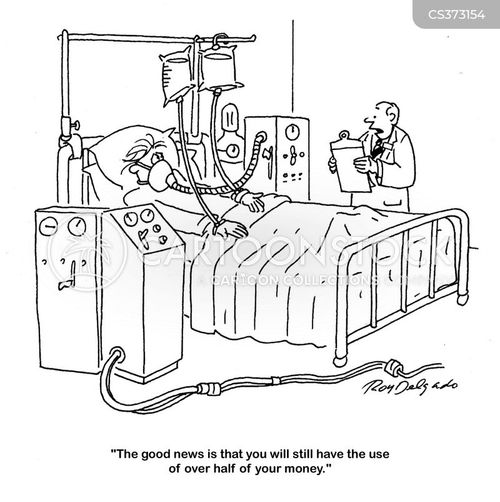
Cartoon – High Deductible Healthcare Today

Part of the issue with surprise billing, also known as balance billing, is thatmost states don’t have laws that protect consumers. Only six states have a “comprehensive” laws that protect against surprise billing, and there are no federal protections against the practice, according to The Commonwealth Fund.
The issue of surprise billing is another example of how the U.S. healthcare system confuses people. Patients who visit in-network hospitals often aren’t able to make sure each doctor working on them is in-network. So, they’re stuck with larger than expected hospital bills later.
Patients don’t like it for obvious reasons, and payors aren’t happy with the higher bills either. The hospital CEO the Times interviewed, Tom Wilbur of Newport Hospital in Spokane, Wash., said switching to EmCare turned out to be a fiasco as confused and angry patients started calling in. “Hindsight being 20/20, we never would have done that,” he told the paper.
A recent Commonwealth Fund study found that 14% of ER visits and 9% of hospital stays were likely to produce a surprise bill. Patients who were admitted to the hospital via the ER were more likely (20%) to receive a surprise bill.
As health systems look to outside agencies more to fill gaps in coverage, surprise billing is not going away and could even intensify. What’s the solution? The Commonwealth Fund suggested it likely won’t come from Washington given the current toxic political climate — especially when it comes to healthcare. Instead, states will need to take up the issue in an attempt to protect consumers from getting large, unexpected hospital bills that are out of their control.

Senate Republicans have run into another problem in passing their ObamaCare replacement bill: It could increase deductibles by thousands of dollars, potentially alienating moderates who are already skeptical of the bill.
An analysis released Thursday by the nonpartisan Congressional Budget Office (CBO) concluded that a single policyholder purchasing a standard benchmark plan under the GOP bill could face a deductible of $13,000 in 2026.
Under current law, an individual making $56,800 would have a deductible of $5,000, while someone making $26,500 would have an $800 deductible.
A higher deductible is the tradeoff Republicans made when they decided that lowering premiums would be a top priority for their legislation; plans with lower premiums generally have higher deductibles.
“The way we come together, the way we bring together senators all across the ideological spectrum, is focusing on lowering premiums,” Sen. Ted Cruz (R-Texas) said on Fox News on Friday.
“If we’re lowering premiums, that’s a win for everyone.”
Deductibles could become so high under the GOP plan, the CBO said, that many low-income people might decide not to purchase a health insurance plan, even if the premiums were low.
That could be an issue for moderates who have worried about coverage losses, especially for those who gained coverage through ObamaCare’s Medicaid expansion.
The Republican legislation ends the expansion by 2023, and those people will be eligible for tax credits to buy insurance under the GOP plan.
Under the Senate bill, the tax credits for purchasing coverage are tied to ObamaCare’s less generous “bronze” plans that have lower premiums and higher deductibles.
Another factor driving the higher deductibles under the Republican proposal, according to the CBO, is the elimination of ObamaCare insurer payments known as cost sharing reduction subsidies. These payments reimburse insurers for giving discounted deductibles to low-income people.
In an attempt to address the issue, the White House is trying to win over moderates by proposing to allow states to use some Medicaid funding to help low-income people pay for their deductibles.
Higher deductibles for low-income people are a concern, said Sen. Bill Cassidy (R-La.), but he hopes the new White House proposal will fix that.
Senate Republican leaders are also considering offering $200 billion to states that expanded Medicaid, which would be funded by leaving in two of ObamaCare’s taxes on high earners.
That money would come in addition to $132 billion the revised bill already sets aside for a long-term state innovation fund and $45 billion to treat opioid addiction.
“If there’s enough to make it real that someone who is lower-income can get the assistance they need to afford insurance, then that matters,” Cassidy told reporters Thursday.
Sen. Mike Rounds (R-S.D.) said the purpose of leaving those taxes in was to “redistribute” that money to people facing higher costs under the bill.
“What we’re trying to do is allow more local control in some areas so individual states can do some things to help people based on what their needs are,” he said.
“That’s why we kept some of that tax revenue in place. So we can redistribute some of that money to help them because they have no place else to go.”
But some lawmakers question whether the additional funding would make a difference.
While the proposal would add $200 billion in funding, the legislation would cut $756 billion from Medicaid over the next decade, which includes the rollback of the expansion.
“As long as we are fundamentally changing Medicaid and taking some $700 billion out of the program, I do not see myself supporting a bill that does that,” Sen. Susan Collins (R-Maine) told reporters Thursday.
The CBO noted in its score that funding provided to states for stabilization would likely be used to reduce premiums, not deductibles, though the analysis did not include the additional $200 billion.
“The CBO expects that most of these funds would be used to lower premiums. There’s not a lot of money left over for cost-sharing,” said Cynthia Cox, an insurance expert with the Kaiser Family Foundation.
http://kcur.org/post/small-missouri-town-went-trump-now-some-fear-health-care-overhaul-0#stream/0

The closest emergency room is 20 miles east on the highway. That’s why it isn’t unusual for people experiencing heart attacks, blood clots and strokes to show up at Dr. Rodney Yager’s clinic on Main Street in Monroe City, Missouri.
Yager, who grew up in the area, can handle the fast pace of a small-town clinic. What worries him more is how federal health care policies being shaped in Washington, D.C., could affect his patients.
The most recent proposal by Senate Republicans would cut taxes for the wealthy and leave 22 million more U.S. residents uninsured by 2026, compared to current law.
But voter frustrations with the Affordable Care Act’s rollout in communities like Monroe City helped fuel the elections of candidates who promised to dismantle it.
“Honestly, I can see the Republican side of wanting to make budget cuts and try to eliminate waste,” Yager said.”But at the same time, they’re hurting a lot of people.”
This town of almost 2,500 people sprang up about 130 miles northwest of St. Louis, along the railroad in the 1850s. Monroe City, which is just west of Hannibal, was once a Democratic stronghold in northeast Missouri. In the last decades, voters have shifted to favor conservative Republican candidates and their policies. In the most recent presidential election, Monroe, Marion, and Ralls counties voted for Republican Donald Trump over Hillary Clinton, his Democratic rival, by a 3 to 1 margin.
Nevertheless, Democratic U.S. Sen. Claire McCaskill received a warm welcome at the Monroe City Senior Nutrition Center last week, where she held her eighth of 10 town halls during the Senate’s July 4 recess. Her Republican counterpart, Sen. Roy Blunt, held none, a decision that drew protests in the St. Louis area. Members of Blunt’s staff said he met with constituents one-on-one throughout the week.
McCaskill is in a tough spot. Her six-year term will be up at the end of 2018, and she’s running for re-election in an increasingly red state. But in Monroe City, about 60 people listened as she vowed to vote against the latest Republican plan to gut the Affordable Care Act, and reiterated a call for Republican senators to accept amendments proposed by Democrats.
“It’s really a big tax break for wealthy folks, paid for by cutting the Medicaid program,” McCaskill said. “So I’m hoping it doesn’t pass. And then we can sit down together and try and fix what we have, repair what we have.”
It took just three questions before someone asked whether health insurance should be the basis of a health care system at all. Nearly everyone in the room raised their hands when McCaskill asked who would favor extending Medicare coverage to everyone, of any age. The idea of a single-payer system for American health care is a non-starter for conservative lawmakers and think tanks, but has grown in popularity among the general public. A recent Politico poll found that 44 percent of respondents would support a federal health care program for everyone.
“Even though more of you are for ‘Medicare for all,’ I’m worried that we can’t afford it right now,” McCaskill told the crowd. “It’s very expensive.”
Like many small towns in the United States, Monroe City’s population is aging. While voters are more likely to cast their ballot for Republican candidates, they are disproportionately affected by cuts in public spending for health care programs.
Erin Corbelli takes three medications to treat high blood pressure, depression and an anxiety disorder. Her health plan covers her drugs and specialist visits, but Corbelli and her family must pay a $3,000 annual deductible before the plan starts picking up any of that tab.
Corbelli’s insurance is linked to a health savings account so that she and her husband can put aside money tax-free to help cover their family’s drug and medical expenses. But there’s a hitch: Plans like theirs can’t cover any care for chronic conditions until the deductible is satisfied.
Those out-of-pocket expenses could shrink under a Trump administration draft executive order that would change Internal Revenue Service rules about what care can be covered before the deductible is met in plans linked to health savings accounts, or HSAs.
“It would save us a lot of money,” said Corbelli, 41, who lives in Orlando with her husband and their two children, ages 3 and 5.
Health plans with deductibles of thousands of dollars have become increasingly commonplace. Plans often cover services like generic drugs or doctor visits before consumers have satisfied their deductibles, typically requiring a copayment or coinsurance rather than demanding that consumers pony up the entire amount.
But plans that link to health savings accounts have more restrictions than other high-deductible plans. In addition to minimum deductibles and maximum HSA contribution limits, the plans can’t pay for anything but preventive care before consumers meet a deductible. Under current IRS rules, such preventive care is limited to services such as cancer screenings and immunizations that prevent a disease or condition, called “primary prevention.” With HSA-eligible plans, medical services or medications that prevent an existing chronic condition from getting worse or prevent complications from occurring — called “secondary prevention” — can’t be covered before the deductible is paid.
The Trump administration’s draft executive order, which was first obtained last month by The New York Times and has yet to be issued, would allow such secondary preventive services to be covered.
Under the Affordable Care Act, most health plans, including HSA-eligible plans, are required to cover services recommended by the U.S. Preventive Services Task Force without charging consumers anything for them. That requirement is generally limited to primary prevention.
“We know health savings accounts are here to stay and we’d like to make them better,” said Dr. A. Mark Fendrick, an internist who is director of the University of Michigan’s Center for Value-Based Insurance Design and who has advocated for the change.
If people have diabetes, for example, they need regular eye and foot exams to prevent complications such as blindness and amputations down the road. But HSA plans can’t pay anything toward that care until people satisfy their deductible. “The executive order gives plans the flexibility to do that,” he said.
Similarly, it’s critical to remove obstacles to treatment for people like Corbelli with high blood pressure or heart disease, said Sue Nelson, vice president for federal advocacy at the American Heart Association.
“For people with cardiovascular disease, affordability is their No. 1 concern,” Nelson said.
The draft executive order is short on details, and administration officials would have to determine which new preventive services should be covered pre-deductible. Guidelines from medical specialty boards and quality metrics that many physicians are already being measured against could be used, said Roy Ramthun, president and founder of HSA Consulting Services who led the Treasury Department’s implementation of the HSA program in the early 2000s.
Back then, they took a conservative approach. “We said we can be more flexible later, but we can’t put the genie back in the bottle,” said Ramthun, who supports expanding preventive services coverage.
Many more employers would offer HSA-eligible plans if the list of services that could be covered pre-deductible were expanded, said Tracy Watts, a senior partner at human resources consultant Mercer. Fifty-three percent of employers with 500 or more workers offer HSA-eligible plans, according to Mercer survey data. Three-quarters of employers put money into their employees’ HSA accounts, she said.
Erin Corbelli’s husband’s employer contributes up to $1,500 every year to their health savings account, which can help cover their pre-deductible costs.
Not everyone is so fortunate. “You’re kind of at the mercy of what your employer can offer and what your disposable income is,” she said.
Republicans have long advocated for the expanded use of health savings accounts as a tax-advantaged way for consumers to get more financial “skin in the game.”
Consumer advocates have been much less enthusiastic, noting that the accounts typically benefit higher-income consumers who have cash to spare.
Still, given the reality of the growing prevalence of high-deductible plans, with or without health savings accounts, it’s a sensible proposal, many say.
“This is not a silver bullet or a solution to the problems that high-deductible plans can pose,” said Lydia Mitts, associate director of affordability initiatives at Families USA, an advocacy group. “But this is a good step in thinking about how we offer access to treatment people need in a timely and affordable way.”
http://healthaffairs.org/blog/2017/06/26/sounding-the-alarms-on-childrens-health-coverage/

Buried beneath a very intense discussion on the future of adult coverage in this country has been a far more serious issue in children’s coverage many years in the making.
The American Health Care Act (AHCA) and the president’s recent budget proposal certainly have those who care for children concerned about the future of children’s insurance. The AHCA’s proposed changes to Medicaid would undo a half century of health care standards that were designed to maximize child development and well-being outcomes, such as guaranteed comprehensive health care coverage that includes access to mental health services, dental care, and school-based assistance for children with special health care needs. For special needs children, they have also insured that children with autism have aides to assist them in school, or that a child with cerebral palsy has access to appropriate transportation for themselves and their durable medical equipment to and from school, as well as the assisted nursing to support them while they are there.
But it’s not just the direct impact to children that is concerning. To the extent the AHCA rolls back the Affordable Care Act’s (ACA) Medicaid expansion, it would strip health insurance coverage from many low-income parents, whose own health is critical to that of their children.
There have also been proposed cuts to Medicaid that are at a magnitude never seen before: the president’s budget recommends reducing Medicaid funding by more than $600 billion dollars over 10 years, above and beyond the more than $800 billion in Medicaid cuts written into the AHCA.
These changes to Medicaid would not be trivial: more than 36 million children and adolescents in this country are insured through Medicaid, a number that grows every day. These are not simply children living in poverty; most hail from working families. Many of these children have complex medical or behavioral health concerns, intellectual disabilities, or are in foster care. Medicaid’s reach among children is huge.
Although the dramatic changes proposed by the AHCA and the president’s budget are more immediate, the truth is that their impact would negate the gains made in reducing the uninsured rate in children and leave families with fewer options for their children’s health care. When the ACA became law in 2010, children’s uninsurance rates in this country were much lower among children than adults (and continued to decline to only 5 percent by 2015). Lawmakers, therefore, designed the ACA principally to address uninsurance among adults, but nonetheless, added regulations that guaranteed a set of essential benefits to families who purchased coverage through the exchanges, including maternity, pediatric, mental health, and substance abuse benefits.
Optimism abounded and many hoped that the exchanges’ success might one day eliminate the need for the Children’s Health Insurance Program (CHIP). CHIP is a federally subsidized state program, which, at its peak, has insured an additional 8 million children in low- and moderate-income families who were not offered affordable coverage through their employers and could not qualify for Medicaid because their families were just above the federal poverty line.
From that high point, there has been a steady erosion of children’s coverage under their parents’ employer-sponsored plans that has gone largely unseen. Even as we’ve climbed out of recession and more low-income individuals are gaining employment, they’re not being provided affordable family coverage by their employers. Facing soaring benefits costs, many employers are dropping dependent coverage for their employees, or offering ever-more-expensive coverage. Escalating family deductibles and premiums have far outpaced those for single-adult enrollees, making such coverage unaffordable for many families.
Lacking affordable options to cover their children, it’s not surprising that many low- and moderate-income families have responded by flocking to public insurance. We reported on this trend in a recent Health Affairs article, in which we found that in 2013, nearly one-third of children in low-income working families above the poverty line got their health coverage through Medicaid or CHIP, up 8 percent from just six years earlier.
Today, more than 40 percent of children and adolescents in this country are now covered by Medicaid and CHIP, second only to employer-sponsored insurance. As a result, children are disproportionately vulnerable to health care reforms that cut public programs. In making any changes, caution is needed, as is an awareness of the many factors leading to families’ heavy reliance on public programs, if we are to improve, or at least maintain, children’s health.
Children largely remain on the outside of the ongoing health care debate, yet they have the most to lose. Beyond protecting Medicaid as an entitlement with certain guaranteed benefits there are other potential solutions that could help mitigate this risk.
While the AHCA works its way through Congress, some may not have noticed that CHIP funding expires this fall. Without re-appropriation, more than 8 million children may lose coverage immediately. States are already sounding alarms; they have been unable to project their CHIP budgets for next year. The immediacy of the CHIP re-appropriation debate in Congress offers a “NOW” opportunity to stake a new way forward and present pragmatic solutions to strengthen children’s insurance, embracing the realities that have reshaped the family insurance market.
The most critical issue arising from any children’s insurance plan today, whether in the employer-sponsored or public insurance market, is the promise of a set of health standards to all children regardless of their insurance. The House-passed AHCA proposes removing the requirement of federally guaranteed essential health benefits from all plans. Should this become law, states will have the choice of whether or not to provide these benefits. So, one solution for protecting children is to require these states to provide families access to a CHIP plan that meets a comprehensive and standard set of federally legislated and guaranteed essential benefits, such as vision, developmental, and behavioral health screenings.
Beyond essential benefits, it may be time to address the affordability and quality of dependent coverage on the employer-sponsored and exchange markets. We may need stronger caps on deductibles as a proportion of income, and limits to exorbitant cost-sharing for child dependents. Furthermore, prohibitions of narrow networks—or the increase of cost-sharing for enrollees who seek out-of-network services—in the pediatric market would go a long way to ensuring that families have critical access to pediatric subspecialty care should their children develop cancer, diabetes, or other debilitating illnesses. While narrow networks may work in the adult health care arena, they are not nimble for families whose children have special health care needs and require specialists based solely in children’s hospital networks that may be tiered out in such plans. All told, the private market is not working for families, and if Congress wishes to halt the migration of families onto public insurance, they may need to hold employers and commercial insurers responsible for their own contributions to crowding families out of that market.
We are at an inflection point in the historic success we’ve had at providing near- universal children’s coverage in this country. While our leaders get mired in discussions around the future of adult coverage, they need to be mindful of immediate vulnerability within the children’s market that could threaten their coverage. It’s time we uncover this threat and make it a bigger part of the mainstream conversation.
http://www.healthcaredive.com/news/ahca-could-mean-725k-fewer-healthcare-jobs-by-2026/445131/

The analysis is of the House version of the bill, and the Senate is expected to make changes when it brings its own version up for a vote. But with those negotiations going on behind closed doors, there is not enough information to makes estimates based on the Senate bill.
The report is a warning call to the healthcare industry and another black mark on the increasingly unpopular AHCA. The bill is already opposed by most major industry groups. They balk at the huge cuts to Medicaid and the Congressional Budget Office estimates up to 23 million people would lose coverage.
The threat of jobs losses could become another rallying cry. In fact, healthcare executives shaken by the potential for repeal of the Affordable Care Act (ACA) are already scaling back hiring and new projects in the face of uncertainty. Former CMS Administrator Andy Slavitt said a poll he conducted found nearly 40% of executives said they are slowing hiring and 31% are cutting capital expenses.
Healthcare job growth spiked after the passage of the ACA, which the AHCA seeks to replace. The ACA helped create about 240,000 jobs in the industry, and employment increased from an average of 1.7% in 2010 to 2.5% from 2014 to 2016. But that trend has tempered. Healthcare has averaged 22,000 job gains a month so far this year. The average monthly gain in 2016 was 32,000.
The AHCA phases out Medicaid expansion, which has been an economic boon for states that decided to expand. The authors of the latest report said those states would be hit hardest in financial terms by the bill.
“Hospitals, health systems, clinics and pharmacies might be forced to close or lay off staff as federal funding for healthcare is cut and the number of uninsured patients grows,” the researchers wrote.

http://www.politico.com/story/2017/07/06/health-care-premiums-republicans-obamacare-240242

Republicans promise to bring down the cost of health insurance for millions of Americans by repealing Obamacare.
But in the race to make insurance premiums cheaper, they ignore a more ominous number — the $3.2 trillion-plus the U.S. spends annually on health care overall.
Republicans are betting it’s smart politics to zoom in on the pocketbook issues affecting individual consumers and families. But by ignoring the mounting expenses of prescription drugs, doctor visits and hospital stays, they allow the health care system to continue on its dangerous upward trajectory.
That means that even if they fulfill their seven-year vow to repeal Obamacare and rein in premiums for some people,the nation’s mounting costs are almost sure to pop out in other places — includingfresh efforts by insurers and employers to push more expenses onto consumers through bigger out-of-pocket costs and narrower benefits.
As a presidential candidate, Donald Trump didn’t talk much about health care in 2016 — not compared to the border wall, jobs, or Hillary Clinton’s emails. But the final days of the campaign coincided with the start of the Obamacare sign-up season — and Trump leapt to attack what he called “60, 70, 80, 90 percent” premium increases. Big spikes did occur in some places, but they weren’t the rule, and most Obamacare customers got subsidies to defray the cost.
But the skyrocketing premium made a good closing message for Trump — and Republicans have stuck with it.
“The Republicans decoded: What is the single, 10-second thing that says why you are running against the Affordable Care Act?” said Bob Blendon, an expert on health politics at the Harvard T.H. Chan School of Public Health. “Premiums became the face of what’s wrong.”
The GOP approach differs from the tack Democrats took when they pushed for the Affordable Care Act back in 2009-10. That debate was about covering more Americans — and about “bending the curve” of national health care spending, which eats up an unhealthy portion of the economy.
Conservatives like Sen. Ted Cruz of Texas argue that Obamacare failed to achieve its promise to bring down costs.
“The biggest reason that millions of people are unhappy with Obamacare is it’s made premiums skyrocket,” said Cruz, who is leading a small band of conservatives trying to pull the Senate repeal bill to the right as leaders seek to cobble together 50 votes. “We’ve got to fix that problem that was created by the failing policies of Obamacare.”
The answer, he says, is getting government out of the way. Conservatives want to free insurers from many of the coverage requirements and consumer protections in Obamacare. That means they could sell plans that wouldn’t cover as comprehensive a set of benefits — but they’d be cheaper.
Even some prominent critics of the Affordable Care Act think that’s not getting at the heart of the U.S. health care problem, even if it sounds good to voters.
“Too many in the GOP confuse adjustments in how insurance premiums are regulated with bringing competitive pressures to bear on the costs of medical services,” the American Enterprise Institute’s James Capretta wrote in a recent commentary for Real Clear Health. “They say they want lower premiums for consumers, but their supposed solution would simply shift premium payments from one set of consumers to another.”
The Congressional Budget Office has not yet evaluated how the House repeal bill, which narrowly passed, or the Senate companion legislation, which is still being negotiated, would affect overall health spending in coming years. It is already a sixth of the U.S. economy — more than 17 cents out of every dollar — and spending is still growing, partly because of an aging population.
The nonpartisan budget office projected the federal government would spend about $800 billion less on Medicaid over a decade, as the GOP legislation upends how Washington traditionally paid its share. But CBO hasn’t yet reported on how that would affect the health sector overall.
Many Republicans predict that limiting federal payments to states would force Medicaid to be more efficient. Democrats says the GOP bill would basically thrust those costs onto the states and onto Medicaid beneficiaries themselves, who are too poor, by definition, to get their care — often including nursing homes — without government assistance.
The CBO gave a mixed assessment of what would happen to premiums under the GOP proposals. They’d rise before they’d fall — and they wouldn’t fall for everyone. Older and sicker people could well end up paying more, and government subsidies would be smaller, meaning that even if the sticker price of insurance comes down, many people at the lower end of the income scale wouldn’t be able to afford it.
“Despite being eligible for premium tax credits, few low-income people would purchase any plan,” the CBO said.
Shrinking insurance benefits may work out fine for someone who never gets injured or sick. But there are no guarantees of perpetual good health; that’s why insurance exists. If someone needs medical treatment not covered in their slimmed-down health plan, the costs could be astronomical and the treatment unobtainable.
Couple that with skimpier benefits, bigger deductibles, smaller subsidies and weaker patient protections, and “Trumpcare” — or whatever an Obamacare successor ends up being called — could spell voter backlash in the not-too-distant future, particularly as poll after poll shows the legislation is already deeply unpopular.
“Premiums are one of the important ways in which consumers experience cost. But it’s not the only way,” said David Blumenthal, president of the Commonwealth Fund, a liberal-leaning think tank, and a former Obama administration official. But deductibles running into the thousands of dollars and steep out-of-pocket costs, he added, “are a source of discontent for Trump and non-Trump voters alike.”
Even the 2009 health debate early in the Obama presidency, which looked at staggering national health spending and what it meant for the U.S. economy, didn’t translate into a bottom line for many American families, said Drew Altman, president and CEO of the Kaiser Family Foundation, which has extensively polled public attitudes on health care.
And the bottom line — the cost of care — is what ordinary people focus on, Kaiser has found. Not just on premiums, but on what it costs to see a doctor, to fill a prescription, or to get treated for a serious disease.
“That’s what all of our polling shows,” Altman said. “The big concern is health care costs.”
Democrats have a long list of things they detest about the Republican repeal-and-replace legislation — and the lack of attention to overall health spending for the country and for individuals and families is right up there.
Sen. Ron Wyden (D-Ore.), the top Democrat on the Finance Committee, would like a bill that tackles cost — starting with rising drug prices. But this bill, he said, does nothing about health care costs.
“This really isn’t a health bill. This is a tax-cut bill,” he said. The repeal bills would kill hundreds of billions of dollars of taxes — many on the health care industry or wealthy people — that were included in Obamacare to finance coverage expansion, though the Senate is now considering keeping some of them to provide more generous subsidies.
Conservative policy experts acknowledge that premiums aren’t the whole story.
The overall cost and spending trajectory “is something we have to get to,” said Stanford University’s Lanhee Chen, who has advised Mitt Romney and other top Republicans. But for now, he said, premiums are a good first step.

 HENRY KOTULA