Last Friday, Chicago Fed President Austan Goolsbee noted that rising unemployment on top of an oil price shock creates “exactly the kind of stagflationary environment that’s as uncomfortable as any that faces a central bank,” per the Wall Street Journal.
Flashback:
Analysts and media started tossing out the “s” word when inflation revved up back in 2021.
The term “stagflation” really took off the next year, when Russia invaded Ukraine, spiking energy prices. Everyone then predicted a recession that never materialized.
State of play:
Today is different for two reasons. First, the job market is more sluggish than it was a few years ago.
Second, the oil shock from the Iran war is potentially magnitudes larger than from the Russian war, taking 20% of global supply oil off the board.
“Disruption to the Strait of Hormuz creates a far larger potential supply shock that extends beyond oil,” Skylar Montgomery Koning, a macro strategist with Bloomberg, wrote in a note.
“Shipping flows more broadly are being disrupted. That is pushing up energy and food costs, lifting inflation and squeezing growth.”
“This stagflationary mix is particularly toxic for markets, as it increases the risk that bonds and equities sell off together.”
Reality check:
It’s not the 1970s. Economists believe the Iran war will slow economic growth and cause an increase in inflation, but not to the extremes seen back then.
“If you want the word ‘stagflation’ with a very little ‘s,’ you could,” says David Kelly, chief global strategist at JPMorgan Asset Management.
He recently revised his economic growth projections slightly downward this year due to the war. And he is projecting slightly higher inflation.
The difference between now and the 1970s is, back then, higher prices led to wage increases, which led to more inflation in a wage-price spiral that got out of hand, he says. Workers just don’t have the power for that today.
“This is probably just going to slow the economy down, rather than trigger some long wave of inflation,” says Michael Madowitz, principal economist at the progressive Roosevelt Institute.
The bottom line:
This is not your father’s economic shock. Yesteryear’s bell bottoms would look a bit weird if you trotted them out today.
Trump’s proposal would revive “catastrophic” plans with deductibles as high as $31,000 — shifting even more costs onto patients with cancer, chronic illness, and medical emergencies.
On Friday, Erica Bersin – who has two chronic illnesses, including multiple sclerosis – wrote about the challenges of finding a decent and affordable health plan in the ACA marketplace. As a sole proprietor, the only plan with a manageable premium ($330 a month) came with a $10,000 deductible. MS drugs are expensive and many people with the disease have to pay hundreds and sometimes thousands of dollars out of their own pockets before their coverage kicks in. Sadly, the way the ACA plans are structured, Americans with chronic conditions – and others who are diagnosed with cancer or have a heart attack or other acute medical event and have no option for coverage other than the ACA marketplace – are penalized financially far more than the rest of us..
But instead of helping those folks out, the Trump administration is proposing to change the marketplace in ways that will make a $10,000 deductible seem like a bargain. Say hello to a $31,000 family deductible. And even if you’re covered by an employer-sponsored plan and in no imminent danger of being enrolled in a plan like that, know that their reappearance (they were outlawed 16 years ago), will push your premiums even higher than they already are. That’s because hospitals and physician practices know people enrolled in those plans will not be able to pay their bills. They’ll have no option but to increase their prices to cover the additional bad debt.
Health insurance policies with deductibles that high were prevalent before the Affordable Care Act was enacted in 2010. When I was a health insurance executive, I knew some insurers were selling policies with family deductibles north of $50,000. Not only that, many of them had annual and lifetime caps and wouldn’t pay for any care related to a preexisting condition.
They were officially called “catastrophic” plans. Patient and consumer advocates had a more appropriate name for them: junk plans. They were outlawed by the ACA, and I thought they had been buried for good. Unfortunately, the Trump administration is bringing them back to life.
I’m sure my former colleagues in the health insurance business went to work immediately getting those plans ready to sell once again to unsuspecting customers. That’s because they can be very, very profitable. Imagine having to pay $50,000 – or even $31,000 – out of your own pocket every year before your insurer will cover the care your doctor says you need. Cigna, where I worked, as well as Aetna and UnitedHealthcare, the country’s biggest health insurers, sold plans like that and collected billions in premiums every month but paid little if anything out in claims during a given year.
When I first testified before Congress, I was one of three people at the witness table, and all of us knew a lot about those plans – including Nancy Metcalf, who was senior program editor at Consumer Reports at the time. She in particular knew about the many shortcomings of those plans because she had heard horror story after horror story from people who had enrolled in a junk plan. She urged lawmakers to outlaw them – or at least make insurers put warning labels on them so people would know what they were buying and how little protection those plans provided. As Nancy testified:
Consumers need to be told, in big letters, what their policy’s out-of-pocket limit is, and right next to it, in equally big letters, if there are any expenses that don’t count towards that. They need to know approximately what their out-of-pocket costs will be for expensive treatments such as cancer chemotherapy, or heart surgery, or infusions of patented biologic drugs. They need, in other words, a fighting chance not to be ripped off by junk insurance.
As Reed Abelson of The New York Times reported last week, the administration’s proposal “involves a type of plan known as a catastrophic or skinny policy. While they may be appropriate for someone who is young and healthy, a sudden emergency room or unexpected hospital stay could cost thousands of dollars in unforeseen bills. People with chronic medical conditions also might have to pay for much – if not all – of their care out of their own pockets.”
Commonwealth Fund president Joseph Betancourt pointed out in the Times’ story that people are already struggling to pay for their medical care:
There’s no doubt that we have an affordability crisis. As we move forward to shifting more of the burden to patients, there’s a chance to really exacerbate the crisis.
Abelson noted that under the proposed rule change, insurance companies could not only sell the catastrophic plans on a multiyear basis once again, they could also sell plans that do not offer an established network of hospitals and doctors. “Those plans,” she wrote, “would instead pay a fixed amount for a doctor’s visit or procedure, and patients would have to pay any difference in price.”
Abelson also warned of another risk associated with sky-high deductibles: Because their premiums are lower, they “will end up being used as the benchmark for the level of subsidies in a given market. People who want a traditional plan with an established network could end up paying more because they receive a lower subsidy.”
As I mentioned, all of us will likely pay more for our coverage when these plans become legal again next year. As BenefitsPro reported last month – quoting the CEO of Community Health Systems, a big hospital chain – most patients who are currently in ACA plans with lower but still high deductibles and coinsurance requirements can’t pay very much of the “big out-of-pocket bills” hospitals have to send them.
How disappearing ACA subsidies, soaring premiums, and bureaucratic chaos nearly left a consultant with multiple sclerosis uninsured.
The business of health care is not broken; it is working exactly how it was intended. It was designed for people to pay in just in case something happens and then not to pay out when it does. It was intended to “maximize shareholder value.”
About 22 million Americans received enhanced premium subsidies in 2025. According to The Urban Institute and The Commonwealth Fund, it’s estimated that “7.3 million people will leave the ACA marketplace in 2026” due to the loss of the subsidies. About 5 million people will go uninsured, rather than find insurance elsewhere.
Some people have said their premiums and deductibles are doubling or even tripling with tens of thousands in deductibles before coverage kicks in. While absolutely imperfect, we must keep the Affordable Care Act intact for everyone otherwise the cost of Medicare, Medicaid, and private and employer-based insurance will skyrocket, resulting in millions of people losing coverage due to lack of affordability.
Accessible insurance is a huge part of living a healthy life. Because of this, we need to expand coverage and make it fair for everyone. The goal should be for every single person in the U.S. to have head-to-toe health care.
My Story
As a single-person LLC consultant, I have navigated the New York State Exchange (ACA) for years. It is the most expensive Exchange in the country for those who do not qualify for subsidies. If subsidies are received, an increase in income requires repayment via federal tax returns the following year.
For 2025, I resigned myself to a catastrophic plan at $330 per month with a $10,000 deductible, as other options approached $1,000 monthly. While applying in November 2024, my temporarily being in-between projects / contracts was interpreted by the NYS Exchange as being unemployed, which led me to unexpectedly qualify for Medicaid. The state market assured me that this was correct for consultants in my situation, and they “saw it all the time.”
However, during open enrollment in October 2025, I was informed that despite meeting the income threshold, I no longer qualified for either Medicaid or financial assistance / subsidies. The catastrophic plan doesn’t seem to exist now, and the “least expensive” option is $675 with poor / limited coverage. After four months, dozens of phone calls, six people (including an aide in my state assembly member’s office), and about 100 hours of everyone’s time, I have health insurance this year, for now.
Living with two chronic illnesses, including multiple sclerosis, my experience with a “government run” system over the last year has led me to believe that, for the most part, it works. Health care should be a right of birth, not a privilege for the rich.
This is just one person’s story. The rise in health care costs impacts everyone, but especially lower income Americans. You can see some of their fears, here.
The Congressional Budget Office regularly updates the Congress on our projections of the Hospital Insurance (HI) Trust Fund’s financial position as well as changes in our outlook on that position. This blog post serves as that update.
The HI trust fund is used to pay for benefits under Medicare Part A, which covers inpatient hospital services, care provided in skilled nursing facilities, home health care, and hospice care. The fund derives its income from several sources. Over the next 30 years, about three-quarters of its annual income comes from the Medicare payroll tax and roughly one-eighth comes from income taxes on Social Security benefits. The rest comes from other sources.
Budget Projections
We estimate that the HI trust fund’s balance is exhausted in 2040. The balance generally increases through 2031, but spending begins to outstrip income in the following year.
That projection is based on our demographic projections published in January 2026, our economic and 10-year budget projections published on February 11, 2026, and our long-term budget projections that extend those earlier projections. It does not account for any effects, including effects on the economy or the budget, of the Supreme Court’s ruling on tariffs on February 20, 2026 (Learning Res., Inc. v. Trump, Nos. 24-1287, 25-250, slip op. (S. Ct. Feb. 20, 2026)).
As required by the Deficit Control Act, our projections reflect the assumption that benefits would be paid as scheduled even after the HI trust fund was exhausted. If the balance of the fund was exhausted and the fund’s spending continued to outstrip its income, total payments to health plans and providers for services covered under Part A would be limited by law to the amount of income credited to the fund. Total benefits would need to be reduced (in relation to the amounts in our baseline projections) by an amount that rises from 8 percent in 2040 to 10 percent in 2056, we estimate. It is unclear what changes the Centers for Medicare & Medicaid Services would make to operate the Part A program under those circumstances.
We estimate that the HI trust fund’s actuarial balance measured over a 25-year period is negative: an actuarial deficit of 0.30 percent of taxable payroll (or 0.13 percent of gross domestic product, or GDP).
The actuarial balance is a single number that summarizes the fund’s current balance and annual future streams of revenues and outlays over a certain period. It is the sum of the present value of projected income and the current trust fund balance minus the sum of the present value of projected outlays and a year’s worth of benefits at the end of the period. A present value is a single number that expresses a flow of current and future income or payments in terms of an equivalent lump sum received or paid today. And taxable payroll is the total amount of earnings—wages and self-employment income—subject to the payroll tax.
To eliminate the actuarial deficit, lawmakers would need to take action. They could increase taxes, reduce payments, transfer money to the trust fund, or take some combination of those approaches. The estimated size of the change needed—0.30 percent of taxable payroll—excludes the effects of changes in taxes or spending on people’s behavior and the economy. Those effects, which would depend on the specifics of the policy change, would alter the size of the tax increase, benefit reduction, or transfer needed to eliminate the actuarial deficit.
Changes in Our Projections Since March 2025
The year in which the HI trust fund’s balance is exhausted in our current projections, 2040, is 12 years earlier than in our most recent estimate of that date, which was published in March 2025. Measured in relation to taxable payroll, the trust fund’s 25-year actuarial deficit is 0.17 percentage points greater in the current projections than in last year’s. (Measured in relation to GDP, the actuarial deficit is 0.07 percentage points greater than we projected last year.) Those changes are driven largely by projections of less income to the fund. Projections of greater spending also contribute to the changes.
Our projections of income to the HI trust fund are less this year than last year for three main reasons:
First, revenues from taxing Social Security benefits are smaller in the current projections because of changes put in place by the 2025 reconciliation act (Public Law 119-21), which lowered tax rates and created a temporary deduction for taxpayers age 65 or older.
Second, we decreased our projections of revenues from payroll taxes to account for projections of lower earnings.
Finally, we now project interest income credited to the trust fund to be smaller than estimated last year because of the smaller trust fund balances in this year’s projections.
Spending is projected to be greater mainly because of an increase in expected spending per enrollee. Per-enrollee spending in Medicare Part A’s fee-for-service program in 2025 and bids in 2026 by providers of Medicare Advantage plans were both higher than we expected, leading to projections of greater per-enrollee spending in both programs.
Projections of the HI trust fund’s balances are sensitive to small changes in projections of its spending and income. As a result, those estimates are highly uncertain.
The Trump administration is doubling down on efforts to revamp the federal discount drug program — a major flashpoint between Big Pharma and hospitals.
Why it matters:
The so-called 340B program has been mired in litigation, most recently over administration efforts to let drugmakers carry out price reductions through rebates instead of cutting prices at the front end.
After a court halted the attempt on procedural grounds, federal health officials this month laid the groundwork to reintroduce changes that providers say could cost them hundreds of millions of dollars.
Driving the news:
The Health Resources and Services Administration last week issued a notice soliciting feedback on whether and how to make hospitals and clinics in the program pay full price up front for the medications.
Drugmakers would then rebate the price difference later, after verifying that a facility qualifies for a discount.
The agency is asking hospitals for financial data to back up industry claims that such a change would threaten facilities’ cash flows and create administrative hassles as they contend with federal Medicaid cuts.
Context:
A federal court in Maine ruled late last year that the Department of Health and Human Services, which HRSA is part of, didn’t solicit enough stakeholder feedback before proposing its initial rebate model.
HHS “cannot fly the plane before they build it,” Judge Lance Walker wrote in response to a lawsuit from the American Hospital Association and other hospital groups.
HHS scrapped the pilot in January and dropped its appeal of the decision.
The new notice it sent this month “suggests a sense of urgency in advancing a new rebate model proposal,” lawyers at Quarles & Brady wrote in a blog post.
Still, HHS would need to formally propose and gather comment on any future model, and has committed to giving providers at least 90 days’ notice before starting the new system.
Where it stands:
The drug industry trade group PhRMA sees the rebate model as a way to add needed transparency to federal drug discounts, spokesperson Alex Schriver said in a statement to Axios.
“We’re heartened by the administration’s efforts to ensure that the program operates as it’s intended,” CEO Steve Ubl told reporters last week.
Pharmaceutical companies have been trying to move in the direction of rebates themselves over the past couple of years, arguing that many providers are gaming the system and getting 340B program discounts as well as Medicaid rebates for drugs.
Courts have blocked individual companies like Bristol Myers Squibb and Johnson & Johnson from switching to rebates from up-front discounts.
The other side:
Hospitals are planning to respond to the information request, but they’re holding out hope that HHS will drop the rebate idea altogether.
HHS should “recognize that imposing hundreds of millions of dollars in costs on hospitals serving rural and underserved communities is not a sound policy,” Aimee Kuhlman, AHA vice president of advocacy and grassroots, said in a statement.
AHA and other hospital groups last week sent a letter to the administration asking to extend the comment period and potentially laying the groundwork for another legal challenge if that isn’t granted.
Community health centers, meanwhile, are urging Congress to pass a bill that exempts them from rebate experiments.
The bottom line:
The administration isn’t giving up on the rebate idea. That will only add to the controversy over a program that covers more than $81 billion in annual drug purchases.
Last week, the Trump White House released a plan to reduce health care costs that is consistent with its approach to many differing questions. There was a dominant populist impulse, with several provisions targeting corporate interests for supposedly causing most of the problems consumers experience, alongside a more libertarian orientation that emphasizes patient choice and control, although the proposals tied to this theme lacked sufficient detail to be convincing. What the White House did not provide is an actionable legislative plan to lower the cost of health care for most Americans. Instead, the status quo is almost certain to prevail this year and for the foreseeable future.
That might have been the intention, as the White House probably wants to avoid a protracted debate on health care as the midterm election approaches. The administration’s one-page summary of its ideas, called “The Great Healthcare Plan,” seems to have been put together for defensive reasons. The Republican Party has been scrambling for several months to deflect Democratic attacks over the December expiration of enhanced premium credits for Affordable Care Act (ACA) insurance plans that had been approved through 2025 during President Joe Biden’s term. The Trump White House’s plan was developed to provide the Republican Party, or at least key officials in the administration, with something to talk about when opposing a straight extension of the credits.
The administration’s plan contains nine proposals that purport to boost transparency, lower costs, or give consumers more control over their health care choices. The net effect of the plan will be minimal because the causes of high and rapidly rising health costs have deep roots and cannot be addressed with surface changes that leave untouched the basic architecture of the status quo.
Last week, the Federal Government released agency reports that paint a perplexing picture for the health industry entering 2026:
Tuesday, The Bureau of Labor Statistics released the EMPLOYMENT COST INDEX SUMMARY noting “Compensation costs for civilian workers increased 0.7%, seasonally adjusted, for the 3-month period ending in December 2025 and 3.4% for the 12-month period ending December, 2025.” Closer look: it was +3.6% for hospitals and +3.2% for nursing homes.
Wednesday, the Bureau of Labor Statistics released THE EMPLOYMENT SITUATION — JANUARY 2026: “Total nonfarm payroll employment rose by 130,000 in January, and the unemployment rate changed little at 4.3%… Job gains occurred in health care, social assistance, and construction, while federal government and financial activities lost jobs…Health care added 82,000 jobs in January, with gains in ambulatory health care services (+50,000), hospitals (+18,000), and nursing and residential care facilities (+13,000). Job growth in health care averaged 33,000 per month in 2025. Employment in social assistance increased by 42,000 in January, primarily in individual and family services (+38,000).” Closer look: the jobs report is based on employer sampling which is revised as subsequent surveys are added to the sample. Thus, data for any single month is at best only directionally accurate. Reliable federal data about the healthcare workforce remains a work in process.
Friday, BLS released the CONSUMER PRICE INDEX REPORT FOR JANUARY, 2026: “Consumer prices rose 2.4% in January from a year earlier down from 2.7% in December.” Core prices, which exclude volatile food and energy items, rose 2.5% from a year earlier vs. medical care commodities (+.3%), hospital services (+6.6%) and physician services (+2.1%). Closer look: prices for hospitals and physicians vary widely (by ownership, specialty, size and location) but differ in one respect: Medicare rates are used as a proxy for both, but rate setting for physicians disallows inflationary adjustments.
Taken together, they reflect the obvious: The healthcare economy is a big deal in the scheme of the overall economy and the nation’s monetary policy. The CBO’s revised projection shows it increasing from 18% of the GDP today to 20.3% by 2033.
But a closer look exposes worrisome signals in the reports:
Increased housing costs are destabilizing lower-and-middle income household finances resulting in increased medical debt, delayed care and heightened sensitivity to healthcare affordability. It also has direct impact on the availability of the local workforce where home ownership or rental costs are out of reach.
Hospital price increases used to offset escalating labor and supply chain costs are well-above other spending categories; some have healthy margins while others are struggling. Public perception about hospital finances is susceptible to misinformation and executive compensation is a lightning rod for detractors. Per a KFF report last week, hospitals accounted for a third of total health spending increases since 2023 but 40% of the total spending increase—higher than any other factor. That puts added pressure on hospitals to justify costs and account for prices.
The healthcare workforce has become the backbone of the labor market: the majority of its expanded labor pool are skilled and unskilled hourly workers for whom competitive wages and benefits are key. Healthcare delivery is labor intense. Across all settings in healthcare, efforts to increase productivity via data-driven, technology-dependent process improvements have been made. But reimbursements by payers have punished improvements in productivity requiring more work for less money. The result: disenchantment about the future of the system is a tsunami in the healthcare workforce.
In every hospital, medical group nursing home and home care organization, pressure to attract and keep a viable workforce is mission critical. In some, the Human Resource function is effectively aligned with regulatory, clinical and technology changes, in some, compensation plans from executive to support are strategically designed to optimize short and long-term performance and ROI. In some, the Board Compensation committee is well-prepared to adjust policies as talent requirements change. In some, leaders and frontline teams show mutual respect and sincere appreciation. But many fall short.
These reports are public record. But their headline stats don’t tell a complete story. Every healthcare organization is obligated to do the rest.
New referral requirement for HMO and HMO-POS plans alarms patients and doctors, who predict bureaucratic delays and reduced access to care.
Theresa Schwartz, a 66-year-old Milwaukee plumber, says she’s one of those people who never went to a doctor before she was 40. That has changed in the second half of her life as she has dealt with major health issues, including lung cancer and rheumatoid arthritis.
In recent years, her regular visits to the Milwaukee Rheumatology Center have been covered, without hassle, by her Medicare Advantage insurance provided through the nation’s largest health insurer, UnitedHealthcare. But Schwartz was surprised and became upset during her most recent visit there when she was told that — because of a new UnitedHealthcare policy — she will now need a referral from a primary care physician to be covered.
Schwartz said she’s never had a primary care physician.
“I’m just spinning the hamster wheel,” said Schwartz, who said in a phone interview that she is already confused and frustrated by the new policy and has little patience or interest in finding a UnitedHealthcare in-network physician. She even offered to pay cash for her visits, which the Milwaukee clinic said it cannot accept for Medicare patients.
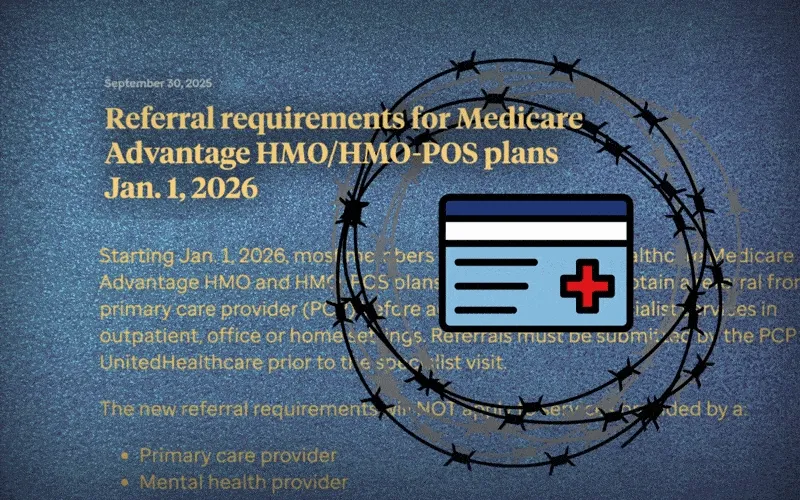
Schwartz’s discontent over the new UnitedHealthcare policy — which launched at the beginning of the year, with reimbursements for visits without referrals to certain types of specialists set to stop after April 30 — is hardly unique. Health care advocates say the policy change affects a large pool of senior citizens in the insurer’s HMO and HMO-Point of Service (POS) Medicare Advantage plans. This is a healthy chunk of the estimated 8.5 million seniors who get their Medicare Advantage coverage through UnitedHealthcare — one of every four MA enrollees.
“I have patients in their 90s who are now facing this, if you can imagine,” said Nilsa Cruz, the tireless patient advocate for Milwaukee Rheumatology Center who frequently speaks out at the Wisconsin state capitol and elsewhere about health care issues. “And they don’t understand their insurance cards, anyway.”
Cruz predicted “a total disaster” when the UnitedHealthcare policy, which is currently in a sort of soft-launch mode, takes full effect in May, as both patients — many who’ve been seeing a specialist for 15 or 20 years without ever needing a referral — and their doctors struggle to adapt to an onerous new system.
The change, which is likely to have the effect of reducing specialist visits and thus saving UnitedHealthcare millions if not billions of dollars, isn’t taking place in a vacuum. Rather, it’s one more assault on seamless and efficient health care coverage. Patient inconvenience seems to be a cornerstone of this icon of Big Insurance’s plan for dealing with what its executives claimed last year were $6.5 billion in annual higher costs.
In recent months, UnitedHealthcare has dropped as many as 180,000 enrollees from its Medicare Advantage plans in targeted geographic areas and plans to drop more than a million by the end of this year. It has also “narrowed” its provider networks, relegating certain clinical practices, such as rheumatology clinics, which provide costly infusion therapies, to out-of-network status.
Some analysts had predicted a kinder, gentler UnitedHealth after a tragedy that made national headlines — the murder in New York of UnitedHealthcare CEO Brian Thompson in December 2024 — focused new attention on the company’s aggressive use of prior authorization to deny coverage for medically necessary care. Instead, the giant insurer has doubled down on ways to drive the highest-cost patients and providers from its system, making it necessary for millions of seniors to scramble to find either new MA insurers or new doctors. Many undoubtedly will go untreated.
The unwelcome requirement for many of UnitedHealth’s Medicare Advantage patients to get primary-doctor referral for treatments they’ve often been getting for years from a specialist looks to be one more way the company is nickel-and-diming a path back to higher profits on the backs of patients with chronic health issues.
Needless to say, UnitedHealthcare, whose financial performance has disappointed investors for more than a year, doesn’t portray the change that way. In announcing the move late last year the company hailed it as a way to improve communication between its affiliated providers and prevent unnecessary tests or procedures, or visits to a specialist that aren’t really necessary.
“The goal of this referral process is to help increase primary care provider (PCP) engagement with patients and help foster collaborative partnerships between PCPs and specialists,” is the upbeat jargon UnitedHealthcare used to explain the change on its provider portal.
Since Jan. 1, the change has been in what UnitedHealthcare considers “a trial period,” which means that while it wants patients to begin getting primary-care referrals before seeing certain types of specialists, visits without a referral are still covered for now. That will no longer be the case after April 30.
The policy does exempt more than a dozen specialists or types of visits — most notably oncology, as well as mental health treatment, physical therapy, and some other common medical treatments. It also won’t affect MA enrollees in California, Texas, and Nevada where referrals were already required.
Madelaine Feldman, M.D., the New Orleans-based immediate past president of the Coalition of State Rheumatology Organizations, said she imagines dire scenarios in which a patient with a sudden flare-up cannot get speedy treatment because of the inability to get a speedy referral, or visits that aren’t covered because the referral is mishandled.
“So the fact that UnitedHealthcare has decided that rheumatologists are not capable of deciding when a patient needs to be seen is ludicrous, capricious, and most importantly, dangerous,” Feldman said. She added that situations that are harmful for patient care “will be seen more and more as a result of policies enacted to improve UnitedHealthcare’s bottom line.”
But for people enrolled in the company’s HMO and HMO-POS Medicare Advantage plans, the new policy seems less a way of improving communication than an additional and unwanted barrier to receiving care.
“Today I found out about it, and I don’t think it’s fair,” said Pamela Matias, a 63-year-old infusion-therapy patient at the Milwaukee Rheumatology Center who filmed a video after learning of the change. “I’ve been getting this medication for 20 years and never needed a referral.”
Unlike Schwartz, Matias does see a primary care doctor, but she still worries that the extra hassles of getting a referral — and making sure it goes through properly — have longtime rheumatoid arthritis patient alarmed. “Without my medication, I would not be able to walk,” she said. “I’ll be in 100% pain all day long.”
Cruz, the center’s patient advocate, said that during this trial period, it’s not just patients who are disoriented. An early problem she’s seen with the program is that doctors’ offices are often faxing or attempting to call in patient referrals when UnitedHealthcare is only recognizing those that are made electronically through its online portal. What’s more, she said doctors need to specify how many visits are covered during a six-month window.
Cruz said even one of the largest health care practices in Wisconsin was improperly faxing the referrals. “I think they were faxing up until the other day — you know, a month and a half, almost, into this thing,” she said. “So that tells you something. Andrimary care physicians were not all fully informed.” Even if they are trained, primary-care doctors don’t always know how many specialist visits a patient will need until they are reevaluated by the specialist and begin their treatments.
If doctors don’t understand the new UnitedHealthcare policy, she worries, then how will elderly Medicare patients — including some with major disabilities — be able to follow the rules? Furthermore, if a patient’s current primary-care doctor retires or relocates, it often takes months in today’s frenzied health care environment to get an appointment with a new one, which could delay critical care.
As a rabble-rousing patient advocate, Cruz seems somewhat ahead of the curve in anticipating a crisis. Many specialists are just beginning to absorb the changes and won’t feel a real impact until May, when UnitedHealthcare stops paying specialists for their patients who didn’t obtain referrals.
But Cruz said she is already lobbying the Coalition of State Rheumatology Organizations, where she is a highly active member, to take a stand against UnitedHealthcare’s new policy, noting that it targets only the lowest-cost Medicare Advantage HMO plans and not the higher-end PPO policies, let alone its commercial insurance customers. To her mind, that is discrimination. “They’re doing the HMO — the sickest patients,” she said. “The sickest.”
This and other moves from UnitedHealthcare and its competitors have the effect of pushing the sickest and most expensive patients off their rolls, either by dropping customers outright or making it harder for them to access the medical care they so desperately need. Forcing sick people to make extra doctor visits to get treatment undoubtedly will cause many to delay or even forgo care — which, sadly, seems to be what UnitedHealthcare is going for as it tries to get back into Wall Street’s good graces.
Sweeping changes to Medicaid and the Affordable Care Act are combining with rising health costs to make 2026 a high-stakes year for hospital operators.
Why it matters:
While major health systems like HCA are likely to weather the worst, some safety net providers and facilities on tight margins could close or scale back services as uncompensated care costs mount and uncertainty around future policies swirls.
“We took a big hit in 2025,” said Beth Feldpush, senior vice president of policy and advocacy at America’s Essential Hospitals.
“I don’t think that the field can absorb any further hits without us really seeing a crisis.”
State of play:
Last year’s GOP tax-and-spending law will decrease federal Medicaid funding by nearly $1 trillion over the next decade, translating into millions more uninsured, lower reimbursements and higher costs for hospitals.
The Trump administration is also considering big changes to the way Medicare pays for outpatient services that could reduce hospital spending by nearly $11 billion over the next decade, including paying less for chemotherapy.
Hospitals have the rest of this year to boost their balance sheets, invest in technology including AI, and even consider merger plans before the biggest changes take effect in 2027, Fitch Ratings wrote in its annual outlook for the nonprofit hospital sector. The financial outlook remains stable for the sector overall next year, the report predicts.
“People are already very proactively looking at those out years and saying, if that’s the worst-case scenario that I’ve got to deal with, what can I do today to make that impact less,” said Kevin Holloran, a senior director at Fitch.
Threat level:
Hospitals in some instances have started closing unprofitable services like maternity care and behavioral health care in the face of financial pressures.
More than 300 rural hospitals are at immediate risk of closing their operations entirely, according to a December report.
Safety net providers also are going to court to fight an administration effort to make them pay full price for medicines they currently get at a steep discount and reimburse them later if they’re found to qualify under the government’s 340B discount drug program.
“Those hospitals that have been underperforming … they are going to continue to struggle,” said Erik Swanson, managing director at consulting firm Kaufman Hall. “Those who are doing really, really well may continue to see growth in their performance.”
Private equity firms will likely continue buying up and building new businesses in outpatient service areas like ambulatory surgery, labs and imaging, he said.
“Hospitals and health systems should continue to expect quite a bit of challenge and disruption in those spaces.”
Congress still could extend the industry some lifelines, though any effort to delay or roll back some of the biggest Medicaid cuts face tough odds this year.
Sen. Josh Hawley (R-Mo.) introduced a bill to repeal parts of the GOP budget law that would slash hospitals’ Medicaid dollars.
Lawmakers are debating whether to renew enhanced ACA subsidies that expired at the end of 2025 and could result in millions more uninsured patients, but that effort would also have to overcome significant GOP opposition.
“Our job is to make sure that we create a predicate that, as these provisions come online, they may very well need to be revisited,” said Stacey Hughes, the American Hospital Association’s executive vice president for government relations and public policy.
What’s ahead:
Beyond policy changes, hospitals also are dealing with inflationary pressures, including rising medical supply costs, and administrative overhead from insurer pre-treatment reviews.
Those trying to pad their margins may ramp up their use of artificial intelligence to code patient visits in a way that increases reimbursements from public and private payers, Raymond James managing director Chris Meekins wrote in an analyst note.
While hospitals have historically been able to navigate big policy challenges, if things don’t go their way, it could turn into a “tornado of trouble,” Meekins wrote.
Over the last few years, I have written for the Rockefeller Institute about trends in healthcare. In 2023, I chose ten trends, including staffing challenges, the increasing role of non-traditional players in health, such as Walmart and CVS, as well as the increasing role of private equity in healthcare, the movement toward value-based care, and the growing use of digital health—all trends that I expect to continue. In 2024, I highlighted a mega trend specific to the provider community, in which a number of factors had combined to lead to the segmentation of the industry into three different categories of entities. Those included what I categorized broadly as “today” entities (i.e., those that we know as traditional providers, many of whom are fighting for their sustainability), “tomorrow” entities (i.e., non-traditional entities that are not necessarily healthcare entities but are in the healthcare space and are typically part of a larger conglomerate or backed with private equity), and “striving survivors” (i.e., today entities that are adapting radically or partnering with tomorrow entities to exist in the future).
The following January, I picked five issues to watch in healthcare in 2025. They were (1) the continued expansion of computational data technologies, especially artificial intelligence (AI); (2) insurance coverage shifts; (3) consolidation in the overall industry; (4) payment, costs, and coverage for pharmaceuticals; and (5) exponential advancements in life sciences.
This blog reviews the status of those 2025 trends and suggests one additional issue that may garner more attention in 2026: the overall cost, pricing, and affordability of healthcare. I discuss the factors pushing this issue into the spotlight and potential options for policymakers to counteract this trend.
A Status Review of the Five 2025 Trends
Before delving into the newly highlighted trend of the cost, price, and affordability of healthcare, it is worth briefly reviewing the status of the five trends that were identified in 2025, since all of them will continue to be important in 2026.
The continued expansion of computational data technologies, especially AIIssue Updates. There has been no slowdown in the use of computational data technologies and AI in healthcare since I wrote about it in 2023, and as part of the trends last year. In April 2025, the healthcare AI company Innovacer did a survey of AI use in the sector. The company’s report noted that adoption of AI is expected to continue its growth as more tools become available for a variety of purposes, including quicker and more effective disease diagnosis, administrative process improvement, and electronic health record management. JP Morgan likewise reported in December 2025 that AI-focused deals now make up 75% of health tech funding. Some of the more interesting areas of advancement are in genomics, remote patient monitoring, medical imaging, and improved documentation. And the use of ambient products that help capture health data from conversation saw some of the biggest growth yet in 2025. On the consumer side, more and more patients (an estimated 40 million people) are using chatbots to help them with making decisions about their own care, while the integration of AI with robotics is increasingly being used to assist physicians with surgery. And very recently, in January 2026, OpenAI released a chatbot specifically for health care.Policy Responses and Options. In terms of policy, there have been different federal actions designed to accelerate AI adoption and use, including a handful of executive orders in 2025. In healthcare specifically, the Department of Health and Human Services issued its AI strategy on December 5, 2025. And there have been federal investments announced that support the use of AI to advance research and cancer treatment. In addition, on December 19, 2025, the Trump administration asked for public input on how technology adoption in healthcare—especially AI—could be accelerated. At the state level over the last year, 47 states issued more than 250 bills to regulate AI in healthcare (with at least 30 bills signed into law). The bills ranged from ones protecting minors from mental health AI-enabled chatbots to bills barring AI from making therapeutic decisions or interacting with patients without licensed oversight. And states like New York are incentivizing more use of AI in healthcare through the use of partners that improve care and strengthen operations, as well as evaluating best-in-class AI tools.
Insurance coverage shifts Issue Updates. In January 2025, I noted the possibility that insurance coverage was likely to shift, in part, because of the possible expiration of the Enhanced Premium Tax Credits (EPTCs) at the end of 2025. The EPTCs were enhanced in 2021 under the American Rescue Plan Act and are sometimes referred to as the “Obamacare subsidies.” They were intended to reduce the cost that people pay when they obtain coverage from qualified health plans on the health exchanges. Although some proposals were made by both Democrats and Republicans at the end of 2025 to help mitigate the impact of the loss of the EPTCs, none of the proposals were able to gain enough bipartisan support to be signed into legislation in 2025, resulting in a spike in costs for premiums starting January 1, 2026. As this blog was being written, Congress was debating the possible partial extension of these credits in some form, although passage was not certain. Either way, it is likely that healthcare coverage will continue to be a topic of much debate in Congress in 2026.In addition, in 2025, changes made to Medicaid coverage in the One Big Beautiful Bill Act (otherwise known as HR1) are also likely to impact insurance costs and coverage in 2026. The changes to health insurance coverage in HR1 were outlined in a paper by the Institute in mid-2025 and will have varying impacts on both funding and coverage over the coming months and years. As I later wrote about with colleagues, additional federal rule changes in 2025 will also impact public insurance coverage in the future. The Urban Institute estimates that close to five million people may lose coverage in 2026, although the exact number who lose coverage versus those who choose cheaper and less expansive coverage options with fewer benefits has yet to be fully analyzed.Policy Responses and Options. With the expiration of the EPTCs and changes in federal reimbursement for coverage of immigrant populations, state policymakers will need to make decisions in 2026 about who and what may be covered with state-only dollars. States appear to be taking different approaches. By mid-2025, the Kaiser Family Foundation reported that of the 14 states that offer health coverage to at least some immigrants, at least three had proposed limits on coverage (some ending it altogether and others restricting it). For example, on January 1, 2026, Medi-Cal, which is California’s Medicaid program, will freeze any new enrollments for certain undocumented adults who receive state-funded full-scope services. In June 2025, the Minnesota legislature voted to limit eligibility for persons over age 18 who are undocumented. New York has applied to federal regulators seeking to change the authorization for its successful Essential Plan—that provides coverage to some 1.7 million New Yorkers, including certain legally present immigrants—from a revocable federal waiver to the Affordable Care Act (ACA) specified Basic Health Program. Expect to see many other states taking actions to either drop or preserve health insurance coverage in 2026. What impact these changes have on the extent of coverage and the number of newly uninsured people this year remains to be seen.
Consolidation in the overall industry Issue Updates. Consolidations in healthcare, both vertical and horizontal, continue. In January 2025, we highlighted mergers, such as the one that created Risant Health. We also examined the continued integration of various companies with United Health Group under Optum Rx (a pharmacy business), Optum Insight (a health analytics company), and Optum Health (care management), as well as the integration of United Health Group and Change Healthcare in early 2024. The consolidation of the insurance industry continued in 2025, with the top 7 companies garnering 75% of the market. The Government Accountability Office also reported on the continued acquisition of physician groups by insurers, hospitals, and private equity firms. Overall, mergers and acquisitions (M&A) transactions among healthcare entities increased steadily from 2021-2024, and, in 2025, healthcare M&A was experiencing its most active M&A cycle in over a decade. Full-year trends were not yet fully assessed by the time of printing this blog, but Pitchbook, which tracks M&A deals across industries, expected that healthcare services M&A levels in 2025 would slightly exceed 2024 levels. This also includes the divestiture of assets from national chains like Ascension and CommonSpirit Health.Policy Responses and Options. At the federal level, shortly after last year’s blog on this trend was published, the federal HHS released a report on how consolidation in the industry continues. For the most part, the Trump administration has kept in place stricter guidelines for reviewing corporate mergers in healthcare, but that hasn’t stopped consolidation from happening. At the state level, we previously highlighted that state policymakers had proposed over 34 bills in 22 states designed to address such consolidations. As this blog was being written, the governor of New York indicated in her State of the State speech that the state planned to expand its monitoring of transactions by healthcare entities that increase revenues by over $25 million. Yet, market forces seem to be allowing such consolidations to continue, and financial and operational strains allow the continuation of mergers and acquisitions that are forcing some systems to divest in hospitals, while regional systems acquire those smaller assets that enable them to expand. Unless states can play a role in propping up financially challenged providers, prevent large insurers from becoming larger, or better regulate nontraditional actors in healthcare, consolidation appears likely to continue in the coming year.
Payment, costs, and coverage for pharmaceuticals Issue Updates. By late 2025, it was reported that pharmaceutical companies were expected to raise prices on at least 350 drugs in 2026. That is higher than at the same time last year. Generally, many of the regulatory actions to control prices come from the federal level. Although states may feel somewhat constrained by the Commerce Clause on their ability to regulate pharmaceuticals across state lines, there are still ways for them to address cost issues, such as through rebate programs, limits on Pharmacy Benefit Managers (PBMs), or price negotiations for drugs purchased under the Medicaid program or for state employee benefit programs.Policy Responses and Options. At the federal level, the Trump administration issued an executive order in the spring of 2025 with suggested actions to lower drug prices. The administration also announced agreements to lower the cost of two of the most used drugs in the country, Ozempic and Wegovy. Then, at the end of 2025, the Centers for Medicare and Medicaid Innovation (CMMI) released a proposed model for controlling prescription costs called the Global Benchmark for Efficient Drug Pricing (GLOBE) Model, which is a mandatory model that would assess a rebate for certain drugs under Medicare Part B if the prices exceed those paid in economically comparable countries. It also released the Guarding US Medicare Against Drug Costs (GUARD) Model, which calculates international reference pricing benchmarks and requires manufacturers to pay a rebate if the Medicare net price is greater than the Model benchmark. Congress introduced bipartisan legislation in mid-2025 to lower drug prices by barring drug companies in the US from charging higher prices. State governments were also very active in 2025, passing legislation to lower drug prices, with 31 states passing nearly 70 bills by the end of the third quarter with the goal of lowering prices. I expect to see additional legislation in more states in 2026, including state efforts that mirror some of the federal actions that took place in 2025. As mentioned, such efforts might include building on existing state efforts, such as drug review boards, expanded rebates under Medicaid, and/or reducing administrative costs through third parties, like PBMs.
Exponential advancements in life sciences Issue Updates. Although AI has transformed medicine in different ways, in the case of life sciences, AI accelerated advancements especially for genomics, precision medicine, and medical imaging. In particular, as noted by MedEdge, life science based medicine like gene editing and CRISPR were better able to move out of the trial phase and into the treatment phase. AI is also augmenting drug discovery by making it easier to observe the interaction of drugs and understand how they fight disease. Molecular editing, lab-grown 3D bioprinting, mRNA vaccine use for cancer, and robotic surgery are all areas that MedEdge saw continued expansion in 2025. Private funding continued to pour into biotechnology in 2025, as tracked by Fierce Healthcare. The Fierce Healthcare tracker shows that many companies, such as Hemab Therapeutics, Electra Therapeutics, or Tubulis (an antibody drug conjugate), raised well over $100 million in venture capital and related funding in 2025.Policy Responses and Options. In contrast to the growing investments of private funding in life sciences, funding from the federal government specifically for life science research—especially from the NIH—was targeted for cuts in 2025 with disproportionate impacts across states depending on where that research was occurring. According to tracking done by The Sciences & Community Impacts Mapping Project, proposed federal funding cuts showed a potential economic loss of an estimated $16 billion. At the state level, policymakers in the Midwest, California, North Carolina, and a few other states are competing to advance major life sciences projects. The investments include supporting the workforce, developing shovel-ready sites or ones adjacent to major universities, and/or providing expedited permitting. Given the growing advancements and potential of life sciences, in the coming year, I expect to see state policymakers implementing more policy strategies that help grow the life sciences sector in their respective states under both the auspices of life sciences and economic development.
An additional trend to watch in 2026Issue Background. Of the trends I noted in 2025, only one (efforts to control the costs of pharmaceuticals) is specifically targeted at addressing the cost and affordability of healthcare. The impact of the actions of state and federal policymakers to improve the affordability of drugs, however, does not seem to be enough yet to curb the overall cost growth in the industry. In fact, of the other trends noted in 2025, some might even be considered cost drivers. For example, mergers and acquisitions and overall consolidation can at times increase costs in some markets, depending on what those mergers include, and for some healthcare consumers who rely on insurance coverage, the loss of the subsidies to pay for healthcare makes that cost increase much more apparent. Although there is some optimism that AI, through process improvement, quicker diagnostics, and disease prevention, could make certain things more efficient, so far, there are mixed results as to whether AI is making healthcare more affordable. With costs for other basic necessities like housing being less affordable, the focus on healthcare affordability is likely to continue in 2026. This is because some consumers will more directly feel the cost of healthcare in 2026, but also because providers have experienced increasing challenges with expenses that contribute to affordability. Examples of areas of expense growth cited by providers include staffing and benefits, supplies, pharmacy, and technology.Industry Responses and Options. Although I previously noted the policy responses of federal and state governments as they relate to these trends, in the case of lowering costs, industry is also responding in new and creative ways. One of the new ways that health systems and providers are attempting to tackle rising prices and costs is through non-traditional partnerships that deliver care, treatments, and services more directly to patients. An example of this is a potential partnership between Humana, an insurance company, and Mark Cuban, co-founder of Cost Plus Drugs. The potential partnership would focus on direct-to-employer programs that cut out companies in the middle, such as PBMs. Another example was the launch of Northwell Direct, a provider system offering direct care to employers without an insurance company. This arrangement is the largest of its kind and recently added a partnership with the influential 32BJ Health Fund, which allows 170,000 participants in the 32BJ Health Fund in the general Northwell service area to have access to the full spectrum of health care services available through Northwell Direct, which is expected to produce significant administrative savings.Policy Responses and Options. One way government policy makers at both the federal and state levels can respond to the affordability crisis is to allow the industry itself to find creative solutions, such as those outlined above. A second way policymakers can respond is by using the authority granted under the ACA for the CMMI to create and experiment with new models of care delivery that could improve care and lower costs. In 2025, CMMI issued at least 6 new payment models, all designed to lower the costs of healthcare. They include some of the ones mentioned above on pharmaceutical cost control, like the GUARD and GLOBE models, but also ones specifically targeting chronic disease, such as the Advancing Chronic Care with Effective Scalable Solutions (ACCESS model), and healthier lifestyles, for example, the Better Approaches to Lifestyle and Nutrition for Comprehensive Health (BALANCE model).
Meanwhile, state governments and officials are proposing various ways to control costs, with over 750 related bills introduced in 2024 alone. Some states are more focused on particular strategies, such as pricing—including hospitals with reference-based pricing. In Indiana, the legislature passed a bill that does not allow hospital systems to exceed prices set before January 1, 2025, for two years. The hospitals would then have to lower prices by a certain percentage each year to reach a goal set by the state’s Office of Management and Budget. For several years now, states have been implementing price transparency policies with the aim of reducing costs. It is, of course, possible that some states will use a combination of these efforts (e.g., promoting industry-initiated efforts through incentives or less regulation to lower costs while also more closely monitoring prices).
Conclusion
The six trends to watch in 2026 noted in this blog are by no means all-encompassing, but they do highlight areas that are likely to garner a lot of attention from policymakers in the near term. As has been true throughout the country’s history, the Federalist system of government allows state and federal governments to develop varied policy approaches to improve how healthcare is funded and delivered. The Rockefeller Institute will be tracking these six trends and will report on any interesting findings, particularly as they relate to the additional trend of the cost and affordability of care in the coming year.










 HENRY KOTULA