Trump’s executive order would mean cheaper insurance premiums for healthy Obamacare customers

http://www.washingtonexaminer.com/trumps-executive-order-would-mean-cheaper-insurance-premiums-for-healthy-obamacare-customers/article/2637105

Image result for underinsured


President Trump is expected to sign an executive order on Obamacare this week that would allow people to buy cheaper health insurance with fewer regulations, targeting healthcare goals that eluded congressional Republicans all year.

The full details of the executive order have not been released, but enough information has been reported to reveal its overall framework. Trump would direct the Departments of Labor, Treasury and Health and Human Services to make changes to regulations so more people could band together to buy “association health plans” which would allow individuals or small businesses to band together, such as members of a Chamber of Commerce, to buy plans sold across state lines. The order also would allow people to buy short-term health insurance plans for longer than the Obama administration allowed and would encourage the use of health savings accounts.

Both association health plans and short-term plans are less expensive than Obamacare plans because they offer limited coverage. They don’t guarantee same-cost coverage, or any coverage, for people with pre-existing illnesses and they do not cover a broad range of medical care, from addiction treatment to maternity care.

Critics have referred to the plans as “junk insurance,” warning that expanding access to them would take customers back to the days before the passage of Obamacare, formally known as the Affordable Care Act. They also warn that providing such options would peel more people from Obamacare’s exchanges, leaving an even sicker — and costly — population with Obamacare plans.

But people who don’t receive federal help paying for their premiums, meaning people who make more than $48,240 for an individual or $98,400 for a family of four, and who do not have a pre-existing illness, may look to use one of the options. Many of those customers are facing double-digit premium increases in 2018. The number of people who have unsubsidized health insurance is pegged at anywhere from 6 to 9 million people. Some will face insurance that is so expensive that under Obamacare they will not be required to pay the law’s penalty if they decide not to get coverage.

The executive order could offer an alternative, but it’s not clear how quickly the plans will become available to customers. Open enrollment for Obamacare begins Nov. 1 and runs through Dec. 15, and officials at the different agencies may not be able to change regulations in time for the start of 2018. The White House declined to provide details about the timeline for implementing the executive order.

Kathy Bakich, national health compliance practice leader at Segal Consulting, said the association health plan regulations may take longer than the short-term plans because the administration may have to propose new rules and take public comments, which could take months. The original rules took more than a decade to create, she said.

“There is a legitimate need in the marketplace for new types of systems to allow small employers to band together,” she said. “Whether this is the right way to do it is a tough question.”

It’s not clear how far the changes to the regulations can go. Depending on how they are written, they raise potential openings for fraud or for insolvency if claims exceed an association’s ability to pay them out, because states won’t be able to regulate plans that are sold elsewhere to crack down on problems or revoke licensing. Bakich raised the possibility of another option, known as reinsurance, that would inject federal funding into the exchanges so that higher-cost claims were paid for while others who have coverage would not see premium increases, but there is little appetite among most Republicans for such a proposal.

Instead, association health plans have been pushed even among House members, who passed a bill to allow more of them earlier this year.

“Unlike larger organizations, America’s small businesses are limited in their ability to negotiate for lower healthcare costs for their millions of employees,” said Rep. Virginia Foxx, R-N.C., chairwoman of the House Education and the Workforce Committee. “It’s time to level the playing field. That’s why the committee advanced and the House passed common-sense legislation to allow small businesses to band together through association health plans.”

Trump had been discussing the idea of association health plans with Sen. Rand Paul, R-Ky., for months. On Tuesday he said on Twitter that he was moving to act because Congress “can’t get its act together on healthcare.” Paul chimed in as well, sharing Trump’s tweet and calling it a “great plan” and a “big deal for millions of Americans.”

“Sen. Paul brought this idea to President Trump as a way to fix many problems in the individual market without more regulations and spending,” Doug Stafford, chief strategist for Paul’s political action committee, said in an email. “They have worked on this for quite some time now and are pleased it will be enacted soon.”

The association health plans could allow members of different industries to band together or allow individuals to join in. The proposal has been billed as one that would allow people to buy insurance across state lines because health plans could be located in states with fewer regulations, which would make them less expensive.

The proposal on short-term plans may be easier to tackle. The Obama administration changed the rules for short-term plans in fall 2016, saying they could be offered for only 90 days at a time, meaning that a customer’s deductible would renew if he were to purchase a plan again at a later date. Prior to that, insurers stretched the definition of “short-term,” with some providing coverage for as long as 364 days. It’s not clear what the difference in pricing will be, but in 2016 the average price for an Obamacare premium was $393 a month and short-term plans averaged about $124 a month. By 2017 unsubsidized premiums for mid-level Obamacare plans had risen across the country by an average of 22 percent and are expected to rise in the double-digits again next year.

Insurers have said that the increases are a result of uncertainty over how the Trump administration or Congress would change Obamacare, but also from incurring losses from selling the plans, which younger, healthier and cheaper enrollees haven’t flocked to.

Obamacare, Bakich said, left a gap in terms of dealing with people who don’t think they can afford the robust coverage and also say they don’t want a wide range of services.

“They just want to be protected from bankruptcy and buy the catastrophic plan and be protected from losing everything in a medical crisis,” she said.

Kev Coleman, head of research and data for HealthPocket, a website that helps consumers compare and buy health plans, said he is a proponent of allowing short-term plans to be used for a longer period, saying that industry data show people use them for about six months and that they are meant to be transitional.

Short-term plans and Obamacare plans have locked in rates with states for 2018 and that will not change the individual market, he said.

He also disputed that the short-term plans would be destabilizing to the Obamacare exchange, noting that the Obama-era regulations went into effect in April and that the number of people who used them previously were small. Data from 2015 peg customers at 148,100.

“This market has been around for decades and it hasn’t been a destabilizing force,” Coleman said.

Larry Levitt, senior vice president for special initiatives at the Kaiser Family Foundation, said on Twitter that people who don’t receive subsidies but who have pre-existing illnesses such as cancer or diabetes would be particularly vulnerable because the short-term and association plans wouldn’t cover their medical needs.

“Short-term insurance plans can offer inexpensive coverage to currently healthy people, but they would exclude people with pre-existing conditions,” he wrote. “If healthy people can enroll in short-term plans and avoid the individual mandate penalty, the ACA marketplaces could collapse. Anything that creates a parallel insurance market for healthy people will lead to unaffordable coverage for sick people.”

But Coleman said working within the existing Obamacare system hasn’t worked.

“Politicians interested in optimizing the health of ACA risk pools would be well-advised to work backwards from consumers’ insurance priorities in order to arrive at a compelling market solution,” Coleman said. “You can’t achieve healthy risk pools without a product that has broad appeal.”
Trump could make waves with health-care order

Trump could make waves with health-care order

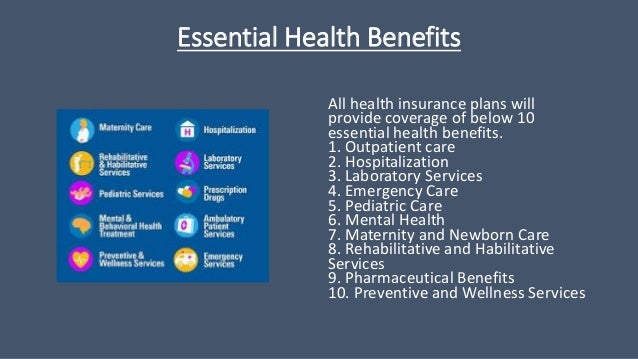
Image result for essential health benefits

President Trump’s planned executive order on ObamaCare is worrying supporters of the law and insurers, who fear it could undermine the stability of ObamaCare.

Trump’s order, expected as soon as this week, would allow small businesses or other groups of people to band together to buy health insurance. Some fear that these association health plans would not be subject to the same rules as ObamaCare plans, including those that protect people with pre-existing conditions.

That would make these plans cheaper for healthy people, potentially luring them away from the ObamaCare market. The result could be that only sicker, costlier people remain in ObamaCare plans, leading to a spike in premiums.

“If this executive order is anything like the rumors then it could have a huge impact on stability of the individual insurance market,” said Larry Levitt, a health policy expert at the Kaiser Family Foundation.

Andy Slavitt, a former top health-care official in the Obama administration, warned that insurers could drop out of the Affordable Care Act markets because of the order.

“I am now hearing that the Executive Order may cause insurers to leave ACA markets right away,” Slavitt tweeted on Sunday.

Slavitt argues the order is part of Trump’s broader effort to undermine ObamaCare. He said the order could accomplish through executive action what Congress failed to do through legislation.

But supporters say Trump’s move could unleash the free market and lower prices for consumers.

Sen. Rand Paul (R-Ky.) has been pushing for the order, arguing it is something Trump can do without Congress to give people an alternative to ObamaCare.

“This is something I’ve been advocating for six months,” Paul said on MSNBC in late September.

“I think it’s bigger than Graham-Cassidy, it’s bigger than any reform we’ve even talked about to date, but hasn’t gotten enough attention,” Paul added, referring to the failed Republican repeal-and-replace bill co-sponsored by Sens. Lindsey Graham (R-S.C.) and Bill Cassidy (R-La.).

Paul said allowing more people to band together to purchase health insurance gives them more leverage to lower premiums than when people are buying coverage on their own.

The National Federation of Independent Businesses (NFIB), which has long opposed ObamaCare, supports expanding association health plans and has been advocating for action.

“Allowing people more affordable arrangements is not a bad thing,” said Kevin Kuhlman, director of government relations at the NFIB. He said fears about undermining ObamaCare markets are “overblown.” His group is waiting to review the details of the order, which he said he expects to be issued on Thursday.

Association health plans already exist, but Trump’s order could allow them to expand and get around ObamaCare rules, creating plans that are only for healthy people.

Experts pointed to the Tennessee Farm Bureau, which currently offers an association health plan in the state that, through a loophole, does not have to follow ObamaCare rules.

The plan has about 73,000 enrollees and may be one of the reasons that Tennessee’s ObamaCare market has struggled, according to researchers at Georgetown University.

There is still much uncertainty about the order. Many observers doubt that Trump has the power to change much on his own.

Tim Jost, a health law expert at Washington and Lee University, said it is hard to imagine how the White House could find the legal authority to expand association health plans to individuals. The move would likely draw legal challenges.

A more likely action, Jost said, would be to expand association health plans so that it is easier for small groups to form them. That could destabilize the small group insurance market but would be a less sweeping step than expanding association health plans to individuals.

Given the limits on his authority, Trump is likely to direct agencies, including the Department of Health and Human Services and the Department of Labor, to issue guidance or regulations. Those additional steps will prolong the process.

Insurers are worried about the potentially destabilizing effects of the order. Lobbyists said insurers had begun quietly working on the issue and talking to the administration but do not yet know how far-reaching the effects would be.

It is possible there could be legal challenges to the regulations. The order would change the interpretation of a 1974 law called the Employee Retirement Income Security Act. That interpretation could be challenged in court, for example if the order sought to allow individuals, not just small groups, to join association health plans.

“There will likely be challenges,” said Kevin Lucia, a professor at Georgetown University’s Center for Health Insurance Reforms.

Lucia said the planned order, in combination with other steps the Trump administration is taking, like cutting back on outreach efforts, “really undermines the future of the individual market.”

A sicker group of enrollees remaining in the ObamaCare plans poses problems.

The changes “will lead to less [insurers] playing in this market and potentially a sicker risk pool which translates to higher premiums,” Lucia said.

Cori Uccello, senior health fellow at the American Academy of Actuaries, said that one aspect to watch in the order is when the changes will take effect. Insurers have already set their prices and made plans for 2018.

“Anything that applied to 2018 would be incredibly destabilizing,” she said. “It would still be destabilizing in 2019 but people would know ahead of time.”

Steep Premiums Challenge People Who Buy Health Insurance Without Subsidies

http://www.npr.org/sections/health-shots/2017/10/07/555957419/steep-premiums-challenge-people-who-buy-health-insurance-without-subsidies

Image result for Uninsured

Paul Melquist of St. Paul, Minn., has a message for the people who wrote the Affordable Care Act: “Quit wrecking my health care.”

Teri Goodrich of Raleigh, N.C., agrees. “We’re getting slammed. We didn’t budget for this,” she says.

Millions of people have gained health insurance because of the federal health law. Millions more have seen their existing coverage improved.

But one slice of the population, which includes Melquist and Goodrich, is unquestionably worse off. They are healthy people who buy their own coverage but earn too much to qualify for help paying their premiums. And the premium hikes that are being announced as enrollment looms for next year — in some states, increases topping 50 percent — will make their situations more miserable.

Exactly how big is this group? According to Mark Farrah Associates, a health care analysis firm, as of 2017, there were 17.6 million people in the individual market, 5.4 million of whom bought policies outside the health exchanges, where premium help is not available. Combine that with the percentage of people who bought insurance on the exchanges but earned too much (more than four times the federal poverty level, or about $48,000 for an individual) to get premium subsidies, and the estimate is 7.5 million, or 43 percent of the total individual market purchasers, according to insurance industry consultant Robert Laszewski.

Who are these people?

“They’re early retirees,” says Laszewski. “They’re people working part time who have substantial outside income. They’re people who are self-employed of any age, people who are small employers.”

Melquist is one of those early retirees. He and his wife are both 59. He worked in the defense industry and retired at the end of 2016.

He always planned to retire at age 55 but ended up working longer, in part because he knew health insurance costs were rising. When he did retire and sought to purchase coverage for himself and his wife, he says, “I was shocked to find out how bad it actually was.”

For a bronze-level plan with a health savings account, Melquist says, “we pay $15,000 a year [in premiums] and the first $6,550 [for health care expenses] for each of us comes out of our pocket. So basically you could be looking at $30,000 out of pocket before anything gets covered.”

Insurance is important, Melquist says, particularly if a catastrophic health issue were to hit either of him or his wife. In the meantime, he can still pay the bills. But he’s frustrated. “I’m not eating dog food, but I’m also not able to do stuff for my grandchildren,” he says, like help with college costs. “It’s not that my life is falling apart, but the [Affordable Care Act] has ruined a lot of things I’d like to have done.”

The good news, if there is any, for Melquist is that premiums in Minnesota are going up by only small amounts for 2018, and in some cases going down, because of a reinsurance program passed by the state legislature that will help cover the costs for some of the state’s sickest patients in the individual market. That move will help keep premiums from spiking even more.

But that won’t be the case in Raleigh, where Goodrich and her husband, John Kistle, work as private consultants in the energy industry.

Goodrich, 59, and Kistle, 57, bought insurance through the ACA exchange in their state for three years. When premiums reached $1,600 per month with deductibles of $7,500 each, however, “it was just unbelievable. We decided just not to get insurance,” Goodrich says.

Eventually, they bought short-term plans that cover only catastrophic illness or injury. That insurance is not considered adequate under the ACA, so the couple could be liable for a tax penalty as well.

Goodrich, who volunteers to help people with their taxes in her spare time, says she has run the numbers and thinks that insurance is so expensive where she lives that the couple will be exempt from the penalty. That is because the cheapest insurance would cost the couple more than 8.16 percent of their income. Under the health law’s provisions, the penalty doesn’t apply above that level because insurance is considered unaffordable.

“We try to be good citizens and do the right thing,” she says. “Next year, we’re trying to figure out how to make less than $64,000 so we can get subsidies.” That amount is equal to 400 percent of the federal poverty line for two people, the cutoff for premium assistance because Congress assumed those who earned more could afford to buy affordable coverage.

Sabrina Corlette, a research professor at Georgetown University who specializes in health insurance, agreed that this is a population “that faced big hikes” in premiums when the health law took effect.

But, she says, in many cases, people in the individual market were previously paying artificially low premiums. Some of those old policies had substandard coverage. For others, however, the higher prices are the result of one of the fundamental changes enacted by the health law. “These are folks who were benefiting from a system that was affordable solely because insurers were able to keep sick people out,” Corlette says, adding that they are now being asked “to pay more of the true cost of health care.”

This is a population that is also more likely to vote Republican, says Laszewski, “which is one of the grand ironies now.”

Republicans in Congress and President Trump haven’t been able to “repeal and replace” the health law. But some of their efforts are undermining it — primarily the administration’s threat to stop paying billions of dollars to insurers in subsidies to help some lower-income people pay their out-of-pocket costs. The uncertainty surrounding those subsidies has led insurers to boost premiums next year by an estimated 20 percent. Those who get premium help from the government won’t have to pay more. But those who are paying the full freight will.

Also driving up premiums for next year, says Corlette, are the administration’s threats not to enforce the individual requirement for insurance and its decision to cancel most advertising and outreach for the year’s open-enrollment period that begins Nov. 1. Both of those provisions bring more healthy people into the insurance pool to help spread costs.

“One could argue that the 2014 premium increases were painful, but it was about getting us to a system that was more fundamentally fair and just,” Corlette says. “Now, it’s completely unnecessary price increases for unsubsidized folks that could so easily be avoided by a rational political system.”

Senate leaves town with no Obamacare fix

State Department: China, Russia want to ‘break the West’

Image result for leaving on a jet plane

The Senate left town on Thursday for more than a week without reaching a deal to stabilize Obamacare’s marketplaces.

Talks between Democrats and Republicans started up again in earnest late last month after the GOP’s latest attempt at Obamacare repeal collapsed. However, the Senate left town Thursday without finalizing any deal, although negotiators pledged to continue talks.

Meanwhile, the Senate is in recess all of next week and won’t return until Oct. 16, just a few weeks before 2018 open enrollment starts on Nov. 1. A Senate aide said there is “no question a sense of urgency if you want to have impact on 2018.”

Sen. Lamar Alexander, R-Tenn., leading the Republican side of the talks, said Thursday that Democrats and Republicans remain in good faith negotiations.

When asked if it was too late to reach an agreement to affect the 2018 coverage year, Alexander quickly responded “no.”

Sen. Patty Murray, D-Wash., did not give a timeline for when to finish a deal.

“We are absolutely working on this. No one should think this is easy,” she said.

Some senators were perturbed they are leaving for a week without any bipartisan plan.

“I had hoped that we would pass before leaving town a bill that would help stabilize the insurance markets and lower premiums,” said Sen. Susan Collins, R-Maine, a major proponent of an agreement.

The basic framework of the agreement is funding insurer subsidies in exchange for giving more flexibility to states for waivers.

The subsidies reimburse insurers for lowering copays and deductibles for low-income Obamacare customers. The Trump administration has been making the payments month to month but has not made a commitment to the payments for 2018, which insurers have been pleading with them to do.

Republicans want in exchange for the subsidies greater flexibility and a quicker approval process for states to waive Obamacare regulations for insurers. States have complained the current process for approving waivers by the federal government is slow and burdensome and they want fewer constraints on what regulations they can waive.

Alexander said earlier this week the two sides have “differences in opinion on what amounts to giving states meaningful flexibility in exchange for two years of cost-reduction payments.”

Insurers are already finalizing rates for next year and some could charge higher rates without the subsidies.

For instance, Highmark Blue Cross Blue Shield in Delaware announced Thursday it will raise Obamacare rates by 25 percent next year, according to Delaware Online. The insurer said the rate request was based on the uncertainty surrounding the payments and questions around whether the federal government will enforce the individual mandate that forces people to have insurance.

The nonpartisan Kaiser Family Foundation has estimated that rates for silver plans, the most popular of Obamacare’s three metal tier plans, will go up 19 percent without the payments.

Critics see Trump sabotage on ObamaCare

http://thehill.com/policy/healthcare/354308-trump-sabotage-seen-on-obamacare

Image result for aca sabotage

The Trump administration is taking a hatchet to ObamaCare after failing to pass legislation through Congress repealing President Obama’s signature law.

The administration has cut funding for advertising and outreach by 90 percent, raising the odds that fewer people will join the health-care exchanges during the fall enrollment period.

It has slashed funds by 41 percent for outside groups that help reach and enroll likely ObamaCare consumers.

The enrollment period has also been chopped in half, and the administration announced plans to take down the Healthcare.gov website for maintenance for hours at a time on several days during the sign-up period, two other steps likely to cut into enrollment.

All of these steps could lead fewer people to sign up for the law, which in turn might lead to higher premiums that could force others off the exchanges.

Healthy people are the most likely to drop coverage because of a lack of outreach, leaving a sicker group of enrollees that drives up costs for everyone else.

“One has to assume at this point that enrollment will be lower as a result of the administration’s actions and that will lead to fewer healthier people signing up,” said Larry Levitt, a health policy expert at the Kaiser Family Foundation.

The Trump attacks go beyond enrollment, too.

President Trump has threatened to cut off key ObamaCare payments to insurers in a bid to make the law “implode.”

And on Friday, his administration took a new step to roll back the law, limiting the requirement for employers and insurance plans to cover birth control.

Andy Slavitt, a former top health-care official in the Obama administration, warned on Twitter Thursday that the administration’s “sabotage” of the law added up to what he called “synthetic repeal,” meaning a range of small steps that add up to repealing ObamaCare even if Congress doesn’t act.

The administration counters that ObamaCare is a failing law that should not be propped up.

“Obamacare has never lived up to enrollment expectations despite the previous administration’s best efforts,” a Department of Health and Human Services spokesperson wrote in an emailed statement. “The American people know a bad deal when they see one and many won’t be convinced to sign up for ‘Washington-knows-best’ health coverage that they can’t afford.”

The cuts are having real world consequences already.

Reducing the outreach budget has forced local organizations known as navigators to dramatically scale back their operations.

Shelli Quenga, director of programs at the Palmetto Project, a navigator group in South Carolina, said her organization has had to cut staff from 62 people to 30 after its funding was reduced by around 50 percent.

“You want to talk about designed to fail?” she said. “This is the playbook for how to build something to make sure it fails.”

Quenga said that she only found out about the cut to her organization’s funding after the administration publicly made an announcement about the navigator cuts and she was called by a reporter for reaction.

She said the career officials she works with at the Centers for Medicare and Medicaid Services (CMS) were not aware of or involved in the decision to cut the funding, saying the decision was made at higher levels of the administration.

Navigators across the country had to scramble to craft new plans ahead of the open enrollment period beginning on Nov. 1.

“I’m just feeling very anxious about the fact that we have a whole lot less time to gear up then we should have had,” said Jodi Ray, director of Florida Covering Kids and Families, which is affiliated with the University of South Florida.

“We had a very well thought out plan, and we definitely had to go back and revise that plan, except we didn’t plan on having 3.5 weeks to put it together,” said Ray, whose group will receive $900,000 less, a 15 percent reduction.

A group of former Obama administration officials this week announced plans to launch their own enrollment effort, called Get America Covered, to try to fill the gap left by the cuts.

Insurers and ObamaCare supporters are also on edge about an executive order from Trump that could come as soon as next week loosening rules to allow businesses and other groups to band together to purchase health insurance. The problem is that these special insurance plans are not subject to the same ObamaCare rules and pre-existing condition protections, which could suck the healthy enrollees out of ObamaCare plans and damage the market.

The administration has also resisted efforts by some states, even conservative ones, to make changes aimed at stabilizing ObamaCare.

Iowa submitted an innovation waiver, which lets states alter ObamaCare as long as the law’s basic protections are retained. Part of the proposal included conservative reforms to the Affordable Care Act, yet President Trump reportedly wasn’t on board.

Trump saw a story about the waiver in The Wall Street Journal, and asked CMS to deny it, according to The Washington Post.

The application has not been formally rejected, at least not yet. It is in the midst of a 30-day public comment period, and is still pending, an Iowa Insurance Division spokesman confirmed to The Hill.

But without it, Iowa’s Insurance Commissioner Doug Ommen has warned the impact “on many Iowa families would be catastrophic.”

The deep-red state of Oklahoma had sought a waiver to help stabilize its markets, but withdrew it at the end of September because it hadn’t received approval from the administration in time.

The withdrawal came even after “months of development, negotiation and near daily communication over the past six weeks” between the state and the administration, Oklahoma wrote in a letter complaining to the administration about the lack of action.

“While we appreciate the work of your staff, the lack of timely waiver approval will prevent thousands of Oklahomans from realizing the benefits of significantly lower insurance premiums in 2018,” wrote Terry Cline, Oklahoma’s Commissioner of Health.


3 Ways the Senate Budget Reopens the Door for ACA Repeal

https://www.americanprogress.org/issues/economy/news/2017/09/29/440039/3-ways-senate-budget-reopens-door-aca-repeal/

After the latest failed attempt to repeal the Affordable Care Act (ACA) in the Senate, Sens. Lindsay Graham (R-SC) and Ron Johnson (R-WI) declared that they would only support a new budget resolution that enabled them to keep trying to force through their own health care bill. The Senate has not had to meet the 60-vote standard to pass ACA repeal because of the budget reconciliation process, which lets the Senate pass legislation with a simple majority vote. This process began with reconciliation instructions included in the fiscal year 2017 budget that Congress passed in January 2017, but those instructions expire on September 30.

While the new FY 2018 budget resolution from the Senate Budget Committee retreats from ACA repeal to some extent—after massive public opposition—it would still enable Congress to revive major elements of ACA repeal using reconciliation. Here are three ways the proposed Senate budget supports ACA repeal.

1. An overly broad reconciliation instruction to the Senate Finance Committee

The Senate Finance Committee has jurisdiction over both tax policy and several federal health care programs, including Medicare and Medicaid. If the Senate wanted to limit the scope of a reconciliation bill to tax policy, the budget resolution could give instructions to the Senate Finance Committee that only cover revenues. Instead, the budget instructs the Finance Committee to produce legislation that increases deficits by up to $1.5 trillion over 10 years.

Since deficit changes can be accomplished via changes to both spending and revenues, the Finance Committee could use this reconciliation instruction to repeal ACA-related taxes as well as much of the spending that helps people purchase health insurance under current law. Politico reports that “95 percent of health care policy” goes through the Senate Finance Committee, according to a Republican Congressional staffer discussing ACA repeal. As a result, the staffer said, “it’s not like we couldn’t slip it in anyway.”

Every dollar the Finance Committee cuts from health care could be used to pay for tax cuts for the rich that would be on top of the $1.5 trillion tax cut financed by deficits. This reconciliation instruction could let Congress pass a huge deficit-financed tax cut for the wealthy and corporations, combined with major elements of ACA repeal, in a single omnibus reconciliation bill. If the Finance Committee’s overall bill does not increase deficits by more than $1.5 trillion over 10 years, the Senate could pass it on a party-line vote under reconciliation.

Aside from the Finance Committee, the only other committee involved in ACA repeal in the Senate is the Health, Education, Labor, and Pensions (HELP) Committee. The Senate budget resolution does not give a reconciliation instruction to the HELP Committee, which signals a meaningful retreat from full ACA repeal. Nevertheless, the Finance Committee instruction would still enable the Senate to change major parts of the law, which could include nullifying the ACA mandate for individuals to purchase health insurance, repealing the ACA-related taxes that finance the coverage expansion, and making all of the Medicaid cuts in earlier ACA repeal legislation, such as repealing the Medicaid expansion and making further cuts by turning the program into a block grant.

2. A deficit-neutral reserve fund for ACA repeal

The Senate budget resolution further smooths the path for ACA repeal with a deficit-neutral reserve fund for “repealing or replacing” the ACA. This allows Senate Budget Committee Chairman Mike Enzi (R-WY) to adjust the aggregates that are included in the budget resolution, such as overall spending and revenue levels, to accommodate ACA repeal. This reserve fund helps the Senate majority avoid points of order that could otherwise create hurdles for passing a future health care bill. A similar reserve fund was also included in the FY 2017 budget resolution.

Budget resolutions often include many reserve funds that are mostly designed to signal rhetorical support for an issue. Not only does the reserve fund for health legislation smooth the way for ACA repeal, it also shows that supporters of the Senate budget continue to endorse ACA repeal even after the FY 2017 reconciliation instructions expire on September 30.

3. Deficit-financed tax cuts

Even if Congress does not go after the ACA using reconciliation instructions in the FY 2018 budget, the deficits from the tax cuts the Senate budget enables will be used by the ACA’s opponents to attack the law in the future. Whipping up hysteria about budget deficits is a common tactic to advocate cuts to programs such as Medicare and Medicaid, and it is already being used to justify ACA repeal. When asked a question on CNN from a person who had recovered from substance abuse addiction and who worried about loss of Medicaid coverage for treatment for others suffering from addiction, Sen. Graham responded, “Let’s talk about $20 trillion of debt.”

If lawmakers increase the debt with the very tax cuts that Treasury Secretary Steven Mnuchin says will be “done by the end of the year,” it will add further fuel to their drive to slash programs for low- and middle-income Americans using reconciliation instructions in their next budget resolution for FY 2019. This will not be a long delay—the FY 2019 budget would be passed by April 15, 2018, if Congress follows the schedule for the regular budget process.

Lawmakers can cut taxes, increase deficits, and use those higher deficits to justify a renewed push to repeal the ACA, all before the 2018 midterm elections.

Conclusion

The window is closing for Congress to pass ACA repeal using the FY 2017 reconciliation instructions, but the Senate Budget Committee is reopening it with the FY 2018 budget. The quest to repeal the ACA—thereby cutting taxes for the wealthy, taking health insurance from tens of millions of Americans, eliminating protections for preexisting conditions, and driving up out-of-pocket costs—will continue if Congress passes the Senate budget resolution.

What’s Past Is Prologue: CBO’s Score for the House-Passed AHCA Reminds Us Why Insurance Markets Need Regulation

http://www.commonwealthfund.org/publications/blog/2017/jun/why-insurance-markets-need-regulation

Related image


The Trump administration has been arguing for months that the insurance market reforms of the Affordable Care Act (ACA) are not working and are even harming consumers. But four years of accumulated data on Americans’ experiences in a reformed individual market provides considerable evidence to the contrary. Americans’ ability to buy comprehensive health plans on their own has improved significantly since the reforms went into effect in 2014. Most people with marketplace plans are satisfied with them and have used their plans to get health care they couldn’t have obtained in the past. A majority of those eligible for subsidies have premiums and deductibles similar to those in employer plans. And while policy fixes are needed to improve affordability, as well competition in some areas of the country, the marketplaces were looking increasingly stable for both consumers and insurers at the beginning of this year.

It is actually the lack of certainty about the administration’s actions regarding the enforcement of the market reforms, rather than the reforms themselves, that are the primary source of the marketplace’s current problems. The importance of the ACA’s insurance market reforms were underscored last week in the Congressional Budget Office’s (CBO) analysis of the House-passed American Health Care Act (AHCA), the Republican’s ACA repeal-and-replace bill. The report included an assessment of an amendment that would allow states to undo some of the reforms. That assessment is a powerful illustration of why these reforms were needed in the first place.

The MacArthur Amendment Relaxes ACA Individual Market Reforms

In the week before the House vote in May, Representative Tom MacArthur sponsored an amendment to the AHCA that provided waivers for states that wanted to relax two major sets of ACA reforms:

  • The requirement that insurance companies sell policies that cover a standard set of health benefits similar to those in employer-based coverage
  • The ban that prevents insurance companies from charging people more based on their health.

Under the first waiver, states could let insurers eliminate coverage for many services, significantly driving up out-of-pocket costs for people who need these services. Under the second waiver, states could allow insurers to price, or underwrite, people’s insurance based on their health if they applied for a plan and had a gap in their insurance of 63 days or more. States with the waivers would be required to establish high-risk pools or reinsurance programs to make coverage affordable for people who had higher premiums as a result. They could draw funds from the AHCA’s Patient and State Stability Fund, a pool of $10–$15 billion a year over 2018–2026 that was supplemented for various purposes through amendments.1

CBO Estimated About Half the U.S. Population Lives in States That Would Request Waivers

If there were doubts about whether any states would apply for the waivers, the CBO had some news: half the U.S. population could live in states that would use these waivers to begin deregulating their individual insurance markets. The basis for their estimate? In part, they considered state approaches to their individual markets prior to the ACA. States that had previously allowed insurers the freest rein in consumer coverage denials, rating on health, and flexibility in what services they would cover were expected to loosen the reins again.

CBO also expected that states that sought the waivers would implement them in different ways. Some states might modestly deregulate their markets while others might make more dramatic changes. For example, some states might require insurers to cover a core set of benefits but allow them to exclude maternity or mental health services. Using 2014 data, RAND researchers have estimated that this could increase the costs to families of having a baby by $6,900 to $9,300 and the annual costs of mental health care by $1,300 to over $12,000. Other states might go a step further and let insurers determine the entire content of their benefit packages as they did in many states prior to the ACA, leaving many people with preexisting conditions stuck with the full cost of their care.

Likewise, CBO assumed that some states would take different approaches to reintroducing individual underwriting in their markets. Because healthy people would face lower premiums if they were rated on the basis of their health, they would have little incentive to maintain continuous coverage, since they would prefer the lower rate they would receive if carriers rated them on health. In order to keep healthy people in the community-rated risk pool (the one with both healthy and unhealthy enrollees), a state might only allow underwriting of people with health problems.

Other states might go whole hog and allow underwriting on health for everyone who had a coverage gap, regardless of their health status. These markets over time would begin to look like those of the pre-ACA past: markets segmented into pools where people in good health could find affordable plans and those with health problems were priced out of the market. The CBO concluded that the funds set aside for state high-risk pools for people with health problems were inadequate to make coverage affordable for people with preexisting conditions in these states.

What’s Past Is Prologue

Decades of experience with the individual market in the United States has shown that without considerable regulation the market simply cannot function for all those who rely on it. Allowing insurers in the past to price each individual’s policy according to their health penalized those who were the sickest and rewarded those who were the healthiest. The 35 states that tried to patch high-risk pools onto their individually rated markets and the ACA’s own transitional Preexisting Conditions Insurance Plan program left robust evidence that high-risk pools were expensive for states and the people who enrolled in them, left millions uninsured, and were ultimately unsustainable. States that had attempted to ban pricing based on health status (like New York and New Jersey) also experienced instabilitybecause the lack of premium subsidies and an individual mandate left their markets lopsided: too many people in poorer health without the balance provided by those in better health.  As a result, premiums soared.

In contrast, four years of experience with the ACA’s insurance market reforms demonstrates that it is possible for this market to offer affordable, comprehensive insurance to people with diverse health needs. In 2010, 60 percent of adults who tried to buy a plan in the individual market said that they found it very difficult or impossible to find one they could afford. By 2016, that number had fallen by nearly half, to 34 percent. While this rate leaves plenty of room for improvement, the substantial decline suggests that the U.S. has been headed in the right direction if private markets are the nation’s preferred path to universal coverage. But any future movement along this path will require the full commitment of the Trump administration and Congress to enforcing and improving the ACA’s reforms of our complex private health insurance markets.

Healthcare Triage News: Let’s Talk Cassidy-Graham

Healthcare Triage News: Let’s Talk Cassidy-Graham

Image result for Healthcare Triage News: Let’s Talk Cassidy-Graham

We had a whole other video planned for today but we have to talk about the Cassidy-Graham bill, which is getting closer to passing despite our predictions last week.

What Graham-Cassidy means for pre-existing conditions

https://www.axios.com/what-graham-cassidy-really-means-for-pre-existing-conditions-2487720743.html

Image result for What Graham-Cassidy means for pre-existing conditions

Jimmy Kimmel’s takedown of Sen. Bill Cassidy, and Cassidy’s response, ripped open the question of whether the GOP’s latest health reform bill protects people with pre-existing conditions. Cassidy and co-sponsor Sen. Lindsey Graham insist it does — as did President Trump in a tweet last night — but experts say that’s not really the case.

The bottom line: The bill’s funding cuts could pressure states — even blue states — to waive protections for sick people, as a way to keep premium increases in check. Older, sicker people in every state could end up paying more as states try to make up for a funding shortfall.

What the bill does: The bill wouldn’t repeal the Affordable Care Act’s rules about pre-existing conditions. But they might end up only existing on paper, the Kaiser Family Foundation’s Larry Levitt said.

Graham-Cassidy doesn’t let states waive the part of the Affordable Care Act that says insurers have to cover sick people. But it does allow states to opt out of several other ACA rules that can cause people with pre-existing conditions to pay more for their health care. Those provisions include:

  • The ban on charging sick people higher premiums than healthy people.
  • The requirement that insurers cover “essential health benefits,” including prescription drugs. People who need expensive drugs might not have access to a plan that covers those drugs, requiring them to pay out of pocket.
    • Services that aren’t “essential” benefits aren’t subject to the ACA’s ban on annual and lifetime limits.
  • The bill also would also loosen rules about how much insurers can raise their premiums because of a customer’s age. (Older people are more likely to have pre-existing conditions.)

What supporters will argue: The bill requires states to say how their waivers would provide affordable and accessible coverage for people with pre-existing conditions. But there’s no definition of what that means, and there’s also no enforcement mechanism.

  • “The bottom line is these protections are much more at risk under this bill than they are now,” said Cori Uccello, a senior health fellow with the American Academy of Actuaries.

Another level: At least theoretically, because the bill gives states so much control, a more liberal state like California might choose to preserve more of the ACA’s regulations than, say, Alabama. But this bill would radically redistribute federal health care funding — generally away from blue and purple states and toward red states. Those cuts could back blue states into seeking more expansive waivers.

  • Caroline Pearson of Avalere told me: “if you have less money, you either cover fewer people, or you cover the same amount of people with less generous coverage. People with pre existing conditions are very reliant on having access to affordable insurance and need insurance that is comprehensive. So if a bill reduces the availability of comprehensive insurance, people with chronic conditions are going to be disproportionately harmed.”