Donald Trump is about to face a rude awakening over Obamacare

https://www.washingtonpost.com/news/wonk/wp/2016/11/12/donald-trump-is-beginning-to-face-a-rude-awakening-over-obamacare/?utm_source=RealClearHealth+Morning+Scan&utm_campaign=c672ab1b84-EMAIL_CAMPAIGN_2016_11_12&utm_medium=email&utm_term=0_b4baf6b587-c672ab1b84-84752421

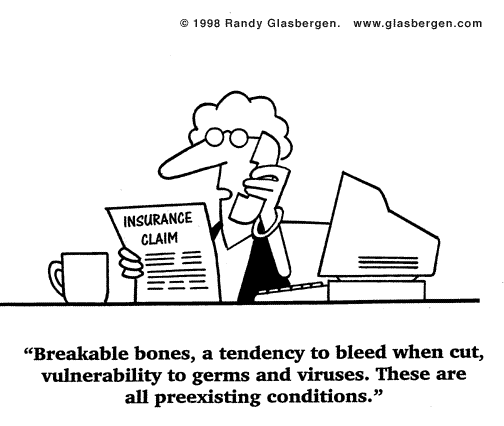
After reiterating his promise to repeal and replace the Affordable Care Act, President-elect Donald Trump has indicated that he may keep two of the law’s most popular provisions. One is straightforward enough — children up to age 26 being allowed to stay on their parents’ plan. The other — preventing insurance companies from denying coverage because of preexisting conditions — offers a perfect illustration of why Trump and most of the other Republicans critics of Obamacare don’t understand the health insurance market.

Let’s say that in the beautiful new world of “repeal and replace,” insurers are required to sell you insurance despite the fact that your kid has a brain tumor. Insurance companies know what to do with that. Their actuaries can calculate that kids with brain tumors typically require (I’m making this number up) about $200,000 a year in medical care. So they’ll offer to sell you a policy at an annual premium of $240,000.

At this point your response will probably be that such an outcome is not fair. When the law says insurance companies can’t discriminate on the basis for preexisting conditions, surely what it means is that they have to charge roughly the same price for health insurance, irrespective of your preexisting condition. In the language of insurance, that’s called “guaranteed issue at community rates.”

Unfortunately, in the states that have tried guaranteed issues at community rates, the insurance markets have collapsed. That’s because if you guarantee everyone the right to buy health insurance at community rates, then some consumers will game the system. The young and healthy ones won’t buy any health insurance at all — they’ll go without until they are diagnosed with diabetes or a brain tumor or get hit by a truck crossing the street. And when that happens, they will immediately call up Aetna or Anthem and exercise their right to buy health insurance at the low community rate, irrespective of their medical condition. It won’t be long before insurance companies begin losing a ton of money and are forced either to raise premiums through the roof or stop writing policies altogether.

Here’s why Trump is already waffling on Obamacare

https://www.washingtonpost.com/posteverything/wp/2016/11/12/heres-why-trump-is-already-waffling-on-obamacare/

President-elect Donald Trump is already signaling that he might backpedal on his promise to repeal the Affordable Care Act, telling the Wall Street Journal Friday that he’d consider hanging onto popular Obamacare provisions such as “the prohibition against insurers denying coverage because of patients’ existing conditions, and a provision that allows parents to provide years of additional coverage for children on their insurance policies.”

His apparent reluctance to scrap the entire ACA is understandable. In the long run, waffling on repeal will probably be less painful than causing a health-care catastrophe. Trump capitalized on Republicans’ long dislike of the Affordable Care Act by focusing on news, in the last weeks of the campaign, that premiums would increase sharply for many Americans purchasing insurance through its exchanges. But he didn’t promise a pared-down health-care regime. He promised to repeal and replace Obamacare with a plan that would cover everyone, offer more choice and cost less.

It was a populist approach to health care that wasn’t new. Sixteen years ago, in “The America We Deserve,” he wrote: “I’m a conservative on most issues, but a liberal on this one,” an appeal that didn’t hurt candidate Trump. But President Trump is likely to find the issue challenging. Repeal requires only the will of Congress. Replacement is subject to the laws of economics and mathematics, which aren’t on his side.

In the campaign, Trump proposed replacing the Affordable Care Act with a tax deduction for individuals who pay for health insurance out of pocket. Like all tax deductions, such a deduction is worth more to people with higher tax rates. But most of those who would be left without coverage by an ACA repeal are lower-income individuals with tax rates that are already low. Thus, the benefit they’d receive from a deduction doesn’t come close to the financial hit they would experience from an ACA repeal. Independent estimates suggest repeal would cause about 20 million people to lose coverage, only one-quarter of whom would purchase insurance with the deduction. The rest wouldn’t be able to afford it.

Big Changes and Big Risks Are Ahead for Health Policy

http://www.realclearhealth.com/articles/2016/11/09/big_changes_and_big_risks_are_ahead_for_health_policy__110237.html?utm_campaign=KHN%3A+Daily+Health+Policy+Report&utm_source=hs_email&utm_medium=email&utm_content=37390717&_hsenc=p2ANqtz-_CzB7SB8_jTflW9iZbujhPgbEgYoEGH0CmjnZCWfYQ6OhRFxv03I_g24L5CSEuvETzsbKwqacigRbc9C9fAU0zdkkgyw&_hsmi=37390717

Image result for Big Changes and Big Risks Are Ahead for Health Policy

The election outcome itself could create more problems for the ACA. The insurance plans sold on the law’s exchanges have already experienced substantial losses due to adverse selection, leading many insurance companies to pull back on their participation. The prospect of a Trump administration steering ACA implementation may be enough to convince some of the insurers still offering products on the exchanges in 2017 to rethink their plans. If more insurance companies head for the exits, the exchanges could become even less stable than they already are.

The “replace” part of “repeal and replace” has always been the tricky part for ACA opponents, and that will also be true for the incoming Trump administration. During the campaign, Trump offered only the vaguest outline of a plan that wouldn’t come close to serving as a starting point for a workable proposal. The ACA, for all of its problems, brought many low-income households into insurance coverage, through an expansion of the Medicaid program and through heavy subsidization of the insurance plans offered on the exchanges. Unless Trump wants to preside over a massive increase in the number of Americans without health insurance during his presidency, he will have to offer a plan that ensures households with low incomes can secure health insurance in some new way.

Repeal Would Be Even Worse Than Obamacare

https://www.bloomberg.com/view/articles/2016-11-09/trump-s-repeal-of-obamacare-would-make-health-care-even-worse?_hsenc=p2ANqtz–YThbb5bpWZsv2RkIpmzMfJQVehsyht_urAaJaQ5SnNPcxHVC6wCEdCEdPdr4egAghSWH7nSB4oSMsFzceJ7fcw1WYUg&_hsmi=37390717&utm_campaign=KHN%3A+Daily+Health+Policy+Report&utm_content=37390717&utm_medium=email&utm_source=hs_email

Image result for Repeal Would Be Even Worse Than Obamacare

I wouldn’t say the mood among Republicans is exactly giddy. Even Fox News seemed a little bit stunned by the news that Donald Trump had been elected president of the United States. But these past 12 hours, one priority has joined #NeverTrumpers and those who want to Make America Great Again: time to repeal Obamacare.

I’ll believe it when I see it.

Can Republicans pass a bill repealing Obamacare lock, stock and barrel? Technically, yes. They have control of the House and the Senate. Democrats in the Senate could filibuster, but I doubt the filibuster survives Trump’s term in any event, so I don’t see this as a permanent obstacle.

There’s still a wee bit of a problem, however, which is that they have to get Republicans to vote for a repeal.

I have no doubt that Republicans would like to vote for something they can call “repealing Obamacare.” The problem is that repealing Obamacare will involve getting rid of two provisions that are really, really popular: “guaranteed issue” (insurers can’t refuse to sell insurance to someone because of their health status) and “community rating” (insurers can’t agree to sell a policy to some undesirable customer for a million dollars a year; the company has to sell to everyone in a given age group at the same price).

These two provisions are consistently popular with voters across the spectrum. Unfortunately, they tend to send health insurance markets into what’s known as a “death spiral”: People know they can always buy insurance if they get sick, so a lot of them don’t buy insurance until they get sick. Because the sick people are really expensive to cover, insurers have to raise the price of the insurance, which means that the healthiest people left in the pool drop their insurance, which means the price of the insurance goes up. … After a few rounds of this, everyone has a guaranteed right to buy insurance — but the sticker price is astronomical.

Obamacare is built to counter this problem — with subsidies to bring down the price for many Americans, with a mandate for individuals to buy insurance or face tax penalties, with rules on enrollment timing to complicate “gaming the system.” These are the unpopular parts of Obamacare.

Repeal will involve getting rid of the unpopular bits. But it will also involve getting rid of the popular bits. Republicans will be under enormous pressure to repeal just the unpopular parts, which would, of course, make the individual market even more dysfunctional than it is now. I wish good luck to President Trump or to any member of Congress who explains to voters that if they want the popular parts, they need the unpopular parts too. Believe me, I’ve tried.

So I suspect that “Repeal Obamacare” will meet the same fate as Social Security reform. Legislators were gung ho. Even the base was sort of theoretically in favor of it. President George W. Bush made it his signature initiative for his second term. But the more that Bush talked about what Social Security reform would actually involve, the more he spooked voters.  Even though his party had control of both the House and the Senate, Bush eventually had to admit he couldn’t get it done. His own party would not back him in the face of voter resistance.

Analysis: Time for GOP to prove it has a better plan for healthcare reform

http://www.fiercehealthcare.com/payer/analysis-time-for-gop-to-prove-it-has-a-better-plan-for-healthcare-reform?utm_medium=nl&utm_source=internal&mrkid=959610&mkt_tok=eyJpIjoiTnpkaFpqRm1ZVEZpWkdZMiIsInQiOiJxY1NBT1ZDbGdDQWsxVzRQQ21iOVwvcEVkOFdDVTBIUG9hZWllQ0tiYmFuM2lUVU52Y2JGWkxnNW9BWDJhTWNZSTVTR2QwVmdTYWdIQkFPWGdxZ3FRWlwvRXVuSFFvZ2pKa3NaTUlwU0M1YmVJPSJ9

With Donald Trump headed to the White House and his party firmly in control of Congress, Republicans will finally have a chance to prove what they’ve been saying all along: that they can produce a better version of healthcare reform than the Affordable Care Act.

It’s clear that the ACA is as imperiled as it has ever been. Trump has fervently vowed to repeal it–and with Republican control of both chambers of Congress, he may well get his wish. After all, the law’s most visible component, the exchanges, are on shaky ground as it is, with premiums rising and some health insurers retreating from the marketplaces.

Plus, President Barack Obama’s last attempt at convincing Republicans to work on fixing the ACA–not repealing it–fell on deaf ears even before the party’s resounding victory Tuesday.

What gets lost in all the talk about the ACA’s uncertain future, though, is the fact that while some insurers have struggled to make a profit in the individual marketplaces, there are other aspects of the law to which they have become quite attached.

Take Medicaid expansion, an idea championed by Democrats (and even once embraced by Vice President-Elect Mike Pence) that has been a boon to insurance companies in the form of lucrative managed care contracts. Some companies that specialize in slimmed-down Medicaid plans have also thrived on the exchanges where others have floundered.

Then there’s the ACA’s provisions that encourage the transition to value-based payments, which insurers have embraced and largely retooled their business models to reflect. Accountable care organizations, for example, have sprung up like wildfire, producing promising results for some companies.

A wholesale repeal of the ACA would also erase the law’s historic gains in reducing the uninsured rate. Though many of the newly insured have turned out to be costlier to cover than expected, such a move would still rob insurers of millions of new customers.

The question, then, becomes what will replace the law–and that’s where it gets interesting.

Trump has a plan, but it is short on details. Perhaps most visibly, he has advocated for selling insurance across state lines–a timeworn GOP talking point that many experts agree is not feasible. He would also repeal Medicaid expansion and convert Medicaid federal matching funds into a block grant, the latter of which would drastically cut Medicaid funding and coverage.

One analysis from The Commonwealth Fund says that his plan could add nearly 20 million peopleto the ranks of the uninsured, and even more if his Medicaid proposals come to fruition.

California Faces Major Reversal If Trump, Congress Scrap Health Law

California Faces Major Reversal If Trump, Congress Scrap Health Law

Attendees speak with heath care volunteers during the WeConnect Health Enrollment Information & Wellness Event in Oakland, California, U.S., on Saturday, Sept. 21, 2013. The battle over Obamacare is taking on political importance as Democrats hope a successful roll-out among Hispanics will further bind those voters to the Democratic Party and undermine Republican efforts to build more support before the 2016 presidential election. Photographer: David Paul Morris/Bloomberg via Getty Images

California has a lot to lose if President-elect Donald Trump and the Republican-led Congress fulfill their campaign pledge to repeal Obamacare.

The Golden State fully embraced the Affordable Care Act by expanding Medicaid coverage for the poor and creating its own health insurance exchange for about 1.4 million enrollees. Supporters held California up as proof the health law could work as intended.

But now President Barack Obama’s signature law is in serious jeopardy and California officials are left wondering what Republicans in Washington may put in its place.

“There is no doubt that Obamacare is dead,” said Robert Laszewski, a health care consultant and expert on the California insurance market. “The only question is just exactly how Republicans will get rid of it.”

Health policy experts don’t expect Republicans to immediately kick millions of people off their insurance policies. Instead, they predict lawmakers may repeal parts of the law and allow for some transition period for consumers while a replacement plan is put together.

Still, the personal and financial impact for the state could be jarring. The number of uninsured Californians would more than double to 7.5 million people if the Affordable Care Act was repealed, according to a recent study by the Urban Institute.

Researchers also said California stands to lose an estimated $15 billion annually in federal funding for Medicaid expansion and insurance subsidies — more than any other state. That loss of federal money would make it difficult for California to pursue health reform on its own.

A “Volatile Marketplace”: Second Quarter Earnings Calls Offer Glimpse of How Insurers Are Faring on ACA Marketplaces—and What 2017 Might Bring

http://www.commonwealthfund.org/publications/blog/2016/sep/volatile-marketplace?omnicid=EALERT1094761&mid=henrykotula@yahoo.com

This has been a turbulent year for the Affordable Care Act (ACA) marketplaces. As part of our ongoing efforts to better understand how the post-ACA insurance markets are evolving, we reviewed the 2016 second-quarter (Q2) earnings calls and financial filings of several large, publicly traded insurers that participate on the marketplaces: Aetna, Anthem, Centene, Cigna, Humana, Molina, and United.1  While the picture provided by these calls and financial reports is limited – dozens of other participating insurers are not required to report to investors because of their nonprofit or private status – they can help us better understand some of the trends affecting the marketplaces’ stability, including insurer exits from some health insurance marketplaces and increases in 2017 premiums.


Nondiscrimination And Chronic Conditions — The Final Section 1557 Regulation

http://healthaffairs.org/blog/2016/07/20/nondiscrimination-and-chronic-conditions-the-final-section-1557-regulation/

Blog_Burwell2

Before the Affordable Care Act (ACA), those with serious or chronic health conditions were often denied health insurance coverage or paid high prices for substandard plans with coverage exclusions. Many went uninsured and untreated. For them, the ACA’s new coverage opportunities and protections against discriminatory practices by health insurers serve as an essential lifeline.

Under the ACA, insurers can no longer charge higher premiums or deny coverage for people with pre-existing conditions. However, some insurers have tried to circumvent ACA protections by designing benefits that discourage enrollment by persons with significant health needs.

NHeLP and The AIDS Institute filed a landmark complaint with the Department of Health and Human Services’ Office for Civil Rights after four Florida insurers placed all HIV medicines, including generic drugs, on the highest cost sharing tiers. Researchers found that this practice—called “adverse tiering”—is widespread. A New England Journal of Medicine study found that one-in-four insurers placed all drugs to treat HIV in the highest tiers. Another study in Journal of the American Medical Association found that up to 15 percent of plans in the federal marketplace lack in-network physicians for at least one specialty, making access to care significantly more expensive for those with specialized care needs.

The Department of Health and Human Services (HHS) recently finalized regulations for the cornerstone non-discrimination provision of the ACA — Section 1557. For the first time, the provision applies civil rights protections against discrimination on the basis of race, ethnicity, national origin, sex, age, and disability specifically to health programs and activities administered by or receiving federal funding.

Health advocates and patient advocacy organizations lauded the final regulations for Section 1557, which expressly prohibit insurers from employing plan benefit designs or marketing practices that discriminate.

Reflections on 17 Years in California Health Policy

http://www.chcf.org/articles/2016/07/reflections-17-years?_cldee=aGVucnlrb3R1bGFAeWFob28uY29t

California Health Care Foundation - Health Care That Works for All Californians

California’s individual health insurance marketplace today bears little resemblance to that of the mid-2000s. Since 2014 Californians have been able to purchase individual coverage without regard to their medical history. They can switch plans and carriers during annual open enrollment periods. Consumers face strong incentives to obtain coverage: They incur tax penalties if they remain uninsured, and all who are lawfully present and meet income standards are eligible for subsidies through Covered California. As a result, a greater share of Californians is now covered through the individual market than is uninsured (14% versus 11%, according to one national survey). While affordability concerns remain, early data show that Californians who bought insurance through the individual market spent significantly less than those buying before the ACA. And the percentage of Californians with individual coverage spending more than 10% of their household income on health care costs also went down.