Guns send thousands to the E.R. every year

https://www.axios.com/vitals-2492155989.html
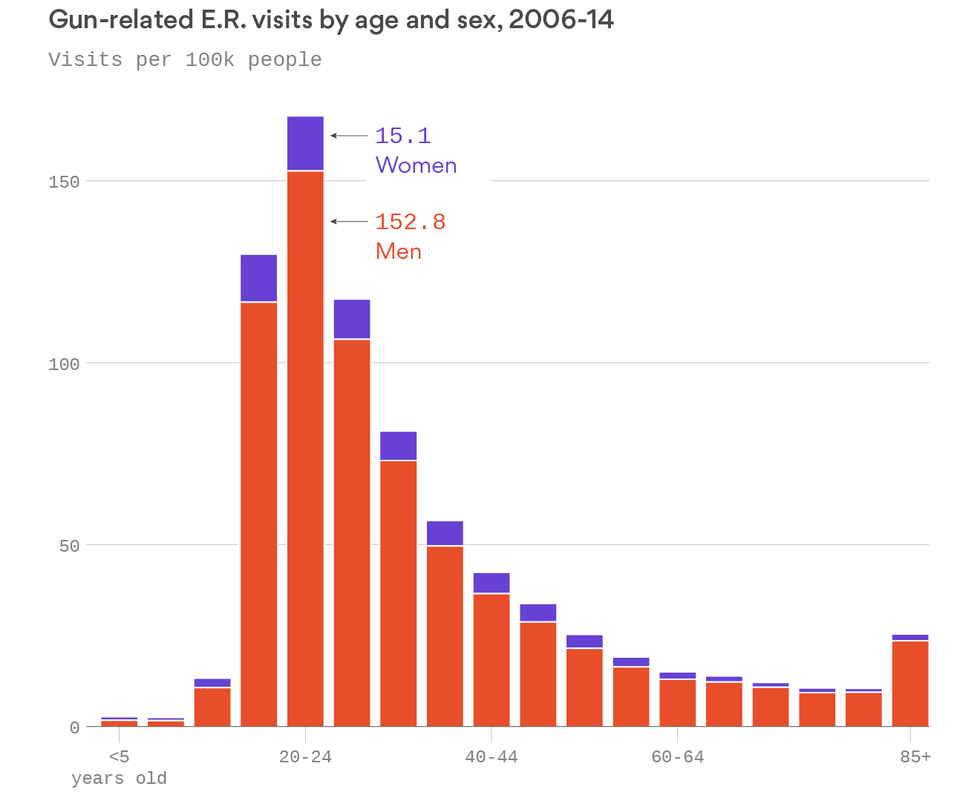
Image result for Guns send thousands to the E.R. every year


Good morning … Our thoughts are with the victims of the horrific mass shooting in Las Vegas, and their families. If you haven’t yet, spend a minute with this graphic, from the Axios visuals team. Whatever your opinions about gun control, mental health interventions, or any other questions of public policy, it’s a stark look at the human toll of mass shootings.

Gun-related injuries send thousands of people to emergency rooms every year, even aside from mass shootings like the tragedy in Las Vegas. In 2015 alone, almost 35,000 people died from gun-related homicides and suicides, and the “clinical burden” from non-fatal gun injuries was three times higher, according to new research published in Health Affairs.

  • Men make up the vast majority of firearm-related E.R. admissions, and young men — ages 15-30 — are especially likely to end up in the hospital because of a gun.
  • A plurality of gun-related E.R. admissions resulted from an assault, followed by accidents, which accounted for about 35% of admissions.
  • Most patients admitted to emergency rooms with firearm-related injuries were discharged, either to home or other facilities. Roughly 37% were admitted for inpatient care, and about 5% died in the emergency room.

Go deeper: Health Affairs is providing free access to this study. You can read the whole thing here.

In search of sweet spots in public policy

In search of sweet spots in public policy

Increasing government spending improves educational outcomes and doesn’t enhance them at all.  Augmenting incarceration rates reduces crime and increases it. Raising the minimum wage will increase unemployment and not affect it in the slightest.  These statements are neither Zen koans nor political doublespeak, but summaries of policy research findings that are not as contradictory as they at first may sound. All of them stem from a reality that is frequently forgotten in political discourse: In many public policy areas there exists a “sweet spot” in which pursuing a certain approach does maximal good, and beyond which further increments make less difference, no difference, or even make things worse.

For a range of political, tribal and emotional reasons, sweet spots are always going to be underappreciated in political debates, when tend to be dominated by shouting matches between proponents of simplistic positions that do not change in light of current circumstances, e.g., “More money for health care!”, “Lower taxes now!”, “Tough on crime!”, “Mass incarceration has failed!”. But a sophisticated policy maker, journalist, researcher or voter should recognize that there are few absolutes in public policy.  Very often the policy change that worked at a different point in the curve will no longer yield a benefit or even be counterproductive of further pursued. Our political life is usually characterized by the search for simple answers, but good governance depends on the search for sweet spots.

The health care production function


2016 Edelman Trust Barometer – Leadership in a Divided World

Click to access 2016-Edelman-Trust-Barometer-Global-_-Leadership-in-a-Divided-World1.pdf

Image result for 2016 Edelman Trust Barometer Leadership in a Divided World