Would Americans Accept Putting Health Care on a Budget?

Would Americans Accept Putting Health Care on a Budget?

Image result for global budget health care

If you wanted to get control of your household spending, you’d set a budget and spend no more than it allowed. You might wonder why we don’t just do the same for spending on American health care.

Though government budgets are different from household budgets, the idea of putting a firm limit on health care spending is far from unknown. Many countries, including Canada, Switzerland and Britain, pay hospitals entirely or partly this way.

Under such a capped system, called global budgeting, a hospital has an incentive to deliver less care — including reducing hospital admissions — and to increase the efficiency of the care it does deliver.

Capping hospital spending raises concerns about harming quality and access. On these grounds, hospital executives and patient advocates might strongly resist spending constraints in the United States.

And yet some American hospitals and health systems already operate this way, including Kaiser Permanente and the Veterans Health Administration. To address concerns about access and quality, these programs are usually paired with quality monitoring and improvement initiatives.

That brings us to Maryland’s experience with a capped system. The evidence from the state is far from conclusive, but this is a weighty and much-watched experiment for health researchers, so it’s worth diving into the details of the latest studies.

Starting in 2010 with eight rural hospitals, and expanding its plan in 2014 to the state’s other hospitals, Maryland set global budgets for hospital inpatient and outpatient services, as well as emergency department care. Each hospital’s budget is based on its past revenue and encompasses all payers for care, including Medicare, Medicaid and commercial market insurance. Budgets for hospitals are updated every year to ensure that their spending grows more slowly than the state’s economy.

Because physician services are not part of the budgets, there is an incentive to provide more physician office visits, including primary care. According to some reports, Maryland hospitals are responding to this incentive by providing additional support outside their walls to patients who have chronic illnesses or who have recently been discharged from a hospital. Greater use of primary care by such patients, for example, could reduce the need for future hospital admissions.

In 2013, early results found, rural hospital admissions and readmissions were both down from their levels before the system was introduced.

In the first three years of the expanded program, revenue growth for Maryland’s hospitals stayed below the state-set cap of 3.58 percent, saving Medicare $586 million. Spending was lower on hospital outpatient services, including visits to the emergency department that do not lead to hospital admissions. In addition, preventable health conditions and mortality fell.

According to a new report from RTI, a nonprofit research organization, Maryland’s program did not reap savings for the privately insured population (even though inpatient admissions fell for that group). However, the study corroborated the impressive Medicare savings, driven by a drop in hospital admissions. In reaching these findings, the study compared Maryland’s hospitals with analogous ones in other states, which served as stand-ins for what would have happened to Maryland hospitals had global budgeting not been introduced.

But a recent study, published in JAMA Internal Medicine, was decidedly less encouraging.

Led by Eric Roberts, a health economist with the University of Pittsburgh, the study examined how Maryland achieved its Medicare savings, using data from 2009-2015. Like RTI’s report, it also compared Maryland hospitals’ experience with that of comparable hospitals elsewhere.

However, unlike the RTI report, Mr. Roberts’s study did not find consistent evidence that changes in hospital use in Maryland could be attributed to global budgeting. His study also examined primary care use. Here, too, it did not find consistent evidence that Maryland differed from elsewhere. Because of the challenges of matching Maryland hospitals to others outside of the state for comparison, the authors took several statistical approaches in reaching their findings. With some approaches, the changes observed in Maryland were comparable to those in other states, raising uncertainty about their cause.

A separate study by the same authors published in Health Affairs analyzed the earlier global budget program for Maryland’s rural hospitals. They were able to use other Maryland hospitals as controls. Still, after three years, they did not find an impact of the program on hospital use or spending.

Changes brought about by the Affordable Care Act, which also passed in 2010, coincide with Maryland’s hospital payment reforms. The A.C.A. included many provisions aimed at reducing spending, and those changes could have led to hospital use and spending in other states on par with those seen in Maryland.

A limitation of Maryland’s approach is that payments to physicians are not included in its global budgets. “Maryland didn’t put the state’s health system on a budget — it only put hospitals on a budget,” said Ateev Mehrotra, the study’s senior author and an associate professor of health care policy and medicine at Harvard Medical School. “Slowing health care spending and fostering better coordination requires including physicians who make the day-to-day decisions about how care is delivered.”

broader global budget program for Maryland is in the works. The U.S. Centers for Medicare and Medicaid Services is reviewing a state application that commits to global budgets for Medicare physician and hospital spending. An editorial that accompanied the JAMA Internal Medicine study noted that a few years may be insufficient time to detect changes. It suggests that five to 10 years may be more appropriate.

“Maryland hospitals are only beginning to capitalize on the model’s incentives to transform care in their communities,” said Joshua Sharfstein, a co-author of the editorial and a professor at the Johns Hopkins Bloomberg School of Public Health. “This means that as Maryland moves forward with new stages of innovation, there is a great deal more potential upside.” As former secretary of health and mental hygiene in Maryland, he helped institute the Maryland hospital payment approach.

Global budgets are unusual in the United States, but their intuitive appeal is growing. A California bill is calling for a commission that would set a global budget for the state. And soon Maryland won’t be the only state using such a system. Pennsylvania is planning a similar program for its rural hospitals.

Can this system work across America?

How much spending control is ceded to the government is the major battle line in health care politics. An approach like Maryland’s doesn’t just poke a toe over that line, it leaps miles beyond it.

But the United States has been trying to get a handle on health care costs for decades, spending far more than other advanced nations without necessarily getting better outcomes. A successful Maryland experiment could open an avenue to cut costs through the states, perhaps one state at a time, bypassing the steep political hurdle of selling a national plan.


Experienced Bedside Nurses: An Endangered Species?

Experienced Bedside Nurses: An Endangered Species?

Image result for Experienced Bedside Nurses: An Endangered Species?

“The trend toward our hospitals being primarily populated with nurses with less than two years’ experience is worrisome.”

At least three colleagues who’ve recently been patients in hospitals or had family members who were have remarked on the youthful nurses they encountered—and on their lack of experience. In two of the conversations, my colleagues cited instances in which this lack of experience was detrimental to care, one of them dangerous. That “sixth sense,” that level of awareness that comes with lived experience and becomes part of expert clinical knowledge, is important for safe, quality patient care.

In the February editorial, I report on the answers I received when I queried our editorial board members about new nurses’ inclination to work in acute care for only two years to gain experience and then leave to pursue NP careers. Many of the board members have seen a similar trend, one reflected by research on nurse retention, some of it published in AJN (most recently, see Christine Kovner’s February 2014 study on the work patterns of newly licensed RNs, free until February 6).

As one board member noted:

“The narrative must be shifted to embrace the full range of roles and contributions of all nurses. Our health care system depends upon a well-trained, experienced workforce. The trend toward our hospitals being primarily populated with nurses with less than two years’ experience is worrisome.”

It’s a complex issue, and no one is faulting new RNs for the career paths they pursue. But as this trend accelerates, what can be done to ensure that there are enough experienced nurses at the bedside to protect patient safety? Let us know your thoughts.


Hospitals are germy, noisy places. Some acutely ill patients are getting treated at home instead.

https://www.washingtonpost.com/national/health-science/hospitals-are-germy-noisy-places-some-acutely-ill-patients-are-getting-treated-at-home-instead/2018/03/30/5fcb5006-2155-11e8-badd-7c9f29a55815_story.html?utm_term=.e3db8d812c05

Phyllis Petruzzelli spent the week before Christmas struggling to breathe. When she went to the emergency department on Dec. 26, the doctor at Brigham and Women’s Faulkner Hospital near her home in Boston said she had pneumonia and needed hospitalization. Then the doctor proposed something that made Petruzzelli nervous. Instead of being admitted to the hospital, she could go back home and let the hospital come to her.

As a “hospital-at-home” patient, Petruzzelli learned, doctors and nurses would come to her home twice a day and perform any needed tests or bloodwork.

A wireless patch would be affixed to her skin to track her vital signs and send a steady stream of data to the hospital. If she had any questions, she could talk via video chat anytime with a nurse or doctor.

Hospitals are germy and noisy places, putting acutely ill, frail patients at risk for infection, sleeplessness and delirium, among other problems. “Your resistance is low,” Petruzzelli said the doctor told her. “If you come to the hospital, you don’t know what might happen. You’re a perfect candidate for this.”

So Petruzzelli, who is now 71, agreed. That afternoon, she arrived home in a hospital vehicle. A doctor and nurse were waiting at the front door. She settled on the couch in the living room, with her husband, Augie, and dog, Max, nearby. The doctor and nurse checked her IV, attached the monitoring patch to her chest, and left.

When David Levine, the doctor, arrived the next morning, he asked Petruzzelli why she had been walking around during the night. Far from feeling uncomfortable that her nocturnal trips to the bathroom were being monitored, “I felt very safe and secure,” Petruzzelli said. “What if I fell while my husband was out getting me food? They’d know.”

After three uneventful days, she was “discharged” from her hospital-at-home stay. “I’d do it again in a heartbeat,” Petruzzelli said.

Brigham Health is one of a slowly growing number of health systems that encourage selected acutely ill emergency department patients to opt for hospital-level care at home.

In the couple of years since Brigham Health started testing this type of care, hospital staff who were initially skeptical have generally embraced it, Levine said. “They very quickly realize that this is really what patients want, and it’s really good care.”

This approach is quite common in Australia, Britain and Canada, but it has faced an uphill battle in the United States.

A key obstacle, clinicians and policy analysts agree, is getting health insurers to pay for it. At Brigham Health, the hospital can charge an insurer for a physician house call, but the remainder of the hospital-at-home services are covered by grants and other funding, Levine said.

Insurers don’t have a position on hospital-at-home programs, said Cathryn Donaldson, a spokeswoman for America’s Health Insurance Plans, an industry trade group.

“Overall, health insurance providers are committed to ensuring patients have access to care they need, and there are Medicare Advantage plans that do cover this type of at-home care,” Donaldson said in a statement.

Levine, a clinician-investigator at Brigham and Women’s Hospital and an instructor at Harvard Medical School, was the lead author of a recently published study comparing patients who received either hospital-level care at home or in the hospital in 2016.

The 20 patients analyzed in the trial had one of several conditions, including infection, heart failure, chronic obstructive pulmonary disease and asthma. The trial found that while there were no adverse events in the home-care patients, their treatment costs were significantly lower — about half that of patients treated in the hospital.

Why? For starters, labor costs for at-home patients are lower than for patients in a hospital, where staff must be on hand around the clock. Home-care patients also had fewer lab tests and visits from specialists.

The study found that both groups of patients were about equally satisfied with their care, but the home-care group was more physically active.

Brigham Health is conducting further randomized controlled trials to test the at-home model for a broader range of diagnoses.

Bruce Leff began exploring the hospital-at-home concept more than 20 years ago, conducting studies that found fewer complications, better outcomes and lower costs in home-care patients.

Hospitals, accustomed to the traditional business model that emphasizes filling hospital beds in a bricks-and-mortar facility, have been slow to embrace the idea, however.

There are practical hurdles, too.

“It’s still easier to get Chinese food delivered in New York City than to get oxygen delivered at home,” said Leff, a professor of medicine and director of Johns Hopkins Medical School’s Center for Transformative Geriatric Research.

Since the seven-hospital Mount Sinai system in New York launched its hospital-at-home program, more than 700 patients have chosen it. And they have fared well on a number of measures.

The average length of stay for acute care was 5.3 days in the hospital vs. 3.1 days for home-care patients, while 30-day readmission rates for home-based patients were about half of those who had been hospitalized: 7.8 percent vs. 16.3 percent.

Begun with a $9.6 million federal grant in 2014, Mount Sinai’s program initially focused on Medicare patients with six conditions, including congestive heart failure, pneumonia and diabetes. Since then, the program has expanded to include dozens of conditions, including asthma, high blood pressure and serious infections such as cellulitis, and is now available to some privately insured and Medicaid patients.

Mount Sinai has also partnered with Contessa Health, a company with expertise in home care, to negotiate contracts with insurers to pay for hospital-at-home services.

Among other things, insurers are worried about the slippery slope of what it means to be hospitalized, said Linda DeCherrie, clinical director of the mobile acute care team at Mount Sinai.

Insurers “don’t want to be paying for an admission if this patient really wouldn’t have been hospitalized in the first place,” DeCherrie said.


AIMING HIGHER: Results from the Commonwealth Fund Scorecard on State Health System Performance

http://www.commonwealthfund.org/interactives/2017/mar/state-scorecard/

Image result for AIMING HIGHER: Results from the Commonwealth Fund Scorecard on State Health System Performance

The 2017 edition of the Commonwealth Fund Scorecard on State Health System Performance finds that nearly all state health systems improved on a broad array of health indicators between 2013 and 2015. During this period, which coincides with implementation of the Affordable Care Act’s major coverage expansions, uninsured rates dropped and more people were able to access needed care, particularly those in states that expanded their Medicaid programs. On a less positive note, between 2011–12 and 2013–14, premature death rates rose slightly following a long decline. The Scorecard points to a constant give-and-take in efforts to improve health and health care, reminding us that there is still more to be done.

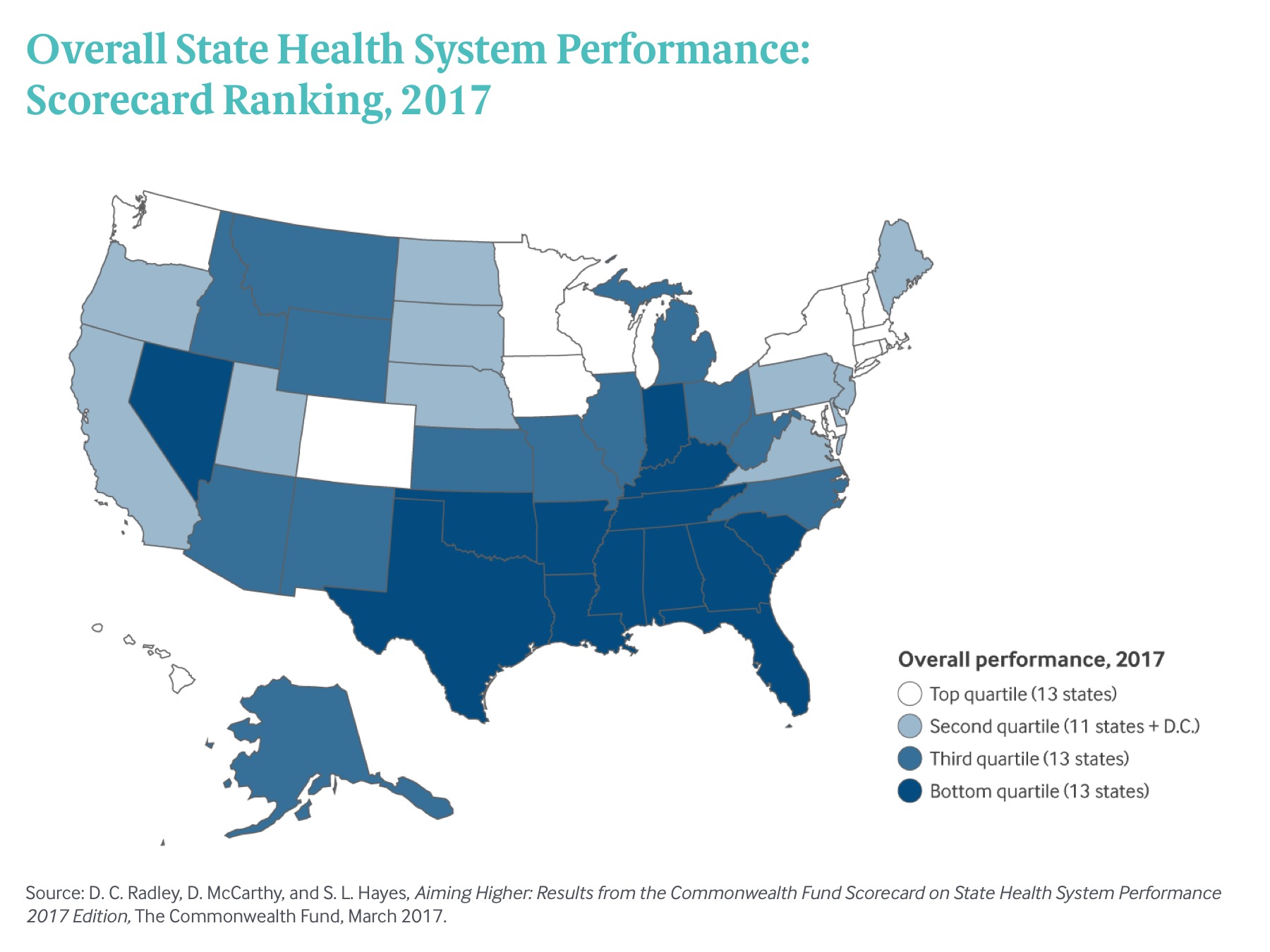
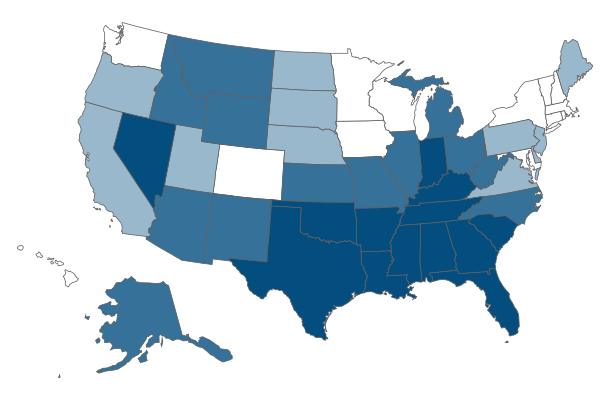
Vermont was the top-ranked state overall in this year’s Scorecard, followed by Minnesota, Hawaii, Rhode Island, and Massachusetts (Exhibit 1). California, Colorado, Kentucky, New York, and Washington made the biggest jumps in ranking, with New York moving into the top-performing group for the first time. Kentucky also stood out for having improved on more measures than any other state.

Exhibit 1Exhibit 1: Overall State Health System Performance: Scorecard Ranking, 2017

Using the most recent data available, the Scorecard ranks states on more than 40 measures of health system performance in five broad areas: health care access, quality, avoidable hospital use and costs, health outcomes, and health care equity. In reviewing the data, four key themes emerged:

  • There was more improvement than decline in states’ health system performance.
  • States that expanded Medicaid saw greater gains in access to care.
  • Premature death rates crept up in almost two-thirds of states.
  • Across all measures, there was a threefold variation in performance, on average, between top- and bottom-performing states, signifying opportunities for improvement.

By 2015, fewer people in every state lacked health insurance. Across the country, more patients benefited from better quality of care in doctors’ offices and hospitals, and Medicare beneficiaries were less frequently readmitted to the hospital. The most pervasive improvements in health system performance occurred where policymakers and health system leaders created programs, incentives, or collaborations to ensure access to care and improve the quality and efficiency of care. For example, the decline in hospital readmissions accelerated after the federal government began levying financial penalties on hospitals that had high rates of readmissions and created hospital improvement innovation networks to help spread best practices. (notes)

Still, wide performance variation across states, as well as persistent disparities by race and economic status within states, are clear signals that our nation is a long way from offering everyone an equal opportunity for a long, healthy, and productive life. Looking forward, it is likely that states will be challenged to provide leadership on health policy as the federal government considers a new relationship with states in public financing of health care. To improve the health of their residents, states must find creative ways of addressing the causes of rising mortality rates while also working to strengthen primary and preventive care.


18k Kaiser nurses vote for option to strike at California facilities

https://www.beckershospitalreview.com/human-capital-and-risk/18k-kaiser-nurses-vote-for-option-to-strike-at-california-facilities.html

Image result for california nurses union

Tens of thousands unionized registered nurses at facilities owned by Oakland, Calif.-based Kaiser Permanente voted for the option to call a strike if an agreement is not reached on issues such as staffing and patient care, according to a California Nurses Association news release.

The CNA — which represents 18,000 RNs who work at more than 20 Kaiser Permanente medical centers and dozens of medical clinics and office buildings in California — said nurses are calling on the healthcare giant to improve patient care standards.

“With this vote nurses are making it absolutely clear: We are ready to strike to make sure our patients get safe care,” said Zenei Cortez, a South San Francisco Kaiser Permanente RN and co-president of CNA.

Union officials said nurses specifically are calling on Kaiser Permanente to support their proposals regarding staffing and patient care standards. These include bringing in a charge nurse on each unit, as well as resource nurses to assist other nurses so they are able to take breaks. The union said nurses also propose “interventions with pharmacy to expedite patients receiving correct medications,” and “increased staffing when needed due to emergent conditions and heightened patient volume.”

Additionally, the CNA said nurses are opposed to Kaiser Permanente’s proposal to move from the existing GRASP patient classification system to Epic Acuity, which nurses contend is less transparent. Nurses are also opposed to what they said are Kaiser Permanente’s plans to cut pay for new hires by 10 percent in the Sacramento region, and 20 percent in Fresno and the Central Valley.

Regarding the union’s claims about staffing, Debora Catsavas, senior vice president of human resources for Kaiser Permanente Northern California, said in a statement: “Our nurse staffing meets, and often exceeds, state-mandated staffing as necessary for patients, based on the complexity of their medical conditions. We employ more than 18,000 nurses, and have hired more than 2,000 nurses in multiple key specialty areas over the last three years, and continue to hire more as needed.”

As far as the move to Epic Acuity, Ms. Catsavas said the move addresses various issues nurses have raised about the existing GRASP patient classification system.

“GRASP is a system from the 1980s based on studies of nursing work flows conducted nearly 50 years ago. Epic Acuity is an up-to-date, comprehensive system that directly reflects the care provided and allows nurses to spend more time at the bedside,” her statement reads. “Epic Acuity uses clinical information directly inputted by the nurses into our electronic medical record.”

She said Kaiser Permanente also offered nurse representatives paid time to talk about and review Epic Acuity’s implementation.

Furthermore, Ms. Catsavas said there are no proposed wage cuts or wage reductions for current nurses. However, she said Kaiser Permanente last October proposed a new wage scale for new nurses hired in the Sacramento, Central Valley and Fresno areas on or after Jan. 1, 2019, “to more closely align with the lower cost of living in these markets.”

She noted Kaiser Permanente nurses in Sacramento, the Central Valley and Fresno earn 24 percent, 37 percent and 45 percent more than non-Kaiser Permanente nurses, respectively.

While the Kaiser Permanente nurses have authorized a potential strike, no strike date is set. For a strike to occur, nurses would have to provide at least 10 days notice.

Ms. Catsavas said Kaiser Permanente anticipated a strike authorization might occur but believes an agreement is within reach.


Kaiser Health News report questions safety of ASCs: 5 things to know

https://www.beckershospitalreview.com/quality/kaiser-health-news-report-questions-safety-of-ascs-5-things-to-know.html

Image result for ambulatory surgery center

Ambulatory surgery centers are often considered low-cost alternatives to expensive in-hospital care, but a new report from Kaiser Health News and USA Today raises questions about the safety of ASCs and the regulations that govern their practices.

Here are five things to know about the report.

1. The report claims the proliferation of increasingly complex surgeries at ASCs has shone a light on facilities’ poor preparation for emergency scenarios. ASCs are required to have patient transfer agreements to local hospitals in the event of an emergency, complying with state and federal regulations. The report cited examples of patients who were transferred from ASCs in rural areas where hospitals were up to 30 miles away and were unable to access the emergency care needed.

2. ASCs are a surgical site option for elective procedures for patients who are good candidates for the outpatient setting, typically otherwise healthy patients without comorbidities. Not every patient is a good candidate for outpatient surgery; those with pre-existing conditions are better suited for the hospital.

Preexisting conditions can complicate even the most routine surgeries, and the report claims over 260 patients have died since 2013 after procedures at ASCs. Though federal regulations require ASCs keep resuscitation equipment on hand in case of emergencies, a number of the patient deaths detailed in the article took place in facilities that skirted these regulations. However, the Ambulatory Surgery Center Association issued a statement March 2 in response to the article, reporting more than 200 million successful procedures have been performed in ASCs across the country over the same five year period.

3. The report cites examples of patients who felt hurried out of ASCs and dying on the way home.

“The stories these reporters tell are indeed tragic and will no doubt be deeply concerning to readers. Unfortunately, the article fails to provide a comparison to other sites of care and make clear that medical errors occur across all sites of care, including hospitals, and typically at much higher rates than in ASCs,” said Rebecca Craig, RN, MBA, the CEO of Fort Collins, Colo.-based Harmony Surgery Center and Peak Surgical Management.

4. In the third quarter of 2017, the most recent data available, the rate of all cause emergency department visits within one day of ASC discharge was 0.69 percent, according to statistics from ASC Quality.

5. Physicians are allowed to have ownership in ASCs, collecting a percentage of the facility fee for each case. The article’s authors suggest this ownership may influence their decision to direct cases to the center , but the laws governing ASC referrals vary by state, with some states barring surgeon referrals to any ASC in which they or a family member maintain a financial interest.

Prescription for secrecy

https://projects.jsonline.com/news/2018/2/28/is-your-doctor-banned-from-practicing-in-other-states.html

Image result for state medical board secrecy


Is your doctor banned from practicing in other states? State licensing system keeps patients in the dark.

Like traveling medicine hucksters of old, doctors who run into trouble today can hopscotch from state to state, staying ahead of regulators.

Instead of snake oil, some peddle opioids. Others have sex with patients, bungle surgeries, misdiagnose conditions or are implicated in patient deaths.

Even after being caught in one state, they can practice free and clear in another; many hold a fistful of medical licenses.

Stories about individual doctors avoiding discipline in a second state have been reported before. An investigation by the Milwaukee Journal Sentinel and MedPage Today shows how widespread the problem is: At least 500 physicians who have been publicly disciplined, chastised or barred from practicing by one state medical board have been allowed to practice elsewhere with a clean license.

And their patients are kept in the dark — even as more become victims — thanks to an antiquated system shrouded in secrecy.

In Colorado, Gary Weiss’ care of a multiple sclerosis patient prompted four doctors to complain to the state medical board when the patient died in 2011. The board and Weiss agreed that he was “permanently inactivating” his license in 2014, meaning he could never get it back.

But in Florida, where Weiss has a long-standing practice, officials applied no restrictions despite malpractice lawsuits from seven other patients in two states, all accusing him of misdiagnosing them with multiple sclerosis.

Plastic surgeon John Siebert had sex with a patient in New York, got his license suspended for three years and was permanently ordered to have a chaperone in the room with any female patients. But he operates free of medical board restrictions in Wisconsin. In fact, he was appointed to an endowed chair at the University of Wisconsin-Madison, funded in part by billionaire Diane Hendricks, a patient and a major political contributor to Gov. Scott Walker.

Look up Jay Riseman on the website of the Division of Professional Registration in Missouri, where he practices as a hospice doctor: It lists no disciplinary history, no red flags.

But in Illinois, where a medical board official once called him an “imminent danger to the public,” the families of three patients who died remain haunted by what he did. Riseman continues to practice, despite having prescribed massive amounts of pre-surgery laxatives to infants and failing to act in the case of an older woman with a blood infection.

Among the more than 500 doctors identified by the Journal Sentinel and MedPage Today, the single biggest reason for board action was medical errors or oversights. One fifth of the cases were a result of putting patients in harm’s way.

All have slipped through a system that makes it difficult for patients, employers and even regulators in other states to find out about their troubling pasts.


At Some California Hospitals, Fewer Than Half Of Workers Get The Flu Shot

At Some California Hospitals, Fewer Than Half Of Workers Get The Flu Shot

How well are doctors, nurses and other workers at your local hospital vaccinated against the flu?

That depends on the hospital.

According to data from the California Department of Public Health, flu vaccination rates among health care staffers at the state’s acute care hospitals range from a low of 37 percent to 100 percent.

Overall, flu vaccination rates among hospital workers climbed significantly in the past several years — from an average of 63 percent during the 2010-11 influenza season to 83 percent during the 2016-17 season, according to the California Department of Public Health. Vaccination rates for the current season won’t be determined until later this year.

But that general increase masks some big variations. Monrovia Memorial Hospital in Los Angeles, Los Robles Hospital and Medical Center, East Campus and Thousand Oaks Surgical Center in Ventura each reported that fewer than 40 percent of their health care workers received the flu vaccine last year. Representatives from those hospitals did not return repeated calls for comment.

On the other end of the spectrum, Rady Children’s Hospital in San Diego reported that every single person working there got the vaccine.

California’s flu vaccination policies for hospital workers, and those of many other states, are far from uniform or ironclad. In various states, health care workers have legally challenged hospital requirements for vaccination on religious and seculargrounds. And some unions in California and elsewhere oppose a legal mandate, partly for civil rights reasons.

Public health officials themselves have different takes on the legal requirements for hospital workers. The Centers for Disease Control and Prevention lists California and Massachusetts among the handful of states where the flu vaccination is mandated for health care workers. But the states’ laws allow health care workers to opt out by signing a form declining the vaccine. For that reason, officials from those two states said they do not actually consider the vaccine mandatory.

Colorado law requires hospital health care workers to provide proof of immunization or a doctor’s note providing for a medical exemption, and requires that non-immunized workers wear masks. Hospitals that achieve a 90 percent or higher flu vaccination rate are exempt from these rules, however.

In California, state law requires that hospitals offer the vaccine free of charge. Many hospitals offer vaccines to personnel in the cafeteria, and during day and night shifts. “The key to getting more people vaccinated is to make it more easily accessible for people,” said Lynn Janssen, chief of the California Department of Public Health’s associated infections branch.

She also said many California counties and hospitals have required health care workers to either get the flu vaccine or wear a mask, which can help prevent spreading illness to others.

Partly as a result, nearly a third of the state’s hospitals now have flu vaccination rates above 90 percent.

Vaccination rates vary significantly among different categories of hospital workers, however. Hospital employees had an average vaccination rate of 87 percent statewide in 2016-17, while licensed independent practitioners — including some physicians, advance practice nurses and physician assistants who do not receive paychecks from the hospital — had a rate of just 67 percent.

The CDC recommends that health workers get one dose of influenza vaccine annually, and cites data showing the vaccine in recent years has been to up 60 percent effective — though it was far less so this year. Dr. Bill Schaffner, an infectious diseases professor at Vanderbilt University School of Medicine in Nashville, Tenn., says there are three principal reasons to get vaccinated: to prevent workers from infecting patients, to keep them healthy in order to care for patients and to spare them a bout with the flu.

A 2017 Canadian study, however, suggests that the benefits of health care worker vaccinations have been overstated.

In any case, just because experts say health care personnel should get the vaccine doesn’t mean they will choose to do so.

“In the studies, and also in our experience, it turns out — to everyone’s great surprise — that health care workers are human beings,” Schaffner said. “Some are too busy, some don’t think the flu vaccine is worth it, some don’t like shots. Some are not convinced they can’t get flu from the flu vaccine.” (Experts say they can’t.)

Because of this, Schaffner said, it’s up to hospital leadership to push staffers to get vaccinated. At Vanderbilt University Medical Center, vaccination rates increased from 70 percent to 90 percent once leaders there effectively made the flu vaccine “mandatory,” he said, requiring noncompliant hospital personnel to present vaccine exemption requests to a hospital committee.

Health officials also encourage patients to ask whether their caregivers are vaccinated.

Jan Emerson-Shea, spokeswoman for the California Hospital Association, said her organization would like the flu vaccine to be mandatory for all health care personnel. Independent physicians have proven an especially challenging group to motivate, she said, since hospitals hold little sway over them.

“I, for the life of me, can’t imagine why a physician wouldn’t want to be vaccinated,” she said. “But they make that choice.”

Yet the California Nurses Association strongly opposes making flu vaccines mandatory, said Gerard Brogan, a registered nurse and spokesman for the union.

He said the union does recommend that providers get the vaccine, but it objects to making vaccination a condition of employment. He said some employees have religious issues or safety concerns about the vaccines and “we think that should be respected as a civil rights issue,” he said.

He also called rules requiring unvaccinated providers to wear a face mask “punitive.”

“It’s almost like the scarlet letter to shame you,” he said.

He said the masks can frighten patients — a contention made by a New York union as well. In any case, he said, wearing the masks is not especially effective in stopping the spread of flu (although some researchers say otherwise). Instead, he said, employees should be encouraged to wash hands and to stay home when they are sick.

Too often, he said, nurses are asked to come in to work when they are ill. He said he was not able to find any nurses willing to discuss their decision not to get the flu shot.


Are Limited Networks What We Hope And Think They Are?

https://www.healthaffairs.org/do/10.1377/hblog20180208.408967/full/


There has long been an imperative to find ways to reduce health care spending, but the advent of public exchanges pressured the industry to find ways to offer health insurance at a more affordable premium. Health plans hoping to participate in public exchanges responded by creating insurance offerings that gave patient members access to a smaller pool of providers—limited or narrow networks. These smaller networks give payers leverage in negotiations and may eliminate more expensive providers. They have also caught the attention of employers and other health care purchasers and are growing in prevalence in the commercial market.

But what exactly are limited or narrow networks, and are they what we want them to be? We set out to understand how health plans form limited networks, postulating that the criteria to select providers for participation in limited networks across health plans would be fairly consistent. We thought we might be able to conclude, for example, that a limited network is one in which health plans exclude providers whose prices are one standard deviation above the mean or that don’t meet minimum quality thresholds.

In addition, we wanted to learn how health plans determine who among certain provider types is eligible to participate (primary care physicians, specialists, hospitals). Is there a consistent process for selecting providers? Does the health plan, for example, generally start by selecting primary care physicians and then assess the hospitals with which those physicians are affiliated?

An Elusive Concept

Catalyst for Payment Reform (CPR) reached out to a dozen health plans, diverse in size and geography, to learn more about how they form narrow networks. We began by querying them about their use of cost and quality thresholds to select providers for their limited network products.

Across health plans, CPR found no consistent formula for selecting providers by type, below a certain price point, or above a specific level of quality. We learned that health plans primarily consider which hospital or provider group will agree to a certain price (based on a premium analysis), whether excluding others is feasible given each provider’s market power or “must have” status, and whether exclusions create access issues. It is notable that among the health plans we spoke to, none used provider quality as the primary selection criterion. Health plans may consider quality while developing a limited network, but it is secondary to other criteria.

Local market characteristics significantly influence how payers define a network. The design of a limited network depends on the number of providers available as well as the level of competition among them. If a health plan develops a limited network with few providers, consumers may have to travel significant distances to receive care. When there are more provider options, competition helps health plans find a provider group willing to offer a better price. The selected provider group assumes it will make up the potential lost revenue with an increase in patient volume. Therefore, health plans perceive the presence of competition among providers as critical to the development of a limited network product. In circumstances in which health plans have greater market power, they may also consider whether providers are willing to take on some financial risk—now or in the future.

CPR’s search also revealed wide variation in the types of providers health plans focus on when they begin narrowing their networks. While most start with the hospital and then select affiliated primary care physicians and specialists, others start with the primary care physicians and look at affiliated hospitals. Some health plans include all primary care physicians in the limited network and then tier the hospitals and specialists based on cost and sometimes quality criteria. The only consistency we found was that there is no consistency! The only commonality among the narrow networks we examined was that they all contained fewer providers than a given health plan’s broadest network.

A Strategy That Is Here To Stay?

Employer and other health care purchasers’ awareness about the variation in quality and payment amounts has steadily grown, as has their need for savings. Purchasers also recognize that threatening to exclude providers from a pool of patients will strengthen their negotiating position as well as that of other payers. The latest survey data suggest that narrow networks are becoming more prevalent—a trend that is likely to continue.

According to the Henry J. Kaiser Family Foundation’s 2017 Employer Health Benefits Survey, 12 percent of benefit-offering firms with 50–999 workers, 23 percent of firms with 1,000–4,999 workers, and 31 percent of firms with 5,000 or more workers offer a high-performance or tiered network. In addition, 6 percent of firms offering benefits said that they or their insurer eliminated a health system from a network to reduce the plan’s cost during the past year.

Furthermore, the 2017 Willis Towers Watson Best Practices in Health Care Employer Survey found that more than half of employers with more than 1,000 employees said that they might add high-performance networks by 2019.

Are Providers Likely To Participate In Them If Selected?

In markets where providers lack competition, they may easily push back on the formation of narrow networks. But in markets where there is competition, providers will likely want to be included instead of risk a loss of patient volume. For providers entering into new delivery models and accepting new forms of payment, they may see narrow networks positively, giving them a greater ability to manage and coordinate patient care as there is less “leakage” of patients to a broad pool of providers. In turn, participating providers may be more willing to take on financial risk for their patients if they know it is easier to control where they seek care, minimizing exposure to particularly high-priced providers.

Are Consumers Likely To Select Them?

The experience with the public exchanges suggest that consumers are willing to make the tradeoff of choice for affordability. By seeking care from a defined group of providers, consumers pay lower out-of-pocket costs and have a straightforward benefit design that clearly distinguishes between in- and out-of-network providers and accompanying cost sharing. Consumers may save further by receiving care from high-value providers who are more likely to provide effective and efficient care the first time.

Some of the employers in CPR’s membership that offer limited or narrow networks, such as an accountable care organization product, find they are meeting or exceeding their enrollment expectations—an indicator that certain consumers will choose price over choice.

Americans are willing to make tradeoffs for now, but they may become skeptical if there isn’t an explicit effort to ensure quality and the perception grows that narrow networks are only about cutting costs. With more experience, Americans may find that physicians with targeted expertise (for example, subspecialists in oncology) or individual members of a care team (for example, anesthesiologists) may not be included in the narrow network, preventing access or resulting in surprise bills for consumers.

Conclusion

Through their use of limited networks, payers may be indicating to health care providers that affordable care will be rewarded with more patients (quality of care could also be a criterion). In markets where providers perceive a higher volume of patients as favorable, the introduction and presence of these networks can send a strong economic signal to providers to improve efficiency and lower prices. It may be too early to identify patterns in how health plans design limited networks; perhaps a standard formula will never materialize. As CPR learned, viable approaches depend on market-specific nuances.