Tax bill has major downside for heavily indebted healthcare companies

https://www.beckershospitalreview.com/finance/tax-bill-has-major-downside-for-heavily-indebted-healthcare-companies.html

Image result for declining money

The Republicans’ tax overhaul plan, which is expected to become law soon, will cause many healthcare organizations to reassess their debt levels.

The tax bill will limit the tax deduction companies take for the interest they pay on their debt to 30 percent of earnings before interest, taxes, depreciation and amortization. This change will put pressure on healthcare companies with heavy debt loads. In 2022, interest expense deductions would be further reduced, which could cause companies’ tax bills to increase further, according to The Wall Street Journal.

Franklin, Tenn.-based Community Health Systems and Dallas-based Tenet Healthcare, which carry about $14 billion and $15 billion of debt, respectively, could be negatively affected by the tax bill’s limit on interest expense deductions. On Tuesday, Tenet said it expects the change to lower its 2018 earnings forecast, according to the report.

In a report issued earlier this month, Moody’s Investors Service said many speculative-grade companies across several sectors, including healthcare, would be negatively affected if deductibility were limited.


Moody’s: 3 ways the GOP tax bill will hurt nonprofit hospitals

https://www.beckershospitalreview.com/finance/moody-s-3-ways-the-gop-tax-bill-will-hurt-nonprofit-hospitals.html

Image result for Tax Bill implications for nonprofit hospitals

The Republicans’ tax overhaul plan, which is expected to become law soon, has negative credit implications for nonprofit hospitals and health systems, according to Moody’s Investors Service.

Here are three ways the tax bill will hurt nonprofit hospitals and health systems.

1. The tax bill will repeal the ACA’s individual insurance mandate. This will cause the uninsured population to rise and raise uncompensated care costs, which will negatively affect healthcare organizations’ operating margins and cash flow, according to Moody’s.

2. The tax plan’s limits on tax-exempt refundings is negative for all issuers of tax-exempt debt, including nonprofit hospitals and health systems, as these financings have been used to reduce long-term borrowing costs and take advantage of lower interest rates, according to Moody’s.

3. The tax bill will slash the corporate tax rate to 21 percent from 35 percent. This change has negative implications for nonprofit hospitals and health systems, as it “makes tax-exempt bonds a less attractive investment for banks and other financial institutions, which will weaken demand, especially for direct bank loans and private placements,” according to Moody’s.

ObamaCare mandate repeal would put pressure on states

ObamaCare mandate repeal would put pressure on states

ObamaCare mandate repeal would put pressure on states

The expected repeal of the ObamaCare mandate to buy health insurance means that states will soon have to step in and decide whether to create their own mandates.

The requirement that everyone must purchase insurance or pay a fine is a bedrock principle of ObamaCare, but it’s also one of the most unpopular parts of the law.

GOP leaders have tried for years to find a way to repeal it, arguing that it’s an unaffordable burden on working class Americans. Now, by including a provision that eliminates the penalty in the tax bill, Republicans are on the cusp of achieving a major legislative victory.

Outside experts and supporters of ObamaCare predict chaos in the insurance markets if the tax bill passes and the mandate is repealed.

Premiums are expected to rise significantly and insurers could leave the marketplace. The Congressional Budget Office estimated that about 13 million more people would be without insurance in 10 years.

States have the power to potentially blunt the damage if they choose to enact their own mandate penalties, but even officials in the most liberal states could face a bruising political battle.

“The idea of penalizing people for not getting insurance is controversial, even in blue states,” said Larry Levitt, a senior vice president at the Kaiser Family Foundation. “The debates on reimposing the mandate are not the same as opposing Republican efforts to repeal it. It’s a different dynamic.”

Levitt noted that the idea has split Democrats in the past. For example, in the 2008 presidential campaign, Hillary Clinton’s health plan included a penalty for being uninsured, while former President Obama’s did not.

“The mandate is the most unpopular part of the Affordable Care Act, so there are political challenges in focusing a debate on just that issue,” Levitt said. “States would have to make the case that it would stabilize the market to overcome political opposition.”

There are no legal barriers if other states want to set up their own mandates, but one of the biggest obstacles is time.

If the tax bill passes as expected early next week, states will face a rapidly ticking clock to try to stabilize their health insurance markets.

“It’s faster to destroy something than to create something. For states to create a replacement infrastructure, it takes time,” said Stan Dorn, a senior fellow at the advocacy group Families USA.

Dorn said states would need to decide how much of a penalty people would pay. There would also have to be regulations about reporting requirements, and the whole package would need to pass a state legislature.

But a former Obama administration official said the administrative costs and logistics of a state-level individual mandate shouldn’t be that complicated.

“It’s something of an operational lift, but compared to what states did to implement the ACA, it’s not that hard,” said Jason Levitis, a policy expert at Yale Law School and former senior official in the Treasury Department under Obama.

Insurers have urged Congress not to repeal the federal mandate, but so far have remained quiet about state alternatives.

To date, California, Maryland and Washington, D.C., have been having public discussions about replacing the federal mandate with a state penalty.

Massachusetts has had an individual mandate on the books since 2006, when it was enacted under the law known as RomneyCare. The Massachusetts mandate is more stringent than the federal one, so other states may not want to follow that template exactly.

Earlier this year, officials in the District of Columbia recommended continuing to enforce the mandate if the federal government stopped. While it’s not the same as enacting a state-level mandate, experts said doing so would be the next logical step.

Much of the Republican opposition to ObamaCare’s individual mandate has been on a philosophical level; they don’t want the federal government imposing a financial requirement on Americans.

But advocates worry that the partisan divide will make state disparities even worse, just like with ObamaCare’s Medicaid expansion.

“The very states that tend to have the most people in need haven’t expanded Medicaid,” Dorn said. “Not all states are going to respond, and in a lot of states we’ll see premiums jump through the roof.”

Levitis said that if the individual mandate were repealed, state Republicans would face a reckoning.

“It’s been really easy over the past eight years to attack the mandate without understanding it, but now that it’s going away … state officials will be faced with a stark reality of what the market looks like without it,” Levitis said.

“One would hope it acts as a wake-up call,” he added.


The GOP is getting closer to passing its tax bill. Here’s what it could mean for health insurers

https://www.fiercehealthcare.com/payer/gop-tax-reform-bill-health-insurers-individual-mandate?mkt_tok=eyJpIjoiTTJFMk1XWm1aalV4WVRsayIsInQiOiJ2STJJYW85ZmhWc0tKakYzU2VlV05Ydk5NbVNpd1orNWt0anFYUW9GcDZkTDBMSmJlTGs0XC9tNDBIT3RmMDhzdmtFazBaTWpDYm9hMVplUjhSTElrSVgreHBJd3FLXC9YaHhzMXpPR2Y4MHVNRVJqcDVvMDVzOGdGQUNIMCtobDZtIn0%3D&mrkid=959610

man counting money

The House and Senate have agreed upon a unified tax overhaul bill, putting Republicans on the fast track to pass legislation that has significant implications for the health insurance industry.

For one, the compromise tax bill will repeal the Affordable Care Act’s individual mandate penalty, Senate Majority Leader Mitch McConnell said in a statement on Wednesday. To McConnell, axing the mandate will offer “relief to low- and middle-income Americans who have struggled under an unpopular and unworkable law.”

Health insurers and the healthcare industry at large have opposed removing the key ACA provision without a viable alternative to encourage healthy consumers to buy coverage, arguing that doing so will destabilize the individual markets. Indeed, the Congressional Budget Office has estimated that repealing the mandate would increase the number of uninsured people by 13 million over the next 10 years and hike individual market premiums by 10% during most years of that decade.

Yet while the individual mandate repeal is problematic for insurers that do business on the ACA exchanges, nearly all insurance companies stand to gain from the GOP tax bill overall, according to Leerink Partners analyst Ana Gupte, Ph.D. She estimates that insurers can capture about 10% to 15% of the potential 25% upside from the legislation, subject to regulatory constraints such as medical loss ratio rules and competitive pricing constraints.

Likely the biggest gain for insurers is the fact that, per the New York Times, the compromise bill sets the corporate tax rate at 21%—significantly lower than the current rate of 35%.

Though the House and Senate have ironed out the differences in their bills, the final version still must be approved by both chambers. GOP leaders have but two votes to spare in the Senate, and will likely have to include two bipartisan measures to shore up the ACA in Congress’ year-end spending bill to win the support of Sen. Susan Collins, R-Maine.

Collins said on Wednesday that Vice President Mike Pence assured her that those measures would make it into the spending bill, according to The Hill. Yet some House conservatives have expressed opposition to the bills, which would provide funding for cost-sharing reduction payments and state-based reinsurance programs, among other provisions.

Meanwhile, the results of the headline-grabbing Senate race in Alabama have put a major crimp in Republicans’ plans to retry repealing the ACA. Once Democrat Doug Jones officially takes his seat, the GOP will have an even slimmer majority in the Senate, where the defection of a handful of moderate Republicans was already enough to kill several repeal bills earlier this year.


Tax Bill Threatens Our Health and Our Democracy

http://www.chcf.org/articles/2017/12/tax-bill-threatens-our-democracy

Related image


Earlier this month, the Senate passed legislation that would overhaul the tax code, make dramatic changes to federal health care policy, and undermine the budgets of Medicaid and Medicare, two pillars of the American health care system. The House and Senate are now trying to reconcile their two tax bills. Each passed the legislation on a party-line vote, with one Republican voting against the bill in the Senate.

Congress is now one step away from passing a tax bill that will have a profound effect on the health and well-being of Americans for a generation. No one should forget that, to get this close, the Senate rushed to approve a deeply unpopular proposal with little transparency and due diligence — and no bipartisanship. Left unchecked, these actions will harm millions of Americans — and American democracy itself.

Even though the legislation has been framed as a tax bill, it is very much a health care bill. The Senate bill would eliminate the Affordable Care Act’s individual health insurance mandate, which would lead to the destabilization of the individual health insurance market. The Congressional Budget Office (CBO) projects that this change alone would increase individual premiums by 10% a year and cause as many as 13 million Americans to join the ranks of the uninsured by the end of the next decade. In California, the uninsured population would grow by 1.7 million people. Congress may still pass separate legislation to restore some stability to the individual market, but the leading proposals are too modest to prevent much damage.

Seismic Impact

On its own, the language in the tax bills would trigger a major earthquake in the health care system, and the aftershocks of this tax bill would be just as dangerous. By eliminating more than $1 trillion of federal revenue, the administration and congressional leaders are manufacturing a budget crisis that would likely lead to automatic cuts to Medicare under federal rules. The CBO, which examined the House bill, has estimated that those cuts could be around $25 billion a year. Republican leaders have also indicated they intend to use the revenue shortfall that they are engineering with this tax bill to seek deep cuts in safety-net programs, starting with Medicaid.

This isn’t merely about what the legislation will do to health care, because it also would exacerbate inequality and worsen health disparities in this country. Under both the House and Senate bills, low- and middle-income families would pay more in taxes and have a harder time paying not just for health care, but also for food, housing, child care, education, and other basic needs. When people struggle so much to make ends meet, they suffer more from illness and die younger. And if inequality keeps getting worse, it will undermine the economic, social, and political stability upon which our nation depends.

The burden on Californians would be particularly heavy. Our families would no longer be able to deduct what they pay in state and local taxes on their federal tax returns. This change alone would take more than $112 billion a year out of the pockets of hardworking Californians — more than any other state. The fact that Californians would be paying more in federal taxes would inevitably put new pressure on our state and municipal governments to reduce their taxes. Under that scenario, it is not hard to imagine a new wave of painful state and local budget cuts.

The irony is that California actually has the power to stop this runaway train. If the entire California congressional delegation worked together to protect their constituents, and if they were united and strong, they could prevent many — if not all — of the worst provisions in the tax bills from becoming law.

This moment is a test of leadership. Nothing less than the health of our people — and our democracy — are at stake.

Hospital Distress to Grow If Congress Closes Door to Muni Market

https://www.bloomberg.com/news/articles/2017-12-08/hospital-distress-to-grow-if-congress-closes-door-to-muni-market

  • Small, lower-rated facilites could see costs rise 1-2 percent
  • At least 26 non-profit hospitals already in default, distress

As Congress moves to assemble the final version of its tax plan, projects like Spooner, Wisconsin’s 20-bed hospital hang in the balance.

The rural community, about 110 miles (177 kilometers) northeast of Minneapolis, sold tax-exempt bonds to build the $26 million facility it opened last May. The hospital’s chief executive officer said that if its access to such low cost financing had been cut off it would have paid over $6 million more in interest.

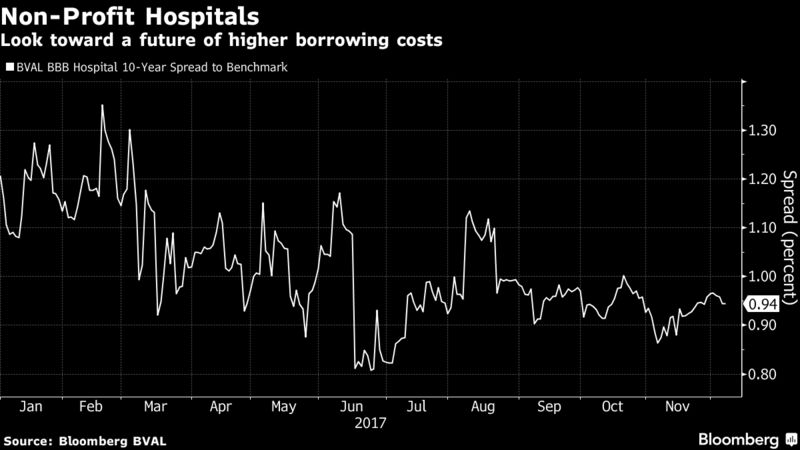
That may soon be an expense that other hospitals across the country will have to shoulder. The House’s tax legislation revokes non-profit hospitals’ ability to raise money in the municipal market, where investors are willing to accept lower interest rates because the income is exempt from federal taxes. That’s threatening to saddle health-care providers with higher borrowing costs at a time when their finances are already under pressure.

“Should tax-exempt financing not be available in the future, it may really harm our ability to build affordable senior housing and assisting living facilities,” said Michael Schafer, Spooner Health’s CEO.

For small, rural hospitals across the country, labor, drug, and technology costs are increasing faster than the revenue and patients’ unpaid debts are on the rise. Higher financing costs would be one more challenge.

David Hammer, head of municipal bond portfolio management for Pacific Investment Management Co., said the loss of the tax-exemption could raise borrowing costs by 1 to 2 percentage points at small facilities with a BBB rating or below. That “could have a meaningful impact on their balance sheets,” he said.

At least 26 non-profit hospitals are already either in default or distress, meaning they’ve notified bondholders of financial troubles that make bankruptcy more likely, according to data compiled by Bloomberg. That includes falling short of financial terms set by their debt agreements and having too little cash on hand.

Many of them are based in rural communities where the populations tend to be “older, poorer and sicker,” according to Margaret Elehwany, the vice president of government affairs and policy at the National Rural Health Association. She estimates that about 44 percent of rural hospitals operate at a loss. There have been at least seven municipal bankruptcy filings by hospitals since last year, the most of any municipal sector excluding Puerto Rico.

The risk that Congress will prevent hospitals from accessing the municipal market worries Dennis Reilly, the executive director of the Wisconsin Health & Educational Facilities Authority, an agency that issues debt for non-profits such as Spooner Health.

“All of us in the industry were completely blindsided by the House proposal,” Reilly said in an interview from Washington, where he was meeting with members of Congress about the proposed bill.

“Without tax-exempt financing, not-for-profits across the country will have increased borrowing costs of 25 to 35 percent because they’ll have to access the taxable market,” he said. “For many of the rural providers like Spooner, much of their project they would not have been able to do with the higher cost of capital.”

A Rush to Beat the Clock

Hospitals are among those rushing to issue tax-exempt debt while they still can. Mercy Health, a Catholic health-care system that operates in Ohio and Kentucky, is scheduled to sell $585 million tax-exempt bonds next week. The deal, originally planned for early next year, was moved up after the release of the House proposal.

Spending more on debt would cut into the funds available for facilities, equipment and charitable outreach, like programs for opioid addiction, according to Jerome Judd, Mercy’s senior vice president and treasurer. “Things like that are impacted,” he said.

At least some members of Congress share the hospital executives’ concerns. Last month, some Republican lawmakers sent a letter to leadership pushing for the final plan to preserve the ability of hospitals and other entities, like affordable housing agencies and universities, to issue tax-exempt bonds.

“Private activity bonds finance exactly the sort of private public partnerships of which we need more of, not less,” they wrote. “These changes are incompatible with President Trump’s priority for infrastructure investment in the United States.”

It’s Tough to be Small

Some hospitals already opt to sell their bonds in the taxable municipal market to avoid disclosures and restrictions over how the proceeds are used, though they are typically larger entities that can secure advantageous rates because of the size of their deals. Patrick Luby, a municipal analyst at CreditSights, said smaller clinics with only a few million of bonds to sell would have a hard time accessing that market, which attracts corporate debt investors accustomed to big issues.

“Even what we would consider a large deal in the muni market is almost an odd lot in corporate bonds,” he said. “Very large hospital chains, large household name universities — global investors will buy those names, but they’re not going to buy a $15, $25, $50 million local hospital.”

If the House plan is enacted, hospitals “will have a really difficult time accessing the market,” he said.


AARP: Congress must prevent ‘sudden cut’ to Medicare in 2018

AARP: Congress must prevent ‘sudden cut’ to Medicare in 2018

Image result for medicare cuts

The AARP is urging House and Senate leaders to waive congressional rules so the Republican tax bill doesn’t trigger deep cuts to Medicare.

If Republicans pass their tax bill, which would add an estimated $1 trillion to the federal deficit, congressional “pay-as-you-go” rules would require an immediate $150 billion in mandatory spending cuts to offset the impact.

“The sudden cut to Medicare provider funding in 2018 would have an immediate and lasting impact, including fewer providers participating in Medicare and reduced access to care for Medicare beneficiaries,” AARP said in a letter sent to congressional leaders Thursday.

Under the bill, according to the Congressional Budget Office, Medicare would be faced with a $25 billion cut in fiscal 2018.

But Senate Majority Leader Mitch McConnell (R-Ky.) and Speaker Paul Ryan (R-Wis.) have promised the cuts won’t happen.

In a joint statement sent just ahead of the Senate vote on the tax bill last week, Ryan and McConnell said there is “no reason to believe that Congress would not act again to prevent a sequester, and we will work to ensure these spending cuts are prevented.”

Lawmakers have voted numerous times in the past to waive the rule, and even House conservatives have said they’ll likely support a waiver once the tax bill passes.

“I can’t imagine any scenario where there’s not a waiver for PAYGO,” House Freedom Caucus Chairman Mark Meadows (R-N.C.) said Wednesday. “It’s using a hammer when maybe a scalpel would do.”

But in the Senate at least, Republicans will need the support of Democrats to waive the rules. So far, they have been reluctant to offer it.


ObamaCare fight could threaten shutdown deal

ObamaCare fight could threaten shutdown deal

ObamaCare fight could threaten shutdown deal

A fight over ObamaCare is spilling into Congress’s December agenda, threatening lawmakers’ ability to keep the government open.

President Trump signed stopgap legislation Friday aimed at averting a shutdown and keeping the government funded through Dec. 22. The bill allows lawmakers to focus on the next — and seemingly more difficult — negotiating period.

Lawmakers on both sides of the aisle have a host of priorities they want to include in the bill, but the question of funding ObamaCare’s cost-sharing reduction (CSR) payments appears to have divided Republicans.

Senate Republicans want to include the cost-sharing payments in the spending package, but House conservatives have little interest in funding subsidies they see as bailing out a law they despise.

Senate Republican leaders view the payments as a necessary bargaining chip.

In order to pass their tax-reform bill and get a much-needed legislative victory, Senate Majority Leader Mitch McConnell (R-Ky.) made a deal with Sen. Susan Collins (R-Maine), a key swing vote.

In exchange for Collins’s vote for the tax bill, McConnell gave an “ironclad commitment” to pass a pair of bipartisan bills.

One bill, sponsored by Sens. Lamar Alexander (R-Tenn.) and Patty Murray (D-Wash.), would temporarily fund the cost-sharing payments. Another would provide “reinsurance” — money to pay for the costs of sick enrollees and bring down premiums.

Together, the bills would shore up ObamaCare’s insurance markets, which experts predict could be gutted by a provision of the tax bill that repeals the mandate to buy health insurance.

But the commitment to Collins came from McConnell, who can’t force the House to take up legislation. Speaker Paul Ryan (R-Wis.) hasn’t given any indication that he would support passing the ObamaCare bills, though he also hasn’t ruled it out.

“I wasn’t part of those conversations,” Ryan told reporters Thursday when was asked about McConnell’s promise to Collins. “I’m not deeply familiar with those conversations.”

Earlier in the week, Ryan reiterated his commitment to repealing ObamaCare, but didn’t tip his hand on the spending bill.

“We think health care is deteriorating. We think premiums are going up through the roof, insurers are pulling out and that’s not a status quo we can live with,” Ryan said.

House conservatives have also said they have little energy for passing a government funding bill that contains any ObamaCare provisions.

“None of us voted in favor of ObamaCare, so supporting it, sustaining it’s not exactly a high objective,” said Rep. Tom Cole (R-Okla.), a leadership ally.

Rep. Mark Walker (R-N.C.), chairman of the conservative Republican Study Committee, said that he had been assured by House leaders that ObamaCare payments would not be attached to the next funding bill.

“The three things that we’ve been told are not going to happen as part of our agreement: no CSRs, no DACA, no debt limit,” Walker said, referring to the Deferred Action for Childhood Arrivals (DACA) program, which offered protections for immigrants brought into the country illegally as children. Trump ended the program with a six-month delay in September.

When asked about any assurances made to Walker, Ryan’s office declined to comment on member discussions.

Separately, Walker said any effort to add ObamaCare provisions to the spending bill would cost Republicans more votes from the GOP than they would gain with Democratic lawmakers.

If the Senate includes ObamaCare payments in the funding package, it could force a showdown with House Republicans, who would be under pressure to pass the Senate’s bill or risk a shutdown.

For now, Democrats are trying to maximize their leverage and are content to let Republicans fight among themselves.

Republicans need at least eight Democrats to break a filibuster in the Senate for any spending bill, and often rely on Democrats to make up for GOP defections in the House.

Alexander, who has long pushed for his bill to be included in a year-end spending bill, dismissed the idea that Republican senators need to pressure their House colleagues.

“The president’s for it, Sen. McConnell’s for it, most Republicans in the House have voted for both two years of cost sharing” and reinsurance in the past, Alexander said. “I feel pretty good about it.”


Healthcare lobbyists not optimistic on changing GOP tax bill

http://www.modernhealthcare.com/article/20171206/NEWS/171209899

Image result for big axe

Healthcare lobbyists are scrambling to win changes in congressional Republican tax legislation, as Senate and House GOP leaders race to merge their separate bills into something both chambers can pass on a party-line vote this month.

But provider, insurer and patient advocacy groups doubt they can convince Republicans to remove or soften the provisions they find most objectionable. They say GOP leaders are moving too fast and providing too little opportunity for healthcare stakeholders to provide input.

“It’s a madhouse,” said Julius Hobson, a veteran healthcare lobbyist with the Polsinelli law firm. “What you worry about is this will get done behind closed doors, even before they start the conference committee process.”

One factor that could slow the rush to pass the Tax Cuts and Jobs Act is the need to pass a continuing resolution this week to fund the federal government and prevent a shutdown. Unlike with the tax bill, Republicans need Democratic support for that, and it’s not clear they’ll make the concessions Democrats are demanding.

Industry lobbyists are particularly targeting provisions in the House and Senate tax bills limiting tax-exempt financing for not-for-profit hospitals and other organizations; repealing the Affordable Care Act’s tax penalty for not buying health insurance; ending corporate tax credits for the cost of clinical trials of orphan drugs; and taxing not-for-profit executive compensation exceeding $1 million.

If the ACA’s insurance mandate is repealed, “our plans will have to evaluate whether they can stay in the individual market or not based on what it does to enrollment and the risk profile of people who choose to stay,” said Margaret Murray, CEO of the Association for Community Affiliated Plans, which represents safety net insurers.

AARP and other consumer lobbying groups are fighting to save the household deduction for high healthcare costs, which the House version of the Tax Cuts and Jobs Act would abolish.

Healthcare lobbyists also are warning lawmakers that capping or ending the federal tax deduction for state and local taxes will force many states to cut Medicaid. Beyond that, they say slashing taxes and increasing the federal deficit will trigger immediate Medicare budget sequestration cuts that would hurt providers and patients, particularly in rural and low-income areas.

“One in three rural hospitals are at financial risk of closure, and sequestration would be devastating for them,” said Maggie Elehwany, vice president of government affairs for the National Rural Health Association. “I’d love to say our message is getting through. But Congress is completely tone-deaf on how troubling the situation in rural America is.”

Hospital groups, led by the American Hospital Association, are battling to preserve tax-exempt bond financing for not-for-profit organizations, which the House bill would zero out. While the Senate bill would keep the tax exemption for interest income on new municipal private activity bonds, both the Senate and House bills would prohibit advance re-funding of prior tax-exempt bond issues.

Hospitals say ending or limiting tax-exempt bond financing would jack up their borrowing costs and hurt their ability to make capital improvements, particularly for smaller and midsize hospital systems. The Wisconsin Hospital Association projected that ending tax-exempt bond financing would increase financing costs by about 25% every year.

According to Merritt Research Services, outstanding end-of-year hospital debt totaled nearly $301 billion in long-term bonds and nearly $21 billion in short-term debt. Nearly all of that debt was issued as tax-exempt bonds.

Suggesting a possible compromise, Rep. Kevin Brady (R-Texas), chairman of the House Ways and Means Committee, said Tuesday that he saw “a good path going forward” to preserve tax-exempt private activity bonds “that help build and enhance the national infrastructure.”

But Hobson raised questions about Brady’s comments. “What is his definition of infrastructure?” he asked. “It suggests they may move away from a blanket repeal, but it doesn’t tell me where they’re going.”

If Republicans decided not to repeal the tax exemption for municipal bond interest income, however, they would have to scale back some of their pet tax cuts for corporations and wealthy families, even as they feel pressure to ease unpopular provisions such as ending the deductibility of state and local taxes. That could make it hard for hospital lobbyists to gain traction on this issue.

“There are a lot of giveaways in the bills that don’t leave a lot of room to recoup the money you lose,” Hobson said.

Some lobbyists hold out a faint hope that the Republicans’ tax cut effort could collapse as a result of intra-party differences, as did their drive to repeal and replace the Affordable Care Act.

One possibility is that Maine Sen. Susan Collins flips and votes no on the tax cut bill emerging from the conference committee if congressional Republicans fail to pass two bipartisan bills she favors to stabilize the individual insurance market.

Collins said she’s received strong assurances from Senate Majority Leader Mitch McConnell and President Donald Trump that they will support the bills to restore the ACA’s cost-sharing reduction payments to insurers and establish a new federal reinsurance program that would lower premiums.

But the fate of those bills is in doubt, given that House Speaker Paul Ryan (R-Wis.) was noncommittal this week, while House ultraconservatives have come out strongly against them.

Collins conceivably could be joined by Alaska Sen. Lisa Murkowski, who also said she wants to see the market stabilization bills passed. If Tennessee Sen. Bob Corker, who voted no on the tax cut bill over deficit concerns, remains opposed, those three GOP senators could sink the tax bill.

“We’d all like to see Collins pull her vote,” Hobson said. “It was always clear that the deal she cut with McConnell won’t fly on the House side.”

One healthcare lobbyist who didn’t want to be named said there may be a deal in the works for House conservatives to support market-stabilization legislation in exchange for lifting budget sequestration caps on military spending.

But healthcare lobbyists are not holding their breath on winning major changes or seeing the tax bill collapse.

“There are chances they won’t reach a deal,” said Robert Atlas, president of EBG Advisors, which is affiliated with the healthcare law firm Epstein Becker Green. “By the same token, Republicans are so determined to pass something that they might just come together.”

AARP to Congress: Don’t Cut Medicare

https://www.aarp.org/politics-society/advocacy/info-2017/medicaid-medicare-tax-reform-fd.html?cmp=EMC-DSO-NLC-WBLTR—MCTRL-120817-F1-2613065&ET_CID=2613065&ET_RID=33152417&mi_u=33152417&mi_ecmp=20171208_WEBLETTER_Member_Control_Winner_251100_391403&encparam=rGtTYC48LtlDepUYFPD2E6KmzkAw6WgcgwvDlv37DZs%3D

Image result for AARP to Congress: Don’t Cut Medicare

The tax bill would trigger an automatic funding cut in the vital program.

AARP Chief Executive Officer Jo Ann Jenkins called on congressional leaders Thursday to keep their promise to America’s seniors and prevent a large cut to Medicare that the tax bill now being debated on Capitol Hill would trigger.

The tax measure would result in a $1.5 trillion increase in the federal deficit over the next decade, according to the nonpartisan Congressional Budget Office (CBO). Such a deficit would prompt an automatic $25 billion cut to Medicare as soon as January because of the “pay-as-you-go” law, commonly referred to as PAYGO.

The law was designed to keep the deficit in check by requiring the administration to reduce spending in many mandatory federal programs if Congress enacts a law that increases the deficit but doesn’t provide offsetting revenue.

In a letter to Senate Majority Leader Mitch McConnell, Minority Leader Charles Schumer, House Speaker Paul Ryan and Minority Leader Nancy Pelosi, Jenkins reminded McConnell and Ryan that they had recently issued a statement promising that “we will work to ensure these spending cuts are prevented.”

In their statement, the Republican leaders pointed out that the PAYGO law has never been enforced since it was passed in 2010 and “we have no reason to believe that Congress would not act again” to forestall the cuts PAYGO would require.

Medicaid, Social Security, food stamps and some other social safety net programs are exempt from the PAYGO law. But Medicare and programs like federal student loans, agricultural subsidies and the operations of U.S. Customs and Border Protection are not exempt.

The law caps how much the government can trim from Medicare at 4 percent. That’s $25 billion the first year, according to CBO. The amount could be higher in subsequent years, depending on the size of the deficit and Medicare’s budget.

The reduction would affect the payments that doctors, hospitals and other health care providers receive for treating Medicare patients. Individual benefits would not be directly cut, but the reduction could have implications for the care beneficiaries receive.

“The sudden cut to Medicare provider funding in 2018 would have an immediate and lasting impact, including fewer providers participating in Medicare and reduced access to care for Medicare beneficiaries,” Jenkins wrote. Health care providers might stop taking Medicare patients, she added, even as 10,000 older adults are enrolling in the health program each day.

In addition, Medicare Advantage plans and Part D prescription drug plans may compensate for the cuts by charging higher premiums or shifting more costs to beneficiaries in future years.

“Our members and other older Americans are counting on you to preserve their access to Medicare services, including their doctors and hospitals,” Jenkins wrote.