Five Worrisome Trends in Healthcare

https://www.medpagetoday.com/publichealthpolicy/healthpolicy/72001?pop=0&ba=1&xid=fb-md-pcp&trw=no

Image result for five worrisome trends in healthcare

A reckoning is coming, outgoing BlueCross executive says.

A reckoning is coming to American healthcare, said Chester Burrell, outgoing CEO of the CareFirst BlueCross BlueShield health plan, here at the annual meeting of the National Hispanic Medical Association.

Burrell, speaking on Friday, told the audience there are five things physicians should worry about, “because they worry me”:

1. The effects of the recently passed tax bill. “If the full effect of this tax cut is experienced, then the federal debt will go above 100% of GDP [gross domestic product] and will become the highest it’s been since World War II,” said Burrell. That may be OK while the economy is strong, “but we’ve got a huge problem if it ever turns and goes back into recession mode,” he said. “This will stimulate higher interest rates, and higher interest rates will crowd out funding in the federal government for initiatives that are needed,” including those in healthcare.

Burrell noted that 74 million people are currently covered by Medicaid, 60 million by Medicare, and 10 million by the Children’s Health Insurance Program (CHIP), while another 10 million people are getting federally subsidized health insurance through the Affordable Care Act’s (ACA’s) insurance exchanges. “What happens when interest’s demand on federal revenue starts to crowd out future investment in these government programs that provide healthcare for tens of millions of Americans?”

2. The increasing obesity problem. “Thirty percent of the U.S. population is obese; 70% of the total population are either obese or overweight,” said Burrell. “There is an epidemic of diabetes, heart disease, and coronary artery disease coming from those demographics, and Baby Boomers will see these things in full flower in the next 10 years as they move fully into Medicare.”

3. The “congealing” of the U.S. healthcare system. This is occurring in two ways, Burrell said. First, “you’ll see large integrated delivery systems [being] built around academic medical centers — very good quality care [but] 50%-100% more expensive than the community average.”

To see how this affects patients, take a family of four — a 40-year-old dad, 33-year-old mom, and two teenage kids — who are buying a health insurance policy from CareFirst via the ACA exchange, with no subsidy. “The cost for their premium and deductibles, copays, and coinsurance [would be] $33,000,” he said. But if all of the care were provided by academic medical centers? “$60,000,” he said. “What these big systems are doing is consolidating community hospitals and independent physician groups, and creating oligopolies.”

Another way the system is “congealing” is the emergence of specialty practices that are backed by private equity companies, said Burrell. “The largest urology group in our area was bought by a private equity firm. How do they make money? They increase fees. There is not an issue on quality but there is a profound issue on costs.”

4. The undermining of the private healthcare market. “Just recently, we have gotten rid of the individual mandate, and the [cost-sharing reduction] subsidies that were [expected to be] in the omnibus bill … were taken out of the bill,” he said. And state governments are now developing alternatives to the ACA such as short-term duration insurance policies — originally designed to last only 3 months but now being pushed up to a year, with the possibility of renewal — that don’t have to adhere to ACA coverage requirements, said Burrell.

5. The lackluster performance of new payment models. “Despite the innovation fostering under [Center for Medicare & Medicaid Innovation] programs — the whole idea was to create a series of initiatives that might show the wave of the future — ACOs [accountable care organizations] and the like don’t show the promise intended for them, and there is no new model one could say is demonstrably more successful,” he said.

“So beware — there’s a reckoning coming,” Burrell said. “Maybe change occurs only when there is a rip-roaring crisis; we’re coming to it.” Part of the issue is cost: “As carbon dioxide is to global warming, cost is to healthcare. We deal with it every day … We face a future where cutbacks in funding could dramatically affect accessibility of care.”

“Does that mean we move to move single-payer, some major repositioning?” he said. “I don’t know, but in 35 years in this field, I’ve never experienced a time quite like this … Be vigilant, be involved, be committed to serving these populations.”


This Tweet Captures the State of Health Care in America Today

Image result for This Tweet Captures the State of Health Care in America Today

A nightmarish accident on a Boston subway platform on Friday — described in gory detail by a local reporter, Maria Cramer, as it unfolded and quickly retweeted by thousands — is one you might expect to see in an impoverished country.

In the face of a grave injury, a series of calculations follow: The clear and urgent need for medical attention is weighed against the uncertain and potentially monumental expense of even basic services, like a bandage or a ride to the hospital, and that cost, in turn, weighed against all the known expenses of living that run through any given head on any given day.

This discord, between agony and arithmetic, has become America’s story, too.

The United States spends vastly more on health care than other industrialized countries, nearly 17 percent of the nation’s gross domestic product in 2014, according to a report by the Commonwealth Fund, compared with just 10 percent of G.D.P. in Canada and Britain. But that disparity is not because Americans use more medical services — it’s because health care is far more expensive here than in other countries. One 2010 study by the Organization for Economic Cooperation and Development found that hospital costs were 60 percent higher in the United States than in 12 other nations.

And that cost is often passed on to patients, either in the form of deductibles and other out-of-pocket expenses or through ever-soaring insurance premiums.

The Affordable Care Act has improved access to health care, especially for lower-income families that now qualify for Medicaid or subsidies to buy private health insurance. Wider access, however, has not come cheaply for most people. As a result, many Americans, including those who are insured, have determined that they must avoid going to the hospital, visiting doctors or filling prescriptions that they need. A 2017 Kaiser Family Foundation survey found that 43 percent of people with insurance said that they struggled affording their deductibles, and 27 percent said that they put off getting care because of cost. Turning to GoFundMe and other crowdsourcing websites has become the norm in medical crises.

Whether the woman on the train platform received the medical attention she needed is unknown. Ms. Cramer said on Monday that she had not been able to get an update on the woman’s condition yet. Ms. Cramer went on to tweet that after several minutes had passed, an ambulance still had not arrived. Instead, fellow passengers tried to help. “One man stood behind her so she could lean against him,” she wrote. “Another pressed cold water bottles to her leg.”

Health care is a complicated problem, one exacerbated by the gridlock in Washington. But the trade-offs that everyday people are being asked to make, the calculations they are being forced to undertake in the scariest of situations, suggest that far too many of America’s politicians have placed too little value on the well-being of its citizens. Nothing will change until their fellow citizens step into the ballot box and insist on something better.


More Americans Paid for ACA Plans This Year — and More Are Getting Priced Out

https://www.thefiscaltimes.com/2018/07/03/More-Americans-Paid-ACA-Plans-Year-and-More-Are-Getting-Priced-Out


President Trump has declared that Obamacare is finished, dead, gone, essentially repealed. And yet, despite the administration’s efforts to undermine the law’s marketplaces, the number of Americans who enrolled in and started paying for Affordable Care Act plans grew slightly this year, according to reports released Monday by the Centers for Medicare and Medicaid Services (CMS).

At the same time, rising premiums are taking a toll, forcing many middle-income Americans — individuals making more than about $48,000 a year, or families of four making more than about $100,000 — to drop coverage. “Taken together, these reports show that state markets are increasingly failing to cover people who do not qualify for federal subsidies even as the Exchanges remain relatively stable,” CMS said.

Here’s a look at what the new reports show:

* While the total number of people who picked a plan for 2018 fell, the number of people who paid for coverage rose from 10.3 million in February 2017 to 10.6 million this past February, an increase of about 3 percent. “The increase is striking because it happened even though federal health officials last year slashed ACA funding to grass-roots groups that help consumers sign up for coverage, cut advertising and other outreach activities by 90 percent, and shortened the enrollment period by half,” writes Amy Goldstein at The Washington Post.

* CMS argued that, based on historical trends, a “significant number” of people will wind up dropping coverage during the year even after making their initial payments. Of the 10.3 million who paid for their plans as of March 15, 2017, only 8.9 million were still in those plans by the end of the year. “This is likely caused by consumers struggling to pay premiums as costs continue to increase,” the CMS report said.

* A larger share of enrollees has been getting federal subsidies. In 2014, the first year Affordable Care Act plans became available, 55 percent of those enrolled in individual market plans on or off the new Obamacare exchanges got financial help, according to Bloomberg. Last year, 62 percent did. In all, more than 8 million people got subsidies last year, while 5 million bought individual plans without financial help. “When premiums rise a lot, a lot more people become eligible for subsidies,” Matthew Fiedler, a fellow at the U.S.C.-Brookings Schaeffer Initiative for Health Policy, told The New York Times.

* As insurance prices rose by an average of 21 percent last year, signups among people who did not qualify for subsidies fell by 1.3 million — a drop of 20 percent compared with 2016. Subsidized enrollees fell by just 3 percent. “These reports show that the high-price plans on the individual market are unaffordable and forcing unsubsidized middle-class consumers to drop coverage,” CMS Administrator Seema Verma said in a statement. Trump administration policies may have played a part in the decline, too, and some people may have stopped buying their own insurance because they found jobs with employer coverage. “But it’s reasonable to think that most of the attrition can be attributed to the spike in prices, as the Trump administration concludes,” writes Margot Sanger-Katz of The New York Times.

What it all means: “The individual health insurance market under the ACA is financially sustainable as subsidies rise to match premium increases,” Larry Levitt of the Kaiser Family Foundation tweeted. “However, the lack of affordable insurance for middle-class people ineligible for subsidies does not seem politically sustainable.”


Preexisting Conditions Can Define Your Future

http://www.philly.com/philly/health/health-costs/pre-existing-condition-protections-aca-lawsuit-20180628.html

Image result for preexisting conditions


How Policy, Business Decisions in Iowa Led to Higher Premiums

https://www.commonwealthfund.org/blog/2018/policy-decisions-iowa?omnicid=EALERT%%jobid%%&mid=%%emailaddr%%

Map of Iowa where premiums are higher due to policy decisions

This year, Iowa’s legislature took the extraordinary step of abdicating the state’s authority to regulate health insurance products. The bill, enacted in April, exempts health plans offered by the state’s Farm Bureau from state and federal insurance regulation, including Affordable Care Act (ACA) provisions designed to protect people with preexisting conditions and provide a minimum standard of benefits.

Proponents argue that such a law is needed to provide individual market consumers with cheaper health plan options than available under the ACA. Critics point out that younger, healthier consumers are most likely to benefit from these plans. And while details haven’t been provided yet, the Farm Bureau plans are expected to be medically underwritten, and not cover the ACA’s minimum set of benefits. As a result, older Iowans, those with preexisting conditions, and those who need comprehensive coverage are unlikely to find these plans affordable or attractive. And many could be denied enrollment outright. As enrollment in the ACA-compliant individual market becomes older and sicker, marketplace consumers who do not qualify for the ACA’s income-related premium subsidies will face increasingly higher premiums.

Iowa’s Farm Bureau statute is making a bad situation worse for the state’s individual market. Thanks to a number of decisions by state policymakers and the dominant insurance company – Wellmark Blue Cross Blue Shield – premiums in the state’s individual market are already among the highest in the country, with an average annual marketplace plan premium in excess of $10,000 in 2018.

A Study of Market Failure: Iowa’s Individual Health Insurance Market

The current dismal state of the ACA individual market in Iowa was not a foregone conclusion. In 2014, when the marketplaces launched, Iowa had four insurers competing in the ACA’s marketplace. In 2018, only one insurer is selling ACA-compliant health plans; it agreed to do so only after implementing an average 50 percent increase to unsubsidized premiums.

Iowa’s marketplace enrollment has also lagged that of other states. As of 2016, only 20 percent of eligible Iowans had enrolled (by comparison, that number was 40 percent in Illinois, 43 percent in Missouri, and 57 percent in Maine). Iowa is an outlier for a critical reason. Wellmark BlueCross BlueShield declined to participate in the marketplace for the first three years, entered only briefly in 2017 and then declined to participate in 2018, but is returning to the market in 2019. The insurer also maintained a large block of pre-ACA grandfathered and transitional, or “grandmothered,” health plans (see table).

Because the enrollees in these plans must pass a health screen before being allowed to enroll, they are relatively healthy. Because Wellmark was able to hang on to these healthy enrollees, the pool of people available for the ACA-compliant market was much smaller and sicker than it otherwise would have been.

Affordable Care Act Grandfathered and Grandmothered Health Plans
Grandfathered health plans Policies in effect before the March 2010  enactment of the ACA;  not subject to ACA standards and protections. Although these policies can be renewed indefinitely as long as they do not undergo substantial changes, they can’t be newly issued.
Grandmothered (transitional) health plans Policies issued after the ACA’s 2010 enactment but before 2014. Policies are not required to meet critical ACA protections.

Grandfathered and Grandmothered Policies: Policy and Business Choices with Long-Term Consequences

Due to the transitional nature of the individual market and the high administrative costs of maintaining grandfathered health plans, many insurers — other than Wellmark — discontinued these products over time. And unlike several states that prohibited these policies in order to ensure a healthier, more stable individual market, Iowa’s leadership embraced the Obama administration’s decision to allow the renewal of grandmothered health plans. Iowa stands out even among states that did not ban such plans:  an estimated 38,000 people remained in grandmothered policies as late as 2018. Indeed, approximately 60 percent of Iowans buying insurance on their own stayed with pre-ACA grandfathered or grandmothered health plans.

Left with a smaller and sicker pool of enrollees than they had projected, it is therefore not surprising that the insurers remaining in the market needed significant premium increases. The premium hike implemented in 2018 likely drove as many as 26,000 Iowans to drop their coverage this year.

Enrollment and Premiums Had Iowa Taken a Different Path

What if Iowa had taken a different path? If Wellmark had, like many other insurers, discontinued its grandfathered policies, and if the state had prohibited grandmothered plans, the individual market would be a lot healthier than it is today. In fact, doing so would have added up to 85,000 people to Iowa’s ACA-compliant market, according to a new estimate by Wakely Consulting Group. Those added enrollees, because they are relatively healthy, would have reduced average premiums for ACA-compliant plans by up to 18 percent (see table).1

Enrollment and Premiums in ACA-Compliant Market Due to Improved Risk Pool
  Without Grandfathered Plans Without Grandmothered Plans Without Grandfathered or Grandmothered Plans
Total change in ACA-compliant enrollment +25,000 to 40,000 +30,000 to 45,000 +55,000 to 85,000
Change in premiums -5% to -12% -5% to -12% -8% to -18%

Analysis by Wakely Consulting Group. Numbers have been rounded.

Looking Ahead

Iowa’s experience offers important lessons. The more the individual market is segmented between healthy and the less-healthy consumers, the more likely unsubsidized enrollees are to face unaffordable premiums. Federal proposals such as those to expand the availability of short-term and association health plans, to the extent they are not limited by state policies, could result in more state individual markets resembling Iowa’s. The primary losers in such a scenario are the working middle-class consumers: entrepreneurs who run their own businesses, freelancers and consultants, farmers and ranchers, and early retirees who earn too much to qualify for the ACA’s premium subsidies.

State leaders can protect these families by adopting policies that will expand the risk pool and maintain a balance between healthy and less-healthy enrollees. A number of states have already done so, through state-level reinsurance programs, expanded annual enrollment opportunities, and limits on short-term and association health plans. It’s not too late for other states to follow their lead.


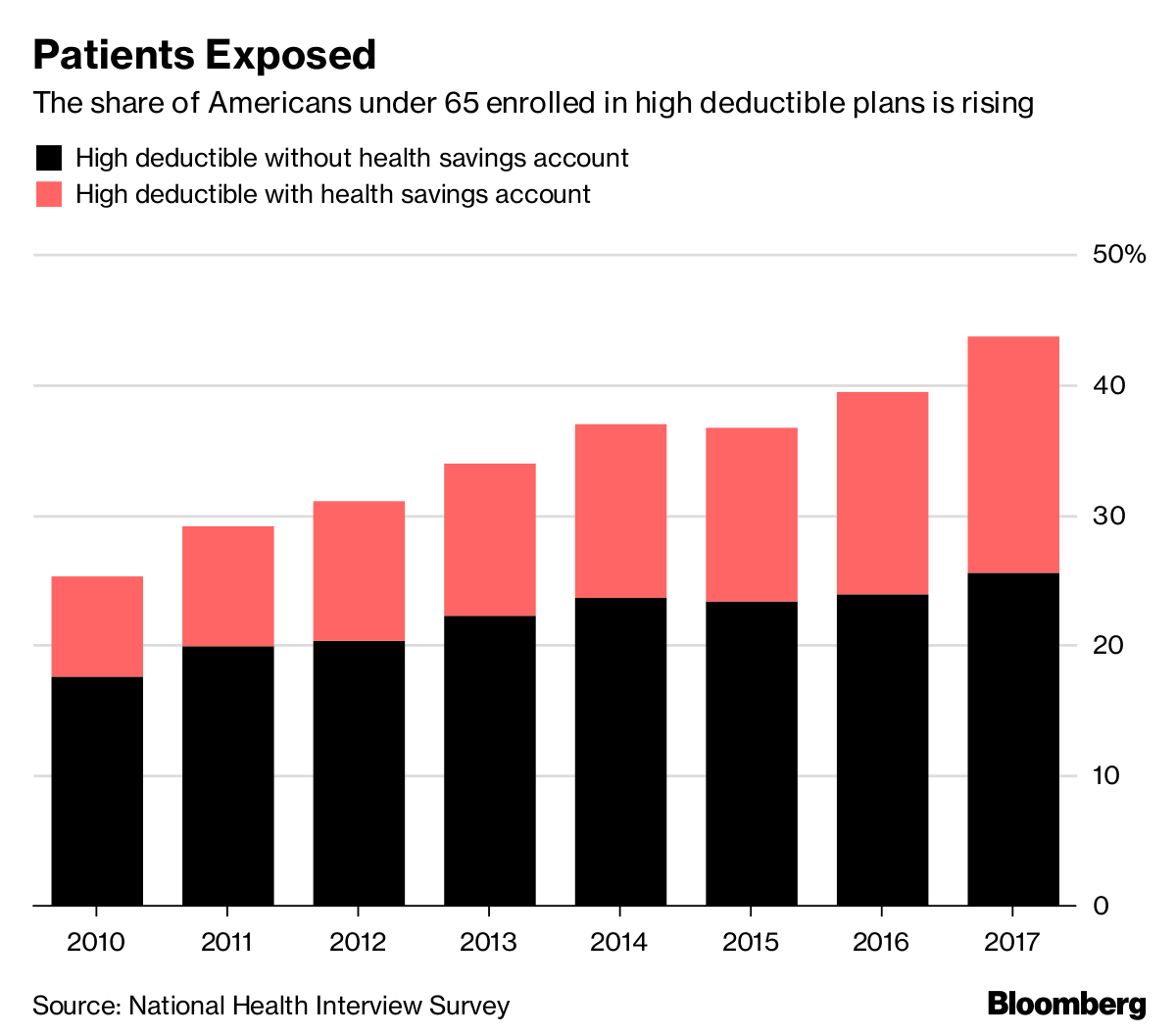
Sky-High Deductibles Broke the U.S. Health Insurance System

https://www.bloomberg.com/news/features/2018-06-26/sky-high-deductibles-broke-the-u-s-health-insurance-system

Image result for Sky-High Deductibles Broke the U.S. Health Insurance System


Image result for Sky-High Deductibles Broke the U.S. Health Insurance System


Should States Allow Insurers to Offer Bare-Bones Health Plans With Fewer Mandated Benefits?

Health insurance is complicated. In many states, it’s about to get worse.

Image result for skinny health plans


Health insurance is complicated. In many states, it’s about to get worse.

That’s the opening of a piece of mine in the Wall Street Journal (gated, unfortunately) about what states should do in response to the Trump administration’s anticipated relaxation of rules governing short-term plans.

Where states allow short-term plans without restriction, the plans will be a lot cheaper than those sold on the exchanges because they don’t have to comply with the ACA. But that low price comes with big tradeoffs.

Short-term plans don’t have to sell to all comers, nor do they have to cover pre-existing conditions. Sick people will have no real choice but to buy insurance on the exchanges. To cover the medical costs of a relatively sicker group of people, exchange insurers will have to increase their premiums.

People who earn less than four times the poverty level will be shielded from the price increases because the ACA caps premiums at no more than about 10% of income. The federal government, however, has to pick up the rest of the tab-so as prices go up, federal outlays will, too, squandering an estimated $38.7 billion over 10 years.

Hurt worst will be people who earn more than four times the poverty level. Federal actuaries estimate that they’ll pay 6% more on account of the short-term rule by 2022. That will come on top of price increases associated with Congress’s repeal of the individual mandate. In 2019 alone, the Urban Institute predicts that insurance prices will grow, on average, by about 18%.

Beyond that, people who buy short-term plans may be surprised to discover just how stingy they are. Insurance is complicated: people rarely read, much less understand, all the fine print. And there’s a lot of fine print.

Squeeze On Affordable Health Insurance For 50- To 64-Year-Olds

https://www.forbes.com/sites/howardgleckman/2018/06/21/the-trump-administrations-squeeze-on-affordable-health-insurance-for-50-64-year-olds/#4ea0538b1d94

Image result for high health premiums

In a series of recent decisions, the Trump Administration is taking steps that will sharply raise insurance premiums for people aged 50 to 64, just before they become eligible for Medicare. While these steps are likely to make coverage less expensive for young, healthy consumers, they will inevitably raise costs for middle-aged people with chronic conditions. For many, insurance will become unaffordable. And that lack of coverage will eventually result in higher costs for Medicare.

Trump is taking three major steps that will affect the availability of Affordable Care Act health insurance for middle-aged consumers.  

Repealing but not replacing

First, at the urging of the Trump Administration, Congress last year repealed the tax penalty that has to be paid by those without health insurance, effective for tax year 2019. The penalty is the ACA’s mechanism to push people to buy insurance. The logic: By broadening the pool of those with ACA insurance to include those less likely to incur significant medical costs, the individual mandate would keep premiums relatively low for everyone.

Then, early this month, the Trump Administration refused to defend the remaining provisions of the ACA in federal court. In the case Texas v. the federal Department of Health and Human Services, 20 red states argued that, absent the now-repealed individual mandate, the rest of the ACA will be unconstitutional. Thus, all its other provisions, including several important to those older consumers, also would be thrown out. They include premium limits for those 50-64, minimum benefit requirements,  and the ban on insurance companies rejecting potential purchasers due to pre-existing conditions.

Pre-existing conditions

Prior to the ACA, in a practice known as age-rating, 60-year-olds could pay premiums that were 11 times higher than younger buyers. The ACA capped that ratio at 3:1. AARP estimates that bumping it up to 5:1 would raise annual premiums for a 60-year-old by more than $3,000, or 22%.

Similarly, allowing carriers to underwrite for pre-existing conditions would make insurance widely unavailable for people aged 50 to 64. AARP estimates that 25 million people, or 40% of those 50 to 64, have a condition that could disqualify them from non-group insurance.

The Urban Institute’s Health Policy Center estimates that tossing out the remaining provisions of the ACA would result in 17 million people losing commercial insurance and another 15 million losing Medicaid and children’s health care under the CHIP program.

By Urban colleagues project that even those remaining  in the private individual insurance market “would likely have policies that cover fewer benefits and require more out-of-pocket spending for services.”

Rare agreement

The Texas lawsuit, and the Administration’s refusal to defend the law in court, has generated an outpouring of opposition. It created a rare moment when consumer groups, hospitals, and doctors agreed on a health policy issue.

But the story doesn’t end there. This week, the Trump Administration took one more step towards dismantling the ACA in a way that will likely harm pre-Medicare consumers: The Department of Labor adopted new rules opening the door to low cost, low-benefit health plans.  These will now be widely available to small businesses and, importantly, self-employed individuals.

The Congressional Budget Office estimates that 4 million people will buy these policies, sold by association health plans (AHPs). The consulting firm Avalere Health estimates that individual AHP premiums will be an average of $9,700 cheaper than ACA coverage, and that 1 million people will shift from marketplace plans to AHP policies. But it predicts premiums will rise by 3.5 percent for more comprehensive ACA insurance, largely because the remaining consumers will be older and sicker than AHP buyers.

President Trump promotes these plans as a less costly alternative to ACA coverage. This week he told the National Federation of Independent Business, “You’re going to save massive amounts of money and have much better health care. You’re going to save a fortune and you’re going to be able to give yourselves and your employees tremendous health care.”

Low cost, few benefits

But the plans do not include any minimum benefit requirements. Thus, they can exclude coverage for pregnancies, mental health issues, or drugs or hospital care. Carriers won’t be able to exclude buyers on the basis of pre-existing conditions but can adjust premiums based on age or sex. And, because they often exclude benefits important to those with chronic conditions, such as medications, they don’t need to underwrite: Those consumers simply won’t buy these policies.

Priced out of ACA coverage and uninterested in limited insurance that won’t cover their needs, it is easy to imagine many of those in their early 60s simply going without coverage (and care) until they become eligible for Medicare at age 65. That will not only put their health at risk, it will raise Medicare costs. Medicare spends about one-third more on medical care for those who join the program without having had insurance in the year before enrolling.

The result of all this: Trump is creating two separate individual health insurance markets, one for young and healthy people, and one for older and sick people.  Some young people may buy low-cost policies that will serve them well—until they get sick. Many older people won’t buy insurance at all, risking their health and, very likely, raising costs to government.


Perceptions of Affordability Among Individual Market Enrollees in California in 2017

Perceptions of Affordability Among Individual Market Enrollees in California in 2017

Image result for california healthcare foundation

In 2017 researchers at The Mongan Institute, Massachusetts General Hospital, and Harvard Medical School sought to answer the following questions: How affordable do Californians in the individual health insurance market perceive their insurance to be? How affordable do they perceive their out-of-pocket costs for medical care to be? How frequently do they report delaying or avoiding medical care because of costs? How frequently do they report cutting back on other necessities (like food, rent, other basics) or borrowing money to pay for care?

Researchers surveyed adult (age 18+) individual market enrollees in 2017 who selected qualified health plans through Covered California or outside of the Covered California marketplace (N = 2,912). The survey was conducted in English and Spanish, and respondents could complete the survey by telephone, web, or paper. The survey was fielded between May and October 2017 with a response rate of 42%.

Key Findings

1. On average, 40% of enrollees reported having some difficulty paying their monthly insurance premiums. Sicker enrollees and African American enrollees were more likely to report having difficulty.

2. On average, 31% of enrollees reported difficulty paying out-of-pocket costs when using health care. Similar to premium affordability, sicker enrollees and African American enrollees were more likely to report having difficulty.

3. Almost one in four enrollees (24%) who reported needing care delayed/avoided care due to costs.

4. Close to one in three (32%) enrollees reported some sort of financial stress due to health care costs: They reported cutting necessities, borrowing money, or both. This was more common among lower-income enrollees, African American enrollees, and sicker enrollees.