


Cartoon – Hey America! Want the Best Healthcare Plan in the World?

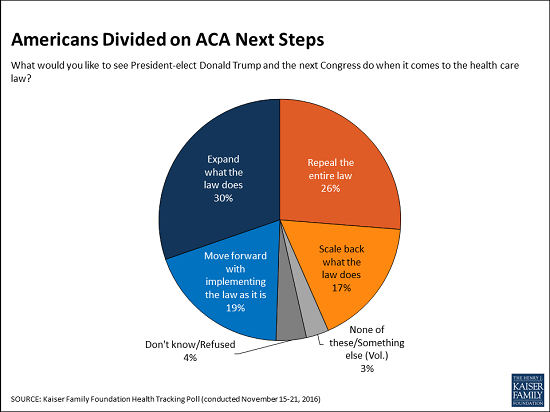
The first Kaiser Health Tracking Poll since the 2016 election finds that Americans are largely divided on the future of the Affordable Care Act even though many of the law’s major provisions remain quite popular across party lines.
The new survey finds that one fourth (26%) of Americans want to see President-elect Donald Trump and the next Congress repeal the entire law, and an additional 17 percent want them to scale back what the law does. This compares to 30 percent of the public who want to see the law expanded and 19 percent who want to see lawmakers move forward with implementing the law as it is.
The poll captures a slight uptick in the share of Americans who want lawmakers to scale back the law as well as a decrease in the share who want lawmakers to repeal the entire law. This is largely driven by Republicans: About half (52%) of Republicans now say they want to see the Affordable Care Act repealed, down from 69 percent in October. At the same time, a quarter (24%) of Republicans now want to see the law scaled back, up from 11 percent in October.
Among the quarter (26%) of Americans that want to see the Affordable Care Act repealed, 31 percent want to see the health care law just repealed and not replaced. About two-thirds wants lawmakers to repeal the health care law and replace it with a Republican-sponsored alternative, with 42 percent wanting lawmakers to wait to repeal it until the details of a replacement plan have been figured out and 21 percent wanting lawmakers to repeal it immediately and figure out a replacement plan later.
Among those who want the law repealed, 38 percent (or 10% of the public overall) change their opinion after hearing the argument that repealing the ACA would mean that insurance companies could deny coverage to people with pre-existing conditions. A slightly smaller share change their opinion after hearing that more than 20 million Americans could lose their coverage.

The drug companies always win, which is why Americans pay far more than citizens of any other country for prescription medications. We pay exactly 100 percent more per capita for pharmaceuticals than the average paid by citizens of the 33 other developed countries that comprise the Organization for Economic Cooperation and Development (OECD).
Obama also once supported drug re-importation, as did Sen. John McCain, the Arizona Republican who lost to Obama in the 2008 presidential election. In 2012, two years after the passage of the Affordable Care Act, McCain teamed up with Sen. Sherrod Brown, (D-Ohio) in another attempt to get Congress to pass a drug re-importation bill.
When it became clear that his bill would not pass, McCain took to the floor to denounce the ability of well-financed special interests to control the federal government.
“What you’re about to see is the reason for the cynicism that the American people have about the way we do business in Washington. (The pharmaceutical industry)… will exert its influence again at the expense of low-income Americans who will again have to choose between medication and eating.”
Don’t expect that to change anytime soon. As long as interest groups can spend unlimited amounts of money to influence elections and can hire hundreds of lobbyists to do their bidding, millions of Americans will have to decide between health care and eating, while executives and shareholders get richer and richer.

The 2010 Affordable Care Act (ACA) included many provisions affecting the Medicare program and the 57 million seniors and people with disabilities who rely on Medicare for their health insurance coverage. Such provisions include reductions in the growth in Medicare payments to hospitals and other health care providers and to Medicare Advantage plans, benefit improvements, payment and delivery system reforms, higher premiums for higher-income beneficiaries, and new revenues.
President-elect Donald Trump, Speaker of the House Paul Ryan, Health and Human Services (HHS) Secretary-nominee and current House Budget Committee Chairman Tom Price, and many other Republicans in Congress have proposed to repeal and replace the ACA, but lawmakers have taken different approaches to the ACA’s Medicare provisions. For example, the House Budget Resolution for Fiscal Year 2017, introduced by Chairman Price in March 2016, proposed a full repeal of the ACA. The House Republican plan, “A Better Way,” introduced by Speaker Ryan in June 2016, proposed to repeal some, but not all, of the ACA’s Medicare provisions.
This brief explores the implications for Medicare and beneficiaries of repealing Medicare provisions in the ACA. The Congressional Budget Office (CBO) has estimated that full repeal of the ACA would increase Medicare spending by $802 billion from 2016 to 2025.1 Full repeal would increase spending primarily by restoring higher payments to health care providers and Medicare Advantage plans. The increase in Medicare spending would likely lead to higher Medicare premiums, deductibles, and cost sharing for beneficiaries, and accelerate the insolvency of the Medicare Part A trust fund. Policymakers will confront decisions about the Medicare provisions in the ACA in their efforts to repeal and replace the law.
Pre-existing Conditions and Medical Underwriting in the Individual Insurance Market Prior to the ACA

Before private insurance market rules in the Affordable Care Act (ACA) took effect in 2014, health insurance sold in the individual market in most states was medically underwritten.1 That means insurers evaluated the health status, health history, and other risk factors of applicants to determine whether and under what terms to issue coverage. To what extent people with pre-existing health conditions are protected is likely to be a central issue in the debate over repealing and replacing the ACA.
This brief reviews medical underwriting practices by private insurers in the individual health insurance market prior to 2014, and estimates how many American adults could face difficulty obtaining private individual market insurance if the ACA were repealed or amended and such practices resumed. We examine data from two large government surveys: The National Health Interview Survey (NHIS) and the Behavioral Risk Factor Surveillance System (BRFSS), both of which can be used to estimate rates of various health conditions (NHIS at the national level and BRFSS at the state level). We consulted field underwriting manuals used in the individual market prior to passage of the ACA as a reference for commonly declinable conditions.


 HENRY KOTULA