


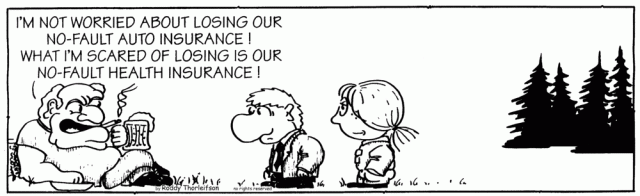
Cartoon – Unprecedented Levels of Unverifiable Productivity

Senate Majority Leader Mitch McConnell (R-Ky.) is tempering expectations that the Senate will pass an overhaul of the nation’s healthcare system, promising his colleagues a vote but not success.
McConnell in his public comments and private conversations about the ObamaCare repeal-and-replace bill is painting a more sober picture than Speaker Paul Ryan (R-Wis.), who in March guaranteed passage through the House.
McConnell is stopping well short of any grand pronouncement.
He says he will bring a bill to the floor for a vote but is not making any promises whether he will get at least 50 members of the 52-member Senate Republican Conference to back it.
“Mitch has been very clear in our conference, and that is there will be a bill and we will be voting on it,” said Sen. Dean Heller (R-Nev.).
But that’s as far as the GOP leader has been willing to go.
“He hasn’t gone beyond explaining that,” said Heller, who recently met with the special working group that is negotiating the healthcare bill.
McConnell warned in an interview with Reuters that passing healthcare reform will be tougher than tax reform, another of President Trump’s top priorities.
Expectations for repealing major parts of ObamaCare soared after the House passed its bill earlier this month, but McConnell cautions the votes in the Senate aren’t there yet.
What’s more, he’s not sure of the path to success.
“I don’t know how we get to 50 [votes] at the moment. But that’s the goal. And exactly what the composition of that [bill] is I’m not going to speculate about because it serves no purpose,” McConnell told Reuters on Wednesday.
Ryan sounded a much more bullish tone in March.
http://www.latimes.com/politics/la-na-pol-gop-healthcare-cbo-20170524-story.html
The Republican healthcare bill that passed the House earlier this month would nearly double the number of people in the U.S. without health insurance over the next decade, according to a new analysis by the nonpartisan Congressional Budget Office.
The much-anticipated report cast a new shadow over the controversial legislation and is expected to complicate Republican efforts to get the bill through the Senate, where it already faces difficult prospects.
According to the budget office, which both parties in Congress look to for estimates on the impact of complex legislation, the bill would cause 23 million fewer people to have health insurance by 2026. Many additional consumers would see skimpier health coverage and higher deductibles, the budget office projected.
The report further undermines claims by President Trump and House Republicans that their campaign to repeal and replace the current healthcare law — often called Obamacare — will protect all Americans’ access to healthcare.
The House bill would be particularly harmful to older, sicker residents of states that waive key consumer protections in the current law, including the ban on insurers charging sick consumers more. The budget office estimates that about one-sixth of the U.S. population live in states that would seek such waivers, which would be allowed under the House bill.
http://www.politico.com/story/2017/05/24/cbo-obamacare-repeal-health-care-238795

Here are some key facts and figures from the new CBO report on the American Health Care Act, the House-passed bill to repeal and replace Obamacare. CBO stressed the uncertainty of its estimates, given that it’s hard to know which states would take up the chance to opt out of certain key parts of Obamacare. All figures are for the decade spanning 2017-2026 unless otherwise specified.

The winners of the IDC Health Insights 2017 HealthTech Rankings released this week named Cerner, McKesson, and Epic Systems among the leading global health IT suppliers.
IDC Health Insights supplied the rankings indicating new benchmarks for health IT hardware, software, and services vendors.
Among the top five largest health IT companies worldwide are Cerner, Epic, and McKesson. This list is the second annual global revenue ranking by IDC Health.
The 2017 HealthTech Rankings comprise the following two lists:
- The Top 50 features the largest companies that derive more than one third of their revenue from healthcare payer and/or provider institutions. The largest of the Top 50 companies is Optum, a subsidiary of UnitedHealth Group.
- The Enterprise Top 25 features the largest companies that derive less than one third of their revenues from healthcare payer and/or provider institutions. The largest of the Enterprise Top 25 companies is IBM.
Cerner was listed as the second largest vendor in the HealthTech Top 50.
GE Healthcare ranked third, McKesson Technology Solutions came in fourth, and Epic Systems ranked as the fifth largest health IT vendor to healthcare payers and providers worldwide.
“IDC Health Insights is excited to release the second annual HealthTech Rankings,” said Research Vice President for IDC Health Insights Lynne Dunbrack. “These global revenue rankings offer a valuable industry benchmark of the leading global technology and service suppliers within the healthcare payer and provider services industry.”
The top five largest vendors listed in the HealthTech Enterprise Top 25 in descending order were IBM, Royal Philips, Siemens, Intel, and Microsoft.
A recent KLAS global EHR market share report similarly named Epic and Cerner among the EHR companies enjoying the highest level of worldwide success across the industry in 2016.
While Cerner maintained its hold as a top contendor, Epic Systems and InterSystems gained more clients than any other EHR vendor last year due in part to the technologies’ vast scope of functionalities and usability.
Epic and InterSystems both boast a wide array of functionalities and user-friendly technologies, but InterSystems won more contracts last year due to its more affordably priced product packages.
However, Epic contracted 8,190 beds in 2016—3,000 more than the next closest competitor.
While Cerner was less lucrative abroad in 2016 than it has been in years past, the vendor still earned the majority of the market share in foreign markets including the Middle East.
The recent spike in contracts for EHR vendors both within the US and abroad are indicative of the widespread adoption of EHR technology in healthcare systems around the globe.

Healthcare organizations on the hunt for lower costs, better outcomes, and value-based care bonuses have invested heavily in hoarding as much big data as they can get their hands on.
From customer service call logs and clinical documentation to satisfaction surveys and patient-generated health data from the Internet of Things, providers of every size and specialty have fully accepted the notion that no scrap of information will go to waste in the era of machine learning, artificial intelligence, and semantic data lakes.
This may be true in the very near future. In just the past few years, the healthcare industry has made huge leaps forward in clinical decision support and predictive analytics.
The use cases for big data are proliferating rapidly as organizations move deeper into population health management and accountable care, and consumers are keeping pace with their growing demand for cost-effective services that leverage the convenience of their favorite apps and devices.
But despite the data-driven promises looming just over the horizon, the majority of healthcare organizations still have a great deal of work to do before they can turn their budding big data analytics competencies into truly actionable clinical intelligence.
A chronic lack of direction, exacerbated by deeply entrenched interoperability issues and a widespread inability to secure a qualified data science team, have left organizations in something of a slump. A series of industry surveys from recent months point out significant staffing gaps, frustrating health data exchange roadblocks, and organizational planning deficiencies that are keeping providers from breaking through their data doldrums.
“The point of analytics is to help make better decisions on a timelier basis,” says Dr. Danyal Ibrahim, Chief Data and Analytics Officer at Saint Francis Care. “But as we all know, there are so many times when our data ends up siloed. One component goes to the finance department, another to IT, and another to the quality improvement team.”
“So even though the data is supposed to be connected around a single patient’s story, ultimately it lands in different siloes all around the organization, and that can be a big barrier to using data to improve care.”
In order to develop a successful big data analytics initiative that can overcome every obstacle from data collection to point-of-care reporting, providers must not only understand where the challenges lie, but also what lies ahead once they overcome their issues.
What does it mean to achieve success with big data analytics, and how can healthcare providers reach their ultimate goal of extracting valuable insights from their rapidly expanding data stores?

The terms electronic medical record (EMR) and electronic health record (EHR) have become widely synonymous, but they did not start that way and some still argue that a distinction between is necessary to restate.
Healthcare organizations and providers have a greater tendency to still use EMR when discussing the health IT system in use by clinicians in the treatment of patients, but many have gravitated toward saying EHR when describing this technology. And there is ample evidence to suggest that the shift is the byproduct of a nationwide effort to promote health data exchange and interoperability.
While EHR is common parlance nowadays, that was not always the case. With EMR usage waning for a large portion of the healthcare industry, an understanding of the EMR/EHR difference demonstrates how far the industry has come — and the progress still needed to be made.


 HENRY KOTULA