Bon Secours Mercy Health to sell majority stake of RCM to PE firm

https://www.modernhealthcare.com/finance/bon-secours-mercy-health-sell-majority-stake-rcm-pe-firm?utm_source=modern-healthcare-daily-dose-thursday&utm_medium=email&utm_campaign=20190530&utm_content=article4-readmore

Image result for alternative revenue sources

Bon Secours Mercy Health plans to sell a majority stake of its revenue-cycle management subsidiary Ensemble Health Partners to private equity firm Golden Gate Capital, the organizations announced Thursday.

The Cincinnati-based Catholic health system aims to sell 51% of the equity in Ensemble netting $1.2 billion in cash proceeds, which will be reinvested in Bon Secours Mercy when the deal is completed following the standard regulatory approvals.

“Our bread and butter is not to be a revenue cycle management company, so we thought maybe it was time to spin it out as a private company,” said John Starcher, Bon Secours Mercy Health president and CEO, adding that Golden Gate has the capital and expertise to continue to build out Ensemble.

Founded in 2014, Ensemble has grown to 3,600 employees in 30 states that serve 27 health systems. Then-Mercy Health acquired Ensemble in 2016, when it worked with about eight health systems, and invested around $60 million.

At that time, Mercy was coming off a failed revenue cycle outsourcing venture and an attempt to bring it in-house as its cost to collect, point of service collections and other metrics were trending negatively, resulting in a $135 million shortfall in expected cash collections, Starcher said.

Ensemble has helped Mercy Bon Secours accrue about $400 million to its bottom line over a three-year period, he said.

“Our terrible numbers had righted in less than one year,” Starcher said.

More providers are outsourcing their scheduling, billing and collections services as patients shoulder more of their healthcare costs and bad debt levels grow. Hospitals and health systems are turning to specialists that claim to deliver on patient satisfaction goals, which are poised to have a greater impact on reimbursement rates. Outsourcing also allows providers to free up capital and mitigate compliance risks.

“There is a tremendous amount of pricing and rate pressure on health systems,” said Judson Ivy, founder and CEO of Ensemble, adding that consumerism is another driving force behind outsourcing revenue cycle management as consumers seek a better experience. “There is also a talent drain on the industry.”

Meanwhile, alternative revenue sources are becoming a bigger part of hospital and health systems’ strategies. Ninety percent of hospital and health system executives in a recent survey indicated that new revenue streams were an urgent priority and expected to yield a return in the next three years, a study from Boston-based Partners HealthCare and healthcare private equity firm Fitzroy Health found.

Pressure on reimbursement rates from government and commercial payers have driven investment in revenue cycle subsidiaries, commercial real estate ventures, consulting spin offs, supply chain companies and other endeavors.

Bon Secours Mercy Health also has an IT subsidiary that specializes in Epic installations and a call center venture that manages the patient journey, among others, Starcher said.

“We also have expertise as we look across the continuum in marketing, supply chain and HR, and we think this is a burgeoning opportunity,” he said.

But you can’t monetize a mediocre service, Starcher said, offering a word of caution. A subsidiary can’t be so tethered to a health system that it can’t be priced competitively with other standalone companies, he said.

“While many health systems talk about this a lot, it doesn’t mean that it has been done successfully,” Starcher said.

Mercy Health and Bon Secours Health System completed their merger in September 2018, expanding its combined network to 43 hospitals, more than $8 billion in net operating revenue and 57,000 employees.

Over a four-month period following the merger, the health system reported $58.9 million in recurring operating income, which excludes restructuring and integration expenses, on operating revenue of $2.7 billion. With the $95.5 million of one-time costs, its operating income fell to negative $36.6 million. Those losses included an impairment charge on the now-defunct HealthSpan Partners’ investment in Summa and merger-related costs.

That compared to $72.9 million in recurring operating income on revenue of $2.69 billion over the same period the year prior. Operating income fell slightly to $68.2 million with $4.7 million of one-time expenses.


House committee to discuss DSH cut repeal next week

https://www.modernhealthcare.com/government/house-committee-discuss-dsh-cut-repeal-next-week?utm_source=modern-healthcare-daily-dose-thursday&utm_medium=email&utm_campaign=20190530&utm_content=article1-readmore

The House Energy and Commerce Committee next week will consider a full repeal of the Medicaid disproportionate share hospital cuts, a sign that hospitals are getting closer to securing the top lobbying priority for safety net providers and academic medical centers.

The committee will hold a hearing next Tuesday on proposed legislation from Rep. Eliot Engel (D-N.Y.), whose home state gets the single largest so-called Medicaid DSH allotment in the country. In fiscal 2018, New York received $1.8 billion of the roughly $12 billion in annual federal payments.

Engel has pitched a full repeal of the cuts mandated by the Affordable Care Act, which are set to take effect Oct. 1. Should those cuts move forward, they would reduce federal DSH payments to states by $4 billion in fiscal 2020 and $8 billion in fiscal 2021. An aide to Engel said that a full repeal “provides the long-term solution.”

Medicaid DSH is the second-largest federal program to boost hospital Medicaid funding, representing about $12 billion in federal spending annually. It has been the subject of a political fight over proposed reforms to the program.

Last week, 300 of the 435 U.S. House of Representatives lawmakers sent a letter to the chamber’s leadership urging a two-year delay to the DSH cuts, and hinted that some in Congress believe the Medicaid DSH formulas need to be reconfigured, calling for a “sustainable, permanent” solution.

“This delay will ensure that hospitals can continue to care for the most vulnerable in our communities,” the lawmakers wrote, led by Engel and Rep. Pete Olson (R-Texas).

The amount the federal government pays out for DSH varies enormously across states and is mostly arbitrary, reflecting the caps set by Congress in 1992 instead of a relevant benchmark.

Florida, where about 3.3 million people are uninsured, gets the exact same federal DSH allotment as Connecticut, where about 245,000 people are uninsured.

Finance Committee Chair Chuck Grassley (R-Iowa) has said he wants to see a reset. Sen. Marco Rubio (R-Fla.), whose state has a strong vested interest in a formula change, has used the Sept. 30 deadline to push a proposal that would base the federal dollar allotment on a particular state’s share of U.S. citizens living below the poverty level.

But the major trade groups representing DSH hospitals continue to push for a simple delay, since their constituents include hospitals in all the states. Dr. Bruce Siegel, CEO of America’s Essential Hospitals, said at a briefing to House staff earlier this month that he’d be open to a formula change as long as hospitals don’t see cuts to existing funding. That means Congress would have to allocate even more money to the program.

House Speaker Nancy Pelosi (D-Calif.) said she backed another delay when she addressed American Hospital Association’s annual meeting in April. She noted that she wouldn’t back a program overhaul.

“We cannot support efforts that will reward states for not expanding Medicaid or simply take DSH money from some other state and give it to others,” she said. “Who thought that was a good idea?”

The DSH debate doesn’t fall along the lines of which states expanded Medicaid or not. Alabama and Missouri haven’t expanded Medicaid but receive high federal DSH allotments, and would likely lose money if Congress decided to redistribute the existing payments.

Although the policy rationale behind the ACA-mandated cuts was that Medicaid expansion would shrink hospitals’ need for DSH money, high-DSH expansion states such as New York and New Jersey aren’t giving an inch.

Siegel framed the debate over expansion states’ need as being “a little more complicated now” than in the early years of the ACA.

“I think the market has changed in the last eight years or nine years when we started down the road of Medicaid expansion,” he said at the Capitol Hill staff briefing.

He pointed to the slight rise in the uninsured rate recently, as well as the increase of high-deductible plans that put more fiscal burden on enrollees.

“We are frankly concerned about any moves to move us toward skinny health plans,” he added.

Enrollment in more bare-bones commercial plans doesn’t really affect the Medicaid enrollment, but he argued that expansion still brings Medicaid shortfall — which is the difference between Medicaid and Medicare reimbursement.

“If you have 70% Medicaid patients which some of our hospitals do, you are in a terrible disadvantage in terms of payment streams, with the shortfall becoming enormous for you,” he said.

There is another Medicaid program that can help hospitals with shortfall: the “upper payment limit” supplement for Medicaid fee-for-service. States can deploy UPL payments to hospitals in order to increase their reimbursement based on rates Medicare would have paid for the same treatment.

UPL is the largest Medicaid supplemental funding program, with about $13 billion in annual spending according to the Medicaid and CHIP Payment and Access Commission data from fiscal 2017.

The UPL program is also under scrutiny by MACPAC, whose analysts found that 17 states have overspent billions of these payments.


Hospital Boards Seeing Low Turnover Rates, AHA Finds

Click to access aha-2019-governance-survey-report_v8-final.pdf

https://www.healthleadersmedia.com/strategy/hospital-boards-seeing-low-turnover-rates-aha-finds

A survey of hospital and health system CEOs noted opportunities for improvement in board governance, alongside some positive trends.

The boards of trustees governing U.S. hospitals and health systems have relatively low turnover rates in an industry that’s shifting rapidly, according to a survey report released Wednesday by the American Hospital Association.

The survey asked more than 1,300 CEOs of nonfederal community hospitals and health systems in the U.S. about their organizations’ governance structures and practices, then the AHA compared their responses to data collected in a similar survey five years ago.

The researchers found that the policies and norms in place for most healthcare organizations result in low levels of board turnover.

The report cited several related opportunities for improvement:

  • Nearly a third of all respondents said their boards do not use term limits at all.
  • More than 75% of respondents said their organizations either didn’t replace board members during their terms or kept reappointing them (when eligible) within the past three years, rather than recruiting a fresh face.
  • Formal assessments were not conducted within the past three years for boards, board members, or chairpersons at 31% of respondent organizations.
  • Older board members are increasingly common. Overall, 12% of board members were age 71 or older in 2018, up from 9% in 2005, the report states. The percentage of members age 50 or younger was 22% last year, down from 29% in 2005.

Luanne R. Stout, president of Stout Associates based in the Dallas/Fort Worth area and a retired Chief Governance Officer of Texas Health Resources, wrote in commentary included with the report that healthcare organizations have a number of options when trying to foster a healthy degree of board turnover.

“Term limits (usually three or four consecutive, three-year terms) are helpful in accomplishing board turnover; however, some boards are reluctant to adopt term limits for fear of losing highly valued board members,” Stout wrote. “Boards that annually review board member attendance, performance and contribution can achieve desired levels of rotation and competency enhancement without utilizing term limits.”

The AHA report also notes some positive trends around healthcare board governance, including the following:

  • There has been some increase in racial and ethnic diversity among board members. The survey found 58% of respondents had boards with at least one non-white member, up from 53% in 2014. (That means about 42% of boards were still composed last year entirely of white members.)
  • A majority of boards restructured to improve their governance.
  • Nearly half of all system boards include members from outside the communities served.

“This year’s survey demonstrates how hospitals and health system boards are rising to meet tomorrow’s challenges through redefining roles, responsibilities and board structures,” said AHA President and CEO Rick Pollack in a statement. “These changes are not surprising given the continued transformation in where, how, when and from whom patients receive care.”


The hospitals staying silent on Medicare for All

https://www.axios.com/hospitals-medicare-for-all-health-care-bernie-sanders-5d28dc00-05cd-411b-98cc-556ddfa12c9b.html

Doctors and nurses treat a patient in a hospital trauma room.

Large hospital systems and trade groups have vociferously criticized Democrats’ “Medicare for All” proposals, but rural facilities and public hospitals that treat mostly low-income patients are sitting on the sidelines of the debate.

Why it matters: Safety nets and many rural hospitals could hypothetically benefit under Medicare for All, but expressing support would put them at odds with their larger brethren.

Between the lines: The Partnership for America’s Health Care Future has become one of the loudest industry-funded voices against Medicare for All.

  • Pharmaceutical companies, health insurers and others are part of PAHCF. But 10 hospital systems and lobbying groups, like Ascension and the American Hospital Association, drive PAHCF.
  • Chip Kahn, the head of the Federation of American Hospitals, said PAHCF was his “brainchild,” according to Modern Healthcare.

Yes, but: Some hospital constituencies aren’t part of the anti-single-payer lobbying.

  • America’s Essential Hospitals, the trade group for safety net hospitals, and the National Rural Health Association, which represents rural hospitals and providers, are not part of PAHCF. They also don’t have official positions on Medicare for All.
  • A spokesperson for AEH said the group recognizes industry peers “have raised reasonable questions” about Medicare for All, but “our focus right now is where our members want it: on stopping the $4 billion cut” to supplemental Medicaid payments.
  • “With specific legislation not moving forward at this time, I don’t see us weighing in anytime soon,” NRHA CEO Alan Morgan said. “I don’t see us at odds. We just haven’t entered the national debate yet.”
  • In an interview, Kahn would not discuss on the record why those two groups were not part of PAHCF.

The big picture: Hospitals that mostly care for poor and uninsured patients could see higher, more stable revenues if everyone had Medicare — a program that often pays higher base rates than Medicaid and infinitely higher rates than nothing at all.

  • Cook County’s public hospital system in Chicago, for instance, gets 79% of its gross patient revenue from the uninsured and Medicaid. That system and multiple other hospitals did not respond to interview requests.
  • Separately, Medicare pays rural “critical access” hospitals 101% of their allowable costs, although those payments have suffered since Congress instituted mandated cuts in 2013.

The intrigue:If you’re trying to solve the problem that we want to get everybody covered and we want to level the playing field between the hospitals that take care of the poor people and hospitals that take care of the rich people, Medicare for All is something we better take a look at,” Eric Dickson, CEO of UMass Memorial Health Care, told Politico.


White House runs into health-care industry hostility as it plans executive order

https://www.washingtonpost.com/national/health-science/white-house-runs-into-health-care-industry-hostility-as-it-plans-executive-order/2019/05/29/a7ce7f2e-817e-11e9-bce7-40b4105f7ca0_story.html?fbclid=IwAR0EnUsQBnp5IKWUK_vB-4C4ec8VMgC9-2uKFVS4NFd8aNxazbSeBr1R2us&noredirect=on&utm_term=.baee5a12d03f

Image result for executive orders


President Trump is preparing to issue an executive order to foster greater price transparency across a broad swath of the health-care industry as consumer concerns about medical costs emerge as a major issue in the lead-up to next year’s presidential election.

The most far-reaching element favored by the White House aides developing the order would require insurers and hospitals to disclose for the first time the discounted rates they negotiate for services, according to health-care lobbyists and policy experts familiar with the deliberations.

The idea has stirred such intense industry opposition, however, that it may be dropped from the final version, the sources said.

Compelling disclosure of negotiated rates “would have the ultimate anti-competitive effect,” said Tom Nickels, the American Hospital Association’s executive vice president for government relations and public policy. “I know they are aware of the concerns.”

Other parts of the order are expected to make it easier for people on Medicare, the federal insurance program for older and disabled Americans, to find out what they would pay for treatment at various hospitals by widening the range of services for which hospitals must post their prices.

The order also may include an effort to promote more competition among hospitals by slowing a trend toward consolidation, according to an administration official who spoke on the condition of anonymity about details that continue to take shape.

“We’re still ironing it out,” the official said.

The executive order, likely to be announced by mid-June and first reported by the Wall Street Journal, would carry the force of law but not bring about immediate change. Such orders essentially direct federal agencies to rewrite rules to advance their goals — in this instance, the departments of Health and Human Services, Labor, and Justice, according to people familiar with the White House’s plans.

The order’s moving parts reflect a conservative conception of how to tame rising health-care costs, relying on competition — the idea that consumers will make prudent, price-minded choices if they are given enough information and options about where to get their care. Critics say that patients are seldom in a position to comparison-shop, following their doctors’ recommendations or confronting medical emergencies.

With surveys showing that voters trust Democrats significantly more than Republicans to solve problems in the health-care system, the order is, in part, a strategy by the White House to portray Trump as an ally of consumers for his reelection campaign.

“My understanding is they are trying to figure out what is going to have high splash value,” said Dan Mendelson, founder of Avalere Health, a Washington-based consulting firm.

The executive order would be Trump’s third relating to health care. Hours after his inauguration, he signed an order giving agencies broad powers to undo regulations the Obama administration had created under the Affordable Care Act. In October 2017, Trump signed another order intended to bypass rules under that law, by making it easier for individuals and small businesses to buy alternative insurance with lower prices, less coverage and fewer consumer protections.

Unlike the first two, the upcoming order would be the first on a theme embraced by both political parties.

Republicans and Democrats alike have introduced nearly two dozen bills related to transparency so far this year, and two major bills are in draft form. Most are focused on curbing the price of prescription drugs, and others are designed to protect patients from what have been termed “surprise” hospital bills involving treatment by physicians outside their insurance networks.

The administration official said the executive order would focus on urging hospitals to increase price transparency for consumers, but the official did not specify how far the policy will go.

The work is being directed by Joe Grogan, director of the White House’s Domestic Policy Council, although senior HHS officials are heavily involved, according to several people who have had conversations with those engaged in the process.

The hospital industry has been consulted by the White House, according to one industry lobbyist. But an insurance industry official said the White House has not reached out to health insurers and has “declined to discuss its thinking on an executive order when asked by industry representatives.”

Both hospitals and insurers are vehemently opposed to being told they need to disclose the rates that they negotiate with one another.

“There is good transparency and bad transparency,” said Kristine Grow, spokeswoman for America’s Health Insurance Plans, a main industry trade group. “Good transparency provides consumers with information they can use to make their own smart decision, and causes health-care prices to go down for everyone

“This is bad transparency, because it is highly likely to cause prices to go up for everyone,” Grow said. If all the parties need to expose what rates they were willing to accept, she said, “it creates a floor for negotiations, not a ceiling.”

Nickels of the American Hospital Association said, “In order for entities in any sector of the economy — health care included — to be able to create a situation where there is give and take, there has to be some privacy.”

A Secret to Better Health Care

https://www.realclearhealth.com/2019/05/28/a_secret_to_better_health_care_279059.html?utm_source=morning-scan&utm_medium=email&utm_campaign=mailchimp-newsletter&utm_source=RC+Health+Morning+Scan&utm_campaign=e0c8de7485-MAILCHIMP_RSS_EMAIL_CAMPAIGN&utm_medium=email&utm_term=0_b4baf6b587-e0c8de7485-84752421


A Secret to Better Health Care


It seems obvious: better social services. So why are things like food stamps and housing not part of the conversation?

Health care is at the center of the national policy conversation, and with the 2020 presidential election now in full swing, that is where it will probably remain. But for all the talk about how to increase access and reduce costs, we’re missing a critical piece of the puzzle: the inverse relationship between health care costs and spending on social programs.

One reason the United States spends more on health care than any other nation — more than 17 percent of gross domestic product, compared with an average of 9 percent for other advanced economies — is that we spend far less on social services like food stamps, free school lunches and public housing.

If our spending on social programs were more in line with other developed countries, our health care costs would fall. That means that as policymakers evaluate a social program, they should weigh not only its direct and second-order benefits — from reducing crime and recidivism to increasing productivity — but also its effect on lowering federal health care costs.

These safety net programs can lower health care costs by strengthening what medical professionals call the “social determinants of health”: the environment in which people are born, grow, live and work. Effective social programs provide access to good nutrition, clean and safe shelter and a subsistence income, which are critical to avoiding disease. They help food-insecure children receive nutrient-dense meals rather than empty calories, and families with incomes below the poverty line to live in sanitary environments free of serious health risks.

Especially important are programs that ameliorate poor housing conditions and prevent disease, including lead abatement, control of mold and dampness and heating-system repairs. Consider a real-life example.

Days after an elderly patient was treated for heart failure at Mount Sinai Hospital and returned home, the elevator in his apartment building broke down. Lacking the ability to climb stairs, he became a prisoner in his own home, unable to go out for a walk, shop for fresh food and visit his doctors for follow-up care.

A social service worker took up his case, and the elevator was repaired. His substandard housing was literally a threat to his health; the intervention of the social worker may have saved his life — and certainly saved him from a possible relapse and expensive hospital care.

Two programs — one in Chicago, the other in Los Angeles — show the multidimensional benefits of social spending. The Chicago program supplemented federal housing subsidies to help patients with chronic health problems afford stable housing. It reduced health care costs in the University of Illinois hospital system for participating patients by roughly 18 percent. And once in stable housing, beneficiaries can better pursue public benefits and job opportunities.

The Los Angeles program showed even greater cost savings, according to a study by the nonpartisan RAND Corporation. After receiving housing assistance, beneficiaries’ costs to the public health system plummeted. Inpatient services fell by 75 percent. Over all, the study found that, even accounting for the increased housing costs, recipients’ total social service and health care costs fell by 20 percent. And beneficiaries showed signs of reduced involvement in crime and improved mental health.

All of this is intuitive and supported by reams of data. But the United States continues to spend a relative pittance on such programs. Housing programs, including rental assistance, public housing and homeless-assistance grants, account for one-quarter of 1 percent of G.D.P. Nutrition programs, such as food stamps and the Women, Infants and Children nutrition program, amount to one-half of 1 percent of G.D.P.

Our underinvestment sets us apart from other advanced nations around the globe, particularly in Western Europe. France, Sweden and Britain commit far more than the United States to social services, as a percentage of their economy, while spending significantly less per capita and as a percentage of their economy on health care — and boast a higher life expectancy.

Many factors influence discrepancies in health care spending and outcomes between the United States and its counterparts: vastly different views about the financial incentives in health care; the high cost of prescription drugs, diagnostic tests and administrative expenses; and cultural expectations about end-of-life care. But we won’t effectively reduce costs, and improve outcomes, until we think bigger and recognize the critical link between health care spending and social programs.


Democrats Yet To Successfully Explain Medicare For All

https://www.forbes.com/sites/brucejapsen/2019/05/26/from-bernie-to-warren-democrats-yet-to-successfully-explain-medicare-for-all/#3e8b63126daf


Kaiser Family Foundation Medicare For All briefing on national public healthcare plan approaches introduced in Congress (May 21, 2019).

Even with two dozen Democrats running for President and most touting an expansion of Medicare benefits to everybody, the public is still unclear how a national single payer health plan like “Medicare for All” will benefit them.

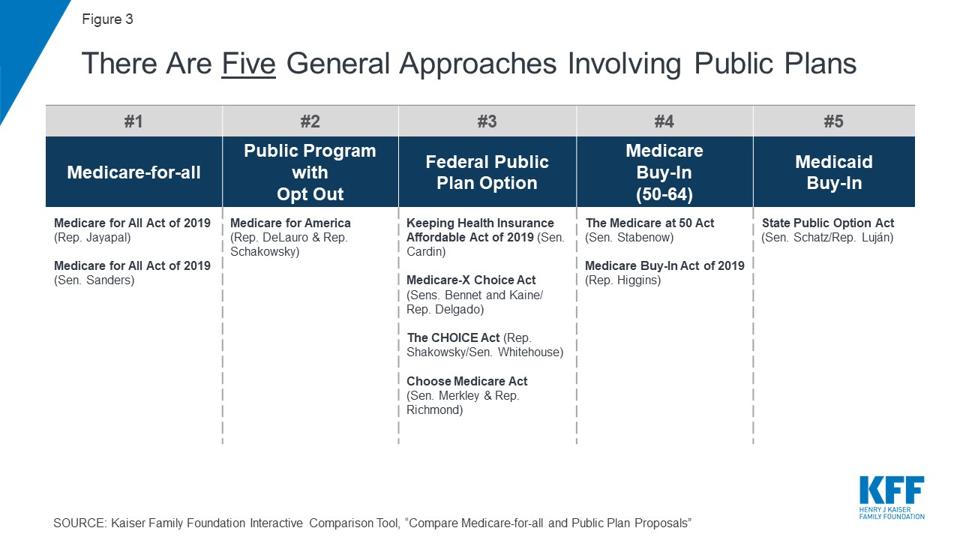
A briefing from experts at the nonpartisan Kaiser Family Foundation for health reporters last week revealed there are five general approaches to expanding coverage involving public plans.

Within those approaches are 10 national plans introduced in Congress that include everything from a single payer version of Medicare for All that would uproot private coverage to a “public program with an opt out” that would be offered along side commercial coverage. Other plans would allow Americans to buy into Medicare as young as 50 years old or buy into Medicaid coverage for the poor.

But no matter the effort to expand health insurance coverage, much is to be done to educate the public at large even as single payer supporters like Sens. Bernie Sanders, Elizabeth Warren and Kamala Harris push Medicare for All on the campaign trail.

“Our polling shows some Americans are unaware of how the implementation of a national health plan could impact them,” said Mollyann Brodie, Kaiser’s senior vice president and executive director, public opinion and survey research. “For example, many people (55%) falsely assume that would be able to keep their current health insurance under a single-payer plan.”

Democrats on the campaign trail hoping to challenge President Donald Trump should Republicans nominate him to run for re-election in 2020 see rising support for a national health plan that would make the government the only insurance carrier.

Kaiser data shows 56% favor a national health plan “in which all Americans would get their insurance from a single government plan.” Just 40% favored such a national health plan 20 years ago, Kaiser data shows.

“Our polls have shown a modest increase in support for the idea of a national health plan,” Kaiser’s Medicare for All presentation showed. Some of these health insurance expansions would be single payer versions of “Medicare for All’ like that proposed by Sanders in the U.S. Senate and Rep. Pramila Jayapal (D-Washington) in the U.S. House of Representatives that would uproot private coverage and replace it with government run Medicare.

Other public approaches would involve a “public program with an opt out” known as Medicare for America or a “Medicare Buy in” like that proposed by Sen. Debbie Stabenow (D-Michigan). Other public plans would involve a so-called “federal public plan option” that would be offered along side commercial coverage on a government exchange and there are also Medicaid buy-in proposals being floated in a number of states.

Politically, the lack of knowledge of Medicare for All and public option proposals offers opportunities for both Democrats who favor Medicare for All and Republicans who want to derail a government expansion of health benefits, particular an approach that would essentially replace much of the private system.

“As the public learns more about the implications of each of these proposals, support may increase or decrease,” Kaiser’s Brodie said.


Who is blocking ‘Medicare for All’?

Who is blocking ‘Medicare for All’?

Who is blocking 'Medicare for All'?

Decades of corporate-friendly politics and policy have decimated communities throughout the country. Centrist Democrats who have chosen corporate profits over people’s needs have aided and abetted this decimation. People are hungry for big ideas to improve their lives and to change the rules that serve only to make the rich richer.

Nowhere is this hunger more apparent than in the demand for improved “Medicare for All”. During a hearing at the House Budget Committee this week it was also apparent that the center-right and their wealthy donors won’t go down without a fight when it comes to health care. 

With guns-a-blazing, they are out to block an incredibly successful and popular program: Medicare, from being improved, expanded and provided to everyone.

Yet polling shows that across party lines,majority of Americans are in favor of Medicare for All. And why not? Right now, nearly 30 million people in this country are uninsured; 40 million can’t afford health-care co-pays and deductibles and 45,000 die annually as a result of not having access to health care.

Those reaping the excessive profits from our illnesses and injuries are in a panic. They’re laying all their chips on the table to make sure Medicare for All never becomes reality. It would mean the end of private insurance companies that profit mightily off the most costly and least effective health-care system in the industrialized world.

So, to continue to rake in their profits, they’ve created the Partnership for America’s Health Care Future, a partnership of corporate hospitals, insurance and drug companies. They must have a lot to lose: last year alone, the group spent $143 million developing attack ads and launching fear campaigns to kill Medicare for All.

It’s time to admit it, while nearly every modern country in the world provides quality, accessible health care for free or very inexpensively to their citizens, the United States stands alone in its willingness to let corporations suck the last pennies out of sick or injured people.

Well, the jig is up. Decades under a corporate-run private health insurance system have proven that we can’t rely on profiteers to provide access to quality health care. We need a publicly held system that is accountable to the people who rely on it. We are able to do so and save trillions of dollars over the next decade.

Medicare for All would reduce national health-care spending by anywhere between $2 trillion to $10 trillion over ten years. Research shows that countries with single-payer systems spend much less on drugs.

Yet opponents continue to decry the “costs” of Medicare for All. They will continue to focus on the cost to taxpayers, conveniently avoiding the truth that already we pay excessive health care costs through insurance premiums, co-pays and deductibles.

Americans suffer from poor health outcomes because they can’t afford to see a doctor until their illness becomes catastrophic. Many weigh the choice between financial ruin and life-saving medicines and treatment. In one of the richest countries in the world that is nothing short of shameful.

The U.S. is a country with abundant resources and more than enough wealth to go around. It’s time to share the wealth in America. It’s a new day and it starts with Medicare for All. Buckle up — because the fight is just beginning.