

Cartoon – In My Office We Celebrate



COURAGE IS THE FIRST VIRTUE of organizational performance. Consider, for example, all the other concepts that courage connects to in workplace settings. Leadership takes courage because it requires making bold decisions that some people won’t agree with or support. Innovation takes courage because it requires creating ideas that are ground-breaking and tradition-defying; great ideas always start out as blasphemy! And sales always take courage because it requires knocking on the doors of prospects over and over in the face of rejection. These aspects of work simply can’t exist in the absence of courage.
That’s why it’s crucial to instill courage in those you lead, both in their development and training programs, but also by leading by example. There’s a lot you can do as a leader toward this end: rewarding jumping first, creating safety nets to make trying and failing a palatable option, teaching to harness fear, and modulating comfort levels are all management tools for setting a foundation that supports and encourages courageous behavior. But while courage in the abstract is an easy thing to get behind, in practice it’s more useful to break it down into different types of courage. Having a way of categorizing courageous behavior allows you to pinpoint the exact type of courage that each individual worker may be most in need of building.
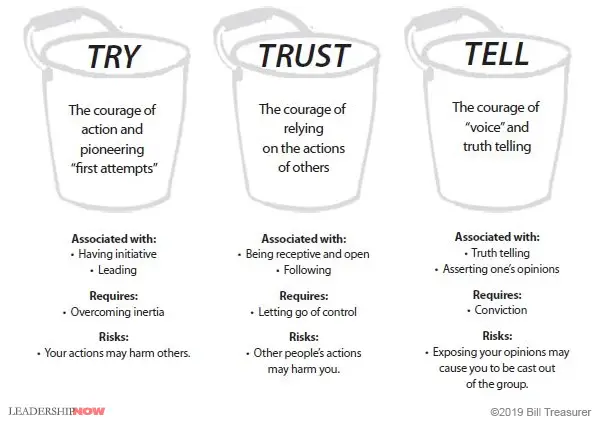
I think of courage as falling into three distinct buckets: TRY, TRUST, and TELL Courage. Let’s talk about each.
TRY Courage
The first bucket of courage is TRY Courage. TRY Courage is the courage of action. It is the courage of initiative. TRY Courage requires you to exert energy in order to overcome inertia. Certainly, it is easier not to do something than to do it, which is one reason why many people prefer to stay in their “comfort zones.” It takes courage to TRY something, particularly when you’ve not done it before. This is the kind of courage that’s demonstrated when someone “steps up to the plate,” for example, taking on a project on which others have failed. You experience your TRY Courage whenever you must attempt something for the very first time, as when you cross over a threshold that other people may have already crossed over.
The courage of try is associated with:
All courage buckets come with a risk, and the risk is what causes people to avoid behaving with courage. The risk associated with TRY Courage is that your courageous actions may harm you, and, perhaps more importantly, other people. If you act on the risk and wipe out, not only are you likely to be hurt, but you could also potentially harm those around you. It is the risk of harming yourself or others that most commonly causes people to avoid exercising their TRY Courage.
TRUST Courage
TRUST Courage involves resisting the temptation to control other people. Unlike TRY Courage, TRUST Courage is not about action. Instead it often involves inaction, or “letting go” of the need to control. With TRUST Courage, you step back and follow the lead of others. A common example of TRUST Courage is delegation. TRUST Courage is very hard for people who tend to be controlling and those who have been burned by trusting people in the past. TRUST Courage, though, is a crucial element in building strong bonds between people.
The courage of trust is associated with:
TRUST Courage, of course, comes with a risk. The risk associated with TRUST Courage isn’t that you will harm other people, but that by trusting them, they might harm you. By trusting others, you open yourself up to the possibility of your trust being misused. Thus, many people, especially those who have been betrayed in the past, find offering people trust very difficult. For them, entrusting others is an act of courage.
TELL Courage
The third bucket of courage is TELL Courage, which is the courage of voice. TELL Courage is what is needed to tell the truth, regardless of how difficult that truth may be for others to hear. It is the courage to not bite your tongue when you feel strongly about something. Brown-nosing and people pleasing are symptoms of low TELL Courage. TELL Courage requires independence of thought. We also use our TELL Courage when we take responsibility for a mistake or offer an apology. Whenever we speak up and say what’s hard to say, whether it be speaking truth to power, admitting a mistake, or saying “I’m sorry,” we are using TELL Courage.
The courage of TELL is associated with:
TELL Courage can be scary and comes with risks too. We avoid using TELL Courage because we don’t want to offend others and fear being cast out of the group. The need for affiliation with those we work with is very strong, and the risk of TELL Courage is that, by speaking up and asserting ourselves, we will be cast out of the group and won’t “belong” anymore.
Courage is Contagious
Understanding (and influencing) courageous behavior requires that you be well versed in the different ways that people behave when their courage is activated. By acting in a way that demonstrates these different types of courage, and by fostering an environment that encourages them, you can make your company culture a courageous one where employees innovate and grow both personally and professionally. Here’s a handy diagram to remind you of these types of courage and what they require:

Imagine a single organization from the perspective of two different cultures: Culture Accountability and Culture Bottleneck.
In Culture A (Accountability), things get done quickly and efficiently. Executive teams are cohesive and managers know what is expected. As a result, managers run a tight ship and are quick to course-correct any activity, behavior or process that doesn’t align with the shared mission and vision. Managers are confident that their decisions will be supported by the executive team. Conversations, both vertical and horizontal, are focused on both process and people; results and relationships. Those who do not fit the culture leave on their own accord.
In Culture B (Bottleneck), bottlenecks create frustration. Decisions seem to be an afterthought and lack of trust precedes the need to micromanage. Managers fear making decisions because their decisions are often overridden. Executives complain that their managers never get the job done. On the front lines, turf wars and internal drama erupt spontaneously. Uncertainty, unexpected change and chaos color the culture. Conversations are avoided and poor performance is justified until something major happens and firing is the only option.
All other things considered, there are two components that distinguish Culture A from Culture B: Clarity and Communication.
In every single instance of time-wasting drama, no matter how it manifests, at the root is a lack of clarity in some form.
On the front lines, when employees are unclear about what success looks like, they lose confidence and waste productive hours getting reassurance and clarification — procrastinating when uncertain. At the highest level, lack of clarity about the real problem or the desired end result wastes time and resources hiring vendors and consultants offering “one and done” workshops or other ineffective solutions.
Even when there is clarity about the real problem, the end result and the process, a big road-block I often see is the lack of clarity about who is in charge and how decisions are made.
For context, let me share a quick example. Years ago I was on a project for a mid-sized corporation. My inside contact, a high-level director, had absolutely no power to push the project forward. Because of this fact, any work I did had to be approved by the top executive who would continuously change calendar dates and, in doing so, would “delegate” the date changing to the director, who had to navigate calendars and multiple dates. I estimate we wasted at least 40 productive hours chasing down the real decision maker to make a change instead of setting up one phone call.
Increasing clarity inevitably increases your productivity and speed. Here are some suggestions for increasing speed by increasing decision-making clarity.
The number-one problem I see that slows progress and efficiency is the inability or unwillingness of leaders to initiate what I call executive conversations. Executive conversations (as I define them) are both results- and relationship-oriented.
Many drama-laden cultures adopt an either-or mentality: a mindset that it’s all about results — anything for a profit, or it’s all about relationships — avoiding conflict at all costs. Both mindsets create accountability-related issues.
In his bestselling book, Advantage, Patrick Lencioni says:
“Many leaders struggle with accountability but don’t know it. Some will tell me that since they aren’t afraid to fire people, they must not have an accountability problem. Of course, this is misguided. Firing someone is not necessarily a sign of accountability, but is often the last act of cowardice for a leader who doesn’t know how or isn’t willing to hold people accountable. At its core, accountability is about having the courage to confront someone about their deficiencies and then to stand in the moment and deal with their reaction which may not be pleasant.“
When there is a lack of accountability there is a lack of alignment, and when there’s a lack of alignment there’s a need for executive conversations.
There are many factors that shape culture; however, it’s up to the senior leaders to eliminate the time-wasting bottlenecks that contribute to high-drama cultures. Get clear on the real problem and the desired end result. Clarify who is in charge and how decisions are made. Initiate executive conversations that are both relationship- and results-oriented to transform the Bottleneck Culture into a Culture of Accountability.
https://www.thinkrevivehealth.com/blog/five-components-thought-leadership-strategy

The role of a thought leader is to offer unique insight on a specific topic, problem, or trend and establish themselves as a go-to resource. A successful thought leadership strategy supports organizational business goals, making it an essential part of any communication plan. You shouldn’t have to look hard to find a thought leader in your organization—they typically are the individuals in your C-suite, but there are likely others equally as valuable in your organization with ideas, passion, and experience that may be credible thought leaders.
Thought leadership can take many forms, such as contributed content, speaking engagements, webinars, white papers, and an ongoing social media presence. It is imperative to remember that, like all communication efforts, strategy should drive thought leadership and consistency is critical. Having a clear strategy tied to your business goals will help establish your voice, get buy-in from leadership, and allow for effective measurement of your program.
The best way to start is by identifying topics your thought leaders can speak to that will support your organization’s goals. For example, if you are a health IT vendor that wants to increase sales of your population health tools, focus on promoting your organization’s point of view (POV) on effective population health management.
Below are five components to consider incorporating in your thought leadership strategy.
Recently, members of ReviveHealth’s public relations team attended July’s Nashville Public Relations Society of America luncheon featuring presenter Johnny Smith Jr., senior director of public relations at Ascension. A fellow attendee asked about why proactive public relations is important to thought leadership. His response?
“PR is a tackle sport.”
The first step of proactive PR is engaging in daily media monitoring and other environmental scanning techniques to determine what topics are trending in your industry. Then, join the conversation via social media, contributed articles, etc., sharing your organization’s point of view. But remember: be strategic and specific about the topics your expert can speak to and make sure they are relevant to your business and the industry. See also: Managing the Race Against a Bad Reputation
Another tip from Smith, Jr.: it’s imperative to establish and maintain relationships with media, which lowers the barrier to entry when joining the conversation. A key part of this is setting up face-to-face meetings between thought leaders and reporters whenever possible—these often prove more valuable than a phone call or email. These conversations are opportunities to share a POV and establish credibility as source for reporters.
Securing coverage in trade and national consumer publications might be the goal, but having a presence in local media is foundational to any thought leadership strategy. This way, when you approach trade and national publications with your company’s story, you’ll already have an established presence as a thought leader on the subject on the local level. This could mean contributing content, writing a monthly column or being mentioned in an industry story.
Local media is also a chance for you to get creative as a PR professional. Is there a cause your thought leaders are passionate about they can advocate for locally? If you have a thought leader that’s making waves in the industry, what local award nominations are a good fit? These activities in the community will help lead to organic media coverage locally and beyond.
Securing speaking engagements are a tried-and-true practice when it comes to elevating the thought leaders in your organization. These opportunities get you in front of your audience and allow you to engage with them directly. Research opportunities for your thought leaders to give keynote speeches and participate in panel discussions or Q&As at industry conferences as part of your proactive PR activities.
Pro tip: the best way for vendors to showcase your business’ innovative solutions is to partner with one of your clients and share their success story. It’s a win-win for both parties. Check out this blog to learn more about The Power of the Proposal.
In addition to earned media coverage, take advantage of blogging, op-eds, contributed content, webinars, and white papers. Developing a variety of content allows you to continually engage with your audience at different stages of the buyer’s journey while generating interest about a topic.
Make sure your content links to other (relevant) previously-developed thought leadership materials – such as white papers you’ve created and recordings of webinars – on your website.
Social media is another avenue for creating content and sharing your POV. Speaking at an event? Tell your organization’s followers and live tweet the presentation. Hosting a webinar? Invite your target audience to attend by setting up a Facebook event. Just released a new white paper discussing the current industry trends? Have the paper’s author publish a short blog about the content on his or her personal LinkedIn page.
Social media is also the place to share relevant industry articles and news that, while may not quote your thought leader specifically, still supports your thought leadership strategy. Remember, use the 80/20 rule on social media. Roughly 80 percent of the content you post should be non-branded industry content, while 20 percent should promote your organization.
A thought leadership strategy is critical to elevating your organization in the public sphere, and therefore helping achieve business goals. To maximize success, be strategic and consistent through proactive activities with your audience such as speaking engagements, content sharing, online communication and local advocacy.

The FTC is prohibited from enforcing antitrust laws against nonprofits, which poses a challenge, Slaughter said.
The commission should conduct another round of retrospective study on closed healthcare mergers, she said.
Commissioners should be ‘as aggressive as possible’ moving forward to preserve healthcare competition, she added.
Federal Trade Commissioner Rebecca Kelly Slaughter told a liberal think tank Tuesday that antitrust regulators should take a more assertive approach to protect competitive forces among healthcare providers.
Slaughter, a Democrat appointed to the FTC by President Trump and confirmed last year, made the remarks in a speech at the Center for American Progress in Washington, D.C., where she took issue with what she described as “a legal shield for anticompetitive conduct” at nonprofit hospitals.
The FTC is allowed to review all hospital mergers, but it cannot enforce antitrust laws against nonprofits, including more than 45% of U.S. hospitals, she said.
“So, for example, if a non-profit hospital merger itself is not anticompetitive, but the newly merged entity engages in anticompetitive practices, the FTC is stuck on the sidelines,” Slaughter said in her prepared remarks.
“In effect, this means that all of the healthcare industry expertise that the FTC has worked for decades to, and continues to, develop cannot be deployed alongside the DOJ and state enforcers to stop anticompetitive practices by roughly half of all hospitals nationwide,” she added. “This is a significant lost opportunity.”
Slaughter called for greater scrutiny of horizontal and vertical mergers alike both in the future and in the past.
“I believe that the FTC should conduct a new round of retrospectives of healthcare provider mergers,” Slaughter said.
Studying the past has led the FTC to some of its biggest improvements in understanding market forces, as was the case with former Chairman Timothy J. Muris’ retrospective analysis of hospital mergers in the early 2000s, Slaughter said.
Moving forward, Slaughter said, the FTC should take another look at recently cleared “close-call hospital mergers” and those that were shielded from antitrust scrutiny by state laws despite posing significant concerns. This is consistent, she said, with a statement the FTC issued last fall when it decided not to challenge a proposed affiliation involving CareGroup Inc., Lahey Health System Inc., Seacoast Regional Health System, and others.
The FTC should also consider taking another look at vertical integration among healthcare providers, such as transactions involving hospitals and physician groups, she said.
“[W]e should be as aggressive as possible in challenging the mergers we encounter today, especially where the proposed consolidation involves new structural arrangements rather than traditional horizontal concerns,” Slaughter added. “It is important for parties considering mergers to know we will not shy away from challenging, for example, anticompetitive vertical organizations.”
“I am sensitive to the concern that we might lose litigation,” she added, “but our obligation is to identify the right outcome and fight for it.”
 HENRY KOTULA