


Thought of the Day

Of his many plans to expand insurance coverage, President-elect Joe Biden’s simplest strategy is lowering the eligibility age for Medicare from 65 to 60.
But the plan is sure to face long odds, even if the Democrats can snag control of the Senate in January by winning two runoff elections in Georgia.
Republicans, who fought the creation of Medicare in the 1960s and typically oppose expanding government entitlement programs, are not the biggest obstacle. Instead, the nation’s hospitals — a powerful political force — are poised to derail any effort. Hospitals fear adding millions of people to Medicare will cost them billions of dollars in revenue.
“Hospitals certainly are not going to be happy with it,” said Jonathan Oberlander, professor of health policy and management at the University of North Carolina at Chapel Hill.
Medicare reimbursement rates for patients admitted to hospitals are on average half what commercial or employer-sponsored insurance plans pay.
“It will be a huge lift [in Congress] as the realities of lower Medicare reimbursement rates will activate some powerful interests against this,” said Josh Archambault, a senior fellow with the conservative Foundation for Government Accountability.
Biden, who turns 78 this month, said his plan will help Americans who retire early and those who are unemployed or can’t find jobs with health benefits.
“It reflects the reality that, even after the current crisis ends, older Americans are likely to find it difficult to secure jobs,” Biden wrote in April.
Lowering the Medicare eligibility age is popular. About 85% of Democrats and 69% of Republicans favor allowing those as young as 50 to buy into Medicare, according to a Kaiser Family Foundation tracking poll from January 2019. (Kaiser Health News is an editorially independent program of the Kaiser Family Foundation.)
Although opposition from the hospital industry is expected to be fierce, it is not the only obstacle to Biden’s plan.
Critics, especially Republicans on Capitol Hill, will point to the nation’s $3 trillion budget deficit as well as the dim outlook for the Medicare Hospital Insurance Trust Fund. That fund is on track to reach insolvency in 2024. That means there won’t be enough money to pay hospitals and nursing homes fully for inpatient care for Medicare beneficiaries.
It’s also unclear whether expanding Medicare will fit on the Democrats’ crowded health agenda, which includes dealing with the COVID-19 pandemic, possibly rescuing the Affordable Care Act (if the Supreme Court strikes down part or all of the law in a current case), expanding Obamacare subsidies and lowering drug costs.
Biden’s proposal is a nod to the liberal wing of the Democratic Party, which has advocated for Sen. Bernie Sanders’ government-run “Medicare for All” health system that would provide universal coverage. Biden opposed that effort, saying the nation could not afford it. He wanted to retain the private health insurance system, which covers 180 million people.
To expand coverage, Biden has proposed two major initiatives. In addition to the Medicare eligibility change, he wants Congress to approve a government-run health plan that people could buy into instead of purchasing coverage from insurance companies on their own or through the Obamacare marketplaces. Insurers helped beat back this “public option” initiative in 2009 during the congressional debate over the ACA.
The appeal of lowering Medicare eligibility to help those without insurance lies with leveraging a popular government program that has low administrative costs.
“It is hard to find a reform idea that is more popular than opening up Medicare” to people as young as 60, Oberlander said. He said early retirees would like the concept, as would employers, who could save on their health costs as workers gravitate to Medicare.
The eligibility age has been set at 65 since Medicare was created in 1965 as part of President Lyndon Johnson’s Great Society reform package. It was designed to coincide with the age when people at that time qualified for Social Security. Today, people generally qualify for early, reduced Social Security benefits at age 62, but full benefits depend on the year you were born, ranging from age 66 to 67.
While people can qualify on the basis of other criteria, such as having a disability or end-stage renal disease, 85% of the 57 million Medicare enrollees are in the program simply because they’re old enough.
Lowering the age to 60 could add as many as 23 million people to Medicare, according to an analysis by the consulting firm Avalere Health. It’s unclear, however, if everyone who would be eligible would sign up or if Biden would limit the expansion to the 1.7 million people in that age range who are uninsured and the 3.2 million who buy coverage on their own.
Avalere says 3.2 million people in that age group buy coverage on the individual market.
While the 60-to-65 group has the lowest uninsured rate (8%) among adults, it has the highest health costs and pays the highest rates for individual coverage, said Cristina Boccuti, director of health policy at West Health, a nonpartisan research group.
About 13 million of those between 60 and 65 have coverage through their employer, according to Avalere. While they would not have to drop coverage to join Medicare, they could possibly opt to pay to join the federal program and use it as a wraparound for their existing coverage. Medicare might then pick up costs for some services that the consumers would have to shoulder out of pocket.
Some 4 million people between 60 and 65 are enrolled in Medicaid, the state-federal health insurance program for low-income people. Shifting them to Medicare would make that their primary health insurer, a move that would save states money since they split Medicaid costs with the federal government.
Chris Pope, a senior fellow with the conservative Manhattan Institute, said getting health industry support, particularly from hospitals, will be vital for any health coverage expansion. “Hospitals are very aware about generous commercial rates being replaced by lower Medicare rates,” he said.
“Members of Congress, a lot of them are close to their hospitals and do not want to see them with a revenue hole,” he said.
President Barack Obama made a deal with the industry on the way to passing the ACA. In exchange for gaining millions of paying customers and lowering their uncompensated care by billions of dollars, the hospital industry agreed to give up future Medicare funds designed to help them cope with the uninsured. Showing the industry’s prowess on Capitol Hill, Congress has delayed those funding cuts for more than six years.
Jacob Hacker, a Yale University political scientist, noted that expanding Medicare would reduce the number of Americans who rely on employer-sponsored coverage. The pitfalls of the employer system were highlighted in 2020 as millions lost their jobs and their workplace health coverage.
Even if they can win the two Georgia seats and take control of the Senate with the vice president breaking any ties, Democrats would be unlikely to pass major legislation without GOP support — unless they are willing to jettison the long-standing filibuster rule so they can pass most legislation with a simple 51-vote majority instead of 60 votes.
Hacker said that slim margin would make it difficult for Democrats to deal with many health issues all at once.
“Congress is not good at parallel processing,” Hacker said, referring to handling multiple priorities at the same time. “And the window is relatively short.”

Public health experts are sounding the alarm about the trajectory of the pandemic in the United States as the coronavirus spreads through the country largely unabated and officials muse aloud about the possibility of fresh lockdowns.
The experts use different language to underscore the situation’s urgency: Former Centers for Disease Control and Prevention director Tom Frieden said the nation is experiencing a “dangerous time.” CNN chief medical correspondent Sanjay Gupta called the crisis a “humanitarian disaster.” Epidemiologist Michael Osterholm, who was recently named to President-elect Joe Biden’s coronavirus task force, described the situation bluntly as “covid-hell.”
Their warnings come amid widespread fatigue with restrictions, even as the virus is nowhere near finished rampaging across the country. Although several states implemented new mitigation measures this week, many people have been letting down their guards or, in some cases, vowing outright to ignore the rules.
Fourteen states, mostly in the Midwest, had reported record numbers of hospitalizations by midday Thursday as the seven-day average number of cases reached highs in 23 states, from Nevada to Maryland, according to data tracked by The Washington Post. Hospital officials predicted that they could soon face excruciating decisions about how to prioritize care as they run short on beds and staff.
“Our hospitals are full,” Megan Ranney, an emergency medicine professor at Brown University, said in an interview. “Our workers are getting sick. And it is simply overwhelming the system.”
The rapid rise in hospitalizations could foreshadow a long period of rising deaths, said Scott Gottlieb, former director of the Food and Drug Administration. Although improvements in care have pushed the mortality rate below 1 percent in the United States, 1,549 people died of the virus Wednesday, the highest toll since April.
The distribution of hospitalizations across the country means it will be hard for health-care workers from one region of the country to serve as backup in another area, Gottlieb wrote on Twitter. The only slightly reassuring news is that most hospitals have not entered true crisis mode, he said Thursday on CNBC’s “Squawk Box.”
“Every hospital system is a little pressed right now,” Gottlieb said. “There’s only a handful that are really overwhelmed: Wisconsin, parts of Texas, Utah, South and North Dakota.”
But the trends suggest that that could change. Osterholm said ballooning numbers of infections nationwide mean more hospitals could soon look like those in El Paso, where health-care workers are bringing in mobile morgues and airlifting patients to other cities.
“We have to tell the story of what’s coming; people don’t want to hear that El Paso isn’t an isolated event,” he told Yahoo Finance on Thursday. “It will become the norm.”
Frieden tweeted that the United States has entered “the exponential phase” of virus spread and that the situation will worsen significantly before it improves. But he emphasized that policy decisions have an impact, and throwing in the towel is the wrong solution.
“Not all of the US is experiencing the same rate of Covid spread — some states are doing much better than others,” he wrote. “For example, South Dakota (the state with the highest rate) has 100 times more spread than Vermont right now.”
Individual decisions also make a difference, Gottlieb said, especially as people prepare to travel and visit people outside their household for Thanksgiving. The transmission of the virus tracks closely with people’s movement in their communities.
“If people on the whole just go to the store one less time a week, you could substantially reduce spread,” Gottlieb said on “Squawk Box.”
The lack of that kind of self-sacrifice is one factor that Ranney said she believes is contributing to the virus surging to a far greater extent than it did in the spring. New rules from local and state governments, such as curfews, have been relatively mild compared to the widespread shutdowns of March and April.
The holiday season, meanwhile, is a looming danger that Ranney expects will lead to a “deadly” spike in infections. The virus’s prevalence across the country means that this is the worst time for people to increase their risk of transmission by attending family-centric celebrations, she said.
The likelihood that there will be an easily available vaccine next year is the light at the end of the tunnel. But in the meantime, Ranney said people need to fight the urge to pretend that life is normal and instead seek ways to socialize more safely — outdoors, at a distance and while wearing masks.
“A vaccine is coming. This is not forever,” she said. “But right now, we’ve got to stop this chain of transmission.”
https://www.washingtonpost.com/nation/2020/11/12/coronavirus-covid-live-updates-us/

The United States’ top infectious-disease expert, Anthony S. Fauci, cautioned against despair as the country endures a surge in covid-19 cases unlike anything it has previously seen. A record high of 145,835 new cases were reported Wednesday, just one week after the U.S. hit 100,000 cases for the first time. At least 65,000 Americans are hospitalized with covid-19, according to The Post’s latest data.
In an interview with “Good Morning America” on Thursday, Fauci insisted that the United States could still make it through the winter without a national lockdown “if we can just hang in there” and adopt stronger social distancing habits until vaccines arrive.
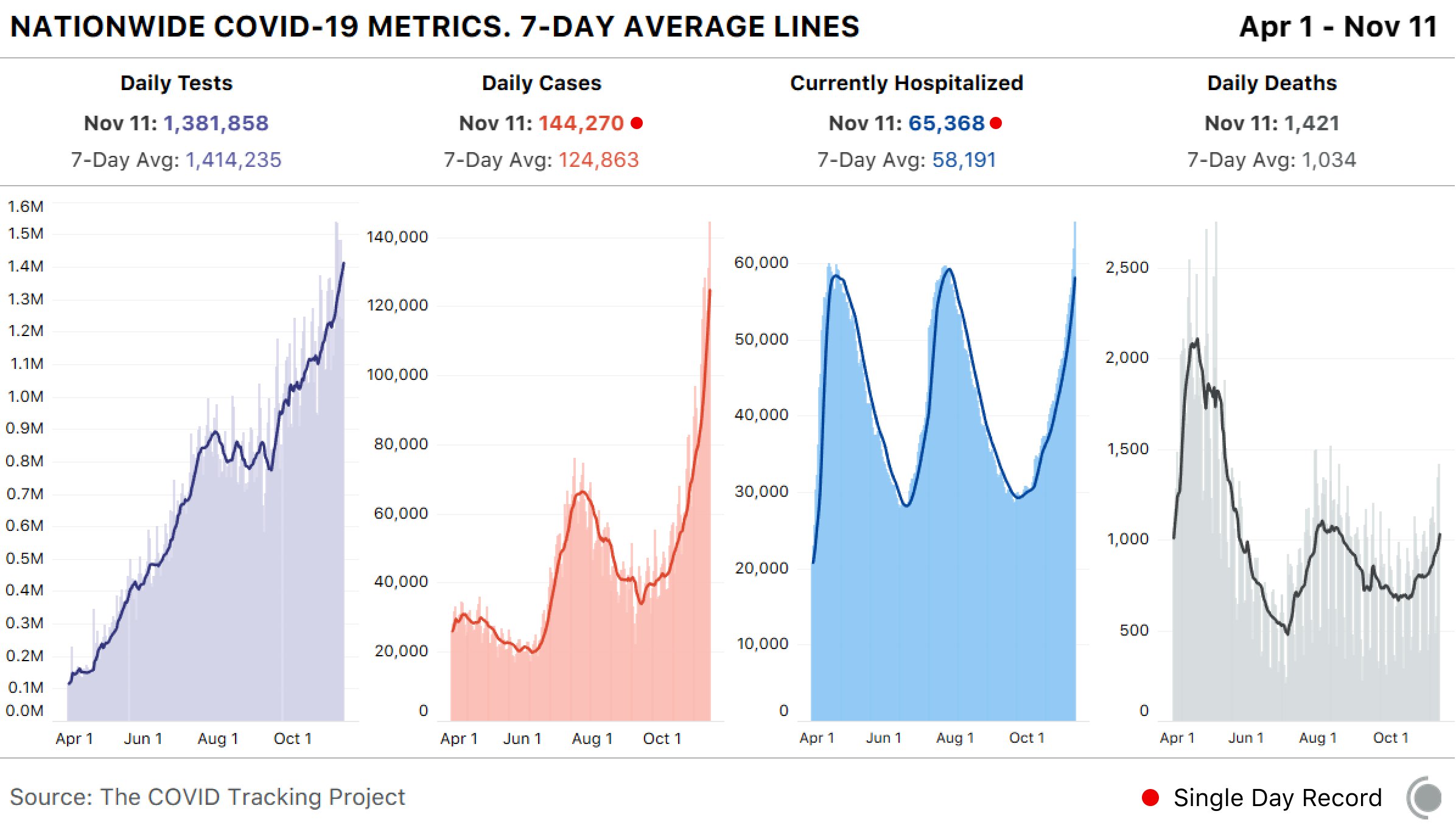
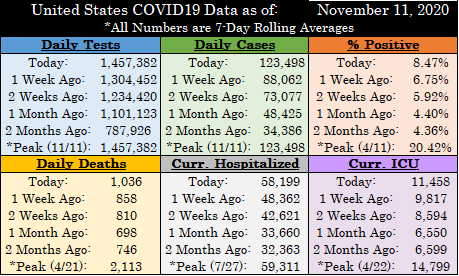
Our daily update is published. States reported 1.4M new tests and 144k cases, another all-time high. 65.4k people are hospitalized, 15k more than on election day. The death toll was 1,421, pushing the 7-day average over 1,000.
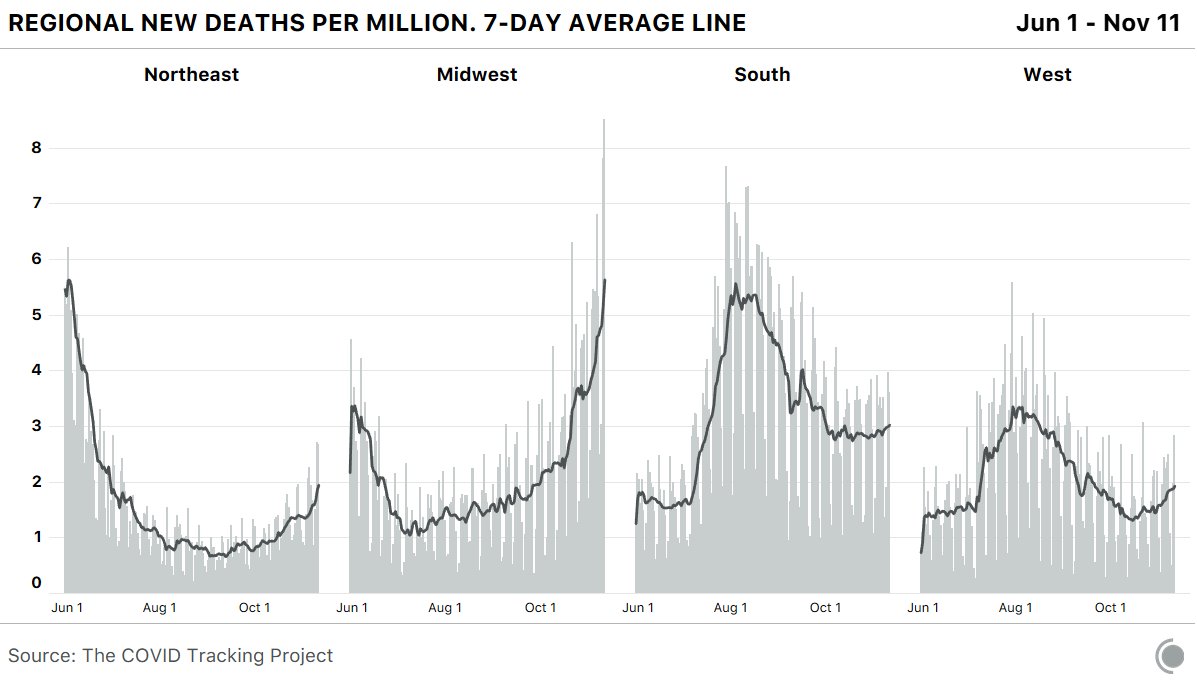
On a per capita basis, more people are now dying across the Midwest than even at the peak of the summer surge in the South.
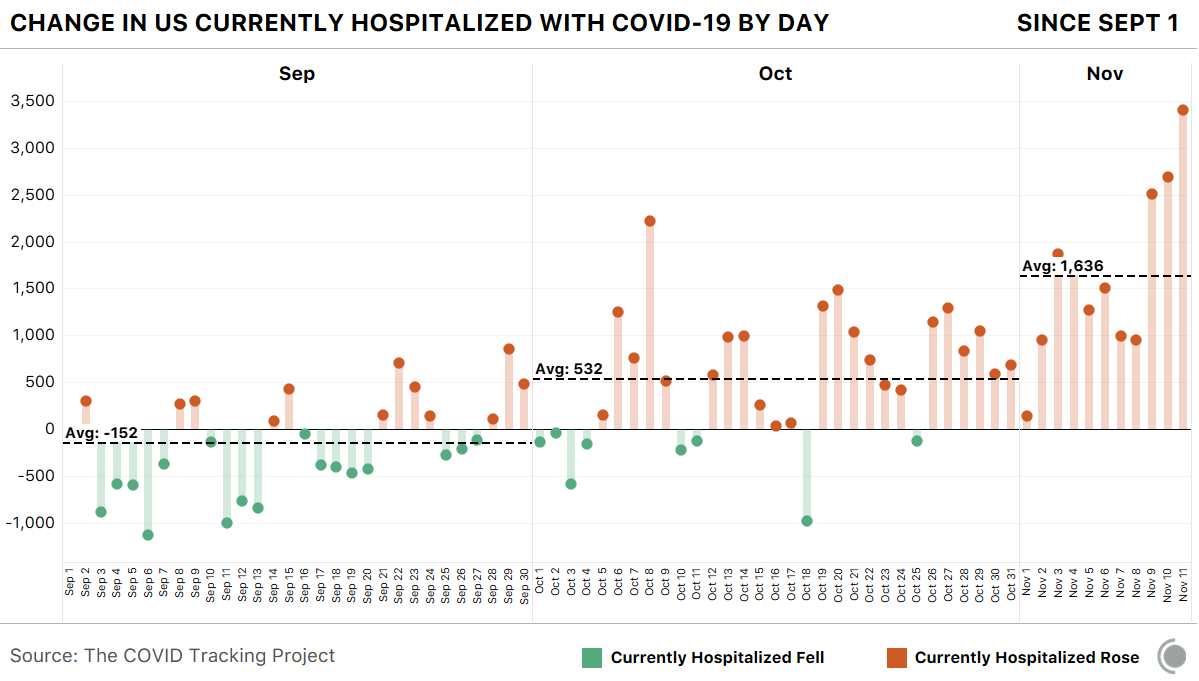
Hospitalizations are now rising very quickly. The last three days standout, but across all of November, we’re averaging 1,636 more current hospitalizations each day.
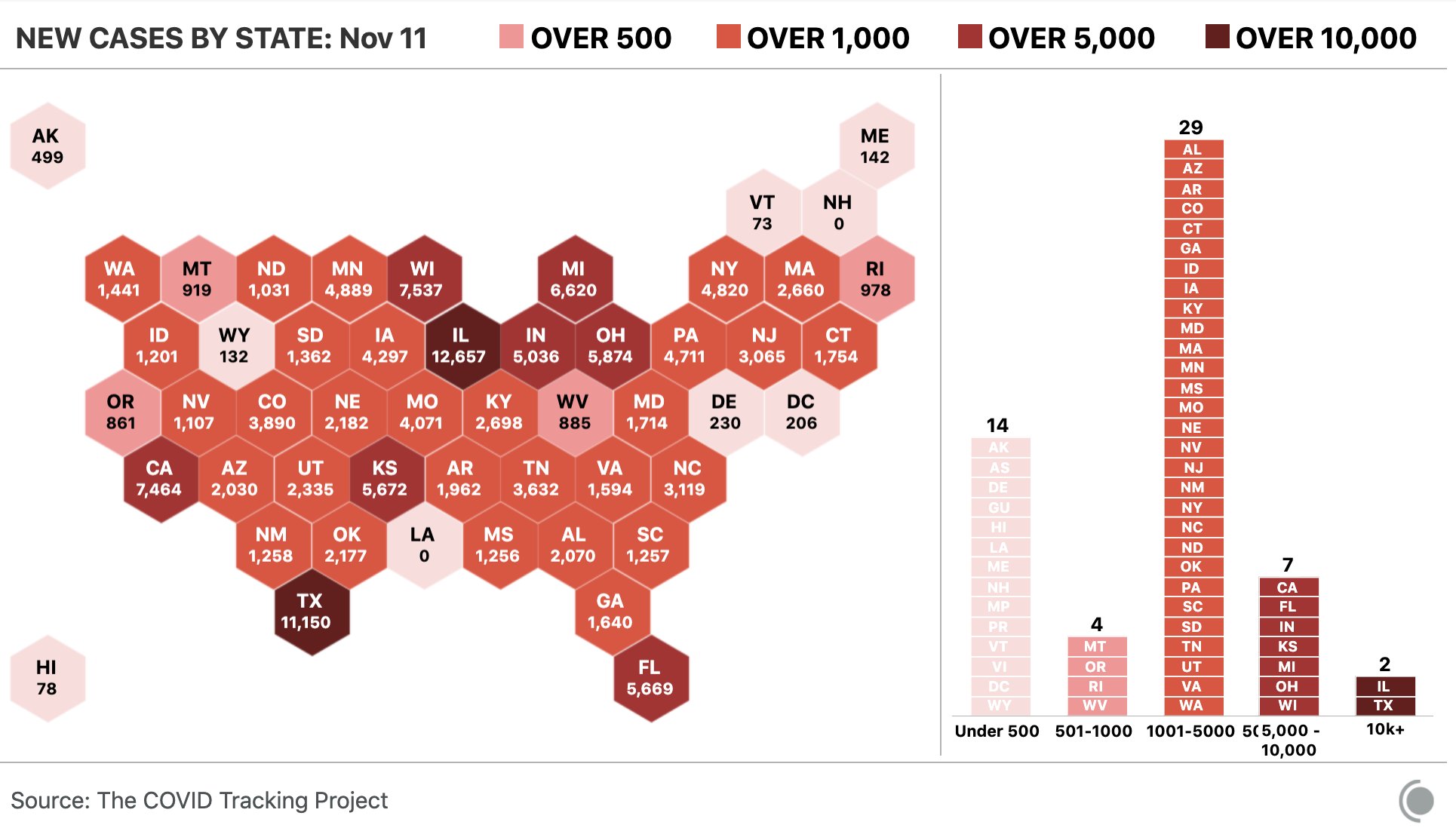
38 states reported over 1,000 cases today.
*Today’s #Covid19 Update Thread* (tests, cases, deaths, hospitalizations, ICU, and % testing positive as of Today, 1 week, 2 weeks, 1 month, and 2 months ago—data from @COVID19Tracking)

For the first time in the coronavirus pandemic, more than 60,000 Americans are hospitalized for Covid-19, according to The COVID Tracking Project, which also reported yet another record for new cases Tuesday—130,989, as the pandemic continues to worsen.
61,964 Covid-19 hospitalizations were reported in the U.S. Tuesday, breaking a record that had stood since April 15, when 59,940 were in the hospital.
The record for new cases was also broken, topping 130,000 for the first time, but the old record had stood for just three days.
1,347 deaths were reported, which is the most since Aug. 19, according to The COVID Tracking Project, which collects its data from local reporting agencies.
The grim impacts of the third U.S. coronavirus surge are starting to be felt. Hard-hit El Paso, Texas is running out of morgue space, while Tulsa ran out of ICU beds Monday night. In North Dakota, hospitals are at capacity and the state is now taking the extreme step of allowing Covid-positive nurses to keep working in some cases amid a serious staffing shortage.
New cases have been rising exponentially since mid-September, with no signs of slowing up. Hospitalizations starting rising around a week later—a rate that has been on the increase. Deaths, which lag behind rises in other metrics, remained relatively steady until around Oct. 18. The death toll has been on a steady rise ever since, with the 7-day rolling average now just shy of 1,000 per day.
President-elect Joe Biden says that fighting coronavirus is a top priority of his incoming administration. He announced a 12-member Covid task force on Monday, with the goal of coming up with a plan to combat the pandemic. That’s in contrast to President Donald Trump, whose administration has not come up with a national plan while the president has continued to make false statements that the U.S. is “rounding the turn” on coronavirus.

 HENRY KOTULA