


Cartoon – Investment Foresight

Here are 24 health systems with strong operational metrics and solid financial positions, according to reports from credit rating agencies Fitch Ratings, Moody’s Investors Service and S&P Global in 2023.
Note: This is not an exhaustive list. Health system names were compiled from credit rating reports.
1. Atrium Health has an ‘AA-‘ and stable outlook with S&P Global. The Charlotte, N.C.-based system’s rating reflects a robust financial profile, growing geographic diversity and expectations that management will continue to deploy capital with discipline.
2. Berkshire Health has an “AA-” rating and stable outlook with Fitch. The Pittsfield, Mass.-based system has a strong financial profile, solid liquidity and modest leverage, according to Fitch.
3. CaroMont Health has an “AA-” rating and stable outlook with S&P Global. The Gastonia, N.C.-based system has a healthy financial profile and robust market share in a competitive region.
4. CentraCare has an “AA-” rating and stable outlook with Fitch. The St. Cloud, Minn.-based system has a leading market position, and its management’s focus on addressing workforce pressures, patient access and capacity constraints will improve operating margins over the medium term, Fitch said.
5. Children’s Minnesota has an “AA” rating and stable outlook with Fitch. The Minneapolis-based system’s broad reach within the region continues to support long-term sustainability as a market leader and preferred provider for children’s health care, Fitch said.
6. Cone Health has an “AA” rating and stable outlook with Fitch. The rating reflects the expectation that the Greensboro, N.C.-based system will gradually return to stronger results in the medium term, the rating agency said.
7. El Camino Health has an “AA-” rating and stable outlook with Fitch. The Mountain View, Calif.-based system has a history of generating double-digit operating EBITDA margins, driven by a solid market position that features strong demographics and a very healthy payer mix, Fitch said.
8. Harris Health System has an “AA” rating and stable outlook with Fitch. The Houston-based system has a “very strong” revenue defensibility, primarily based on the district’s significant taxing margin that provides support for operations and debt service, Fitch said.
9. Hoag Memorial Hospital Presbyterian has an “AA” rating and stable outlook with Fitch. The Newport Beach, Calif.-based system’s rating is supported by a leading market position in its immediate area and very strong financial profile, Fitch said.
10. Inspira Health has an “AA-” rating and stable outlook with Fitch. The Mullica Hill, N.J.-based system’s rating reflects its leading market position in a stable service area and a large medical staff supported by a growing residency program, Fitch said.
11. Mayo Clinic has an “Aa2” rating and stable outlook with Moody’s. The Rochester, Minn.-based system’s credit profile characterized by its excellent reputations for clinical services, research and education, Moody’s said.
12. McLaren Health Care has an “AA-” rating and stable outlook with Fitch. The Grand Blanc, Mich.-based system has a leading market position over a broad service area covering much of Michigan and a track-record of profitability despite sector-wide market challenges in recent years, Fitch said.
13. Novant Health has an “AA-” rating and stable outlook with Fitch. The Winston-Salem, N.C.-based system has a highly competitive market share in three separate North Carolina markets, Fitch said, including a leading position in Winston-Salem (46.8 percent) and second only to Atrium Health in the Charlotte area.
14. NYC Health + Hospitals has an “AA-” rating with Fitch. The New York City system is the largest municipal health system in the country, serving more than 1 million New Yorkers annually in more than 70 patient locations across the city, including 11 hospitals, and employs more than 43,000 people.
15. Orlando (Fla.) Health has an “AA-” and stable outlook with Fitch. The system’s upgrade from “A+” reflects the continued strength of the health system’s operating performance, growth in unrestricted liquidity and excellent market position in a demographically favorable market, Fitch said.
16. Rush System for Health has an “AA-” and stable outlook with Fitch. The Chicago-based system has a strong financial profile despite ongoing labor issues and inflationary pressures, Fitch said.
17. Saint Francis Healthcare System has an “AA” rating and stable outlook with Fitch. The Cape Girardeau, Mo.-based system enjoys robust operational performance and a strong local market share as well as manageable capital plans, Fitch said.
18. Salem (Ore.) Health has an “AA-” rating and stable outlook with Fitch. The system has a “very strong” financial profile and a leading market share position, Fitch said.
19. Stanford Health Care has an “AA” rating and stable outlook with Fitch. The Palo Alto, Calif.-based system’s rating is supported by its extensive clinical reach in the greater San Francisco and Central Valley regions and nationwide/worldwide destination position for extremely high-acuity services, Fitch said.
20. SSM Health has an “AA-” rating and stable outlook with Fitch. The St. Louis-based system has a strong financial profile, multi-state presence and scale, with solid revenue diversity, Fitch said.
21. UCHealth has an “AA” rating and stable outlook with Fitch. The Aurora, Colo.-based system’s margins are expected to remain robust, and the operating risk assessment remains strong, Fitch said.
22. University of Kansas Health System has an “AA-” rating and stable outlook with S&P Global. The Kansas City-based system has a solid market presence, good financial profile and solid management team, though some balance sheet figures remain relatively weak to peers, the rating agency said.
23. WellSpan Health has an “Aa3” rating and stable outlook with Moody’s. The York, Pa.-based system has a distinctly leading market position across several contiguous counties in central Pennsylvania, and management’s financial stewardship and savings initiatives will continue to support sound operating cash flow margins when compared to peers, Moody’s said.
24. Willis-Knighton Health System has an “AA-” rating and stable outlook with Fitch. The Shreveport, La.-based system has a “dominant inpatient market position” and is well positioned to manage operating pressures, Fitch said.

The University of South Alabama Health Care Authority has announced plans to acquire Providence Health System from St. Louis-based Ascension. The transaction is subject to routine regulatory approval as well as customary closing conditions and is expected to close in the fall of 2023.
About the Transaction
USA Health engaged Cain Brothers, a division of KeyBanc Capital Markets, to serve as their strategic financial advisor based on its deep academic medicine and health system sector knowledge. USA Health and Providence have a longstanding relationship and the transaction will help the organizations enhance access to high quality healthcare in the Mobile community and further USA Health’s ability to fulfill its tripartite mission of education, research, and clinical care. The transaction expands USA Health’s footprint in the greater Mobile market, ensuring that the community has access to sustainable, quality healthcare long into the future.
About USA Health
USA Health is located in Mobile, AL, and stands as the only academic health system along the upper Gulf Coast. The system is comprised of nearly 30 care delivery locations, including USA Health University Hospital, the USA Health Mitchell Cancer Institute, USA Health Children’s & Women’s Hospital, a Level I trauma center, a comprehensive stroke center, and a Level III NICU. USA Health employs 3,900 clinical and nonclinical staff members, including 180 academic physicians who serve dual roles treating patients and teaching the next generation of medical doctors.
About Providence Health System
Mobile, AL-based Providence Hospital, which was founded in 1854 by the Daughters of Charity, is a full-service 349 bed hospital with 24/7 emergency care, a Level III trauma center, an outpatient diagnostic center, and a freestanding rehabilitation and wellness center. In addition to the hospital, Providence operates related sites of care throughout the greater Mobile community, including the physician practices of Ascension Medical Group. Providence became part of Ascension in 1999 when the Daughters of Charity and Sisters of St. Joseph Health System merged to form Ascension.
About Ascension
Ascension is one of the nation’s leading not-for-profit and Catholic health systems, with a mission of delivering compassionate, personalized care to all with special attention to persons living in poverty and those most vulnerable. Ascension includes approximately 37,000 aligned providers and operates more than 2,600 sites of care – including 138 hospitals in 19 states.

The Cigna Group beat investor expectations and reported a 10 percent growth in membership year over year, according to the company’s first quarter earnings published May 5.
“Our strong results in the first quarter demonstrate how our company continues to execute well, while also introducing innovative, market-leading solutions that improve clinical outcomes, affordability and transparency for the benefit of those we serve,” Chair and CEO David Cordani said.
Total revenues in the first quarter were $46.5 billion, up 6 percent year over year.
Evernorth revenues rose 8 percent year over year to $36.2 billion. The insurance side of the business, Cigna Healthcare, reported first-quarter revenues of $12.8 billion, up 13 percent from the previous year.
In the first quarter, net income was $1.3 billion, up 6 percent year over year.
The company’s medical loss ratio was 81.3 percent in the first quarter, compared to 81.5 percent during the same period last year.
As of March 31, Cigna had 19.5 million total medical members, up 10 percent year over year.
For 2023, the company projects revenues of at least $188 billion. Full-year adjusted income from operations is projected to be at least $7.36 billion, or at least $24.70 per share.

One of the most overlooked, yet lethal forms of organizational rot is toxic ambiguity. Basically, killing people with fog, Jim VandeHei writes.
Why it matters:
Think of all the time wasted, relationships ruined, budgets missed and moods fouled by leaders or managers offering hazy direction.
Gallup developed a workplace survey system for companies to track engagement and performance. We use it at Axios to spot pockets of emerging staff issues.
The toxicity comes when the ambiguity is so thick others can exploit the cloudiness, or suffer from it. Here are some common manifestations to watch for:
💡 What you can do: If you’re unsure what’s expected of you, that’s on you!
The big picture:
Clarity and candor are tough but essential — especially in anxious or uncertain times.
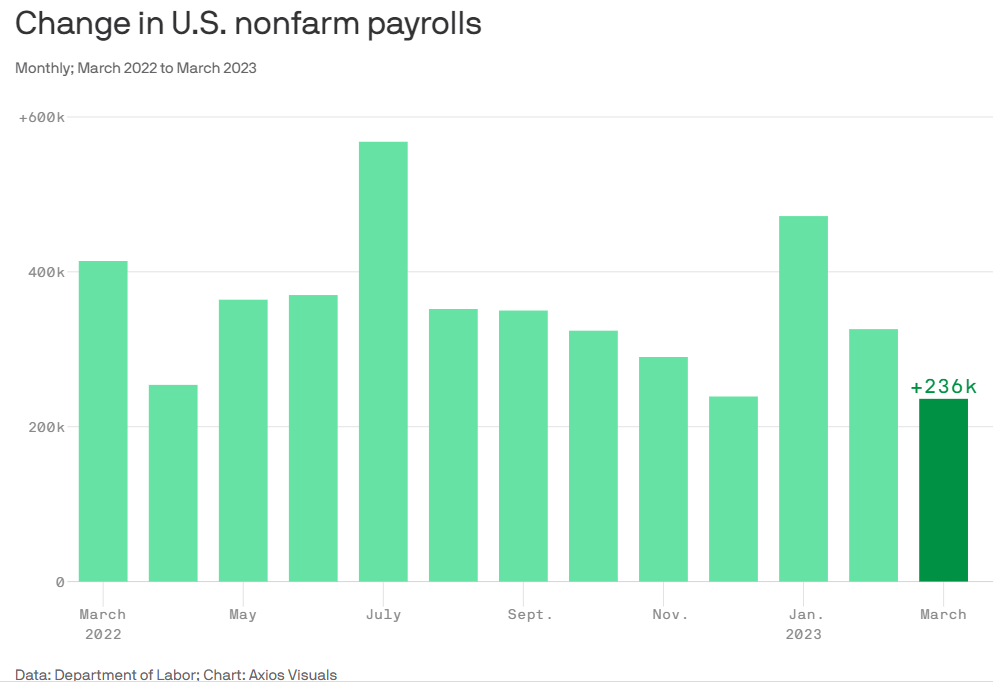
The labor market added 253,000 payrolls in April, while the unemployment rate dipped to 3.4% — a historically low level.
Why it matters:
Job growth continued to boom last month, the latest sign that economy has strong momentum despite recent bank failures.
Details:
The April job figures are a pickup from the 165,000 jobs added the previous month, which were revised down by 71,000, the Labor Department said on Friday.
The big picture:
In recent months, more Americans have joined the workforce, helping to ease labor force shortages.
Where it stands:
The Federal Reserve has been concerned about an out-of-balance labor market that it fears could stoke inflation that’s already running high.



 HENRY KOTULA