What is “Medically Necessary”?

How Big Health Insurers hijacked a medical term and built a denial machine around it.

We hear the term “medically necessary” used every day by insurance companies as a reason to deny or delay health care. While doctors were hard at work treating patients, insurers quietly co-opted the term, and that’s causing serious problems now.

If you ask most doctors to define ‘medically necessary,’ you’ll get some version of: “The test, therapy, drug or procedure that will do the best job of treating my patient.” It’s that simple: whatever is best for my patient.

If you ask an insurer, you may get some legal definition about care “provided for the cure or relief of a health condition, illness, injury or disease (looks good so far, but wait there’s more!), and is not for experimental, investigational or cosmetic purposes and is necessary for and appropriate to the….” The problem begins with the meaning of “necessary and appropriate.”

The terms ‘necessary’ and ‘appropriate’ are left to interpretation. My doctor may feel that a certain test or medication is necessary and appropriate, but someone else may disagree. So how do insurers resolve that disagreement? This is where things go off the rails.

They resolve it by having a medical director they employ review what my doctor wants for me – and that medical director becomes the sole arbiter of what care I can have that will be covered by my health plan. That medical director can sign off on a denial of a claim or a request, and many times they justify that denial by saying the treatment isn’t medically necessary – for reasons that are entirely defined by the health plan.

It seems a clear conflict of interest when an anonymous medical director – possibly lacking in both expertise and experience – rejects a course of treatment laid out by a physician specializing in that disease or condition who has a history with that particular patient. But it happens all the time.

These medical directors work for the company that is denying the claim or request. They have been granted stock and stock options in that company. Their bonus is tied to the financial performance of the company. To say they are impartial and doing what is best for the patient is laughable at best.

Frequently, these medical directors are reviewing requests in areas outside their specialty. In addition, they make these determinations without ever seeing the patient, or reviewing the medical records, studies or lab results that led the treating physician to make the recommendation in the first place. An investigation by ProPublica found that Cigna medical directors were signing off on denials once every 1.2 seconds. This isn’t clinical review; this is profit enhancement.

This brings us to another problem: “coverage policies.” Insurance corporations have created a whole library of coverage policies, and they differ from health plan to health plan. If you’ve never read one of these coverage policies let me save you some time and trouble. Get up now and place your head between the door and the door jam. Now slam the door. You just achieved the headache and confusion that reading a long coverage policy would give you in a fraction of the time. You’re welcome.

Even if you read the policy and think it’s got you covered, you still aren’t home free. A medical director can overrule the policy and still deny the care. Also, that coverage policy may be different for each health plan, and they change from time to time. I am struck by this basic question: Why should the care you receive depend on the insurance card in your wallet and not your clinical situation? The answer, of course, is because that’s how the insurance companies want it.

So, what do we do about this? Let me give you two relatively easy solutions.

First, follow a coverage policy.

If only there was a group of doctors that represented every specialty, we could get them to meet and determine universal coverage policies that could be mandated for all health insurance, both government and commercial. Wouldn’t that be nice? Doctors could then provide good care to patients without having to figure out a library of different coverage policies. Wait, a group like that does exist. It’s called the RUC.

The RUC (Relative Value Scale Update Committee) is an American Medical Association specialty panel, a volunteer group of 32 physicians and over 300 physician advisors who represent every medical specialty. The committee evaluates thousands of individual services across the medical spectrum. Why don’t we ask them to develop a universal set of clinical coverage policies?

Second, fix the denial system. Pass a law that says whenever an insurer denies payment or a request for care, that denial must be signed by a medical doctor, and signing that denial qualifies as “the practice of medicine.” This would make those denials and the doctor who signed off on them subject to all the responsibilities and accountabilities required to practice medicine.

This includes:

  • having an active license in the state where the patient is seeking care; practicing within your specialty;
  • documenting your decision-making in the patient’s medical record, including the information you reviewed to come to your decision; and
  • being liable for malpractice if your decision causes harm to the patient and is not clinically justified.

Let’s assume we had this in place right now and applied it to a real-world situation: the GLP-1 coverage debate. When these glucagon-like peptide-1 drugs for diabetes and weight loss came to market they would have gone before the RUC for a clinical coverage policy. Let’s say the RUC determines that the drugs should be covered for individuals with a BMI over 30 who have tried and failed other diet programs, or for people with a BMI between 25 and 30 who have significant cardiac risk or are diabetic.

Now we have a universal coverage guideline. The doctors prescribing the drug have a very clear understanding of who will be covered and when, and it would apply to all patients regardless of which insurance company they had. As long as the prescribing physician stays inside the guidelines, no denials would be expected.

Let’s take an example from the flip side. A doctor wants to prescribe an expensive chemotherapy regimen to an elderly patient with cancer. The insurer could have that request reviewed and possibly denied by a medical director. However, that medical director would need to be an oncologist with a valid license in the state where the patient is getting treatment. If that oncologist reviews the patient information, denies the chemotherapy for valid clinical reasons, and documents those reasons in the patient’s chart, then the insurer can deny the request.

These two changes would eliminate so many problems, improve the lives of doctors, improve the lives of patients, and reduce administrative costs.

So why hasn’t this been done already? Well the one thing these changes would not do is increase the stock prices of insurance companies.

To put it more succinctly, it’s profits over patients. That’s why.
Senate Judiciary: UnitedHealth Turned Medicare Advantage Risk Adjustment Into a Profit Engine

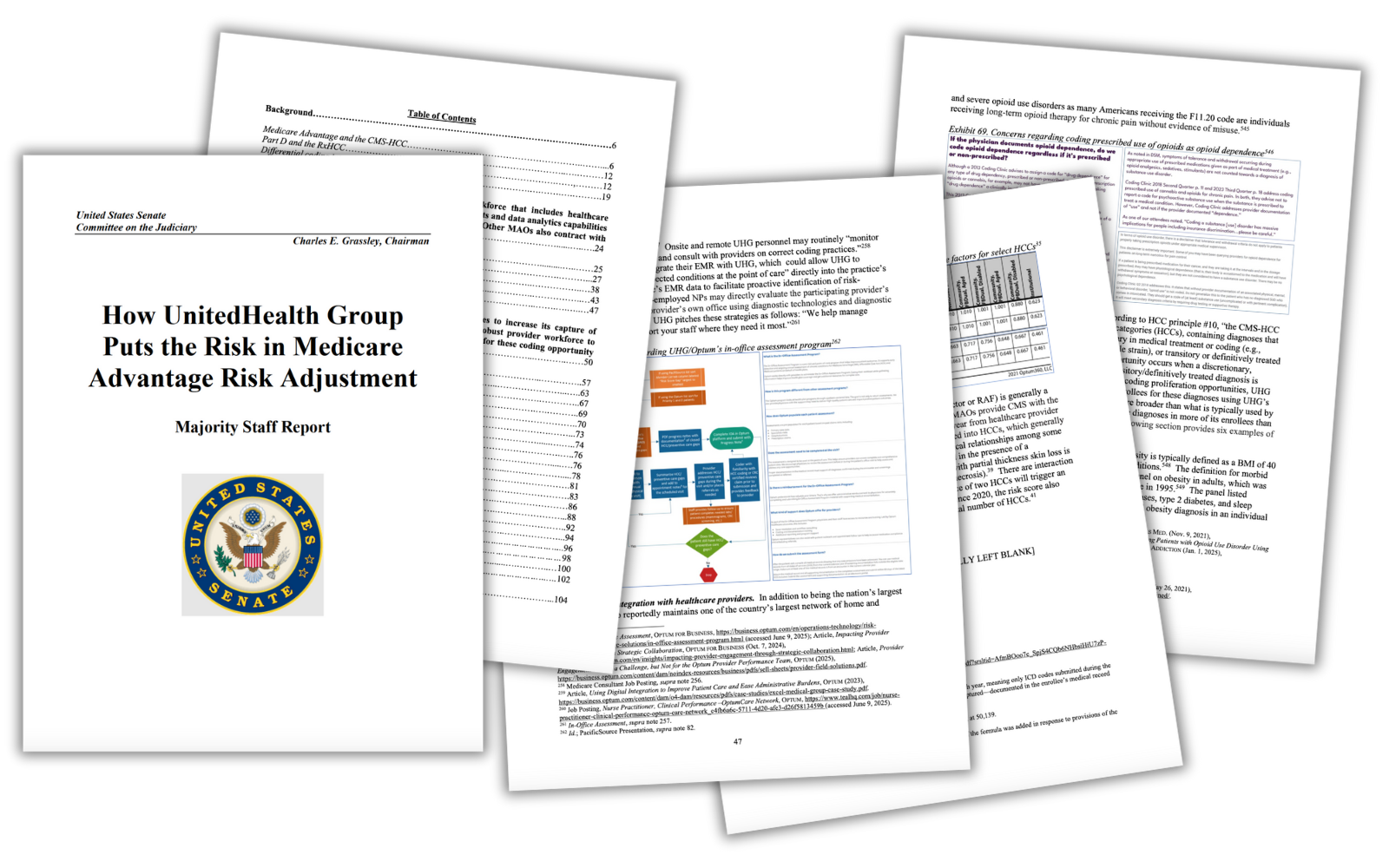
A new report from the Republican-led Senate Judiciary Committee describes how UnitedHealth Group has turned a safeguard for sick patients in the Medicare Advantage program into a profit-making strategy.

The report, How UnitedHealth Group Puts the Risk in Medicare Advantage Risk Adjustment, details how Medicare Advantage (MA) payments (seemingly designed to compensate health insurers more for enrolling patients with greater health needs) have increasingly rewarded insurers with the resources, data and scale to capture and maximize diagnosis codes. According to the committee, UnitedHealth Group has leveraged its size, vertical integration and advanced data and AI capabilities to consistently stay ahead of efforts by the Centers for Medicare & Medicaid Services to curb excess payments tied to coding intensity.

Read the U.S. Senate Judiciary Committee’s How UnitedHealth Group Puts the Risk in Medicare Advantage Risk Adjustment here.

After reviewing more than 50,000 pages of internal UnitedHealth documents, Judiciary Committee investigators found that the company built a vast diagnosis-capture infrastructure that includes in-home health risk assessments, secondary chart reviews, “pay-for-coding” arrangements with providers, and tightly controlled clinical workflows within UnitedHealth-aligned medical practices. These efforts, the report states, go well beyond neutral documentation and instead amount to an aggressive strategy to maximize risk scores and, by extension, federal payments.

The committee, chaired by Sen. Chuck Grassley, (R-Iowa), warns that even when CMS attempts to rein in abuse (such as excluding more than 2,000 diagnosis codes from the risk-adjustment model) UnitedHealth appears uniquely positioned to identify new, untapped diagnoses among the thousands that remain. Because UnitedHealth also sells its diagnostic criteria, coding tools and workforce to rival insurers, its strategies can quickly spread across the entire Medicare Advantage market.

The report concludes with this:

While Senator Grassley’s staff will continue to evaluate the information produced by UHG, this initial review has revealed how UHG has been able to profit from the way that CMS risk adjusts payments to MAOs. The investigation has also shown that risk adjustment in MA has become a business in itself—by no means should this be the case. MAOs should receive payments that are commensurate to the complexity and acuity of the Medicare beneficiaries that they insure, not their knowledge of coding rules and their ability to find new ways to expand inclusion criteria for diagnoses. Taxpayers and patients deserve accurate and clear-cut risk adjustment policies and processes.

But what makes these findings especially notable is who commissioned the investigation in the first place. Grassley was one of the original architects and longtime champions of Medicare Advantage when it was enacted back in 2003. In recent years, he now warns that the program’s “promise of efficiency and choice” has been undermined by vertical consolidation, blinded oversight and systemic risk-code gaming.

In past inquiries — spurred by reporting from outlets like The Wall Street Journal and findings from the Health & Human Services’ Office of Inspector General — he has demanded answers from UnitedHealth over the use of in-home assessments and chart reviews that allegedly drove billions of dollars in additional payments to the company.

Continuing the bipartisan scrutiny of MA insurers, CMS recently released its proposed payment rates for MA plans in 2027. Notably, CMS is proposing to exclude diagnosis codes added to a patient’s chart during chart reviews by AI or insurers from their risk score; something many reform advocates and I have long supported. These changes and this investigation are important steps in reining in the abuses by MA insurers and reason for hope we are on the right track.

If The House Votes for Senate-Approved Spending Package, PBM Reform Becomes Law

As early as today, the House of Representatives is expected to vote on a government funding package (approved by the U.S. Senate last Friday) that includes long-sought reforms to pharmacy benefit managers (PBM) – pharmaceutical middlemen, the biggest of which are owned by just three health insurance conglomerates – that sit between patients and their prescriptions.

None of this happened over night. PBM reform – even in the health care advocacy world – has only recently become a bi-partisan, winning issue. PBMs were largely only known to pharmacists, other middlemen, health-policy wonks and the small but mighty circle of advocates who understood how they squeeze patients and independent pharmacies and funnel profits back to Big Insurance. PBMs began life as intermediaries meant to negotiate lower drug prices on behalf of consumers, but over time their role changed as they huge profit centers for insurers like UnitedHealth, Cigna and Aetna merged with or created their own PBMs – which now control more than 80% of the PBM business in the country.

This monopolistic-evolution captured the attention of policymakers and watchdogs after HEALTH CARE un-covered and reform advocates began to raise the alarm about PBM abuses and profiteering.

The need for PBM reform was one of the reasons I started the Lower Out-of-Pockets (LOOP NOW) Coalition, in 2021. Over the years, the LOOP NOW Coalition, along with its 100 partner organizations, have worked to educate lawmakers about how PBMs restrict access to life-saving medications and contribute to the U.S. medical debt crisis. The coalition has endorsed legislation to ban several PBM business practices, like spread pricing, and to force PBMs to be far more transparent, especially in their dealings with employers that offer health benefits to their workers. Our work also led to an invitation for me to testify at a meeting of the Department of Labor’s Advisory Council on Employee Welfare and Pension Benefit Plans (the ERISA Advisory Council) and to meet with the Federal Trade Commission regarding the vertical integration of big insurers and the need for PBM (and Medicare Advantage) reform.

Through the work of advocates on the ground, things began to shift. What was once a side quest among health-policy activists became something real in Washington because the issue is easy to understand: PBMs have become unneeded profit centers insurers erected between patients and the medicines their doctors say they need.

We came close to reining in the PBM industry in late 2024 when reforms were included in House Speaker Mike Johnson’s first spending package, but they were scrapped after Elon Musk complained about the size and scope of the legislation.. His Tweets prompted GOP leadership to strip out the PBM provisions, even though they had broad bipartisan support in Congress and were backed by many consumer advocates and independent pharmacists. But now, it seems like the PBM language in the current spending package is more locked in. Here’s what the bill will do:

  • Change how PBMs get paid in Medicare Part D by moving them away from percentage-based payments tied to high drug list prices and toward flat, transparent service fees — so PBMs no longer profit more when drug prices are higher.
  • Require CMS to define and enforce contract terms between PBMs and Medicare Part D plans, giving the agency real authority to police abusive or one-sided arrangements.
  • Increase transparency by allowing CMS to track how PBMs pay pharmacies and which pharmacies are included (or excluded) from PBM networks, so regulators can finally see payment patterns and network practices across the system.
  • Lock into law existing protections requiring plan sponsors and PBMs to contract with any pharmacy that agrees to their standard terms — as long as those terms are reasonable and relevant — instead of quietly steering business to preferred or affiliated pharmacies.

These are important reforms, although more are needed. We’ll keep you posted on PBM-related efforts not only on Capitol Hill but also at the Department of Labor and in the states.