



Drug companies raised prices on seven popular drugs during 2017 and 2018 without clinical evidence that the drugs had been improved in any way, according to a new report.
The increases cost patients and insurers more than $5 billion, the Institute for Clinical and Economic Review (ICER) found in its report. None of the drugs examined showed evidence of improved safety or effectiveness, the analysis found.
The report looked at the seven top-selling drugs by sales revenue that had price increases of more than two times inflation, as measured by the medical consumer price index.
The culprits, and how much they added to drug spending over two years:

Medicare overpaid hospitals about $1.3 billion in 2015 for the government’s Teaching Health Center Graduate Medical Education program, according to a study published in JAMA Internal Medicine.
The Graduate Medical Education rate is $150,000 per resident. While 25 percent of hospitals received less than $106,000 per resident in 2015, 25 percent received more than $182,000 per resident. That same year, nearly half of teaching hospitals got more than $150,000 per resident.
If Medicare GME payments were capped at the $150,000 rate, researchers predict Medicare would save more than $1 billion every year.
“Our study suggests Medicare GME may be overpaying some hospitals up to $1.28 billion annually,” said Candice Chen, MD, lead study author and associate professor of health policy and management at the George Washington University Milken Institute School of Public Health in Washington, D.C. “Those funds could be redirected and used to strengthen the physician workforce, especially in underserved areas.”
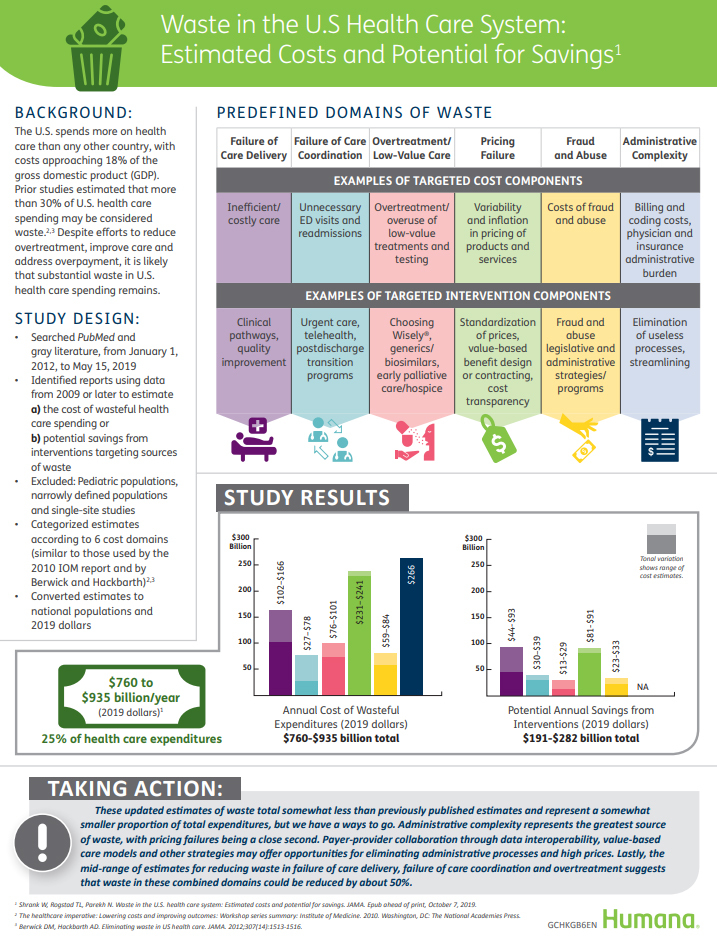
About 25 percent of U.S. healthcare spending can be classified as waste, according to a new study published in JAMA Oct. 7.
For the study, researchers from Humana and the University of Pittsburgh School of Medicine analyzed 54 peer-reviewed studies, government reports and other medical literature to estimate the levels of waste in the U.S. healthcare system.
Researchers divided waste into six previously developed categories including: failure of care delivery; failure of care coordination; overtreatment or low-value care; pricing failure; fraud and waste; and administrative complexity.
Administrative complexity accounted for the most waste with $265.6 billion annually, followed by pricing failure or inefficiencies, which accounted for up to $240.6 billion in waste per year.
Approximately $300 billion in waste accrued from failure of care delivery, failure of care coordination and overtreatment. The study estimated that about half of this waste could be avoided.
Overall, the researchers found that the cost of waste in the U.S. healthcare system ranges from $760 billion to $935 billion annually.
Of the $760 billion to $935 billion of waste, researchers estimated that using interventions found to reduce waste could cut between $191 billion and $282.1 billion in healthcare spending.
Access the full report here.





 HENRY KOTULA