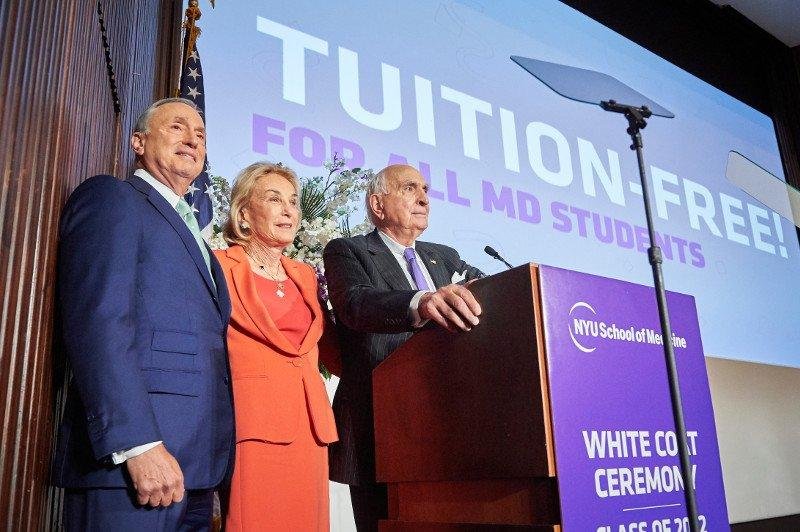
WILL NYU’S TUITION-FREE MED SCHOOL REALLY BOOST PRIMARY CARE?

https://www.healthleadersmedia.com/finance/will-nyus-tuition-free-med-school-really-boost-primary-care

Image result for NYU medical school

The factors at play may be a bit more complicated that some expect.

New York University made waves last week when it announced it will cover all tuition expenses for all its medical students in perpetuity.

While the news left some NYU alumni wishing they had waited just a few years longer to enroll, it also reanimated debate over the problems high educational debt levels can cause for doctors and the healthcare delivery system at large.

In an op-ed for Stat News, fourth-year NYU medical student Eli Cahan noted that researchers have identified debt burden as one of the factors propelling doctors into more lucrative specialty areas, leaving a shortage of primary care physicians.

“Eliminating medical school tuition, and thus medical school debt, could help nudge more students to choose much-needed careers in primary care,” Cahan wrote.

But research suggests the burden of educational debt is one factor among several in a complex relationship affecting the likelihood of new doctors to choose primary care.

A study published in 2014 by the Annals of Family Medicine, for example, concluded that reducing debt for medical students could help to enlarge the primary care physician workforce but that the positive effects of such an initiative would vary depending on which types of students benefited from the debt reduction.

“Students from lower-income families, in general, tend to have more interest in primary care careers, and students from disadvantaged backgrounds tend to have more interest in primary care careers,” lead researcher Julie Phillips, MD, MPH, an associate professor of family medicine at Michigan State University College of Human Medicine, tells HealthLeaders.

“Those same students also tend to have more debt because students from lower-income families don’t have the parents’ resources to help them with medical school costs,” Phillips adds.

The study, which analyzed data from more than 136,000 physicians, found that students from higher-income families were significantly less influenced by educational debt in their specialization decisions. What’s more, although the researchers found that educational debt deterred graduates of public medical schools from choosing primary care, the same could not be said of graduates of private medical schools.

This research suggests that the benefits of tuition-free medical school on primary care could be diminished by the fact that NYU is a private institution. That’s not to say, of course, that the decision to go tuition-free comes without benefits.

“I think it will make a difference. It’s hard to know if it will make a big difference,” Phillips says, calling NYU’s announcement “a great step in the right direction.”

“It would be really wonderful if public schools were able to implement this,” she adds, “but I just think they don’t typically have those resources.”

“The income disparity between primary care doctors and specialists in the United States is concerning, and there’s pretty good evidence that if you change that, the whole game changes,” Phillips says.

“As a culture, we tend to look on people who make money as being more valuable,” she adds, “so the income disparity between primary care doctors and specialists sort of creates a culture or contributes to a culture where primary care is not as well-respected, and that’s a really big problem.”


Health Insurance Premiums Are Stabilizing

http://www.pewtrusts.org/en/research-and-analysis/blogs/stateline/2018/08/16/health-insurance-premiums-are-stabilizing-despite-gop-attacks

Stateline Aug16


Despite Republican efforts to undermine the Affordable Care Act, insurance premiums will go up only slightly in most states where carriers have submitted proposed prices for next year. And insurance carriers are entering markets rather than fleeing them.

The improvements stem from less political uncertainty over health policy, steeper than necessary increases this year, better understanding of the markets, improvements in care and a host of actions taken by individual states.

Average proposed premiums for all levels of plans in California, Colorado, Delaware, Florida, Indiana, Nevada, Ohio and Pennsylvania will increase less than 9 percent in 2019, according to the Kaiser Family Foundation.

By contrast, this year’s mid-priced plans increased an average of 37 percent nationally compared to 2017.

In some states, 2019 premiums are projected to decrease. Prices also are expected to drop for people in a number of metropolitan areas, including Atlanta, Baltimore, Denver, New York and Washington, D.C.

And unless the Trump administration launches new attacks on the Affordable Care Act in the coming months, analysts believe the average increase across the United States will hold to the single digits.

To be sure, not all areas will fare as well. Some can still expect to see big increases next year, according to the Kaiser Family Foundation. For instance, proposed premium increases in Maryland average 30 percent for 2019.

(In some states, carriers have not yet had to file their rate proposals for 2019, but will in the coming weeks.)

But after a couple years in which carriers fled many markets around the country, insurers are planning to enter exchanges in many states, including Arizona, Florida, Michigan, New Mexico and Wisconsin. In some states, existing insurers are pushing into new areas.

“That they are entering markets is a sign that the insurers are pretty confident about those markets,” said Rabah Kamal, who analyzes health reform and health insurance for Kaiser.

“After several years of big losses, insurers are actually turning a profit,” said Kamal. “They’re doing well, so overall, there’s no justification for big increases.”

To a large extent, premiums in 2019 appear to be moderating because carriers raised rates higher than necessary in 2018 in reaction to the uncertainty over how Congress and the Trump administration might undermine the ACA. “It boils down to the fact that last year’s rates were too high,” said Emily Curran, a research fellow at Georgetown University’s Health Policy Institute.

Carriers also understand the marketplace much better than they did in 2014 when the exchanges were launched across the country, Curran and others say. Carriers have a better sense of who they are covering and how to predict their health risks, Curran said. Insurers and medical providers also have better coordinated care to reduce duplication.

State Roles

States also have had a major hand in stabilizing their markets, seeking to limit the damage the federal government is doing to the ACA.

Massachusetts had its own individual mandate before the ACA, and now New Jersey does as well. Three states, Massachusetts, New Jersey and New York, have passed outright bans on issuing short-term health insurance policies, while 12 others have adopted standards more restrictive than federal policy. Some states, including Alaska, Minnesota and Oregon, have also created state-funded reinsurance pools, which protect carriers from financially crippling individual medical claims.

Finally, a number of states have done their own outreach to publicize their exchanges and promote enrollment in the absence of federal efforts.

Pennsylvania is one of those states. The insurance market has stabilized there, said Jessica Altman, the state’s insurance commissioner. She projects the average state premium increase in 2019 will amount to 0.7 percent, compared to 30.6 percent this year. She said in 31 of 67 Pennsylvania counties, there will be more carriers selling policies next year compared to 2018. And, she said, many carriers are pushing into new territories.

Her agency estimates that the increase this year would have been only 7.6 percent absent the federal government’s elimination of cost-sharing reductions, which were federal payments to insurance carriers to cushion them from exorbitant individual medical claims.

“We had pretty significant increases last year, and we shouldn’t have,” Altman said.

Julie Mix McPeak, commissioner of the Department of Commerce and Insurance in Tennessee, where premiums are expected to fall and more carriers are intending to operate, said the ACA brought more than 200,000 Tennesseans into health plans — many of whom previously had not sought routine health care — which meant higher claims in the first years.

“We had a pretty negative health score in terms of dollars spent on claims because so many people coming into primary care had health issues that needed to be addressed. Now that they’ve been in care for several years now, we aren’t seeing those claims rising any more. They are leveling off.”

Whether the stability that appears to be settling the markets in 2019 will continue beyond that largely depends on what Washington does. “No one,” said Curran, “wants to see more uncertainty.”

Undermining the ACA

A Brookings Institution study released this month estimated that insurers on the health insurance market this year will enjoy an underwriting profit margin of 10.5 percent, up from 1.2 percent last year.

The study estimated that, absent federal policies disrupting the marketplaces, premiums would have dropped 4.3 percent nationwide in 2019.

Many health care analysts agree. “In cases where we are seeing modest increases, we might have seen decreases,” said Myra Simon, executive director of individual market policy for America’s Health Insurance Plans, a lobbying arm of the health insurance industry.

Steps taken by Republicans in Washington to undermine the exchanges include Congress’ repeal starting next year of the individual mandate, which requires all Americans to obtain health insurance, and the Trump administration’s decision to end the Obama-era cost-sharing reduction payments.

The administration also eliminated most funds for outreach to encourage enrollment in the markets and shortened the periods during which people could sign up for plans. In addition, the administration has moved forward with plans to loosen regulation on association and short-term health plans that don’t have to be as comprehensive as plans sold under the Affordable Care Act.

Health insurance analysts of all stripes had said those actions would draw people away from the insurance exchanges, particularly the young and healthy. Their departure, analysts said, could drive up premiums for all those remaining and set the markets on a “death spiral” that would ultimately drive all carriers from the exchanges.

The president has been clear about his intentions. “Essentially, we are getting rid of Obamacare,” he said in April.

But as carriers file their plans with state insurance offices for next year, it appears that warnings of imminent catastrophe were, at the least, premature.

“The administration has done almost everything on its list to destabilize the market or, in their words, ‘create more choice,’” said Chris Sloan, a director at Avalere Health, a Washington-based health policy research and consulting firm. “They’ve done it all and the market is still standing.”


Humana completes sale of long-term care insurance policy business KMG, at a loss of $790 million

https://www.healthcarefinancenews.com/news/humana-completes-sale-long-term-care-insurance-policy-business-kmg-loss-790-million?mkt_tok=eyJpIjoiWTJNeE5UZzRNalU1WWprMSIsInQiOiJRNjRWYXFQcSt3aHpGMlB4RVwvbXA3ckt4MVlxZ04zeHl5VWtKMzB4V2dpa21LTTY3U2pMdWlnSHh3MXRMWlwvWkdQNEdldGVjRWpWUG5Md0xmbTlQVE0zVTdFUStxY0lQcmNpUkRRRHpPelZSOUNBTW90WDNNbGd1ekZsZGZHVU04In0%3D

Image result for humana headquarters

Humana has completed the sale of its wholly-owned subsidiary KMG America Corporation, in a transaction first announced in November 2017.

Humana has owned KMG since 2007.

KMG subsidiary, Kanawha Insurance Company, offers commercial, long-term care insurance policies and currently serves an estimated 29,300 policyholders.

Humana sold its shares in KMG for a reported $2.4 billion to HC2 Holdings, which includes Continental General Insurance Company, based in Texas.

In its second quarter earnings statement, Humana reported a $790 million loss on the sale of KMG, which is expected to close during the third quarter.

Humana said it would no longer have plans in the commercial long-term care insurance business.

Humana instead is closing on two transactions to acquire an at-home provider in Kindred at Home and Curo Health Services, which specializes in hospice care, according to the Q2 report.

Curo provides hospice care in 22 states. Humana and a consortium of TPG Capital and Welsh, Carson, Anderson & Stowe, purchased Curo for $1.4 billion, Humana announced in April.

Humana will have a 40 percent interest.

Also, this past June, Humana partnered with Walgreens Boots Alliance in a pilot to operate senior-focused primary care clinics inside of two drug stores in the Kansas City, Missouri area.

Revenue remained strong for the insurer, which specializes in Medicare Advantage plans. Its MA business in Q2 realized both growth and lower utilization.

While revenue remained strong, Humana’s net income dropped to a reported $684 million this year compared to $1.8 billion last year.

The insurer benefitted from a lower tax rate year-over-year as a result of the tax reform law and negatively felt the return of health insurance tax in 2018.

“Our strong 2018 financial results are testimony to the underlying improvement in our operating metrics, like Net Promoter Score, digital self-service utilization and call transfer reduction, and to the growing effectiveness of our national and local clinical programs,” said Bruce D. Broussard, Humana’s CEO and president. “Also, we took another large step this quarter in helping our members, especially those living with chronic conditions, by beginning the integration of important clinical services through our investments in Kindred at Home and Curo, and through our partnership with Walgreens.”


Alphabet’s $375 million investment in Oscar Health will expand insurer into Medicare Advantage

https://www.healthcarefinancenews.com/news/alphabets-375-million-oscar-health-will-expand-insurer-medicare-advantage-business?mkt_tok=eyJpIjoiWTJNeE5UZzRNalU1WWprMSIsInQiOiJRNjRWYXFQcSt3aHpGMlB4RVwvbXA3ckt4MVlxZ04zeHl5VWtKMzB4V2dpa21LTTY3U2pMdWlnSHh3MXRMWlwvWkdQNEdldGVjRWpWUG5Md0xmbTlQVE0zVTdFUStxY0lQcmNpUkRRRHpPelZSOUNBTW90WDNNbGd1ekZsZGZHVU04In0%3D

Oscar says it uses technology to lower cost: More than 60 percent of member interactions with health systems are virtual.

Alphabet, the parent company of Google, is investing $375 million in Oscar Health, the technology-driven health insurer cofounded by Mario Schlosser and Joshua Kushner, brother of White House advisor Jared Kushner.

The funds will help move the New York City-based insurer into its next phase of expansion, entering the Medicare Advantage market.

“Today, we are announcing Alphabet’s plans to invest $375 million into Oscar Health,” said Mario Schlosser, co-founder and CEO of Oscar Health. “Oscar will accelerate the pursuit of its mission: to make our healthcare system work for consumers. We will continue to build a member experience that lowers costs and improves care, and to bring Oscar to more people — deepening our expansion into the individual and small business markets while entering a new business segment, Medicare Advantage, in 2020.”

Schlosser also announced the addition of Salar Kamangar to Oscar’s board. Kamangar is a senior executive at Google and former CEO of YouTube.

This is the second big investment for Oscar Health in less than a year. In March, Oscar raised $165 million from Alphabet, Founders Fund and other sources.

Numerous insurers have jumped into the MA market, finding there a growing population of aging baby boomers who are attracted to the plan’s additional benefits, such as dental and vision. About a third of Medicare beneficiaries have Medicare Advantage as their plan.

MA has seen strong earnings for insurers. UnitedHealth Group, Humana, AetnaCigna, Anthem, Centene and numerous Blue Cross Blue Shield plans are in the MA market, contracting with the federal government to offer the private plans.

Oscar is also in the Affordable Care Act market.

However, the insurer has struggled to turn a profit, according to Politico.

Schlosser and Kushner founded the company in 2012, saying the only way to fix the broken healthcare system is to empower the consumer.

Oscar uses data science and technology to do lower costs. 

Sixty-three percent of member interactions with the healthcare system are virtual, the company said. More than 40 percent manage their health through the Oscar website and mobile apps. Forty-three percent of members’ first visits to the doctor are routed through Oscar.

In June, Oscar announced it had added three states, Florida, Arizona and Michigan, to the existing six where it has a footprint: California, Ohio, New York, New Jersey, Texas and Tennessee.

It added three additional large metro areas in Ohio, Tennessee and Texas for a total of 14 markets, 260,000 members and $1 billion in premiums.


Trying to Survive: Community Responses to Uncertainties About Federal Funding for Medicaid and Public Health Programs

https://www.commonwealthfund.org/blog/2018/community-responses-federal-funding?omnicid=EALERT1457501&mid=henrykotula@yahoo.com

Mother and baby at a Federally Qualified Health Center

“We are just trying to survive.”

So says the director of an Ohio federally qualified health center (FQHC) that, like many such clinics nationwide, struggles to meet the demand for a wide range of services, from prenatal and other preventive care to addiction treatment and oral health care.

Along with community hospitals and public health departments, FQHCs — critical providers of health services in many low-income communities — are funded through state and local taxes, federal and state government programs, and private philanthropy. But some FQHCs are experiencing shortfalls in trying to meet their clients’ needs. Threats from Congress to reduce federal Medicaid funding, scale back Medicaid expansion, and decrease funding for public health programs have further compounded the financial uncertainties.

To learn how funding shortfalls are being experienced on the ground, my colleagues and I spoke with hospital administrators, chiefs of emergency departments, directors of county public health departments, and heads of FQHCs and behavioral health clinics. We also interviewed community leaders connected to businesses, law enforcement, local media, religious organizations, and political groups in eight North Carolina, Ohio, Pennsylvania, and Wisconsin counties.

Local Health Funding Inadequate

Nearly all of these community leaders described increasing access to health care as just one of three priorities for their communities. Improving local schools and attracting businesses with good-paying jobs are the other top concerns. As one school superintendent said, “We need to focus on all of these if we are to attract employers and people and remain a desirable place to live.”

But local health needs keep growing. The list is daunting: the decontamination of public water supplies; prenatal and infant care; immunizations; reductions in smoking and obesity; better nutrition; dental care for children and adults; and addressing mental illness, suicide risks, and substance use disorders. “We don’t have the capacity to deal with all who [need help],” says a Wisconsin county public health director. “We need to build infrastructure” — clinics and treatment centers — “and provider network capacity.”

Health departments and community clinics report that local funding has been inadequate for some time. As state and county governments have resisted raising taxes and increasing funds for public health needs and community clinics, grants from local organizations and foundations have helped fill the breach. But private philanthropy only goes so far. “Local foundations do not want to fund long-term staff needs,” one public health director said.

Medicaid Funding Is Critical for FQHCs and Emergency Departments

Threats to Medicaid funding have community providers worried. Medicaid generally provides about half the revenues for FQHCs, enabling them to provide care to all, regardless of ability to pay. FQHC directors fear that changes to eligibility — including requirements that beneficiaries work or volunteer, as proposed under various waivers — could mean that some patients will lose coverage, along with their access to counseling and medications for mental illness or chronic conditions like diabetes. Medicaid cutbacks also could make it harder for FQHCs to find specialists willing to see their uninsured or underinsured patients.

Hospital emergency departments (EDs) also would suffer from cuts to Medicaid. “Medicaid and self-pay [patients are] now 40 percent of our revenue, compared to 20 percent before Medicaid was expanded,” one ED chief told us. While more patients are covered thanks to the expansion, ED revenue from private insurance in these communities is down over the past two years, making hospitals more dependent on public insurance. ED chiefs also say that people with mental illnesses or substance use disorders experiencing crises are already crowding EDs, in part because it’s often easier for Medicaid beneficiaries to get to the hospital than to find primary care providers willing to treat them in a timely manner. If Medicaid funding is cut or eligibility requirements are changed, such problems could become much worse.

Medicaid Changes Already Impacting Providers

Complicating matters is a 2016 rule issued by the Centers for Medicare and Medicaid Services that was intended to improve quality of care and oversight for the growing number of Medicaid beneficiaries enrolled in managed care. Some states are responding to the rule by requiring that FQHCs and other safety-net clinics use more complex coding to file their claims for reimbursement, adding to the administrative burden on clinics. “We used to use just 15 codes to bill for services,” the director of a behavioral health clinic said. “Now there are about 250, and I’ve had to hire more administrative staff.”

Moreover, some clinics have seen longer gaps between the time claims are submitted and reimbursement is received from the state. The resulting cash flow problems hit smaller clinics, which have narrow operating margins, particularly hard. “This [delay] is causing smaller clinics to live in their ‘line of [bank] credit’,” one clinic director said. “Does the state want to deal only with large provider agencies?”

Paralyzed by Unease About the Future

These ongoing changes to Medicaid payment, along with proposed eligibility changes and fears of funding cutbacks, are causing grave concerns among community health leaders. With needs for care growing, they are understandably focused on the present. Otherwise, as one clinic director said, “[we] would be paralyzed by unease about the future.”

In the counties we visited, local independent political groups that have sprung up in response to these and other concerns see the federal government as out of touch with local needs for better health care, better schools, and higher-paying jobs — and with communities’ inability to dig deeper into their pockets to address these needs. For the clinics and hospitals that serve Medicaid patients and their communities, stable Medicaid funding will be critical to meeting their missions.


Nobody loves the ACA as much as New Jersey

Related image

New Jersey leads the nation in so many important things: rest stops named for historical figures, willingness to wear track suits in public — and now, reconstituting the Affordable Care Act under President Trump.

No state has moved faster or more aggressively to shore up its ACA markets than Jersey.

  • Yesterday, the Trump administration approved the state’s proposal for a new, five-year reinsurance program — essentially a subsidy that helps insurers pay for their most expensive customers, so they don’t have to pass those costs on through higher premiums.
  • That program will be paid for, in part, by New Jersey’s newly enacted individual mandate.
  • New Jersey also bans short-term insurance plans that don’t cover pre-existing conditions. The Trump administration has loosened the rules for those plans, but states are free to enact their own restrictions.

Those three policies — an individual mandate, a reinsurance program and limits on short-term plans — are states’ most muscular options for stabilizing their individual insurance markets, especially if they want to stick to the same core model of the pre-Trump ACA.

  • Right now, Jersey is the only state that has all three.

Meanwhile: The California State Assembly passed a bill yesterday to ban short-term plans.

The big picture: As more states — mostly blue states — restrict short-term plans and win approval for reinsurance programs, expect to see a deepening red-blue divide in state insurance markets and, as a result, in average premiums within the ACA’s exchanges.