As HLTH 2023 Convenes, Three Themes speak Volumes about Where U.S, Healthcare is Headed

In Las Vegas this week, 10,000 healthcare entrepreneurs, investors, purchasers and industry onlookers are gathered to celebrate the business of U.S. healthcare. It follows the inaugural Nashville Healthcare Sessions last month that drew a crowd to Music City touting “the premier healthcare conference set in the most relevant, exciting, and welcoming city in the south.“

Besides their locations and exceptional marketing, three notable themes are prominent that speak volumes about where this industry is:

1- The focus is systemness—integrated, connected, data-driven and scalable. Traditional divides that separate health and social services, hospitals and insurers, biotherapeutics and companion diagnostics are obsolete and access to private capital and swift execution vitals. And embedded in systemness is an expanded role of human resources that create workforces that are right-sized, diverse, AI-enabled and productive.
2-Technologies focused on end user value are gaining traction. Solutions that enable better, quicker, more accurate and affordable transactions with consumers are prominent. While traditional providers—hospitals, physicians, long-term care providers and public health programs– see HIT and AI investments as ways to make their work more efficient and satisfying, disruptors are focused on the untapped consumer market that’s dissatisfied with the status quo.
3-Access to smart capital is key. The venture capital and private equity markets in healthcare services are weathering corrections that have deflated returns and forced many to pullback or exit. The possibility of regulatory reforms involving greater transparency, carried interest restrictions and minimum hold periods means stronger funds with experienced operating partners and stable LP funding will be advantaged. In Vegas, they’ll be working the hallways to find tuck-ins for their platform bets and courting not-for-profit hospitals needing non-operating income to fund their growth and diversification efforts.

Those attending recognize the U.S. health industry faces unprecedented challenges:

  • Growing employer activism against lack of price transparency and inexplicably high unit costs for hospital care, prescription drugs, insurer overhead and mal-effect of consolidation in each sector.
  • Medical inflation that’s persistent but disproportionately absorbed by fewer and fewer employers and individuals who lack bargaining power.
  • Value-based purchasing activities that have failed to achieve desired cost containment goals.
  • Public dissatisfaction with the “system” and growing receptivity to alternatives.
  • Growing hostility in media coverage about hospitals, especially large not-for-profit hospitals, deemed to be profitable and wasteful.
  • Increased tension between providers (hospitals, medical groups) and insurers.
  • Increased regulation in states and court rulings that change (or have the potential to alter) how care is defined, provided, funded and legally authorized.

HLTH and Session attendees recognize the uncertainties of the political, economic and global markets in which healthcare operates. Israel will be front of mind to all as the fast-paced HLTH proceedings continue this week. 

The root causes of the system’s poor performance are understood and considered: they’re daunting. But that does not impede the willingness of private investors to make bets presuming the future of the U.S. healthcare is not a repeat of its past.

Contrary to pop culture, what happens in Vegas this week will not stay in Vegas: that’s the point. The health system is not working well. While some HLTH and Sessions attendees are no doubt focused on incremental innovations to improve the performance of their legacy organizations, others are looking beyond. And, if industries akin to healthcare like financial services and higher education are instructive, the latter are better prepared to respond than the former.

PS: Nearly 50 years to the day after the Yom Kippur War in 1973, Israel was again taken by surprise by a sudden attack. Unlike the series of clashes with Palestinian forces in Gaza over the past few years, this appears to be a full-scale conflict mounted by Hamas and its allies including Iran. 

Thousands are dead, more are injured and the health systems in both will be overwhelmed by the need. Health systems matter!

Rich vs. poor hospitals

https://www.axios.com/hospitals-coronavirus-inequality-segregation-f10c49eb-5ccc-4739-b2a9-254fd9a3d40e.html

Rich vs. poor hospitals | News Break

The inequalities in American health care extend right into the hospital: Cash-strapped safety-net hospitals treat more people of color, while wealthier facilities treat more white patients.

Why it matters: Safety-net hospitals lack the money, equipment and other resources of their more affluent counterparts, which makes providing critical care more difficult and exacerbates disparities in health outcomes.

The big picture: A majority of patients who go to safety-net hospitals are black or Hispanic; 40% are either on Medicaid or uninsured.

The other side: Wealthy hospitals, including many prominent academic medical centers, are “far less likely to serve or treat black and low-income patients even though those patients may live in their backyards,” said Arrianna Planey, an incoming health policy professor at the University of North Carolina.

  • An investigation by the Boston Globe in 2017 found black people in Boston “are less likely to get care at several of the city’s elite hospitals than if you are white.”
  • The Cleveland Clinic has expanded into a global icon for health care, but rarely cares for those in the black neighborhoods that surround its campus, Dan Diamond of Politico reported in 2017.

Between the lines: The way the federal government is bailing out hospitals for the revenues they’ve lost during coronavirus is exacerbating this inequality. More money is flowing to richer hospitals.

  • For example, the main hospital within University of Colorado Health has gotten $79.3 million from the government’s main “provider relief” fund — about the same amount as Cook County Health, Chicago’s public hospital system, which predominantly treats low-income black and Hispanic people. It has gotten $77.6 million from that pot.
  • The Colorado system, however, is sitting on billions of dollars in cash and investments that Chicago’s safety-net hospitals don’t have. Chicago has also seen a worse coronavirus outbreak.

The bottom line: Poor hospitals that treat minorities have had to rely on GoFundMe pages and beg for ventilators during the pandemic, while richer systems move ahead with new hospital construction plans.


State-by-state breakdown of 354 rural hospitals at high risk of closing

https://www.beckershospitalreview.com/finance/state-by-state-breakdown-of-354-rural-hospitals-at-high-risk-of-closing.html?utm_medium=email

What Rural Hospital Closures Mean for EMS Professionals

Twenty-five percent of the 1,430 rural hospitals in the U.S. are at high risk of closing unless their finances improve, according to an annual analysis from Guidehouse, a consulting firm. 

The 354 rural hospitals at high risk of closing are spread across 40 states and represent more than 222,000 annual discharges. According to the analysis, 287 of these hospitals — 81 percent — are considered highly essential to the health and economic wellbeing of their communities.

Several factors are putting rural hospitals at risk of closing, according to the analysis, which looked at operating margin, days cash on hand, debt-to-capitalization ratio, current ratio and inpatient census to determine the financial viability of rural hospitals. Declining inpatient volume, clinician shortages, payer mix degradation and revenue cycle management challenges are among the factors driving the rural hospital crisis.

The Guidehouse study analyzed the financial viability of rural hospitals prior to the COVID-19 pandemic, and the authors noted that the rural hospital crisis could significantly worsen due to the pandemic or any downturn in the economy. 

Here are the number and percentage of rural hospitals at high risk of closing in each state based on the analysis:

Tennessee
Rural hospitals at high risk of closing: 19 (68 percent)

Alabama
Rural hospitals at high risk of closing: 18 (60 percent)

Oklahoma
Rural hospitals at high risk of closing: 28 (60 percent)

Arkansas
Rural hospitals at high risk of closing: 18 (53 percent)

Mississippi
Rural hospitals at high risk of closing: 25 (50 percent)

West Virginia
Rural hospitals at high risk of closing: 9 (50 percent)

South Carolina
Rural hospitals at high risk of closing: 4 (44 percent)

Georgia
Rural hospitals at high risk of closing: 14 (41 percent)

Kentucky
Rural hospitals at high risk of closing: 18 (40 percent)

Louisiana
Rural hospitals at high risk of closing: 11 (37 percent)

Maine
Rural hospitals at high risk of closing: 7 (33 percent)

Indiana
Rural hospitals at high risk of closing: 8 (31 percent)

Kansas
Rural hospitals at high risk of closing: 26 (31 percent)

New Mexico
Rural hospitals at high risk of closing: 3 (30 percent)

Michigan
Rural hospitals at high risk of closing: 13 (29 percent)

Missouri
Rural hospitals at high risk of closing: 10 (26 percent)

Virginia
Rural hospitals at high risk of closing: 5 (25 percent)

Oregon
Rural hospitals at high risk of closing: 4 (24 percent)

California
Rural hospitals at high risk of closing: 6 (23 percent)

North Carolina
Rural hospitals at high risk of closing: 6 (23 percent)

Florida
Rural hospitals at high risk of closing: 2 (22 percent)

North Dakota
Rural hospitals at high risk of closing: 7 (21 percent)

Ohio
Rural hospitals at high risk of closing: 6 (20 percent)

Vermont
Rural hospitals at high risk of closing: 2 (20 percent)

Idaho
Rural hospitals at high risk of closing: 4 (19 percent)

Pennsylvania
Rural hospitals at high risk of closing: 4 (19 percent)

Washington
Rural hospitals at high risk of closing: 5 (18 percent)

Wyoming
Rural hospitals at high risk of closing: 3 (18 percent)

Texas
Rural hospitals at high risk of closing: 14 (16 percent)

Colorado
Rural hospitals at high risk of closing: 4 (14 percent)

Illinois
Rural hospitals at high risk of closing: 7 (14 percent)

Montana
Rural hospitals at high risk of closing: 7 (14 percent)

Nebraska
Rural hospitals at high risk of closing: 8 (13 percent)

New York
Rural hospitals at high risk of closing: 4 (13 percent)

Iowa
Rural hospitals at high risk of closing: 9 (12 percent)

Minnesota
Rural hospitals at high risk of closing: 8 (11 percent)

Alaska
Rural hospitals at high risk of closing: 1 (10 percent)

Arizona
Rural hospitals at high risk of closing: 1 (10 percent)

New Hampshire
Rural hospitals at high risk of closing: 1 (9 percent)

Wisconsin
Rural hospitals at high risk of closing: 5 (9 percent)


Top 5 Differences Between NFPs and For-Profit Hospitals

https://www.healthleadersmedia.com/finance/top-5-differences-between-nfps-and-profit-hospitals
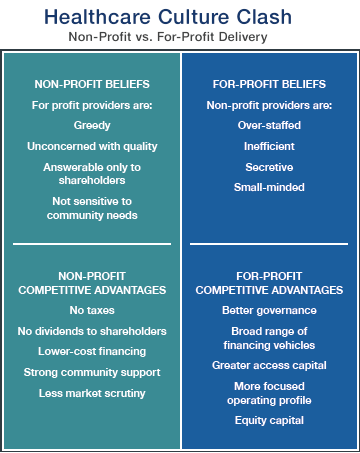
Image result for Non-Profit and For-Profit Hospitals

Although nonprofit and for-profit hospitals are fundamentally similar, there are significant cultural and operational differences, such as strategic approaches to scale and operational discipline.

All hospitals serve patients, employ physicians and nurses, and operate in tightly regulated frameworks for clinical services. For-profit hospitals add a unique element to the mix: generating return for investors.

This additional ingredient gives the organizational culture at for-profits a subtly but significantly different flavor than the atmosphere at their nonprofit counterparts, says Yvette Doran, chief operating officer at Saint Thomas Medical Partners in Nashville, TN.

“When I think of the differences, culture is at the top of my list. The culture at for-profits is business-driven. The culture at nonprofits is service-driven,” she says.

Doran says the differences between for-profits and nonprofits reflect cultural nuances rather than cultural divides. “Good hospitals need both. Without the business aspects on one hand, and the service aspects on the other, you can’t function well.”

There are five primary differences between for-profit and nonprofit hospitals.

1. Tax Status

The most obvious difference between nonprofit and for-profit hospitals is tax status, and it has a major impact financially on hospitals and the communities they serve.

Hospital payment of local and state taxes is a significant benefit for municipal and state governments, says Gary D. Willis, CPA, a former for-profit health system CFO who currently serves as CFO at Amedisys Inc., a home health, hospice, and personal care company in Baton Rouge, LA. The taxes that for-profit hospitals pay support “local schools, development of roads, recruitment of business and industry, and other needed services,” he says.

The financial burden of paying taxes influences corporate culture—emphasizing cost consciousness and operational discipline, says Andrew Slusser, senior vice president at Brentwood, TN-based RCCH Healthcare Partners.

“For-profit hospitals generally have to be more cost-efficient because of the financial hurdles they have to clear: sales taxes, property taxes, all the taxes nonprofits don’t have to worry about,” he says.

“One of the initiatives we’ve had success with—in both new and existing hospitals—is to conduct an Operations Assessment Team survey. It’s in essence a deep dive into all operational costs to see where efficiencies may have been missed before. We often discover we’re able to eliminate duplicative costs, stop doing work that’s no longer adding value, or in some cases actually do more with less,” Slusser says.

2. Operational Discipline

With positive financial performance among the primary goals of shareholders and the top executive leadership, operational discipline is one of the distinguishing characteristics of for-profit hospitals, says Neville Zar, senior vice president of revenue operations at Boston-based Steward Health Care System, a for-profit that includes 3,500 physicians and 18 hospital campuses in four states.

At Steward, we believe we’ve done a good job establishing operational discipline. It means accountability. It means predictability. It means responsibility. It’s like hygiene. You wake up, brush your teeth, and this is part of what you do every day.”

A revenue-cycle dashboard report is circulated at Steward every Monday morning at 7 a.m., including point-of-service cash collections, patient coverage eligibility for government programs such as Medicaid, and productivity metrics, he says. “There’s predictability with that.”

A high level of accountability fuels operational discipline at Steward and other for-profits, Zar says.

There is no ignoring the financial numbers at Steward, which installed wide-screen TVs in most business offices four years ago to post financial performance information in real-time. “There are updates every 15 minutes. You can’t hide in your cube,” he says. “There was a 15% to 20% improvement in efficiency after those TVs went up.”

3. Financial Pressure

Accountability for financial performance flows from the top of for-profit health systems and hospitals, says Dick Escue, senior vice president and chief information officer at the Hawaii Medical Service Association in Honolulu.

Escue worked for many years at a rehabilitation services organization that for-profit Kindred Healthcare of Louisville, Kentucky, acquired in 2011. “We were a publicly traded company. At a high level, quarterly, our CEO and CFO were going to New York to report to analysts. You never want to go there and disappoint. … You’re not going to keep your job as the CEO or CFO of a publicly traded company if you produce results that disappoint.”

Finance team members at for-profits must be willing to push themselves to meet performance goals, Zar says.

“Steward is a very driven organization. It’s not 9-to-5 hours. Everybody in healthcare works hard, but we work really hard. We’re driven by each quarter, by each month. People will work the weekend at the end of the month or the end of the quarter to put in the extra hours to make sure we meet our targets. There’s a lot of focus on the financial results, from the senior executives to the worker bees. We’re not ashamed of it.”

“Cash blitzes” are one method Steward’s revenue cycle team uses to boost revenue when financial performance slips, he says. Based on information gathered during team meetings at the hospital level, the revenue cycle staff focuses a cash blitz on efforts that have a high likelihood of generating cash collections, including tackling high-balance accounts and addressing payment delays linked to claims processing such as clinical documentation queries from payers.

For-profit hospitals routinely utilize monetary incentives in the compensation packages of the C-Suite leadership, says Brian B. Sanderson, managing principal of healthcare services at Oak Brook, IL–based Crowe Horwath LLP.

“The compensation structures in the for-profits tend to be much more incentive-based than compensation at not-for-profits,” he says. “Senior executive compensation is tied to similar elements as found in other for-profit environments, including stock price and margin on operations.”

In contrast to offering generous incentives that reward robust financial performance, for-profits do not hesitate to cut costs in lean times, Escue says.

“The rigor around spending, whether it’s capital spending, operating spending, or payroll, is more intense at for-profits. The things that got cut when I worked in the back office of a for-profit were overhead. There was constant pressure to reduce overhead,” he says. “Contractors and consultants are let go, at least temporarily. Hiring is frozen, with budgeted openings going unfilled. Any other budgeted, but not committed, spending is frozen.”

4. Scale

The for-profit hospital sector is highly concentrated.

There are 4,862 community hospitals in the country, according to the American Hospital Association. Nongovernmental not-for-profit hospitals account for the largest number of facilities at 2,845. There are 1,034 for-profit hospitals, and 983 state and local government hospitals.

In 2016, the country’s for-profit hospital trade association, the Washington, DC–based Federation of American Hospitals, represented a dozen health systems that owned about 635 hospitals. Four of the FAH health systems accounted for about 520 hospitals: Franklin, TN-based Community Hospital Systems (CHS); Nashville-based Hospital Corporation of America; Brentwood, TN–based LifePoint Health; and Dallas-based Tenet Healthcare Corporation.

Scale generates several operational benefits at for-profit hospitals.

“Scale is critically important,” says Julie Soekoro, CFO at Grandview Medical Center, a CHS-owned, 372-bed hospital in Birmingham, Alabama. “What we benefit from at Grandview is access to resources and expertise. I really don’t use consultants at Grandview because we have corporate expertise for challenges like ICD-10 coding. That is a tremendous benefit.”

Grandview also benefits from the best practices that have been shared and standardized across the 146 CHS hospitals. “Best practices can have a direct impact on value,” Soekoro says. “The infrastructure is there. For-profits are well-positioned for the consolidated healthcare market of the future… You can add a lot of individual hospitals without having to add expertise at the corporate office.”

The High Reliability and Safety program at CHS is an example of how standardizing best practices across the health system’s hospitals has generated significant performance gains, she says.

“A few years ago, CHS embarked on a journey to institute a culture of high reliability at the hospitals. The hospitals and affiliated organizations have worked to establish safety as a ‘core value.’ At Grandview, we have hard-wired a number of initiatives, including daily safety huddles and multiple evidence-based, best-practice error prevention methods.”

Scale also plays a crucial role in one of the most significant advantages of for-profit hospitals relative to their nonprofit counterparts: access to capital.

Ready access to capital gives for-profits the ability to move faster than their nonprofit counterparts, Sanderson says. “They’re finding that their access to capital is a linchpin for them. … When a for-profit has better access to capital, it can make decisions rapidly and make investments rapidly. Many not-for-profits don’t have that luxury.”

5. Competitive Edge

There are valuable lessons for nonprofits to draw from the for-profit business model as the healthcare industry shifts from volume to value.

When healthcare providers negotiate managed care contracts, for-profits have a bargaining advantage over nonprofits, Doran says. “In managed care contracts, for profits look for leverage and nonprofits look for partnership opportunities. The appetite for aggressive negotiations is much more palatable among for-profits.”