The Fundamental Problem at the Heart of American Health Insurance

Administrative waste, denials, and deadly incentives — the U.S. model shows what happens when profit rules.

The United States is the only country where a health insurance executive has been gunned down in the street. But that’s not the only thing that’s unique about American health insurance.

Almost all of our peer countries – advanced, free-market democracies — have health insurance companies. In some cases (Germany, Switzerland, Japan), private health insurance is the chief way to pay for medical care. In others (such as Great Britain), private insurance works as a supplement to government-run health care systems. But there’s a fundamental difference between health insurance elsewhere and the U.S. system. 

In all the other advanced democracies, basic health insurance is not for profit; the insurers are essentially charities. They exist not to pay large sums to executives and investors, but rather to keep the population healthy by assuring that everyone can get medical care when it’s needed. 

America’s health insurance giants are profit-making businesses. Indeed, in the insurers’ quarterly earnings reports to investors, the standard industry term for any sums spent paying people’s medical bills is “medical loss.” They view paying your doctor bill as a loss that subtracts from the dividends they owe their stockholders. 

When I studied health care systems around the world, I asked economists and doctors and health ministers why they want health insurance to be a nonprofit endeavor. Everyone gave essentially the same answer:

There’s a fundamental contradiction between insuring a nation’s health and making a profit on health insurance.

Health insurance exists to help people get the preventive care and treatment they need by paying their medical bills. But the way to make a profit on health insurance is to avoid paying medical bills. Accordingly, the U.S. insurance giants have devised ingenious methods for evading payment — schemes like high deductibles, narrow networks of approved doctors, limited lists of permitted drugs, and pre-authorization requirements, so that the insurance adjuster, not your doctor, determines what treatment you get. 

Other countries don’t allow those gimmicks. In America, the patient pays twice — first the insurance premium, and then the bill that the insurer declines to pay. That’s why Americans hate health insurance companies — as reflected in the tasteless barrage of angry social media commentary aimed at the victim, not the perpetrator, of the sidewalk shooting in 2024  of UnitedHealthcare’s CEO Brian Thompson in New York City. 

Another unique aspect of U.S.-style health insurance is the huge amount of money our big insurers waste on administrative costs. Any insurance plan has administrative expenses; you’ve got to collect the premiums, review the patients’ claims, and get the payments out to doctors and hospitals.

In other countries, the administrative costs are limited to about 5% of premium income; that is, insurers use 95% of all the money they take in to pay medical bills. But the U.S. insurance giants routinely report administrative costs in the range of 15% to 20%.

When the first drafts of the Affordable Care Act (“Obamacare”) were floated on Capitol Hill in 2009, the statutory language called for limiting insurers’ admin costs to 12% of premium income. Then the insurance lobby went to work. The final text of that law allows them to spend up to 20% of their income on salaries, marketing, dividends, and other stuff that doesn’t pay anybody’s hospital bill. 

There is one American insurance system, however, that is as thrifty as foreign health insurance plans. Medicare, the federal government’s insurance program for seniors and the disabled, reports administrative costs in the range of 3% — about one-fifth as much as the big private insurers fritter away. And Medicare’s administrators — federal bureaucrats — are paid less than a tenth as much as the executives running the far less efficient private insurance firms. 

Americans generally believe that the profit-driven private sector is more efficient and innovative than government. In many cases, that’s true. I wouldn’t want some government agency designing my cell phone or my hiking boots.

But when it comes to health insurance, all the evidence shows that nonprofit and government-run plans provide better coverage at lower cost than the private plans from America’s health insurance giants.

If we were to make basic health insurance a nonprofit endeavor, as it is everywhere else, or put everybody on a public plan like Medicare, the U.S. would save billions and improve our access to life-saving care. Then Americans might stop celebrating on social media when an insurance executive is killed. 

Hospitals living paycheck to paycheck, unable to make long-term investments

Healthcare added almost 45,000 jobs in November, but many hospitals and health systems will continue to struggle to meet staffing needs, retain top executives and providers, and foster long-term pipelines for talent, Ted Chien, president and CEO of independent consulting firm SullivanCotter, wrote in a Dec. 15 article for Nasdaq.

Hospitals and health systems are living “paycheck to paycheck” and unable to make long-term investments at the height of the current workforce crisis, Mr. Chien said.

The challenge boils down to a healthcare delivery problem, not a demand problem. 

Baby Boomers are the greatest source of care demand on the healthcare system, but are unable to contribute to the provider workforce in the numbers needed to achieve balance, according to Mr. Chien. To compound that issue, burnout is a major factor why “too many” frontline workers have left or plan to exit healthcare, he said. 

Last year, an estimated 333,942 healthcare providers dropped out of the workforce, including about 53,000 nurse practitioners, which has led hospitals to spend more on contract labor and feeling more pressure to consolidate, according to an October report published by Definitive Healthcare.

Long term, a continued lack of healthcare workers would force hospitals to operate in a heightened crisis mode, according to Mr. Chien, depriving non-critical patients of sufficient health prevention and demanding too much of providers who are already overly taxed. 

Mr. Chien highlighted three key areas to tackle the workforce crisis: smarter technology, resilient teams and excellent leadership. 

Technologies that alleviate providers’ administrative burdens will be critical to reduce burnout and keep caregivers focused on patient care, while smarter tech can also forge pipelines for future providers by streamlining clinical experience operations and aligning student placements with existing opportunities.

Building resilient teams begins with competitive pay and robust benefit packages, which fosters trust and demonstrates that a hospital values its staff, according to Mr. Chen. Supporting career growth, including upskilling and redeploying staff when appropriate, empowers employees.

Lastly, capable executive leadership teams, under intense scrutiny from industry stakeholders, must clearly outline their hospital or health system’s strategy and provide the change needed to support their staff. Lack of trust in leaders drives staff out of healthcare, so it is crucial to recruit and retain “modern, strategic thinkers with depth of experience who are prepared to lead,” Mr. Chien wrote. 

Click here to read the full article.

U.S. health care costs a lot, and not just in money

Administrative Burden | RSF

Health spending in the United States is highest in the world, driven in part by administrative complexity. To date, studies examining the administrative costs of American health care have primarily focused on clinicians and organizations—rarely on patients.

A new study in Health Services Research finds administrative complexity in the U.S. health care system has consequences for access to care that are on par with those of financial barriers like copays and deductibles. In other words, we pay for health care in two ways: in money and in the hassle of dealing with a complex, confusing, and error-riddled system. Both are barriers to access. The study was led by Michael Anne Kyle, and coauthor, Austin Frakt.

Main Findings

  • Nearly three-quarters (73%) of people surveyed reported doing at least one health care-related administrative task in the past 12 months. Such administrative tasks include: appointment scheduling; obtaining information from an insurer or provider; obtaining prior authorizations; resolving insurance or provider billing issues; and resolving premium problems.
  • Administrative tasks often impose barriers to care: Nearly one-quarter (24.4%) of survey respondents reported delaying or foregoing needed care due to administrative tasks.
  • This estimate of administrative barriers to access to care is similar to those of financial barriers to access: a 2019 Kaiser Family Foundation survey, found that 26% of insured adults 18-64 said that they or a family member had postponed or put off needed care in the past 12 months due to cost.
  • Administrative burden has consequential implications for equity. The study finds administrative burden falls disproportionately on people with high medical needs (disability) and that existing racial and socioeconomic inequities are associated with greater administrative burden.

Methods

To measure the size and consequences of patients’ administrative roles, we used data from the nationally representative March 2019 Health Reform Monitoring Survey of insured, nonelderly adults (18-64) to assess the annual prevalence of five common types of administrative tasks patients perform: (1) appointment scheduling; (2) obtaining information from an insurer or provider; (3) obtaining prior authorizations; (4) resolving insurance or provider billing issues; (5) and resolving insurance premium problems. The study examined the association of these tasks with two important measures of their burden: delayed and forgone care.

Conclusions

High administrative complexity is a central feature of the U.S. health care system. Largely overlooked, patients frequently do administrative work that can create burdens resulting in delayed or foregone care. The prevalence of delayed or foregone care due to administrative tasks is comparable to similar estimates of cost-related barriers to care. Administrative complexity is endemic to all post-industrial health systems, but there may be opportunity to design administrative tools with greater care to avoid exacerbating or reinforcing inequities.

25% of US healthcare spending is waste, study finds

https://www.beckershospitalreview.com/finance/25-of-us-healthcare-spending-is-waste-study-finds.html?oly_enc_id=2893H2397267F7G

Image result for Journal of the American Medical Association (JAMA) Publishes Humana Study on Health Care Spending


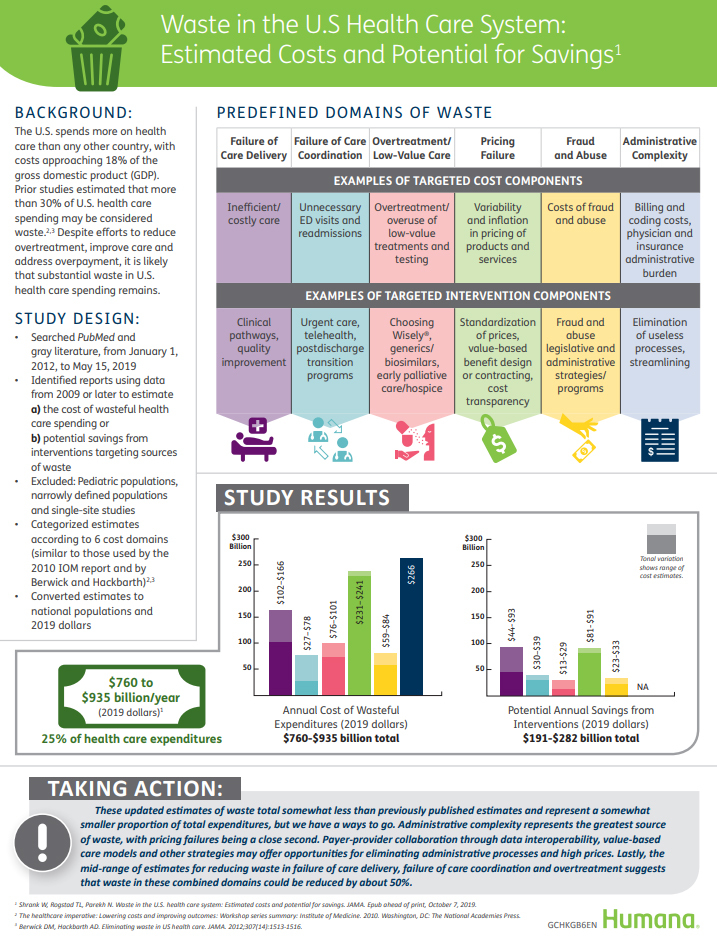
About 25 percent of U.S. healthcare spending can be classified as waste, according to a new study published in JAMA Oct. 7. 

For the study, researchers from Humana and the University of Pittsburgh School of Medicine analyzed 54 peer-reviewed studies, government reports and other medical literature to estimate the levels of waste in the U.S. healthcare system.

Researchers divided waste into six previously developed categories including: failure of care delivery; failure of care coordination; overtreatment or low-value care; pricing failure; fraud and waste; and administrative complexity. 

Administrative complexity accounted for the most waste with $265.6 billion annually, followed by pricing failure or inefficiencies, which accounted for up to $240.6 billion in waste per year.

Approximately $300 billion in waste accrued from failure of care delivery, failure of care coordination and overtreatment. The study estimated that about half of this waste could be avoided.

Overall, the researchers found that the cost of waste in the U.S. healthcare system ranges from $760 billion to $935 billion annually.

Of the $760 billion to $935 billion of waste, researchers estimated that using interventions found to reduce waste could cut between $191 billion and $282.1 billion in healthcare spending.

Access the full report here