Anthony Fauci’s security is stepped up as doctor and face of U.S. coronavirus response receives threats

https://www.washingtonpost.com/politics/anthony-faucis-security-is-stepped-up-as-doctor-and-face-of-us-coronavirus-response-receives-threats/2020/04/01/ff861a16-744d-11ea-85cb-8670579b863d_story.html?utm_campaign=wp_news_alert_revere&utm_medium=email&utm_source=alert&wpisrc=al_news__alert-hse–alert-national&wpmk=1

Nation's top coronavirus expert Dr. Anthony Fauci forced to beef ...

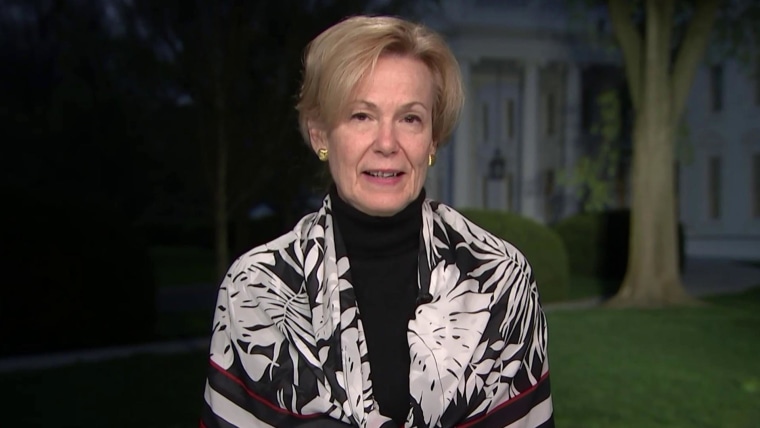
Anthony S. Fauci, the nation’s top infectious-diseases expert and the face of the U.S. response to the novel coronavirus pandemic, is facing growing threats to his personal safety, prompting the government to step up his security, according to people familiar with the matter.

The concerns include threats as well as unwelcome communications from fervent admirers, according to people with knowledge of deliberations inside the Department of Health and Human Services and the Department of Justice.

Fauci, 79, is the most outspoken member of the administration in favor of sweeping public health guidelines and is among the few officials willing to correct President Trump’s misstatements. Along with Deborah Birx, the coordinator for the White House’s task force, Fauci has encouraged the president to extend the timeline for social-distancing guidelines, presenting him with grim models about the possible toll of the pandemic.

“Now is the time, whenever you’re having an effect, not to take your foot off the accelerator and on the brake, but to just press it down on the accelerator,” he said Tuesday as the White House’s task force made some of those models public, warning of 100,000 to 240,000 deaths in the United States.

The exact nature of the threats against him was not clear. Greater exposure has led to more praise for the doctor but also more criticism.

Fauci has become a public target for some right-wing commentators and bloggers, who exercise influence over parts of the president’s base. As they press for the president to ease restrictions to reinvigorate economic activity, some of these figures have assailed Fauci and questioned his expertise.

Last month, an article depicting him as an agent of the “deep state” gained nearly 25,000 interactions on Facebook — meaning likes, comments and shares — as it was posted to large pro-Trump groups with titles such as “Trump Strong” and “Tampa Bay Trump Club.”

Alex Azar, the HHS secretary, recently grew concerned about Fauci’s safety as his profile rose and he endured more vitriolic criticism online, according to people familiar with the situation. In recent weeks, admirers have also approached Fauci, asking to him sign baseballs, along with other acts of adulation. It was determined that Fauci should have a security detail. Azar also has a security detail because he is in the presidential line of succession.

Asked Wednesday whether he was receiving security protection, Fauci told reporters, “I would have to refer you to HHS [inspector general] on that. I wouldn’t comment.”

The president interjected, saying, “He doesn’t need security. Everybody loves him.”

HHS asked the U.S. Marshals Service to deputize a group of agents in the office of the HHS inspector general to provide protective services for the doctor, according to an official with knowledge of the request.

The U.S. Marshals Service conveyed the request to the deputy attorney general, who has authority over deputations for the purpose of providing protective services, with the recommendation that it be approved, according to the official, who spoke on the condition of anonymity to reveal sensitive plans that the person was not authorized to discuss.

A Justice Department official signed paperwork Tuesday authorizing HHS to provide its own security detail to Fauci, according to an administration official.

An HHS spokesperson declined to discuss details of the doctor’s security but said: “Dr. Fauci is an integral part of the U.S. Government’s response against covid-19. Among other efforts, he is leading the development of a covid-19 vaccine and he regularly appears at White House press briefings and media interviews.”

At the briefings, Fauci, who has advised presidents of both parties as director of the National Institute of Allergy and Infectious Diseases, has spoken authoritatively about the spread of the coronavirus and the sacrifices involved in mitigating its effects.

He has at times corrected the president, in particular when prompted by reporters. After Trump said a covid-19 vaccine would be available in a couple of months, Fauci said it would in fact be available in about a year to a year and a half, at best.

His role has turned him into a hero for some. When he was absent from a briefing last month, followers who had grown accustomed to his frank assessments of the outbreak were alarmed that he might have been sidelined for his forthrightness. Many took to Twitter to ask, “Where is Dr. Fauci?” causing the question to trend on the platform.

He gained viral attention two days later when he placed his hand in front of his face in a gesture of apparent disbelief as Trump referred to the State Department as the “deep state department” from the White House briefing room.

Fauci has also given several interviews in which he has tempered praise for the president with doubts about his pronouncements, including about the viability of anti-malarial drugs as a treatment for the novel coronavirus. Most notably, he told the journal Science that he attempts to guide Trump’s statements but “can’t jump in front of the microphone and push him down.”

These moves have inspired fandom. But they have also drawn scorn from some of the president’s most vocal supporters, even as both men have sought to tamp down the appearance of tension.

“The president was right, and frankly Fauci was wrong,” Lou Dobbs said last week on his show on the Fox Business Network, referring to the use of experimental medicine.

Right-wing news and opinion sites have gone further, launching baseless smears against the doctor that have gained significant traction within pro-Trump communities online.

Outlets such as the Gateway Pundit and American Thinker seized on a 2013 email — released by WikiLeaks as part of a cache of communications hacked by Russian operatives — in which Fauci praised Hillary Clinton’s “stamina and capability” during her testimony as secretary of state before the congressional committee investigating the attacks in Benghazi, Libya.

The headline in the American Thinker referred to Fauci as a “Deep-State ­Hillary Clinton-loving stooge.” The author, Peter Barry Chowka, didn’t respond to requests for comment. When asked about the relevance of Fauci’s emails to his role in advising the White House’s coronavirus response, Jim Hoft, the editor of the Gateway Pundit, said, “I don’t have a problem with more information being shared about the doctor.”

The outlet has continued to criticize Fauci in recent days, saying that by offering new predictions about the possible death toll, Fauci and others were “going to destroy the U.S. economy based on total guesses and hysterical predictions.”

Several senior administration officials said that Trump respects Fauci and that the two generally have a good working relationship. Trump heeded the guidance of Fauci and Birx this week when he announced his administration would extend social-distancing guidelines for another 30 days. Last week, many health officials and experts grew worried when Trump said he hoped to reopen the country by Easter, even as coronavirus cases in the United States continue to rapidly climb.

The immunologist, who graduated first in his class from Cornell’s medical school, has been the director of the National Institute of Allergy and Infectious Diseases since 1984. Between 1983 and 2002, he was the 13th-most-cited scientist among the 2.5 million to 3 million authors worldwide and across all disciplines publishing in scientific journals, according to the Institute for Scientific Information.


As coronavirus spreads, so do reports of companies mistreating workers

https://www.washingtonpost.com/business/2020/03/31/worker-retaliation-mistreatment-coronavirus/?fbclid=IwAR1uQPecWtRM3G__toecrlhfYhszBQkDoYFkxsUrMYY_UZtKaTHpq3cblH4&utm_campaign=wp_main&utm_medium=social&utm_source=facebook

Workers complain of mistreatment as they try to cope with the ...

From nurses to retail salespeople, workers are walking off the job and facing retribution for speaking out.

She could wear her protective mask while seeing her patients. Many were, after all, elderly, with respiratory problems, susceptible to getting severely sick from the novel coronavirus. And so Laura Moreno, a nurse in Oklahoma City, wanted to protect them — as well as herself and her 12-year-old daughter, who has asthma and a thyroid condition.

She could not, however, wear her mask in the hallways, or the cafeteria or any of the hospital’s common areas, because her supervisors told her it would scare patients. “I was told if I wanted to wear a mask, I would not be working there,” she said. “So I said I’m not willing to put my life at risk, and my contract was terminated.”

Since the viral pandemic started ravaging the country in recent weeks, workers, unions and attorneys are seeing a dramatic rise in cases they say illustrate a wave of bad employer behavior, forcing workers into conditions they fear are unsafe, withholding protective equipment, and retaliating against those who speak up or walk out.

Moreno’s case was one of many that her attorney, Rachel Bussett, and her colleagues at the National Employment Lawyers Association have been inundated with as workers grow increasingly fearful of retribution from, as Bussett said, “employers who value the economy over people.”

A handful of workers at a McDonald’s outside San Francisco walked off the job to protest the lack of safety measures. So did about 50 workers at a Perdue chicken plant in Georgia, as well as workers at Instacart and Amazon, while the companies said they were taking steps to ensure their employees’ safety and well-being. (Amazon’s chief executive, Jeff Bezos, owns The Washington Post.)

Meanwhile, employees at several major retailers have circulated petitions urging the companies to close their stores and protect workers. And some workers have said they were fired outright for speaking their minds and pushing companies to look after them.

The complaints come as the virus’s toll mounts and health officials warned that extreme measures, such as lockdowns, would continue. On Sunday, health officials said social distancing guidelines would remain in place through April, and President Trump said the nation “will be well on its way to recovery” by June 1, not Easter, as he had said previously.

“This is a situation we’ve never had to deal with before,” said Heidi Burakiewicz, a D.C. attorney and a member of the employment lawyers association. “We’re doing everything we can to help these employees — not just about protecting jobs. But people’s lives are at stake, and people should never have to be faced with questions about whether they need to risk exposing themselves and their families or losing their jobs.”

The designations for “essential” businesses can vary by state but generally include supermarkets, pharmacies, hardware stores, auto repair shops and the defense industry.

Workers at a number of large retailers — such as craft stores, video-gaming shops and office supply chains — have questioned their employers’ decision to stay open despite stay-at-home orders across the country.

“It is unnecessary and unsafe to be open during a PANDEMIC,” Staples employees wrote in a petition. “We are not an essential store and corporate is fighting and begging to stay open, claiming Staples is essential and putting employees and their families at risk. Staples should temporarily close stores and pay their employees for the time being.”

Staples spokeswoman Meghan McCarrick said the company is “an essential provider of business and educational materials and products, household goods and cleaning supplies.” She said that an intensive care unit at a Baltimore hospital recently purchased ink and toner for a printer at Staples, while a hospital in Virginia bought webcams to set up remote telemedicine offices.

Last week, the Federal Bureau of Prisons turned away employees who said they had taken pain medications such as Advil, Tylenol or Motrin within four hours of reporting for work. That meant guards with balky hips or bad backs were forced to take sick leave, even if they had no fever or other symptoms of the virus, union officials said.

“You have unqualified people asking questions that are medically related,” said Sandy Parr, a union official. “They’re sending people home just because they took Motrin, which is decreasing the staff available to work — and that increases the danger.”

After guard workers complained and The Post inquired about the measure, the Bureau of Prisons said last week that it was discontinuing the practice.

Across the country, some health-care facilities are hoarding masks, goggles and gloves — forcing some workers to bring in their own, use the same equipment again and again, or go without.

“It’s in cabinets locked away, collecting dust while people need it now,” said Rebecca Reindel, the safety and health director of the AFL-CIO, who said the union has raised the issue “in every avenue we can.”

Moreno’s concern wasn’t the availability of the equipment — only her ability to use it. A contract nurse at Select Specialty Hospital, she felt she needed to wear a mask at all times, especially given that the patients she was treating were particularly susceptible to the worst effects of the virus. The hospital’s website says it provides “specialized care for patients with acute or chronic respiratory disorders. Our primary focus is to wean medically complex patients from mechanical ventilation and restore independent breathing.”

The state is under a “safer at home” order, which directs people over 65 and those with underlying medical conditions to stay home and limits gatherings to no more than 10 people, among other restrictions.

On Wednesday, however, Moreno was told her contract was being terminated because the hospital did not want her wearing a mask in common areas of the hospital, she said. But by the next afternoon, after The Post had contacted the hospital, she said hospital officials “had completely changed their tune” and decided to allow nurses to wear masks throughout the hospital and not just in patient rooms.

On Friday, she went back to work. In an email, a hospital spokeswoman said, “The nurse is still engaged with us and her upcoming scheduled shifts have been confirmed.”

The policy change “feels wonderful,” Moreno said, “because I know I will be protected and my friends and co-workers will be protected.”

Kevin Readel, another nurse in Oklahoma City, said he was fired for a similar reason — but in his case it was for insisting on wearing a mask while with patients.

He said he was told “point blank that I can’t wear a mask” because it “could cause fear and anxiety amongst the other nurses and the patients.”

He filed a suit against the Oklahoma Heart Hospital South for wrongful termination, claiming that “the hospital was more concerned about the perception of due diligence than actually performing due diligence.”

A spokesman for the hospital said he could not comment on pending litigation but said the hospital’s “entire focus is on making sure we protect the safety of our patients and health care professionals in preparation for an expected surge in COVID-19 patients. As part of our preparation, we are strictly complying with the guidelines on the personal protective equipment set forth by the World Health Organization and the Centers for Disease Control.”

Lauri Mazurkiewicz, a nurse who lives outside Chicago, grew nervous when she was repeatedly exposed to patients diagnosed with covid-19, the disease caused by the coronavirus. “This is so contagious. It’s spreading so fast. I need an N95 mask,” she said, referring to a specialty mask worn by many health-care workers.

She happened to have an N95 and began wearing it during her rounds at Northwestern Memorial Hospital, she said, but was told the hospital was prohibiting the use of N95 masks and using regular surgical masks instead.

She sent an email warning her colleagues that those masks were less effective. She was fired shortly afterward — the result, she alleged in a lawsuit against the hospital, of her attempts to “disclose public corruption and/or wrongdoing.”

A spokesman for the hospital declined to comment on the specifics of her complaint in the lawsuit, but said it is “committed to the safety of our employees who are on the frontlines of this global health care crisis.” He added that it follows “CDC guidance regarding the use of personal protective equipment for our health care providers.”

In a statement Monday, the American College of Emergency Physicians said it was “shocked and outraged by the growing reports of employers retaliating against frontline health workers who are trying to ensure they and their colleagues are protected while caring for patients in this pandemic. … Not only does this type of retribution remove healthy physicians from the frontlines, it encourages others to work in unsafe conditions, increasing their likelihood of getting sick.”

In the retail sector, employees at Michaels crafts stores said they were told the company’s shops would remain open because they serve “people who are bored at home” and double as UPS drop-off sites, according to an employee at a Phoenix store who is awaiting results for a coronavirus test.

The worker, who spoke on the condition of anonymity, has been home with a low-grade fever, cough and chest pain but says store managers have not been supportive.

“Every time I call in sick, there’s just an incredibly disappointed sound on the other end,” she said. “This is not an essential business — nobody in the history of mankind has ever dropped dead from boredom. They need to close their doors.”

Anjanette Coplin, a spokeswoman for Michaels, said its stores provide necessary products and services for parents and small-business owners. “We want to support and remain a lifeline for the teachers, parents and small businesses who rely on Michaels and our products to enable creative learning,” she said. Michaels is offering curbside pickup and has temporarily closed locations in certain states, including California, New York and Pennsylvania.

JoAnn craft stores, GameStop, Office Depot and Guitar Center have also come under fire for keeping stores open. A spokesman for Office Depot said the company is not requiring retail employees to come to work if they are not comfortable. Guitar Center, which furloughed 9,000 workers on Monday, said it is following state and local rules regarding store closures. JoAnn and GameStop did not respond to requests for comment.

In Plain City, Ohio, workers at a TenPoint Complete call center who administer automotive surveys by phone have been instructed to report to work even after the state issued a stay-at-home order, according to one employee who spoke on the condition of anonymity because she feared reprisal.

Her work, she said, consists of calling customers to ask about their experience at the body shop.

“This is not an essential job,” she said.

TenPoint Complete did not respond to a request for comment.

Even as other department stores, such as Nordstrom and Kohl’s, have temporarily shut their doors and kept paying their workers, Dillard’s has kept locations operating where government authorities allow it, making it one of the few remaining mall-based stores to remain open despite the pandemic, employees say.

That has sparked concern from employees, social media outrage by community members and a petition drive urging it to close that alleges, “Unlike other retailers who care about the safety and well-being of their employees and the guests they serve everyday, Dillard’s is choosing to run a blind eye in order to keep money funneling into their greedy pockets.”

Some employees who work for the company expressed fear about the stores remaining open, saying that they have been offered no assurances of pay if their stores close and that they had to pay more for their health insurance as their hours were cut.

One full-time Dillard’s employee based in Colorado, who requested anonymity to preserve her job, said that before her store closed in the middle of last week, she tried to use the vacation time she has accumulated to take off two weeks, but was told she couldn’t because the store was short-staffed. Her store has since closed because of local restrictions for nonessential businesses, and she said they were not being paid during the closure, other than for earned vacation leave. They have received little clear information about whether they would get their jobs back when the stores reopened, she said.

An employee in her 60s based in southwest Florida said she has not yet accumulated any paid time off, so if she were to get sick, she would have no paid leave. “They say you’re more than welcome to stay home, but that’s, of course, without pay,” at least for her.

She said the company has done little to directly encourage social distancing from customers making purchases. “They’re just telling us to relay to customers — politely — to stand back,” she said, but not putting up signage or tape to mark where customers should stand. “They are providing us at each register with a little small bottle of hand sanitizer. Mine has about a quarter of it left.”

In an email, Julie Johnson Guymon, a company spokeswoman, said “direct communication” with associates began Monday. In an earlier statement, she said Dillard’s is “fully cooperating with any government directives in our markets and promptly closing under those guidelines. Importantly, we are strictly following CDC guidelines for the safety of our associates and the customers who choose to visit us where open. No associate who is uncomfortable working is required to do so. We believe continuing to operate using current safety standards is the best thing we can do long term for our associates and for the economy.”


Dr. Birx predicts up to 200,000 coronavirus deaths ‘if we do things almost perfectly’

https://www.yahoo.com/news/dr-birx-predicts-200-000-115800421.html

Dr. Birx predicts up to 200,000 U.S. coronavirus deaths 'if we do ...

The White House coronavirus response coordinator said Monday that she is “very worried about every city in the United States” and projects 100,000 to 200,000 American deaths as a best case scenario.

In an interview on “TODAY,” Dr. Deborah Birx painted a grim message about the expected fatalities, echoing that they could hit more than 2 million without any measures, as coronavirus cases continue to climb throughout the country.

“I think everyone understands now that you can go from five to 50 to 500 to 5,000 cases very quickly,” Birx said.

“I think in some of the metro areas we were late in getting people to follow the 15-day guidelines,” she added.

Birx said the projections by Dr. Anthony Fauci that U.S. deaths could range from 1.6 million to 2.2 million is a worst case scenario if the country did “nothing” to contain the outbreak, but said even “if we do things almost perfectly,” she still predicts up to 200,000 U.S. deaths.

Fauci, the director of the National Institute of Allergy and Infectious Diseases, reiterated Monday on CNN that “I don’t want to see it, I’d like to avoid it, but I wouldn’t be surprised if we saw 100,000 deaths.”

Politics

Birx said the best case scenario would be for “100 percent of Americans doing precisely what is required, but we’re not sure that all of America is responding in a uniform way to protect one another,” referencing images circulating online of people still congregating in big groups and ignoring guidelines from the Centers for Disease Control and Prevention.

Birx was also on “Meet the Press” on Sunday warning that “no state, no metro area will be spared,” a message she repeated Monday. Even if metro or rural areas don’t see the virus in the community now, by the time it does appear, the outbreak will be significant, she added.

How long Americans will be expected to comply with measures, including socially distancing and sheltering in place, remains unclear in this growing pandemic after several states and larger cities began implementing measures over the past couple of weeks.

President Trump announced Sunday that the administration’s guidelines on social distancing have been extended until April 30. Trump said last week that he wanted to see much of the country return to normal by Easter, April 12, despite warnings from top health experts that easing guidelines early could cause mass deaths. Now, Trump said he expects “great things to be happening” by June 1.

Birx said on Sunday that the choice to extend the guidelines had not been made lightly.

“We know it’s a huge sacrifice for everyone,” she added.


What the U.S. can learn from other countries in the coronavirus fight

https://www.axios.com/coronavirus-lessons-other-countries-24794264-1653-4500-922c-7f1c66efa011.html

Coronavirus lessons that the U.S. can learn from other countries ...

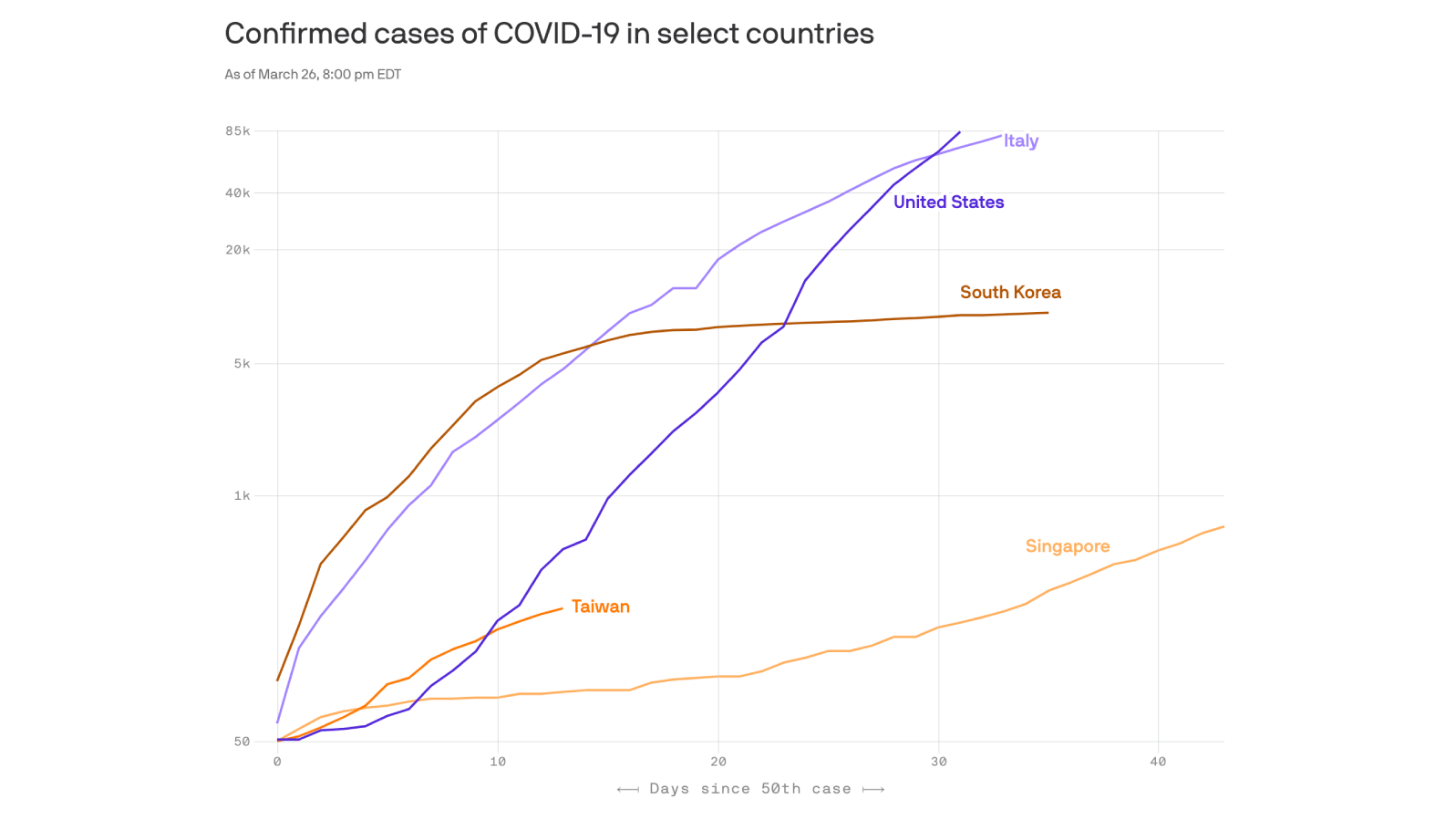
The countries that have most successfully fended off the novel coronavirus have mainly done it with a combination of new technology and old-school principles.

Why it matters: There’s a lot the U.S. can learn from the way other countries have handled this global pandemic — although we may not be able to apply those lessons as quickly as we’d like.

The big picture: A handful of Asian countries, including South Korea, Singapore and Taiwan, have succeeded where the U.S. and Europe have failed.

  • They were able to quickly bring the virus under control, reducing the number of new cases that cropped up each day. And they did it largely without shutting down schools, businesses and public life.

The bad news: It’s too late for the U.S. to simply do what worked in those countries. We’ve already made too many mistakes.

  • But there are still lessons for the U.S. to learn for future outbreaks — and, hopefully, there are some pieces of those countries’ larger strategies that we can adapt to our coronavirus response now.
Lesson 1: The playbook works

As a new infection begins to spread, you want to quickly test the people who might have it, and quarantine the ones who do. Then you want to figure out who else they might have infected, and test those people, and quarantine the ones who are indeed sick. This process gets repeated.

  • “If you don’t know what your population is that you’re supposed to be monitoring, you don’t have a chance,” said Claire Standley, an infectious-disease expert at Georgetown University’s Center for Global Health Science and Security.

This test-and-trace process is nothing new. It’s the standard playbook. South Korea, Singapore and Taiwan just executed it a lot better than the United States.

  • Testing and contact tracing are particularly important with this strain of coronavirus because people can spread it before they start to feel sick — so if you’re only testing the sickest patients, the virus is still spreading unchecked.
  • And it’s important to do this early. It’s a lot easier to stop five people from infecting another 15 than it is to stop 20,000 people from infecting another 60,000.

Next time a mysterious virus starts spreading abroad, better testing and a much faster response will be imperative.

Lesson 2: Technology can help

Singapore has gotten pretty draconian with its track-and-trace process.

  • The government tracks the location of residents’ smartphones, so it knows exactly who had come within a few feet of an infected or potentially infected person.
  • It uses the same location data to help enforce mandatory quarantines.

That might be too Big Brother for the U.S., but a voluntary version of it might work — we already consent to a whole lot of location tracking for much less important ends.

  • And researchers are already using population-level smartphone data to see, for example, which cities are flouting stay-at-home orders. That can help inform local response even without individualized tracking.
  • “I think we’re further along that pathway than maybe people think,” Standley said.

Taiwan, meanwhile, aided its coronavirus response by making better use of data it already had. It quickly merged its immigration and health care databases, giving authorities a real-time view of who was getting sick and where they had traveled.

  • That might be hard to copy in the U.S., though, because the relevant data are scattered across multiple local, state and federal agencies with little to no integration. And we have no centralized health data.
Lesson 3: Messaging matters

Public communication is one of the big things Italy — a leading example of what not to do — got wrong.

  • Some Italian officials downplayed the virus for too long. Leaders often contradicted each other, and sometimes themselves, about piecemeal interventions before finally locking down the entire country as cases skyrocketed.

Singapore, by contrast, came out early with a clear message: This was going to be bad for a while, and people needed to stick together and do their part.

The U.S., so far, looks a lot more like Italy.

  • President Trump has sent similarly mixed messages here, initially downplaying the virus and saying it would go away on its own before changing his tone as cases mounted.
What’s next

The U.S. can’t go back in time to get things right at the beginning. So we can’t match the success of places like South Korea.

  • Our best backup plan is to stick with aggressive social distancing and give our testing capacity more time to ramp up.
  • We don’t seem to be on track to ever achieve the kind of sophisticated track-and-trace programs Asia employed, but hopefully some cruder version can help us find our way out of this if we keep the number of new cases low in the meantime.

The bottom line: “If we had got on top of this thing two months ago, America would look very, very different,” Ashish Jha, director of Harvard’s Global Health Institute, said in a recent interview with the New Yorker.


The U.S. Tried to Build a New Fleet of Ventilators. The Mission Failed.

The U S Tried to Build a New Fleet of Ventilators The Mission ...

As the coronavirus spreads, the collapse of the project helps explain America’s acute shortage.

Thirteen years ago, a group of U.S. public health officials came up with a plan to address what they regarded as one of the medical system’s crucial vulnerabilities: a shortage of ventilators.

The breathing-assistance machines tended to be bulky, expensive and limited in number. The plan was to build a large fleet of inexpensive portable devices to deploy in a flu pandemic or another crisis.

Money was budgeted. A federal contract was signed. Work got underway.

And then things suddenly veered off course. A multibillion-dollar maker of medical devices bought the small California company that had been hired to design the new machines. The project ultimately produced zero ventilators.

That failure delayed the development of an affordable ventilator by at least half a decade, depriving hospitals, states and the federal government of the ability to stock up. The federal government started over with another company in 2014, whose ventilator was approved only last year and whose products have not yet been delivered.

Today, with the coronavirus ravaging America’s health care system, the nation’s emergency-response stockpile is still waiting on its first shipment. The scarcity of ventilators has become an emergency, forcing doctors to make life-or-death decisions about who gets to breathe and who does not.

The stalled efforts to create a new class of cheap, easy-to-use ventilators highlight the perils of outsourcing projects with critical public-health implications to private companies; their focus on maximizing profits is not always consistent with the government’s goal of preparing for a future crisis.

“We definitely saw the problem,” said Dr. Thomas R. Frieden, who ran the Centers for Disease Control and Prevention from 2009 to 2017. “We innovated to try and get a solution. We made really good progress, but it doesn’t appear to have resulted in the volume that we needed.”

The project — code-named Aura — came in the wake of a parade of near-miss pandemics: SARS, MERS, bird flu and swine flu.

Federal officials decided to re-evaluate their strategy for the next public health emergency. They considered vaccines, antiviral drugs, protective gear and ventilators, the last line of defense for patients suffering respiratory failure. The federal government’s Strategic National Stockpile had full-service ventilators in its warehouses, but not in the quantities that would be needed to combat a major pandemic.

In 2006, the Department of Health and Human Services established a new division, the Biomedical Advanced Research and Development Authority, with a mandate to prepare medical responses to chemical, biological and nuclear attacks, as well as infectious diseases.

In its first year in operation, the research agency considered how to expand the number of ventilators. It estimated that an additional 70,000 machines would be required in a moderate influenza pandemic.

The ventilators in the national stockpile were not ideal. In addition to being big and expensive, they required a lot of training to use. The research agency convened a panel of experts in November 2007 to devise a set of requirements for a new generation of mobile, easy-to-use ventilators.

In 2008, the government requested proposals from companies that were interested in designing and building the ventilators.

The goal was for the machines to be approved by regulators for mass development by 2010 or 2011, according to budget documents that the Department of Health and Human Services submitted to Congress in 2008. After that, the government would buy as many as 40,000 new ventilators and add them to the national stockpile.

The ventilators were to cost less than $3,000 each. The lower the price, the more machines the government would be able to buy.

Companies submitted bids for the Project Aura job. The research agency opted not to go with a large, established device maker. Instead it chose Newport Medical Instruments, a small outfit in Costa Mesa, Calif.

Newport, which was owned by a Japanese medical device company, only made ventilators. Being a small, nimble company, Newport executives said, would help it efficiently fulfill the government’s needs.

Ventilators at the time typically went for about $10,000 each, and getting the price down to $3,000 would be tough. But Newport’s executives bet they would be able to make up for any losses by selling the ventilators around the world.

“It would be very prestigious to be recognized as a supplier to the federal government,” said Richard Crawford, who was Newport’s head of research and development at the time. “We thought the international market would be strong, and there is where Newport would have a good profit on the product.”

Federal officials were pleased. In addition to replenishing the national stockpile, “we also thought they’d be so attractive that the commercial market would want to buy them, too,” said Nicole Lurie, who was then the assistant secretary for preparedness and response inside the Department of Health and Human Services. With luck, the new generation of ventilators would become ubiquitous, helping hospitals nationwide better prepare for a crisis.

The contract was officially awarded a few months after the H1N1 outbreak, which the C.D.C. estimated infected 60 million and killed 12,000 in the United States, began to taper off in 2010. The contract called for Newport to receive $6.1 million upfront, with the expectation that the government would pay millions more as it bought thousands of machines to fortify the stockpile.

Project Aura was Newport’s first job for the federal government. Things moved quickly and smoothly, employees and federal officials said in interviews.

Every three months, officials with the biomedical research agency would visit Newport’s headquarters. Mr. Crawford submitted monthly reports detailing the company’s spending and progress.

The federal officials “would check everything,” he said. “If we said we were buying equipment, they would want to know what it was used for. There were scheduled visits, scheduled requirements and deliverables each month.”

In 2011, Newport shipped three working prototypes from the company’s California plant to Washington for federal officials to review.

Dr. Frieden, who ran the C.D.C. at the time, got a demonstration in a small conference room attached to his office. “I got all excited,” he said. “It was a multiyear effort that had resulted in something that was going to be really useful.”

In April 2012, a senior Health and Human Services official testified before Congress that the program was “on schedule to file for market approval in September 2013.” After that, the machines would go into production.

Then everything changed.

The medical device industry was undergoing rapid consolidation, with one company after another merging with or acquiring other makers. Manufacturers wanted to pitch themselves as one-stop shops for hospitals, which were getting bigger, and that meant offering a broader suite of products. In May 2012, Covidien, a large medical device manufacturer, agreed to buy Newport for just over $100 million.

Covidien — a publicly traded company with sales of $12 billion that year — already sold traditional ventilators, but that was only a small part of its multifaceted businesses. In 2012 alone, Covidien bought five other medical device companies, in addition to Newport.

Newport executives and government officials working on the ventilator contract said they immediately noticed a change when Covidien took over. Developing inexpensive portable ventilators no longer seemed like a top priority.

Newport applied in June 2012 for clearance from the Food and Drug Administration to market the device, but two former federal officials said Covidien had demanded additional funding and a higher sales price for the ventilators. The government gave the company an additional $1.4 million, a drop in the bucket for a company Covidien’s size.

Government officials and executives at rival ventilator companies said they suspected that Covidien had acquired Newport to prevent it from building a cheaper product that would undermine Covidien’s profits from its existing ventilator business.

Some Newport executives who worked on the project were reassigned to other roles. Others decided to leave the company.

“Up until the time the company sold, I was really happy and excited about the project,” said Hong-Lin Du, Newport’s president at the time of its sale. “Then I was assigned to a different job.”

In 2014, with no ventilators having been delivered to the government, Covidien executives told officials at the biomedical research agency that they wanted to get out of the contract, according to three former federal officials. The executives complained that it was not sufficiently profitable for the company.

The government agreed to cancel the contract. The world was focused at the time on the Ebola outbreak in West Africa. The research agency started over, awarding a new contract for $13.8 million to the giant Dutch company Philips. In 2015, Covidien was sold for $50 billion to another huge medical device company, Medtronic. Charles J. Dockendorff, Covidien’s former chief financial officer, said he did not know why the contract had fallen apart. “I am not aware of that issue,” he said in a text message.

Robert J. White, president of the minimally invasive therapies group at Medtronic who worked at Covidien during the Newport acquisition, initially said he had no recollection of the Project Aura contract. A Medtronic spokeswoman later said that Mr. White was under the impression that the contract had been winding down before Covidien bought Newport.

In a statement Sunday night, after the article was published, Medtronic said, “The prototype ventilator, developed by Newport Medical, would not have been able to meet the specifications required by the government, nor at the price required.” Medtronic said that one problem was that the machine was not going to be usable with newborns.

It wasn’t until last July that the F.D.A. signed off on the new Philips ventilator, the Trilogy Evo. The government ordered 10,000 units in December, setting a delivery date in mid-2020.

As the extent of the spread of the new coronavirus in the United States became clear, Dr. Anthony S. Fauci, director of the National Institute of Allergy and Infectious Diseases, revealed on March 15 that the stockpile had 12,700 ventilators ready to deploy. The government has since sped up maintenance to increase the number available to 16,660 — still fewer than a quarter of what officials years earlier had estimated would be required in a moderate flu pandemic.

Last week, the Health and Human Services Department contacted ventilator makers to see how soon they could produce thousands of machines. And it began pressing Philips to speed up its planned shipments.

The stockpile is “still awaiting delivery of the Trilogy Evo,” a Health and Human Services spokeswoman said. “We do not currently have any in inventory, though we are expecting them soon.”


The Lost Month: How a Failure to Test Blinded the U.S. to Covid-19

The Lost Month: How a Failure to Test Blinded the U.S. to Covid-19 ...

Aggressive screening might have helped contain the virus in the United States. But technical flaws, regulatory hurdles and lapses in leadership let it spread undetected for weeks.

Early on, the dozen federal officials charged with defending America against the coronavirus gathered day after day in the White House Situation Room, consumed by crises. They grappled with how to evacuate the United States consulate in Wuhan, China, ban Chinese travelers and extract Americans from the Diamond Princess and other cruise ships.

The members of the coronavirus task force typically devoted only five or 10 minutes, often at the end of contentious meetings, to talk about testing, several participants recalled. The Centers for Disease Control and Prevention, its leaders assured the others, had developed a diagnostic model that would be rolled out quickly as a first step.

But as the deadly virus spread from China with ferocity across the United States between late January and early March, large-scale testing of people who might have been infected did not happen — because of technical flaws, regulatory hurdles, business-as-usual bureaucracies and lack of leadership at multiple levels, according to interviews with more than 50 current and former public health officials, administration officials, senior scientists and company executives.

The result was a lost month, when the world’s richest country — armed with some of the most highly trained scientists and infectious disease specialists — squandered its best chance of containing the virus’s spread. Instead, Americans were left largely blind to the scale of a looming public health catastrophe.

The absence of robust screening until it was “far too late” revealed failures across the government, said Dr. Thomas Frieden, the former C.D.C. director. Jennifer Nuzzo, an epidemiologist at Johns Hopkins, said the Trump administration had “incredibly limited” views of the pathogen’s potential impact. Dr. Margaret Hamburg, the former commissioner of the Food and Drug Administration, said the lapse enabled “exponential growth of cases.”

And Dr. Anthony S. Fauci, a top government scientist involved in the fight against the virus, told members of Congress that the early inability to test was “a failing” of the administration’s response to a deadly, global pandemic. “Why,” he asked later in a magazine interview, “were we not able to mobilize on a broader scale?”

Across the government, they said, three agencies responsible for detecting and combating threats like the coronavirus failed to prepare quickly enough. Even as scientists looked at China and sounded alarms, none of the agencies’ directors conveyed the urgency required to spur a no-holds-barred defense.

Dr. Robert R. Redfield, 68, a former military doctor and prominent AIDS researcher who directs the C.D.C., trusted his veteran scientists to create the world’s most precise test for the coronavirus and share it with state laboratories. When flaws in the test became apparent in February, he promised a quick fix, though it took weeks to settle on a solution.

The C.D.C. also tightly restricted who could get tested and was slow to conduct “community-based surveillance,” a standard screening practice to detect the virus’s reach. Had the United States been able to track its earliest movements and identify hidden hot spots, local quarantines might have confined the disease.

Dr. Stephen Hahn, 60, the commissioner of the Food and Drug Administration, enforced regulations that paradoxically made it tougher for hospitals, private clinics and companies to deploy diagnostic tests in an emergency. Other countries that had mobilized businesses were performing tens of thousands of tests daily, compared with fewer than 100 on average in the United States, frustrating local health officials, lawmakers and desperate Americans.

Alex M. Azar II, who led the Department of Health and Human Services, oversaw the two other agencies and coordinated the government’s public health response to the pandemic. While he grew frustrated as public criticism over the testing issues intensified, he was unable to push either agency to speed up or change course.

Mr. Azar, 52, who chaired the coronavirus task force until late February, when Vice President Mike Pence took charge, had been at odds for months with the White House over other issues. The task force’s chief liaison to the president was Mick Mulvaney, the acting White House chief of staff, who was being forced out by Mr. Trump. Without high-level interest — or demands for action — the testing issue festered.

At the start of that crucial lost month, when his government could have rallied, the president was distracted by impeachment and dismissive of the threat to the public’s health or the nation’s economy. By the end of the month, Mr. Trump claimed the virus was about to dissipate in the United States, saying: “It’s going to disappear. One day — it’s like a miracle — it will disappear.”

By early March, after federal officials finally announced changes to expand testing, it was too late. With the early lapses, containment was no longer an option. The tool kit of epidemiology would shift — lockdowns, social disruption, intensive medical treatment — in hopes of mitigating the harm.

Now, the United States has more than 100,000 coronavirus cases, the most of any country in the world. Deaths are rising, cities are shuttered, the economy is sputtering and everyday life is upended. And still, many Americans sickened by the virus cannot get tested.

In a statement, Judd Deere, a White House spokesman, said that “any suggestion that President Trump did not take the threat of Covid-19 seriously or that the United States was not prepared is false.” He added that at Mr. Trump’s direction, the administration had “expanded testing capacities.”

Dr. Bruce Aylward, a senior adviser at the World Health Organization, led an expert team to China last month to research the mysterious new virus. Testing, he said, was “absolutely vital” for understanding how to defeat a disease — what distinguishes it from others, the spectrum of illness and, most important, its path through populations.

“You want to know whether or not you have it,” Dr. Aylward said. “You want to know whether the people around you have it. Because you know what? Then you could stop it.”

“You can’t stop it,” he warned, “if you can’t see it.”

The first time Dr. Robert Redfield heard about the severity of the virus from his Chinese counterparts was around New Year’s Day, when he was on vacation with his family. He spent so much time on the phone that they barely saw him. And what he heard rattled him; in one grim conversation about the virus days later, George F. Gao, the director of the Chinese Center for Disease Control and Prevention, burst into tears.

Dr. Redfield, a longtime AIDS researcher, had never run a government agency before his appointment to lead the C.D.C. in 2018. Until then, his biggest priorities had been fighting the opioid epidemic and the spread of H.I.V. Suddenly, a man who preferred treating patients in Haiti or Africa to being in the public glare was facing a new pandemic threat.

At first, Dr. Redfield’s agency moved quickly.

On Jan. 7, the C.D.C. created an “incident management system for the coronavirus and advised travelers to Wuhan to take precautions. By Jan. 20, just two weeks after Chinese scientists shared the genetic sequence of the virus, the C.D.C. had developed its own test, as usual, and deployed it to detect the country’s first coronavirus case.

“That’s our prime mission,” Dr. Redfield said later in an interview, “to get eyes on this thing.”

Assessing the virus would prove challenging. It was so new that scientists had little information to work with. China provided limited data, and rebuffed an early attempt by Mr. Azar and Dr. Redfield to send C.D.C. experts there to learn more. That the virus could cause no symptoms and still spread — something not initially known — made it all the more difficult to understand.

To identify the virus, the C.D.C. test used three small genetic sequences to match up with portions of a virus’s genome extracted from a swab. A German-developed test that the W.H.O. was distributing to other countries used just two, potentially making it less precise.

But soon after the F.D.A. cleared the C.D.C. to share its test kits with state health department labs, some discovered a problem. The third sequence, or “probe,” gave inconclusive results. While the C.D.C. explored the cause — contamination or a design issue — it told those state labs to stop testing.

The startling setback stalled the C.D.C.’s efforts to track the virus when it mattered most. By mid-February, the nation was testing only about 100 samples per day, according to the C.D.C.’s website.

Dr. Redfield played down the problem in task force meetings and conversations with Mr. Azar, assuring him it would be fixed quickly, several administration officials said.

With capacity so limited, the C.D.C.’s criteria for who was tested remained extremely narrow for weeks to come: only people who had recently traveled to China or had been in contact with someone who had the virus.

The lack of tests in the states also meant local public health officials could not use another essential epidemiological tool: surveillance testing. To see where the virus might be hiding, nasal swab samples from people screened for the common flu would also be checked for the coronavirus.

The C.D.C. announced a plan on Feb. 14 to perform the screening in five high-risk cities: New York, Chicago, Los Angeles, San Francisco and Seattle. An agency official said it could provide “an early warning signal to trigger a change in our response strategy.” But most of the cities could not carry it out.

“Had we had done more testing from the very beginning and caught cases earlier,” said Dr. Nuzzo, of Johns Hopkins, “we would be in a far different place.”

The consequences became clear by the end of February. For the first time, someone with no known exposure to the virus or history of travel tested positive, in the Seattle area, where the U.S.’s first case had been detected more than a month earlier. The virus had probably been spreading there and elsewhere for weeks, researchers later concluded. Without a more complete picture of who had been infected, public health workers could not do “contact tracing” — finding all those with whom any contagious people had interacted and then quarantining them to stop further transmission.

The C.D.C. gave little thought to adopting the test being used by the W.H.O. The C.D.C.’s test was working in its own lab — still processing samples from states — which gave agency officials confidence. Dr. Anne Schuchat, the agency’s principal deputy director, would later say that the C.D.C. did not think “we needed somebody else’s test.”

And the German-designed W.H.O. test had not been through the American regulatory approval process, which would take time.

Throughout February, Dr. Redfield shuttled between Atlanta, where the C.D.C. is based, and Washington, holding multiple calls every day with Mr. Azar and participating in the coronavirus task force.

Mr. Azar’s take-charge style contrasted with the more deliberative manner of Dr. Redfield, who lacked the kind of commanding television presence that impressed Mr. Trump. He was “a consensus person,” as one colleague described him, who sought to avoid conflict. He relied heavily on some of the C.D.C.’s career scientists, like Dr. Schuchat and Dr. Nancy Messonnier, the director of the agency’s National Center for Immunization and Respiratory Diseases.

Under scrutiny from Congress, Dr. Redfield offered reassurances. Responding on Feb. 24 to a letter from 49 members of Congress about the need for testing in the states, he wrote, “CDC’s aggressive response enables us to identify potential cases early and make sure that they are properly handled.”

Days later, his agency provided a workaround, telling state and local health department labs that they could finally begin testing. Rather than awaiting replacements, they should use their C.D.C. test kits and leave out the problematic third probe.

Meanwhile, the agency’s epidemiologists were growing more concerned as the virus spread in South Korea and Italy. On Feb. 25, Dr. Messonnier gave a briefing with a much blunter warning than usual. “Disruption to everyday life might be severe,” she said.

Mr. Trump, returning from a trip to India, was furious, according to senior administration officials. Later that day, Mr. Azar seemed to be tamping down the level of concern. All Dr. Messonnier had meant, he said at a news conference, was that people should “start thinking about, in their own lives, what that might involve.”

“Might,” Mr. Azar repeated emphatically. “Might involve.”

Dr. Stephen Hahn’s first day as F.D.A. commissioner came just six weeks before Mr. Azar declared a public health emergency on Jan. 31.radiation oncologist and researcher who helped turn around MD Anderson in Houston, one of the nation’s leading cancer centers, Dr. Hahn had come to Washington to oversee a sprawling federal agency that regulates everything from lifesaving therapies to dog food.

But overnight, his mission — to manage 15,000 employees in a culture defined by precision and caution — was upended. A pathogen that Mr. Trump would later call the “invisible enemy” was hurtling toward the United States. It would fall to the newly arrived Dr. Hahn to help build a huge national capacity for testing by academic and private labs.

Instead, under his leadership, the F.D.A. became a significant roadblock, according to current and former officials as well as researchers and doctors at laboratories around the country.

Private-sector tests were supposed to be the next tier after the C.D.C. fulfilled its obligation to jump-start screening at public labs. In other countries hit hard by the coronavirus, governments acted quickly to speed tests to their populations. In South Korea, for example, regulators in early February summoned executives from 20 medical manufacturers, easing rules as they demanded tests.

But Dr. Hahn took a cautious approach. He was not proactive in reaching out to manufacturers, and instead deferred to his scientists, following the F.D.A.’s often cumbersome methods for approving medical screening.

Even the nation’s public health labs were looking for the F.D.A.’s help. “We are now many weeks into the response with still no diagnostic or surveillance test available outside of C.D.C. for the vast majority of our member laboratories,” Scott Becker, chief executive of the Association of Public Health Laboratories, wrote to Mr. Hahn in late February. “We believe a more expeditious route is needed at this time.”

Ironically, it was Mr. Azar’s emergency declaration that established the rules Dr. Hahn insisted on following. Designed to make it easier for drugmakers to pursue vaccines and other therapies during a crisis, such a declaration lets the F.D.A. speed approvals that could otherwise take a year or more.

But the emergency announcement created a new barrier for hospitals and laboratories that wanted to create their own tests to diagnose the coronavirus. Usually, they faced minimal federal regulation. But once Mr. Azar took action, they were subject to an F.D.A. process called an “emergency use authorization.”

Even though researchers around the country quickly began creating tests that could diagnose Covid-19, many said they were hindered by the F.D.A.’s approval process. The new tests sat unused at labs around the country.

Stanford was one of them. Researchers at the world-renowned university had a working test by February, based on protocols published by the W.H.O. The organization had already delivered more than 250,000 of the German-designed tests to 70 laboratories around the world, and doctors at the Stanford lab wanted to be prepared for a pandemic.

“Even if it didn’t come, it would be better to be ready than not to be ready,” said Dr. Benjamin Pinsky, the lab’s medical director.

But in the face of what he called “relatively tight” rules at the F.D.A., Dr. Pinsky and his colleagues decided against even trying to win permission. The Stanford clinical lab would not begin testing coronavirus samples until early March, when Dr. Hahn finally relaxed the rules.

Executives at bioMérieux, a French diagnostics company, had a similar experience. The company makes a countertop testing system, BioFire, that is routinely used to check for the flu and other respiratory illnesses in 1,700 hospitals around the country. It can provide results in about 45 minutes.

“A lot of us said, you know, your typical E.U.A. is just much too demanding,” said Dr. Mark Miller, the company’s chief medical officer, referring to the emergency approval. “It’s going to take much too much time. And can’t you do something to shorten that?”

Officials at the F.D.A. tried to be responsive, Dr. Miller said. But rather than throw out the rules, the agency only modified the regulatory requirements, still requiring weeks of discussions and negotiations.

After conversations with the F.D.A. in mid-February, the company received emergency approval for its BioFire test on March 24. (The company also began talking to the F.D.A. in January about another type of test, but decided not to pursue it in the United States for now.) Dr. Miller said that while he was ultimately satisfied with the F.D.A.’s actions, the overall response by the government was too slow, especially when it came to logistical questions like getting enough testing supplies to those who needed them.

“You’ve got other countries — and I’m sorry, unfortunately, the U.S. is one of those — where they’ve been slow, disorganized,” he said. “There are still not enough tests available there to test everybody who needs it.”

In an emailed statement, Dr. Hahn maintained that his agency had moved as quickly as it safely could to ensure that tests would be accurate. “Since the early days of this pandemic,” he said, “the F.D.A.’s doors have always been and still remain open to test developers.”

Alex Azar had sounded confident at the end of January. At a news conference in the hulking H.H.S. headquarters in Washington, he said he had the government’s response to the new coronavirus under control, pointing out high-ranking jobs he had held in the department during the 2003 SARS outbreak and other infectious threats.

“I know this playbook well,” he told reporters.

A Yale-trained lawyer who once served as the top attorney at the health department, Mr. Azar had spent a decade as a top executive at Eli Lilly, one of the world’s largest drug companies. But he caught Mr. Trump’s attention in part because of other credentials: After law school, Mr. Azar was a clerk for some of the nation’s most conservative judges, including Justice Antonin Scalia of the Supreme Court. And for two years, he worked as Ken Starr’s deputy on the Clinton Whitewater investigation.

As Mr. Trump’s second health secretary, confirmed at the beginning of 2018, Mr. Azar has been quick to compliment the president and focus on the issues he cares about: lowering drug prices and fighting opioid addiction. On Feb. 6 — even as the W.H.O. announced that there were more than 28,000 coronavirus cases around the globe — Mr. Azar was in the second row in the White House’s East Room, demonstrating his loyalty to the president as Mr. Trump claimed vindication from his impeachment acquittal the day before and lashed out at “evil” lawmakers and the F.B.I.’s “top scum.”

As public attention on the virus threat intensified in January and February, Mr. Azar grew increasingly frustrated about the harsh spotlight on his department and the leaders of agencies who reported to him, according to people familiar with the response to the virus inside the agencies.

Described as a prickly boss by some administration officials, Mr. Azar has had a longstanding feud with Seema Verma, the Medicare and Medicaid chief, who recently became a regular presence at Mr. Trump’s televised briefings on the pandemic. Mr. Azar did not include Dr. Hahn on the virus task force he led, though some of the F.D.A. commissioner’s aides participated in H.H.S. meetings on the subject.

And tensions grew between the secretary and Dr. Redfield as the testing issue persisted. Mr. Azar and Dr. Redfield have been on the phone as often as a half-dozen times a day. But throughout February, as the C.D.C. test faltered, Mr. Azar became convinced that Dr. Redfield’s agency was providing him with inaccurate information about testing that the secretary repeated publicly, according to several administration officials.

In one instance, Mr. Azar appeared on Sunday morning news programs and said that more than 3,600 people had been tested for the virus. In fact, the real number was much smaller because many patients were tested multiple times, an error the C.D.C. had to correct in congressional testimony that week. One health department official said Mr. Azar was repeatedly assured that the C.D.C.’s test would be widely available within a week or 10 days, only to be given the same promise a week later.

Asked about criticism of his agency’s response to the pandemic, Dr. Redfield said: “I’m personally not focused on whether they’re pointing fingers here or there. We’re focused on doing all we can to get through this outbreak as quickly as possible and keep America safe.”

For all Mr. Azar’s complaints, however, he continued to defer to the scientists at the two agencies, according to several administration officials. Mr. Azar’s allies said he was told by Dr. Redfield and Dr. Fauci that the C.D.C. had the resources it needed, that there was no reason to believe the virus was spreading through the country from person to person and that it was important to test only people who met certain criteria.

But even in the face of a crescendo of complaints from doctors and health care researchers around the country, Mr. Azar failed to push those under him to do the one thing that could have helped: broader testing.

In a statement, Caitlin Oakley, Mr. Azar’s spokeswoman, said that the secretary had “empowered and followed the guidance of world-renowned U.S. scientists” on the testing issue. “Any insinuation that Secretary Azar did not respond with needed urgency to the response or testing efforts,” she said, “are just plain wrong and disproven by the facts.”

By Feb. 26, Dr. Fauci was concerned that the stalled testing had become an urgent issue that needed to be addressed. He called Brian Harrison, Mr. Azar’s chief of staff, and asked him to gather the group of officials overseeing screening efforts.

Around noon on Feb. 27, Dr. Hahn, Dr. Redfield and top aides from the F.D.A. and H.H.S. dialed in to a conference call. Mr. Harrison began with an ultimatum: No one leaves until we resolve the lag in testing. We don’t have answers and we need them, one senior administration official recalled him saying. Get it done.

By the end of the day, the group agreed that the F.D.A. should loosen regulations so that hospitals and independent labs could move forward quickly with their own tests.

But the evening before, Mr. Azar had been effectively removed as the leader of the task force when Mr. Trump abruptly put Mr. Pence in charge, a decision so last-minute that even the top health officials in the White House learned of it while watching the announcement.

Previous presidents have moved quickly to confront disease threats from inside the White House by installing a “czar” to manage the effort.

During an outbreak of the Ebola virus in 2014, President Barack Obama tapped Ron Klain, his vice president’s former chief of staff, to direct the response from the West Wing. Mr. Obama later created an office of global health security inside the National Security Council to coordinate future crises.

“If you look historically in the United States when it is challenged with something like this — whether it’s H.I.V. crises, whether it’s pandemic, whether it’s whatever — man, they pull out all the stops across the system and they make it work,” said Dr. Aylward, the W.H.O. epidemiologist.

But faced with the coronavirus, Mr. Trump chose not to have the White House lead the planning until nearly two months after it began. Mr. Obama’s global health office had been disbanded a year earlier. And until Mr. Pence took charge, the task force lacked a single White House official with the power to compel action.

Since then, testing has ramped up quickly, with nearly 100 labs at hospitals and elsewhere performing it. On Friday, the health care giant Abbott said it had received emergency approval for a portable test that could detect the virus in five minutes.

The president boasted on Tuesday that the United States had “created a new system that now we are doing unbelievably big numbers” of tests for the virus. The U.S., he said, had done more testing for the coronavirus in the last eight days than South Korea had done in eight weeks.

Yet hospitals and clinics across the country still must deny tests to those with milder symptoms, trying to save them for the most serious cases, and they often wait a week for results. In tacit acknowledgment of the shortage, Mr. Trump asked South Korea’s president on Monday to send as many test kits as possible from the 100,000 produced there daily, more than the country needs.

Public health experts reacted positively to the increased capacity. But having the ability to diagnose the disease three months after it was first disclosed by China does little to address why the United States was unable to do so sooner, when it might have helped reduce the toll of the pandemic.

“Testing is the crack that split apart the rest of the response, when it should have tied everything together,” said Dr. Nahid Bhadelia, ​the medical director of the Special Pathogens Unit at Boston University School of Medicine.

“It seeps into every other aspect of our response, touches all of us,” she said. “The delay of the testing has impacted the response across the board.”


Grocery workers are keeping Americans alive during the COVID-19 pandemic. Here’s what they need.

https://www.brookings.edu/blog/the-avenue/2020/03/25/grocery-workers-are-keeping-americans-alive-during-the-covid-19-pandemic-heres-what-they-need/?utm_campaign=Brookings%20Brief&utm_source=hs_email&utm_medium=email&utm_content=85335188

Grocery workers are keeping Americans alive during the COVID-19 ...

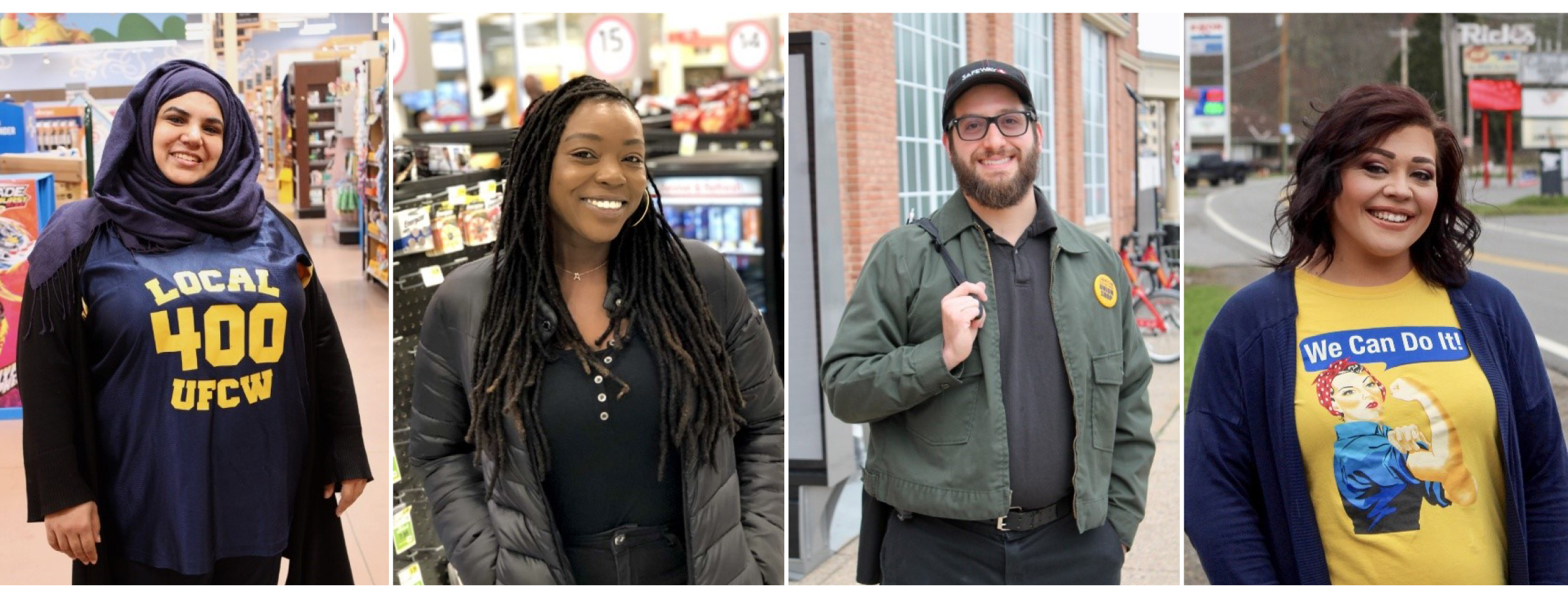
As worried Americans pack supermarket aisles in anticipation of quarantines and shelter-in-place orders, grocery workers like Courtney Meadows are working at a frantic pace to keep Americans fed and alive, and risking their own health in the process.

Meadows, a cashier at Kroger in Beckley, W.Va., said her store is the busiest she has seen it in 10 years on the job. “I have worked through snow scares, a blizzard, two derechos, holidays, anything that can impact a grocery store,” she told me. “This is the absolute worst I have seen it. It is a sea of people everywhere.”

Over the last week, I traveled to supermarkets across the Washington, D.C. region and interviewed workers from Virginia, Maryland, West Virginia and the District to hear—in their words—how COVID-19 is impacting them. These crowded stores I visited had few visible safeguards or protections for workers.

“We aren’t staying six feet away from the customers,” said Michelle Lee, a Safeway cashier in Alexandria, Va. “When we ring them up, they are like two feet away from us. We check out 200 customers a day. A doctor can wear a mask and protective gear. We don’t have all of that.”

Amber Stevens, a cashier at Shoppers in Prince George’s County, Md., expressed concern over social distancing as well. “I do still have a job to go to, but it isn’t helping me with social distancing because I am hands-on with customers,” she told me. “That is the scary part. Dealing with money, having to be so close to people.”

More than their own health, the grocery store employees I interviewed expressed the most concern about the safety of those around them: their loved ones at home, their elderly customers, their colleagues with underlying health conditions, and their neighbors in crowded apartment buildings. Several workers welled up with emotion as they described how hard it is to be unable to care for older relatives during the pandemic.

“All of that worry plus the stress of double the number of customers we normally have,” said Lisa Harris, a cashier at Kroger in Richmond, Va. “This isn’t just for one day. It is for weeks.”

As grocery workers put their lives on the line—often for low wages and few benefits—it is imperative that employers, policymakers, and even customers act with urgency to protect, support, and compensate them.

EMPLOYERS MUST KEEP GROCERY WORKERS HEALTHY

Employers need to implement immediate steps to reduce grocery workers’ exposure to COVID-19. First, employers should expand access to personal protective equipment (PPE) such as masks and gloves and end any restrictions on workers wearing them. While supplies of protective masks and gloves are extremely limited across the country, employers and policymakers should prioritize PPE for grocery workers as they become available. Employers should provide adequate cleaning supplies and hand sanitizer, regular opportunities for workers to wash their hands, and frequent equipment cleaning.

Second, stores should shorten hours and limit the number of customers at any given time. While several stores—including Trader Joe’sWalmart, and Safeway—have limited store hours and introduced “senior only” hours, most stores are not following the CDC’s guidance of limiting gatherings to 50 people. Even tighter restrictions may be needed to keep workers safe as the virus spreads; for instance, some stores in China are checking customers’ temperatures before they enter the store.

Third, grocery stores should implement additional measures to protect workers and enforce safe spacing of customers. Albertsons, which owns Safeway and 19 other grocery chains, was the first major company to announce they will install plexiglass “sneeze-guard” barriers at checkouts in its 2,200 stores over the next two weeks. Walmart and Kroger have made similar commitments, and other grocery stores should follow.

Even in the absence of specific CDC guidelines for grocery workers, employers should act boldly and creatively to modify stores to keep workers safe, continuously adapt to evolving best practices, and respond to safety priorities identified by unions like the United Food and Commercial Workers International Union (UFCW), which represents over 1.2 million workers.

INCREASE COMPENSATION AND OFFER HAZARD PAY

The coronavirus pandemic has put a harsh spotlight on the low wages that grocery workers earn for their life-saving work. At Kroger, the country’s second-largest grocery chain with 453,000 workers, the average hourly wage of cashiers is just $9.94 per hour, according to estimates on Indeed.com.

Lisa Harris, a Kroger cashier, described the financial hardships she and her low-wage colleagues face: “I have coworkers who stand all day serving people, and then have to go pay for their own groceries with food stamps. I am very lucky that my boyfriend works in pizza because that is our survival food. If we can’t afford to buy food, he brings home a pizza.”

Even in “normal” times, grocery workers—like other service and low-wage workers—deserve better wages. In these extreme times, adequately compensating them is even more imperative. As grocery sales soar and their stock prices rise, employers should provide additional compensation and hazard pay to their workers on the front line.

“I think that some pay increase would be wonderful,” Kroger cashier Courtney Meadows told me. “I don’t think they understand the toll that comes through in our lives. They don’t see it. They don’t see the panic on people’s faces.”

In response to the pandemic, the two largest grocery employers, Kroger and Walmart, have offered workers one-time bonuses of $300. Responding to pressure from the UFCW, Safeway and Shoppers are now offering an additional $2 per hour of hazard pay, while Whole Foods and Target are also raising pay $2 per hour.

These pay increases are an important start, but they don’t go far enough. The raises should be permanent, and enough to provide a family-sustaining wage to workers.

ENSURE ACCESS TO HEALTH INSURANCE AND EXTEND PAID SICK LEAVE

Now more than ever, paid sick leave and health insurance are critical for grocery workers. Well before the COVID-19 pandemic, hundreds of thousands of grocery workers didn’t receive paid sick leave from their employers. Responding to public outrage and pressure from employees and unions, most large employers now have updated their sick leave policy to respond to COVID-19. However, their policies don’t go far enough: They are temporary, focus narrowly on COVID-19, and are insufficient to meet the needs of workers.

Companies including Safeway, Kroger, and Walmart are now offering 14 days paid sick leave for workers with a confirmed COVID-19 diagnosis. But COVID-19 tests are in extremely short supply and many workers with suspected cases will be unable to get tested. Employers should modify paid leave policies to allow flexibility for ill workers to access the benefits even without a confirmed test, at least until testing is more widely available.

Policies should cover paid leave for grocery workers to care for their immediate family members or people they live with if they become ill. Employers should also compensate workers for any coronavirus-related medical bills that are not covered by their health insurance.

Employers should provide extra support to grocery workers who are especially high-risk, such as older workers and the immunocompromised. The most vulnerable workers may need to simply stay home during the pandemic and not work for weeks or months. Employers should do their part to ensure those workers have extended paid leave or other forms of adequate compensation and benefits, including health insurance.

CUSTOMERS CAN HELP KEEP GROCERY WORKERS SAFE

A major concern for the workers I interviewed was the actions of individual customers that could jeopardize their health. Many workers noted that customers continue to come to their store even when they are sick.

“Some customers will come through the line and cough or sneeze in their hand,” said Safeway cashier Michelle Lee. “If you are sick, you should stay home or cough in their elbow.”

Customers should do their part by keeping a safe distance from workers at checkout and throughout the store, practicing proper hygiene when coughing or sneezing, and staying home when ill.

RIGHT NOW, GROCERY WORKERS ARE EMERGENCY PERSONNEL

On March 15, Minnesota Governor Tim Walz made grocery store employees and food distribution personnel eligible for free child care by designating them as emergency workers. Four days later, Vermont’s Department of Public Safety added grocery workers to its list of essential personnel, giving them free child care at school-based centers set up by the state.

Other states should follow the lead of Minnesota and Vermont and designate grocery workers as emergency personnel, granting them the same protections and benefits as first responders and health workers.

If we had an opportunity to get free child care, people like me could go in,” Matt Milzman, a 29-year-old Safeway cashier in Washington, D.C. and father of two small children, told me. “They need all the people they can. I am low risk and healthy. I would much rather me work than someone who is older with a million health problems.”

Grocery workers are among the true heroes of the pandemic, providing basic necessities to keep Americans alive, but also human comfort for their customers during an anxious time.

“I choose to be happy and positive,” cashier Courtney Meadows told me. “If you can talk and make someone laugh, that might be the only positive thing in their life that day. That is what I choose to do.”

We owe them not only our gratitude, but the protection, support, and compensation they deserve.


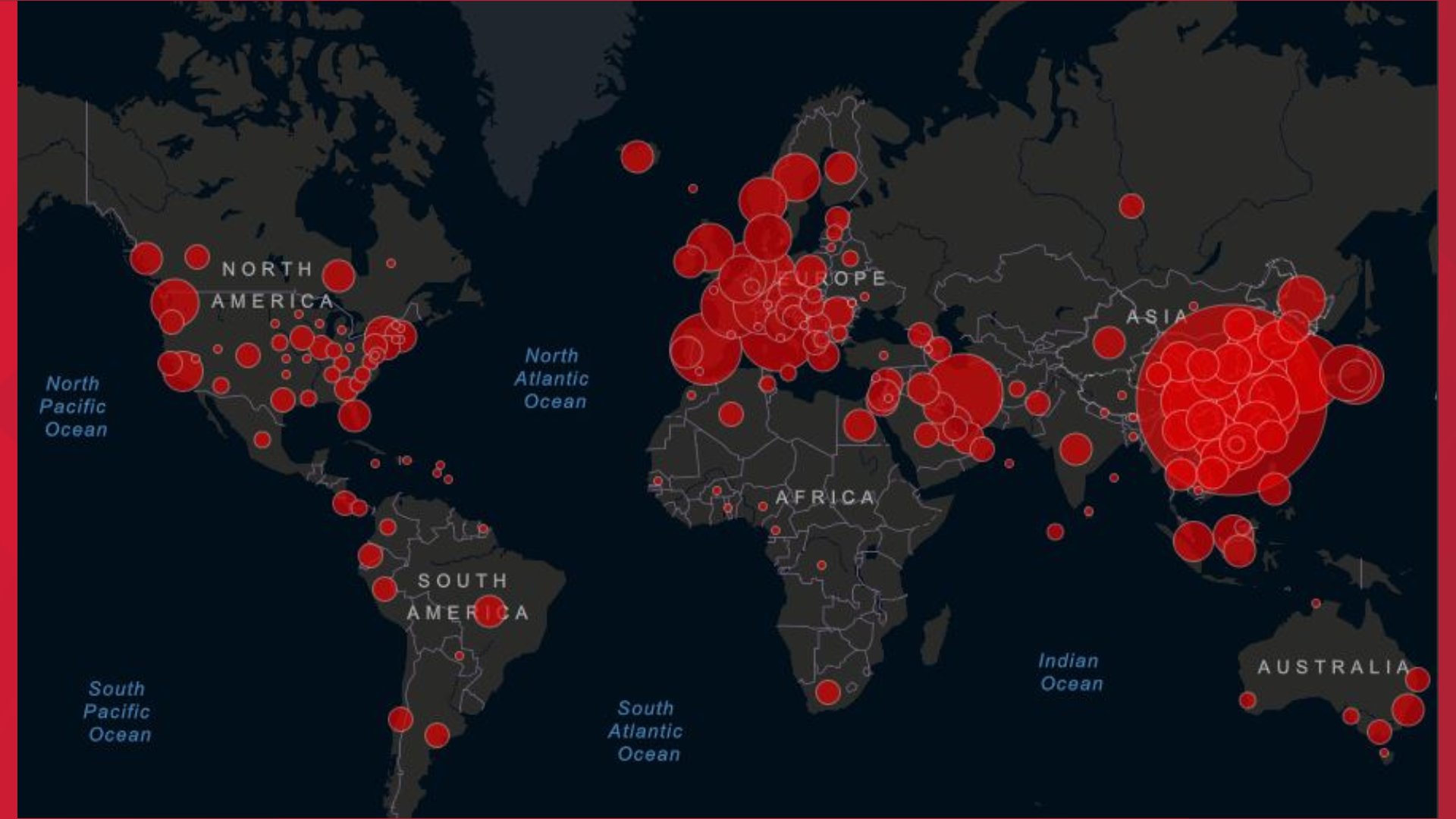
U.S. now has more confirmed Coronavirus Cases than China and Italy

https://www.arcgis.com/apps/opsdashboard/index.html?fbclid=IwAR3ZcDx_u6lJk1W7uXkLTT2SzyFEQfjKcLFFvuiIP7vS3SxEeVBvfTO_NRs#/bda7594740fd40299423467b48e9ecf6

These interactive maps show all reported coronavirus cases in the ...


Administration Considers Reopening Economy, Over Health Experts’ Objections

Image result for Trump Considers Reopening Economy, Over Health Experts’ Objections

The president is questioning whether stay-at-home orders have gone too far. But relaxing them could significantly increase the death toll from the coronavirus, health officials warn.

As the United States entered Week 2 of trying to contain the spread of the coronavirus by shuttering large swaths of the economy, President Trump, Wall Street executives and many conservative economists began questioning whether the government had gone too far and should instead lift restrictions that are already inflicting deep pain on workers and businesses.

Consensus continues to grow among government leaders and health officials that the best way to defeat the virus is to order nonessential businesses to close and residents to confine themselves at home. Britain, after initially resisting such measures, essentially locked down its economy on Monday, as did the governors of Virginia, Michigan and Oregon. More than 100 million Americans will soon be subject to stay-at-home orders.

Relaxing those restrictions could significantly increase the death toll from the virus, public health officials warn. Many economists say there is no positive trade-off — resuming normal activity prematurely would only strain hospitals and result in even more deaths, while exacerbating a recession that has most likely already arrived.

The economic shutdown is causing damage that is only beginning to appear in official data. Morgan Stanley researchers said on Monday that they now expected the economy to shrink by an annualized rate of 30 percent in the second quarter of this year, and the unemployment rate to jump to nearly 13 percent. Both would be records, in modern economic statistics.

Officials have said the federal government’s initial 15-day period for social distancing is vital to slowing the spread of the virus, which has already infected more than 40,000 people in the United States. But Mr. Trump and a chorus of conservative voices have begun to suggest that the shock to the economy could hurt the country more than deaths from the virus.

On Monday, Mr. Trump said his administration would reassess whether to keep the economy shuttered after the initial 15-day period ends next Monday, saying it could extend another week and that certain parts of the country could reopen sooner than others, depending on the extent of infections.

“Our country wasn’t built to be shut down,” Mr. Trump said during a briefing at the White House. “America will, again, and soon, be open for business. Very soon. A lot sooner than three or four months that somebody was suggesting. Lot sooner. We cannot let the cure be worse than the problem itself.”

Similar views are emanating from parts of corporate America, where companies are struggling with a shutdown that has emptied hotels, airplanes, malls and restaurants and sent the stock market tumbling so fast that automatic circuit breakers to halt trading have been tripped repeatedly. Stocks have collapsed about 34 percent since the coronavirus spread globally — the steepest plunge in decades — erasing three years of gains under Mr. Trump.

Lloyd Blankfein, the former chief executive of Goldman Sachs, wrote on Twitter that “crushing the economy” had downsides and suggested that “within a very few weeks let those with a lower risk to the disease return to work.”

Even Gov. Andrew M. Cuomo of New York, whose state has emerged as the epicenter of the outbreak in the United States, has begun publicly floating the notion that, at some point, states will need to restart economic activity and debating how that should unfold.

“You can’t stop the economy forever,” Mr. Cuomo said in a news conference on Monday. “So we have to start to think about does everyone stay out of work? Should young people go back to work sooner? Can we test for those who had the virus, resolved, and are now immune and can they start to go back to work?”

Any push to loosen the new limits on commerce and movement would contradict the consensus advice of public health officials, risking a surge in infections and deaths from the virus. Many economists warn that abruptly reopening the economy could backfire, overwhelming an already stressed health care system, sowing uncertainty among consumers, and ultimately dealing deeper, longer-lasting damage to growth.

The recent rise of cases in Hong Kong, after there had been an easing of the spread of the virus, is something of an object lesson about how ending strict measures too soon can have dangerous consequences. Yet places like China, which took the idea of lockdown to the extreme, have managed to flatten the curve.

“You can’t call off the best weapon we have, which is social isolation, even out of economic desperation, unless you’re willing to be responsible for a mountain of deaths,” said Arthur Caplan, a professor of bioethics at NYU Langone Medical Center. “Thirty days makes more sense than 15 days. Can’t we try to put people’s lives first for at least a month?”

For the last four days, some White House officials, including those working for Vice President Mike Pence, who leads the coronavirus task force, have been raising questions about when the government should start easing restrictions.

Among the options being discussed are narrowing restrictions on economic activity to target specific age groups or locations, as well as increasing the numbers of people who can be together in groups, said one official, who cautioned that the discussions were preliminary.

Health officials inside the administration have mostly opposed that idea, including Dr. Anthony S. Fauci, an infectious diseases expert and a member of the White House coronavirus task force, who has said in interviews that he believes it will be “at least” several more weeks until people can start going about their lives in a more normal fashion.

Dr. Deborah L. Birx, the White House coronavirus response coordinator, said the United States had learned from other countries like China and South Korea, which were able to control the spread of the virus through strict measures and widespread testing.

“Those were eight- to 10-week curves,” she said on Monday, adding that “each state and each hot spot in the United States is going to be its own curve because the seeds came in at different times.”

Dr. Birx added that the response “has to be very tailored geographically and it may have to be tailored by age group, really understanding who’s at the greatest risk and understanding how to protect them.”

Other advisers, including members of Mr. Trump’s economic team, have said repeatedly in recent months that the virus does not itself pose an extraordinary threat to Americans’ lives or the economy, likening it to a common flu season. Some advisers believe the White House overreacted to criticism of Mr. Trump’s muted actions to deal with the emerging pandemic and gave health experts too large a sway in policymaking.

On Monday, Mr. Trump echoed those concerns, saying that things like the flu or car accidents posed as much of a threat to Americans as the coronavirus and that the response to those was far less draconian.

“We have a very active flu season, more active than most. It’s looking like it’s heading to 50,000 or more deaths,” he said, adding: “That’s a lot. And you look at automobile accidents, which are far greater than any numbers we’re talking about. That doesn’t mean we’re going to tell everybody no more driving of cars. So we have to do things to get our country open.”

Mr. Trump has watched as a record economic expansion and booming stock market that served as the basis of his re-election campaign evaporated in a matter of weeks. The president became engaged with the discussion on Sunday evening, after watching television reports and hearing from various business officials and outside advisers who were agitating for an end to the shutdown.

Casey Mulligan, a University of Chicago professor who served as chief economist for Mr. Trump’s Council of Economic Advisers, said on Monday that efforts to shut down economic activity to slow the virus would be more damaging than doing nothing at all. He suggested a middle ground, one that weighs the costs and benefits of saving additional lives.

“It’s a little bit like, when you discover sex can be dangerous, you don’t come out and say, there should be no more sex,” Mr. Mulligan said. “You should give people guidance on how to have sex less dangerously.”

Many other economists say the restrictions in activity now are helping the economy in the long run, by beginning to suppress the infection rate.

“The idea that there’s a trade-off between health and economics right now is likely badly mistaken,” said Jason Furman of Harvard University, a former chairman of the Council of Economic Advisers under President Barack Obama. “The thing damaging our economy is a virus. Everyone who is trying to stop that virus is working to limit the damage it does to our economy and help our eventual rebound. The choice may well be taking pretty extreme steps now or taking very extreme steps later.”

Mr. Furman and other economists have pushed Mr. Trump and Congress to ease the economic pain by offering trillions of dollars in government assistance to affected workers and businesses. As lawmakers tried to negotiate an agreement on such a bill Monday, an influential business lobbying group, the U.S. Chamber of Commerce, said it supported restrictions on the economy to slow the virus.

“Our view is, when it comes to how you contain the virus, you do everything the public health professionals say to contain the virus,” said Neil Bradley, the chamber’s executive vice president and chief policy officer.

The president’s suggestion that the response may be an overreaction plays into doubts already held by some Americans suffering the economic consequences. Among the self-quarantined, some have questioned the purpose of isolating themselves if the virus is already circulating widely. Students sent home from college have wondered whether they are more likely to infect higher-risk older adults at home.

Dan Patrick, Texas’ lieutenant governor, said Monday on Fox News that he was in the “high-risk pool” but would be willing to risk his life to preserve the country for his children and grandchildren.

“We are going to be in a total collapse, recession, depression, collapse in our society,” said Mr. Patrick, who turns 70 next week. “If this goes on another several months, there won’t be any jobs to come back to for many people.”

But public health officials stress that there would be consequences to ending the measures too quickly. In a tweet on Monday morning, Thomas P. Bossert, the former homeland security adviser who for weeks has been vocal about the need for the U.S. government to take stricter measures, said: “Sadly, the numbers now suggest the U.S. is poised to take the lead in #coronavirus cases. It’s reasonable to plan for the US to top the list of countries with the most cases in approximately 1 week. This does NOT make social intervention futile. It makes it imperative!”

Mr. Trump’s interest in potentially easing some of the restrictions met with pushback from one of his close allies, Senator Lindsey Graham, Republican of South Carolina, who himself self-quarantined after a potential exposure. “President Trump’s best decision was stopping travel from China early on,” Mr. Graham tweeted on Monday. “I hope we will not undercut that decision by suggesting we back off aggressive containment policies within the United States.”

Health officials remain largely united in defense of sustaining the restrictions.

“There is a way to think through how and when to start reopening our economy and society, and it’s important to get this right,” said Dr. Thomas R. Frieden, a former director of the Centers for Disease Control and Prevention.

Dr. Tom Inglesby, the director of the Center for Health Security at the Johns Hopkins Bloomberg School of Public Health, pointed to the experience of countries like Italy, which did not institute aggressive measures to stop the spread of the virus and saw infection rates and deaths soar as a result.

The United States will need “a couple weeks” to see positive effects from its measures, Dr. Inglesby said, and abandoning them would mean “patients will get sick in extraordinary numbers all over the country, far beyond what the U.S. health care system will bear.”