Wealthy nations — including the U.S., the U.K. and the EU — have vaccinated their citizens at a rate of one person per second over the last month, while most developing countries still haven’t administered a single shot, according to the People’s Vaccine Alliance.
Why it matters:As higher-income countries aim to achieve herd immunity in a matter of months, most of the world’s vulnerable people will remain unprotected.
Experts say that mutations that may arise while the virus spreads could be a danger to us all, vaccinated or not.
The big picture: Even though more vaccines will arrive in developing nations soon, only 3% of people in those countries are likely to be vaccinated by mid-2021.
At best, only a fifth of their population will be vaccinated by the end of the year, per the People’s Vaccine Alliance.
What we’re watching: Three dozen countries have bought several times the amount of vaccine that they’ll need to vaccinate their entire population.
The U.S. alone has ordered more than a billion extra doses, Science Magazine reports. Global health leaders are saying it’s time to figure out where all of these excess doses will go.
“Over the next year or two, U.S. surplus doses and those from other countries could add up to enough to immunize everyone in the many poorer nations that lack any secured COVID-19 vaccine,” Science writes.
One year after the World Health Organization declared COVID-19 a pandemic, the end of that pandemic is within reach.
The big picture:The death and suffering caused by the coronavirus have been much worse than many people expected a year ago — but the vaccines have been much better.
Flashback: “Bottom line, it’s going to get worse,” Anthony Fauci told a congressional panel on March 11, 2020, the day the WHO formally declared COVID-19 to be a global pandemic.
A year ago today, the U.S. had confirmed 1,000 coronavirus infections. Now we’re approaching 30 million.
In the earliest days of the pandemic, Americans were terrified by the White House’s projections — informed by well-respected modeling — that 100,000 to 240,000 Americans could die from the virus. That actual number now sits at just under 530,000.
Many models at the time thought the virus would peak last May. It was nowhere close to its height by then. The deadliest month of the pandemic was January.
Yes, but: Last March, even the sunniest optimists didn’t expect the U.S. to have a vaccine by now.
They certainly didn’t anticipate that over 300 million shots would already be in arms worldwide, and they didn’t think the eventual vaccines, whenever they arrived, would be anywhere near as effective as these shots turned out to be.
Where it stands: President Biden has said every American adult who wants a vaccine will be able to get one by the end of May, and the country is on track to meet that target.
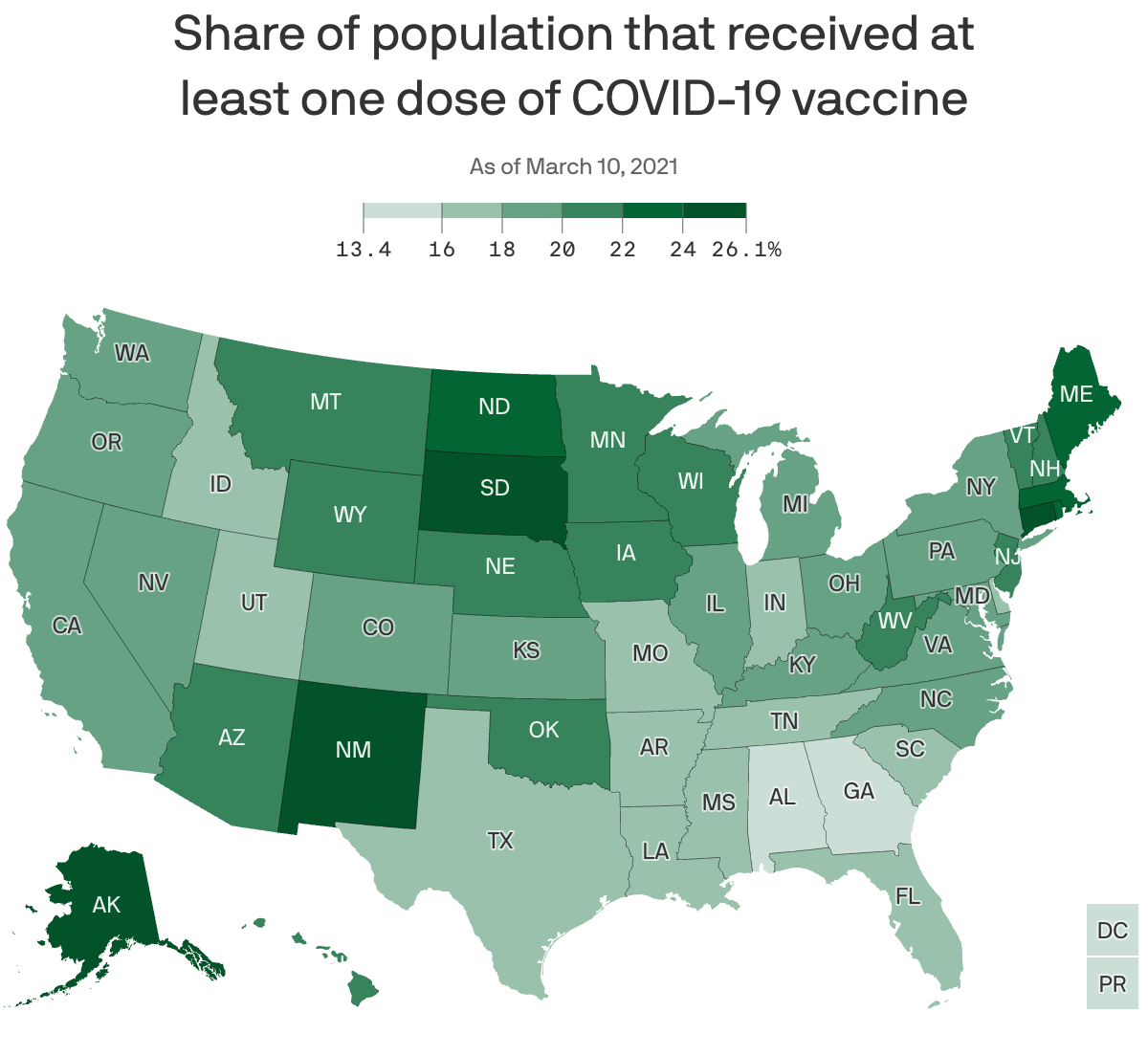
The U.S. is administering over 2 million shots per day, on average. Roughly 25% of the adult population has gotten at least one shot.
The federal government has purchased more doses than this country will be able to use: 300 million from Pfizer, 300 million from Moderna and 200 million from Johnson & Johnson.
The Pfizer and Moderna orders alone would be more than enough to fully vaccinate every American adult. (The vaccines aren’t yet authorized for use in children.)
Yes, millions of Americans are still anxiously awaiting their first shot — and navigating signup websites that are often frustrating and awful.
But the supply of available vaccines is expected to surge this month, and the companies say the bulk of those doses should be available by the end of May.
Cases, hospitalizations and deaths are all falling sharply at the same time vaccinations are ramping up.
The bottom line: Measured in death, loss, isolation and financial ruin, one year has felt like an eternity. Measured as the time between the declaration of a pandemic and vaccinating 60 million Americans, one year is an instant.
The virus hasn’t been defeated, and may never fully go away. Getting back to “normal” will be a moving target. Nothing’s over yet. But the end of the worst of it — the long, brutal nightmare of death and suffering — is getting close.
President Biden‘s announcement that there will be enough vaccines for all adults by May is raising hopes for a return to normal soon.
But the next few months in the pandemic are critical. Concern is growing over moves by some states to lift restrictions already, while new variants of the virus are on the rise in the U.S. Experts warn that actions taken now risk delaying getting back to some semblance of normal.
Health officials are urging restrictions to remain in place for the final stretch, saying that it will not be much longer before the situation markedly improves, and it does not make sense to lift all restrictions when widespread vaccinations are in sight.
Biden on Wednesday issued his most forceful comments to date, calling out the governors of Texas and Mississippi for lifting their states’ mask mandates and all capacity limits on businesses.
He noted that vaccinations for all adults are on the horizon.
“The last thing we need is Neanderthal thinking that in the meantime everything’s fine, take off your mask, forget it,” he said. “It still matters.”
Estimates differ on when exactly the country might return to something like “normal,” though many say they expect this summer will be much better.
Former Food and Drug Administration Commissioner Scott Gottlieb said on CNBC on Wednesday that he thinks even as soon as April will be “profoundly better,” given that vaccine supply will have ramped up significantly, allowing vaccine availability to be “wide open” by then.
Centers for Disease Control and Prevention Director Rochelle Walensky on Wednesday put the time frame at three months until the country could be vaccinated.
“The next three months are pivotal,” she said.
Thomas Tsai, a researcher at the Harvard T.H. Chan School of Public Health, said that by summer, “I think we can have a much more, I don’t want to say normal, but at least a ‘new normal’ summer.”
But experts warn that the return to normal could actually be delayed if restrictions are lifted too soon, causing a new spike in cases in the near term.
Tsai likened the current situation to the seventh inning stretch of a baseball game. “Progress has been made; it’s OK to take stock of that,” he said. “How we play the next two innings determines if this is a single game or turns into a doubleheader.”
Maintaining restrictions as people get fatigued and see the end in sight could be a challenge, though, particularly in red states that were skeptical of instituting health restrictions from the start.
Texas Gov. Greg Abbott and Mississippi Gov. Tate Reeves, both Republicans, pointed to the ongoing vaccination campaign in saying that the time has come to end restrictions.
“With the medical advancements of vaccines and antibody therapeutic drugs, Texas now has the tools to protect Texans from the virus,” Abbott said Tuesday. “We must now do more to restore livelihoods and normalcy for Texans by opening Texas 100 percent.”
Responding to Biden’s criticism on Wednesday, Reeves added: “Mississippians don’t need handlers.”
“As numbers drop, they can assess their choices and listen to experts,” he added. “I guess I just think we should trust Americans, not insult them.”
Gottlieb argued for a middle ground, saying that public health officials risk having the public simply ignore all guidance if they do not provide a “realistic glide path to a better future,” though March is “a little bit premature” to lift all restrictions.
“March really is a difficult month,” he said. “It sits between two worlds. February was a raging epidemic, it was very clear we needed to have measures in place. I think April’s going to be profoundly better, and March is sitting in the middle.”
Variants of the virus also pose a threat that adds another degree of uncertainty. The most common variant spreading in the US, known as B117, or the United Kingdom variant, responds well to vaccines, but is more infectious.
“The B117 hyper-transmissible variant looms ready to hijack our successes to date,” Walensky said.
Variants first identified in Brazil and South Africa also pose a risk of reducing the effectiveness of the vaccines, though the extent is not fully clear, and vaccine manufacturers are preparing backup plans to provide booster shots or updated vaccines if necessary.
“We are at a critical nexus in the pandemic,” Walensky said. “So much can turn in the next few weeks.”
After weeks of declines, both cases and deaths are ticking up. According to CDC data, the seven-day average of new cases per day, at 66,000, is up 3.5 percent from the past week, and deaths, at just over 2,000 per day, are up 2.2 percent.
Barbara Alexander, president of the Infectious Diseases Society of America, issued a statement Wednesday calling on people to continue wearing masks, distancing from others, and avoiding large gatherings.
“All of these measures together will bring us closer to ending the pandemic,” she said. “Abandoning them now will postpone the day we can put COVID-19 behind us.”
Still, the declines in past weeks and the increasing pace of vaccinations is offering some hope after a long year.
“I’m more optimistic than I have been in the last year,” Tsai said.
The Centers for Disease Control and Prevention (CDC) on Friday released long-awaited guidance on safely reopening schools, emphasizing the importance of having schools open as long as proper safety precautions are followed.
The guidance states it is “critical for schools to open as safely and as soon as possible,” given the benefits of in-person learning.
The top recommendations for doing so safely are universal wearing of masks by students, staff and teachers as well as distancing so that people are six feet apart.
Vaccination of teachers should be prioritized, the agency said, but “should not be considered a condition” of reopening schools.
Schools can adjust whether they are fully in-person or hybrid depending on the level of spread in the surrounding community and mitigation measures in place.
Schools are encouraged to use “podding” to separate students into smaller groups to help make contract tracing easier.
Doctors and scientists have been relieved that the dreaded “twindemic”—the usual winter spike of seasonal influenza superimposed on the COVID pandemic—did not materialize.
In fact, flu cases are at one of the lowest levels ever recorded, with just 155 flu-related hospitalizations this season (compared to over 490K in 2019). A new piece in the Atlantic looks at the long-term ramifications of a year without the flu.
Public health measures like masking and handwashing have surely lowered flu transmission, but scientists remain uncertain why flu cases have flatlined as COVID-19, which spreads via the same mechanisms, surged.
Children are a much greater vector for influenza, and reduced mingling in schools and childcare likely slowed spread. Perhaps the shutdown in travel slowed the viruses’ ability to hop a ride from continent to continent, and the cancellation of gatherings further dampened transmission.
Nor are scientists sure what to expect next year. Optimists hope that record-low levels of flu could take a strain out of circulation. But others warn that flu could return with a vengeance, as the virus continues to mutate while population immunity declines.
Researchers developing next year’s vaccines, meanwhile, face a lack of data on what strains and mutations to target—although many hope the mRNA technologies that proved effective for COVID will enable more agile flu vaccine development in the future.
Regardless, renewed vigilance in flu prevention and vaccination next fall will be essential, as a COVID-fatigued population will be inclined to breathe a sigh of relief as the current pandemic comes under control.
A family member in her 70s called with the great news that she received her first dose of the COVID vaccine this week. She mentioned that she was hoping to plan a vacation in the spring with a friend who had also been vaccinated, but her doctor told her it would still be safest to hold off booking travel for now: “I was surprised she wasn’t more positive about it. It’s the one thing I’ve been looking forward to for months, if I was lucky enough to get the shot.”
It’s not easy to find concrete expert guidance for what it is safe (or safer?) to do after receiving the COVID vaccine. Of course, patients need to wait a minimum of two weeks after receiving their second shot of the Pfizer or Moderna vaccines to develop full immunity.
But then what? Yes, we all need to continue to wear masks in public, since vaccines haven’t been proven to reduce or eliminate COVID transmission—and new viral variants up the risk of transmission. But should vaccinated individuals feel comfortable flying on a plane? Visiting family? Dining indoors? Finally going to the dentist?
It struck us that the tone of much of the available guidance speaks to public health implications, rather than individual decision-making. Take this tweet from CDC director Dr. Rochelle Walensky. A person over 65 asked her if she could drive to visit her grandchildren, whom she hasn’t seen for a year, two months after receiving her second shot. Walensky replied, “Even if you’ve been vaccinated, we still recommend against traveling until we have more data to suggest vaccination limits the spread of COVID-19.”
From a public health perspective, this may be correct, but for an individual, it falls flat. This senior has followed all the rules—if the vaccine doesn’t enable her to safely see her grandchild, what will? It’s easy to see how the expert guidance could be interpreted as “nothing will change, even after you’ve been vaccinated.”
Debates about masking showed us that in our individualistic society,public health messaging about slowing transmission and protecting others sadly failed to make many mask up.
The same goes for vaccines:mostAmericans are motivated to get their vaccine so that they personally don’t die, and so they can resume a more normal life, not by the altruistic desire to slow the spread of COVID in the community and achieve “herd immunity”.
In addition to focusing on continued risk,educating Americans on how the vaccinated can make smart decisions will motivate as many people as possible to get their shots.
The national COVID indicators all continued to move in the right direction this week, with new cases down 16 percent, hospitalizations down 26 percent, and deaths (while still alarmingly high at more than 3,000 per day) down 6 percent from the week prior.
More good news: both nationally and globally, the number of people vaccinated against COVID now exceeds the total number of people infected with the virus, at least according to official statistics—the actual number of coronavirus infections is likely several times higher.
On the vaccine front, Johnson & Johnson filed with the Food and Drug Administration (FDA) for an Emergency Use Authorization for its single-dose COVID vaccine, which could become the third vaccine approved for use in the US following government review later this month. The J&J vaccine is reportedly 85 percent effective at preventing severe COVID disease, although it is less effective at preventing infection than the Pfizer and Moderna shots.
Elsewhere, TheLancet reported interim Phase III results for Russia’s Sputnik V vaccine trials, showing it to be 91 percent effective at preventing infection, and a new study found the Oxford-AstraZeneca vaccine to be 75 percent effective against the more-contagious UK virus variant.
Amid the positive vaccine news, the Biden administration moved to accelerate the vaccination campaign, invoking the Defense Production Act to boost production and initiating shipments directly to retail pharmacies. With the House and Senate starting the budget reconciliation process that could eventually lead to as much as $1.9T in stimulus funding, including billions more for vaccines and testing, it feels as though the tide may be finally turning in the battle against coronavirus.
While the key indicators are still worrisome—we’re only back to Thanksgiving-week levels of new cases—and emerging variants are cause for concern, it’s worth celebrating a week that brought more good news than bad.
Best to follow Dr. Fauci’s advice for this Super Bowl weekend, however: “Just lay low and cool it.”
Over the weekend I realized that my son Henry, born in June 2019, has lived more than half of his life in the pandemic era. He’s too young to be cognizant of it, of course, but my wife and I are acutely conscious of the experiences his older brother had already enjoyed by the time he was Henry’s age, things that are impractical or impossible in the moment.
He’s not alone in that, of course. Most Americans are experiencing some ongoing deprivations because of the pandemic. (Most of those for whom the pandemic is not imposing unusual restrictions are, ironically, probably contributing to the pandemic’s extent and duration.) Just about everyone in the United States is eagerly scanning the horizon for signs of normalcy — as we have been for months, occasionally spotting oases that too often turn out to be mirages.
So when will we return to some semblance of normal? It’s hard to say with certainty. The best tool we have to reach that point, though, is the broad deployment of the vaccines approved for emergency use by the government. But even the existence of those vaccines can’t completely answer the question.
For example, the rate at which the vaccines are deployed makes a massive difference. A pace of 2 million shots per day as opposed to 1 million seems like a subtle distinction but, obviously, means achieving immunity for recipients twice as fast.
What level of immunity is necessary is a question of its own. Do we need 70 percent of the country to have been immunized? Or, as infectious-disease expert Anthony S. Fauci has recently said, is the figure closer to 80 or 85 percent?
When doing this calculation, do you include the 26 million Americans who have already had coronavirus infections? What about young people? The vaccine trials included only those age 16 and over. Those younger have constituted about a 10th of the total infections. And what vaccine are we talking about? The Pfizer and Moderna iterations require two shots; the vaccine from Johnson & Johnson requires only one.
All of these factors affect how we can figure out when the country might hit the herd-immunity mark. If we assume that young people will be included among those needed to be vaccinated — a complicated question on its own — the calculator below will allow you to figure out when immunity might be achieved at various immunization rates.
At this rate, the country would reach 70 percent herd immunity through vaccinations by Nov. 10
How we calculate this: There are about 330 million Americans, meaning that we need 231 million to be resistant to the virus to hit 70 percent immunity. We can take out the 5.8 million Americans who’ve already been vaccinated. That leaves 211.3 million people to be vaccinated.
From there the math is straightforward: doing two-shot vaccinations at a rate of 1.5 million shots per day means it will take 282 days to complete the job.
Bear in mind that sliding the little bar to determine how quickly shots are administered is far easier than actually scaling up the infrastructure to do so. President Biden’s original target for daily vaccinations was 1 million; he recently increased it to 1.5 million. At that rate, we’re still months from resolution. But because administering the vaccine is more complicated and requires more tracking than vaccinations such as that for the seasonal flu, it’s necessarily trickier to scale up.
At this point, the more urgent concern is the efficacy of the vaccine against any variants of the virus that might emerge. Manufacturers have already noted that the vaccine works less well against a virus variant first identified in South Africa, though the vaccines are still broadly effective, particularly at protecting the recipient from severe illness or death after infection.
Well, that and the fact that a fifth of Americans said in a recent Kaiser Family Foundation poll that they won’t get the vaccine or would do so only if it was required. Happily, more Americans are now saying they’re eager to get a vaccine.
The faster we get people immunized, the better we protect against the emergence of new mutations that prove less able to be controlled by the vaccines. The faster we get shots in arms, as the phrasing has it, the faster we get back to normal.
Which would be nice for all of us, including my 1-year-old.
“And we believe that we’ll soon be able to confirm the purchase of an additional 100 million doses for each of the two FDA-authorized vaccines: Pfizer and Moderna,” Biden said. “That’s 100 million more doses of Pfizer and 100 million more doses of Moderna — 200 million more doses than the federal government had previously secured. Not in hand yet, but ordered. We expect these additional 200 million doses to be delivered this summer.”
After review of the current vaccine supply from manufacturing plants, the federal government believes it can increase overall weekly vaccination distribution to states, tribes, and territories from 8.6 million doses to a minimum of 10 million doses, starting next week.
But the pandemic is expected to get worse before it gets better, Biden said, with experts predicting the death toll as likely to top 500,000 by the end of February.
“But the brutal truth is: It’s going to take months before we can get the majority of Americans vaccinated. Months. In the next few months, masks — not vaccines — are the best defense against COVID-19,” he said.
WHY THIS MATTERS
The increases in the total vaccine order in the United States from 400 million ordered to 600 million doses will be enough vaccine to fully vaccinate 300 Americans by the end of the summer or the beginning of fall, Biden said.
“It’ll be enough to fully vaccinate 300 [million] Americans to beat this pandemic — 300 million Americans,” he said. “And this is an aggregate plan that doesn’t leave anything on the table or anything to chance, as we’ve seen happen in the past year.”
Biden’s team said they found the vaccine program to be in worse shape than they thought it would be and that they were starting from scratch.
“But it’s also no secret that we have recently discovered, in the final days of the transition — and it wasn’t until the final days we got the kind of cooperation we needed — that once we arrived, the vaccine program is in worse shape than we anticipated or expected,” Biden said.
Governors have been guessing at what they’ll receive for vaccine shipments, the president said.
The federal government is working with the private industry to ramp up production of vaccine and protective equipment such as syringes, needles, gloves, swabs and masks. The team has already identified suppliers and is working with them to move the plan forward.
Also, the Federal Emergency Management Agency is being directed to to stand up the first federally-supported community vaccination centers and to make vaccines available to thousands of local pharmacies beginning in early February.
THE LARGER TREND
Last week, Biden signed a declaration to begin reimbursing states 100% for the use of their National Guard to help the COVID-19 relief effort, both in getting sites set up and in using some of their personnel to administer the vaccines.
Biden has also said he wants to expand testing, which will help reopen schools and businesses.
He has formalized the Health Equity Task Force to ensure that the most vulnerable populations have access to vaccines.
He is also pushing for a $1.9 trillion relief package.






 HENRY KOTULA