


The online activity helps cement the impression that opposition to the restrictions is more widespread than polling suggests. Nearly 70 percent of Republicans said they supported a national stay-at-home order, according to a recent Quinnipiac poll. Ninety-five percent of Democrats backed such a measure in the survey.
Still, the Facebook groups have become digital hubs for the same sort of misinformation spouted in recent days at state capitol buildings — from comparing the virus to the flu to questioning the intentions of scientists working on a vaccine.
Public-health experts say stay-at-home orders are necessary to slow the spread of the new coronavirus, which has already killed more than 40,000 in the United States. The Trump administration last week outlined three phases for states to reopen safely — guidelines contradicted by the president when he urged citizens to rise up against the rules that heed the recommendations of his own public-health advisers.
“If people feel that way, you’re allowed to protest,” Trump said Sunday. “Some governors have gone too far, some of the things that happened are maybe not so appropriate.”
Facebook said Sunday it did not plan to take action to remove the groups or events, partly because states have not outlawed them. Organizers also have called for “drive-in” protests, in keeping with recommendations that people keep a short distance between each other. In other cases, involving protests planned for states like New Jersey and California, the company has removed that content, Facebook said.
“Unless government prohibits the event during this time, we allow it to be organized on Facebook. For this same reason, events that defy government’s guidance on social distancing aren’t allowed on Facebook,” said Andy Stone, a spokesman for the company.
None of the Dorr brothers responded to calls and emails on Sunday.
“Wisconsinites Against Excessive Quarantine” was created on Wednesday by Ben Dorr. His brother Christopher is the creator of “Pennsylvanians Against Excessive Quarantine,” as well as “Ohioans Against Excessive Quarantine.” A third brother, Aaron, is the creator of “New Yorkers Against Excessive Quarantine.”
The online coordination offered additional clues about how the protest activity is spreading nationwide, capturing the imagination of the president and of Fox News even though it represents the views of a small minority of Americans. Trump himself tied the protests to gun rights — a primary cause for the Dorr brothers — in telling Virginians that the Second Amendment was “under siege” as he urged them to liberate the state.
On the ground, pro-Trump figures — including some who act as surrogates for his campaign — as well as groups affiliated with prominent conservative donors have helped organize and promote the demonstrations.
Some of the most vehement protest activity, in Michigan, has been organized by the Michigan Conservative Coalition. Its founders are a Republican state lawmaker and his wife, Meshawn Maddock, who sits on the Trump campaign’s advisory board and is a prominent figure in the “Women for Trump” coalition. Jeanine Pirro, a Fox News host and avid Trump supporter, interviewed Maddock on her show Saturday, telling her, “Keep going. Thank you.”
Also promoting the demonstrations — including spending several hundred dollars to advertise the event on Facebook — was the Michigan Freedom Fund, which is headed by Greg McNeilly, a longtime adviser to the DeVos family. He served as campaign manager for Dick DeVos, the husband of Education Secretary Betsy DeVos, when he ran unsuccessfully for governor of Michigan in 2006.
The state’s Democratic governor, Gretchen Whitmer, who has become a target for Trump and his conservative allies, last week criticized the nonprofit, noting that it was “funded in large part by the DeVos family,” and saying it was “really inappropriate for a sitting member of the United States president’s cabinet to be waging political attacks on any governor, but obviously, on me here at home.”
McNeilly said the funds used to promote the event were “not dedicated program funds” but instead came from “our grassroots fundraising efforts,” and so had “nothing to do with any DeVos work.”
The Dorr brothers manage a slew of pro-gun groups across a wide range of states, from Iowa to Minnesota to New York, and seek primarily to discredit organizations like the National Rifle Association as being too compromising on gun safety. Minnesota Gun Rights, for which Ben Dorr serves as political director, describes itself as the state’s “no-compromise gun rights organization.”
In numerous states, they have bypassed rules requiring them to register as lobbyists by arguing that they are instead involved in “pro-gun grassroots mobilization,” as “Ohio Gun Owners,” whose board Chris Dorr directs, describes its work.
A now-retired state legislator in Iowa, who in 2017 sought to close a loophole allowing the brothers to skirt lobbying rules, said he was not surprised the Dorr brothers were involved in fomenting resistance to the public-health precautions.
“The brothers will do anything to fan the flames of a controversial issue, and maybe make a quick nickel,” said the former state legislator, Republican Clel Baudler.
Nearly 97,000 people had joined “Wisconsinites Against Excessive Quarantine” by Sunday afternoon, a Facebook group whose posts are visible only to members that asserted Gov. Tony Evers has been on a “power trip, controlling our lives, destroying our businesses” and “forcing us to hand over our freedoms and our livelihood!” In the group, some members speculated that Evers closed most state businesses and shuttered schools to appease pharmaceutical giants — not because of data showing the novel coronavirus is highly contagious and deadly, infecting more than 4,300 in the state and killing 220.
The group, along with Ben Dorr, created an event on Facebook for a “drive-in rally” at the capital next Friday that has attracted hundreds of pledged participants. They also seek to steer visitors to a website for the “Wisconsin Firearms Coalition,” where people can enter their names, email addresses and other contact information and share their views with the state’s governor. In doing so, they encourage visitors who are not “already a member of the Wisconsin Firearms Coalition” to “join us.” A page asking users to join the Minnesota group offered several rates for membership, from $35 to $1,000.
Another private Facebook group focused on Pennsylvania, gaining more than 63,000 members by Sunday. Many questioned the wisdom of wearing masks publicly, contrary to recommendations by state and federal officials, and linked to a similar website catering to Pennsylvania gun owners. Still another targeting New York had become a forum for roughly 23,000 members to question whether the coronavirus is really that bad — despite the fact New York City has become the epicenter of the U.S. outbreak.
“While seizing power at a breathtaking pace,” the group’s description began, “Andrew Cuomo is sending NY’s economy into a death spiral!”



/cdn.vox-cdn.com/uploads/chorus_image/image/66580807/2660331.jpg.0.jpg)


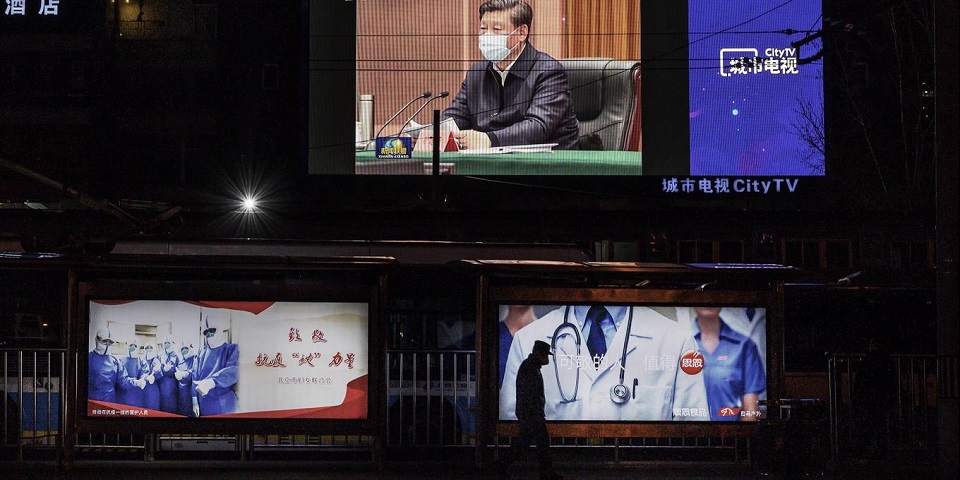
LONDON – As the COVID-19 crisis roars on, so have debates about China’s role in it. Based on what is known, it is clear that some Chinese officials made a major error in late December and early January, when they tried to prevent disclosures of the coronavirus outbreak in Wuhan, even silencing health-care workers who tried to sound the alarm. China’s leaders will have to live with these mistakes, even if they succeed in resolving the crisis and adopting adequate measures to prevent a future outbreak.
What is less clear is why other countries think it is in their interest to keep referring to China’s initial errors, rather than working toward solutions. For many governments, naming and shaming China appears to be a ploy to divert attention from their own lack of preparedness. Equally concerning is the growing criticism of the World Health Organization, not least by US President Donald Trump, who has attacked the organization for supposedly failing to hold the Chinese government to account. At a time when the top global priority should be to organize a comprehensive coordinated response to the dual health and economic crises unleashed by the coronavirus, this blame game is not just unhelpful but dangerous.
Globally and at the country level, we desperately need to do everything possible to accelerate the development of a safe and effective vaccine, while in the meantime stepping up collective efforts to deploy the diagnostic and therapeutic tools necessary to keep the health crisis under control. Given that there is no other global health organization with the capacity to confront the pandemic, the WHO will remain at the center of the response, whether certain political leaders like it or not.
Having dealt with the WHO to a modest degree during my time as chairman of the UK’s independent Review on Antimicrobial Resistance (AMR), I can say that it is similar to most large, bureaucratic international organizations. Like the International Monetary Fund, the World Bank, and the United Nations, it is not especially dynamic or inclined to think outside the box. But rather than sniping at these organizations from the sidelines, we should be working to improve them. In the current crisis, we should be doing everything we can to help both the WHO and the IMF to play an effective, leading role in the global response.
As I have argued before, the IMF should expand the scope of its annual Article IV assessments to include national public-health systems, given that these are critical determinants in a country’s ability to prevent or at least manage a crisis like the one we are now experiencing. I have even raised this idea with IMF officials themselves, only to be told that such reporting falls outside their remit because they lack the relevant expertise.
That answer was not good enough then, and it definitely isn’t good enough now. If the IMF lacks the expertise to assess public-health systems, it should acquire it. As the COVID-19 crisis makes abundantly clear, there is no useful distinction to be made between health and finance. The two policy domains are deeply interconnected, and should be treated as such.
In thinking about an international response to today’s health and economic emergency, the obvious analogy is to the 2008 global financial crisis. Everyone knows that crisis started with an unsustainable US housing bubble, which had been fed by foreign savings, owing to the lack of domestic savings in the United States. When the bubble finally burst, many other countries sustained more harm than the US did, just as the COVID-19 pandemic has hit some countries much harder than it hit China.
And yet, not many countries around the world sought to single out the US for presiding over a massively destructive housing bubble, even though the scars from that previous crisis are still visible. On the contrary, many welcomed the US economy’s return to sustained growth in recent years, because a strong US economy benefits the rest of the world.2
So, rather than applying a double standard and fixating on China’s undoubtedly large errors, we would do better to consider what China can teach us. Specifically, we should be focused on better understanding the technologies and diagnostic techniques that China used to keep its (apparent) death toll so low compared to other countries, and to restart parts of its economy within weeks of the height of the outbreak.
And, for our own sakes, we also should be considering what policies China could adopt to put itself back on a path toward 6% annual growth, because the Chinese economy inevitably will play a significant role in the global recovery. If China’s post-pandemic growth model makes good on its leaders’ efforts in recent years to boost domestic consumption and imports from the rest of the world, we will all be better off.