68 health systems with strong finances

Here are 68 health systems with strong operational metrics and solid financial positions, according to reports from credit rating agencies Fitch Ratings, Moody’s Investors Service and S&P Global in 2023. 

AdventHealth has an “AA” rating and stable outlook with Fitch. The rating reflects the  Altamonte Springs, Fla.-based system’s strong financial profile, characterized by still-adequate liquidity and moderate leverage, typically strong and highly predictable profitability, Fitch said. 

Advocate Aurora Health has an “AA” rating and stable outlook with Fitch. The Downers Grove, Ill.- and Milwaukee-based system’s rating reflects a very strong financial profile in the context of an already sound market position and geographic reach that was enhanced after merging with Charlotte, N.C.-based Atrium Health, Fitch said.    

AnMed Health has an “AA-” rating and stable outlook with Fitch. The Anderson, S.C.-based system has maintained strong performance through the COVID-19 pandemic and current labor market pressures, Fitch said.  

AtlantiCare has an “AA-” rating and stable outlook with Fitch. The Atlantic City, N.J.-based system has a strong balance sheet with solid liquidity position and low debt burden, Fitch said. 

Atrium Health has an “AA-” rating and stable outlook with S&P Global. The Charlotte, N.C.-based system’s rating reflects a robust financial profile, growing geographic diversity and expectations that management will continue to deploy capital with discipline. 

Banner Health has an “AA-” and stable outlook with Fitch. The Phoenix-based system’s rating highlights the strength of its core hospital delivery system and growth of its insurance division, Fitch said. 

BayCare Health System has an “AA” rating and stable outlook with Fitch. The Tampa, Fla.-based system’s rating reflects its excellent financial profile supported by its leading market position in a four-county area and the ability to sustain a solid operating outlook in the face of inflationary sector headwinds, Fitch said. 

Bayhealth has an “AA” rating and stable outlook with Fitch. The rating reflects the strength of the Dover, Del.-based system’s market positions and the stability of its financial profile, Fitch said.  

Beacon Health System has an “AA-” rating and stable outlook with Fitch. The rating reflects the strength of the South Bend, Ind.-based system’s balance sheet, the rating agency said.   

Berkshire Health has an “AA-” rating and stable outlook with Fitch. The Pittsfield, Mass.-based system has a strong financial profile, solid liquidity and modest leverage, according to Fitch. 

Bryan Health has an “AA-” rating and stable outlook with Fitch. The rating reflects the Lincoln, Neb., system’s leading and growing market position as a regional referral center with strong expense flexibility and cash flow, Fitch said.  

Cape Cod Healthcare has an “AA-” and stable outlook with Fitch. The Hyannis, Mass.-based system’s rating reflects a dominant market position in its service area and historically solid operating results, the rating agency said. 

Carle Health has an “AA-” rating and stable outlook with Fitch. The rating reflects the Urbana, Ill.-based system’s distinctly leading market position over a broad service area, Fitch said. 

CaroMont Health has an “AA-” rating and stable outlook with S&P Global. The Gastonia, N.C.-based system has a healthy financial profile and robust market share in a competitive region.  

CentraCare has an “AA-” rating and stable outlook with Fitch. The St. Cloud, Minn.-based system has a leading market position, and its management’s focus on addressing workforce pressures, patient access and capacity constraints will improve operating margins over the medium term, Fitch said. 

Children’s Health System of Texas has an “AA” and stable outlook with Fitch. The Dallas-based system’s rating reflects its solid operating performance in 2022, resulting from inpatient, outpatient and surgical volume growth, as well as one-time support from pandemic-era stimulus funding, Fitch said. 

Children’s Minnesota has an “AA” rating and stable outlook with Fitch. The Minneapolis-based system’s broad reach within the region continues to support long-term sustainability as a market leader and preferred provider for children’s health care, Fitch said. 

Concord (N.H.) Hospital has an “AA-” rating and stable outlook with Fitch. The rating reflects the strength of Concord’s leverage and liquidity assessment and Fitch’s assessment that two recently acquired hospitals will be strategically and financially accretive. 

Cone Health has an “AA” rating and stable outlook with Fitch. The rating reflects the expectation that the Greensboro, N.C.-based system will gradually return to stronger results in the medium term, the rating agency said.

Cottage Health has an “AA-” rating and stable outlook with Fitch. The rating reflects the Santa Barbara, Calif.-based system’s leading market position and broad reach in a service area that exhibits modest population growth but consistently high demand for acute care services, Fitch said. 

Deaconess Health System has an “AA” rating and stable outlook with Fitch. The Evansville, Ind.-based system demonstrated operating cost flexibility through the pandemic and recent labor and inflationary pressure, Fitch said. 

Duke University Health System has an “AA-” rating and stable outlook with Fitch. Fitch projects the Durham, N.C.-based system will benefit from the integration of the former Private Diagnostic Clinic and from North Carolina’s recently enacted Medicaid expansion and Healthcare Access and Stabilization Program. 

El Camino Health has an “AA-” rating and stable outlook with Fitch. The Mountain View, Calif.-based system has a history of generating double-digit operating EBITDA margins, driven by a solid market position that features strong demographics and a very healthy payer mix, Fitch said. 

Franciscan Health has an “AA” rating and stable outlook with Fitch. The rating reflects the Mishawaka, Ind.-based system’s strong and stable balance sheet, favorable payer mix, and leading or near leading market share in its service areas, Fitch said. 

Froedtert Health has an “AA” rating and stable outlook with Fitch. The rating reflects the Milwaukee-based system’s maintenance of a strong, albeit compressed, operating performance and a robust liquidity position, Fitch said. 

Geisinger has an “AA-” credit rating and stable outlook with S&P. The Danville, Pa.-based system enjoys strong integration and value-based care experience, the ratings agency said.

Hackensack Meridian Health has an “AA-” rating and stable outlook with Fitch. The Edison, N.J.-based system’s rating is supported by its strong presence in its large and demographically favorable market, Fitch said.  

Harris Health System has an “AA” rating and stable outlook with Fitch. The Houston-based system has a “very strong” revenue defensibility, primarily based on the district’s significant taxing margin that provides support for operations and debt service, Fitch said.

Hoag Memorial Hospital Presbyterian has an “AA” rating and stable outlook with Fitch. The Newport Beach, Calif.-based system’s rating is supported by a leading market position in its immediate area and very strong financial profile, Fitch said.  

Intermountain Health has an “Aa1” rating and stable outlook with Moody’s. The Salt Lake City-based system’s rating is reflected by its distinctly leading market position in Utah and strong absolute and relative cash levels, Moody’s said.   

Inspira Health has an “AA-” rating and stable outlook with Fitch. The Mullica Hill, N.J.-based system’s rating reflects its leading market position in a stable service area and a large medical staff supported by a growing residency program, Fitch said. 

IU Health has an “AA” rating and stable outlook with Fitch. The Indianapolis-based system has a long track record of strong operating margins and an overall credit profile that is supported by a strong balance sheet, the rating agency said. 

Lucile Packard Children’s Hospital has an “AA-” rating and stable outlook with Fitch. The rating reflects the Palo Alto, Calif.-based hospital’s role as a nationally known, leading children’s hospital, Fitch said. It also benefits from resilient clinical volumes and a solid market position, as well as its relationship with Stanford University and Stanford Health Care. 

Kaiser Permanente has an “AA-” and stable outlook with Fitch. The Oakland, Calif.-based system’s rating is driven by a strong financial profile, which is maintained despite a challenging operating environment in fiscal year 2022. 

Mayo Clinic has an “Aa2” rating and stable outlook with Moody’s. The Rochester, Minn.-based system’s credit profile characterized by its excellent reputations for clinical services, research and education, Moody’s said.

McLaren Health Care has an “AA-” rating and stable outlook with Fitch. The Grand Blanc, Mich.-based system has a leading market position over a broad service area covering much of Michigan and a track-record of profitability despite sector-wide market challenges in recent years, Fitch said.

McLeod Regional Medical Center has an “AA-” rating and stable outlook with Fitch. The rating reflects the Florence, S.C.-based system’s very strong financial profile assessment, historically strong operating EBITDA margins and its solid market position, Fitch said.   

MemorialCare has an “AA-” rating and stable outlook with Fitch. The rating reflects the Fountain Valley, Calif.-based system’s strong financial profile and excellent leverage metrics despite its weaker operating performance, Fitch said. 

Memorial Sloan-Kettering Cancer Center has an “AA” rating and stable outlook with Fitch. The rating reflects Fitch’s expectation that the New York City-based system’s national and international reputation as a premier cancer hospital will continue to support growth in its leading and increasing market share for its specialty services. 

Midland (Texas) Health has an “AA-” rating and stable outlook with Fitch. The rating reflects Midland’s exceptional market position and limited competition for acute-care services and growing outpatient services, Fitch said.  

Monument Health has an “AA-” rating and stable outlook with Fitch. The rating reflects the Rapid City, S.D.-based system’s dominant inpatient market share and excellent market position across its geographically broad service area, Fitch said. 

Munson Healthcare has an “AA” rating and stable outlook with Fitch. The rating reflects the strength of the Traverse City, Mich.-based system’s market position and its leverage and liquidity profiles.  

MyMichigan Health has an “AA-” rating and stable outlook with Fitch. The Midland-based system reflects the system’s market position as the largest provider of acute care services and its leading market position in a sizable geographic area covering 25 counties in mid and northern Michigan, the rating agency said. 

North Mississippi Health Services has an “AA” rating and stable outlook with Fitch. The Tupelo-based system’s rating reflects its very strong cash position and strong market position, Fitch said. 

NewYork-Presbyterian Hospital has an “AA” rating and stable outlook with Fitch. The rating reflects the New York City-based system’s market position as one of New York’s major academic healthcare systems with a reputation that extends beyond the region, Fitch said. 

Novant Health has an “AA-” rating and stable outlook with Fitch. The Winston-Salem, N.C.-based system has a highly competitive market share in three separate North Carolina markets, Fitch said, including a leading position in Winston-Salem (46.8 percent) and second only to Atrium Health in the Charlotte area.  

NYC Health + Hospitals has an “AA-” rating with Fitch. The New York City system is the largest municipal health system in the country, serving more than 1 million New Yorkers annually in more than 70 patient locations across the city, including 11 hospitals, and employs more than 43,000 people. 

OhioHealth has an “AA+” rating and stable outlook with Fitch. The Columbus-based system has an exceptionally strong credit profile, very favorable leverage metrics and reliably strong profitability, Fitch said.    

Orlando (Fla.) Health has an “AA-” rating and stable outlook with Fitch. The system’s upgrade from “A+” reflects the continued strength of the health system’s operating performance, growth in unrestricted liquidity and excellent market position in a demographically favorable market, Fitch said.  

Phoenix Children’s Hospital has an “AA-” and stable outlook with Fitch. The rating reflects its position as a distinct leading provider of pediatric health services in a growing primary service area, Fitch said. 

The Queen’s Health System has an “AA” rating and stable outlook with Fitch. The Honolulu-based system’s rating reflects its leading state-wide market position, historically strong operating performance and diverse revenue streams, the rating agency said. 

Rush System for Health has an “AA-” and stable outlook with Fitch. The Chicago-based system has a strong financial profile despite ongoing labor issues and inflationary pressures, Fitch said. 

Saint Francis Healthcare System has an “AA” rating and stable outlook with Fitch. The Cape Girardeau, Mo.-based system enjoys robust operational performance and a strong local market share as well as manageable capital plans, Fitch said. 

Salem (Ore.) Health has an “AA-” rating and stable outlook with Fitch. The system has a “very strong” financial profile and a leading market share position, Fitch said. 

Sanford Health has an “AA-” rating and stable outlook with Fitch. The Sioux Falls, S.D.-based system rating reflects its leading inpatient market share positions in multiple markets and strong overall financial profile, the rating agency said. 

Stanford Health Care has an “AA” rating and stable outlook with Fitch. The Palo Alto, Calif.-based system’s rating is supported by its extensive clinical reach in the greater San Francisco and Central Valley regions and nationwide/worldwide destination position for extremely high-acuity services, Fitch said. 

SSM Health has an “AA-” rating and stable outlook with Fitch. The St. Louis-based system has a strong financial profile, multi-state presence and scale, with solid revenue diversity, Fitch said.  

St. Clair Health has an “AA-” rating and stable outlook with Fitch. The rating reflects the Pittsburgh-based system’s strong financial profile assessment, solid market position and historically strong operating performance, the rating agency said. 

St. Tammany Parish Hospital has an “AA-” rating and stable outlook with Fitch. The rating reflects the Covington, La.-based system’s strong operating risk assessment and very strong financial profile supported by consistently robust operating cash flows, Fitch said.  

Texas Medical Center has an “AA-” rating and stable outlook with Fitch. The rating reflects the Houston-based system’s profitable service enterprise, its long and collaborative relationship with strong university, nonprofit and medical industry partners, and sizable financial reserve levels, Fitch said. 

TriHealth has an “AA-” rating and stable outlook with Fitch. The Cincinnati-based system’s rating reflects its broad reach, high-acuity services and stable market position in a highly fragmented and competitive market, Fitch said.  

UChicago Medicine has an “AA-” rating and stable outlook with Fitch. The rating reflects the system’s broad and growing reach for high-acuity services and the considerable benefits it receives from its high degree of integration with the University of Chicago, Fitch said.   

UCHealth has an “AA” rating and stable outlook with Fitch. The Aurora, Colo.-based system’s margins are expected to remain robust, and the operating risk assessment remains strong, Fitch said.  

University of Kansas Health System has an “AA-” rating and stable outlook with S&P Global. The Kansas City-based system has a solid market presence, good financial profile and solid management team, though some balance sheet figures remain relatively weak to peers, the rating agency said. 

Virtua Health has an “AA-” rating and stable outlook with Fitch. The rating is supported by the Marlton, N.J.-based system’s leading market position in a stable service area and the successful integration of the Lourdes Health System, Fitch said.  

VHC Health has an”AA-” rating and stable outlook with Fitch. The Arlington-based system has demonstrated strong operating cost flexibility, growth in high acuity service lines and an expanding outpatient footprint, Fitch said.  

WellSpan Health has an “Aa3” rating and stable outlook with Moody’s. The York, Pa.-based system has a distinctly leading market position across several contiguous counties in central Pennsylvania, and management’s financial stewardship and savings initiatives will continue to support sound operating cash flow margins when compared to peers, Moody’s said.

Willis-Knighton Health System has an “AA-” rating and stable outlook with Fitch. The Shreveport, La.-based system has a “dominant inpatient market position” and is well positioned to manage operating pressures, Fitch said.

Inside Rating Committee: Five Things to Know

Rating agencies have done a great job in increasing transparency around how ratings are determined. Detailed methodologies, scorecards, and medians are a big part of that effort.

Central to the rating process is the rating committee. All rating decisions are made by a rating committee, not an individual. The rating committee provides a robust discussion of various viewpoints as it deliberates, votes, and assigns ratings to the debt instrument.

Here are five things to know about what happens in a rating committee.

1. Rating committees are presided over by a Rating Committee Chair.

The Chair’s primary responsibility is to check that the committee follows numerous processes that meet company and SEC-mandated guidelines. For example, the Chair must verify that the correct methodology is being used to determine the rating, or if a rating requires additional methodologies (such as short-term rating methodologies on variable rate debt). The Chair must confirm that the rating decision will be based on verifiable facts or assessments (such as an audit) and that voting members are free of conflicts. Committees can be subject to internal and external reviews after the fact to ensure that decisions were made impartially and documented correctly.

The Chair ensures that the committee is populated with voting members who possess in-depth knowledge about the sector or related-credit knowledge (such as a higher education analyst in the case of an academic medical center) and are skilled in credit assessment. Each voting member has one vote and an equal vote. Serving as a voting member of a rating committee or as a Chair is a privilege and must be earned.

2. The rating committee discussion centers around the ability of a borrower to repay its obligations, or said another way, the likelihood of payment default.

As such, debt structure is integral to the rating committee. Detailed information provided in the committee package will include information on outstanding and proposed debt (if a bond financing is imminent), debt structure risks (fixed versus variable, for example), debt service schedule (level payments or with bullets), maturities and call dates, taxable and tax-exempt debt, bank lines and revolvers, counterparty risk and termination events, derivative products such as interest rate swaps and collateral thresholds, senior-subordinate debt structures, bond and bank covenants, obligated group, and security pledge, to name a few. Leases and pension obligations are also considered, particularly when liabilities outsize the direct debt.

Rating committees review hundreds of financial metrics to assess recent financial performance and an organization’s ability to pay debt in the future. Audited financial statements, year-to-date results, and annual budgets and projections are the basis for computing the financial ratios. Non-quantitative factors include success with past strategies and capital projects, market position and essentiality, management, governance and corporate structure, workforce needs, and local economic data. Confidential information provided by the organization is also shared. The job of the lead analyst is to distill all the information and present an organized credit story to the rating committee.

3. Rating consistency is paramount.

An “A” should be an “A” should be an “A.” Comparables (or “comps”) are an important part of the rating committee. Comps may include the other hospitals and health systems operating in the same state given shared Medicaid and state regulations (such as Certificate of Need or state-mandated minimum wage), workforce environment (such as the presence of active unions), and similar economic factors. Like-sized peers in the same rating category also populate comps. The type of hospital being evaluated is also important. For example, health systems that own health plans would be compared to other integrated delivery systems; likewise for children’s hospitals, academic medical centers, or subacute care providers. Medians are also a part of the comps and provide relativity to like-rated borrowers by highlighting outliers.

4. Rating committee spends time reviewing the draft report to make sure the committee’s views are accurately expressed and check that confidential information was not inadvertently revealed. If you want to know what was discussed in the rating committee, read the last rating report.

Over the years, many executives have asked to speak directly to the rating committee. While that is not possible, you can bring your voice to the discussion with an informative, well-crafted rating presentation. That brings me to my final “inside rating committee” point.

5. Rating presentations matter.

Effective, informative presentations that encapsulate your organization’s strengths will be shared with the rating committee. Every slide in your presentation should send a clear message that the organization’s ability to repay the debt and exceed covenants is strong. Emphasize the positives, acknowledge the challenges, and share what your action plan is to address them. Do your homework and review what you shared with the analysts last year; they will be doing the same to prepare. Provide updates on how the strategic plans are going. If you exceeded your financial goals, explain how. If you fell short, explain why.

How you tell the story is as important as the story itself. That’s how you can inform the discussion and ensure your voice is heard around the rating committee table.

California system’s 10.2% operating margin bucks national trend

Mountain View, Calif.-based El Camino Health ended the first quarter with an impressive operating margin of 10.2 percent when many health systems saw their margins hover above zero or fall into the red. The system’s revenue for the quarter totaled $131,290. 

For the nine months ended March 31, the two-hospital system posted an operating gain of $141.4 million on revenue of just over $1 billion. 

However, like most health systems, El Camino’s expenses are substantially higher than the same period last year, increasing 10.6 percent year over year for the nine months ending March 31, 2023, to $881.9 million. 

The system is making a conscious effort to march down labor costs while also placing a significant emphasis on retention. In June, El Camino agreed a deal to increase pay for nurses by 16 percent over three years.

“Like nearly all hospitals, our nursing staff comprises the largest part of our workforce. With the recruitment of a single nurse estimated to be nearly $60,000, our primary strategy to reduce labor costs is to focus on decreasing turnover,” El Camino CEO Dan Woods told Becker’s.

“Our turnover rate for nurses is just about 8 percent while the turnover rate nationally is still running at 22 percent.”

In March, the system also received a credit rating upgrade from Moody’s, which noted the system’s “superlative cash metrics and operating performance.” Fitch Ratings also revised El Camino’s outlook to positive in February, noting that the system has a history of generating double-digit operating EBITDA margins, driven by a solid market position that features strong demographics and a very healthy payer mix.

9 recent health system downgrades and outlook revisions

Here is a summary of recent credit downgrades and outlook revisions for hospitals and health systems.

The downgrades and downward revisions reflect continued operating challenges many nonprofit systems are facing, with multiyear recovery processes expected.

Downgrades:

Yale New Haven (Conn.) Health: Operating weakness and elevated debt contributed to the downgrade of bonds held by Yale New Haven (Conn.) Health, Moody’s said May 5. The bond rating slipped from “Aa3” to “A1,” and the outlook was revised to stable from negative.

The system saw a second downgrade as its default rating and that on a series of bonds were revised one notch to “A+” from “AA-” amid continued operating woes, Fitch said June 28.

Not only have there been three straight years of such challenges, but the operating environment continues to cast a pall into the second quarter of the current fiscal year, Fitch said.

UC Health (Cincinnati): The system was downgraded on a series of bonds, Moody’s said May 10.

The move, which involved a lowering from a “Baa2” to “Baa3” grade, refers to such bonds with an overall value of $580 million.

In February, UC Health suffered a similar downgrade from “A” to “BBB+” on its overall rating and on some bonds because of what S&P Global termed “significantly escalating losses.”

UNC Southeastern (Lumberton, N.C.): The system, which is now part of the Chapel Hill, N.C.-based UNC Health network, saw its ratings on a series of bonds downgraded to “BB” amid operating losses and sustained weakness in its balance sheet, S&P Global said June 23.

While UNC Southeastern reported an operating loss of $74.8 million in fiscal 2022, such losses have continued into fiscal 2023 with a $15 million loss as of March 31, S&P Global said. The system had earlier been placed on CreditWatch but that was removed with this downgrade.

Butler (Pa.) Health: The system, now merged with Greensburg, Pa.-based Excela Health to form Independence Health System, saw its credit rating downgraded significantly, falling from “A” to “BBB.”

The move reflects continued operating challenges and low patient volumes, Fitch said June 26.

Such operating challenges, including low days of cash on hand, could result in potential default of debt covenants, Fitch warned.

Outlook revisions:

Redeemer Health (Meadowbrook, Pa.): The system had its outlook revised to negative amid “persistent operating losses,” Fitch Ratings said June 14. The health system, anchored by a 260-bed acute care hospital, reported a $37 million operating loss in the nine months ending March 31, Fitch said.

Thomas Jefferson University (Philadelphia): The June 9 downward revision of its outlook, which includes both the health system and the university’s academic sector, was due to sustained operating weakness, S&P Global said.

IU Health (Indianapolis): While it saw ratings affirmed at “AA,” the 16-hospital system had its outlook downgraded amid persistent inflationary pressures and large capital expense, Fitch said May 31.

UofL Health (Louisville, Ky.): Slumping operating income and low days of cash on hand (42.8 as of March 31) contributed to S&P Global revising its outlook for the six-hospital system to negative May 24.

45 health systems with strong finances

Here are 45 health systems with strong operational metrics and solid financial positions, according to reports from credit rating agencies Fitch Ratings, Moody’s Investors Service and S&P Global in 2023. 

Note: This is not an exhaustive list. Health system names were compiled from credit rating reports.

1. AdventHealth has an “AA” rating and stable outlook with Fitch. The rating reflects the  Altamonte Springs, Fla.-based system’s strong financial profile, characterized by still-adequate liquidity and moderate leverage, typically strong and highly predictable profitability, Fitch said. 

2. AnMed Health has an “AA-” rating and stable outlook with Fitch. The Anderson, S.C.-based system has maintained strong performance through the COVID-19 pandemic and current labor market pressures, Fitch said.  

3. Atrium Health has an “AA-” and stable outlook with S&P Global. The Charlotte, N.C.-based system’s rating reflects a robust financial profile, growing geographic diversity and expectations that management will continue to deploy capital with discipline. 

4. Banner Health has an “AA-” and stable outlook with Fitch. The Phoenix-based system’s rating highlights the strength of its core hospital delivery system and growth of its insurance division, Fitch said. 

5. BayCare Health System has an “AA” rating and stable outlook with Fitch. The Tampa, Fla.-based system’s rating reflects its excellent financial profile supported by its leading market position in a four-county area and the ability to sustain a solid operating outlook in the face of inflationary sector headwinds, Fitch said. 

6. Beacon Health System has an “AA-” rating and stable outlook with Fitch. The rating reflects the strength of the South Bend, Ind.-based system’s balance sheet, the rating agency said.   

7. Berkshire Health has an “AA-” rating and stable outlook with Fitch. The Pittsfield, Mass.-based system has a strong financial profile, solid liquidity and modest leverage, according to Fitch. 

8. Cape Cod Healthcare has an “AA-” and stable outlook with Fitch. The Hyannis, Mass.-based system’s rating reflects a dominant market position in its service area and historically solid operating results, the rating agency said. 

9. Carle Health has an “AA-” rating and stable outlook with Fitch. The rating reflects the Urbana, Ill.-based system’s distinctly leading market position over a broad service area, Fitch said. 

10.CaroMont Health has an “AA-” rating and stable outlook with S&P Global. The Gastonia, N.C.-based system has a healthy financial profile and robust market share in a competitive region.  

11. CentraCare has an “AA-” rating and stable outlook with Fitch. The St. Cloud, Minn.-based system has a leading market position, and its management’s focus on addressing workforce pressures, patient access and capacity constraints will improve operating margins over the medium term, Fitch said. 

12. Children’s Minnesota has an “AA” rating and stable outlook with Fitch. The Minneapolis-based system’s broad reach within the region continues to support long-term sustainability as a market leader and preferred provider for children’s health care, Fitch said. 

13. Concord (N.H.) Hospital has an “AA-” rating and stable outlook with Fitch. The rating reflects the strength of Concord’s leverage and liquidity assessment and Fitch’s assessment that two recently acquired hospitals will be strategically and financially accretive. 

14. Cone Health has an “AA” rating and stable outlook with Fitch. The rating reflects the expectation that the Greensboro, N.C.-based system will gradually return to stronger results in the medium term, the rating agency said.

15. Cottage Health has an “AA-” rating and stable outlook with Fitch. The rating reflects the Santa Barbara, Calif.-based system’s leading market position and broad reach in a service area that exhibits modest population growth but consistently high demand for acute care services, Fitch said. 

16. El Camino Health has an “AA-” rating and stable outlook with Fitch. The Mountain View, Calif.-based system has a history of generating double-digit operating EBITDA margins, driven by a solid market position that features strong demographics and a very healthy payer mix, Fitch said. 

17. Froedtert Health has an “AA” rating and stable outlook with Fitch. The rating reflects the Milwaukee-based system’s maintenance of a strong, albeit compressed, operating performance and a robust liquidity position, Fitch said. 

18. Hackensack Meridian Health has an “AA-” rating and stable outlook with Fitch. The Edison, N.J.-based system’s rating is supported by its strong presence in its large and demographically favorable market, Fitch said.  

19. Harris Health System has an “AA” rating and stable outlook with Fitch. The Houston-based system has a “very strong” revenue defensibility, primarily based on the district’s significant taxing margin that provides support for operations and debt service, Fitch said.

20. Hoag Memorial Hospital Presbyterian has an “AA” rating and stable outlook with Fitch. The Newport Beach, Calif.-based system’s rating is supported by a leading market position in its immediate area and very strong financial profile, Fitch said.  

21. IU Health has an “AA” rating and stable outlook with Fitch. The Indianapolis-based system has a long track record of strong operating margins and an overall credit profile that is supported by a strong balance sheet, the rating agency said. 

22. Inspira Health has an “AA-” rating and stable outlook with Fitch. The Mullica Hill, N.J.-based system’s rating reflects its leading market position in a stable service area and a large medical staff supported by a growing residency program, Fitch said. 

23. Lucile Packard Children’s Hospital has an “AA-” rating and stable outlook with Fitch. The rating reflects the Palo Alto, Calif.-based hospital’s role as a nationally known, leading children’s hospital, Fitch said. It also benefits from resilient clinical volumes and a solid market position, as well as its relationship with Stanford University and Stanford Health Care. 

24. Kaiser Permanente has an “AA-” and stable outlook with Fitch. The Oakland, Calif.-based system’s rating is driven by a strong financial profile, which is maintained despite a challenging operating environment in fiscal year 2022. 

25. Mayo Clinic has an “Aa2” rating and stable outlook with Moody’s. The Rochester, Minn.-based system’s credit profile characterized by its excellent reputations for clinical services, research and education, Moody’s said.

26. McLaren Health Care has an “AA-” rating and stable outlook with Fitch. The Grand Blanc, Mich.-based system has a leading market position over a broad service area covering much of Michigan and a track-record of profitability despite sector-wide market challenges in recent years, Fitch said. 

27. MemorialCare has an “AA-” rating and stable outlook with Fitch. The rating reflects the Fountain Valley, Calif.-based system’s strong financial profile and excellent leverage metrics despite its weaker operating performance, Fitch said. 

28. Memorial Sloan-Kettering Cancer Center has an “AA” rating and stable outlook with Fitch. The rating reflects Fitch’s expectation that the New York City-based system’s national and international reputation as a premier cancer hospital will continue to support growth in its leading and increasing market share for its specialty services. 

29. Midland (Texas) Health has an “AA-” rating and stable outlook with Fitch. The rating reflects Midland’s exceptional market position and limited competition for acute-care services and growing outpatient services, Fitch said.  

30. Munson Healthcare has an “AA” rating and stable outlook with Fitch. The rating reflects the strength of the Traverse City, Mich.-based system’s market position and its leverage and liquidity profiles.  

31. North Mississippi Health Services has an “AA” rating and stable outlook with Fitch. The Tupelo-based system’s rating reflects its very strong cash position and strong market position, Fitch said. 

32. Novant Health has an “AA-” rating and stable outlook with Fitch. The Winston-Salem, N.C.-based system has a highly competitive market share in three separate North Carolina markets, Fitch said, including a leading position in Winston-Salem (46.8 percent) and second only to Atrium Health in the Charlotte area.  

33. NYC Health + Hospitals has an “AA-” rating with Fitch. The New York City system is the largest municipal health system in the country, serving more than 1 million New Yorkers annually in more than 70 patient locations across the city, including 11 hospitals, and employs more than 43,000 people. 

34. Orlando (Fla.) Health has an “AA-” and stable outlook with Fitch. The system’s upgrade from “A+” reflects the continued strength of the health system’s operating performance, growth in unrestricted liquidity and excellent market position in a demographically favorable market, Fitch said.  

35. The Queen’s Health System has an “AA” rating and stable outlook with Fitch. The Honolulu-based system’s rating reflects its leading state-wide market position, historically strong operating performance and diverse revenue streams, the rating agency said. 

36. Rush System for Health has an “AA-” and stable outlook with Fitch. The Chicago-based system has a strong financial profile despite ongoing labor issues and inflationary pressures, Fitch said. 

37. Saint Francis Healthcare System has an “AA” rating and stable outlook with Fitch. The Cape Girardeau, Mo.-based system enjoys robust operational performance and a strong local market share as well as manageable capital plans, Fitch said. 

38. Salem (Ore.) Health has an “AA-” rating and stable outlook with Fitch. The system has a “very strong” financial profile and a leading market share position, Fitch said. 

39. Stanford Health Care has an “AA” rating and stable outlook with Fitch. The Palo Alto, Calif.-based system’s rating is supported by its extensive clinical reach in the greater San Francisco and Central Valley regions and nationwide/worldwide destination position for extremely high-acuity services, Fitch said. 

40. SSM Health has an “AA-” rating and stable outlook with Fitch. The St. Louis-based system has a strong financial profile, multi-state presence and scale, with solid revenue diversity, Fitch said.  

41. St. Clair Health has an “AA-” rating and stable outlook with Fitch. The rating reflects the Pittsburgh-based system’s strong financial profile assessment, solid market position and historically strong operating performance, the rating agency said. 

42. UCHealth has an “AA” rating and stable outlook with Fitch. The Aurora, Colo.-based system’s margins are expected to remain robust, and the operating risk assessment remains strong, Fitch said.  

43. University of Kansas Health System has an “AA-” rating and stable outlook with S&P Global. The Kansas City-based system has a solid market presence, good financial profile and solid management team, though some balance sheet figures remain relatively weak to peers, the rating agency said. 

44. WellSpan Health has an “Aa3” rating and stable outlook with Moody’s. The York, Pa.-based system has a distinctly leading market position across several contiguous counties in central Pennsylvania, and management’s financial stewardship and savings initiatives will continue to support sound operating cash flow margins when compared to peers, Moody’s said.

45. Willis-Knighton Health System has an “AA-” rating and stable outlook with Fitch. The Shreveport, La.-based system has a “dominant inpatient market position” and is well positioned to manage operating pressures, Fitch said.

7 systems with recently affirmed credit ratings

Below is a summary of hospitals and health systems that have recently received affirmations of existing credit ratings. Some of these have not been reported on previously.

  1. New York City-based cancer specialist Memorial Sloan Kettering Cancer Center was affirmed by Fitch Ratings May 22 at “AA” with a stable outlook both for its default rating and on a series of bonds totaling approximately $2.6 billion.
  2. Baltimore-based University of Maryland Medical System had an “A” rating affirmed on a series of bonds May 19 amid its robust operating profile and status as a premier healthcare provider in Maryland, S&P Global said. The 12-hospital system reported an operating loss of $8.9 million for the nine months ending March 31.
  3. Oakland, Calif.-based Kaiser Permanente had its “AA” default rating and that on a series of bonds affirmed May 15 by Fitch as the system was able to maintain a strong financial profile even in the face of a challenging operating environment.
  4. Providence, R.I.-based Care New England has had its default rating and that on $135.8 million of bonds affirmed at “BB-,” Fitch Ratings said May 12. The system’s outlook remains negative.The ratings reflect Care New England’s “ongoing operational challenges and thin liquidity,” Fitch said. While operating performance is expected to improve, there remains a low cash position of concern, the note said.
  5. New Hyde Park, N.Y.-based Northwell Health had an “A-” rating affirmed on a series of bonds amid strong market share and robust financial performance, Fitch said April 28. The 21-hospital system had $15.6 billion revenues in 2022.
  6. While its relatively weaker operating performance may continue in the shorter term, Rochester, Minn.-based Mayo Clinic has had its long-term ratings affirmed because of its excellent reputation in overall health services, both S&P Global and Moody’s said.Mayo Clinic’s revenue bonds remain at “AA” with a stable outlook, S&P said. Mayo Clinic’s “Aa2” stable credit profile is characterized by its excellent reputations for clinical services, research and education, Moody’s said.
  7. Moody’s affirmed New York City-based Montefiore Health System‘s “Baa3” rating because of the 10-hospital system’s leading market share in the Bronx, its clinical expertise, and its flagship status as the primary teaching hospital for Albert Einstein College of Medicine.

24 health systems with strong finances

Here are 24 health systems with strong operational metrics and solid financial positions, according to reports from credit rating agencies Fitch Ratings, Moody’s Investors Service and S&P Global in 2023

Note: This is not an exhaustive list. Health system names were compiled from credit rating reports.

1. Atrium Health has an ‘AA-‘ and stable outlook with S&P Global. The Charlotte, N.C.-based system’s rating reflects a robust financial profile, growing geographic diversity and expectations that management will continue to deploy capital with discipline. 

2. Berkshire Health has an “AA-” rating and stable outlook with Fitch. The Pittsfield, Mass.-based system has a strong financial profile, solid liquidity and modest leverage, according to Fitch. 

3. CaroMont Health has an “AA-” rating and stable outlook with S&P Global. The Gastonia, N.C.-based system has a healthy financial profile and robust market share in a competitive region.  

4. CentraCare has an “AA-” rating and stable outlook with Fitch. The St. Cloud, Minn.-based system has a leading market position, and its management’s focus on addressing workforce pressures, patient access and capacity constraints will improve operating margins over the medium term, Fitch said. 

5. Children’s Minnesota has an “AA” rating and stable outlook with Fitch. The Minneapolis-based system’s broad reach within the region continues to support long-term sustainability as a market leader and preferred provider for children’s health care, Fitch said. 

6. Cone Health has an “AA” rating and stable outlook with Fitch. The rating reflects the expectation that the Greensboro, N.C.-based system will gradually return to stronger results in the medium term, the rating agency said.

7. El Camino Health has an “AA-” rating and stable outlook with Fitch. The Mountain View, Calif.-based system has a history of generating double-digit operating EBITDA margins, driven by a solid market position that features strong demographics and a very healthy payer mix, Fitch said. 

8. Harris Health System has an “AA” rating and stable outlook with Fitch. The Houston-based system has a “very strong” revenue defensibility, primarily based on the district’s significant taxing margin that provides support for operations and debt service, Fitch said.

9. Hoag Memorial Hospital Presbyterian has an “AA” rating and stable outlook with Fitch. The Newport Beach, Calif.-based system’s rating is supported by a leading market position in its immediate area and very strong financial profile, Fitch said.  

10. Inspira Health has an “AA-” rating and stable outlook with Fitch. The Mullica Hill, N.J.-based system’s rating reflects its leading market position in a stable service area and a large medical staff supported by a growing residency program, Fitch said. 

11. Mayo Clinic has an “Aa2” rating and stable outlook with Moody’s. The Rochester, Minn.-based system’s credit profile characterized by its excellent reputations for clinical services, research and education, Moody’s said.

12. McLaren Health Care has an “AA-” rating and stable outlook with Fitch. The Grand Blanc, Mich.-based system has a leading market position over a broad service area covering much of Michigan and a track-record of profitability despite sector-wide market challenges in recent years, Fitch said. 

13. Novant Health has an “AA-” rating and stable outlook with Fitch. The Winston-Salem, N.C.-based system has a highly competitive market share in three separate North Carolina markets, Fitch said, including a leading position in Winston-Salem (46.8 percent) and second only to Atrium Health in the Charlotte area.  

14. NYC Health + Hospitals has an “AA-” rating with Fitch. The New York City system is the largest municipal health system in the country, serving more than 1 million New Yorkers annually in more than 70 patient locations across the city, including 11 hospitals, and employs more than 43,000 people. 

15. Orlando (Fla.) Health has an “AA-” and stable outlook with Fitch. The system’s upgrade from “A+” reflects the continued strength of the health system’s operating performance, growth in unrestricted liquidity and excellent market position in a demographically favorable market, Fitch said.  

16. Rush System for Health has an “AA-” and stable outlook with Fitch. The Chicago-based system has a strong financial profile despite ongoing labor issues and inflationary pressures, Fitch said. 

17. Saint Francis Healthcare System has an “AA” rating and stable outlook with Fitch. The Cape Girardeau, Mo.-based system enjoys robust operational performance and a strong local market share as well as manageable capital plans, Fitch said. 

18. Salem (Ore.) Health has an “AA-” rating and stable outlook with Fitch. The system has a “very strong” financial profile and a leading market share position, Fitch said. 

19. Stanford Health Care has an “AA” rating and stable outlook with Fitch. The Palo Alto, Calif.-based system’s rating is supported by its extensive clinical reach in the greater San Francisco and Central Valley regions and nationwide/worldwide destination position for extremely high-acuity services, Fitch said. 

20. SSM Health has an “AA-” rating and stable outlook with Fitch. The St. Louis-based system has a strong financial profile, multi-state presence and scale, with solid revenue diversity, Fitch said.  

21. UCHealth has an “AA” rating and stable outlook with Fitch. The Aurora, Colo.-based system’s margins are expected to remain robust, and the operating risk assessment remains strong, Fitch said.  

22. University of Kansas Health System has an “AA-” rating and stable outlook with S&P Global. The Kansas City-based system has a solid market presence, good financial profile and solid management team, though some balance sheet figures remain relatively weak to peers, the rating agency said. 

23. WellSpan Health has an “Aa3” rating and stable outlook with Moody’s. The York, Pa.-based system has a distinctly leading market position across several contiguous counties in central Pennsylvania, and management’s financial stewardship and savings initiatives will continue to support sound operating cash flow margins when compared to peers, Moody’s said.

24. Willis-Knighton Health System has an “AA-” rating and stable outlook with Fitch. The Shreveport, La.-based system has a “dominant inpatient market position” and is well positioned to manage operating pressures, Fitch said.

Financial Reserves as a Buffer for Disruptions in Operation and Investment Income

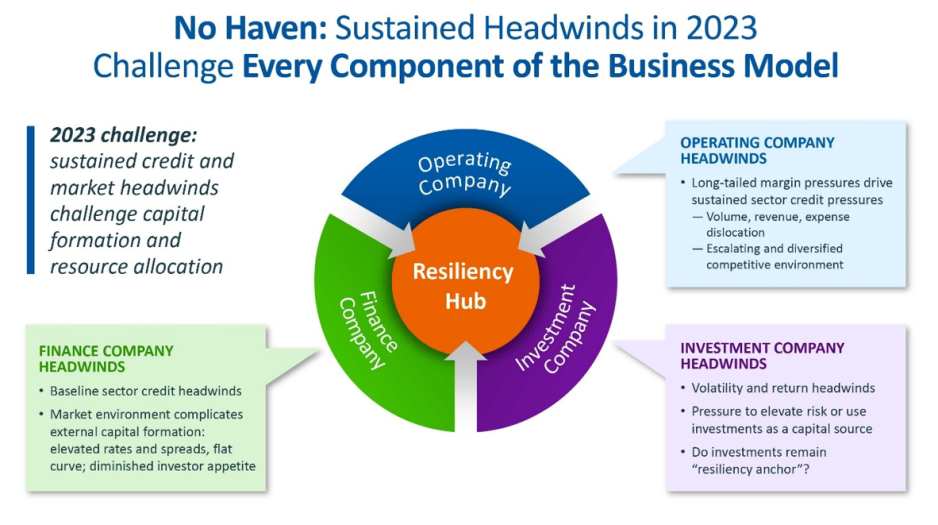
For the first time in recent history, we saw all three
functions of the not-for-profit healthcare system’s
financial structure suffer significant and sustained
dislocation over the course of the year 2022
(Figure above).

The headwinds disrupting these functions
are carrying over into 2023, and it is uncertain how
long they will continue to erode the operating and
financial performance of not-for-profit hospitals
and health systems.


Ÿ The Operating Function is challenged by elevated
expenses, uncertain recovery of service volumes, and
an escalating and diversified competitive environment.


Ÿ The Finance Function is challenged by a more
difficult credit environment (all three rating agencies

now have a negative perspective on the not-forprofit healthcare sector), rising rates for debt, and
a diminished investor appetite for new healthcare
debt issuance. Total healthcare debt issuance in
2022 was $28 billion, down sharply from a trailing
two-year average of $46 billion.


Ÿ The Investment Function is challenged by volatility and
heightened risk in markets concerned with the Federal
Reserve’s tightening of monetary policy and the
prospect of a recession. The S&P 500—a major stock
index—was down almost 20% in 2022. Investments
had served as a “resiliency anchor” during the first
two years of the pandemic; their ability to continue
to serve that function is now in question.

A significant factor in Operating Function challenges is
labor:
both increases in the cost of labor and staffing
shortages that are forcing many organizations to
run at less than full capacity. In Kaufman Hall’s 2022
State of Healthcare Performance Improvement Survey, for
example, 67% of respondents had seen year-over-year
increases of more than 10% for clinical staff wages,
and 66% reported that they had run their facilities at
less-than-full capacity because of staffing shortages.


These are long-term challenges,

dependent in part on
increasing the pipeline of new talent entering healthcare
professions, and they will not be quickly resolved.
Recovery of returns from the Investment Function
is similarly uncertain. Ideally, not-for-profit health
systems can maintain a one-way flow of funds into
the Investment Function, continuing to build the
basis that generates returns. Organizations must now
contemplate flows in the other direction to access

funds needed to cover operating losses, which in
many cases would involve selling invested assets at a
loss in a down market and reducing the basis available
to generate returns when markets recover.


The current situation demonstrates why financial
reserves are so important:

many not-for-profit
hospitals and health systems will have to rely on
them to cover losses until they can reach a point
where operations and markets have stabilized, or
they have been able to adjust their business to a
new, lower margin environment. As noted above,
relief funding and the MAAP program helped bolster
financial reserves after the initial shock of the
pandemic. As the impact of relief funding wanes
and organizations repay remaining balances under
the MAAP program, Days Cash on Hand has begun
to shrink, and the need to cover operating losses is
hastening this decline. From its highest

point in 2021, Days Cash on Hand had decreased, as
of September 2022, by:


Ÿ 29% at the 75th percentile, declining from 302 to 216
DCOH (a drop of 86 days)


Ÿ 28% at the 50th percentile, declining from 202 to 147
DCOH (a drop of 55 days)


Ÿ 49% at the 25th percentile, declining from 67 to 34
DCOH (a drop of 33 days)


Financial reserves are playing the role
for which they were intended; the only
question is whether enough not-for-profit
hospitals and health systems have built
sufficient reserves to carry them through
what is likely to be a protracted period of
recovery from the pandemic.

KEY TAKEAWAYS

All three functions of the not-for-profit healthcare
system’s financial structure—operations, finance,
and investments—suffered significant and
sustained dislocation over the course of 2022.


Ÿ These headwinds will continue to challenge not-forprofit

hospitals and health systems well into 2023.

Ÿ Days Cash on Hand is showing a steady decline, as
the impact of relief funding recedes and the need
to cover operating losses persists.


Ÿ Financial reserves are playing a critical role in
covering operating losses as hospitals and health
systems struggle to stabilize their operational and
financial performance.

Conclusion

Not-for-profit hospitals and health systems serve
many community needs. They provide patients
access to healthcare when and where they need it.
They invest in new technologies and treatments that
offer patients and their families lifesaving advances
in care. They offer career opportunities to a broad
range of highly skilled professionals, supporting the
economic health of the communities they serve.


These services and investments are expensive and
cannot be covered solely by the revenue received
from providing care to patients.


Strong financial reserves are the foundation of good
financial stewardship for not-for-profit hospitals and
health systems.

Financial reserves help fund needed
investments in facilities and technology, improve an
organization’s debt capacity, enable better access to
capital at more affordable interest rates, and provide a
critical resource to meet expenses when organizations
need to bridge periods of operational disruption or
financial distress.
Many hospitals and health systems today are relying
on the strength of their reserves to navigate a difficult

environment; without these reserves, they would
not be able to meet their expenses and would be at
risk of closure.

Financial reserves, in other words,
are serving the very purpose for which they are
intended—ensuring that hospitals and health systems
can continue to serve their communities in the face of
challenging operational and financial headwinds.

When these headwinds have subsided, rebuilding these
reserves should be a top priority to ensure that our
not-for-profit hospitals and health systems can remain
a vital resource for the communities they serve.

Financial Reserves and Credit Management

For large capital projects—construction of a new cancer
treatment center, for example, or replacement of an
aging facility—issuance of municipal debt is one of the
most affordable ways for not-for-profit hospitals and
health system to finance the project
.

The affordability of that debt is, however, partly contingent on the
organization’s ability to maintain a strong credit rating,
and financial reserves—again measured as Days Cash on
Hand—are a significant component of that credit rating.


There are two basic forms of municipal debt:


Ÿ General obligation bonds are backed by the full
taxing power of the issuing municipal authority and
are considered relatively low risk. Hospitals that are
owned by a city or county can be funded by general
obligation bonds, although there are practical
limitations on their ability to issue these bonds,
including in many instances the need to obtain voter
or county commissioner approval. Organizations

without municipal ownership—including most
not-for-profit hospitals and health systems—
cannot issue general obligation bonds.


Ÿ Revenue-backed municipal bonds are backed by
the ability of the organization borrowing the debt
to meet its obligation to make principal and interest
payments through the revenue it generates over the
life of the bond. Because revenues can be disrupted
by any range of factors, revenue-backed bonds are
higher risk for investors. Most healthcare bonds
are revenue-backed municipal bonds.


When determining whether to invest in revenue-backed
municipal healthcare bonds, investors will look to the
credit rating of the hospital or health system that is
borrowing the debt. Credit ratings—issued by one or
more of the three major credit rating agencies (Fitch
Ratings, Moody’s Investors Service, and S&P Global
Ratings)—provide an assessment of the probability

that the hospital or health system will be able to meet
the terms of the debt obligation. These ratings are
tiered. A credit rating in the AA tier is better than a credit
rating in the A tier, which is better than a rating in the
BBB tier. Ratings below the BBB tier are considered sub-investment grade.

Organizations with a sub-investment
grade rating can still access various forms of debt,
but the amount of debt they can access generally will
be lower, the cost of the debt will be higher, and the
covenants that lenders require will be more stringent
than for investment-grade rated organizations.


Financial reserves and credit ratings


Days Cash on Hand is one of the most important factors
credit rating agencies use because it is an indicator
of how long the rated organization could withstand
serious disruption to its operations and cashflow.
The rating agencies issue median values for the various
metrics they use to determine credit ratings. Median

values for Days Cash on Hand increased significantly
across most rating categories for all three agencies
in 2020 and 2021; this reflects the temporary inflow
of pandemic relief funding through, for example,
the Coronavirus Aid, Relief, and Economic Security
(CARES) Act.


We anticipate these medians will move
closer to pre-pandemic levels as relief funds are
exhausted and hospitals repay remaining balances
on Medicare’s COVID-19 Accelerated and Advanced
Payment (MAAP) program funds. But even before
the pandemic, organizations in 2019 had a median
Days Cash on Hand
of 276 to 289 days at the AA level,
173 to 219 days at the A level, and 140 to 163 days at
the BBB level.


In other words, the Days Cash on Hand
benchmark for organizations seeking to maintain an
investment-grade rating would be well over 100 Days
Cash on Hand, and well over 200 Days Cash on Hand for
organizations seeking to achieve a higher rating level.
Again, these reserves are proportionate to the operating
expenses of the individual hospital or health system.

Impact of credit ratings on access to capital


Organizations that can achieve a higher rating can
also borrow money at more affordable interest
rates. Figure 3 shows average interest rates for
municipal bonds across a range of maturities as of
mid-December 2022 (maturity is the term in years
for repayment of the bond at the time the bond is
issued). Lower-risk general obligation municipal bonds
are shown as the baseline, with lines for AA, A, and
BBB rated healthcare revenue-backed bonds above
it. As a reminder, most hospitals and health systems
cannot borrow money using general obligation bonds;
instead, they use higher-risk revenue-backed bonds
.
Because revenue-backed bonds are a higher risk for
investors than tax-based general obligation bonds,

even hospitals and health systems with a strong
AA credit rating will pay a higher interest rate than
would a city or county that could back repayment of
the bond with tax revenues (see the line for AA rated
Healthcare Revenue Bonds compared to the line
for AAA rated General Obligation bonds). But there
is also a significant gap between the interest rate a
hospital with an AA credit rating would pay compared
to the interest rate available to a hospital with a lower
BBB rating
. Here, the difference is approximately
three-fourths of a full percentage point. When the
amount borrowed for a major new hospital project
can run into the hundreds of millions of dollars,
that difference represents significant savings for
organizations with a higher credit rating.

Financial reserves and debt capacity


Financial reserves and the funds they generate—
including investment income—also help define an
organization’s debt capacity: essentially, the amount of
debt an organization can assume without jeopardizing
its current credit rating. There are two key ratios here:


Ÿ The first is total unrestricted cash and investments
to debt.
In general, the more favorable that ratio is,
the more latitude a hospital or health system has to
take on additional debt, especially if the organization
is toward the middle to top end of its rating tier.

Ÿ The second is the debt service coverage ratio,
which measures the organization’s ability to
make principal and interest payments with funds
derived from both operating and non-operating
(e.g., investment income) activity. A higher ratio
here means the organization has more funds
available to service debt.


The ability to assume additional debt is an important
safety valve
if, for example, an organization needs to
mitigate poor financial performance to fund ongoing
capital needs or strategic initiatives.

KEY TAKEAWAYS

Not-for-profit hospitals and health systems often
borrow debt through revenue-backed municipal
bonds, meaning that the debt obligations will be
met by the revenue the organization generates
over the life of the bond.


Ÿ Because revenue-backed bonds are higher
risk than general obligation bonds
backed by a
municipality’s taxing authority (revenues can
be disrupted), investors seek assurance that an
organization will be able to meet its obligations.


Ÿ Credit ratings offer investors an assessment of
an organization’s current and near-term ability to
meet these obligations.

Ÿ Days Cash on Hand is an important metric in
assessing the organization’s credit rating, and a
higher rating generally requires a higher number of
Days Cash on Hand.


Ÿ A higher credit rating allows organizations to
borrow money at more affordable interest rates.


Ÿ A higher level of financial reserves and investment
income in relation to existing debt obligations also
increases an organization’s debt capacity, creating
an important safety valve if an organization has
to borrow money to mitigate poor operating or
investment performance.

13 hospital and health systems hit with credit downgrades, revisions

Here is a summary of recent credit downgrades and outlook revisions for hospitals and health systems going back to the most recent major roundup March 16.

The various downgrades reflect continued operating challenges many nonprofit systems are facing and will likely continue to deal with for some years to come. The most recent downgrades and revisions, which have not been included in any more recent roundups, are listed first.

Baptist Health Care (Pensacola, Fla.): 

BHC had the rating downgraded on a series of its bonds as a reflection of “pressured operating performance and cash flow,” S&P Global said April 19.

As well as typical industry pressures of inflation and labor expenses, the three-hospital system may face further challenge because of a replacement project for its flagship Baptist Hospital that is due to be completed in late 2023.

Beacon Health (South Bend, Ind.): 

Beacon Health System had its outlook revised to negative from stable on “AA-” rated bonds it holds, S&P Global said April 14.

The move reflects weaker operating results and an expectation of increased debt over the near term.

Kuakini Health System (Honolulu): 

Kuakini Health System, which has a “CCC” long-term rating, has been placed on CreditWatch with negative implications, S&P Global said April 14.

The move reflects the system’s sustained operating challenges with no foreseeable major changes and questions about its long-term viability, the agency said, describing the system’s “precarious financial position.”

Baystate Health (Springfield, Mass.): 

Baystate Health had ratings downgraded on specific bonds related to its flagship medical center, S&P Global said April 12.

While ratings were affirmed on other debt, those on others specific to the 780-bed Baystate Medical Center were downgraded to “A” from “A+” as the system’s operating challenges continue into 2023, the agency said.

Penn State Health (Hershey, Pa.): 

Higher-than-expected operating losses have led to Penn State Health being downgraded on a series of bonds from “A+” to “A,” S&P Global said April 6.

Original budgets for the first part of fiscal 2023 targeted a slightly positive full-year operating margin, but data shows a $75 million lower-than-forecasted figure, S&P Global said. Operating income showed a loss of $154.5 million for the six months ending Dec. 31 compared with a $48.8 million loss in all of fiscal 2022.

Legacy Health (Portland, Ore.): 

Legacy Health had its outlook revised to negative from stable amid expectations the eight-hospital system will continue to experience difficult operating conditions and concern it will continue to fail to meet debt obligations, Moody’s said April 5.

The rating on its revenue bonds was affirmed at “A1.” Total debt stands at $738 million.

Providence (Renton, Wash.): 

The 51-hospital system recorded the first of three downgrades in the space of a few weeks March 17 when Fitch Ratings attached an “A” grade to both the system’s default rating and a series of bonds worth approximately $7.4 billion. The outlook for the system is negative due to its higher-than-average debt loads, Fitch said. 

S&P Global then downgraded Providence to the same notch from “A+” March 21 amid higher expenses and an expectation of only a multiyear process of recovery. The outlook for the system was also negative given the steep operating losses that need to be dealt with, S&P said.

Finally, Providence was downgraded by Moody’s on a series of bonds from “A1” to “A2.

Thomas Jefferson (Philadelphia): 

Thomas Jefferson University has undergone a credit downgrade with cash flow margins expected to stay low for “several years,” Moody’s said March 30.

The 18-hospital system, which also operates 10 colleges located primarily on two campuses in Philadelphia, is expected to stabilize its days of cash on hand to about 140, but debt will remain high, Moody’s said. The outlook is stable.

Oaklawn Hospital (Marshall, Mich.): 

The 68-bed community hospital was downgraded to “BBB-” from “BBB” as it reported operating losses due to higher expenses and length of patient stay, Fitch Ratings said March 29.

The downgrade refers both to its default rating and on bonds worth $63.5 million. The outlook is negative.

DCH Health (Tuscaloosa, Ala.): 

The three-hospital system saw its rating on a series of bonds lowered to “A-” from “A” as it continues to suffer operating losses, S&P Global said March 29.

The system’s “deeply negative underlying operations” are unlikely to lead to any substantial improvement in the near future, the agency said.

DCH Health operates a total of 510 staffed beds.

AU Health System (Augusta, Ga.): 

The system, which is being pursued by Marietta, Ga.-based Wellstar Health, was downgraded March 23 amid concern over negative cash flow and that it may breach covenant agreements later this year, Moody’s said.

The downgrade to “B2” from “Ba3” applies to revenue bonds the system holds. The outlook is negative.

PeaceHealth (Vancouver, Wash.): 

“Considerable operating stress” was the driver behind Fitch Ratings downgrading the 10-hospital system March 21.

The downgrade to “A+” from “AA-” applied to both the system’s default rating and on a series of bonds. The outlook is stable.

Management is targeting a return to profitability by fiscal 2026, Fitch noted.

Mercy Iowa City Hospital:

The hospital, part of Des Moines, Iowa-based MercyOne, was downgraded March 16 to “Caa1” from “B1” because of what Moody’s called “severe cash flow deterioration.” The “Caa1” categorization is seen as “substantial risk.”