


Sign of the Times – Harsh Reality of Life
https://www.cbsnews.com/news/jobs-report-may-inflation-interest-rates/

The US labor market added more jobs than expected in May defying previous signs of a slowdown in the economy.
Data from the Bureau of Labor Statistics released Friday showed the labor market added 272,000 nonfarm payroll jobs in May, significantly more additions than the 180,000 expected by economists.
Meanwhile, the unemployment rate rose to 4% from 3.9% the month prior. May’s job additions came in significantly higher than the 165,000 jobs added in April.
The print highlights the difficulty the Federal Reserve faces in determining when to lower interest rates and how quickly. The economy and labor market has held up overall, and inflation has remained sticky, building the case for holding rates higher for longer. Yet some cracks have emerged, such as signs of inflation pressuring lower income consumers and rising household debt.
“They’re really walking a tight rope here,” Robert Sockin, Citi senior global economist, told Yahoo Finance of the central bank. He noted the longer the Fed holds rates steady, the more cracks could develop in the economy.
Wages, considered an important metric for inflation pressures, increased 4.1% year over year, reversing a downward trend in year-over-year growth from the month prior. On a monthly basis, wages increased 0.4%, an increase from the previous month’s 0.2% gain.
“To see more confidence that inflation could move lower over time, you’d really like to see the wage numbers look a little lower than we’ve seen them today,” Lauren Goodwin, New York Life Investments economist and chief market strategist, told Yahoo Finance.
Also in Friday’s report, the labor force participation rate slipped to 62.5% from 62.7% the month prior. However, participation among prime-age workers, ages 25-54, rose to 83.6%, its highest level in 22 years.
The largest jobs increases in Friday’s report were seen in healthcare, which added 68,000 jobs in. May. Meanwhile, government employment added 43,000 jobs. Leisure and hospitality added 42,000 jobs.
The report comes as the stock market has hit record highs amid a slew of softer-than-expected economic data, which had increased investor confidence that the Federal Reserve could cut interest rates as of September. After Friday’s labor report, that trend reversed with investors pricing in a 53% chance the Fed cuts rates in September, down from a roughly 69% chance seen just a day prior, per the CME FedWatch Tool.
Other data out this week has reflected a still-resilient labor market that’s showing further signs of normalizing to pre-pandemic levels. The latest Job Openings and Labor Turnover Survey (JOLTS), released Tuesday, showed job openings fell in April to their lowest level since February 2021.
Notably, the ratio between the number of job openings and unemployed people returned to 1.2 in May, which is in line with pre-pandemic levels.
https://www.axios.com/2024/02/02/us-jobs-report-january-2024

The U.S. economy added 353,000 jobs in January, while the unemployment rate held at 3.7%, the Labor Department said Friday.
Why it matters:
The first look at the 2024 labor market shows it’s on fire — not slowing down as previously thought.
Details:
The January payroll figures show hiring picked up from the 333,000 added the prior month, which itself was revised higher by 117,000.
What’s new:
The hiring boom last month came amid strong job gains in health care, retail and professional and business services, while mining and oil and gas extraction are among the sectors that shed jobs.
The big picture:
The data is the latest in recent weeks to show that the economy is revving up, with fading inflation and steady hiring — a welcome development for the Biden administration that is touting its economic agenda ahead of the 2024 election.
The intrigue:
The strong growth in both jobs and earnings will make the Federal Reserve reluctant to cut interest rates soon, out of fear that labor market strength could reverse progress on inflation.
The bottom line:
Despite high profile layoffs at media and technology companies, the report shows that broader labor market is heating up.

The post-pandemic labor force has 1.5 million fewer individuals with some post-secondary education short of a bachelor’s degree. This shortfall is hitting healthcare hardest, affecting wages and qualification levels among jobholders.
Job vacancies requiring a post-secondary certificate or associate degree, particularly in healthcare, remain high. The mismatch between the supply of workers with this education level and the ongoing demand for them is leading to increased wages and greater reliance on more educated workers, according to a December 2023 bulletin from the Federal Reserve Bank of Kansas City.
Five takeaways from the bank’s report:
1. Before the pandemic, job openings across educational groups moved together and subsequently peaked together in mid-2022. Since then, while vacancies for most groups have fallen, the number of job vacancies requiring some college education remains 60% above its pre-pandemic level.
2. Vacancies for jobs requiring some college education are concentrated in healthcare. As of August 2023, about 50% of all open jobs posted in 2023 that required an associate degree or non-degree certificate were in healthcare.
3. As a result of the high demand, healthcare employers are turning to more educated workers to fill positions with requirements for some college education. Healthcare employment among workers with some college education has dropped by about 400,000 since 2019; healthcare employment among workers with a bachelor’s degree or more has increased by 600,000.
4. Combined, these factors can place upward pressure on healthcare wages. The supply-demand mismatch can lead employers to offer higher wages to competitively attract qualified workers. Employers turning to workers with more education, who are generally more expensive, will increase the average wage in these occupations.
5. From 2019 to 2023, overall wages for healthcare workers rose by nearly 25%, an increase the bank partially attributes to both increased wages within educational groups and composition effects. The shift in employment toward higher-educated workers accounts for an additional 2.7 percentage points of the total wage increase, for instance.
https://mailchi.mp/59f0ab20e40d/the-weekly-gist-october-27-2023?e=d1e747d2d8
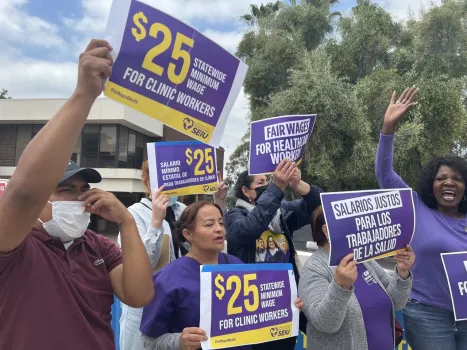
Earlier this month, Governor Gavin Newsom signed a bill that puts all full- and part-time California healthcare workers, including all ancillary support staff, on a path to earning $25 per hour.
While wage increases will begin phasing in next year, the timeline for implementation depends on facility type and other factors like payer mix. Large health systems and dialysis centers have until 2026 to fully implement the new wage, while rural, independent hospitals and those with high public payer mixes, as well as other clinical facilities, have more time to comply.
The law, which replaces the $15.50 state minimum wage for all workers, is projected to impact over 469K healthcare workers in the state, potentially including 50K who already earn more than $25 per hour but are forecasted to receive wage increases to maintain their pay premiums. Strongly backed by California healthcare unions, the law ultimately received the support of the California Hospital Association on the grounds that it will “create stability and predictability for hospitals” by preempting local wage and compensation measures active in many California cities.
The Gist: On the heels of a tentatively successful labor negotiation with Kaiser Permanente—which would raise the system’s hourly minimum wage to $25—California healthcare unions have flexed their might for another win.
While this new law directly benefits healthcare workers earning less than $25 an hour, its knock-on effects will extend to those earning above that to avoid pay compression, as well as to workers in other industries that draw from the same labor pool.
The mandated higher pay may provide California healthcare employers with a recruitment edge (and lure talent away from neighboring states), but higher costs will exacerbate the margin challenges plaguing many hospitals in the state.

The law, which was heavily backed by healthcare unions, is expected to affect approximately 469,000 healthcare workers and will be phased in over the next several years.
The law, backed by California healthcare unions, broadly defines healthcare workers as full-time or contract employees of a healthcare facility, including those in roles supporting the provision of healthcare, such as janitors, clerical workers, food service workers and medical billing personnel.
The wage increase is projected to impact approximately 469,000 employees, many of whom are currently living on the margins, according to an analysis from the University of California, Berkeley’s Labor Center.
Nearly half of California’s healthcare workers do not presently earn enough to cover basic needs, such as housing, and are enrolled in public safety net programs, according to the UC Berkeley Labor Center.
Newsom signed the bill into law on the same day that Kaiser Permanente unions announced they had secured a tentative $25 per hour minimum wage for over 60,000 California-based Kaiser employees, pending ratification from members. California healthcare workers were represented by SEIU-United Healthcare Workers West president Dave Regan during Kaiser bargaining.
In Senate analyses of the minimum wage bill conducted in May and September, lawmakers said that SEIU-UHW’s organizing elsewhere in the state had motivated the state-level analysis of pay. The union spearheaded several similar local ordinances last year, including in Los Angeles and San Diego.
SEIU California, which sponsored the bill, released a statement on Friday saying that raising healthcare workers’ wages is a matter of equity. Three out of four workers who will see increases in wages thanks to the new law are women, and 76% are workers of color, according to SEIU California. Almost half of all healthcare workers affected are Latino, the union said.
“Governor Newsom signed SB 525 into law because he heard our call for change to a status quo that has left us exhausted and struggling to pay our bills,” Dr. Kelley Butler, resident physician at San Francisco General Hospital and member of SEIU California, said in a statement. “I’m proud of our collective advocacy as a union and proud of our Governor for doing right by the California healthcare workforce and the patients it serves.”
The law went through several edits since the beginning of the legislative session to make it more palatable to healthcare facilities, which largely opposed its passage earlier this year. An earlier version of the bill, debated in May, tasked all healthcare providers with instituting the new minimum by June 2025.
The final version of the law has a phase-in approach that grants some workers the new minimum by 2026 and leaves others waiting ten years to reap the full sum. Healthcare facilities that are in financial distress can also apply for a waiver program to temporarily delay payroll hikes. Tribal clinics are excluded from the new pay requirements entirely.
The California Hospital Association, a lobbying organization, ultimately supported the law, saying in a statement that it provided “stability and predictability for hospitals” by providing more reasonable phase-in requirements and “preempting city and county minimum wage measures for 10 years and local compensation measures for six years.”
The dialysis industry also got on board after lawmakers added an amendment which prevents SEIU from pushing for ballot measures targeting dialysis centers. The union’s unsuccessful lobbying for changes in the dialysis industry has cost the healthcare industry over 100 million dollars in recent years, according to reporting from CalMatters.
https://mailchi.mp/9fd97f114e7a/the-weekly-gist-october-6-2023?e=d1e747d2d8

On Wednesday, 75K Kaiser Permanente (KP) healthcare workers in five states and Washington, DC walked off the job as part of the largest healthcare strike in US history.
The striking workers are a diverse group, based mostly in California, that includes support staff, X-ray technicians, medical assistants, and pharmacy workers. They will continue their work stoppage until Saturday morning, though union leadership is threatening an even larger strike in November if a new contract agreement is not reached by then.
Their employment contract expired on September 30th, and while negotiations have progressed on issues like shift-payment differentials and employee training investments, union leaders and KP executives remain at odds over key wage increase demands, with the unions asking for a $25 national minimum wage, and KP proposing $21.
The company has sought to minimize disruptions to patient care during the strike, bringing in temporary labor to keep critical infrastructure open, but has told its members to expect some non-urgent procedures to be rescheduled, some clinic and pharmacy operating hours to be reduced, and call center wait times to be lengthy.
The Gist: Kaiser Permanente has enjoyed solid relations with its unions for decades, making this strike a significant break from precedent, fueled by post-pandemic burnout and staffing shortages.
While KP is keeping all essential services open, care disruptions are inevitable with around one third of its total workforce on strike.
The stakes of these labor negotiations extend far beyond just KP and its employees, as union success could inspire other unionized healthcare workers to adopt similar tactics and demands. (Case in point: Employees at eleven Tenet Healthcare facilities in California represented by SEIU-UHW, one of the unions representing striking KP workers, just voted to authorize their own strike.)
While happening alongside high-profile strikes in other industries, labor unrest is a troubling trend for health systems, whose margins remain well below historical levels amid persistently high labor and supply expenses.

Shorter contracts, noncompete agreements and increased emphasis on value-based components are among the shifts occurring in physician contracts as hospitals and medical groups build recruitment pipelines and offer incentives to retain physicians.
Changes in how physician contracts are layered echoes a trend that has been occurring in the labor market itself. Physicians are increasingly opting for employed opportunities and contracts within those models are changing accordingly.
From 2019 to 2021, more than 108,700 physicians left private practice for employment opportunities, with 58,200 physicians joining hospitals. About three in four physicians are now employed by hospitals, health systems, private-equity-owned groups, payers or other corporate entities.
The rising costs of private practice, increasing administrative burdens and reimbursement hurdles are also making solo practice a challenging model for many physicians today.
Fewer large medical groups are offering salaries with production bonuses, according to an AMN Healthcare report on physician and advanced practitioner recruiting incentives. The company’s 2017 report found that 75 percent of contracts featured a salary with production bonus, while only 17 percent had a straight salary.
Some medical groups have stopped offering production bonuses because they found that the straight salary model has less ambiguity and is less likely to cause friction with physicians, according to the report.
AMN also found that a relatively high percentage of academic medical centers do not offer the salary with production bonus model, which may account for the decline in the use of this compensation structure in its report.
Income guarantees, which are essentially loans that must be repaid generally (but can be forgiven over time) are used to establish physicians in solo or small independent practices. Income guarantees were once the standard contract model, but as the number of private practices has declined, so has the use of income guarantees, according to the report..
Health systems continue to rethink physician contracts as healthcare continues its shift away from fee for service, but challenges remain when it comes to compensation in these models. Systems at the forefront of this shift are developing ways to incentivize physicians in value-based care as the trend towards team-based compensation gains traction and fosters collaboration among providers.


Contrary to widespread reports of staffing shortages, healthcare employment reached pre-pandemic levels with the addition of 44,200 jobs in February, according to a recent report from Altarum.
A recent survey of hospital CEOs found that healthcare staffing was their top concern. Nurses nationwide have reported unsafe staffing levels, leading health systems to restructure and lawmakers to consider safe-staffing laws.
Yet, healthcare currently has 1.3 percent more jobs than it did in February 2020, according to the monthly Health Sector Economic Indicators brief from Altarum. The nonprofit, healthcare-focused research and consulting organization analyzes available data on spending, prices, employment and utilization to craft the monthly report.
The data holds that this isn’t a new occurence. The sector has been adding — on average — 49,100 jobs per month for the past year, according to the brief. In February, hospitals led that growth, tapping 19,400 workers. Nursing and residential care facilities added 13,700 jobs, and ambulatory care settings added 11,100.
However, as healthcare employment rises, its wage growth continues to decline and now lags behind economywide growth. Healthcare wage growth has been declining since mid-2022; in January, pay grew 4.2 percent year over year, while total private sector wage growth grew 4.4 percent.
This statistic also defies industry narratives, as recent labor negotiations between unions and health systems have scored big raises for workers and clinicians.
 HENRY KOTULA